
Cannabis Oil Market Size, Trends & Demand by 2034
Coverage: By Sources (Hemp, Marijuana); Distribution (B2B, B2C); Application (Personal Use, Medical Use) , and Geography (North America, Europe, Asia Pacific, and South and Central America)
- Status : Data Released
- Report Code : TIPRE00027863
- Category : Life Sciences
- No. of Pages : 150
- Available Report Formats :


- Last update date : August 21, 2026


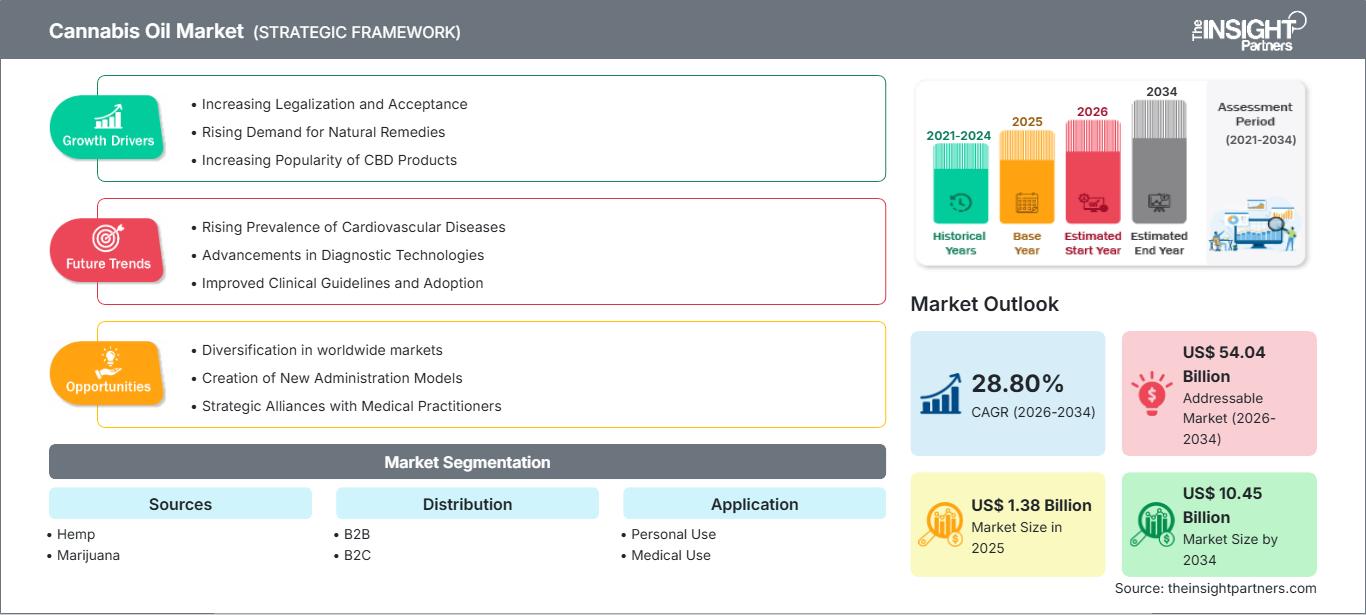
2025 Market Size
US$ 1.38 Bn
Base year value
2034 Forecast
US$ 10.45 Bn
Projected by 2034
CAGR 2026-2034
28.80 %
Growth rate
Addressable Market
US$ 54.04 Bn
(2026-2034)
The Cannabis Oil Market is projected to grow from US$ 1.38 Billion in 2025 to US$ 10.45 Billion by 2034, expanding at a CAGR of 28.80% during 2026–2034. The market is gaining momentum as cannabinoid-based oils move from niche wellness consumption into regulated medical, nutraceutical, and personal-care channels, supported by improving extraction technologies, broader product standardization, and increasing acceptance of hemp-derived formulations.
Across North America, the Cannabis Oil Market size is supported by well-developed retail access, physician-led medical adoption, and expanding use of full-spectrum and broad-spectrum oils in daily wellness routines. The region is estimated to grow at a CAGR of 27–30% during 2026–2034, with demand reinforced by state-level medical cannabis programs, established hemp cultivation capacity, and the shift toward tested, traceable, and dosage-specific oil products.
Cannabis Oil Market Assessment and Insights
- North America held 42–46% share in 2025 and is expected to grow at a CAGR of 27–30% during 2026–2034, supported by mature dispensary infrastructure, strong hemp supply, and rising demand for medical-grade and wellness oils.
- US accounted for 78–82% of North America in 2025 and is projected to grow at a CAGR of 28–31% during 2026–2034, driven by state-regulated access and product diversification.
- Europe represented 25–29% share in 2025 and is expected to expand at a CAGR of 26–29% during 2026–2034, led by the UK, Germany, France, Italy, and Spain as medical cannabis frameworks strengthen.
- Asia Pacific held 16–20% share in 2025 and is projected to grow at a CAGR of 31–34% during 2026–2034, with China, Japan, South Korea, India, and Australia shaping regulated wellness and medical demand.
- Largest Segment: Largest segment was hemp, with 62–66% market share in 2025 and an estimated CAGR of 27–30% during 2026–2034, owing to legal availability, lower psychoactivity risk, and scalable extraction economics.
- High Growth Segment: High growth segment was medical use, with 39–43% market share in 2025 and a CAGR of 30–33% during 2026–2034, supported by prescription pathways and clinical product validation.
- Key companies analyzed in detail: ENDOCA BV, Cannoid LLC, Medical Marijuana, Inc., Folium Biosciences, Elixinol Wellness Limited, NuLeaf Naturals, LLC, Isodiol International Inc., PharmaHemp d.o.o., Canopy Growth Corporation, Charlotte’s Web Holdings, Inc., Curaleaf Holdings, Inc., and cbdMD, Inc.
Source: The Insight Partners' analysis based on proprietary research, government publications, company annual reports, investor presentations, industry databases, and expert interviews.
Production economics have shifted from small-batch extraction toward standardized CO₂, ethanol, and hybrid processing lines that improve purity, yield, and batch repeatability. Formulators are also prioritizing cannabinoid profiles, terpene retention, carrier-oil stability, and contaminant testing as buyers demand transparent certificates of analysis. This evolution is reducing quality variability and helping the Cannabis Oil Market serve pharmacies, clinics, wellness retailers, and B2B ingredient buyers with more consistent supply.
In the coming years, newly regulated geographies will witness investment for cultivation, extraction, testing facilities, and distribution to the medical segment. The new geographies include Australia, Germany, Brazil, Japan, the Gulf regions, and Africa because the regulatory bodies have started distinguishing the pharmaceutical route from the consumer route. Investors will be inclined towards companies having compliant sourcing, safety standards, formulations, and channel flexibility.
Cannabis Oil Market Report Scope
| Report Attribute | Details |
|---|---|
| Market size in 2025 | US$ 1.38 Billion |
| Market Size by 2034 | US$ 10.45 Billion |
| Global CAGR (2026 - 2034) | 28.80% |
| Historical Data | 2021-2024 |
| Forecast period | 2026-2034 |
Cannabis Oil Market Analysis
Demand is moving beyond early wellness adopters as consumers seek measurable dosing, non-combustible formats, and plant-derived alternatives for sleep, pain, anxiety support, and general relaxation. Cannabis Oil Market growth is also reinforced by expanding medical cannabis participation, where oils are preferred for controlled titration, patient familiarity, and physician monitoring. Supply remains sensitive to cultivation licensing, extraction capacity, testing costs, and fragmented national regulations.
The value chain consists of the cultivators of hemp and marijuana, extractors, formulation companies, testing labs, package providers, dispensaries, pharmacies, e-commerce firms, and prescribing physicians. Traceability is becoming increasingly relevant because there is increased regulatory pressure to limit the concentration of THC, pesticides, heavy metals, microbial contamination, and labeling accuracy. Companies that can control cultivation, extraction, and branding have an edge in managing margins and product quality.
Competitive positioning is influenced by the scale of business, formulation capabilities, retail presence, and international regulations compliance. As per the Cannabis Oil Market analysis, ENDOCA BV, PharmaHemp d.o.o., Elixinol Wellness Limited, and NuLeaf Naturals, LLC compete by means of specialization in hemp oil products, whereas Canopy Growth Corporation, Curaleaf Holdings, Inc., and Charlotte’s Web Holdings, Inc. are diversifying and focusing on their brands’ reputations based on cannabis.
The investments into the market tend to be made on the principles of cost management, medical-channel credibility, and different delivery systems and not on the principle of SKU expansion. The CBDMD, Inc. has been concentrating on its product safety and healthcare channels, while the Medical Marijuana, Inc. and Isodiol International Inc. have continued to focus on their cannabinoid brands portfolio.
● REPORT CUSTOMIZATION
Tailor This Report To Align With Your Specific Business Requirements
This report can be customized to align precisely with your business objectives, scope, and target markets. Customization options include tailored segmentation, geography, competitive analysis, and strategic insights to support informed decision-making.
Customize This Report →WHAT YOU CAN ADJUST
- ● Segmentations
- ● Geography
- ● Competitive Analysis
- ● Language Preferences
Cannabis Oil Market: Strategic Insights
Regional Insights
North America Cannabis Oil Market
North America led with 42–46% Cannabis Oil Market share in 2025 and is projected to grow at a CAGR of 27–30% during 2026–2034. The area enjoys the following strengths of having legalized state markets, efficient extraction capability, consumer awareness of tinctures, and wide access via dispensaries, wellness stores, and online commerce.
The area's strengths come from its established hemp cultivation, standardized product testing, and cannabinoid brands. The use of medicine is becoming increasingly important because of the preference for oils for dosing accuracy. The U.S. dominates the market, whereas Canada provides support for the controlled production of both medical and recreational cannabis.
U.S. Cannabis Oil Market
The U.S. accounted for 78–82% of the North America Cannabis Oil Market in 2025 and is forecast to grow at a CAGR of 28–31% during 2026–2034. Demand is strongest in states with mature dispensary networks, medical cannabis enrollment, and consumer acceptance of hemp-derived CBD oils for daily wellness and symptom management.
Company presence is broad, with Charlotte’s Web Holdings, Inc., cbdMD, Inc., Curaleaf Holdings, Inc., Medical Marijuana, Inc., and NuLeaf Naturals, LLC active across branded oils, tinctures, and related cannabinoid formats. Application trends show personal use remains large, but medical use is advancing as patients seek non-inhaled products, consistent serving sizes, and physician-supervised titration.
Europe Cannabis Oil Market
Europe held 25–29% share of the Cannabis Oil Market in 2025 and is expected to expand at a CAGR of 26–29% during 2026–2034. Germany is the leading country, supported by prescription cannabis reforms and pharmacy distribution, while the UK continues to build demand through private clinics, wellness retail, and pending clarity around cannabinoid product authorization.
Germany’s growth is tied to physician familiarity, pharmacy dispensing, and insurer-linked medical pathways. Oils are favored because they allow controlled dosage and can be supplied with documentation. The UK remains attractive for hemp-derived wellness products, although firms must manage novel food requirements and conservative advertising rules.
France, Italy, and Spain are gradually widening the opportunity base through pilot programs, pharmacy channels, and medical cannabis consultations. France is cautious but clinically relevant, Italy offers pharmacy-based access, and Spain benefits from cannabis social-use familiarity. Together, these markets build a regulated foundation for oils without creating abrupt oversupply risk.
APAC Cannabis Oil Market
Asia Pacific accounted for 16–20% share of the Cannabis Oil Market in 2025 and is forecast to grow at a CAGR of 31–34% during 2026–2034. Australia takes the lead because of its prescription medical marijuana regulations, while Japan, South Korea, China, and India are working towards long-term possibilities by way of wellness, research, or industrial hemp programs.
The motivators behind each policy are all different. Australia has a physician-driven approach for medical oils, while Japan is cautious about, but increasingly supportive of, non-psychoactive CBD use. China has always had an advantage in industrial hemp growing and cannabinoid extraction materials. India's long history with cannabis could prove useful for future medicinal applications.
Middle East & Africa Cannabis Oil Market
The Middle East & Africa Cannabis Oil Market is projected to grow at a CAGR of 24–27% during 2026–2034, with South Africa leading regional adoption. Demand is shaped by medical access, wellness consumption, private healthcare, and controlled import channels, while Saudi Arabia and the UAE remain highly regulated and selective.
The infrastructure and energy context influence regional participation because controlled-environment cultivation, cold-chain logistics, and laboratory testing require capital-intensive systems. The UAE may emerge as a distribution and compliance hub over time, whereas South Africa offers a more immediate production and medical-use base for compliant oils and extracts.
Segmentation Analysis
Sources
The Sources segment is projected to grow at a CAGR of 27–30% during 2026–2034. Cannabis Oil Market scope across sources is defined by legal classification, cannabinoid composition, cultivation economics, and extraction output. Hemp remains dominant because it supports lower-THC products, wider consumer access, and B2B ingredient scalability, while marijuana-derived oils serve medical and adult-use channels that require stricter licensing and controlled dispensing.
- Hemp remains the leading source due to broader legality, scalable cultivation, and suitability for CBD-rich oils used in wellness, personal care, and nutraceutical formulations.
- Marijuana is strategically important in medical and regulated adult-use channels where THC-containing oils require licensing, physician oversight, compliant packaging, and controlled retail access.
Distribution
The Distribution segment is expected to grow at a CAGR of 28–31% during 2026–2034. Channel strategy is becoming more specialized as brands separate bulk extract supply, white-label partnerships, medical distribution, and consumer-facing sales. Regulatory controls shape channel availability, especially for THC-containing oils, while hemp-based products can reach broader digital and retail channels where national rules permit.
- B2B demand is driven by ingredient suppliers, private-label manufacturers, clinical product developers, and wellness brands seeking standardized oils with reliable cannabinoid content.
- B2C remains highly visible through dispensaries, pharmacies, e-commerce, and specialty wellness stores where consumers prioritize brand trust, product testing, and convenient formats.
Application
The Application segment is projected to expand at a CAGR of 29–32% during 2026–2034. Adoption is shaped by the contrast between self-directed wellness use and clinically supervised medical consumption. Personal use supports volume through daily wellness routines, while medical use is advancing faster as patients and providers seek non-inhaled cannabinoid formats with predictable dosing.
- Personal Use is supported by wellness-oriented consumers seeking oils for relaxation, sleep routines, recovery, and general balance through accessible tinctures and flavored formulations.
- Medical Use is strategically significant because physician guidance, dosing consistency, pharmacy access, and clinical documentation increase product credibility and long-term pricing resilience.
Opportunity Snapshot
| Segment Name | Revenue Contribution | Trend Tag | Adoption Stage |
| Personal Use | High | Daily Wellness | Scaling |
| Medical Use | High | Clinical Oils | Scaling |
Cannabis Oil Market Growth Drivers and Impact Analysis
Expansion of Medical Cannabis Access
Cannabis oils have become an important factor behind demand growth thanks to their dosing flexibility and reduced risk of respiratory complications relative to other forms. Medical cannabis demand becomes evident in those countries where doctors are authorized to prescribe cannabinoid drugs for pain management, seizure disorders, palliative care, and resistant diseases. With the development of medical programs, there will be a need for standardized medicines and more rigorous patient education programs, which will play to the strength of firms with a pharmaceutical background, not solely with a consumer-oriented brand. Moreover, switching costs will become higher as both patients and prescribers tend to remain loyal to products that demonstrate tolerability.
Shift Toward Tested and Traceable Hemp-Derived Products
There is now a growing importance of certificates of analysis, transparency in the sourcing process, and proper cannabinoid labeling as far as consumer trust is concerned. The reason why this driver is significant is that the previous expansion led to a situation where products vary widely in terms of quality, making regulatory authorities and other interested parties call for increased compliance. Products with a tested oil can enjoy better shelf space, avoid legal risks, and secure repeated purchases by wary consumers. Business-to-business buyers value those manufacturers that have been subjected to testing for pesticides, solvents, heavy metals, and microbials due to the liability issue facing brands.
Growth of Non-Combustible Cannabinoid Consumption
Moving away from smoke and vapor will increase demand for oils, tinctures, capsules, and soft gels. People opt for oils as they are discreet, easier to dose, can be incorporated into a daily routine, and can be used in places where inhaled cannabis use is prohibited. This change in behavior widens the target audience from regular cannabis consumers to those who would not traditionally consume cannabis, such as older adults and wellness or medical consumers. There is also an ability to create more precise formulations that include CBD, THC, CBG, CBN, terpenes, and carrier oils. With brands working on improving the absorption technologies and emulsion stability, the differentiation increases.
Cannabis Oil Market Future Trends
Precision Formulations and Minor Cannabinoid Blends
Cannabis Oil Market trends are moving toward targeted formulations that combine CBD, THC, CBN, CBG, and selected terpenes for clearly defined wellness or medical use cases. Products that will come up in the future will focus more on sleep, stress relief, inflammation, pain, and recovery than on any other form of cannabinoid. Bioavailability, controlled release, taste masking, and clean label vehicles will be a priority to offer an improved consumer experience. This will create more need for analysis and formulation. Those companies that will be able to offer consistent cannabinoid ratios and safety will have an edge over their competitors.
Regulated Cross-Border Supply and Medical Standardization
The international trade in cannabinoid oils is likely to become increasingly organized in view of the establishment of import regulations, medical grade specifications, and the documentation requirements by the countries. This will create an opportunity for companies that are able to meet good manufacturing practice, stability tests, and country-specific THC levels. The European Union, Australia, Latin America, and select Asian markets will need a standardized product dossier, presenting export and contract manufacturing opportunities. On the other hand, poor quality oils will not be welcomed by the regulators. This will result in an industry shift from opportunistic export to qualification-led supply, pharmacy collaboration, and medically proven distribution.
Cannabis Oil Market Opportunities
Healthcare Channel Development
Healthcare distribution represents one of the most attractive investment routes because it links cannabinoid oils with professional guidance, patient monitoring, and repeat prescriptions. Cannabis Oil Market Forecasts indicate that compliant medical channels will outperform unverified consumer channels where regulatory uncertainty remains high. Companies can act by building physician education programs, pharmacist training, patient-support materials, and product dossiers that explain dosing, safety, and batch quality. Partnerships with clinics and telehealth platforms can improve access while maintaining oversight. This opportunity is especially relevant in Germany, Australia, the UK, Brazil, and selected U.S. states where medical adoption is expanding through formal consultation routes.
B2B Ingredient Supply and Private-Label Manufacturing
B2B provision of supply is a scalable business for extractors and formulators that will allow serving of wellness brands, pharmaceutical companies, cosmetics companies, and nutraceutical companies. There are a number of downstream brands that lack extraction ability and need partners that can offer them oils in a consistent manner with standardized documentation and various types of cannabinoid profiles. Building up the ability to purify and conduct stability studies will allow one to improve the margin while at the same time lowering the need to acquire consumers. The private label manufacturing is what will make it possible for regional brands to get into the market without any cultivation facilities.
Recent Developments
- July 2026: cbdMD, Inc. launched Oasis Mixer, a hemp-derived, zero-proof THC spirit designed for beverage blending, with quad-filtered formulation, child-resistant packaging, and distribution planned across Tennessee, Florida, Texas, South Carolina, and selected North Carolina markets. The launch indicates rising interest in cleaner cannabinoid delivery formats and responsible packaging standards.
- November 2025: Charlotte’s Web Holdings, Inc. reported progress in medical-channel development, launched a scientific advisory board, expanded its sleep portfolio, and internalized Brightside gummy production to increase manufacturing capacity. The company’s update highlighted a stronger focus on clinical validation, healthcare integration, cost savings, and in-house production efficiency.
- May 2025: Canopy Growth Corporation reported fiscal year 2025 results, including 13% growth in Canada medical cannabis revenue during the fourth quarter and a 49% reduction in total debt. The company also outlined a refined strategy focused on global medical cannabis, commercial execution in Canada, and annualized cost savings.
Frequently Asked Questions

- Comprehensive Market Sizing and Forecast Analysis
- Detailed Segmentation Analysis
- In-Depth Market Dynamics Assessment
- Regional and Country-Level Insights
- Competitive Landscape and Company Benchmarking
- Strategic Business Intelligence
Recent Reports
Testimonials

The Insight Partners' SCADA System Market report is comprehensive, with valuable insights on current trends and future forecasts. The team was highly professional, responsive, and supportive throughout. We are very satisfied and highly recommend their services.
RAN KEDEM Partner, Reali Technologies LTDs
I requested a report on a very specific software market and the team produced the report in a few days. The information was very relevant and well presented. I then requested some changes and additions to the report. The team was again very responsive and I got the final report in less than a week.
JEAN-HERVE JENN Chairman, Future Analytica
We worked with The Insight Partners for an important market study and forecast. They gave us clear insights into opportunities and risks, which helped shape our plans. Their research was easy to use and based on solid data. It helped us make smart, confident decisions. We highly recommend them.
PIYUSH NAGPAL Sr. Vice President, High Beam Global
The Insight Partners delivered insightful, well-structured market research with strong domain expertise. Their team was professional and responsive throughout. The user-friendly website made accessing industry reports seamless. We highly recommend them for reliable, high-quality research services
YUKIHIKO ADACHI CEO, Deep Blue, LLC.
This is the first time I have purchased a market report from The Insight Partners.While I was unsure at first, I visited their web site and felt more comfortable to take the risk and purchase a market report.I am completely satisfied with the quality of the report and customer service. I had several questions and comments with the initial report, but after a couple of dialogs over email with their analyst I believe I have a report that I can use as input to our strategic planning process.Thank you so much for taking the extra time and making this a positive experience.I will definitely recommend your service to others and you will be my first call when we need further market data.
JOHN SUZUKI President and Chief Executive Officer, Board Director, BK Technologies
I wish to appreciate your support and the professionalism you displayed in the course of attending to my request for information regarding to infectious disease IVD market in Nigeria. I appreciate your patience, your guidance, and the fact that you were willing to offer a discount, which eventually made it possible for us to close a deal. I look forward to engaging The Insight Partners in the future, all thanks to the impression you have created in me as a result of this first encounter.
DR CHIJIOKE ONYIA MANAGING DIRECTOR, PineCrest Healthcare Ltd.Reason to Buy
- Informed Decision-Making
- Understanding Market Dynamics
- Competitive Analysis
- Identifying Emerging Markets
- Customer Insights
- Market Forecasts
- Risk Mitigation
- Boosting Operational Efficiency
- Strategic Planning
- Investment Justification
- Tracking Industry Innovations
- Aligning with Regulatory Trends





 Get Free Sample for