
Capsulotomy Market Size, Share & Demand by 2034
Coverage: By Product Type ( Fixed Capsulotomy System, Mobile Capsulotomy System ); Technology ( Pulse Capsulotomy Systems, Thermal Capsulotomy Systems, Others ); Type ( Anterior Capsulotomy, Posterior Capsulotomy ); End User ( Hospital, Ambulatory Surgical Centers, Eye Care Centers ), and Geography (North America, Europe, Asia Pacific, and South and Central America)
- Status : Data Released
- Report Code : TIPRE00020018
- Category : Life Sciences
- No. of Pages : 150
- Available Report Formats :


- Last update date : August 21, 2026


2025 Market Size
US$ 186.21 Mn
Base year value
2034 Forecast
US$ 277.65 Mn
Projected by 2034
CAGR 2026-2034
4.54 %
Growth rate
Addressable Market
US$ 2,106.24 Mn
(2026-2034)
The Capsulotomy Market was valued at US$ 186.21 Million in 2025 and is projected to reach US$ 277.65 Million by 2034, registering a CAGR of 4.54% during 2026–2034. Growth reflects steady adoption of controlled anterior and posterior capsule opening technologies in cataract, refractive lens exchange, and laser-assisted ophthalmic surgery, supported by rising procedure volumes and surgeon preference for reproducible capsulotomy geometry.
North America remains the most mature demand center, with Capsulotomy Market size supported by high cataract surgery throughput, premium intraocular lens penetration, and broad availability of ophthalmic surgical platforms. The region is estimated to grow at a CAGR of 4.1–4.6% during 2026–2034, driven by ambulatory surgical center expansion and procurement of workflow-integrated systems that reduce manual variability in complex cataract cases.
Capsulotomy Market Assessment and Insights
- North America held 38–40% share in 2025 and is growing at a CAGR of 4.1–4.6% during 2026–2034, supported by cataract surgical volumes, premium IOL adoption, and outpatient ophthalmology infrastructure.
- US accounted for 78–82% of North America in 2025 and is growing at a CAGR of 4.0–4.5% during 2026–2034, led by ASC-based cataract surgery.
- Europe represented 27–29% share in 2025 and is growing at a CAGR of 4.2–4.7% during 2026–2034, led by Germany, France, the UK, Italy, and Spain.
- Asia Pacific captured 23–25% share in 2025 and is growing at a CAGR of 5.3–5.8% during 2026–2034, with China, Japan, India, South Korea, and Australia leading adoption.
- Largest Segment: anterior capsulotomy held 62–66% market share in 2025, with CAGR of 4.3–4.8% during 2026–2034, reflecting routine use in cataract surgery.
- High Growth Segment: Mobile capsulotomy systems held 18–22% market share in 2025, with CAGR of 5.6–6.2% during 2026–2034, due to outreach and ASC deployment.
- Key companies analyzed in detail: Mynosys Cellular Devices, Inc., International BioMedical Devices, Inc., Excel-Lens, Inc., Optotek Medical d.o.o., Carl Zeiss Meditec AG, Ellex Medical Lasers Pty Ltd., Lumenis Be Ltd., Johnson & Johnson Surgical Vision, Inc., Alcon Inc., and Bausch + Lomb Corporation.
Source: The Insight Partners' analysis based on proprietary research, government publications, company annual reports, investor presentations, industry databases, and expert interviews.
Capsulotomy market technology development is evolving from manual capsulorhexis procedures performed by the surgeon to controlled capsule opening with the use of the appropriate devices. The pulse systems attract considerable interest in cases of complicated cataracts, weak zonules, small pupils, and premium IOL implants that require precise centration. Manufacturing trends involve balancing between reusable consoles and disposable tips that interact with patients, ensuring profitability of the process without violating sterility requirements.
In the coming years, the investments will be driven by surgical productivity, portability, and the ability to integrate digital workflows. New geographical areas will concentrate on the cataract backlog, while the developed countries will emphasize refractive outcome and ASC efficiency. The regulatory environment will support those devices that can prove their safety, reproducibility, and integration with the existing phacoemulsification procedures.
Capsulotomy Market Report Scope
| Report Attribute | Details |
|---|---|
| Market size in 2025 | US$ 186.21 Million |
| Market Size by 2034 | US$ 277.65 Million |
| Global CAGR (2026 - 2034) | 4.54% |
| Historical Data | 2021-2024 |
| Forecast period | 2026-2034 |
Capsulotomy Market Analysis
Rising cataract burden, older demographics, and higher patient expectations for post-surgical visual quality are the primary forces behind Capsulotomy Market growth. The ecosystem includes device developers, energy-source component suppliers, sterile disposable manufacturers, ophthalmic distributors, hospitals, ASCs, and eye care chains. Supply dynamics remain specialized because clinical adoption depends on surgeon training, compatibility with incision size, and evidence that capsule strength and centration improve procedural predictability.
Demand is also shaped by procedure economics. Hospitals prioritize multi-use consoles and service reliability, while ASCs value rapid setup and low disruption to surgery lists. In lower-resource settings, portable systems are attractive because they can extend standardized cataract techniques outside large tertiary centers, although reimbursement and capital budgets still influence adoption curves.
Positioning in the competition is now determined by cataract workflow integration, installed base advantage, and generation of evidence. Capsulotomy Market Analysis shows that Alcon Inc., Carl Zeiss Meditec AG, Johnson & Johnson Surgical Vision, Inc., and Bausch + Lomb Corporation are positioned because of their wider cataract portfolio, whereas Mynosys Cellular Devices, Inc. and specialists position themselves based on high capsulotomy performance.
Innovations include investments in robots, software-assisted planning, single-use sterile interface and premium IOL workflow compatibility. Differentiation will be achieved not through the technology itself but through improved efficiency and reduced need for repetition in the case of dense cataracts and small pupils.
● REPORT CUSTOMIZATION
Tailor This Report To Align With Your Specific Business Requirements
This report can be customized to align precisely with your business objectives, scope, and target markets. Customization options include tailored segmentation, geography, competitive analysis, and strategic insights to support informed decision-making.
Customize This Report →WHAT YOU CAN ADJUST
- ● Segmentations
- ● Geography
- ● Competitive Analysis
- ● Language Preferences
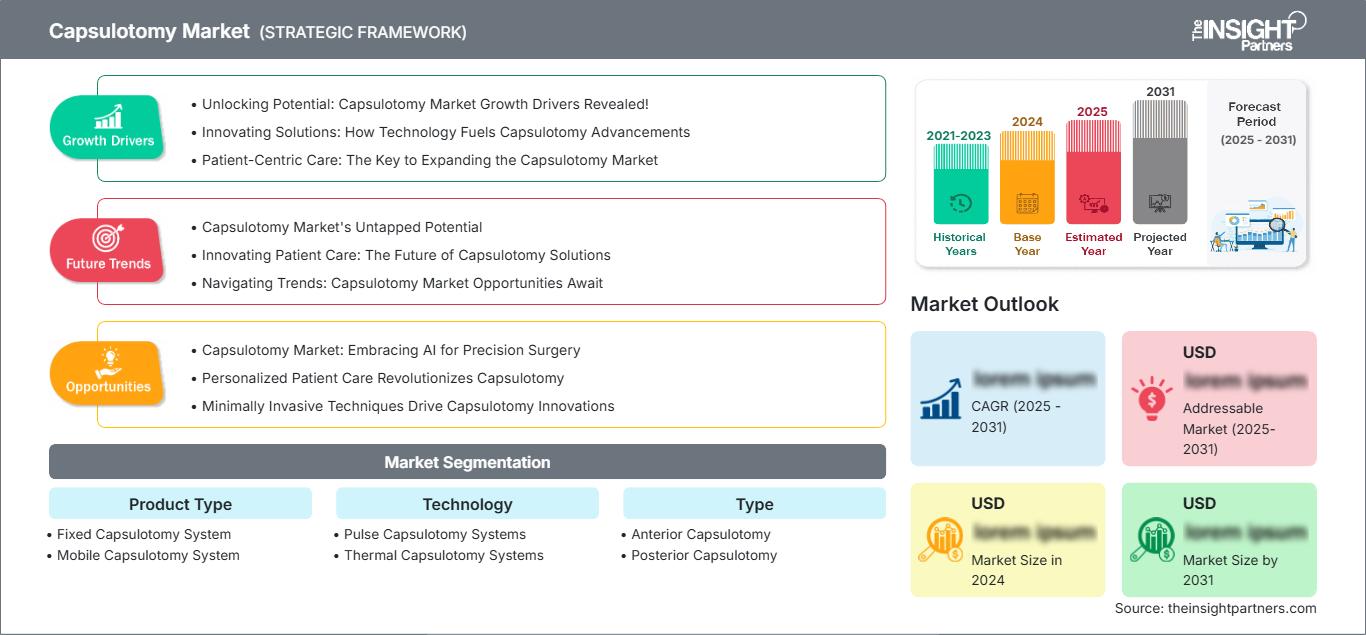
Capsulotomy Market: Strategic Insights
Regional Insights
North America Capsulotomy Market
North America accounted for 38–40% share in 2025 and is projected to expand at a CAGR of 4.1–4.6% during 2026–2034. The region benefits from high cataract procedure volumes, advanced phacoemulsification penetration, and established reimbursement pathways for outpatient ophthalmic surgery. Premium intraocular lens use strengthens device-assisted capsulotomy demand because accurate capsule sizing and centration influence refractive outcomes.
Procurement decisions are led by ASCs, hospital outpatient departments, and integrated eye care groups. The regional Capsulotomy Market share is reinforced by surgeon familiarity with energy-based systems and broader adoption of digital planning. Growth is expected to remain moderate rather than explosive, as adoption depends on evidence, surgeon preference, and per-case economics.
U.S. Capsulotomy Market
The U.S. represented 78–82% of North America in 2025 and is estimated to grow at a CAGR of 4.0–4.5% through 2034. Migration of procedures to ASCs facilitates the requirement for small systems that can accommodate the high volume throughput in cataract rooms. The already large base of cataract machines aids in the entry of other technologies through the existing clinical connections.
There is a heavy company presence in the form of Alcon Inc., Johnson & Johnson Surgical Vision, Inc., Bausch + Lomb Corporation, and Carl Zeiss Meditec AG. Technologies offered by companies such as Mynosys Cellular Devices, Inc. assist in the complicated case of anterior capsulotomy. The adoption rate is higher in places where there is the use of premium lenses and refractive cataracts.
Europe Capsulotomy Market
Europe held 27–29% share in 2025 and is projected to grow at a CAGR of 4.2–4.7% during 2026–2034. Germany is the dominant market due to ophthalmological density, rapid technology testing, and high levels of surgeon involvement at cataract and refractive congresses. The UK sustains the demand based on a high number of cataracts, outpatient surgery reforms, and the introduction of premium lenses in the private segment.
Germany will continue to be the key market with purchases driven by specialized clinics and hospital groups testing digital cataract operations. The UK will selectively implement the devices due to cataract surgery and refractive requirements in the private segment.
France, Italy, and Spain ensure moderate growth due to an aging population, pressure for public surgery capacity, and regional private ophthalmology segments. Implementation is slow due to cautious reimbursement policies and hospital tenders.
APAC Capsulotomy Market
APAC accounted for 23–25% share in 2025 and is expected to grow at a CAGR of 5.3–5.8% during 2026–2034, making it the fastest regional growth zone. China is the leading country, followed by Japan, India, South Korea, and Australia, supported by cataract backlog reduction, premium urban eye hospitals, and rising surgical training capacity.
Policies focused on avoidable blindness, expanding ophthalmic chains, and domestic device distribution are improving access. Japan and Australia emphasize precision and premium outcomes, while India and China combine high surgical volume with demand for mobile and cost-efficient systems. Regional uptake depends on affordability, surgeon education, and service coverage.
Middle East & Africa Capsulotomy Market
The Middle East & Africa is projected to grow at a CAGR of 3.8–4.3% during 2026–2034. Saudi Arabia and the UAE lead adoption due to healthcare infrastructure investment, specialist eye hospitals, and medical tourism positioning. South Africa remains the key sub-Saharan market, while the Rest of MEA is shaped by public eye health programs.
Energy-sector revenues in Gulf countries support specialist hospital investment, but broader regional demand remains uneven. Infrastructure gaps, limited trained ophthalmic surgeons, and import dependence constrain uptake. Mobile capsulotomy systems offer practical value where outreach surgery and high-volume cataract camps require predictable procedure quality.
Segmentation Analysis
Product Type
Product Type is projected to grow at a CAGR of 4.4–4.9% during 2026–2034. The Capsulotomy Market scope across fixed and mobile systems reflects two procurement models: capital-intensive precision platforms for high-volume surgical centers and portable solutions for ASCs or outreach programs. Adoption depends on procedure volume, sterilization workflow, surgeon familiarity, and the ability to maintain consistent capsule geometry without extending operating time.
- Fixed Capsulotomy System supports hospitals and high-volume ophthalmic centers that require stable integration with cataract surgery rooms, service contracts, staff training, and predictable utilization across premium and complex procedures.
- Mobile Capsulotomy System is gaining relevance in ASCs, secondary hospitals, and outreach programs because its compact design, faster deployment, and lower installation complexity fit decentralized cataract surgery delivery.
Technology
Technology is projected to grow at a CAGR of 4.6–5.1% during 2026–2034. Pulse and thermal platforms address the same clinical need but differ in energy delivery, interface design, and surgeon perception. Pulse systems are associated with rapid circular capsulotomy formation, while thermal systems remain relevant where controlled localized tissue interaction and established laser workflows influence adoption.
- Pulse Capsulotomy Systems are preferred for rapid anterior capsule opening, especially in dense cataracts or cases requiring strong capsulotomy edges, visual axis centration, and minimal disruption to standard phaco workflow.
- Thermal Capsulotomy Systems retain strategic relevance in settings where surgeons value controlled energy application, procedural familiarity, and integration with ophthalmic laser or energy-based platforms.
Type
Type is projected to grow at a CAGR of 4.2–4.8% during 2026–2034. Anterior capsulotomy dominates because it is central to cataract surgery and premium IOL alignment. Posterior capsulotomy supports post-operative capsule opacification management, particularly in laser settings. This segmentation links initial cataract surgery quality with downstream visual maintenance.
- Anterior Capsulotomy is the largest procedural category due to routine use in cataract surgery, strong relevance to IOL positioning, and higher demand in premium and complex lens replacement procedures.
- Posterior Capsulotomy supports treatment of posterior capsule opacification after cataract surgery, with demand tied to long-term follow-up volumes, laser access, and patient expectations for restored visual clarity.
End User
End User is projected to grow at a CAGR of 4.5–5.0% during 2026–2034. Hospitals remain important for complex cases and capital equipment procurement, while ASCs are expanding due to outpatient cataract migration. Eye care centers are becoming influential as integrated ophthalmology networks standardize devices across multiple sites and improve patient access.
- Hospital demand is driven by complex cataract cases, teaching programs, broader ophthalmic equipment budgets, and preference for systems with strong service support and regulatory documentation.
- Ambulatory Surgical Centers prioritize compact, efficient, and high-throughput solutions that reduce room turnover constraints and support premium lens procedures in outpatient surgical environments.
- Eye Care Centers are scaling adoption as multi-site ophthalmology groups standardize cataract workflows, train surgeons centrally, and invest in technologies that differentiate refractive cataract services.
Opportunity Snapshot
| Segment Name | Revenue Contribution | Trend Tag | Adoption Stage |
| Hospital | High | Complex Cases | Mature |
| Ambulatory Surgical Centers | High | ASC Migration | Scaling |
| Eye Care Centers | Medium | Network Clinics | Scaling |
Capsulotomy Market Growth Drivers and Impact Analysis
Rising Cataract Surgery Volumes and Premium Lens Penetration
Cataract surgery continues to be among the most commonly done surgeries on Earth, and now there are growing concerns about lens implantation with regard to refractive results rather than simply opacity removal. Such a move emphasizes the significance of capsule geometry, size, and positioning, since any deviations from proper IOL placement may impair its high-quality function. In the Capsulotomy Market, hospitals and ASCs consider new technologies, making capsulotomies more predictable between doctors and in challenging cases. The highest effect on the market is demonstrated by premium cataract practices, which offer premium lenses to patients who will be paying out-of-pocket for them and expect vision correction without glasses.
Outpatient Surgery Migration and Need for Workflow Efficiency
The move of cataract surgeries from hospital settings to ASCs and specialized eye clinics is affecting buying criteria. High-volume surgery centers are looking for a predictable setup, short learning curve, small space requirement, and minimization of impact on the phacoemulsification process. This affects the Capsulotomy Market by creating a need for systems that are small enough to fit through a tiny incision, that have a sterile interface which is disposable, and that minimize the dependency of the procedure on the skills of the surgeon. The effect can be seen in buying decisions, which compare the economics per case to better predictability and throughput.
Technology Integration Across Cataract Planning and Surgery
Advanced planning with digital tools, image-guided cataract surgery, and connectivity on ophthalmology platforms are prompting surgeons to consider capsulotomy as an element of an overall precision workflow. Diagnostics can help in IOL selection, while controlled capsulotomy will facilitate the procedure in the operating room. This driver works in favor of companies with comprehensive cataract offerings and also creates potential partnerships for specialists. From a practical perspective, it will result in the implementation of capsulotomy by those practices who have already invested in digital planning, operating microscopes, femtosecond lasers, or premium IOL systems. Within the Capsulotomy Market, the devices that provide integration with existing workflows, capsule strength data, and consistent centration are going to be preferred.
Capsulotomy Market Future Trends
Portable Precision Systems for Decentralized Eye Surgery
Capsulotomy Market trends will increasingly favor portable systems that bring controlled capsule opening to ASCs, secondary hospitals, and outreach surgery programs. The future of these products seems geared towards reducing capital outlay, disposables in terms of sterile tips, easy training, and compatibility with conventional surgical microscope systems. Such trends will be highly pertinent in APAC and some MEA markets where a reduction in cataract backlogs is achieved using cost-effective means beyond the confines of tertiary facilities. Companies able to integrate portable technologies and proven safety features will be well-positioned to cater to both premium and public-private eye care programs.
Evidence-Led Adoption in Complex Cataract Indications
Future use will be determined by clinical outcomes in challenging cataract subgroups instead of blanket statements regarding automation. The surgeons will have their focus on clinical outcomes regarding capsule strength, IOL positioning, surgical time, and utilization in small pupils, pseudoexfoliation, hard cataracts, and weak zonules. This development will force the industry to spend more money on registry studies and comparison studies. Devices that prove to add value to complicated cases can justify the costs, even when basic cataract procedures are highly cost-conscious.
Capsulotomy Market Opportunities
ASC-Focused Commercial Models and Procedure-Based Pricing
The strongest near-term commercial opening lies in ASC-focused business models that align device costs with procedure volume. Capsulotomy Market Forecasts indicate that outpatient cataract growth will favor suppliers offering flexible capital placement, disposable tip revenue, training support, and service responsiveness. Vendors can improve adoption by bundling systems with surgeon education, premium IOL workflow protocols, and utilization analytics. Procedure-based pricing can reduce upfront budget barriers for ASCs while creating predictable recurring revenue for manufacturers. This approach is especially attractive in the U.S., Canada, Japan, Australia, and private European clinics where premium lens conversion supports incremental technology spending.
Emerging Market Partnerships for Cataract Backlog Reduction
Public-private partnerships for large volume cataract surgeries provide a long-term possibility for the development of portable and durable capsulotomy devices. India, China, Southeast Asia, and chosen Middle Eastern countries are building their eye-care capabilities through specialized chains, government campaigns, and charities involving eye surgical operations. The sellers can market their small-sized machines as instruments that help to provide uniform standards of quality for operations conducted by surgeons with different experience from location to location. Local delivery, academies for training, and low-cost consumables will make all the difference here.
Recent Developments
- October 2025: Alcon Inc. showcased expanded ophthalmic offerings at AAO 2025, including newly available LenSx OnAxis Technology for astigmatism management and the UNITY cataract system, strengthening its position across laser-assisted cataract workflows where capsulotomy precision remains a critical procedural step.
- September 2025: Carl Zeiss Meditec AG presented cataract and refractive workflow innovations at ESCRS 2025, including milestones for digital planning and surgical workflow solutions, reinforcing its strategy of connecting diagnostics, visualization, and surgical execution for cataract practices.
- April 2025: Bausch + Lomb Corporation announced more than 50 scientific presentations at ASCRS 2025, including data on intraocular lenses and surgical technologies, supporting clinical engagement with cataract surgeons and reinforcing its role in premium cataract procedure ecosystems.
Frequently Asked Questions

- Comprehensive Market Sizing and Forecast Analysis
- Detailed Segmentation Analysis
- In-Depth Market Dynamics Assessment
- Regional and Country-Level Insights
- Competitive Landscape and Company Benchmarking
- Strategic Business Intelligence
Recent Reports
Testimonials

The Insight Partners provided valuable market intelligence that supported our global go-to-market strategy. Their team was professional, responsive, and attentive to our feedback, providing thoughtful analysis and helpful methodological clarifications throughout the project.
Junmo Kim Chief Financial Officer (CFO), Enertech Co., Ltd.
The Insight Partners' SCADA System Market report is comprehensive, with valuable insights on current trends and future forecasts. The team was highly professional, responsive, and supportive throughout. We are very satisfied and highly recommend their services.
RAN KEDEM Partner, Reali Technologies LTDs
I requested a report on a very specific software market and the team produced the report in a few days. The information was very relevant and well presented. I then requested some changes and additions to the report. The team was again very responsive and I got the final report in less than a week.
JEAN-HERVE JENN Chairman, Future Analytica
We worked with The Insight Partners for an important market study and forecast. They gave us clear insights into opportunities and risks, which helped shape our plans. Their research was easy to use and based on solid data. It helped us make smart, confident decisions. We highly recommend them.
PIYUSH NAGPAL Sr. Vice President, High Beam Global
The Insight Partners delivered insightful, well-structured market research with strong domain expertise. Their team was professional and responsive throughout. The user-friendly website made accessing industry reports seamless. We highly recommend them for reliable, high-quality research services
YUKIHIKO ADACHI CEO, Deep Blue, LLC.
This is the first time I have purchased a market report from The Insight Partners.While I was unsure at first, I visited their web site and felt more comfortable to take the risk and purchase a market report.I am completely satisfied with the quality of the report and customer service. I had several questions and comments with the initial report, but after a couple of dialogs over email with their analyst I believe I have a report that I can use as input to our strategic planning process.Thank you so much for taking the extra time and making this a positive experience.I will definitely recommend your service to others and you will be my first call when we need further market data.
JOHN SUZUKI President and Chief Executive Officer, Board Director, BK Technologies
I wish to appreciate your support and the professionalism you displayed in the course of attending to my request for information regarding to infectious disease IVD market in Nigeria. I appreciate your patience, your guidance, and the fact that you were willing to offer a discount, which eventually made it possible for us to close a deal. I look forward to engaging The Insight Partners in the future, all thanks to the impression you have created in me as a result of this first encounter.
DR CHIJIOKE ONYIA MANAGING DIRECTOR, PineCrest Healthcare Ltd.Reason to Buy
- Informed Decision-Making
- Understanding Market Dynamics
- Competitive Analysis
- Identifying Emerging Markets
- Customer Insights
- Market Forecasts
- Risk Mitigation
- Boosting Operational Efficiency
- Strategic Planning
- Investment Justification
- Tracking Industry Innovations
- Aligning with Regulatory Trends





 Get Free Sample for