
Cardiac Mapping Market Size, Growth & Trends by 2034
Coverage: By Product ( Contact Cardiac Mapping Systems, Non-Contact Cardiac Mapping Systems ); Indication ( Atrial Fibrillation, Atrial Flutter, AVNRT, Other Arrhythmias ); End-User ( Hospitals, Clinics, Ambulatory Surgical Centers, Diagnosis Centers ), and Geography (North America, Europe, Asia Pacific, and South and Central America)
- Status : Data Released
- Report Code : TIPRE00017640
- Category : Life Sciences
- No. of Pages : 150
- Available Report Formats :


- Last update date : September 07, 2026


2025 Market Size
US$ 2.39 Bn
Base year value
2034 Forecast
US$ 4.99 Bn
Projected by 2034
CAGR 2026-2034
8.53 %
Growth rate
Addressable Market
US$ 33.12 Bn
(2026-2034)
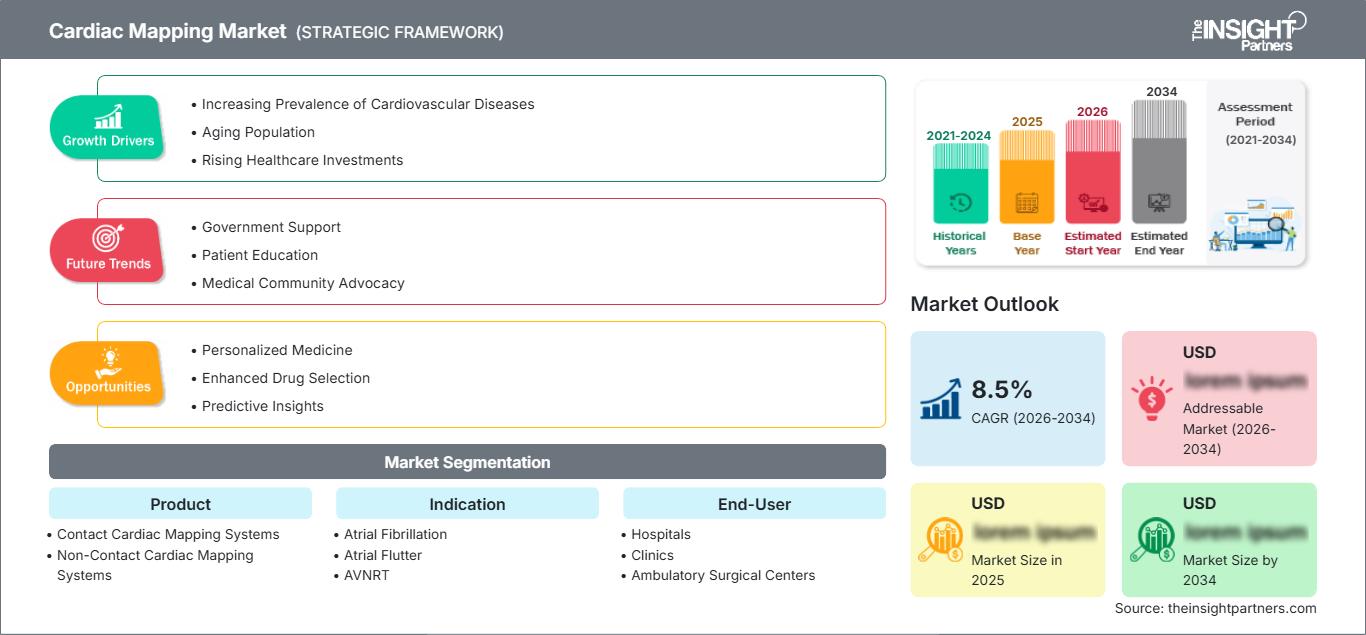
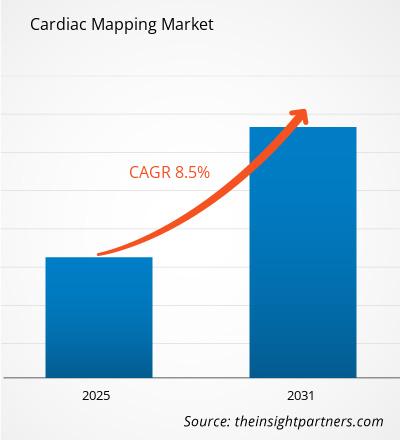
The Cardiac Mapping Market was valued at US$ 2.39 Billion in 2025 and is projected to reach US$ 4.99 Billion by 2034. It is expected to register a CAGR of 8.53% during 2026–2034. Expansion reflects increasing demand for precise arrhythmia localization, wider adoption of catheter ablation, and continued integration of electroanatomic mapping with advanced imaging, navigation, and therapeutic delivery technologies.
Within North America, the Cardiac Mapping Market size is expected to advance at a modelled CAGR of 7.8–8.4% during 2026–2034. Growth is supported by established electrophysiology laboratories, rising atrial fibrillation treatment volumes, and accelerated integration of mapping with pulsed field ablation. The US further benefits from specialist training capacity, developed reimbursement pathways, and recurring hospital investment in digitally connected cardiac care infrastructure.
Cardiac Mapping Market Assessment and Insights
- North America: The region accounted for a modelled 38–42% share in 2025 and is expected to record a 7.8–8.4% CAGR between 2026–2034, supported by established electrophysiology centers, ablation volumes, and early technology adoption.
- US: The country represented 82–86% of North America in 2025 and is projected to expand at a 7.9–8.5% CAGR between 2026–2034, driven by high procedure density and specialist availability.
- Europe: Europe held a modelled 27–31% share in 2025 and is expected to register a 7.4–8.0% CAGR between 2026–2034. Germany, the UK, France, Italy, and Spain remain leading national markets.
- Asia Pacific: Asia Pacific represented a modelled 21–25% share in 2025 and is projected to grow at a 9.7–10.5% CAGR between 2026–2034, led by China, Japan, India, South Korea, and Australia.
- Largest Segment: Contact cardiac mapping systems represented a modelled 68–72% market share in 2025 and are expected to register a 7.9–8.5% CAGR during 2026–2034, reflecting established procedural use.
- High Growth Segment: Non-contact cardiac mapping systems accounted for a modelled 28–32% market share in 2025 and are projected to grow at a 9.4–10.2% CAGR during 2026–2034.
- Key companies analyzed in detail: Biosense Webster, Inc.; Abbott Laboratories; Boston Scientific Corporation; Medtronic plc; MicroPort Scientific Corporation; EP Solutions SA; Acutus Medical, Inc.; Koninklijke Philips N.V.; Lepu Medical Technology (Beijing) Co., Ltd.; and BIOTRONIK SE & Co. KG.
Source: The Insight Partners' analysis based on proprietary research, government publications, company annual reports, investor presentations, industry databases, and expert interviews.
The evolution in cardiac mapping has occurred from lower density point sampling to three dimensional electroanatomic platforms that can handle large signals volume, detect near field signals, and combine images and therapeutic delivery. As such, production economics have transitioned towards consoles, multipolar catheters, proprietary software, and disposables revenues. In this respect, manufacturers who can minimize catheter swaps, fluoroscopy use, and analysis time without compromising the quality of signal in complicated atrial or ventricular substrates gain a competitive advantage within the Cardiac Mapping Market.
Over the forecast period, there will be an expansion in adoption by new regions outside the already well-established tertiary centers as Asia Pacific and select Middle Eastern healthcare systems develop their electrophysiology capabilities. Acceptance of integrated mapping and ablation platforms and of non-invasive technologies by regulators will enhance access to the procedures. However, capital investment will be geared towards automation of annotations, cloud-based procedure information, and training collaborations despite procurement being cost sensitive to hardware, disposables, cybersecurity needs, and electrophysiologists expertise.
Cardiac Mapping Market Report Scope
| Report Attribute | Details |
|---|---|
| Market size in 2025 | US$ 2.39 Billion |
| Market Size by 2034 | US$ 4.99 Billion |
| Global CAGR (2026 - 2034) | 8.53% |
| Historical Data | 2021-2024 |
| Forecast period | 2026-2034 |
Cardiac Mapping Market Analysis
Increasing cases of arrhythmias, aging population, and enhanced rhythm disorders detection drive the growth of the Cardiac Mapping Market. Among the cardiac arrhythmias, atrial fibrillation is the most frequently encountered one, while the CDC forecasts that there will be around 12.1 million cases of the condition in the US by 2050. Thus, the demand for mapping services expands throughout the entire range of diagnosis, ablation, energy delivery, and ablation endpoints validation. Ecosystem includes hospitals as major players and catheter manufacturers, imaging firms, software companies, distributors, and training specialists as supporting entities.
Market supply conditions are favorable for those companies which own capital equipment and procedure-specific disposables. Mapping consoles create long-term relationships with electrophysiology laboratories, whereas catheters, patches, sensors, and software updates provide recurring revenues. Reliability, availability of regulatory documents, clinical support and services, and service responsiveness, along with acquisition price, play a role in the decision-making process. On the one hand, integrated systems help to establish more standardized workflow. On the other hand, proprietary compatibility may increase switching costs and make it difficult to source multiple vendors.
According to the analysis of the Cardiac Mapping Market, the competitive structure is concentrated in terms of the premium segment with such competitors as Biosense Webster, Inc., Abbott Laboratories, Boston Scientific Corporation, and Medtronic plc. MicroPort Scientific Corporation and Lepu Medical Technology (Beijing) Co., Ltd. intensify competition in pricing and regional aspects of business, especially in Asia. EP Solutions SA and Acutus Medical, Inc. develop specialist approaches to non-invasive or non-contact mapping.
Current investment trends include combination of mapping and ablation, automated interpretation of signals, and imaging-guided navigation. Koninklijke Philips N.V. and BIOTRONIK SE & Co. KG become participants due to their imaging, navigation, and rhythm management solutions. Positioning strategy is based on installed base conversion, physician training, regulatory sequencing, and multi-energy modality compatibility. Vendors that can provide reproducible workflows and reduce laboratory complexity will have higher utilization rate after capital purchase.
● REPORT CUSTOMIZATION
Tailor This Report To Align With Your Specific Business Requirements
This report can be customized to align precisely with your business objectives, scope, and target markets. Customization options include tailored segmentation, geography, competitive analysis, and strategic insights to support informed decision-making.
Customize This Report →WHAT YOU CAN ADJUST
- ● Segmentations
- ● Geography
- ● Competitive Analysis
- ● Language Preferences
Cardiac Mapping Market: Strategic Insights
Regional Insights
North America Cardiac Mapping Market
North America held a modelled 38–42% Cardiac Mapping Market share in 2025 and is expected to expand at a 7.8–8.4% CAGR during 2026–2034. The region benefits from a dense network of electrophysiology laboratories, established catheter-ablation pathways, favorable access to advanced devices, and substantial clinical research participation. Rising detection through ambulatory monitoring also increases referrals for invasive electrophysiology evaluation.
Adoption of systems is moving towards those which integrate high-resolution mapping, intracardiac imaging, pulsed field ablation imaging, and automatic lesion recording. Demand from the US is prevalent, whereas Canada plays an important role through research institutions and cardiovascular programs from provinces. Committees for procurement are more focused on procedure efficiency, disposable expenses, service scope, and cybersecurity. Shortage of electrophysiology expertise might hamper small institutions.
U.S. Cardiac Mapping Market
The US accounted for a modelled 82–86% of North American revenue in 2025 and is forecast to register a 7.9–8.5% CAGR during 2026–2034. Demand is driven by high atrial fibrillation hospitalization rates, early diagnosis, and ongoing growth in catheter ablation. The US sees in excess of 454,000 hospitalizations per year for atrial fibrillation as the main condition, indicating the medical workflow leading to the use of mapping.
Some of the players involved in this market are Biosense Webster, Inc., Abbott Laboratories, Boston Scientific Corporation, and Medtronic plc. Uses are expanding from pulmonary vein isolation into persistent atrial fibrillation, atrial tachycardia, and ventricular tachycardia. There may be advantages in systems that allow the mapping and delivery of therapy without multiple catheter changes, thus improving the workflow in the lab. Still, hospital budget cycles, data needs, operator preference, and disposables economics influence platform choice.
Europe Cardiac Mapping Market
Europe represented a modelled 27–31% share in 2025 and is projected to grow at a 7.4–8.0% CAGR during 2026–2034. Germany is the largest national market, aided by its electrophysiology capability and modern hospital infrastructure. The UK has centralized procurement and specialist arrhythmia centers, and its reimbursement evaluations have a focus on clinical evidence, procedural value, and efficiency of staffing.
France provides a supportive environment via university hospitals and well-developed cardiovascular pathways. Italy and Spain are growth markets through modernization at a regional level; however, procurement timing varies from health authority to health authority. The mature ablation market in Germany offers opportunities for advanced mapping technology and combination platforms. Across Europe, adherence to Medical Device Regulation impacts product launches and post-launch evidence generation.
APAC Cardiac Mapping Market
Asia Pacific held a modelled 21–25% share in 2025 and is projected to record a 9.7–10.5% CAGR during 2026–2034, the fastest regional range. China leads through hospital expansion and domestic device manufacturing, while Japan maintains sophisticated electrophysiology practice and strong demand for precision technologies.
India’s specialist centers, South Korea’s digital hospitals, and Australia’s established reimbursement environment broaden adoption. Aging populations, urban cardiovascular burden, training partnerships, and public investment in tertiary infrastructure support growth. Local manufacturing and value-oriented platforms are expected to improve access beyond major metropolitan hospitals.
Middle East & Africa Cardiac Mapping Market
The Middle East and Africa region is expected to grow at a modelled 8.6–9.4% CAGR during 2026–2034. Saudi Arabia leads through hospital modernization and specialist-care investment, while the UAE is developing advanced cardiac centers serving residents and medical travelers.
South Africa anchors sub-Saharan access through private and academic hospitals. The rest of the region remains limited by capital availability, referral distances, and workforce shortages. Energy-secure hospitals, digital infrastructure, service contracts, and physician training are necessary for sustainable electrophysiology laboratory expansion.
Segmentation Analysis
Product
The Product segment is expected to register a modelled 8.1–8.7% CAGR during 2026–2034. The Cardiac Mapping Market scope covers established contact platforms and evolving non-contact systems, with purchasing decisions shaped by signal resolution, workflow integration, catheter compatibility, procedural complexity, and capital cost. Demand is increasingly oriented toward systems that support automated annotation, rapid chamber reconstruction, and efficient transition from diagnosis to ablation.
- Contact Cardiac Mapping Systems: These systems retain the leading position because direct electrode-tissue measurements support detailed activation and voltage mapping, established ablation workflows, and reproducible assessment across atrial and ventricular arrhythmias.
- Non-Contact Cardiac Mapping Systems: Adoption is increasing where clinicians require rapid global chamber assessment, reduced catheter manipulation, or noninvasive planning, making this category strategically important for complex substrates and workflow differentiation.
Indication
The Indication segment is projected to expand at a modelled 8.2–8.8% CAGR during 2026–2034. Growth is driven by increasing atrial fibrillation intervention, improved differentiation of reentrant circuits, and broader use of high-density mapping for complex tachycardias. Mapping value rises when conventional electrocardiography cannot precisely localize arrhythmogenic tissue or when previous ablation has altered the cardiac substrate.
- Atrial Fibrillation: This indication generates the strongest procedural demand because pulmonary vein isolation, persistent disease, repeat ablation, and substrate assessment require accurate anatomical visualization and electrical signal interpretation.
- Atrial Flutter: Mapping supports identification of macro-reentrant circuits and critical isthmuses, enabling targeted ablation while helping clinicians confirm conduction block and differentiate typical from atypical flutter.
- AVNRT: Electrophysiology mapping assists localization near the atrioventricular node, where procedural precision is strategically important for successful slow-pathway modification while limiting unintended damage to normal conduction.
End-User
The End-User segment is expected to record a modelled 8.0–8.6% CAGR during 2026–2034. Hospitals account for most capital placements because complex ablation requires multidisciplinary teams, imaging support, anesthesia access, and emergency capabilities. Clinics and ambulatory facilities are gaining relevance for selected procedures, while diagnosis centers strengthen referral pipelines through rhythm detection and pre-procedural evaluation.
- Hospitals: Hospitals remain the principal purchasers owing to comprehensive electrophysiology laboratories, specialist staffing, intensive care backup, high procedure throughput, and the ability to manage complex or high-risk arrhythmia cases.
- Clinics: Specialist cardiology clinics support patient evaluation, follow-up, and selected mapping-linked workflows, while their purchasing decisions emphasize compact systems, service availability, interoperability, and predictable operating expenditure.
- Ambulatory Surgical Centers: These centers offer potential for lower-complexity ablation as reimbursement and safety protocols mature, creating demand for streamlined platforms, rapid room turnover, and reduced equipment footprints.
- Diagnosis Centers: Diagnosis centers strengthen the treatment funnel by identifying rhythm abnormalities and referring suitable patients, with strategic value concentrated in noninvasive mapping, ECG integration, and digital data transfer.
Opportunity Snapshot
| End-User | Revenue Contribution (High/Medium/Low) | Trend Tag | Adoption Stage |
| Hospitals | High | Integrated EP | Mature |
| Clinics | Medium | Compact Mapping | Scaling |
| Ambulatory Surgical Centers | Medium | Outpatient Ablation | Emerging |
| Diagnosis Centers | Low | Noninvasive Triage | Scaling |
Cardiac Mapping Market Growth Drivers and Impact Analysis
Rising Arrhythmia Burden and Earlier Patient Identification
Worldwide aging, high blood pressure, obesity, diabetes, and advanced rhythm monitoring have increased the number of patients being diagnosed for cardiac arrhythmia. There has been an increase in the prevalence of atrial fibrillation worldwide from 33.5 million individuals in 2010 to 59 million people in 2019, while the lifetime risk following age 45 has been estimated at one in three to five persons. Earlier diagnosis using wearable devices, ambulatory monitoring systems, and regular screening leads to more referrals to electrophysiologists. The economic effect does not stop at purchasing the first equipment but will also involve regular purchases of catheters, patches, sensors, software, and services.
Expansion of Catheter Ablation and Integrated Procedural Workflows
The Cardiac mapping market forecasts show that catheter ablation is widely adopted to tackle patients suffering from atrial fibrillation or other types of arrhythmia cases when medical treatment fails to provide a solution. The role of mapping systems becomes extremely important in terms of reconstructing patient's anatomy, detecting irregularities in conduction, delivering energy, and achieving procedure endpoints. The integration with pulsed field ablation plays an especially critical role in this respect, because the operator needs to precisely track the movement of the catheter as well as deliver energy in the right place. Boston Scientific claims that its mapping solution works both for radiofrequency and pulsed field ablation procedures, thus proving the trend towards energy agnostic solutions in the industry.
Improving Signal Resolution, Automation, and Image Integration
The high-density catheter, point collection through automation, omnipolar signal processing, intracardiac echocardiography, and advanced annotation tools have been revolutionizing the work of electrophysiologists with regard to the interpretation of complex substrates. Contemporary platforms have the capacity to produce sophisticated three-dimensional maps while minimizing the need for manual tagging and operator bias. For instance, the EnSite technologies from Abbott have used the technique of omnipolar processing to enhance point density as well as isolate the localized near-field signals. This gives an indication of where the technology is headed in its clinical applications. Automation can minimize variability, enable less experienced staff to map, and help maximize laboratory time.
Cardiac Mapping Market Future Trends
Convergence of Mapping, Imaging, and Therapy Delivery
Among the leading Cardiac Mapping Market trends, platform convergence will reshape electrophysiology laboratories. Future systems will combine anatomical reconstruction, electrogram interpretation, intracardiac imaging, energy delivery, and endpoint validation within a connected procedural environment. Single-catheter mapping and ablation could reduce exchanges, simplify inventory, and shorten setup time. AI-based imaging modules will automate chamber modelling and structure labeling while maintaining physician oversight. Johnson & Johnson’s 2026 CARTOSOUND SONATA introduction illustrates this direction by converting intracardiac ultrasound images into detailed multi-chamber maps. Competitive advantage should increasingly depend on interoperable data, workflow consistency, and measurable procedural efficiency rather than map resolution alone.
Expansion of Noninvasive and Pre-Procedural Mapping
Noninvasive electrocardiographic imaging will increasingly complement catheter-based mapping by supporting triage, procedural planning, and localization before vascular access. Technologies combining body-surface electrodes, standard ECG signals, imaging data, and computational models may help identify focal arrhythmias, ventricular tachycardia exits, and reentry pathways. A 2025 clinical review identified growing use of ECG imaging for ventricular tachycardia and investigation of scar and critical-isthmus detection. Adoption will depend on validation across patient anatomies, integration with laboratory systems, and reimbursement. Rather than replacing contact systems, noninvasive platforms are likely to create a layered workflow that improves case selection and reduces exploratory mapping.
Cardiac Mapping Market Opportunities
Localized Electrophysiology Platforms for High-Growth Asian Markets
Manufacturers can capture growth by adapting systems to the purchasing economics, clinical workflows, languages, and service requirements of China, India, and Southeast Asia. The opportunity extends beyond lower equipment prices. Vendors need local catheter production, responsive field support, physician training, regulatory expertise, and financing structures that reduce initial capital barriers. Partnerships with teaching hospitals can establish reference centers and accelerate specialist development. Modular platforms that begin with core mapping capabilities and add advanced software later may improve affordability. Domestic manufacturing also reduces logistics risk and supports public procurement preferences, allowing suppliers to address secondary cities where arrhythmia treatment remains concentrated in major metropolitan institutions.
Workflow-Based Contracting and Recurring Digital Services
Vendors can move beyond conventional capital sales by offering procedure-linked pricing, managed equipment contracts, software subscriptions, and outcome-oriented service packages. These approaches align hospital expenditure with utilization while lowering technology-refresh barriers. Investment should prioritize remote diagnostics, cybersecurity, predictive maintenance, standardized case analytics, and structured training. The Cardiac Mapping Market Report opportunity is strongest for suppliers that connect hardware performance with measurable laboratory outcomes, including setup time, catheter exchanges, mapping duration, and system availability. Contract structures must remain transparent and avoid restrictive dependencies, but well-designed service models can deepen customer relationships, improve installed-base utilization, and create predictable recurring revenue.
Recent Developments
- August 2026: Medtronic plc received an expanded CE Mark indication for the Affera Mapping and Ablation System and Sphere-9 Catheter for ventricular arrhythmia treatment. The authorization extended an integrated high-density mapping and dual-energy platform into ventricular ablation, supporting broader use across complex electrophysiology procedures and reinforcing the strategic convergence of mapping, radiofrequency energy, and pulsed field energy.
- April 2026: Biosense Webster, Inc., part of Johnson & Johnson MedTech, launched the CARTOSOUND SONATA Module at the Heart Rhythm Society Annual Meeting. The AI-enabled module works with the CARTO System to transform intracardiac echocardiography images into detailed maps and automatically label cardiac structures, supporting atrial fibrillation, ventricular tachycardia, and complex combined procedures.
- October 2025: Abbott Laboratories highlighted the combined introduction of the TactiFlex Sensor Enabled Ablation Catheter and EnSite X EP System in Asian markets. The integrated workflow combines flexible-tip, contact-force sensing with detailed three-dimensional electrical mapping, aiming to improve catheter stability, treatment localization, and procedural control during atrial fibrillation ablation.
Frequently Asked Questions

- Comprehensive Market Sizing and Forecast Analysis
- Detailed Segmentation Analysis
- In-Depth Market Dynamics Assessment
- Regional and Country-Level Insights
- Competitive Landscape and Company Benchmarking
- Strategic Business Intelligence
Recent Reports
Testimonials

The Insight Partners provided valuable market intelligence that supported our global go-to-market strategy. Their team was professional, responsive, and attentive to our feedback, providing thoughtful analysis and helpful methodological clarifications throughout the project.
Junmo Kim Chief Financial Officer (CFO), Enertech Co., Ltd.
The Insight Partners' SCADA System Market report is comprehensive, with valuable insights on current trends and future forecasts. The team was highly professional, responsive, and supportive throughout. We are very satisfied and highly recommend their services.
RAN KEDEM Partner, Reali Technologies LTDs
I requested a report on a very specific software market and the team produced the report in a few days. The information was very relevant and well presented. I then requested some changes and additions to the report. The team was again very responsive and I got the final report in less than a week.
JEAN-HERVE JENN Chairman, Future Analytica
We worked with The Insight Partners for an important market study and forecast. They gave us clear insights into opportunities and risks, which helped shape our plans. Their research was easy to use and based on solid data. It helped us make smart, confident decisions. We highly recommend them.
PIYUSH NAGPAL Sr. Vice President, High Beam Global
The Insight Partners delivered insightful, well-structured market research with strong domain expertise. Their team was professional and responsive throughout. The user-friendly website made accessing industry reports seamless. We highly recommend them for reliable, high-quality research services
YUKIHIKO ADACHI CEO, Deep Blue, LLC.
This is the first time I have purchased a market report from The Insight Partners.While I was unsure at first, I visited their web site and felt more comfortable to take the risk and purchase a market report.I am completely satisfied with the quality of the report and customer service. I had several questions and comments with the initial report, but after a couple of dialogs over email with their analyst I believe I have a report that I can use as input to our strategic planning process.Thank you so much for taking the extra time and making this a positive experience.I will definitely recommend your service to others and you will be my first call when we need further market data.
JOHN SUZUKI President and Chief Executive Officer, Board Director, BK Technologies
I wish to appreciate your support and the professionalism you displayed in the course of attending to my request for information regarding to infectious disease IVD market in Nigeria. I appreciate your patience, your guidance, and the fact that you were willing to offer a discount, which eventually made it possible for us to close a deal. I look forward to engaging The Insight Partners in the future, all thanks to the impression you have created in me as a result of this first encounter.
DR CHIJIOKE ONYIA MANAGING DIRECTOR, PineCrest Healthcare Ltd.Reason to Buy
- Informed Decision-Making
- Understanding Market Dynamics
- Competitive Analysis
- Identifying Emerging Markets
- Customer Insights
- Market Forecasts
- Risk Mitigation
- Boosting Operational Efficiency
- Strategic Planning
- Investment Justification
- Tracking Industry Innovations
- Aligning with Regulatory Trends





 Get Free Sample for