
Catheter with Antibacterial Coating Market Growth, Trends & Forecast by 2034
Coverage: By Type (Antimicrobial Treatment Catheter, and Hygienically Clean Catheter); Application (Urinary, Vascular Access, and Other); End Use (Hospitals, Clinics, and Other), and Geography (North America, Europe, Asia Pacific, and South and Central America)
- Status : Data Released
- Report Code : TIPRE00022295
- Category : Life Sciences
- No. of Pages : 150
- Available Report Formats :


- Last update date : September 07, 2026


2025 Market Size
US$ 3.33 Bn
Base year value
2034 Forecast
US$ 5.3 Bn
Projected by 2034
CAGR 2026-2034
5.3 %
Growth rate
Addressable Market
US$ 39.15 Bn
(2026-2034)
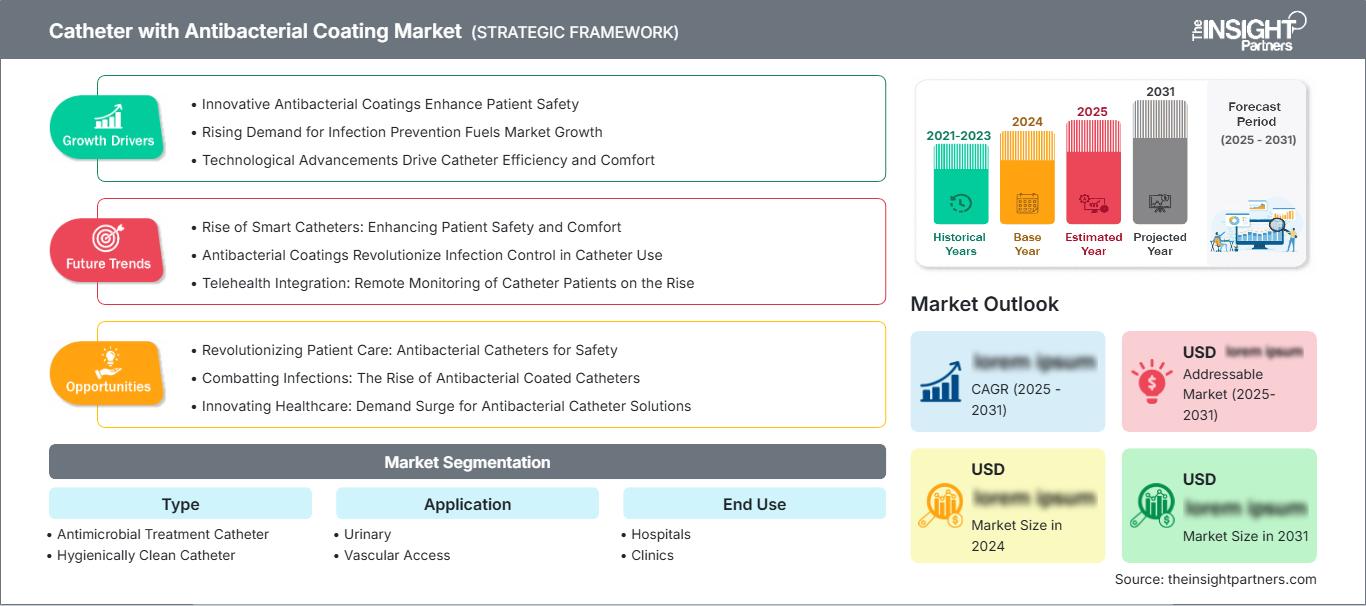
The Catheter with Antibacterial Coating market was valued at US$ 3.33 billion in 2025 and is expected to reach US$ 5.3 billion by 2034; it is estimated to record a CAGR of 5.3% during 2026-2034.
Catheter with Antibacterial Coating Market Assessment and Insights
- North America: Representing a 35–38% share in 2025, the region is projected to grow at a 5.4–6.0% CAGR between 2026–2034, supported by infection reporting, hospital quality metrics, and premium device adoption.
- US: Accounting for 82–85% of North America in 2025, the country is expected to record a 5.5–6.1% CAGR between 2026–2034, driven by standardized infection-prevention purchasing.
- Europe: Holding a 27–30% share in 2025, Europe is projected to expand at a 5.0–5.6% CAGR between 2026–2034, with Germany, the UK, and France leading adoption.
- Asia Pacific: Capturing a 23–26% share in 2025, Asia Pacific is forecast to grow at a 6.8–7.5% CAGR between 2026–2034, led by China, Japan, India, and South Korea.
- Largest Segment: Urinary applications held a 57–61% market share in 2025 and are projected to register a 5.5–6.1% CAGR between 2026–2034, reflecting substantial catheter utilization across inpatient care.
- High Growth Segment: Vascular access represented a 39–43% market share in 2025 and is expected to expand at a 6.4–7.0% CAGR between 2026–2034, supported by intensive-care and infusion demand.
- Key companies analyzed in detail: Teleflex Incorporated, Guangdong Baihe Medical Technology Co., Ltd., B. Braun SE, Edwards Lifesciences Corporation, ICU Medical, Inc., Coloplast A/S, Well Lead Medical Co., Ltd., Henan Tuoren Medical Device Group Co., Ltd., Becton, Dickinson and Company, Cook Medical LLC, Medi-Globe GmbH, Sewoon Medical Co., Ltd., SCW Medicath Ltd., Medtronic plc, and Lepu Medical Technology (Beijing) Co., Ltd.
Source: The Insight Partners' analysis based on proprietary research, government publications, company annual reports, investor presentations, industry databases, and expert interviews.
Product development has evolved from simple surface treatments towards controlled release of anti-microbials, anti-adhesive properties, hydrophilicity and coatings that aim at blocking biofilm formation. Manufacturers are improving their techniques such as extrusion, impregnation, sterilization and packaging to maintain the uniformity of the coatings during their shelf-life. On the other hand, buyers will judge the coatings of catheters based on infection rates, dwell-time compatibility, materials and procedure costs instead of just unit costs, hence making it more commercially significant between validated and generic technologies.
In the coming years, procurement will increase in the countries of Asia Pacific, Middle East, and certain Latin American health care systems due to improved intensive-care facilities and infection surveillance capabilities. The investment in the market will focus on scalable coatings, local manufacturing capability and evidence gathering about particular patient segments. Guidance issued by WHO for catheters, EU infection control guidelines and initiatives taken by US hospitals for improving quality will drive procurement.
Catheter with Antibacterial Coating Market Report Scope
| Report Attribute | Details |
|---|---|
| Market size in 2025 | US$ 3.33 Billion |
| Market Size by 2034 | US$ 5.3 Billion |
| Global CAGR (2026 - 2034) | 5.3% |
| Historical Data | 2021-2024 |
| Forecast period | 2026-2034 |
Catheter with Antibacterial Coating Market Analysis
The main factor for the expansion of the Catheter with Antibacterial Coating Market is the operational and clinical burden resulting from the infection associated with catheter use. According to WHO, up to 70% of inpatients in hospitals require a peripheral vascular catheter, making the quality of its insertion and maintenance, as well as the choice of equipment, patient safety issues. Infections resistant to antimicrobials, directly caused, accounted for no less than 1.27 million fatalities worldwide in 2019, demonstrating the importance of preventive equipment together with aseptic procedures.
The value chain consists of polymer producers, the developers of antimicrobial agents, catheter extrusion, coating services, sterilization, regulatory labs, distributors, and clinical end users. The stability of supply chain needs the availability of coating agent, validation of the clean room and antimicrobial effectiveness after the sterilization process. The influence of hospitals in downstream market remains present because the formulary boards analyze the coated catheters in relation to regular catheters based on the criteria of infection rate, catheter days, acuity of patients, nursing process and frequency of change.
According to the Catheter with Antibacterial Coating Market Report, the competition is rather diverse and includes both multinational producers and local competitors. Teleflex Incorporated, B. Braun SE, Becton, Dickinson and Company, Coloplast A/S, Cook Medical LLC and Medtronic plc compete using their clinical experience, wide distribution and procedural portfolio. Well Lead Medical Co., Ltd., Henan Tuoren Medical Device Group Co., Ltd. and Guangdong Baihe Medical Technology Co., Ltd. improve price and production competition in Asia.
Nowadays, the focus of investment shifts to improving coating longevity, minimizing bacterial attachment, increasing lubricity and being compatible with prolonged dwell times. Edwards Lifesciences Corporation and ICU Medical, Inc. represent the advanced procedures in the hospital sector, while Medi-Globe GmbH, Sewoon Medical Co., Ltd., SCW Medicath Ltd. and Lepu Medical Technology (Beijing) Co., Ltd. cover specialized or geography oriented needs. Competitive advantage now becomes more reliant on indication specific data, tenders response, reliable supply and education about right use.
● REPORT CUSTOMIZATION
Tailor This Report To Align With Your Specific Business Requirements
This report can be customized to align precisely with your business objectives, scope, and target markets. Customization options include tailored segmentation, geography, competitive analysis, and strategic insights to support informed decision-making.
Customize This Report →WHAT YOU CAN ADJUST
- ● Segmentations
- ● Geography
- ● Competitive Analysis
- ● Language Preferences
Catheter with Antibacterial Coating Market: Strategic Insights
Regional Insights
North America Catheter with Antibacterial Coating Market
North America had a 35-38% Catheter with Antibacterial Coating Market share for the Catheter with Antibacterial Coating in 2025 and is estimated to grow at 5.4-6.0% CAGR from 2026-2034. The adoption is driven by acute-care hospitals, intensive care units, oncology departments, and operating rooms that track infections related to catheters. According to CDC's surveillance data for the year 2024, 15,347 cases of catheter-associated urinary tract infection occurred in general acute-care hospitals in the US.
Total cost consideration has become more prevalent when buying products in regional countries that take into consideration costs of treating infections, hospital stay, catheter change, and nurses' time. In Canada, the provinces have an infection control program and hospital procurement process, while in Mexico, there are many opportunities in the private hospitals and health system of big cities. Companies with clinical education personnel, wide distribution network, and studies proving that coatings reduce risk in patients belonging to particular risk group are in advantageous position, however, hospitals usually use coated catheters in case of risks.
U.S. Catheter with Antibacterial Coating Market
North America accounted for 82-85% share of revenues in the United States in 2025 and is expected to grow at a 5.5-6.1% CAGR in 2026-2034. The CDC data shows a substantial decrease in the standardized infection ratios for catheter-associated UTIs from 2023-2024, showing prevention success despite continuing pressure on hospitals to sustain their achievements. Infection-related quality measurement and nonpayment policies still affect buying decisions.
Teleflex Incorporated, Becton, Dickinson and Company, B. Braun SE, Cook Medical LLC, ICU Medical, Inc., and Medtronic plc have notable presence on commercial or clinical levels regarding catheter solutions. The use of urinary catheters focuses on perioperative, critical care, retention management, and neurogenic bladder segments. The need for vascular catheters originates in central access, infusion therapy, oncology, and critical care interventions. Antimicrobial catheters are becoming an essential component in the bundle of catheter insertion, daily necessity evaluation, aseptic access, and catheter removal.
Europe Catheter with Antibacterial Coating Market
For Europe, the market share was estimated at 27-30%, whereas the CAGR growth rate from 2026 to 2034 is predicted at 5.0-5.6%. Germany is the leading country in Europe since it is associated with the large hospital size, production of medical devices, and organized procurement. The UK uses infection surveillance, antibiotic stewardship, and catheter selection to adopt into high-risk wards.
France, Italy, and Spain are included because of an aging population, public hospitals' modernization and the need to prevent urinary and vascular infections. Products that show value to clinical workflow and are based on comparative evidence are preferred by budget control. According to the ECDC estimation, more than 3.5 million HAI take place each year in the EU and EEA, resulting in over 90,000 deaths, but 50% can be prevented.
Germany will stay a leading country in this region, thanks to specialist distributors and manufacturers like B. Braun SE and Medi-Globe GmbH. Continence products from Coloplast A/S are relevant in European countries. The regulatory requirements regarding biocompatibility, antimicrobial claims, sterilization, and post-market surveillance favor technologically differentiated products.
APAC Catheter with Antibacterial Coating Market
Market shares of the Asia Pacific region are expected to be 23-26% in 2025 and a CAGR of 6.8-7.8% from 2026 to 2034 is projected in the Asia Pacific. Prominent players are China owing to growth in hospitals, production, and procedure rate. Japan is concerned about the quality of products and continence care due to its aging population, while South Korea highlights.
India provides growing demand via tertiary hospitals and insurance coverage, but Australia already has well-developed infection control measures in place. Favorable regional policy towards localization of medical devices helps Well Lead Medical Co., Ltd., Henan Tuoren Medical Device Group Co., Ltd., Guangdong Baihe Medical Technology Co., Ltd., Sewoon Medical Co., Ltd., and Lepu Medical Technology (Beijing) Co., Ltd.
Middle East & Africa Catheter with Antibacterial Coating Market
The region is estimated to have a 5.7%-6.4% CAGR from 2026 to 2034. Saudi Arabia is leading through the construction of hospitals, investments in specialist care, and centralized procurement, while the UAE promotes the use of premium devices through internationally accredited hospitals and facilities for medical tourism.
South Africa forms the core demand for sub-Saharan Africa through the establishment of private hospitals and tertiary government hospitals. The Rest of MEA is diverse in nature, where adoption depends on budget considerations, distribution network, and training of clinicians. Energy-driven infrastructure projects in Gulf states offer chances for high-end urinary and vascular devices.
Segmentation Analysis
Type
Type is projected to expand at a 5.7–6.3% CAGR during 2026–2034. The Catheter with Antibacterial Coating Market scope encompasses products using active antimicrobial treatment and hygienically optimized surfaces intended to limit microbial attachment or contamination. Adoption depends on coating mechanism, intended dwell time, sterilization stability, compatibility with body tissues, and clinical evidence. Hospitals increasingly distinguish active antimicrobial claims from cleanliness-oriented surface characteristics during evaluation.
- Antimicrobial Treatment Catheter: These products occupy a strategically important position in high-risk care, where active agents or impregnated materials are selected to inhibit colonization and complement established infection-prevention bundles.
- Hygienically Clean Catheter: Demand is supported by intermittent catheterization and routine procedures requiring low-friction, ready-to-use, contamination-conscious handling, particularly where usability and patient independence influence product selection.
Application
Application is forecast to register a 5.9–6.5% CAGR during 2026–2034. Urinary products retain the larger installed base because catheterization is common across surgery, intensive care, retention management, and chronic bladder conditions. Vascular access is growing faster as oncology, infusion therapy, dialysis, and critical-care pathways increase exposure to catheter-related bloodstream infection risks. Selection remains closely linked to expected dwell time and patient acuity.
- Urinary: The segment leads demand because hospitals and clinics use indwelling and intermittent devices across perioperative, neurological, geriatric, and bladder-management settings where infection reduction remains a measurable quality objective.
- Vascular Access: Strategic importance is increasing as central venous and peripheral access supports complex drug delivery, nutrition, hemodynamic monitoring, and oncology care involving vulnerable patients and repeated catheter manipulation.
End Use
End use is anticipated to advance at a 5.6–6.2% CAGR during 2026–2034. Hospitals dominate purchasing through intensive-care usage, inpatient catheter-days, infection committees, and structured tender processes. Clinics provide a smaller but relevant channel for ambulatory urology, infusion therapy, and follow-up care. Suppliers must adapt packaging, unit quantities, education, and distributor service to the differing operational requirements of these environments.
- Hospitals: Revenue contribution is highest because acute-care facilities manage complex patients, longer catheter dwell times, and formal infection-surveillance obligations, supporting evidence-based purchasing of premium coated devices in selected departments.
- Clinics: Demand is concentrated in outpatient urology, infusion, specialist, and ambulatory procedure settings where convenient handling, predictable supply, and simplified insertion workflows are critical procurement considerations.
Opportunity Snapshot
| Application | Revenue Contribution | Trend Tag | Adoption Stage |
| Urinary | High | Biofilm Control | Mature |
| Vascular Access | High | Extended Dwell | Scaling |
Catheter with Antibacterial Coating Market Growth Drivers and Impact Analysis
Persistent Burden of Catheter-Associated Infections
Catheter-related infections remain a direct clinical and economic concern despite improved prevention practices. CDC surveillance reported 15,347 catheter-associated urinary tract infections in US general acute-care hospitals during 2024, while one in 38 hospital patients had at least one healthcare-associated infection on a given day in 2023. These data sustain demand for additional preventive layers in intensive care, oncology, surgery, and long-term catheterization. Coated devices can address microbial attachment at the material interface, but their impact depends on correct indication, aseptic insertion, closed drainage or access systems, maintenance compliance, and prompt removal. Consequently, suppliers that position coatings within complete infection-prevention pathways, supported by training and utilization criteria, can demonstrate stronger institutional value than vendors presenting antibacterial functionality as an isolated product attribute.
Expansion of High-Acuity and Infusion-Based Care
Growing use of infusion therapy, intensive-care monitoring, cancer treatment, parenteral nutrition, and complex surgery increases the number of patients exposed to vascular access devices. WHO notes that up to 70% of inpatients require a catheter inserted into a peripheral vein or artery during hospitalization. This extensive exposure creates opportunities for products engineered for specific dwell durations and infection-risk profiles. Procurement teams increasingly evaluate whether antimicrobial protection can reduce unplanned replacement, line complications, nursing interventions, and treatment disruption. The commercial impact extends beyond unit sales because manufacturers can develop differentiated portfolios for peripheral access, central access, urinary drainage, and intermittent catheterization. Product success will nevertheless depend on credible comparative evidence establishing benefits within modern infection-prevention bundles rather than against outdated clinical practice.
Stronger Institutional Accountability for Infection Outcomes
Hospitals face growing accountability through public reporting, accreditation requirements, internal quality dashboards, and reimbursement-linked performance measures. In the US, Medicare has not reimbursed hospitals for certain additional costs associated with hospital-acquired catheter-related urinary infections since October 2008. This policy environment encourages infection committees to compare acquisition premiums with avoidable treatment and hospitalization costs.
European and Asia Pacific institutions are similarly expanding surveillance, antimicrobial stewardship, and standardized catheter protocols. Antibacterial coatings benefit when purchasers identify persistent infection rates despite strong compliance with foundational measures. The resulting demand is selective but commercially durable, concentrating on intensive-care units, immunocompromised patients, and prolonged catheter use. Manufacturers can improve adoption by supplying audit tools, staff education, traceability data, and health-economic evidence tailored to local procurement rules.
Catheter with Antibacterial Coating Market Future Trends
Non-Leaching and Anti-Adhesive Surface Engineering
Future Catheter with Antibacterial Coating Market trends will increasingly emphasize non-leaching surfaces, covalently bonded agents, and microstructured materials that limit bacterial attachment without relying solely on continuous antimicrobial release. This direction addresses regulatory scrutiny concerning systemic exposure, coating durability, cytotoxicity, and potential selection pressure for resistance. Development programs will combine surface chemistry with hydrophilic performance, low friction, and thromboresistance, particularly for vascular devices. Manufacturers will also use more sophisticated biofilm models to evaluate activity over clinically relevant dwell periods. Commercial winners will translate laboratory performance into repeatable manufacturing, sterilization stability, and patient-level evidence for defined indications rather than broad, unsupported antibacterial claims.
Evidence-Linked and Risk-Stratified Procurement
Purchasing will shift from broad product substitution toward risk-stratified protocols that identify patients most likely to benefit from coated catheters. Hospitals may incorporate device type, expected dwell time, immune status, prior infection, ward-specific incidence, and bundle compliance into selection pathways. Digital surveillance systems will help infection teams connect catheter utilization, device-days, microbiology results, and adverse events. Suppliers will respond by developing indication-specific economic models and post-market evidence packages. This transition favors manufacturers capable of clinical support and data integration, while limiting products differentiated only by coating terminology. Adoption will therefore deepen within high-risk cohorts before expanding across routine catheterization.
Catheter with Antibacterial Coating Market Opportunities
Localized Manufacturing for High-Growth Healthcare Systems
Asia Pacific and Middle Eastern healthcare expansion creates an investable opportunity for regional coating, extrusion, sterilization, and packaging capacity. Local manufacturing can shorten lead times, reduce exposure to import disruptions, and improve competitiveness in price-sensitive public tenders. Companies should prioritize technology-transfer controls that preserve coating thickness, antimicrobial activity, lubricity, and shelf-life performance across production sites. Partnerships with domestic catheter manufacturers can accelerate regulatory navigation and hospital access, particularly in China, India, Saudi Arabia, and the UAE. Successful localization requires more than final assembly. Investors should establish validated raw-material sourcing, microbiological testing, traceability, and clinician-training capabilities that support consistent product performance and defensible antibacterial claims.
Clinical Evidence Programs for High-Risk Patient Groups
Manufacturers can create differentiated value by funding pragmatic studies in intensive care, oncology, neurogenic bladder management, dialysis, and prolonged infusion therapy. Trials should measure catheter-associated infection, colonization, dwell time, replacement frequency, antimicrobial use, nursing workload, and total treatment cost. Evidence generation should compare coated products with contemporary best-practice bundles, ensuring results remain relevant to hospital committees. The Catheter with Antibacterial Coating Market Forecast can support strategic screening, but investment decisions require local incidence and procurement analysis. Companies that combine controlled trials, multicenter observational evidence, and transparent post-market surveillance can negotiate value-based access more effectively and reduce dependence on price-led tender competition.
Recent Developments
- December 2025: Intersurgical Limited announced an agreement to acquire the Acute Care and Interventional Urology businesses of Teleflex Incorporated. The transaction covers established medical-device portfolios, operating capabilities, and technical expertise, giving Intersurgical a broader platform across urology and acute-care categories while Teleflex streamlines its strategic focus toward critical-care and high-acuity hospital markets.
- June 2025: Aesculap, Inc., a B. Braun company, introduced XABO antibiotic-impregnated catheters in the US for hydrocephalus shunt procedures. The launch expanded access to catheters designed to address infection risk in neurosurgical care, demonstrating how antimicrobial catheter technologies are being adapted for specialized, high-consequence applications beyond conventional urinary and vascular access settings.
- May 2024: Coloplast A/S expanded the Luja portfolio with a next-generation intermittent catheter for women. The product was developed around complete bladder emptying and contamination-conscious handling, strengthening the company’s continence-care offering and illustrating continued investment in urinary catheter design intended to improve usability, hygiene, and patient confidence during intermittent self-catheterization.
Frequently Asked Questions

- Comprehensive Market Sizing and Forecast Analysis
- Detailed Segmentation Analysis
- In-Depth Market Dynamics Assessment
- Regional and Country-Level Insights
- Competitive Landscape and Company Benchmarking
- Strategic Business Intelligence
Recent Reports
Testimonials

The Insight Partners' SCADA System Market report is comprehensive, with valuable insights on current trends and future forecasts. The team was highly professional, responsive, and supportive throughout. We are very satisfied and highly recommend their services.
RAN KEDEM Partner, Reali Technologies LTDs
I requested a report on a very specific software market and the team produced the report in a few days. The information was very relevant and well presented. I then requested some changes and additions to the report. The team was again very responsive and I got the final report in less than a week.
JEAN-HERVE JENN Chairman, Future Analytica
We worked with The Insight Partners for an important market study and forecast. They gave us clear insights into opportunities and risks, which helped shape our plans. Their research was easy to use and based on solid data. It helped us make smart, confident decisions. We highly recommend them.
PIYUSH NAGPAL Sr. Vice President, High Beam Global
The Insight Partners delivered insightful, well-structured market research with strong domain expertise. Their team was professional and responsive throughout. The user-friendly website made accessing industry reports seamless. We highly recommend them for reliable, high-quality research services
YUKIHIKO ADACHI CEO, Deep Blue, LLC.
This is the first time I have purchased a market report from The Insight Partners.While I was unsure at first, I visited their web site and felt more comfortable to take the risk and purchase a market report.I am completely satisfied with the quality of the report and customer service. I had several questions and comments with the initial report, but after a couple of dialogs over email with their analyst I believe I have a report that I can use as input to our strategic planning process.Thank you so much for taking the extra time and making this a positive experience.I will definitely recommend your service to others and you will be my first call when we need further market data.
JOHN SUZUKI President and Chief Executive Officer, Board Director, BK Technologies
I wish to appreciate your support and the professionalism you displayed in the course of attending to my request for information regarding to infectious disease IVD market in Nigeria. I appreciate your patience, your guidance, and the fact that you were willing to offer a discount, which eventually made it possible for us to close a deal. I look forward to engaging The Insight Partners in the future, all thanks to the impression you have created in me as a result of this first encounter.
DR CHIJIOKE ONYIA MANAGING DIRECTOR, PineCrest Healthcare Ltd.Reason to Buy
- Informed Decision-Making
- Understanding Market Dynamics
- Competitive Analysis
- Identifying Emerging Markets
- Customer Insights
- Market Forecasts
- Risk Mitigation
- Boosting Operational Efficiency
- Strategic Planning
- Investment Justification
- Tracking Industry Innovations
- Aligning with Regulatory Trends





 Get Free Sample for