
CBCT Systems Market Size, Trends & Growth by 2034
Coverage: by Application (Dental, Other); Patient Position (Single Position); Detector Type (Image Intensifier Detector, Flat-Panel Imager Detector); Field of View (FOV) (Small FOV Systems, Medium FOV Systems, Large FOV Systems); End-User (Hospitals and Clinics, Imaging Centers, Academic and Research Institutes), and Geography (North America, Europe, Asia Pacific, and South and Central America)
- Status : Data Released
- Report Code : TIPRE00009780
- Category : Life Sciences
- No. of Pages : 150
- Available Report Formats :


- Last update date : September 07, 2026


2025 Market Size
US$ 1.67 Bn
Base year value
2034 Forecast
US$ 5.23 Bn
Projected by 2034
CAGR 2026-2034
13.50 %
Growth rate
Addressable Market
US$ 29.85 Bn
(2026-2034)
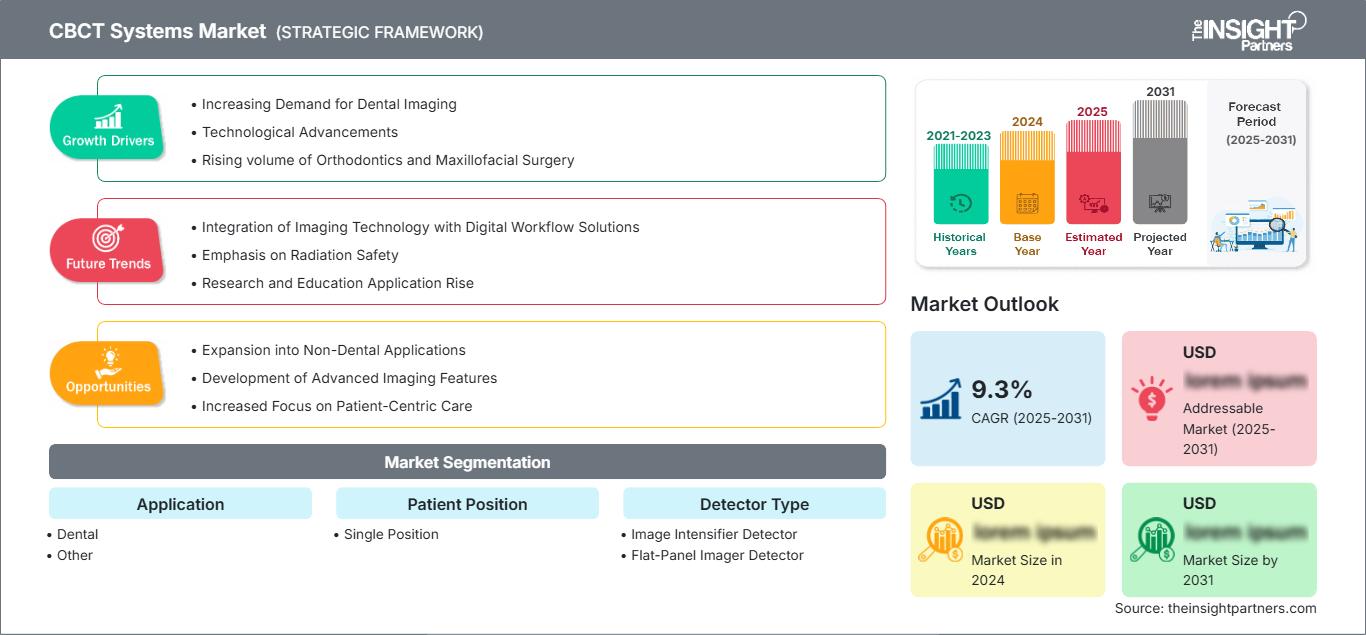
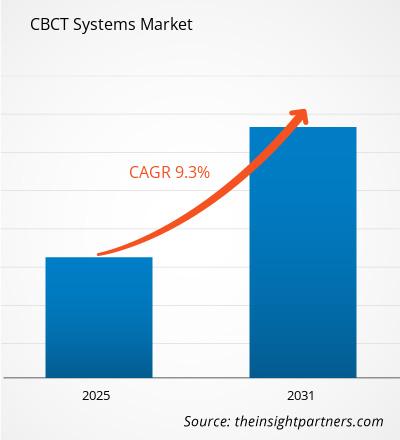
The CBCT Systems Market was valued at US$ 1.67 Billion in 2025 and is projected to reach US$ 5.23 Billion by 2034, registering a CAGR of 13.50% during 2026–2034. The expansion is justified by the shift from 2D radiography to 3D diagnosis, increased need for implant planning, and greater use of cone-beam imaging in connection with orthodontics, endodontics, surgery, and digitized restoration.
North American CBCT Systems Market size is anticipated to witness growth at a forecasted CAGR of 12.5-13.5% between 2026 and 2034. North America gains from the availability of dental service organizations, high replacement requirements, and quick adoption of imaging devices enabled by artificial intelligence. National partnership between PDS Health and DEXIS brought artificial intelligence and CBCT technology to over 1,000 dental practices in the United States.
CBCT Systems Market Assessment and Insights
- North America: The region represented a 36–38% share in 2025 and is projected to grow at a CAGR of 12.5–13.5% during 2026–2034, supported by organized dental networks, favorable technology replacement cycles, and extensive specialist infrastructure.
- US: The country accounted for 83–86% of North American revenue in 2025 and is expected to register a CAGR of 12.0–13.0% through 2034.
- Europe: Europe captured a 27–29% share in 2025 and is forecast to expand at a CAGR of 12.0–13.0%, with Germany, the UK, France, Italy, and Spain leading equipment adoption.
- Asia Pacific: Asia Pacific held a 25–28% share in 2025 and is expected to record a CAGR of 14.5–15.5%, led by China, Japan, South Korea, India, and Australia.
- Largest Segment: Dental applications represented an 84–88% market share in 2025 and are projected to grow at a CAGR of 13.0–14.0% during 2026–2034.
- High Growth Segment: Large FOV systems accounted for an 18–22% market share in 2025 and are expected to register a CAGR of 15.0–16.5% during 2026–2034.
- Key companies analyzed in detail: ACTEON Group, Asahi Roentgen Ind. Co., Ltd., Carestream Dental LLC, Cefla S.C., Dentsply Sirona Inc., Envista Holdings Corporation, Genoray Co., Ltd., J. MORITA CORP., Planmeca Oy, and Vatech Co., Ltd.
Source: The Insight Partners' analysis based on proprietary research, government publications, company annual reports, investor presentations, industry databases, and expert interviews.
Product development is driving CBCT Systems Market towards modular devices with multiple functionalities including panoramic imaging, cephalometric imaging, facial scanning, and model scanning. Companies have been focusing on flat panel detectors, customizable FOV options, reduction of metal artifacts, motion correction, and automatic positioning. One example is Carestream Dental's CS 9600, which includes five imaging capabilities, 14 volume sizes, and provides images with resolution up to 75 microns. Such features are increasing the importance of production efforts focused on software, detector quality, and integration.
In the forecast period, capital allocation will focus increasingly on developing dental chains, urban diagnostic facilities, university hospitals, and oral surgery networks in Asia Pacific and the Middle East. Regulation recommendations focused on indication-specific imaging, staff education, quality control measures, and minimizing unnecessary radiation exposure will be in favor of devices that have selectable FOV options and dose management software. For instance, the 2025 guidelines for endodontic imaging published in January 2026 included 12 recommendations and emphasized selective CBCT usage for particular patients.
CBCT Systems Market Report Scope
| Report Attribute | Details |
|---|---|
| Market size in 2025 | US$ 1.67 Billion |
| Market Size by 2034 | US$ 5.23 Billion |
| Global CAGR (2026 - 2034) | 13.50% |
| Historical Data | 2021-2024 |
| Forecast period | 2026-2034 |
CBCT Systems Market Analysis
Growth Drivers in the CBCT Systems Market include an increase in demand for three-dimensional information about the patient’s anatomy for implant insertion, impacted teeth examination, endodontics, orthognathic surgery, and airway analysis. Starting from X-ray generators, flat panel detectors, motion control elements, reconstruction algorithms, and cybersecurity solutions to ending with manufacturers, distributors, installers, and users, the value chain is based on the need for three-dimensional information that is unavailable in conventional dental radiography, despite the higher radiation exposure compared to traditional dental X-rays.
Thus, the dynamics of the supply side are determined by availability of the detectors, semiconductor costs, localization of the software, regulatory approvals, and service engineering. Presence of local technical teams at vendors allows for minimizing downtime and protocol optimization, while scalability of the configurations helps to upgrade to cephalometric or wide-field CBCTs when procedure volume increases.
The CBCT Systems Market Report for competitive differentiation is becoming increasingly dependent on comprehensive digital ecosystems. Carestream Dental LLC, Planmeca Oy, Dentsply Sirona Inc., and Envista Holdings Corporation offer imaging devices along with planning and/or clinical software solutions, while Vatech Co., Ltd., Genoray Co., Ltd., and Asahi Roentgen Ind. Co., Ltd. compete by offering wider configuration range, small size, and performance-to-price ratio.
Cefla S.C., J. MORITA CORP., and ACTEON Group maintain their strategic significance due to specialized clinical ranges and distribution channels. The capital is being invested into AI-driven reconstruction and segmentation capabilities, remote diagnostics and cloud-based case sharing. Acquisitions and partnerships become increasingly significant since manufacturers need to integrate scanners with practice management software, guided surgery software, orthodontics software, and laboratory operations without adding another manual data conversion step.
● REPORT CUSTOMIZATION
Tailor This Report To Align With Your Specific Business Requirements
This report can be customized to align precisely with your business objectives, scope, and target markets. Customization options include tailored segmentation, geography, competitive analysis, and strategic insights to support informed decision-making.
Customize This Report →WHAT YOU CAN ADJUST
- ● Segmentations
- ● Geography
- ● Competitive Analysis
- ● Language Preferences
CBCT Systems Market: Strategic Insights
Regional Insights
North America CBCT Systems Market
The North America region contributed 36-38% market share in 2025 and is projected to grow at a rate of 12.5-13.5% CAGR till 2034. The CBCT Systems Market share is influenced by an extensive installed base, significant amount of implants and endodontic procedures, purchases by dental networks with multiple locations, clinical demand due to experienced professionals in the area of oral radiology and distribution channels for installation, calibration, training and software support.
Replacement purchases increasingly include configurable equipment with panoramic, cephalometric and 3D imaging capabilities. Radiation control regulations and professional guidelines favor indications-based scans instead of routine scans and therefore, the importance of field of view selectability, pediatric protocol and dose recording features becomes more significant. The Food and Drug Administration (FDA) states that dental CBCT has been commercially available in the USA since early 2000s and is employed for such indications as implant planning, jaw assessment, endodontics, trauma, pathological teeth among others.
U.S. CBCT Systems Market
The US accounted for 83-86% of North American revenues in 2025 and will achieve a CAGR of 12.0-13.0% for 2026-2034. Demand is focused on dental service organizations, implant centers, orthodontic offices, endodontists, oral surgeons, and academic institutions. Procurement initiatives may facilitate protocol implementation, cybersecurity standards, software solutions, and training for staff members at hundreds of sites.
Envista Holdings Corporation, Carestream Dental LLC, Dentsply Sirona Inc., Planmeca OY, and Vatech Co. Ltd. all maintain their commercial presence in the region. There have been trends in the usage of cone beam CT scans from planning procedures involving dental implants to airway assessment, surgical procedures, complicated cases of endodontics, and patient education. In July 2025, PDS Health reported that its implementation of DEXIS AI software and CBCT systems in more than a thousand dental practices had been completed. FDA approved AI interpretation tools will add value to 3D data sets.
Europe CBCT Systems Market
Europe held a 27–29% market share in 2025 and is expected to grow at a CAGR of 12.0–13.0% over the period up to 2034. Leading by far is Germany, which boasts rich dental infrastructure, equipment engineering capacity, and needs in implantology and restoration procedures. Compliance with European requirements regarding medical devices and protection from radiation increases the significance of quality management, clinical data, documentation, and dose optimization.
Private investments in dental care and referrals centers in the UK create favorable conditions, but budget constraints prolong purchase cycles. In Germany, the lab network and digital dentistry drive high-quality multimodal facilities. France, Italy, and Spain offer other opportunities in implantation-focused clinics, modernization of private clinics, and replacement of panoramic equipment with hybrids. Local equipment producers such as Planmeca Oy and Cefla S.C. gain an advantage due to the local production expertise; global providers have to use distributors and integrate with treatment planning software.
APAC CBCT Systems Market
Asia-Pacific had a 25-28% market share in 2025 and is expected to post a CAGR of 14.5-15.5% from 2026-2034. China leads the regional demand due to equipment manufacturing, expansion of private clinics, and imaging investments by hospitals. Japan and South Korea have developed manufactures as well as technologically advanced dental practices.
India presents a growth potential for metropolitan diagnostic centers and multispecialty clinics, whereas Australia provides an avenue for premium adoption via specialist dentistry. Regional availability of industries in detectors, electronics, and precision manufacturing would help the region’s supply chain. Modernization of healthcare facilities via policy actions and clinician education should increase access but regulatory disparities and servicing would affect commercialization.
Middle East & Africa CBCT Systems Market
CAGR growth for the Middle East & Africa region is expected to be between 11.5% and 12.5% until 2034. The largest market in this region is Saudi Arabia due to hospital construction, private dental practices, and other healthcare facility developments. The UAE contributes to the market via upscale clinics, medical tourism, and digitally enabled centers of treatment.
South Africa is the key sub-Saharan market due to its pool of specialists and private healthcare facilities. Limited capital budget, reliance on imports, and servicing in the rest of the region will limit market penetration. Market opportunities will be found in smaller systems, distributor training, equipment financing, and installation into new urban hospitals.
Segmentation Analysis
Application
Application is projected to register a CAGR of 13.0–14.0% during 2026–2034. The CBCT Systems Market scope across applications is shaped by diagnostic complexity, treatment-planning requirements, and the economic value of performing imaging within the clinic. Dental workflows dominate because three-dimensional visualization supports implant placement, endodontic evaluation, orthodontics, oral surgery, trauma assessment, and maxillofacial diagnosis.
- Dental: Dental applications occupy the leading position because implantology, orthodontics, endodontics, periodontics, and oral surgery require precise visualization of roots, bone volume, nerves, sinuses, impacted teeth, and craniofacial anatomy.
- Other: No separate analysis is provided in accordance with the specified segmentation requirements.
Patient Position
Patient position is expected to expand at a CAGR of 12.5–13.5% during 2026–2034. Positioning architecture affects equipment footprint, patient accessibility, motion risk, examination consistency, and clinic throughput. Automated alignment cameras, head supports, scout imaging, and AI-guided positioning are becoming influential because avoidable movement can produce artifacts and require repeat exposure.
- Single Position: Single-position configurations support workflow consistency and space-efficient installations, making them strategically suitable for dental practices seeking standardized acquisition, simplified staff training, predictable patient alignment, and reliable imaging throughput.
Detector Type
Detector type is forecast to record a CAGR of 13.5–14.5% during 2026–2034. Detector performance influences spatial resolution, dynamic range, scan speed, noise, dose efficiency, equipment size, and lifetime maintenance costs. Procurement is shifting toward digital detector architectures that support rapid image capture and integration with advanced reconstruction algorithms.
- Image Intensifier Detector: Image intensifier systems retain relevance in cost-sensitive and installed-base replacement environments, although bulkier architecture, geometric distortion considerations, and lower alignment with next-generation compact designs limit their strategic position.
- Flat-Panel Imager Detector: Flat-panel imagers hold the stronger market position because compact construction, digital acquisition, resolution consistency, and software compatibility support premium dental imaging, multimodal platforms, dose management, and AI-assisted reconstruction.
Field of View
Field of view is projected to grow at a CAGR of 14.0–15.0% during 2026–2034. FOV selection determines anatomical coverage, voxel requirements, radiation exposure, and clinical versatility. Manufacturers increasingly provide multiple selectable volumes within one platform, enabling practices to match the scan area to the diagnostic question and expand services without replacing equipment.
- Small FOV Systems: Small FOV systems are important for endodontics and localized implant assessment, where focused anatomical coverage, fine voxel resolution, artifact control, and indication-specific dose management are primary purchasing considerations.
- Medium FOV Systems: Medium FOV platforms balance anatomical coverage and capital expenditure, supporting general dentistry, implant planning, orthodontic assessment, and multi-quadrant evaluation while remaining suitable for clinics with diverse case mixes.
- Large FOV Systems: Large FOV systems serve oral surgery, maxillofacial diagnosis, airway analysis, orthognathic planning, and complex orthodontics, giving specialist centers broader procedural coverage and stronger referral-service potential.
Opportunity Snapshot
| Application | Revenue Contribution (High/Medium/Low) | Trend Tag | Adoption Stage (Emerging/Scaling/Mature) |
| Dental | High | Guided Planning | Scaling |
| Other | Low | ENT Imaging | Emerging |
CBCT Systems Market Growth Drivers and Impact Analysis
Increasing Precision Requirements in Dental Treatment Planning
Implant placement, endodontic retreatment, impacted-tooth removal, and orthognathic surgery depend on accurate knowledge of bone dimensions and nearby anatomical structures. CBCT enables three-dimensional assessment of teeth, jaws, sinuses, nerves, and maxillofacial anatomy, improving planning where two-dimensional images may create superimposition or dimensional ambiguity. The impact extends beyond diagnostic confidence because in-practice imaging can shorten referral cycles, support guided surgery, and improve communication with patients and laboratories. Regulatory authorities nevertheless emphasize that examinations should be justified and optimized because CBCT generally delivers more radiation than conventional dental radiography. Consequently, suppliers offering selectable FOVs, pediatric protocols, low-dose modes, and auditable exposure settings are positioned to capture demand while supporting responsible clinical utilization.
Expansion of Multisite Dental Organizations
Dental service organizations create a scalable route for equipment deployment because purchasing, software governance, training, and maintenance can be coordinated across extensive practice networks. Standardized CBCT platforms allow clinical leaders to establish common imaging protocols while enabling remote case review and consistent treatment-planning workflows. Enterprise purchasing also favors vendors that can provide national installation capacity, cybersecurity controls, uptime commitments, and integration with existing clinical applications. The commercial effect is visible in the PDS Health and DEXIS deployment, which brought AI-powered imaging software and CBCT systems to more than 1,000 US dental practices. Such programs increase unit demand and create recurring revenue from software subscriptions, service agreements, upgrades, and professional education, while raising entry barriers for suppliers lacking broad technical support.
Convergence of Imaging Hardware and Diagnostic Software
Modern purchasing decisions increasingly assess the complete diagnostic environment rather than the scanner alone. Reconstruction quality, automated positioning, metal artifact reduction, implant-planning tools, segmentation, cloud exchange, and laboratory connectivity directly influence clinical productivity. Carestream Dental’s CS 8200 3D Advance Edition illustrates this convergence through configurable fields of view and AI-supported implant planning, while its installed family exceeded 25,000 CS 8200 3D and CS 8100 3D systems worldwide by February 2025. The resulting market impact is a shift toward software-led differentiation and lifecycle revenue. Manufacturers must fund algorithm validation, interface design, cybersecurity, and interoperability alongside detector and generator development. Providers gain faster workflows, but they also evaluate data portability, subscription costs, and compatibility before committing to a platform.
CBCT Systems Market Future Trends
AI-Assisted Three-Dimensional Interpretation
CBCT Systems Market trends will increasingly center on algorithms that identify, label, segment, and quantify anatomical structures. FDA clearance for Overjet CBCT Assist in December 2025 demonstrated movement toward automated assessment of bone levels, airway dimensions, impacted teeth, and distances from planned treatment sites to critical anatomy. Future systems are likely to combine positioning guidance, acquisition-quality checks, reconstruction, and decision support within one workflow. Adoption will depend on externally validated performance, clinician oversight, cybersecurity, and transparent treatment of uncertain findings. Manufacturers with access to diverse clinical datasets and regulatory expertise should gain an advantage, while hardware-only suppliers may require software partnerships to maintain differentiation.
Configurable Multimodal Imaging Platforms
Future product development will favor platforms that expand from localized dental scans to larger craniofacial examinations through software-enabled FOV options and modular hardware. Practices can begin with routine panoramic and small-volume CBCT capabilities, then add cephalometric, facial, model-scanning, airway, or surgical-planning functions as procedure volumes increase. Planmeca’s portfolio already spans adjustable volumes from 3 x 3 centimeters to 30 x 30 centimeters across different units, illustrating the breadth expected from configurable families. This architecture reduces premature replacement risk, strengthens vendor relationships, and enables manufacturers to monetize upgrades. Dose optimization and movement correction will remain essential as anatomical coverage expands.
CBCT Systems Market Opportunities
Localized Platforms for High-Growth Asian Dental Networks
Manufacturers can pursue expansion through localized platforms designed for private dental chains, diagnostic centers, and hospital networks in China, India, South Korea, and Southeast Asia. The CBCT Systems Market Forecast opportunity requires more than lower equipment pricing. Vendors need local-language software, regionally validated clinical workflows, rapid spare-parts availability, distributor training, and financing structures aligned with practice cash flows. Compact floor plans and modular FOV upgrades can broaden adoption among clinics transitioning from panoramic imaging. Partnerships with dental schools and specialist associations can build interpretation competency and reduce underutilization. Suppliers that combine local assembly, application support, and interoperable software can capture growth while managing import costs, regulatory variation, and service expectations.
Lifecycle Services for Installed Imaging Fleets
A growing installed base creates investment opportunities in maintenance, calibration, protocol optimization, cybersecurity, cloud storage, software upgrades, and staff certification. Providers increasingly require assurance that systems will remain clinically reliable and compatible with evolving planning platforms throughout multiyear ownership periods. Vendors can establish recurring revenue by packaging preventive maintenance, remote monitoring, detector-performance checks, dose audits, and application training into tiered service agreements. The commercial model also supports refurbished equipment programs and subscription-based software for smaller practices. Success will depend on transparent service-level commitments, secure data exchange, and demonstrable reductions in downtime. This opportunity complements equipment sales without relying exclusively on new clinic construction or replacement cycles.
Recent Developments
- December 2025: Envista Holdings Corporation participated through DEXIS in the completion of a nationwide AI and three-dimensional imaging deployment across more than 1,000 PDS Health-supported dental practices. The implementation included DTX Studio Clinic and DEXIS OP 3D and OP 3D Pro CBCT systems, supporting standardized diagnostics, treatment planning, patient education, and connected clinical workflows.
- July 2025: Carestream Dental LLC announced that its CS 9600 and CS 8200 3D Family received Digital Dentistry Society product certification following an evaluation of manufacturing quality, reliability, innovation, workflow integration, and supporting scientific evidence. The systems incorporate AI-based positioning, configurable fields of view, and metal artifact reduction for implantology, surgery, orthodontics, and other applications.
- February 2025: Carestream Dental LLC introduced the Advance Edition of the CS 8200 3D, offering three configurable field-of-view packages, two additional large-volume options, and AI-enabled implant-planning functionality. The company reported that more than 25,000 CS 8200 3D and CS 8100 3D units had been installed globally, illustrating the platform’s established commercial base.
Frequently Asked Questions

- Comprehensive Market Sizing and Forecast Analysis
- Detailed Segmentation Analysis
- In-Depth Market Dynamics Assessment
- Regional and Country-Level Insights
- Competitive Landscape and Company Benchmarking
- Strategic Business Intelligence
Recent Reports
Testimonials

The Insight Partners' SCADA System Market report is comprehensive, with valuable insights on current trends and future forecasts. The team was highly professional, responsive, and supportive throughout. We are very satisfied and highly recommend their services.
RAN KEDEM Partner, Reali Technologies LTDs
I requested a report on a very specific software market and the team produced the report in a few days. The information was very relevant and well presented. I then requested some changes and additions to the report. The team was again very responsive and I got the final report in less than a week.
JEAN-HERVE JENN Chairman, Future Analytica
We worked with The Insight Partners for an important market study and forecast. They gave us clear insights into opportunities and risks, which helped shape our plans. Their research was easy to use and based on solid data. It helped us make smart, confident decisions. We highly recommend them.
PIYUSH NAGPAL Sr. Vice President, High Beam Global
The Insight Partners delivered insightful, well-structured market research with strong domain expertise. Their team was professional and responsive throughout. The user-friendly website made accessing industry reports seamless. We highly recommend them for reliable, high-quality research services
YUKIHIKO ADACHI CEO, Deep Blue, LLC.
This is the first time I have purchased a market report from The Insight Partners.While I was unsure at first, I visited their web site and felt more comfortable to take the risk and purchase a market report.I am completely satisfied with the quality of the report and customer service. I had several questions and comments with the initial report, but after a couple of dialogs over email with their analyst I believe I have a report that I can use as input to our strategic planning process.Thank you so much for taking the extra time and making this a positive experience.I will definitely recommend your service to others and you will be my first call when we need further market data.
JOHN SUZUKI President and Chief Executive Officer, Board Director, BK Technologies
I wish to appreciate your support and the professionalism you displayed in the course of attending to my request for information regarding to infectious disease IVD market in Nigeria. I appreciate your patience, your guidance, and the fact that you were willing to offer a discount, which eventually made it possible for us to close a deal. I look forward to engaging The Insight Partners in the future, all thanks to the impression you have created in me as a result of this first encounter.
DR CHIJIOKE ONYIA MANAGING DIRECTOR, PineCrest Healthcare Ltd.Reason to Buy
- Informed Decision-Making
- Understanding Market Dynamics
- Competitive Analysis
- Identifying Emerging Markets
- Customer Insights
- Market Forecasts
- Risk Mitigation
- Boosting Operational Efficiency
- Strategic Planning
- Investment Justification
- Tracking Industry Innovations
- Aligning with Regulatory Trends





 Get Free Sample for