
Cell Sorting Market Trends, Size & Growth Opportunities by 2034
Coverage: by Technology (Fluorescence-Based Droplet Cell Sorting, Magnetic-Activated Cell Sorting (MACS), Micro-Electromechanical Systems (MEMS) - Microfluidics); Product (Cell Sorters, Cell Sorting Reagents and Consumables, Cell Sorting Services); Application (Research, Clinical); End User (Research Institutes, Pharmaceutical and Biotechnology Companies, Medical Schools, Hospitals and Clinical Testing Laboratories), and Geography (North America, Europe, Asia Pacific, and South and Central America)
- Status : Data Released
- Report Code : TIPRE00010455
- Category : Life Sciences
- No. of Pages : 150
- Available Report Formats :


- Last update date : September 09, 2026


2025 Market Size
US$ 3.21 Bn
Base year value
2034 Forecast
US$ 7.51 Bn
Projected by 2034
CAGR 2026-2034
9.90 %
Growth rate
Addressable Market
US$ 47.70 Bn
(2026-2034)
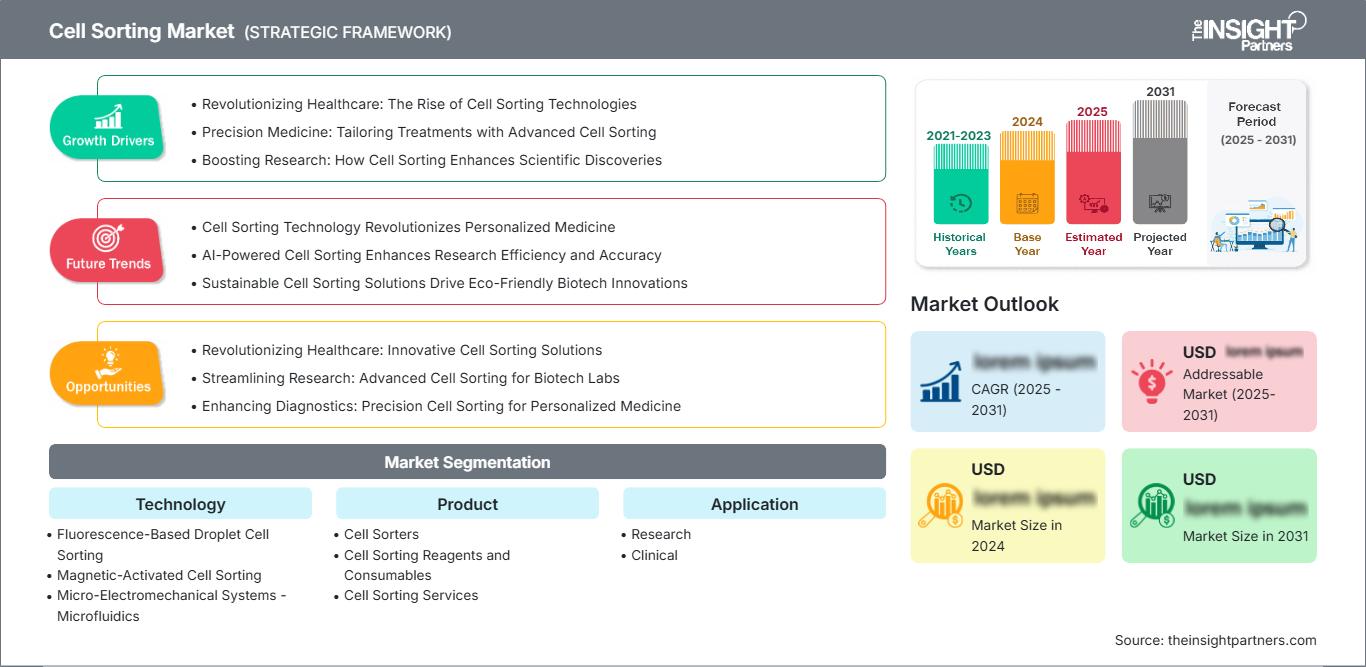
The Cell Sorting Market was valued at US$ 3.21 Billion in 2025 and is projected to reach US$ 7.51 Billion by 2034. The market is expected to register a CAGR of 9.90% during 2026–2034. Expansion reflects increasing use of high-parameter cell isolation in immunology, oncology, stem-cell research, drug discovery, and translational medicine, alongside broader adoption of automated and microfluidic sorting workflows.
Within North America, the Cell Sorting Market size is estimated to expand at a CAGR of 9.2–9.8% during 2026–2034. Growth is supported by concentrated biomedical research funding, established flow-cytometry core facilities, and expanding cell and gene therapy pipelines. Pharmaceutical companies are also investing in standardized cell-selection workflows that improve sample reproducibility, protect viability, and facilitate downstream genomic, proteomic, and functional analyses.
Cell Sorting Market Assessment and Insights
- North America: The region accounted for a 38–42% share in 2025 and is expected to record a CAGR between 9.2–9.8% during 2026–2034, supported by biomedical infrastructure, translational research, and advanced therapy development.
- US: The country represented 84–88% of North American revenue in 2025 and is projected to register a CAGR between 9.3–9.9% during 2026–2034.
- Europe: Europe held a 27–31% share in 2025 and is forecast to grow at a CAGR between 8.8–9.4% during 2026–2034, led by Germany, the UK, and France.
- Asia Pacific: Asia Pacific represented a 22–26% share in 2025 and is anticipated to expand at a CAGR between 10.8–11.6% during 2026–2034, led by China, Japan, India, and South Korea.
- Largest Segment: Fluorescence-Based Droplet Cell Sorting captured a 45–49% market share in 2025 and is projected to grow at a CAGR between 9.1–9.7% during 2026–2034.
- High Growth Segment: Micro-Electromechanical Systems - Microfluidics held a 19–23% market share in 2025 and is expected to register a CAGR between 11.8–12.6% during 2026–2034.
- Key companies analyzed in detail: Becton, Dickinson and Company, Bio-Rad Laboratories, Inc., Danaher Corporation, Merck KGaA, pluriSelect Life Science UG & Co. KG, STEMCELL Technologies Inc., Sysmex Partec GmbH, Terumo BCT, Inc., Thermo Fisher Scientific Inc., and Union Biometrica, Inc.
Source: The Insight Partners' analysis based on proprietary research, government publications, company annual reports, investor presentations, industry databases, and expert interviews.
The approach to cell isolation technology has shifted from laborious low-parameter techniques to automated and multi-parametric approaches involving spectral detection, imaging, microfluidics, and software-based gating. Device manufacturers are moving towards small footprint machines meant for individual laboratories, whereas core laboratories have an increasing need for multiparameter flexibility and throughput. Reagent manufacturers have expanded their offerings of fluorochromes, antibodies, beads, and buffers to facilitate complex panel-based analysis. The production strategy is now focusing more on device-reagent ecosystems, standardization, enclosed fluidics, and service arrangements to minimize variability between locations.
The investment trend will probably change direction from the already established US and European research centers towards biopharma research centers in China, India, South Korea, Singapore, and Gulf nations. Reproducibility, sample management, and control of cell isolation environment may be factors that push towards the adoption of closed and disposable systems in response to the regulatory authorities’ pressure. The number of units may further rise due to government initiatives on genomic studies, oncology consortiums, and biomanufacturing initiatives.
Cell Sorting Market Report Scope
| Report Attribute | Details |
|---|---|
| Market size in 2025 | US$ 3.21 Billion |
| Market Size by 2034 | US$ 7.51 Billion |
| Global CAGR (2026 - 2034) | 9.90% |
| Historical Data | 2021-2024 |
| Forecast period | 2026-2034 |
Cell Sorting Market Analysis
Growth of the Cell Sorting Market is driven by increased need for rare cell isolation, immunophenotyping, single-cell sequencing, and engineered cells. The samples pass through an environment consisting of sample acquisition, dissociation, labeling, sorting, quality control, and further molecular analysis. Reliability of equipment has a direct influence on recovery, purity, viability, and reproducibility, and application support and workflow validation are key purchase drivers.
The features of supply vary for each technology type. Droplet sorters are specific in their requirements for optics, lasers, fluidics, detectors, nozzles, and biohazard protection equipment. This increases the switching costs. The magnetic separation technologies require more consumable reagents such as beads, antibodies, columns, and buffers. The microfluidics sorting devices reduce infrastructure requirements but demand cartridge production and sample handling validation.
The Cell Sorting Market Report suggests that competitive advantage is moving from instruments capabilities to workflow capabilities. Becton, Dickinson and Company and Thermo Fisher Scientific Inc. compete through high parameter ecosystems, while Bio-Rad Laboratories, Inc. competes through bench-top workflow capabilities. Danaher Corporation provides a wide range of flow cytometry instruments as well as automation and software solutions through its business units.
Product positioning is also aligned with the needs of cell therapy production. STEMCELL Technologies Inc. is moving its product offering for cell isolation into closed microfluidic sorting systems, while Merck KGaA and Terumo BCT, Inc. provide offerings adjacent to this requirement. PluriSelect Life Science UG & Co. KG and Union Biometrica, Inc. position themselves through their specific application-based cell-separation products.
● REPORT CUSTOMIZATION
Tailor This Report To Align With Your Specific Business Requirements
This report can be customized to align precisely with your business objectives, scope, and target markets. Customization options include tailored segmentation, geography, competitive analysis, and strategic insights to support informed decision-making.
Customize This Report →WHAT YOU CAN ADJUST
- ● Segmentations
- ● Geography
- ● Competitive Analysis
- ● Language Preferences
Cell Sorting Market: Strategic Insights
Regional Insights
North America Cell Sorting Market
The North American Cell Sorting Market share was 38–42% in 2025 and is anticipated to grow at a CAGR of 9.2–9.8% over 2026–2034. The region is characterized by highly concentrated academic medical facilities, pharmaceutical research sites, genomics laboratories, and flow cytometry centers. Major end-user application areas include immuno-oncology, vaccine research, stem cell characterization, biomarker discovery, and quality control of advanced therapies.
Purchasers have begun to take into account overall cost, biosafety considerations, instrument reliability, compatibility of sorting panels, and operator training. Canadian contributions will come from research networks at universities and biotech clusters, whereas Mexico will offer a developing base for clinical laboratories and biomanufacturing. Suppliers in the region are countering by developing benchtop systems, automatic calibration, remote services, analysis software, and applications-specific reagents, allowing laboratories to perform selected sorting operations in decentralized research settings.
U.S. Cell Sorting Market
The United States was responsible for 84-88% of North America’s revenues in 2025 and is projected to have a CAGR of 9.3-9.9% for 2026-2034. The country leads due to an extensive federal biomedical research program, existing cancer centers, biotech clusters, and the use of cell-based therapies. Core laboratories have been heavy buyers of fast droplet sorters, while research groups favor compact and automated equipment.
Among the key players with commercial presence and/or application in the country are Becton, Dickinson and Company, Bio-Rad Laboratories, Inc., Danaher Corporation, Thermo Fisher Scientific Inc., and STEMCELL Technologies Inc. Applications in research make up most installations; however, applications in clinics and translational science become increasingly important. The top priority for laboratories is live recovery of rare populations, standardization of data processing, aerosol containment, and compatibility with sequencing. Outsourcing becomes another method of addressing sporadic needs, helping biotech companies avoid costs of buying equipment and maintenance during pilot projects.
Europe Cell Sorting Market
Europe represented a 27–31% market share in 2025 and will witness a CAGR of 8.8–9.4% up to 2034. Germany dominates the regional market owing to applications by biomedical research institutes, university hospitals, diagnostics companies, and biopharmaceuticals production facilities. Focus lies on high parameter reproducibility workflows, shared research facilities, and standardization of sample preparation. UK offers good opportunities because of strong demand by genomics projects, immunology facilities, biotech clusters, and contract research organizations.
France ensures adoption from cancer institutes and translational laboratories, whereas Italy and Spain add capabilities via university collaborations and research institutions tied to hospitals. Procurement trends in Europe give importance to energy usage, consistency of reagents, service reachability, and documentation of compliance. Germany is the leading country, whereas UK holds strong opportunities for microfluidic as well as service-oriented approaches. France, Italy, and Spain hold opportunities for small-footprint platforms which reduce need for training and facilities without affecting viability, purity, and compatibility of cells.
APAC Cell Sorting Market
The Asia Pacific region accounted for 22–26% in 2025 and is expected to demonstrate a CAGR of 10.8–11.6% in 2026–2034. China excels owing to biopharmaceutical R&D, hospital labs, and local cell therapy activities. Japan drives demand with the help of advanced instrumentation, while South Korea focuses on biotechnology and regenerative medicine.
In India, facilities are being developed for genomics, contract research, and biomanufacturing, whereas Australia is noted for its research and clinical expertise. Financial support for research, production, training, and distribution helps the process. Small-sized sorters and outsourced services are critical in situations where there are budget and staffing constraints.
Middle East & Africa Cell Sorting Market
The Middle East and Africa region is expected to grow at a CAGR of 7.8–8.6% during 2026–2034. Saudi Arabia leads investment through hospital modernization, biotechnology programs, genomic medicine, and research infrastructure. The UAE is developing precision-medicine and laboratory capabilities, supported by specialized healthcare clusters and international partnerships.
South Africa continues to be the leading sub-Saharan hub of research in infectious diseases and immunology. Spread in the rest of the region faces limitations in terms of capital costs, maintenance, and delivery of reagents. Laboratory services, shared facilities, and benchtop systems form realistic ways forward.
Segmentation Analysis
Technology
Technology is projected to register a CAGR of 9.4–10.2% during 2026–2034. The Cell Sorting Market scope spans high-throughput droplet instruments, accessible magnetic separation, and emerging chip-based platforms. Selection depends on desired purity, throughput, viability, sterility, parameters, operator skill, and downstream use. Droplet sorting remains central to multiparameter research, while magnetic and microfluidic systems gain relevance in routine enrichment and closed cell-processing environments.
- Fluorescence-Based Droplet Cell Sorting: This technology leads complex immunophenotyping and rare-population isolation because it supports multiparameter discrimination, high throughput, and flexible collection, making it strategically important to core laboratories and advanced discovery programs.
- Magnetic-Activated Cell Sorting: Magnetic separation serves routine enrichment and depletion workflows through relatively simple operation, scalable sample handling, and broad cell-type coverage, supporting research laboratories and cell-processing workflows requiring reproducible population selection.
- Micro-Electromechanical Systems - Microfluidics: Microfluidic sorting is gaining attention for disposable cartridges, reduced sample volumes, gentler handling, compact footprints, and closed operation, positioning the technology for decentralized research and advanced therapy manufacturing.
Product
The product segment is expected to expand at a CAGR of 9.3–10.1% during 2026–2034. Instrument sales establish installed capacity, whereas reagents and consumables generate recurring workflow expenditure. Services address laboratories with episodic workloads or limited specialist expertise. Vendors increasingly combine equipment, preventive maintenance, software, training, assay support, and consumable supply to improve retention and reduce workflow fragmentation.
- Cell Sorters: Systems account for substantial capital expenditure and remain essential for laboratories requiring workflow control, rapid access, or specialized configurations, with purchasing increasingly influenced by automation, biosafety, footprint, and software usability.
- Cell Sorting Reagents and Consumables: Antibodies, magnetic beads, buffers, calibration materials, cartridges, nozzles, and collection products benefit from recurring use, protocol standardization, and expanding experimental complexity across installed instrument platforms.
- Cell Sorting Services: Service providers support organizations lacking equipment or trained operators, offering access to specialized configurations, validated protocols, flexible capacity, and expert handling of rare or technically demanding samples.
Application
Application revenue is projected to grow at a CAGR of 9.5–10.3% during 2026–2034. Research remains the principal use case because sorting supports cell biology, immunology, oncology, microbiology, and genomic studies. Clinical adoption advances more selectively due to validation and regulatory requirements. Translation from discovery to therapeutic development increases demand for reproducible methods, traceable materials, controlled software, and viable cell recovery.
- Research: Academic, government, and commercial laboratories use sorting to investigate cellular heterogeneity, isolate rare populations, prepare sequencing inputs, validate biomarkers, and study functional responses across disease and developmental models.
- Clinical: Clinical applications focus on hematology, immune monitoring, transplant research, diagnostics support, and advanced therapy workflows, creating demand for standardized protocols, documented quality controls, closed processing, and reproducible performance.
End User
End users are forecast to register a CAGR of 9.6–10.4% during 2026–2034. Adoption differs by funding cycle, sample volume, technical complexity, and regulatory exposure. Research institutes prioritize flexibility, pharmaceutical companies seek scalability and standardization, medical schools integrate education with translational programs, and hospital laboratories emphasize reliability, traceability, biosafety, and service responsiveness.
- Research Institutes: Institutes represent a major installed base because shared core facilities aggregate multidisciplinary demand, justify advanced configurations, and provide trained operators for complex sorting, panel design, and downstream sample preparation.
- Pharmaceutical and Biotechnology Companies: These companies require high-throughput, reproducible isolation for target discovery, screening, biomarker development, and cell-therapy pipelines, making workflow automation and reliable transfer between development sites strategically important.
- Medical Schools: Medical schools combine basic research, clinical collaboration, and workforce training, supporting demand for adaptable systems that accommodate diverse samples, user experience levels, and translational study requirements.
- Hospitals and Clinical Testing Laboratories: Hospital-linked laboratories use sorting selectively in immune characterization, hematology, research diagnostics, and clinical studies, placing greater emphasis on validated procedures, contamination control, traceable documentation, and service continuity.
Opportunity Snapshot
| End User | Revenue Contribution (High/Medium/Low) | Trend Tag | Adoption Stage (Emerging/Scaling/Mature) |
| Research Institutes | High | Core Automation | Mature |
| Pharmaceutical and Biotechnology Companies | High | Therapy Scaleup | Scaling |
| Medical Schools | Medium | Translational Labs | Scaling |
| Hospitals and Clinical Testing Laboratories | Medium | Clinical Validation | Emerging |
Cell Sorting Market Growth Drivers and Impact Analysis
Expansion of Single-Cell and Multiomics Research
Single-cell sequencing and multiomics applications necessitate viable and correctly sorted cell populations for molecular profiling. Cell sorting helps in reducing biological variability, enriches rare cell types, and allows scientists to link phenotype and genomics/proteomics profiling. Therefore, growing immunology, oncology, neuroscience, developmental biology, and infection biology studies will drive the use of equipment and reagents. High-parameter fluorescent panels are increasing in importance because labs want to isolate smaller cell sub-populations from complex tissues. The driver impacts the entire value chain from dissociation media, antibodies, calibration products, software, instrumentation, and sequencing preparation. Vendors that show consistent cell recovery rates, minimal carryover, and flexibility in moving panels can ensure recurrent business from core labs and biotech labs.
Scaling Cell and Gene Therapy Development
Enrichment, depletion, characterization, and selection of desired cell or gene therapies depend upon well-controlled enrichment and depletion of desired therapeutic or supportive cell populations. With advances in the pipeline towards large-scale studies, the demand for processes ensuring viability and avoiding contamination is increasing, along with decreasing operator variability. Closed magnetic and microfluidic approaches have particular importance, as disposability will ease changeovers and create a controlled environment for the manufacturing process. Droplet sorters for research purposes are highly useful for target discovery and process development stages, when flexible phenotyping is needed. Impact in commercial terms goes far beyond the purchase of instruments, involving reagents, cartridges, maintenance services, and applications. Vendor approaches aligned with equipment documentation, software control, material traceability, and scaling are highly important for developing a long-term relationship in the process of development of therapy.
Decentralization Through Automated Benchtop Systems
Traditional high-speed sorters often require dedicated rooms, trained operators, fluidics expertise, and substantial maintenance. Automated benchtop platforms lower these barriers through guided setup, calibration routines, enclosed fluid paths, simplified cleaning, and compact footprints. Individual laboratories can conduct time-sensitive experiments without transporting fragile samples or waiting for shared-facility access. Decentralization expands the addressable customer base among smaller biotechnology companies, medical schools, hospital research units, and regional institutes. It also changes purchasing criteria from maximum parameter count toward ease of use, uptime, biosafety, and predictable operating cost. Suppliers can capture this demand through modular configurations, leasing, reagent bundles, remote diagnostics, and structured training, while service providers remain relevant for experiments requiring advanced configurations or infrequent specialist support.
Cell Sorting Market Future Trends
Convergence of Spectral Detection and Real-Time Imaging
Cell Sorting Market trends increasingly point toward instruments that combine full-spectrum fluorescence information with morphological imaging during acquisition. This convergence allows researchers to distinguish populations that share conventional surface markers but differ in shape, localization, interaction, or intracellular distribution. Future platforms are likely to integrate machine-learning classification with real-time sort decisions, reducing dependence on manually constructed gates. Adoption will initially concentrate in advanced core facilities and biopharmaceutical research, where complex datasets justify premium systems. Over time, standardized algorithms, improved computing capacity, and validated analysis templates should extend image-enabled sorting to functional screening, rare-cell discovery, extracellular vesicle studies, and quality assessment of engineered cellular products.
Closed Cartridge-Based Sorting for Manufacturing
Disposable microfluidic cartridges are expected to reshape workflows requiring sterility, gentle handling, and rapid changeover. Closed designs can reduce aerosol generation, cleaning requirements, cross-sample exposure, and infrastructure dependence, creating practical advantages for distributed cell-processing facilities. Future product development will focus on higher throughput, broader cell-size compatibility, multiparameter detection, automated clog management, and electronic batch records. Suppliers must also improve cartridge manufacturing yields and control per-run cost to compete with established magnetic and droplet methods. Strategic value will be highest where cell health and contamination control outweigh maximum sorting speed, including autologous therapy development, stem-cell processing, organoid research, and sensitive primary-cell applications.
Cell Sorting Market Opportunities
Localized Service Networks in Emerging Biomedical Clusters
Instrument manufacturers and specialist laboratories in the Cell Sorting Market Forecast can invest in regional sorting centers across China, India, Southeast Asia, the Middle East, and selected African research hubs. Shared facilities reduce customers’ capital burden while creating demand for reagents, training, maintenance, and application development. Operators should locate capacity near biotechnology parks, university hospitals, genomics centers, and contract research clusters, where multiple users can sustain utilization. Commercial models may combine per-sample fees, reserved capacity, panel-development services, and downstream sequencing preparation. Partnerships with universities and distributors can strengthen workforce development and logistical coverage. Successful providers will differentiate through sample traceability, turnaround time, biosafety, validated handling procedures, and access to multiple sorting technologies.
Integrated Solutions for Advanced Therapy Workflows
Manufacturers can capture higher lifetime value by connecting cell isolation with activation, expansion, washing, quality control, and data management. Rather than offering standalone instruments, suppliers can develop interoperable equipment, qualified consumables, and software that record materials, process parameters, deviations, and outcomes. Partnerships with therapy developers, contract manufacturers, and hospital production centers provide routes for workflow validation and reference-site creation. Investment should prioritize closed-system compatibility, scalable throughput, gentle processing, and change control for critical components. Companies that establish credible research-to-manufacturing transfer pathways can reduce customers’ redevelopment burden and secure recurring consumable revenue, technical-service contracts, and collaborative opportunities within emerging personalized medicine production networks.
Recent Developments
- May 2026: STEMCELL Technologies Inc. introduced the Highway1 Cell Sorter to a broader audience as a next-generation benchtop system using microchip-based Vortex-Actuated Cell Sorting technology. The platform employs single-use microfluidic cartridges and machine-vision monitoring to support gentle, sterile cell handling, with applications spanning basic research, translational studies, and cell therapy development.
- December 2025: Becton, Dickinson and Company commercially released additional three-laser and four-laser configurations of the BD FACSDiscover A8 Cell Analyzer. Although primarily an analytical platform, the systems integrate spectral and real-time imaging capabilities and pair with the company’s FACSDiscover cell sorters and reagents, supporting panel transfer and broader access to high-dimensional cell workflows.
- March 2025: Danaher Corporation’s Beckman Coulter Life Sciences launched the CytoFLEX mosaic Spectral Detection Module, a modular solution compatible with selected CytoFLEX instruments. The product offers as many as 88 detection channels and provides laboratories with an upgrade path into spectral analysis, supporting more complex panel development and subsequent transfer into sorting workflows.
Frequently Asked Questions

- Comprehensive Market Sizing and Forecast Analysis
- Detailed Segmentation Analysis
- In-Depth Market Dynamics Assessment
- Regional and Country-Level Insights
- Competitive Landscape and Company Benchmarking
- Strategic Business Intelligence
Recent Reports
Testimonials

The Insight Partners' SCADA System Market report is comprehensive, with valuable insights on current trends and future forecasts. The team was highly professional, responsive, and supportive throughout. We are very satisfied and highly recommend their services.
RAN KEDEM Partner, Reali Technologies LTDs
I requested a report on a very specific software market and the team produced the report in a few days. The information was very relevant and well presented. I then requested some changes and additions to the report. The team was again very responsive and I got the final report in less than a week.
JEAN-HERVE JENN Chairman, Future Analytica
We worked with The Insight Partners for an important market study and forecast. They gave us clear insights into opportunities and risks, which helped shape our plans. Their research was easy to use and based on solid data. It helped us make smart, confident decisions. We highly recommend them.
PIYUSH NAGPAL Sr. Vice President, High Beam Global
The Insight Partners delivered insightful, well-structured market research with strong domain expertise. Their team was professional and responsive throughout. The user-friendly website made accessing industry reports seamless. We highly recommend them for reliable, high-quality research services
YUKIHIKO ADACHI CEO, Deep Blue, LLC.
This is the first time I have purchased a market report from The Insight Partners.While I was unsure at first, I visited their web site and felt more comfortable to take the risk and purchase a market report.I am completely satisfied with the quality of the report and customer service. I had several questions and comments with the initial report, but after a couple of dialogs over email with their analyst I believe I have a report that I can use as input to our strategic planning process.Thank you so much for taking the extra time and making this a positive experience.I will definitely recommend your service to others and you will be my first call when we need further market data.
JOHN SUZUKI President and Chief Executive Officer, Board Director, BK Technologies
I wish to appreciate your support and the professionalism you displayed in the course of attending to my request for information regarding to infectious disease IVD market in Nigeria. I appreciate your patience, your guidance, and the fact that you were willing to offer a discount, which eventually made it possible for us to close a deal. I look forward to engaging The Insight Partners in the future, all thanks to the impression you have created in me as a result of this first encounter.
DR CHIJIOKE ONYIA MANAGING DIRECTOR, PineCrest Healthcare Ltd.Reason to Buy
- Informed Decision-Making
- Understanding Market Dynamics
- Competitive Analysis
- Identifying Emerging Markets
- Customer Insights
- Market Forecasts
- Risk Mitigation
- Boosting Operational Efficiency
- Strategic Planning
- Investment Justification
- Tracking Industry Innovations
- Aligning with Regulatory Trends





 Get Free Sample for