
Cell Surface Markers Market Trends, Demand & Growth by 2034
Coverage: By Product (Antibodies and PCR Arrays); Cell Type (T Cell Surface Markers, B Cell Surface Markers, NK Cell Surface Markers, Monocyte Cell Surface Markers, and Other Cell Types); Application (Research Applications and Clinical Applications); End User (Academic and Research Institutes, Hospitals and Clinical Testing Laboratories, and Pharmaceutical and Biotechnology Companies), and Geography (North America, Europe, Asia Pacific, and South and Central America)
- Status : Data Released
- Report Code : TIPRE00003473
- Category : Life Sciences
- No. of Pages : 150
- Available Report Formats :


- Last update date : September 07, 2026


2025 Market Size
US$ 3.48 Bn
Base year value
2034 Forecast
US$ 5.54 Bn
Projected by 2034
CAGR 2026-2034
5.99 %
Growth rate
Addressable Market
US$ 42.37 Bn
(2026-2034)
The Cell Surface Markers Market was valued at US$ 3.48 Billion in 2025 and is projected to reach US$ 5.54 Billion by 2034, registering a CAGR of 5.99% during 2026–2034. Expansion results from continuous demand for antibodies and PCR arrays that help in identifying immune cell phenotypes, understanding disease pathways, developing drugs, and enhancing testing processes at research institutions, hospitals, diagnostic laboratories, and biopharmaceutical companies.
In North America, the Cell Surface Markers Market size for Cell Surface Markers will increase at a rate of 5.6–6.2% CAGR between 2026 and 2034. Factors contributing to growth include existing flow cytometry platforms, translational immunology programs, and continuing investment in biomedical research. The US continues to be significant in terms of demand since there has been an increasing incorporation of immune profiling in cancer drug trials in the region, and hospital laboratories have also begun adopting antibody panels for evaluating hematological cancers.
Cell Surface Markers Market Assessment and Insights
- North America: Representing a 36–39% share in 2025, North America is projected to record a CAGR of 5.6–6.2% during 2026–2034, supported by advanced cytometry laboratories, clinical research networks, and immunotherapy development.
- US: Accounting for 83–86% of North American revenue in 2025, the US is expected to expand at a CAGR of 5.7–6.3% during 2026–2034.
- Europe: Holding a 27–30% share in 2025, Europe is forecast to register a CAGR of 5.2–5.8% during 2026–2034, led by Germany, the UK, and France.
- Asia Pacific: Capturing a 23–26% share in 2025, Asia Pacific is projected to grow at a CAGR of 6.7–7.3% during 2026–2034, with China, Japan, and India driving laboratory expansion.
- Largest Segment: Antibodies held a 78–82% market share in 2025 and are expected to register a CAGR of 5.7–6.3% during 2026–2034, reflecting their central role in immunophenotyping.
- High Growth Segment: Clinical Applications represented a 40–44% market share in 2025 and are forecast to expand at a CAGR of 6.4–7.0% during 2026–2034 as standardized diagnostic panels gain adoption.
- Key companies analyzed in detail: Thermo Fisher Scientific Inc., Becton, Dickinson and Company, Abcam plc, QIAGEN N.V., F. Hoffmann-La Roche Ltd, Bio-Rad Laboratories, Inc., Danaher Corporation, GenScript Biotech Corporation, BioLegend, Inc., and Merck KGaA.
Source: The Insight Partners' analysis based on proprietary research, government publications, company annual reports, investor presentations, industry databases, and expert interviews.
The technological advances have transitioned the Cell Surface Markers Market from low-throughput mono-color antibody stains to the adoption of spectral cytometry, recombinant antibodies, imaging and combined protein-RNA workflows. The manufacturers are producing high-conjugated antibodies with narrow emission spectrum, leading to enhanced identification of rare and weakly expressed populations. In addition, the use of recombinant technology is decreasing variability and dependency on animal-based production. On a laboratory level, the increased automation of sample preparation, design software, and standardized controls are enhancing reproducibility while enabling laboratories to perform more advanced immune monitoring without proportionally increasing the number of specialists.
In the forecast period, clinically relevant geographical distribution and developing biomedical centers will drive the demand for products and services. The APAC governments are increasing investments into genomics medicine, oncology and hospital laboratories. The EU focus on reproducibility of diagnostic procedures favors validation of reagents and workflow documentation. However, suppliers should account for fluorophore licensing, cold chain logistics, validation expenses of the antibodies, and different research use only and in vitro diagnostic requirements.
Cell Surface Markers Market Report Scope
| Report Attribute | Details |
|---|---|
| Market size in 2025 | US$ 3.48 Billion |
| Market Size by 2034 | US$ 5.54 Billion |
| Global CAGR (2026 - 2034) | 5.99% |
| Historical Data | 2021-2024 |
| Forecast period | 2026-2034 |
Cell Surface Markers Market Analysis
Research into biopharmaceuticals is a major driver behind growth in the Cell Surface Markers Market, as immune profiling is essential for cell therapies, monoclonal antibodies, vaccines, and immunotherapy. The demand chain extends from antibody discovery to clone validation, conjugation, manufacturing, distribution, instrument compatibility, and analysis. Antibodies continue to be the primary consumables due to the high frequency of use in recurring panels compared to the capital instruments.
The supply chain is becoming more specialized with the need for bright fluorochromes, low spillover fluorochrome combinations, and validated clones for rare antigens with high-parameter experiments. Suppliers with antibodies, instrument, software, and technical expertise can decrease the risk in the workflow. Small specialists still have a role with novel clones and conjugations but at the cost of higher quality control expenses and distribution channels into clinical laboratories.
Competitive Position Analysis of the Cell Surface Markers Market Report includes portfolio, reagents, instrument base, and applications. Thermo Fisher Scientific Inc. and Becton, Dickinson and Company offer broad antibody portfolios with cell analysis systems. Danaher Corporation offers competition through its instrument and life science segments; while BioLegend, Inc., Abcam plc, Merck KGaA, and Bio-Rad Laboratories, Inc. offer competition through their antibodies, fluorophores, and reagents. QIAGEN N.V. and F. Hoffmann-La Roche Ltd offer molecular and clinical workflow services; while GenScript Biotech Corporation offers improved custom antibody and recombinant technologies.
The trend of investment in the market is towards multiplexing, recombinant technology, automation, and quality assurance with software. There is potential in being a premium player with cross-lot consistency and compatibility on different instruments in longitudinal clinical trials where changes in the protocols affect the comparison.
● REPORT CUSTOMIZATION
Tailor This Report To Align With Your Specific Business Requirements
This report can be customized to align precisely with your business objectives, scope, and target markets. Customization options include tailored segmentation, geography, competitive analysis, and strategic insights to support informed decision-making.
Customize This Report →WHAT YOU CAN ADJUST
- ● Segmentations
- ● Geography
- ● Competitive Analysis
- ● Language Preferences
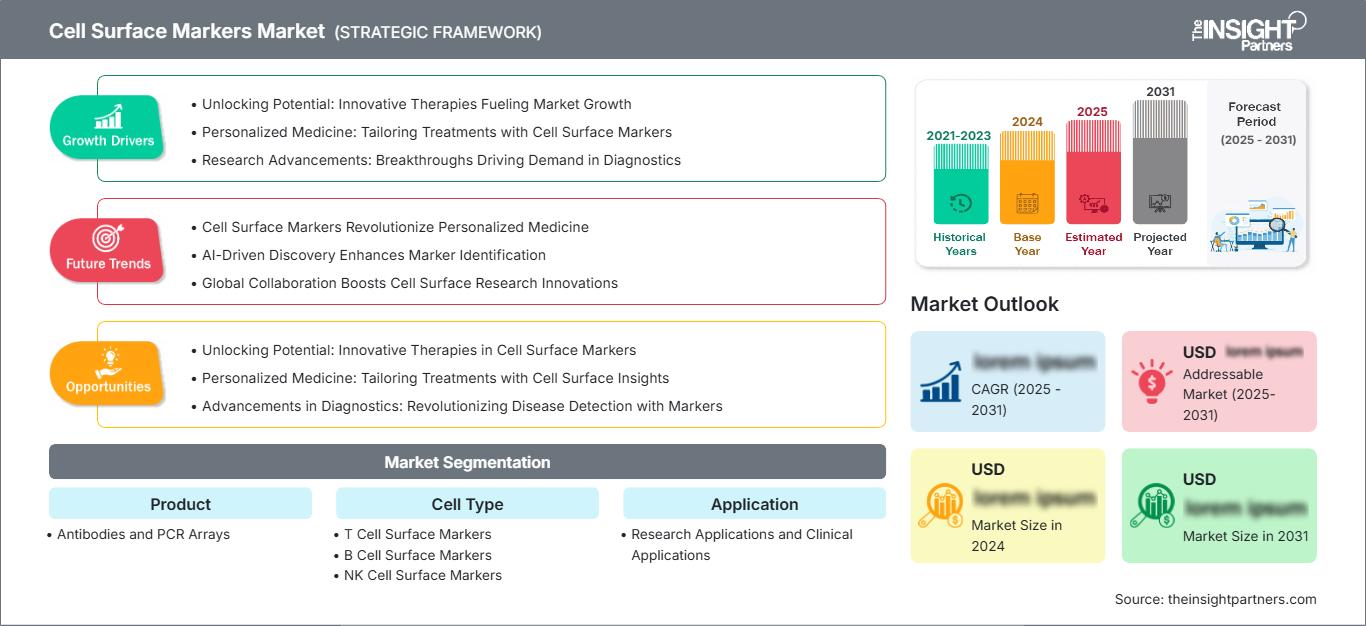
Cell Surface Markers Market: Strategic Insights
Regional Insights
North America Cell Surface Markers Market
North America accounted for around 36–39% Cell Surface Markers Market share in 2025 and is forecasted to grow at a CAGR of 5.6–6.2% from 2026 to 2034. Leadership among regions is due to the prevalence of flow cytometry systems, focused drug discovery, and increasing demand for immune-monitoring validated reagents. NIH awarded US$ 35.3 billion in competing and non-competing extramural grants in fiscal year 2025, highlighting a greater biomedical network that supports cell characterization and translational medicine efforts.
Clinical applications of markers are based on multiparameteric immunophenotyping carried out in the oncological departments to analyze the patient's leukemia, lymphoma, transplantation, and treatment response. The contribution of Canada will be provided by universities and precision health programs, whereas Mexico provides expanding possibilities for contract research and diagnostics. The demand for panels, recombinant antibodies, spectroscopically-compatible fluorochromes, and automation will keep growing. The purchase decision will depend on laboratory budget, reimbursement policy, and availability of cytometrists.
U.S. Cell Surface Markers Market
US held a market share of around 83-86% of North America in 2025 and is expected to witness a CAGR of 5.7-6.3% in 2026-2034. This is attributed to major academic medical centers, biopharma clusters, contract research organizations, and reference labs. Clinical demand is growing as well as that from research due to the use of reproducible antibodies in hematology laboratories for the detection of lineages, minimal residual disease, and monitoring the status of the immune system.
Thermo Fisher Scientific Inc., Becton, Dickinson and Company, Bio-Rad Laboratories, Inc., Danaher Corporation, and BioLegend, Inc. have major business activities in the United States such as manufacturing, distribution, commercial or technical support of their products. There is a shift in demand towards high dimensional immunophenotyping, CAR-T characterization, tumor microenvironment and single cell multiomics. The fiscal year 2025 appropriations by NIH of US$ 48.5 billion including programs and ARPA-H are crucial for funding but still success rates in grants and purchasing cycles impact the reagent usage.
Europe Cell Surface Markers Market
In 2025, Europe accounted for 27-30%, and was anticipated to observe a CAGR of 5.2-5.8% from 2026-2034. Germany is led by pharmaceutical manufacturing, university hospitals, and immunology research. The labs appreciate antibodies' validation, process documentation, and compatibility with cytometry automation, which results in repeat purchases for well-known and niche reagents providers.
The UK features genomics centers, academia, and biotech companies in its early stages. Research in translational oncology and immune-mediated diseases are drivers, but evidence of reproducibility and commercial viability is necessary for government procurement. France provides through cancer research institutes and hospital networks, as well as the growing interest in standardized immune monitoring.
Italy and Spain are key players in developing oncology and transplantation assays, while Nordic and Benelux organizations provide innovative single-cell research. The regulatory transition to European in vitro diagnostics requirements increases the burden of evidence and quality systems requirements. This makes suppliers with capabilities for clinical validation, documentation, and regional supply with reliable delivery advantageous.
APAC Cell Surface Markers Market
The Asia Pacific accounted for a 23–26% market share in 2025 and is expected to witness a CAGR of 6.7–7.3% over 2026–2034. The China region earns the largest revenue from hospital growth, native biopharmaceutical innovation, and funding in research. Japan has well-established clinical labs, while South Korea focuses on biotechnology and cell therapy.
India invests in diagnosis chains, research institutions, and biosimilar research, while Australia emphasizes high-end immuno-oncology research. Policies supporting personalized medicine, reagent production, and clinical trial facilities widen the application base. However, price considerations and variations in specialist accessibility make small panel tests, distributor training, and technology agnostic reagents more common.
Middle East & Africa Cell Surface Markers Market
The market is forecast to grow with a CAGR of 4.7-5.3% between 2026 and 2034. Leading players include Saudi Arabia, driven by modernization of healthcare systems, research universities and oncology setup, and the UAE, driven by investments in precision medicine and high-end laboratories. South Africa continues to be a hub for research related to infectious diseases, pathology, and academic immunology.
In terms of adoption across the rest of MEA, reliance on imported reagents, cold chain management, laboratory accreditation, and maintenance of instruments will be required. Public investment based on energy resources will support research centers in Gulf nations, but lack of infrastructure will prevent adoption in other regions.
Segmentation Analysis
Product
Product demand is projected to grow at a CAGR of 5.6–6.2% during 2026–2034. The Cell Surface Markers Market scope encompasses antibody-based protein detection and PCR arrays used to examine expression patterns. Antibodies dominate routine immunophenotyping because they directly identify extracellular epitopes, while PCR arrays provide complementary transcriptional context. Purchasing decisions reflect specificity, clone validation, conjugate brightness, multiplex compatibility, sample type, and reproducibility.
- Antibodies: Antibodies occupy the leading position because flow cytometry, immunohistochemistry, cell sorting, and imaging depend on target-specific binding. Recombinant production, broader conjugate menus, and application-validated clones strengthen their strategic importance.
- PCR Arrays: PCR arrays support focused gene-expression assessment where researchers need pathway-level information alongside protein phenotyping. Their standardized content, accessible analysis, and suitability for medium-throughput studies sustain demand across translational laboratories.
Cell Type
The cell type segment is expected to record a CAGR of 5.8–6.4% during 2026–2034. Demand varies according to disease area, therapeutic mechanism, and immune-monitoring protocol. T-cell and B-cell panels remain foundational, while NK-cell and monocyte markers gain relevance in innate immunity, cell therapy, inflammation, and tumor microenvironment research. Multiparameter studies increasingly combine lineage, activation, exhaustion, trafficking, and maturation markers.
- T Cell Surface Markers: T-cell markers hold a central position in immuno-oncology, infectious-disease research, transplantation, and cellular therapy. Demand centers on identifying helper, cytotoxic, regulatory, memory, activated, and exhausted T-cell populations.
- B Cell Surface Markers: B-cell markers support leukemia and lymphoma classification, immune-development studies, vaccine-response assessment, and antibody-mediated disease research. Their strategic importance increases as developers investigate B-cell depletion and immune-modulating therapies.
- NK Cell Surface Markers: NK-cell markers are gaining visibility in innate immune profiling and engineered cell-therapy research. Panels must distinguish activation, inhibition, maturation, and cytotoxic function while resolving phenotypically diverse NK-cell subsets.
- Monocyte Cell Surface Markers: Monocyte markers support inflammation, infection, cardiovascular research, and tumor microenvironment characterization. Demand emphasizes separating classical, intermediate, and nonclassical populations and evaluating differentiation into macrophage or dendritic-cell states.
Application
Applications are forecast to expand at a CAGR of 6.0–6.6% during 2026–2034. Research remains the broader usage base, while clinical applications represent the high-growth segment as laboratories adopt standardized immunophenotyping. Translation from exploratory panels to validated assays creates opportunities for suppliers offering documentation, controls, and stable manufacturing. The distinction between research-use-only and diagnostic products remains critical for commercialization and laboratory compliance.
- Research Applications: Research applications maintain broad demand across immunology, oncology, infectious disease, neuroscience, and drug discovery. Flexible panel design, custom conjugation, and access to emerging targets make product breadth strategically valuable.
- Clinical Applications: Clinical applications are becoming more influential in hematological malignancy classification, immune deficiency evaluation, transplantation, and treatment monitoring. Adoption favors standardized cocktails, quality controls, automation compatibility, and demonstrable interlaboratory reproducibility.
End User
End-user demand is projected to register a CAGR of 5.9–6.5% during 2026–2034. Academic institutes generate diverse target requirements, hospitals prioritize validated workflows, and biopharmaceutical companies seek scalable panels suitable for multicenter studies. Suppliers must therefore balance catalog breadth with documentation, lot reservation, custom development, and global logistics. Adoption also depends on instrument access, trained personnel, testing throughput, and research funding.
- Academic and Research Institutes: Academic laboratories represent a diverse customer base, purchasing markers for discovery-led studies and core facilities. Grant timing shapes orders, while shared instrumentation encourages broad, platform-compatible reagent portfolios.
- Hospitals and Clinical Testing Laboratories: Hospitals and testing laboratories prioritize consistency, turnaround time, accreditation support, and diagnostic relevance. Recurring testing creates dependable consumption, but adoption requires validated procedures, controls, and trained interpretation.
- Pharmaceutical and Biotechnology Companies: Pharmaceutical and biotechnology companies use marker panels for target validation, biomarker development, pharmacodynamic assessment, and clinical trials. Multisite reproducibility, lot continuity, custom panels, and regulatory documentation influence supplier selection.
Opportunity Snapshot
Cellular immunophenotyping offers the strongest strategic opportunity by end user. Cell Surface Markers Market Forecasts indicate that biopharmaceutical demand will increasingly favor customized, trial-ready panels, while clinical laboratories provide durable recurring consumption through standardized testing.
| End User | Revenue Contribution (High/Medium/Low) | Trend Tag | Adoption Stage (Emerging/Scaling/Mature) |
| Academic and Research Institutes | High | Shared Cytometry | Mature |
| Hospitals and Clinical Testing Laboratories | High | Panel Standardization | Scaling |
| Pharmaceutical and Biotechnology Companies | High | Trial Biomarkers | Scaling |
Cell Surface Markers Market Growth Drivers and Impact Analysis
Expansion of Immuno-Oncology and Cell Therapy Pipelines
Immuno-oncology and cell therapy pipelines need repeated immune phenotype characterization from discovery through manufacturing and clinical trials and follow-up with patients. Surface markers reveal lineage, activation, exhaustion, memory, and migration statuses, thus requiring antibody panels for understanding the mode of action of the therapy. In WHO’s 2026 Global Assessment, there have been 20.6 million newly diagnosed cases of cancer yearly, which is estimated to rise up to 35 million cases by 2050. These numbers warrant the commitment to continue the work in cancer research and diagnosis. The commercial impact is not just in increased volumes of antibodies since complicated pipelines will need custom conjugations and validated panels with reference standards.
Transition Toward High-Parameter Cellular Analysis
Spectral cytometry, imaging-enabled instruments, and single-cell multiomics allow laboratories to examine more markers from limited biological material. Higher dimensionality increases demand for bright fluorophores, low-spillover dyes, validated antibody combinations, and software-supported panel design. The practical impact is a shift from individual reagent purchasing toward coordinated panels, controls, compensation products, and workflow services. Laboratories can detect rare populations and resolve subtle functional states, but experimental complexity raises the costs of failed runs and inconsistent reagents. Consequently, buyers place greater value on application validation and technical support. Manufacturers with coordinated instrument and reagent portfolios benefit, while independent suppliers can compete through novel clones, custom formats, and cross-platform compatibility.
Broader Clinical Use of Standardized Immunophenotyping
Clinical laboratories employ surface-marker panels to classify hematological malignancies, evaluate immune deficiencies, monitor transplantation, and assess treatment response. Adoption is expanding as automated sample preparation and predefined antibody cocktails reduce operator-dependent variability. Clinical demand has a durable commercial profile because routine testing produces recurring reagent use and requires consistent controls. However, transition from research to clinical implementation involves analytical validation, quality-management documentation, stability evidence, and jurisdiction-specific regulatory compliance. Suppliers capable of maintaining lot continuity and supporting laboratory verification are positioned to secure longer purchasing cycles. The impact is particularly meaningful in expanding hospital networks where centralized protocols can create standardized demand across several sites and strengthen supplier relationships.
Cell Surface Markers Market Future Trends
Integration of Protein Phenotyping with Single-Cell Molecular Data
Cell Surface Markers Market trends increasingly point toward combined measurement of surface proteins, transcripts, morphology, and functional responses from the same specimen. Integrated datasets can distinguish cells that appear similar under conventional lineage gating but differ in activation or therapeutic relevance. During 2026–2034, suppliers are expected to develop barcoded antibodies, analysis-ready panels, and software connections that simplify multimodal interpretation. Adoption will initially concentrate in translational research and biopharmaceutical development before moving into selected clinical workflows. Competitive advantage will depend on validated marker combinations, interoperable data formats, and bioinformatics support rather than antibody availability alone, encouraging partnerships between reagent, instrument, and analytics providers.
Growth of Recombinant and Application-Specific Antibody Portfolios
Recombinant production is expected to replace a growing proportion of conventionally produced antibodies because sequence-defined reagents provide stronger lot reproducibility, scalable manufacturing, and easier format conversion. Suppliers will increasingly offer the same clone across multiple fluorophores, purified formats, and barcoded configurations. Application-specific validation will become equally influential as laboratories seek evidence for sample type, fixation method, instrument configuration, and multiplex compatibility. This transition can reduce revalidation burdens in longitudinal studies and clinical development. It also changes portfolio economics by increasing upfront development expenditure while supporting longer product lifecycles, controlled intellectual property, and more consistent global supply across research and regulated applications.
Cell Surface Markers Market Opportunities
Localized Panel Development for Asia Pacific Laboratories
Expanding biotechnology clusters and hospital systems across China, India, South Korea, and Southeast Asia create investment opportunities for regionally configured panels, local conjugation, quality-control facilities, and technical training. Many laboratories require cost-efficient products that remain compatible with established flow cytometers and locally prevalent testing protocols. Manufacturers can improve penetration by combining international clone standards with regional manufacturing or packaging, reducing lead times and cold-chain exposure. Partnerships with distributors, academic core facilities, and clinical reference laboratories can support validation and user education. Successful investment should prioritize dependable supply, smaller pack sizes, multilingual documentation, and panels adapted to oncology, infectious disease, and immune-monitoring requirements.
Trial-Ready Biomarker Panels for Biopharmaceutical Sponsors
Biopharmaceutical companies need standardized immune-monitoring panels that can transfer from exploratory studies into multicenter clinical trials. This creates an opportunity for suppliers to deliver validated antibody combinations, controls, protocol documentation, lot reservation, and centralized data-quality services. The commercial model in the Cell Surface Markers Market Forecast can extend beyond reagent sales through custom development, assay transfer, training, and postanalytical support. Investment should focus on therapeutic areas where circulating immune markers provide pharmacodynamic or patient-stratification information, including cellular therapy, immune-oncology, autoimmune disease, and vaccines. Providers able to coordinate manufacturing and global distribution can reduce sponsor risk, shorten assay deployment timelines, and establish recurring relationships throughout clinical development.
Recent Developments
- July 2025: Becton, Dickinson and Company detailed the launch of the BD FACSDiscover A8 Cell Analyzer following its introduction at CYTO 2025. The platform combines spectral flow cytometry with real-time cellular imaging, supporting high-parameter immunophenotyping and morphological analysis. The launch can increase demand for compatible antibody panels, brighter fluorophores, and standardized controls used in complex cell-surface-marker studies.
- January 2025: Bio-Rad Laboratories, Inc. launched TrailBlazer Tag and TrailBlazer StarBright Dye Label Kits. The two-kit system uses SpyTag and SpyCatcher technology to conjugate selected StarBright dyes to antibodies chosen by researchers. It supports bespoke high-plex flow cytometry panels and provides laboratories with greater flexibility when commercially preconjugated antibodies are unavailable for specific marker combinations.
- February 2024: Thermo Fisher Scientific Inc. introduced the Invitrogen Attune CytPix Flow Cytometer with enhanced imaging functionality in selected markets, combining acoustic focusing-based flow cytometry with brightfield image collection. The system enables researchers to connect phenotypic marker measurements with cellular morphology, supporting applications involving aggregates, cell interactions, and sample-quality assessment in immunology and cell biology workflows.
Frequently Asked Questions

- Comprehensive Market Sizing and Forecast Analysis
- Detailed Segmentation Analysis
- In-Depth Market Dynamics Assessment
- Regional and Country-Level Insights
- Competitive Landscape and Company Benchmarking
- Strategic Business Intelligence
Recent Reports
Testimonials

The Insight Partners' SCADA System Market report is comprehensive, with valuable insights on current trends and future forecasts. The team was highly professional, responsive, and supportive throughout. We are very satisfied and highly recommend their services.
RAN KEDEM Partner, Reali Technologies LTDs
I requested a report on a very specific software market and the team produced the report in a few days. The information was very relevant and well presented. I then requested some changes and additions to the report. The team was again very responsive and I got the final report in less than a week.
JEAN-HERVE JENN Chairman, Future Analytica
We worked with The Insight Partners for an important market study and forecast. They gave us clear insights into opportunities and risks, which helped shape our plans. Their research was easy to use and based on solid data. It helped us make smart, confident decisions. We highly recommend them.
PIYUSH NAGPAL Sr. Vice President, High Beam Global
The Insight Partners delivered insightful, well-structured market research with strong domain expertise. Their team was professional and responsive throughout. The user-friendly website made accessing industry reports seamless. We highly recommend them for reliable, high-quality research services
YUKIHIKO ADACHI CEO, Deep Blue, LLC.
This is the first time I have purchased a market report from The Insight Partners.While I was unsure at first, I visited their web site and felt more comfortable to take the risk and purchase a market report.I am completely satisfied with the quality of the report and customer service. I had several questions and comments with the initial report, but after a couple of dialogs over email with their analyst I believe I have a report that I can use as input to our strategic planning process.Thank you so much for taking the extra time and making this a positive experience.I will definitely recommend your service to others and you will be my first call when we need further market data.
JOHN SUZUKI President and Chief Executive Officer, Board Director, BK Technologies
I wish to appreciate your support and the professionalism you displayed in the course of attending to my request for information regarding to infectious disease IVD market in Nigeria. I appreciate your patience, your guidance, and the fact that you were willing to offer a discount, which eventually made it possible for us to close a deal. I look forward to engaging The Insight Partners in the future, all thanks to the impression you have created in me as a result of this first encounter.
DR CHIJIOKE ONYIA MANAGING DIRECTOR, PineCrest Healthcare Ltd.Reason to Buy
- Informed Decision-Making
- Understanding Market Dynamics
- Competitive Analysis
- Identifying Emerging Markets
- Customer Insights
- Market Forecasts
- Risk Mitigation
- Boosting Operational Efficiency
- Strategic Planning
- Investment Justification
- Tracking Industry Innovations
- Aligning with Regulatory Trends





 Get Free Sample for