
Cell Viability Assays Market Size, Trends & Growth by 2034
Coverage: By Product (Consumables, Instruments); Cell Type (Human Cells, Animal Cells, Microbial Cells); Application (Drug Discovery and Development, Basic Research, Stem Cell Research, Clinical and Diagnostic Applications, Other Applications); End User (Pharmaceutical and Biotechnology Companies, Academic and Research Institutes, Hospital and Diagnostic Laboratories, Other End Users), and Geography (North America, Europe, Asia Pacific, and South and Central America)
- Status : Data Released
- Report Code : TIPRE00007417
- Category : Life Sciences
- No. of Pages : 150
- Available Report Formats :


- Last update date : September 08, 2026


2025 Market Size
US$ 2.15 Bn
Base year value
2034 Forecast
US$ 4.26 Bn
Projected by 2034
CAGR 2026-2034
7.90 %
Growth rate
Addressable Market
US$ 28.85 Bn
(2026-2034)
The Cell Viability Assays Market was valued at US$ 2.15 Billion in 2025 and is projected to reach US$ 4.26 Billion by 2034, registering a CAGR of 7.90% during 2026–2034. Expansion comes from increasing use of viability tests in screening, toxicology, discovery of biologics, studies of cell therapies, applications of microbiology, and diagnostics where the requirement is a need to test metabolically active, viable, or proliferating cells.
North American Cell Viability Assays Market size is estimated to record a compounded growth rate of 7.2% - 7.8% during 2026-2034. Growth drivers include strong ecosystem of pharmaceutical research, continuous biomedical research funding, and use of automation systems for screening purposes. In 2025, there have been approvals of 46 new drugs in US FDA, indicating consistent efforts in drug development, including screening for cell viability and cytotoxicity.
Cell Viability Assays Market Assessment and Insights
- North America: The region accounted for a modelled 36–39% share in 2025 and is expected to record a 7.2–7.8% CAGR between 2026–2034, supported by pharmaceutical research, advanced laboratory automation, and established translational research networks.
- US: The country represented 82–85% of North American revenue in 2025 and is projected to register a 7.3–7.9% CAGR between 2026–2034, led by drug screening and cell therapy research.
- Europe: Europe held a modelled 27–30% share in 2025 and is expected to achieve a 6.8–7.4% CAGR between 2026–2034. Germany, the UK, and France lead through pharmaceutical research capacity and academic laboratory demand.
- Asia Pacific: Asia Pacific represented an estimated 23–26% share in 2025 and is projected to expand at an 8.8–9.5% CAGR between 2026–2034. China, Japan, India, and South Korea anchor biotechnology investment and laboratory modernization.
- Largest Segment: Consumables captured a modelled 68–72% market share in 2025 and are forecast to grow at a 7.8–8.4% CAGR during 2026–2034 because assays require recurring reagents, dyes, substrates, and microplates.
- High Growth Segment: Stem cell research represented a modelled 9–12% market share in 2025 and is expected to register a 9.2–10.0% CAGR during 2026–2034 as regenerative medicine programs adopt non-destructive viability monitoring.
- Key companies analyzed in detail: Thermo Fisher Scientific Inc., Merck KGaA, Bio-Rad Laboratories, Inc., GE HealthCare Technologies Inc., Danaher Corporation, Becton, Dickinson and Company, Promega Corporation, abcam Limited, Revvity, Inc., and Agilent Technologies, Inc.
Source: The Insight Partners' analysis based on proprietary research, government publications, company annual reports, investor presentations, industry databases, and expert interviews.
The development of the market is moving viability assessment away from labor-intensive dye exclusion methods and single-point colorimetric assays towards homogenous assays employing luminescence, fluorescence, impedance, and imaging. The use of ready-to-use reagents ensures standardization, while multimode analyzers measure absorbance, fluorescence, luminescence, and perform microscopy. Liquid handling and high-density plates are being increasingly used by laboratories for compound screening. Suppliers will thus be focusing on balance between instrument placement and continuous sales of consumables, application support, validated protocols, and software for multi-dimensional cellular response analysis.
In the coming years, investments will be increasingly made into biotech clusters in the Asia Pacific Cell Viability Assays Market, translational laboratories in Europe, and growing CRO capabilities. Reproducibility requirements and the need for physiologically relevant model systems and decrease in animal experiments will make the use of validated three-dimensional cultures and organoid assays more appealing. Suppliers should focus their investments on scalable instruments, multiplexed reagents, and standardizing analysis tools. Suppliers that can localize their distribution, training, and assays will benefit greatly.
Cell Viability Assays Market Report Scope
| Report Attribute | Details |
|---|---|
| Market size in 2025 | US$ 2.15 Billion |
| Market Size by 2034 | US$ 4.26 Billion |
| Global CAGR (2026 - 2034) | 7.90% |
| Historical Data | 2021-2024 |
| Forecast period | 2026-2034 |
Cell Viability Assays Market Analysis
The increasing complexity of pharmaceutical pipelines fuels the Cell Viability Assays Market growth because every compound needs several rounds of evaluation for viability, proliferation, cytotoxicity, and mechanism of action. This market has a chain of suppliers beginning from reagent producers and instrument makers, distributors, laboratory automation vendors, contract research organizations, pharmaceuticals, and academic labs. The consumption of these products requires reliable enzymes, substrates, fluorophores, antibodies, dyes, formulation compatibility with media, and microplates quality control.
In supply chain management, stable at ambient temperatures, fewer steps in protocols, and compatibility with 96, 384, and 1,536 well plates are taking prominence. Promega delivers the ATP-based technology to automate cell assays, whereas Thermo Fisher Scientific delivers membrane integrity, enzymatic, and metabolic analysis by microscopy, flow cytometry, and plate readers.
According to Cell Viability Assays Market Report, the competition is amongst integrated systems rather than kits alone. Thermo Fisher Scientific Inc., Merck KGaA, and Promega Corporation compete on account of broad reagents portfolio, whereas Bio-Rad Laboratories, Inc., Becton, Dickinson and Company, and Danaher Corporation integrate viability analysis with flow cytometry, imaging, and laboratory workflow. GE HealthCare Technologies Inc. competes on account of its cell analysis and bioprocessing research and development capabilities.
Market participants position themselves not only in terms of instruments and consumables but also software and services. Revvity, Inc. is leveraging artificial intelligence for cellular imaging, while Agilent Technologies, Inc. couples impedance and imaging with microplate readers. abcam Limited offers solutions to research workflow challenges through antibodies and assay reagents. The capital expenditures are selective, pushing the vendors to provide modular upgrade packages, application-oriented solutions, demonstrations, and access to core facilities.
● REPORT CUSTOMIZATION
Tailor This Report To Align With Your Specific Business Requirements
This report can be customized to align precisely with your business objectives, scope, and target markets. Customization options include tailored segmentation, geography, competitive analysis, and strategic insights to support informed decision-making.
Customize This Report →WHAT YOU CAN ADJUST
- ● Segmentations
- ● Geography
- ● Competitive Analysis
- ● Language Preferences
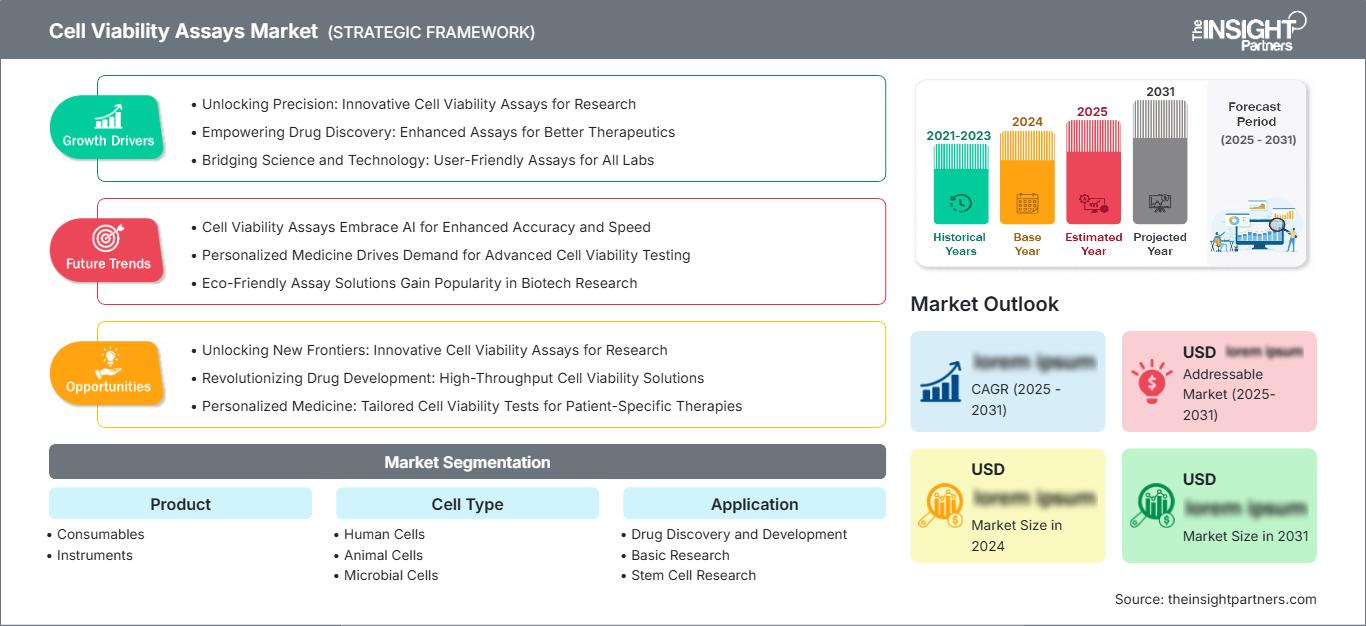
Cell Viability Assays Market: Strategic Insights
Regional Insights
North America Cell Viability Assays Market
North America held a simulation-based 36% to 39% share in the Cell Viability Assays Market in 2025, expected to grow at a 7.2% to 7.8% compound annual growth rate during 2025-2034. North America’s key advantages include densely populated pharmaceutical hubs, contract research operations, cancer institutes, cell therapies, and core university laboratories. Plate readers and flow cytometers are common, encouraging transition from manual counting to multiplexing and real time assessments.
US biomedical grants, translational research, and regulation requirement of replicable preclinical studies promote usage of viability test kits. The budget request by NIH in 2025 for US$50.1 billion in program-level for fundamental research and research on disease has been made. Academic medicine, biological research, and central laboratories in Canada provide demand in this nation. Pharmaceutical manufacturing, clinical research, and university labs in Mexico provide demand in the nation; nevertheless, high tech instrument availability is restricted to metropolitan research labs only. Competition is ensured via validation process, client services, and automation compatibility.
U.S. Cell Viability Assays Market
The US has been modelled to represent 82-85% of North America’s revenues in 2025, and its growth is forecasted at 7.3-7.9% CAGR in 2026-2034. Boston, San Francisco, San Diego, New Jersey, Maryland, and North Carolina are regions where there is high demand from biotechnology firms, federal laboratories, contract research organizations, and academic medical centers. Programs such as oncology, immunology, neuroscience, and rare diseases need viability testing in their hit identification and lead optimization.
There are major players like Thermo Fisher Scientific Inc., Danaher Corporation, Bio-Rad Laboratories, Inc., Becton, Dickinson and Company, Promega Corporation, and Agilent Technologies, Inc. having significant commercial and operational presence in the region. There is growing demand in applications for immune cell killing, organoids, induced pluripotent stem cells, and drug response. FDA approved 46 new drugs in 2025, but fluctuations in funding may affect the purchase cycles in academic laboratories. The core facilities have started consolidating instrumentation and using standardized consumables.
Europe Cell Viability Assays Market
Europe holds an approximate Cell Viability Assays Market share of 27–30% in 2025 and is projected to have a CAGR of 6.8–7.4% between 2025 and 2034. The dominant country in Europe is Germany owing to the presence of pharmaceutical manufacturing, biotech hubs, studies on toxicology, and instrument engineering. German labs focus on reproducibility, automation, and validation of protocols for advanced cellular systems.
UK's strengths include university research, genomics facilities, drug discovery, and expanding translational networks. Key areas of demand include oncology, immunology, stem cells, and organoids, while shared facilities help enhance access to high content systems. Public research organizations along with pharmaceuticals and diagnostics are present in France. Academic labs, oncology research centers, infectious disease research, and European collaboration projects exist in Italy and Spain. In the markets under discussion, financial limitations favor laboratories' decision to maintain their current readers while purchasing more sensitive consumables and upgraded software. Alternative testing techniques, which are being promoted in European initiatives to reduce animal testing, help in assessing toxicity and efficacy of compounds using cell-based assays.
APAC Cell Viability Assays Market
Asia Pacific was estimated to hold a modelled 23-26% share in 2025 and is expected to have an 8.8-9.5% CAGR over 2026-2034. China dominates regional demand by virtue of its biopharmaceutical pipelines, building laboratories, regulatory advancements, and internal research efforts. Japan retains its strengths in pharmaceuticals and regenerative medicines, whereas South Korea focuses on biologics and cell-based medicines.
India produces biosimilars, while in Australia, its university institutions are responsible for adding their part. Innovations made through the government, scientific know-how coming back to the country, and maintenance of the equipment locally are increasing adoption. Purchasing is frugal, and there is scope for small footprint readers, reagent rentals, and locally packaged consumables.
Middle East & Africa Cell Viability Assays Market
The regional market will have a modeled 6.4–7.1% CAGR from 2026 to 2034. Saudi Arabia takes lead in healthcare diversification, research universities, hospitals, and localizing biotechnology. The UAE is making developments in the field of genomics, precision medicines, and laboratory facilities, whereas distributors are providing the import of instruments and consumables.
South Africa drives the demand in sub-Saharan countries due to universities, pathology laboratories, infectious diseases, and clinical trials facilities. Rest of MEA continues to be fragmented in nature, where procurement is affected due to currency risks, cold chain, and technical services. Incomes related to economic diversification and lab facilities will slowly increase access in the region.
Segmentation Analysis
Product
Product demand is projected to increase at a 7.5–8.1% CAGR during 2026–2034. The Cell Viability Assays Market scope includes recurring assay chemistries and capital equipment used to detect metabolic activity, membrane integrity, ATP, enzyme activity, fluorescence, or morphology. Procurement decisions depend on throughput, sensitivity, cell compatibility, workflow time, multiplexing capacity, and installed reader availability.
- Consumables: Consumables hold the leading position because reagents, stains, substrates, buffers, assay plates, and control materials are replenished repeatedly. Ready-to-use formats reduce preparation steps and support standardized high-throughput screening across laboratories.
- Instruments: Instruments support automated counting, microplate detection, microscopy, flow cytometry, and real-time impedance analysis. Demand favors multimode platforms that consolidate workflows and provide upgradeable software, imaging, environmental control, and robotic integration.
Cell Type
Cell-type segment in the Cell Viability Assays Market is forecast to expand at a 7.4–8.0% CAGR through 2034. Assay selection varies with membrane properties, metabolic rate, culture architecture, growth kinetics, and background signal. Human cells dominate translational workflows, while animal and microbial cells remain essential for comparative biology, toxicology, bioprocessing, antimicrobial development, and environmental research.
- Human Cells: Human-cell assays occupy the strongest research position because cancer lines, primary cells, immune cells, and induced pluripotent stem cells provide disease-relevant evidence for therapeutic screening, toxicity testing, and personalized research.
- Animal Cells: Animal-cell workflows remain strategically important for veterinary research, comparative biology, vaccine development, and preclinical studies. Suppliers must accommodate adherent and suspension cultures while maintaining consistent performance across species and matrices.
- Microbial Cells: Microbial viability testing supports antimicrobial discovery, contamination monitoring, fermentation, food testing, and environmental applications. Rapid luminescent and fluorescent methods offer practical alternatives where conventional colony counting delays operational decisions.
Application
Applications segment in the Cell Viability Assays Market are projected to record a 7.6–8.2% CAGR during 2026–2034. Drug discovery generates broad demand, while stem cell research provides the fastest expansion. Adoption reflects the need to distinguish cytostatic effects from cell death, quantify dose response, validate culture conditions, and preserve valuable samples for downstream molecular analysis.
- Drug Discovery and Development: This application commands substantial demand because viability testing supports compound screening, concentration optimization, toxicity profiling, lead selection, and combination studies. Automation compatibility and low variability are critical for large screening campaigns.
- Basic Research: Academic and government laboratories use viability assays to investigate signaling, metabolism, stress, apoptosis, proliferation, and disease mechanisms. Purchasing favors adaptable protocols that work across common readers and diverse experimental conditions.
- Stem Cell Research: Non-destructive and real-time measurements are strategically important for stem cell expansion, differentiation, organoid formation, and regenerative medicine. Researchers require sensitive assays that minimize interference with fragile or scarce cell populations.
- Clinical and Diagnostic Applications: Clinical and diagnostic laboratories use viability measurements in selected cell-processing, microbiology, fertility, and treatment-response workflows. Adoption depends on validated performance, quality controls, traceability, and compatibility with regulated laboratory procedures.
End User
End-user demand is forecast to increase at a 7.5–8.1% CAGR during 2026–2034. Pharmaceutical and biotechnology companies prioritize throughput and reproducibility, while academic institutions emphasize flexibility and affordability. Hospitals and diagnostic laboratories require documented quality, straightforward workflows, and dependable technical support.
- Pharmaceutical and Biotechnology Companies: These organizations provide the largest commercial opportunity because screening teams consume assays throughout discovery, preclinical testing, biologics characterization, and cell therapy development. Standardized platforms also facilitate data transfer between internal sites and partners.
- Academic and Research Institutes: Universities and public institutes generate diversified demand across basic biology, oncology, neuroscience, microbiology, toxicology, and regenerative medicine. Shared instrumentation and grant cycles strongly influence purchasing frequency and platform selection.
- Hospital and Diagnostic Laboratories: Hospitals adopt viability methods for specialized cell analysis, microbiological assessment, transplantation research, and laboratory-developed workflows. Requirements center on repeatability, operator simplicity, quality controls, and integration with existing laboratory systems.
Opportunity Snapshot
Cell Viability Assays Market Forecasts indicate that end-user opportunity will depend on recurring assay volume, workflow standardization, and capacity to support advanced cellular models.
| End User | Revenue Contribution | Trend Tag | Adoption Stage |
| Pharmaceutical and Biotechnology Companies | High | Automated Screening | Mature |
| Academic and Research Institutes | High | Shared Platforms | Scaling |
| Hospital and Diagnostic Laboratories | Medium | Workflow Validation | Scaling |
| Other End Users | Low | Contract Testing | Emerging |
Cell Viability Assays Market Growth Drivers and Impact Analysis
Expansion of High-Throughput Drug Screening
Pharmaceutical developers require viability testing at hit discovery, lead optimization, toxicity assessment, and combination-treatment evaluation. Homogeneous assays that use one reagent addition reduce handling error and support miniaturization into 384- and 1,536-well plates. Higher throughput increases recurring demand for substrates, dyes, controls, plates, and calibration materials while encouraging purchases of multimode readers and automation. The commercial impact extends beyond oncology as metabolic, inflammatory, neurological, infectious, and rare-disease programs adopt phenotypic screening. Vendors can strengthen retention by validating assay performance across cell densities, media formulations, incubation periods, and automation platforms. CellTiter-Glo 2.0, for example, supports high-density formats and automated workflows while producing results through ATP quantification.
Rising Use of Three-Dimensional and Patient-Derived Models
Organoids, spheroids, primary cells, and patient-derived cultures provide more physiologically relevant responses than conventional monolayers but create measurement challenges involving reagent penetration, heterogeneous cell populations, and complex optical backgrounds. Laboratories consequently need sensitive luminescent, imaging, and multiplex assays optimized for three-dimensional structures. The transition increases demand for specialized protocols, longer-read signals, environmental control, and image-analysis capabilities. It also creates service opportunities in assay development, reference controls, and model-specific validation. Suppliers that demonstrate consistent lysis, signal linearity, and compatibility with scarce samples can command stronger positions in translational research. Promega identifies compatibility across two-dimensional, three-dimensional, organoid, primary-cell, and stem-cell workflows as a central feature of its cell-health portfolio.
Automation and Reproducibility Requirements
Reproducibility concerns are driving laboratories toward standardized reagent preparation, automated dispensing, objective image analysis, and software-controlled quality checks. Traditional workflows can introduce pipetting variation, subjective thresholds, edge effects, and inconsistent incubation. Integrated systems reduce operator dependence and generate auditable data suitable for collaboration across research sites. This shift supports demand for ready-to-use reagents, robotic-compatible plates, multimode instruments, and validated analysis templates. Vendors benefit when customers standardize a chemistry or platform across multiple programs, creating recurring consumable revenue and higher switching costs. Artificial intelligence is extending this effect by automating cell segmentation and reducing manual parameter adjustment in label-free imaging, particularly where cell morphology and density vary between experiments.
Cell Viability Assays Market Future Trends
AI-Assisted Multiparametric Cell Interpretation
Cell Viability Assays Market trends will increasingly move beyond binary live-or-dead outputs toward combined interpretation of morphology, metabolic activity, membrane integrity, proliferation, and temporal response. Artificial intelligence will automate segmentation, identify subtle phenotypic changes, and standardize analysis across operators. Instruments combining imaging with impedance or plate-reader signals can reveal whether an apparent viability decline reflects detachment, metabolic suppression, cytostasis, or death. Vendors will therefore invest in pretrained models, explainable quality metrics, cloud-compatible data structures, and application-specific algorithms. Adoption will begin in high-content discovery laboratories before extending to shared academic facilities and bioprocess development teams requiring consistent, scalable analysis.
Non-Destructive and Continuous Monitoring Workflows
Future assay design will prioritize repeated measurements from the same well, allowing researchers to observe response kinetics without sacrificing samples at every time point. Non-lytic fluorescence, real-time luminescence, impedance, and live-cell imaging will reduce plate consumption and improve understanding of delayed toxicity, recovery, and treatment resistance. Continuous data will be particularly valuable for organoids, immune-cell killing, stem cell differentiation, and long-duration exposure studies. Commercial differentiation will depend on low phototoxicity, stable signals, environmental control, and compatibility with downstream molecular assays. Suppliers will increasingly package reagents, instruments, analysis software, and kinetic protocols as integrated application workflows.
Cell Viability Assays Market Opportunities
Localized Platforms for Emerging Biotechnology Clusters
Rapid biotechnology expansion in China, India, South Korea, the Gulf states, and selected Southeast Asian markets creates an opportunity for suppliers to localize technical service, reagent packaging, training, and application development. Cell Viability Assays Market Forecasts support investment in compact multimode readers and automation-ready consumables suited to laboratories scaling from manual research to standardized screening. Commercial models can include reagent rentals, shared-instrument placements, distributor certification, and regional protocol libraries. Companies should prioritize reliable cold-chain logistics, local-language software, and response-time guarantees. Partnerships with research parks, contract laboratories, and university core facilities can accelerate adoption while reducing the cost of maintaining direct sales coverage.
Assay Validation for Cell and Gene Therapy
Cell and gene therapy developers require reliable viability measurements during cell isolation, activation, editing, expansion, transport, cryopreservation, and release-related research. This creates opportunities for assays capable of distinguishing viable, apoptotic, damaged, and functionally active cells without consuming excessive sample. Suppliers can invest in closed-workflow compatibility, rapid analysis, traceable controls, and standardized protocols for T cells, natural killer cells, stem cells, and engineered lines. Strategic partnerships with therapy developers and manufacturing organizations can generate application evidence before scale-up. Although research-use products will remain important, companies that establish quality documentation and manufacturing consistency will be better positioned for regulated laboratory and bioprocess applications.
Recent Developments
- July 2026: Agilent Technologies, Inc. launched the xCELLigence RTCA eSight AI software module for label-free cellular imaging analysis. The module reduces manual segmentation and parameter tuning while combining imaging and impedance information from the same cells, supporting more standardized real-time analysis in drug discovery and high-throughput biopharmaceutical research.
- April 2026: Agilent Technologies, Inc. introduced the BioTek Cytation 9 cell imaging multimode reader, combining inverted fluorescence microscopy, upright imaging, and multimode microplate detection. The platform was developed for basic research and high-content screening, with expanded imaging capabilities and approximately twice the imaging speed of earlier Cytation configurations.
- January 2025: Revvity, Inc. unveiled Phenologic.AI software for Harmony and Signals Image Artist workflows at SLAS 2025. Pretrained deep-learning models analyze brightfield images, provide an additional multiplexing channel, and support scalable live-cell analysis. Revvity also introduced Harmony 5.3 for faster, more intuitive high-content imaging data management.
Frequently Asked Questions

- Comprehensive Market Sizing and Forecast Analysis
- Detailed Segmentation Analysis
- In-Depth Market Dynamics Assessment
- Regional and Country-Level Insights
- Competitive Landscape and Company Benchmarking
- Strategic Business Intelligence
Recent Reports
Testimonials

The Insight Partners' SCADA System Market report is comprehensive, with valuable insights on current trends and future forecasts. The team was highly professional, responsive, and supportive throughout. We are very satisfied and highly recommend their services.
RAN KEDEM Partner, Reali Technologies LTDs
I requested a report on a very specific software market and the team produced the report in a few days. The information was very relevant and well presented. I then requested some changes and additions to the report. The team was again very responsive and I got the final report in less than a week.
JEAN-HERVE JENN Chairman, Future Analytica
We worked with The Insight Partners for an important market study and forecast. They gave us clear insights into opportunities and risks, which helped shape our plans. Their research was easy to use and based on solid data. It helped us make smart, confident decisions. We highly recommend them.
PIYUSH NAGPAL Sr. Vice President, High Beam Global
The Insight Partners delivered insightful, well-structured market research with strong domain expertise. Their team was professional and responsive throughout. The user-friendly website made accessing industry reports seamless. We highly recommend them for reliable, high-quality research services
YUKIHIKO ADACHI CEO, Deep Blue, LLC.
This is the first time I have purchased a market report from The Insight Partners.While I was unsure at first, I visited their web site and felt more comfortable to take the risk and purchase a market report.I am completely satisfied with the quality of the report and customer service. I had several questions and comments with the initial report, but after a couple of dialogs over email with their analyst I believe I have a report that I can use as input to our strategic planning process.Thank you so much for taking the extra time and making this a positive experience.I will definitely recommend your service to others and you will be my first call when we need further market data.
JOHN SUZUKI President and Chief Executive Officer, Board Director, BK Technologies
I wish to appreciate your support and the professionalism you displayed in the course of attending to my request for information regarding to infectious disease IVD market in Nigeria. I appreciate your patience, your guidance, and the fact that you were willing to offer a discount, which eventually made it possible for us to close a deal. I look forward to engaging The Insight Partners in the future, all thanks to the impression you have created in me as a result of this first encounter.
DR CHIJIOKE ONYIA MANAGING DIRECTOR, PineCrest Healthcare Ltd.Reason to Buy
- Informed Decision-Making
- Understanding Market Dynamics
- Competitive Analysis
- Identifying Emerging Markets
- Customer Insights
- Market Forecasts
- Risk Mitigation
- Boosting Operational Efficiency
- Strategic Planning
- Investment Justification
- Tracking Industry Innovations
- Aligning with Regulatory Trends





 Get Free Sample for