
Cellulose Ether & Derivatives Market Size, Demand & Growth by 2034
Cellulose Ether & Derivatives Market Size and Forecasts (2021 - 2034), Global and Regional Share, Trends, and Growth Opportunity Analysis Report Coverage : by Product Type (Methyl Cellulose & Derivatives, Carboxymethyl Cellulose, HEC, HPC, EC); Application (Construction, Pharmaceutical, Personal Care, Food & Beverage); and Geography (North America, Europe, Asia Pacific, and South and Central America)
- Status : Data Released
- Report Code : TIPRE00040245
- Category : Chemicals and Materials
- No. of Pages : 150
- Available Report Formats :


- Last update date : August 07, 2026


2025 Market Size
US$ 10.50 Bn
Base year value
2034 Forecast
US$ 14.77 Bn
Projected by 2034
CAGR 2026-2034
3.86 %
Growth rate
Addressable Market
US$ 114.75 Bn
(2026-2034)
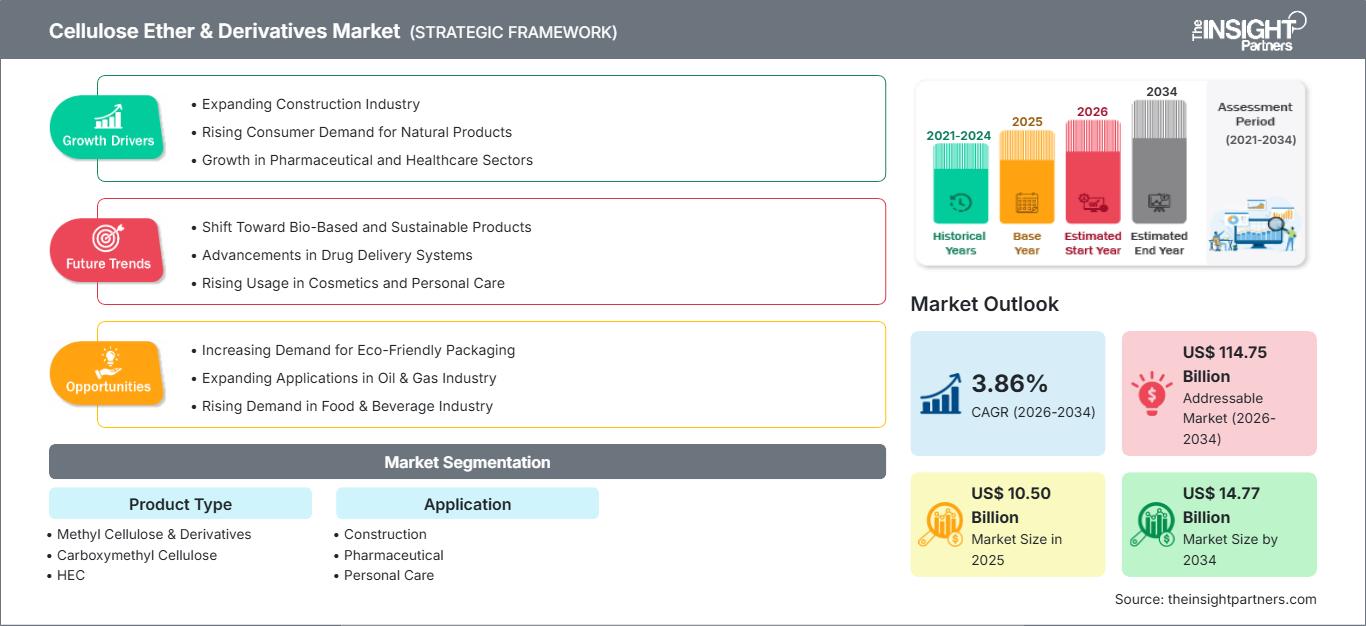
The Cellulose Ether and Derivatives Market held a value of US$ 10.50 billion in 2025 and is estimated to rise to US$ 14.77 billion by 2034, growing at a CAGR of 3.86% during 2026–2034. It is continuing to witness growth owing to increasing use in the development of construction materials, pharmaceuticals, personal care items, and processed food products. Technological innovations in product offerings, increasing preference for additives that can serve multiple purposes, and the shift towards sustainability in cellulose derivatives is driving commercial success in the industry.
North America still remains technologically advanced owing to the presence of active construction activities, quality-oriented pharmaceutical segment, and increasing demand for sustainable specialty chemicals. The Cellulose Ether and Derivatives Market in the region is predicted to grow at a CAGR of 3.2%–3.8% between 2026 and 2034, due to increased infrastructure renovation initiatives, growing investments in developing advanced drug delivery mechanisms, and increased use of high-performance cellulose derivatives.
Cellulose Ether & Derivatives Market Assessment and Insights
- North America: The region accounted for 30%–33% share in 2025 and is projected to expand at a CAGR of 3.2%–3.8% during 2026–2034. Stable construction activity, stringent pharmaceutical manufacturing standards, and increasing demand for sustainable formulation ingredients continue to strengthen regional consumption of cellulose ethers and their derivatives.
- U.S.: The country represented 78%–82% of the North American market in 2025 and is anticipated to register a CAGR of 3.3%–3.9% during 2026–2034. Demand remains supported by residential renovation, pharmaceutical excipient production, and premium personal care formulations requiring multifunctional cellulose-based additives.
- Europe: Europe held 27%–30% share in 2025 and is forecast to grow at a CAGR of 3.4%–4.0% during 2026–2034. Germany, France, the UK, and Italy remain leading contributors, supported by sustainable construction materials, regulated pharmaceutical manufacturing, and increasing use of bio-based specialty chemicals.
- Asia Pacific: The region captured 31%–34% share in 2025 and is expected to record the fastest expansion with a CAGR of 4.4%–5.0% during 2026–2034. China, Japan, India, and South Korea continue to drive demand through rapid urbanization, expanding pharmaceutical production, and growth in personal care manufacturing.
- Largest Segment: Construction remained the leading application with a market share of 42%–46% in 2025 and is projected to grow at a CAGR of 3.5%–4.1% during 2026–2034, supported by increasing demand for tile adhesives, cement modifiers, and dry-mix mortar formulations.
- High Growth Segment: Pharmaceutical is expected to witness the highest growth, accounting for 20%–24% market share in 2025 while expanding at a CAGR of 4.8%–5.4% during 2026–2034, driven by rising production of controlled-release dosage forms and advanced drug delivery technologies.
- Key companies analyzed in detail: The Dow Chemical Company, Ashland Inc., Rayonier Advanced Materials Inc., Shin-Etsu Chemical Co., Ltd., LOTTE Fine Chemical Co., Ltd., DKS Co., Ltd., Nouryon Chemicals Holding B.V., J.M. Huber Corporation, Shandong Head Co., Ltd., Colorcon, LLC, FENCHEM, Lamberti S.p.A., J. Rettenmaier & Söhne GmbH + Co. KG, Hebei JiaHua Cellulose Co., Ltd., and Zibo Hailan Chemical Co., Ltd.
Source: The Insight Partners' analysis based on proprietary research, government publications, company annual reports, investor presentations, industry databases, and expert interviews.
From being used in providing basic viscosity modifiers, the Cellulose Ether and Derivatives Market has transformed itself to provide multifunctional speciality chemicals with applications including rheology modification, water retention, film formation and controlled release. Increased focus on purification technologies, improvements in processes as well as sourcing of sustainable raw materials has improved efficiency of production along with enabling companies to cater to strict requirements in sectors such as construction, pharmaceuticals, food and personal care products. Expansion of capacities in Asia as well as upgrade in manufacturing facilities in North America and Europe have further boosted supply flexibility.
In terms of future growth of the market, increasing industrial investments in Asia Pacific, Middle East and certain Latin American countries where infrastructure construction and pharmaceutical manufacturing activities are gaining momentum will drive growth of the market. Environmental policies which promote usage of bio-based additives as well as increasing R&D for high performance cellulose derivatives will open new avenues for businesses.
Cellulose Ether & Derivatives Market Report Scope
| Report Attribute | Details |
|---|---|
| Market size in 2025 | US$ 10.50 Billion |
| Market Size by 2034 | US$ 14.77 Billion |
| Global CAGR (2026 - 2034) | 3.86% |
| Historical Data | 2021-2024 |
| Forecast period | 2026-2034 |
Cellulose Ether & Derivatives Market Analysis
The Cellulose Ether and Derivatives Market growth is driven largely due to the growth in infrastructure development, pharmaceuticals manufacture, and preference for bio-based functional additives in various applications. The cellulosic ether offers water binding, thickening, bonding, stabilizing, and film forming features, which make these materials extremely important in dry-mortar mixes, tablet preparations, cosmetics, and food processing. The rise in investments in both residential and commercial building activities, especially in Asia Pacific and North America, continues to boost the use of methyl cellulose, hydroxyethyl cellulose, and carboxymethyl cellulose.
Availability of raw materials, integration of the production process, and regional distribution channels largely affect the supply dynamics. Wood pulp and refined cotton linters still act as the main raw materials, while there is an emphasis on energy efficient manufacturing processes to achieve better quality products. Successful collaborations between raw material suppliers, specialty chemicals makers, formulators, and end users ensure constant supply in industries having strict quality control and regulatory requirements.
Cellulose Ether and Derivatives Market Competitive Landscape shows the presence of a somewhat consolidated competitive landscape with global players making efforts toward increasing capacities, innovations, and regionalizing supply chain operations in order to enhance their position in the marketplace. Companies such as The Dow Chemical Company, Shin-Etsu Chemical Co., Ltd., Ashland Inc., and LOTTE Fine Chemical Co., Ltd. keep developing high-quality cellulose derivatives that find application in pharmaceutical industries and specialties construction. At the same time, regional companies are increasing manufacturing capacities for satisfying rising local demand and enhancing export capabilities.
Currently, investments in sustainable production methods, digitalization of the process control system, and customization of products for high-end applications become more frequent. Companies such as Rayonier Advanced Materials Inc., Nouryon Chemicals Holding B.V., J.M. Huber Corporation, DKS Co., Ltd., Lamberti S.p.A., Colorcon, LLC, Shandong Head Co., Ltd., FENCHEM, Hebei JiaHua Cellulose Co., Ltd., and Zibo Hailan Chemical Co., Ltd. keep developing their position by diversifying product portfolio, collaborating on the technical level, and expanding into rapidly growing pharmaceutical, construction, and personal care markets.
● REPORT CUSTOMIZATION
Tailor This Report To Align With Your Specific Business Requirements
This report can be customized to align precisely with your business objectives, scope, and target markets. Customization options include tailored segmentation, geography, competitive analysis, and strategic insights to support informed decision-making.
Customize This Report →WHAT YOU CAN ADJUST
- ● Segmentations
- ● Geography
- ● Competitive Analysis
- ● Language Preferences
Cellulose Ether & Derivatives Market: Strategic Insights
Regional Insights
North America Cellulose Ether and Derivatives
North America accounted for 30%–33% of the Cellulose Ether and Derivatives market share in 2025 and is projected to expand at a CAGR of 3.2%–3.8% during 2026–2034. Demand remains supported by infrastructure modernization, residential renovation activities, and increasing adoption of high-performance construction chemicals. Growing utilization of cellulose ethers in dry-mix mortars, cement-based formulations, and insulation materials continues to support regional consumption, while pharmaceutical manufacturers increasingly incorporate high-purity cellulose derivatives into controlled-release drug formulations.
The region also benefits from advanced manufacturing capabilities, well-established regulatory standards, and a strong specialty chemicals ecosystem. Increasing investments in sustainable building materials and bio-based additives encourage manufacturers to develop environmentally responsible cellulose derivatives. The expanding personal care and food processing industries further contribute to demand as formulators seek multifunctional ingredients offering thickening, stabilization, and moisture-retention properties.
U.S. Cellulose Ether and Derivatives Market
The U.S. represented 78%–82% of the North American market in 2025 and is expected to register a CAGR of 3.3%–3.9% during 2026–2034. The country remains a major production and consumption hub owing to the presence of leading manufacturers, extensive pharmaceutical manufacturing capacity, and continuous investments in commercial and residential construction. Demand is particularly strong for methyl cellulose and hydroxyethyl cellulose used in construction chemicals, coatings, and pharmaceutical excipients.
Leading companies such as The Dow Chemical Company, Ashland Inc., Colorcon, LLC, and J.M. Huber Corporation maintain a significant operational presence across the country, supporting technological innovation and product development. Rising adoption of advanced excipients, increasing infrastructure rehabilitation projects, and growing demand for sustainable specialty chemicals continue to reinforce long-term market expansion while strengthening domestic production capabilities.
Europe Cellulose Ether and Derivatives Market
Europe accounted for 27%–30% of the global market in 2025 and is estimated to have a CAGR of 3.4%–4.0% during 2026–2034. Germany continues to be the most prominent regional market owing to its highly developed construction chemical industry, robust pharmaceutical manufacturing sector, and sustainability focus for industrial materials. Continuous investments made by Germany in energy-efficient building designs further boost the use of cellulose ethers in mortar, plaster, and insulation applications.
In the UK, demand is steady from the pharmaceutical manufacturing and high-quality personal care products sector, with growing renovations aiding in the consumption from the construction sector. France, Italy, and Spain together account for growing demand due to increasing food processing, cosmetics manufacturing, and modernization of infrastructure.
APAC Cellulose Ether and Derivatives Market
Asia Pacific accounted for 31%–34% of the global market in 2025 and is projected to register the fastest regional expansion at a CAGR of 4.4%–5.0% during 2026–2034. China leads regional demand through extensive construction activity and large-scale specialty chemical manufacturing, while Japan and South Korea support growth through advanced pharmaceutical and personal care production.
India continues to benefit from rapid urbanization and expanding infrastructure investment, whereas Australia records steady demand from the construction and food processing industries. Government initiatives supporting industrial development, domestic manufacturing, and sustainable building materials continue to strengthen long-term regional market prospects.
Middle East & Africa Cellulose Ether and Derivatives Market
It is predicted that the market in the Middle East and Africa will witness a growth rate ranging between 3.8% to 4.4% CAGR during 2026-2034, owing to infrastructure diversification as well as increased investments in industries. Saudi Arabia is expected to remain the dominant market in the region due to extensive construction activity and rising demand for advanced construction materials, whereas the UAE is gaining traction in terms of real estate developments and specialty coatings.
South Africa has consistent demand because of construction and food processing activities, and the Rest of the Middle East and Africa are witnessing gradual growth in consumption along with industrial diversification activities.
Segmentation Analysis
Product Type
The Product Type segment is projected to expand at a CAGR of 3.8%–4.3% during 2026–2034. Product innovation remains centered on improving rheological performance, water retention, film formation, and stabilization across diverse industrial applications. The Cellulose Ether and Derivatives Market scope continues to broaden as manufacturers develop specialized grades tailored for construction materials, pharmaceutical formulations, food processing, and personal care products while emphasizing sustainable and high-purity production technologies.
- Methyl Cellulose & Derivatives: Widely utilized in dry-mix mortars, tile adhesives, coatings, and pharmaceutical formulations due to excellent water-retention and thickening properties. Continuous formulation improvements support sustained demand across the construction and healthcare industries.
- Carboxymethyl Cellulose: Serves as an effective stabilizer, binder, and viscosity modifier in food processing, pharmaceuticals, detergents, and paper manufacturing. Growing demand for multifunctional additives continues to strengthen its strategic market position.
- HEC: Hydroxyethyl Cellulose is extensively adopted in architectural coatings, oilfield chemicals, cosmetics, and cleaning formulations because of its superior thickening efficiency, suspension capability, and compatibility with water-based systems.
- HPC: Hydroxypropyl Cellulose is primarily used in pharmaceutical tablets, ophthalmic formulations, and specialty coatings. Its excellent film-forming capability and controlled-release performance support increasing adoption in advanced healthcare applications.
- EC: Ethyl Cellulose finds broad application in controlled drug delivery, protective coatings, printing inks, and industrial formulations where moisture resistance, chemical stability, and durable film formation are essential performance requirements.
Application
The Application segment is expected to register a CAGR of 4.0%–4.6% during 2026–2034. Expanding demand from construction, pharmaceuticals, food processing, and personal care continues to diversify application opportunities. Manufacturers increasingly develop customized cellulose ether formulations to satisfy stringent regulatory requirements, improve product functionality, and address evolving performance expectations across industrial and consumer markets.
- Construction: The largest application, driven by extensive use in cement-based mortars, tile adhesives, plasters, gypsum products, and self-leveling compounds, where improved workability, adhesion, and water retention are critical.
- Pharmaceutical: Increasing adoption in tablet binders, controlled-release formulations, capsule coatings, and ophthalmic products supports strong long-term demand as healthcare manufacturing expands worldwide.
- Personal Care: Cellulose ethers improve viscosity, texture, stabilization, and sensory performance in shampoos, creams, lotions, facial cleansers, and cosmetic formulations, supporting increasing demand for premium personal care products.
- Food & Beverage: Used as stabilizers, emulsifiers, thickeners, and moisture-retention agents in bakery products, dairy items, sauces, beverages, and processed foods to enhance consistency, shelf life, and product quality.
Opportunity Snapshot
| Application | Revenue Contribution | Trend Tag | Adoption Stage |
|---|---|---|---|
| Construction | High | Green Buildings | Mature |
| Pharmaceutical | High | Controlled Release | Scaling |
| Personal Care | Medium | Clean Beauty | Scaling |
| Food & Beverage | Medium | Texture Enhancement | Mature |
Cellulose Ether & Derivatives Market Growth Drivers and Impact Analysis
Rising Demand for High-Performance Construction Chemicals
With increasing investments worldwide in construction, infrastructures, residential and commercial constructions, there is an increasing demand for cellulose ethers in dry mortar, cement render, tile adhesive, gypsum products and leveling compounds. This material helps in retaining water, workability, open time and adhesion, allowing for better construction and construction productivity. Countries within Asia Pacific, North America and Europe are advocating for energy efficiency and sustainability in building materials, leading to a higher uptake of advanced construction additives. Manufacturers are coming up with special grades of construction additives that have improved performance characteristics for building materials. There will be sustained use of cellulose ether products due to durability of infrastructure and efficient application technologies in construction.
Expansion of Pharmaceutical Manufacturing and Advanced Drug Formulations
The pharmaceutical sector has come to rely heavily on cellulose derivatives for applications such as tablet binders, controlled-release drug delivery, coatings, capsules, and ophthalmics. The rise in healthcare spending, increase in generics manufacturing, and the need for complex oral solid dosage forms have served to boost the uptake of pharmaceutical-grade cellulose ethers. Excipient quality and reliability are of paramount importance to regulatory authorities, which drive companies to adopt technologies that allow for high purity products. Research into extended release drugs and patient-centered drug delivery systems provides further impetus for innovation. With the growth of manufacturing facilities in Asia Pacific, North America, and Europe, demand for cellulose derivatives will only increase.
Growing Preference for Bio-Based and Multifunctional Specialty Ingredients
Incorporating renewable, sustainable, and multifunctional materials in lieu of synthetic additives is a trend that many industries are embracing to achieve their sustainability targets and comply with new regulations. The cellulose ethers act as a thickener, stabilizer, binder, emulsifier, and film former but are renewable because they are extracted from cellulose, making them favorable in food, cosmetics, pharmaceutical, and other applications. The growing demands of consumers for products that have an environmentally friendly profile and the commitment of manufacturers to reduce the environmental footprint is making the shift to bio-based specialty chemicals more imminent. The improvements in efficiencies, product customization, and formulation are creating more opportunities.
Cellulose Ether & Derivatives Market Future Trends
Development of High-Purity Cellulose Derivatives for Specialty Applications
Growing quality requirements across the pharmaceutical, personal care, and food industries are encouraging manufacturers to develop high-purity cellulose derivatives with improved functionality and regulatory compliance. The Cellulose Ether and Derivatives Market trends indicate increasing investment in advanced purification technologies, process automation, and customized product grades designed for controlled drug delivery, premium cosmetics, and clean-label food formulations. Companies are also strengthening quality assurance systems and expanding research partnerships to develop next-generation cellulose derivatives that deliver greater consistency, enhanced stability, and superior performance. This trend is expected to support higher-value product portfolios while improving manufacturers' competitiveness in regulated end-use industries over the forecast period.
Digital Manufacturing and Sustainable Production Technologies
Manufacturers are increasingly integrating digital process monitoring, predictive maintenance, and automated quality control into cellulose ether production facilities to improve operational efficiency and product consistency. At the same time, sustainability initiatives are driving investments in energy-efficient manufacturing, waste reduction, and responsible raw material sourcing. Advanced process optimization helps reduce production costs while maintaining the stringent quality standards required by construction, pharmaceutical, and food industries. Companies are also evaluating renewable energy integration and circular manufacturing practices to reduce carbon emissions. These technological developments are expected to improve production resilience, strengthen supply chain efficiency, and support long-term environmental objectives across the global industry.
Cellulose Ether & Derivatives Market Opportunities
Expansion into Emerging Pharmaceutical Manufacturing Hubs
The rapid growth of pharmaceutical manufacturing across India, Southeast Asia, the Middle East, and parts of Latin America presents significant opportunities for cellulose ether producers. Increasing investments in generic medicines, biologics, and advanced oral dosage formulations are creating sustained demand for high-quality pharmaceutical excipients. Cellulose Ether and Derivatives Market Forecasts indicate that manufacturers establishing regional production facilities, technical service centers, and strategic partnerships with pharmaceutical companies can improve supply reliability and reduce lead times. Investment in regulatory compliance, product traceability, and customized formulation support will further strengthen competitive positioning while enabling suppliers to capture long-term business opportunities in expanding healthcare markets.
Innovation in Sustainable Construction Additives
Global efforts to improve energy efficiency and reduce the environmental impact of buildings are increasing demand for sustainable construction materials containing bio-based performance additives. Cellulose ether manufacturers have opportunities to develop advanced grades that improve mortar performance, reduce material consumption, and support low-carbon construction practices. Continued investments in prefabricated buildings, infrastructure modernization, and green building certification programs are expected to accelerate product adoption. Companies that focus on formulation innovation, regional manufacturing expansion, and collaboration with construction chemical producers can strengthen market penetration while addressing evolving customer requirements for high-performance and environmentally responsible building materials.
Recent Developments
- June 2025: Eastman Chemical Company launched Esmeri™ CC1N10, a readily biodegradable cellulose ester micropowder for color cosmetics. Developed to comply with the European Union's microplastics regulations, the product is sourced from sustainably managed forests and offers improved optical performance, compatibility, and formulation stability for cosmetic applications.
- May 2025: Colorcon, LLC entered an exclusive multi-year partnership with ASHA Cellulose to distribute ASHACEL® ethyl cellulose polymers across Europe, the Middle East, Africa, Northeast Asia, and Southeast Asia. The collaboration expands access to pharmaceutical cellulose excipients used in controlled-release, taste-masking, and barrier membrane formulations for pharmaceutical and nutraceutical products.
Frequently Asked Questions

- Comprehensive Market Sizing and Forecast Analysis
- Detailed Segmentation Analysis
- In-Depth Market Dynamics Assessment
- Regional and Country-Level Insights
- Competitive Landscape and Company Benchmarking
- Strategic Business Intelligence
Recent Reports
Testimonials

The Insight Partners' SCADA System Market report is comprehensive, with valuable insights on current trends and future forecasts. The team was highly professional, responsive, and supportive throughout. We are very satisfied and highly recommend their services.
RAN KEDEM Partner, Reali Technologies LTDs
I requested a report on a very specific software market and the team produced the report in a few days. The information was very relevant and well presented. I then requested some changes and additions to the report. The team was again very responsive and I got the final report in less than a week.
JEAN-HERVE JENN Chairman, Future Analytica
We worked with The Insight Partners for an important market study and forecast. They gave us clear insights into opportunities and risks, which helped shape our plans. Their research was easy to use and based on solid data. It helped us make smart, confident decisions. We highly recommend them.
PIYUSH NAGPAL Sr. Vice President, High Beam Global
The Insight Partners delivered insightful, well-structured market research with strong domain expertise. Their team was professional and responsive throughout. The user-friendly website made accessing industry reports seamless. We highly recommend them for reliable, high-quality research services
YUKIHIKO ADACHI CEO, Deep Blue, LLC.
This is the first time I have purchased a market report from The Insight Partners.While I was unsure at first, I visited their web site and felt more comfortable to take the risk and purchase a market report.I am completely satisfied with the quality of the report and customer service. I had several questions and comments with the initial report, but after a couple of dialogs over email with their analyst I believe I have a report that I can use as input to our strategic planning process.Thank you so much for taking the extra time and making this a positive experience.I will definitely recommend your service to others and you will be my first call when we need further market data.
JOHN SUZUKI President and Chief Executive Officer, Board Director, BK Technologies
I wish to appreciate your support and the professionalism you displayed in the course of attending to my request for information regarding to infectious disease IVD market in Nigeria. I appreciate your patience, your guidance, and the fact that you were willing to offer a discount, which eventually made it possible for us to close a deal. I look forward to engaging The Insight Partners in the future, all thanks to the impression you have created in me as a result of this first encounter.
DR CHIJIOKE ONYIA MANAGING DIRECTOR, PineCrest Healthcare Ltd.Reason to Buy
- Informed Decision-Making
- Understanding Market Dynamics
- Competitive Analysis
- Identifying Emerging Markets
- Customer Insights
- Market Forecasts
- Risk Mitigation
- Boosting Operational Efficiency
- Strategic Planning
- Investment Justification
- Tracking Industry Innovations
- Aligning with Regulatory Trends





 Get Free Sample for