
Centrifugal Subsea Pumps Market Demand, Share & Growth by 2034
Coverage: By Product Type (Single-phase pump, Multiphase pumps); Application (Oil and Gas, Water Treatment, Chemical Process) , and Geography (North America, Europe, Asia Pacific, and South and Central America)
- Status : Data Released
- Report Code : TIPRE00023231
- Category : Manufacturing and Construction
- No. of Pages : 150
- Available Report Formats :


- Last update date : September 07, 2026


2025 Market Size
US$ 16.49 Bn
Base year value
2034 Forecast
US$ 34.26 Bn
Projected by 2034
CAGR 2026-2034
8.46 %
Growth rate
Addressable Market
US$ 227.68 Bn
(2026-2034)
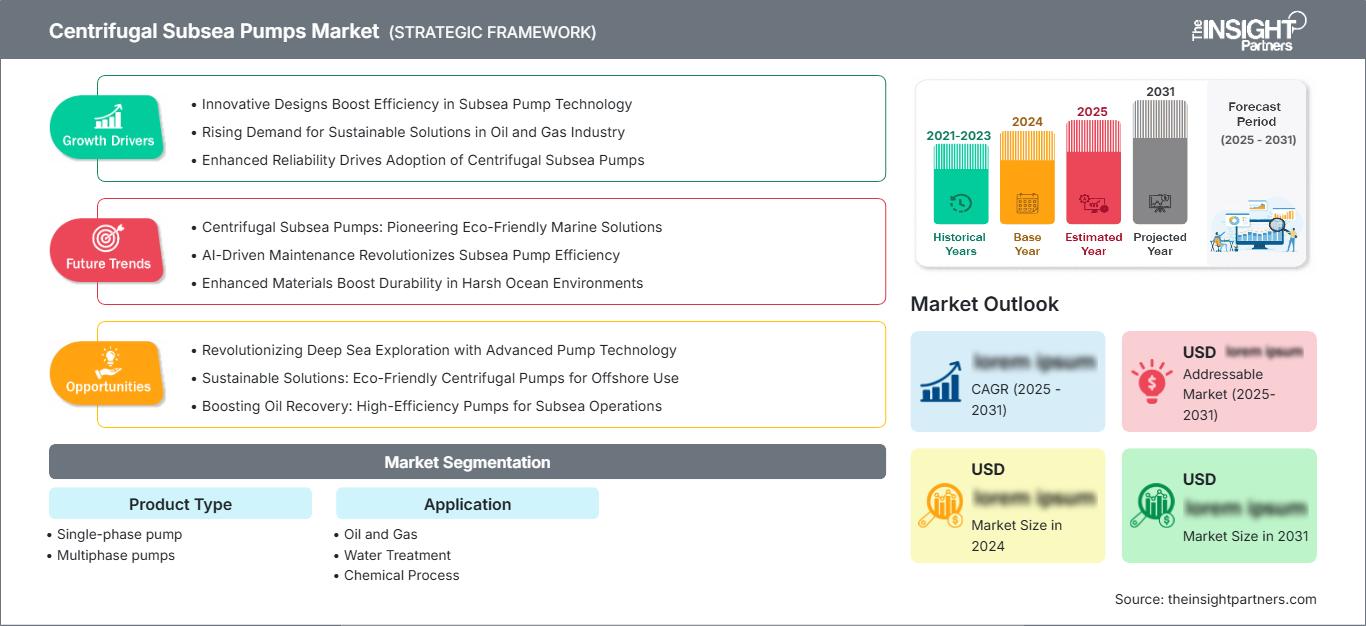
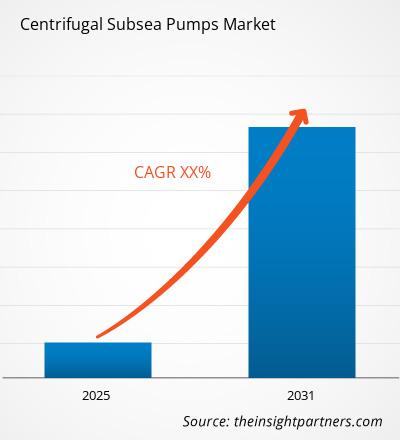
The Centrifugal Subsea Pumps market was valued at US$ 16.49 billion in 2025 and is expected to reach US$ 34.26 billion by 2034; it is estimated to record a CAGR of 8.46% during 2026-2034.
Centrifugal Subsea Pumps Market Assessment and Insights
- North America: Share in 2025 was 28–30%, supported by Gulf of America tiebacks, mature-field optimization, and deepwater service capacity; the region is projected to grow at a CAGR between 8.8–9.4% during 2026–2034.
- US: The country represented 82–86% of North American demand in 2025 and is expected to record an 8.9–9.5% CAGR through 2034.
- Europe: Share in 2025 reached 26–28%, led by Norway and the UK, with Germany supporting engineering supply; regional CAGR is estimated at 8.5–9.1% during 2026–2034.
- Asia Pacific: Share in 2025 stood at 22–24%, with China and Australia leading procurement and Japan, South Korea, and India expanding capability; CAGR is estimated at 10.3–11.0% through 2034.
- Largest Segment: Multiphase pumps held a 56–60% market share in 2025 and are projected to expand at a 10.0–10.6% CAGR during 2026–2034.
- High Growth Segment: Oil and Gas accounted for 68–72% in 2025 and is forecast to grow at a 9.7–10.3% CAGR through 2034.
- Key companies analyzed in detail: Baker Hughes Company, TechnipFMC plc, Flowserve Corporation, Sulzer Ltd, Alfa Laval AB, SPX Technologies, Inc., KSB SE & Co. KGaA, The Weir Group PLC, NOV Inc., and Fuglesangs Subsea AS.
Source: The Insight Partners' analysis based on proprietary research, government publications, company annual reports, investor presentations, industry databases, and expert interviews.
Subsea pumps have moved from specialized and difficult-to-maintain equipment into modularized equipment that can handle changes in the gas ratio with variable-speed drive trains and wet mate connections. Pumping operations are combining their equipment with separation, power distribution, and condition monitoring in order to ensure production at increasing tieback lengths. Today, economics make it more feasible to employ standard hydraulic modules and replaceable cartridges, with equipment suppliers providing assembly close to the offshore basins.
Between now and 2034, spending is expected to diversify geographically to include Brazil, Guyana, West Africa, eastern Mediterranean, and Southeast Asia regions as producers seek to monetize discoveries via a phased tieback approach. Concerns about methane management, produced water management, and reduced topsides energy use will contribute towards efficient seabed processing. Financing will be limited to projects that have an existing host facility, proven equipment, and economic benefits compared to standalone greenfield projects.
Centrifugal Subsea Pumps Market Report Scope
| Report Attribute | Details |
|---|---|
| Market size in 2025 | US$ 16.49 Billion |
| Market Size by 2034 | US$ 34.26 Billion |
| Global CAGR (2026 - 2034) | 8.46% |
| Historical Data | 2021-2024 |
| Forecast period | 2026-2034 |
Centrifugal Subsea Pumps Market Analysis
The centrifugal subsea pumps market growth is driven by long tiebacks, falling natural reservoir pressure, and the industry’s inclination towards brownfield barrels that involve low infrastructure costs. The purchasing process starts from the feasibility phase and moves to hydraulic design, materials qualification, motorization, testing, installation, and service life cycle. Reliability performance and interface control play a major role in the purchasing process as well as the cost of the equipment.
Supply chain is dominated by companies with the capability to perform pressure testing, subsea electrical compatibility, and prolonged qualifications. Forgings, corrosion-resistant metals, high voltage connectors, and special bearings may impact delivery time. Manufacturers are now standardizing pump structures, identifying other qualified suppliers, and implementing digital twins technology to decrease engineering iterations. Inspections of the equipment after purchase, remote diagnosis, and design of the retrievable module provide additional income streams for the manufacturers.
Centrifugal subsea pumps competitive analysis reveals competition among both integrated subsea systems vendors and specialized pump makers. Baker Hughes Company and TechnipFMC plc compete based on system design, delivery, controls, and service for the installed base. Flowserve Corporation, Sulzer Ltd, KSB SE & Co. KGaA, and The Weir Group PLC provide the experience of making rotating equipment, material science, and process industry distribution channels that complement the application into adjacent water and chemical markets.
Increasingly, strategic positioning is defined by modular platforms with qualifications, local content, and service. Alfa Laval AB, SPX Technologies, Inc., NOV Inc., and Fuglesangs Subsea AS offer separation, flow assurance, pumping, and special subsea technology. Investment is directed to testing facilities, electrification, sensors, and regional service centers. The vendors that are able to demonstrate energy efficiency, availability, and ease of recovery can protect margins while lowering the cost of ownership for operators.
● REPORT CUSTOMIZATION
Tailor This Report To Align With Your Specific Business Requirements
This report can be customized to align precisely with your business objectives, scope, and target markets. Customization options include tailored segmentation, geography, competitive analysis, and strategic insights to support informed decision-making.
Customize This Report →WHAT YOU CAN ADJUST
- ● Segmentations
- ● Geography
- ● Competitive Analysis
- ● Language Preferences
Centrifugal Subsea Pumps Market: Strategic Insights
Regional Insights
North America centrifugal subsea pumps market
North America held a 28–30% centrifugal subsea pumps market share in 2025 and is forecast to advance at an 8.8–9.4% CAGR through 2034. Subsea boosting in Gulf of America projects continues to be the major demand driver, where subsea boosting facilitates long tiebacks, depleted fields, and field-development using hubs. Canada offers opportunities that are related to harsh environment offshore facilities and water handling considerations.
The regional opportunity is enabled by substantial engineering capabilities, existing qualification capability, and access to operators, EPC firms, and marine vessels. Digital monitoring and variable speed control and standardization of modular subsea boosters are increasingly important in terms of purchasing due to the high costs associated with intervention. U.S. offshore leasing, brownfield development, and energy security concerns drive the demand, despite project execution risks.
U.S. Centrifugal Subsea Pumps Market
The U.S. represented 82–86% of North American demand in 2025 and is projected to expand at an 8.9–9.5% CAGR through 2034. Deep-water producers utilize pumps for enhancing the efficiency of their hosts, increasing recovery, and linking satellite finds through non-platform solutions. Brownfield developments require smaller-scale installations that fit into existing power generation, control systems, and intervention methods.
Houston-based procurement, construction and supply chains ensure vendor reliability. Baker Hughes Company, TechnipFMC plc, Flowserve Corporation, NOV Inc. and other specialists have the necessary expertise in this area. The oil & gas industry is the core application domain, but there are adjacent needs for coastal water treatment and chemicals processing. Procurement focuses more and more on validated run time, retrievability, monitoring and security.
Europe Centrifugal Subsea Pumps Market
Europe accounted for 26–28% of global demand in 2025 and is expected to post an 8.5–9.1% CAGR through 2034, with Norway the leading country. North Sea brownfield developments necessitate stimulation, water flooding, and produced water handling as reservoir pressures diminish. The UK provides tie-back expertise and subsea technology, whereas Norway is a combination of deepwater technology, electrification knowledge, and high lifecycle demands.
Germany is more involved with motors, drives, material sciences, and machining than offshore installations alone. France, Italy, and Spain provide pump technology, EPC technology, chemical processing needs, and Mediterranean projects. EU regulations on emissions and operator carbon reduction programs encourage efficient machinery and minimized topsides. Qualifications, proximity to services, and compatibility with existing facilities will be key determinants for success, especially for limited intervention weather windows and close analysis of life extension costs.
APAC Centrifugal Subsea Pumps Market
Asia Pacific held 22–24% in 2025 and is projected to grow at a 10.3–11.0% CAGR through 2034, with China leading. Australia’s LNG-linked offshore developments, China’s domestic energy-security agenda, and India’s deepwater ambitions stimulate orders.
Japan and South Korea contribute motors, shipbuilding, controls, and high-specification manufacturing. Policy support for domestic offshore capability, growing water infrastructure, and chemical investment expands the addressable base, while localization requirements encourage partnerships, regional testing, and service capacity.
Middle East & Africa Centrifugal Subsea Pumps Market
Middle East & Africa is forecast to expand at a 9.6–10.2% CAGR through 2034, led by Saudi Arabia. Offshore capacity additions, gas development, desalination, and produced-water reinjection support demand in Saudi Arabia and the UAE.
South Africa provides industrial and water-treatment opportunities, while the Rest of MEA includes West African deepwater projects and emerging gas hubs. Local-content rules, service access, and financing shape procurement, favoring modular systems supported by regional technicians and predictable spare-parts availability.
Segmentation Analysis
Product Type
The Product Type segment is projected to grow at a 9.4–10.0% CAGR during 2026–2034. The centrifugal subsea pumps market scope covers single-phase and multiphase architectures selected according to gas fraction, pressure uplift, solids tolerance, and tieback distance. Modular hydraulics, standardized motors, and variable-speed operation are reducing customization while enabling operators to adapt pumping performance as reservoirs mature.
- Single-phase pump: Demand centers on water injection, treated-liquid transfer, and stabilized hydrocarbon streams where predictable fluid properties enable high hydraulic efficiency and established centrifugal designs.
- Multiphase pumps: These systems address mixed oil, gas, and water streams, supporting long tiebacks and pressure-depleted fields while reducing dependence on topside separation infrastructure.
Application
The Application segment is expected to expand at a 9.5–10.1% CAGR over 2026–2034. Oil and gas remains the core demand pool because subsea boosting directly supports recovery and host utilization. Water treatment and chemical process applications broaden requirements toward corrosion resistance, sealing integrity, solids handling, and controlled dosing, encouraging suppliers to transfer proven materials and monitoring practices across industries.
- Oil and Gas: Deepwater production, brownfield tiebacks, water injection, and subsea separation sustain purchasing, with reliability evidence and lifecycle service central to project qualification.
- Water Treatment: Coastal intake, discharge, desalination, and produced-water systems require corrosion-resistant pumping, energy efficiency, and dependable operation where access is difficult or continuous service is essential.
- Chemical Process: Hazardous and corrosive fluid duties reward sealless concepts, compatible metallurgy, secondary containment, and precise monitoring, particularly where leakage prevention and uptime have high operational value.
Opportunity Snapshot
| Application | Revenue Contribution | Trend Tag | Adoption Stage |
| Oil and Gas | High | Subsea Tiebacks | Mature |
| Water Treatment | Medium | Deepwater Intake | Scaling |
| Chemical Process | Low | Sealless Handling | Emerging |
Centrifugal Subsea Pumps Market Growth Drivers and Impact Analysis
Longer Tiebacks and Mature-Field Recovery
Operators are linking their smaller finds to their current hosts, thus the call for additional seabed pressure augmentation. In order to enhance oil production efficiency as the reservoir declines, pumps are used to maintain flow and production stability and optimize utilization of the available pipeline and riser capacity. The economic benefits will be seen when the additional barrels produced reduce capital costs and reduce the time to first oil production. Suppliers will be beneficiaries from the need for hydraulic analysis as well as supply of qualified pump modules, power systems, control, and lifetime services. The projects will still require careful flow assurance modeling owing to varying gas fractions, solid content, and temperature.
Subsea Processing Reduces Surface Constraints
Bringing boosting, separation, and injection operations downhole alleviates the constraints on topsides and minimizes backpressure in long flowlines. Centrifugal pumps turn into enabling technology in configurations aimed at handling liquids in the underwater environment, treating produced water, and performing reinjections. The advantage is an increase in the capacity of the host installation without corresponding growth in the surface infrastructure. Subsea power distribution systems, wet-mate connectors, instrumentation, and control software requirements will also be generated. Such technologies are being applied primarily in those projects where the reserves are large enough to justify qualification and integration efforts. Vendor-provided interoperable modules and interface specifications minimize execution risk, whereas operators enjoy increased flexibility to stage development and drill additional satellite wells.
Reliability, Monitoring, and Lower Intervention Exposure
Deepwater intervention requires specialized vessels, favorable weather, and complex retrieval planning, making equipment availability a direct economic variable. Buyers increasingly specify condition monitoring, variable-speed operation, redundancy, and retrievable cartridges to detect degradation before failure and simplify maintenance campaigns. Baker Hughes states that its Aptara modular compact pump can reduce topside footprint by 50% or more, illustrating how architecture can influence both installation and lifecycle cost. The broader impact extends to data services, remote diagnostics, and performance-based maintenance. Suppliers able to demonstrate run-life evidence, cybersecure control, and spare-parts readiness improve bankability. Operators, meanwhile, can schedule intervention around production priorities rather than reacting to unplanned shutdowns.
Centrifugal Subsea Pumps Market Future Trends
Modular Electrified Pumping Architectures
The centrifugal subsea pumps market trends will increasingly center on modular motor stages, standardized hydraulics, and subsea variable-speed drives that can be configured without redesigning an entire package. This architecture supports phased field development and easier adaptation to changing flow conditions. Electrification will also encourage common power and control interfaces across pumps, separators, and compression equipment. Over time, qualification data from repeated deployments should shorten engineering cycles and improve schedule certainty. Suppliers will invest in digital configuration tools and hardware commonality, while operators will evaluate platforms on energy efficiency, redundancy, and recoverability across multiple assets rather than one project.
Autonomous Condition-Based Operations
Monitoring will progress from alarm-driven supervision toward predictive models that combine vibration, temperature, electrical load, pressure, and fluid composition. Edge analytics can identify hydraulic instability or bearing degradation before output deteriorates, allowing operators to adjust speed or operating envelopes remotely. Future service agreements may link supplier compensation to availability and energy performance, requiring transparent data governance and validated algorithms. Digital twins will help compare actual behavior with expected reservoir and pipeline conditions, improving diagnostics. Adoption will be gradual because cybersecurity, sensor reliability, and model accountability must be proven, but the direction favors fewer routine interventions and more targeted maintenance campaigns.
Centrifugal Subsea Pumps Market Opportunities
Brownfield Tieback Packages for Emerging Basins
The centrifugal subsea pumps market forecasts highlight actionable openings in Brazil, Guyana, West Africa, Southeast Asia, and the eastern Mediterranean, where discoveries can be linked to existing or planned hosts. Vendors can capture value by pairing early hydraulic studies with prequalified pump, power, control, and retrieval packages. Local assembly, technician training, and spares stocking will improve compliance with domestic-content expectations and reduce service delay. Partnerships with EPC contractors and operators can standardize interfaces before final investment decisions. The strongest opportunities will involve repeatable basin-wide designs, allowing suppliers to spread qualification costs across several tiebacks while operators gain schedule certainty and lower engineering risk.
Cross-Industry Expansion into Water and Chemicals
Suppliers can extend subsea-grade reliability into coastal water treatment, desalination intake, produced-water handling, and hazardous chemical transfer. These applications reward corrosion-resistant materials, sealless construction, monitoring, and long unattended run periods. Commercial success requires application-specific channel partners rather than simply repackaging oilfield equipment. Manufacturers should develop reference installations, validate materials against target fluids, and quantify energy and maintenance advantages against conventional pumping arrangements. Flowserve Corporation’s March 2025 launch of a double-hermetically sealed magnetic-drive pump illustrates continuing innovation around containment. Businesses that combine safety documentation, modular service, and lifecycle analytics can build differentiated positions in regulated process environments.
Recent Developments
- December 2025: TechnipFMC plc – received a significant Chevron contract for Gorgon Stage 3, introducing its first 7-inch Subsea 2.0 horizontal trees and flexible jumpers intended to raise gas production and support flow assurance. The award demonstrates continued platform standardization in brownfield subsea development.
- September 2025: Baker Hughes Company – secured a significant award from TPAO and TP-OTC for deepwater subsea production and intelligent completion systems for Sakarya Gas Field Phase 3, covering water depths of 6,500–7,200 feet. Execution was scheduled to begin in late 2025.
Frequently Asked Questions

- Comprehensive Market Sizing and Forecast Analysis
- Detailed Segmentation Analysis
- In-Depth Market Dynamics Assessment
- Regional and Country-Level Insights
- Competitive Landscape and Company Benchmarking
- Strategic Business Intelligence
Recent Reports
Testimonials

The Insight Partners provided valuable market intelligence that supported our global go-to-market strategy. Their team was professional, responsive, and attentive to our feedback, providing thoughtful analysis and helpful methodological clarifications throughout the project.
Junmo Kim Chief Financial Officer (CFO), Enertech Co., Ltd.
The Insight Partners' SCADA System Market report is comprehensive, with valuable insights on current trends and future forecasts. The team was highly professional, responsive, and supportive throughout. We are very satisfied and highly recommend their services.
RAN KEDEM Partner, Reali Technologies LTDs
I requested a report on a very specific software market and the team produced the report in a few days. The information was very relevant and well presented. I then requested some changes and additions to the report. The team was again very responsive and I got the final report in less than a week.
JEAN-HERVE JENN Chairman, Future Analytica
We worked with The Insight Partners for an important market study and forecast. They gave us clear insights into opportunities and risks, which helped shape our plans. Their research was easy to use and based on solid data. It helped us make smart, confident decisions. We highly recommend them.
PIYUSH NAGPAL Sr. Vice President, High Beam Global
The Insight Partners delivered insightful, well-structured market research with strong domain expertise. Their team was professional and responsive throughout. The user-friendly website made accessing industry reports seamless. We highly recommend them for reliable, high-quality research services
YUKIHIKO ADACHI CEO, Deep Blue, LLC.
This is the first time I have purchased a market report from The Insight Partners.While I was unsure at first, I visited their web site and felt more comfortable to take the risk and purchase a market report.I am completely satisfied with the quality of the report and customer service. I had several questions and comments with the initial report, but after a couple of dialogs over email with their analyst I believe I have a report that I can use as input to our strategic planning process.Thank you so much for taking the extra time and making this a positive experience.I will definitely recommend your service to others and you will be my first call when we need further market data.
JOHN SUZUKI President and Chief Executive Officer, Board Director, BK Technologies
I wish to appreciate your support and the professionalism you displayed in the course of attending to my request for information regarding to infectious disease IVD market in Nigeria. I appreciate your patience, your guidance, and the fact that you were willing to offer a discount, which eventually made it possible for us to close a deal. I look forward to engaging The Insight Partners in the future, all thanks to the impression you have created in me as a result of this first encounter.
DR CHIJIOKE ONYIA MANAGING DIRECTOR, PineCrest Healthcare Ltd.Reason to Buy
- Informed Decision-Making
- Understanding Market Dynamics
- Competitive Analysis
- Identifying Emerging Markets
- Customer Insights
- Market Forecasts
- Risk Mitigation
- Boosting Operational Efficiency
- Strategic Planning
- Investment Justification
- Tracking Industry Innovations
- Aligning with Regulatory Trends





 Get Free Sample for