
Cinematography Cameras Market Demand, Share & Growth by 2034
Coverage: by Product (ENG Cameras, Cinema Cameras, EFP Cameras); Video Resolution (4K, 8K, Full HD); Application (Live Production, Cinematography, News and Broadcast Production, Others) , and Geography (North America, Europe, Asia Pacific, and South and Central America)
- Status : Data Released
- Report Code : TIPRE00011482
- Category : Electronics and Semiconductor
- No. of Pages : 150
- Available Report Formats :


- Last update date : July 21, 2026


2025 Market Size
US$ 1.72 Bn
Base year value
2034 Forecast
US$ 3.55 Bn
Projected by 2034
CAGR 2026-2034
8.37 %
Growth rate
Addressable Market
US$ 23.64 Bn
(2026-2034)
The Cinematography Cameras market was valued at US$ 1.72 Billion in 2025 and is projected to reach US$ 3.55 Billion by 2034, registering a CAGR of 8.37% during 2026–2034. The market covers professional imaging systems used in film, live production, news, and broadcast workflows where resolution, dynamic range, color science, frame rate, reliability, and lens ecosystem compatibility determine procurement decisions.
North America Cinematography Cameras Market size is expected to grow at a CAGR of 7.6–8.4% during 2026–2034, supported by streaming commissions, live sports production, studio modernization, and premium scripted content pipelines. Buyers are prioritizing 4K HDR, selective 8K adoption, IP-ready workflows, remote production compatibility, and serviceable camera platforms that can remain useful through several production cycles.
Cinematography Cameras Market Assessment and Insights
- North America held 31–35% share in 2025 and is growing at a CAGR of 7.6–8.4% during 2026–2034, led by scripted streaming, sports broadcasting, and virtual production adoption.
- US represented 78–82% of North American revenue in 2025 and is growing at a CAGR of 7.8–8.6% during 2026–2034, supported by studio and live-event capex.
- Europe accounted for 22–26% share in 2025 and is growing at a CAGR of 6.9–7.7% during 2026–2034, with the UK, Germany, France, Italy, and Spain leading procurement.
- Asia Pacific held 27–31% share in 2025 and is growing at a CAGR of 8.8–9.6% during 2026–2034, driven by China, Japan, South Korea, India, and Australia.
- Largest Segment Cinema Cameras held 44–48% market share in 2025 and is growing at a CAGR of 8.4–9.1% during 2026–2034 as premium productions demand cinematic image control.
- High Growth Segment 8K represented 14–18% market share in 2025 and is growing at a CAGR of 10.2–11.4% during 2026–2034, supported by premium capture, reframing, and VFX pipelines.
- Key companies analyzed in detail: ARRI AG; Blackmagic Design Pty. Ltd.; Canon Inc.; Hitachi, Ltd.; Nikon Corporation; Panasonic Holdings Corporation; Panavision Inc.; RED Digital Cinema, LLC; Sony Group Corporation; Vision Research, Inc.
Source: The Insight Partners' analysis based on proprietary research, government publications, company annual reports, investor presentations, industry databases, and expert interviews.
Professional camera purchasing has shifted from simple resolution upgrades toward integrated imaging ecosystems that combine large-format sensors, HDR monitoring, color-managed workflows, metadata capture, and cloud-friendly post-production. Within the Cinematography Cameras Market, growth is reinforced by shorter production cycles, premium episodic content, live event capture, and hybrid broadcast-cinema workflows. Manufacturers now compete on reliability, lens interoperability, codec efficiency, service support, and platform longevity rather than sensor resolution alone.
Future demand will be affected by new production centers, investments in sports media rights, regionally oriented streaming services, and government incentives for film infrastructure. Camera Systems adoption will grow where film studios leverage LED volumes, remote productions, and multi-cam live broadcasts. Purchasing departments will seek modular solutions that provide 4K output currently, some 8K capture, and software upgradability without the need to change out all their equipment.
Cinematography Cameras Market Report Scope
| Report Attribute | Details |
|---|---|
| Market size in 2025 | US$ 1.72 Billion |
| Market Size by 2034 | US$ 3.55 Billion |
| Global CAGR (2026 - 2034) | 8.37% |
| Historical Data | 2021-2024 |
| Forecast period | 2026-2034 |
Cinematography Cameras Market Analysis
Cinematography Cameras' growth is driven by rising demand for high-quality scripted, sports, news, and branded video content. Streaming services, broadcasters, production houses, and rental companies are refreshing camera fleets to support 4K HDR delivery, higher dynamic range, low-light performance, and faster turnaround. Demand is strongest where productions require dependable color pipelines, repeatable image matching, and robust accessories for studio, field, and mobile workflows.
The value chain includes sensor design, camera bodies, lenses, viewfinders, batteries, media, codecs, rental networks, broadcasters, studios, post-production facilities, and service partners. Within the Cinematography Cameras Market, supply dynamics are shaped by semiconductor availability, thermal management, firmware support, and channel relationships. Buyers evaluate total ownership cost because camera uptime, accessory compatibility, warranty support, and resale values often outweigh the initial purchase price.
The Cinematography Cameras market analysis presents a competitive landscape that is divided into premium film cameras, broadcast-ready ENG/EFP systems, and smaller form factor prosumer devices. ARRI AG, Sony Group Corporation, Canon Inc., and Panasonic Holdings Corporation compete in the traditional production pipeline segment, while Blackmagic Design Pty. Ltd., RED Digital Cinema, LLC, Nikon Corporation, and Vision Research, Inc. provide high resolution, niche and high-speed solutions.
Market trends include investments in full-frame sensors, large format, virtual production capabilities, IP capability, artificial intelligence-assisted autofocus, and workflow metadata. The legacy of Panavision Inc. lives on via its camera rentals, providing access to premium systems, while Hitachi, Ltd. covers broadcast/studio applications. Market strategy is determined by lens system coverage, service availability, software development roadmap, and mixed production environment support without interrupting existing creative processes.
● REPORT CUSTOMIZATION
Tailor This Report To Align With Your Specific Business Requirements
This report can be customized to align precisely with your business objectives, scope, and target markets. Customization options include tailored segmentation, geography, competitive analysis, and strategic insights to support informed decision-making.
Customize This Report →WHAT YOU CAN ADJUST
- ● Segmentations
- ● Geography
- ● Competitive Analysis
- ● Language Preferences
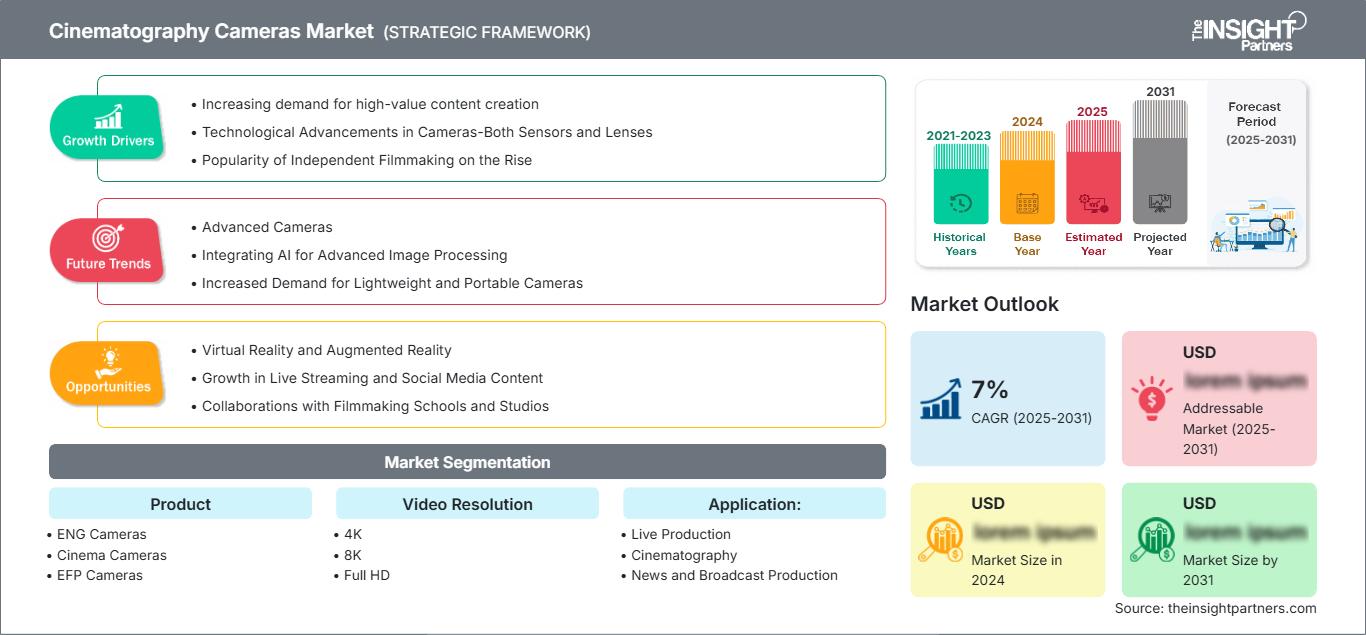
Cinematography Cameras Market: Strategic Insights
Regional Insights
North America Cinematography Cameras Market
North America accounted for 31–35% of the Cinematography Cameras Market share in 2025 and is projected to expand at a CAGR of 7.6–8.4% during 2026–2034. Demand is backed up by streaming originals, sports production, advertising shoot production, virtual production studios, and the replacement of HD era broadcasting equipment by 4K HDR and large format systems.
Rental companies and studios are buying influencers due to the fact that many productions rely on top-tier camera packages via short-term projects, not direct purchase. Buyers look for superior color science, workflow reliability, durability, and support. Cinematography Cameras demand is helped out by multi-camera live production, documentaries, commercial productions by creators, and post-production studios that favor standardized codecs and metadata workflows.
U.S. Cinematography Cameras Market
The U.S. represented 78–82% of North American revenue in 2025 and is expected to grow at a CAGR of 7.8–8.6% during 2026–2034. Demand is concentrated in scripted streaming, film production, live sports, news gathering, corporate video, and advertising, with camera packages selected for reliability under fast production schedules.
Company presence is broad, with Sony Group Corporation, Canon Inc., ARRI AG, RED Digital Cinema, LLC, Panasonic Holdings Corporation, Blackmagic Design Pty. Ltd., Panavision Inc., and Vision Research, Inc. serving buyers through sales, rentals, service, and production partnerships. Application trends favor compact cinema bodies, high-frame-rate capture, cloud collaboration, and cameras that integrate cleanly with LED volumes.
Europe Cinematography Cameras Market
Europe held 22–26% share in 2025 and is projected to grow at a CAGR of 6.9–7.7% during 2026–2034. The UK is the leading country, supported by studio clusters, high-end television, international film incentives, and strong rental networks that maintain premium camera inventory for episodic, commercial, and live production. These factors continue to strengthen the Cinematography Cameras Market across the region.
Germany benefits from engineering-led broadcast production, sports coverage, and manufacturer proximity, while France supports cinema, luxury advertising, and public broadcasting demand. Italy and Spain add volume through local film incentives, tourism-linked production, and streaming projects. Buyers emphasize dependable service, EU-compliant supply chains, and camera platforms that fit multilingual crews and cross-border productions.
APAC Cinematography Cameras Market
Asia Pacific accounted for 27–31% share in 2025 and is forecast to grow at a CAGR of 8.8–9.6% during 2026–2034. China is the leading country, supported by film studios, online video platforms, live commerce, and domestic content production. Japan and South Korea add advanced imaging ecosystems and premium broadcast requirements.
India and Australia contribute through streaming originals, regional cinema, sports coverage, and production incentives. Policy support for creative industries and digital infrastructure is improving professional equipment adoption. Cinematography Cameras procurement in APAC favors flexible price tiers, strong dealer networks, compact bodies, and systems that can move between studio, documentary, live, and social-first production.
Middle East & Africa Cinematography Cameras Market
The Middle East & Africa market is projected to grow at a CAGR of 6.3–7.1% during 2026–2034. Saudi Arabia and the UAE lead regional adoption through studio investment, tourism media, live entertainment, and large infrastructure-linked events. South Africa contributes through film services, advertising, and documentary production.
The rest of MEA demand remains project-based, with rental channels important for premium access. Energy-sector communications, government events, sports broadcasts, and city-branding content create recurring needs. Adoption depends on trained crews, maintenance availability, and import logistics, making compact cinema and broadcast-compatible cameras attractive for mixed field and studio work.
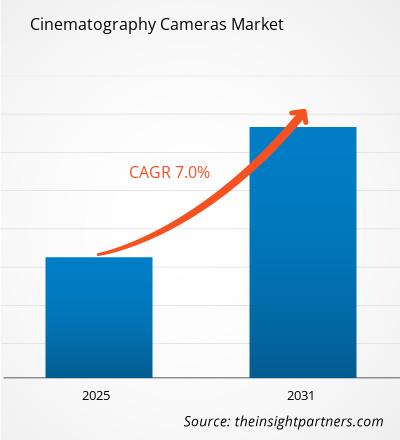
Segmentation Analysis
Product
Product is projected to grow at a CAGR of 8.0–8.8% during 2026–2034. The Cinematography Cameras scope spans shoulder-mounted ENG systems, digital cinema bodies, and EFP cameras for studio or outside-broadcast production. Demand patterns differ by buyer, with news teams valuing speed and ergonomics, cinematographers prioritizing image character, and live producers requiring synchronization, connectivity, and operational consistency.
- ENG Cameras remain important for mobile news, documentary, and field reporting because they combine durability, shoulder ergonomics, broadcast audio, fast zoom control, and rapid deployment in unpredictable environments.
- Cinema Cameras lead premium adoption as producers seek large-format sensors, broad dynamic range, high-bit-depth recording, lens flexibility, and color workflows suited to theatrical, streaming, advertising, and virtual production.
- EFP Cameras serve studio, sports, concerts, worship, and outside-broadcast workflows where multi-camera matching, long operating hours, remote control, tally, intercom, and dependable live output are essential.
Video Resolution
Video Resolution is forecast to grow at a CAGR of 8.5–9.3% during 2026–2034. Resolution strategy is shifting from headline pixel count to capture flexibility, HDR performance, oversampling, stabilization, post-production reframing, and archival value. 4K remains the commercial baseline, while 8K is increasingly justified for premium productions, VFX-heavy work, live-event reframing, and future-proof asset creation.
- 4K is the dominant professional standard because it balances image quality, storage cost, editing efficiency, HDR delivery, and compatibility with broadcast, streaming, corporate, and independent production workflows.
- 8K is expanding in premium cinema, sports, VFX, and large-screen applications where reframing, stabilization, visual effects, and long-term content value justify higher storage and processing requirements.
- Full HD remains relevant for cost-sensitive live production, education, local news, and internal communications where bandwidth efficiency, existing infrastructure, and quick turnaround matter more than ultra-high resolution.
Application
Application is projected to grow at a CAGR of 8.2–9.0% during 2026–2034. Live production, cinematography, and news and broadcast production each require distinct performance trade-offs. Live users prioritize latency and reliability, cinematographers value image latitude and creative control, and broadcasters need speed, interoperability, and rugged systems for daily deployment across studios and field operations.
- Live Production uses multi-camera systems for sports, concerts, events, worship, and corporate broadcasts. Demand centers on matched output, IP connectivity, long operation, and reliable integration with switchers.
- Cinematography drives premium camera selection through requirements for dynamic range, color fidelity, lens choice, high frame rates, metadata capture, and compatibility with post-production and virtual production workflows.
- News and broadcast production require dependable ENG and studio cameras that support fast setup, broadcast audio, stable autofocus, long battery life, weather tolerance, and efficient newsroom file transfer.
Opportunity Snapshot
| Application | Revenue Contribution | Trend Tag | Adoption Stage |
| Live Production | High | IP Workflow | Scaling |
| Cinematography | High | Large Format | Mature |
| News and Broadcast Production | Medium | Remote News | Scaling |
Cinematography Cameras Market Growth Drivers and Impact Analysis
Streaming and premium content increase camera fleet refresh
There are more and more commissioned works that require adherence to uniform technical standards in terms of delivery, whether in 4K HDR format, multilingual post-production, or international distribution. There is a clear need for cameras that demonstrate consistency in terms of color science, codecs, metadata, and reliability during long shooting sessions. The effect is most noticeable among rental companies and production facilities, since one successful platform validation would result in continuous usage of equipment for different projects. Companies that provide comprehensive solutions, from body to monitoring equipment, media, firmware, and service, could benefit here.
Live sports and events accelerate broadcast-camera modernization
Sports leagues, concerts, and event producers are increasingly adopting the practice of using multi-camera shoots to provide content for the broadcasting feed, live streams, screenshots, highlights, and social media cuts. This trend boosts the requirement for EFP and cinema setups that work with switchers, intercom, tally systems, remote shading control, and IP delivery capabilities. The effect is not limited to only major events since regional sports leagues, churches, universities, and corporate venues have also moved from HD to 4K compatible pipelines. Companies providing reliable operation, accurate color matching between cameras, and field services will win recurring orders.
Virtual production raises requirements for sensor and metadata accuracy
Cameras for LED-volume stages and real-time visual effects need to have genlock capabilities, a good color response, low noise levels, proper metadata and consistent performance in a variety of lighting situations. These needs are pushing the specifications for high-end productions and making customers gravitate towards those platforms approved by virtual production supervisors. This driver impacts the industry in a concrete way, with cameras that make the tracking, color grading and postproduction process easier, saving time and retakes. It’s also a driver that makes manufacturers who are well integrated with lens makers, render engines, monitors and studios.
Cinematography Cameras Market Future Trends
AI-assisted capture becomes a professional workflow layer
Cinematography Cameras Market trends point toward AI-assisted focus, subject tracking, exposure support, noise reduction, and automated metadata tagging becoming standard workflow layers rather than optional features. Professionals will continue to safeguard creative manual control, but intelligent support can minimize mistakes, save time on shoots, and bring consistency in documentaries, sports, and live events. In the long run, the industry will prefer companies with dependable sensor technology and updates in firmware and control. Eventually, features of AI will carry as much weight in the decision-making process as codec selection because of their impact on efficiency and post-production indexing.
Cloud-connected production changes camera ecosystem design
The performance of future camera systems will depend on their ability to transport video, proxies, looks, and metadata efficiently from set to editor, colorist, and even remotely. Connecting to cloud services will make vendors strive to become better at providing proxies in-camera, secure transfer, accurate timecodes, and post production services integration. The development will affect not only connectivity but also the way production companies schedule dailies, approvals, highlights of sports events, and news turnovers. It will help suppliers to generate more ecosystem lock-in through easy data movement.
Cinematography Cameras Market Opportunities
Regional rental fleets for streaming and live production
Cinematography Cameras Market Forecasts indicate attractive investment potential in regional rental fleets that combine cinema bodies, ENG systems, EFP chains, lenses, accessories, and trained support crews. Many filmmakers prefer to rent equipment due to the rapid development of camera technology and varying budget constraints for films being produced. A difference can be made by having different platforms, good maintenance, insurance services, and workflow consultancy services. This applies most especially in the new studio centers and sports where demand for content is growing faster than budget constraints.
8K and high-frame-rate workflows for premium capture
There are many applications where premium content production, scientific imaging, sports replays, visual effects, and large screen formats become areas for utilizing 8K and high frame rate cameras. The adoption process will be limited since there are big expenses related to storage, processing, monitoring, and post-production, but the benefit of doing so will be obvious if reframing, slow-motion, stabilization, or archiving is needed. The manufacturers can capitalize on it by providing efficient codecs, cooling solutions, media types, and educating clients on the workflow.
Recent Developments
- July 2026: NEC Corporation (NEC; TSE: 6701) has developed a first-of-its-kind technology that uses proprietary AI to rapidly generate highly detailed 3D models in as little as one minute, solely from footage captured with general-purpose cameras such as those on smartphones, while automatically removing unnecessary subjects. This technology was developed in collaboration with the Keio AI Research Center.
- April 2026: GoPro announced its new MISSION 1 Series of cameras— the world’s smallest, lightest, and most rugged 8K and 4K Open Gate cinema cameras. Featuring a new 50MP 1” sensor and GoPro’s new, ultra-efficient GP3 processor, the MISSION 1 Series cameras deliver category-leading resolutions, frame rates, runtimes and thermal performance for mission-critical reliability in even the most demanding environments. The new series is comprised of three camera models—MISSION 1 PRO, MISSION 1 and MISSION 1 PRO ILS, which features an interchangeable Micro Four Thirds lens system compatible with an even broader array of lenses via adapters.
- September 2025: FUJIFILM Corporation announces the launch of its first dedicated filmmaking camera, the “FUJIFILM GFX ETERNA 55” (GFX ETERNA 55), scheduled for release in late October 2025. The “GFX ETERNA 55” is a filmmaking camera equipped with a large format sensor “GFX 102MP CMOS II HS*1” and the high-speed image processing engine “X-Processor 5”. In addition to delivering rich gradation and three-dimensional image expression, the camera leverages Fujifilm’s proprietary color reproduction technology cultivated over more than 90 years since its founding, enabling even more diverse visual expression.
Frequently Asked Questions

- Comprehensive Market Sizing and Forecast Analysis
- Detailed Segmentation Analysis
- In-Depth Market Dynamics Assessment
- Regional and Country-Level Insights
- Competitive Landscape and Company Benchmarking
- Strategic Business Intelligence
Recent Reports
Testimonials

The Insight Partners' SCADA System Market report is comprehensive, with valuable insights on current trends and future forecasts. The team was highly professional, responsive, and supportive throughout. We are very satisfied and highly recommend their services.
RAN KEDEM Partner, Reali Technologies LTDs
I requested a report on a very specific software market and the team produced the report in a few days. The information was very relevant and well presented. I then requested some changes and additions to the report. The team was again very responsive and I got the final report in less than a week.
JEAN-HERVE JENN Chairman, Future Analytica
We worked with The Insight Partners for an important market study and forecast. They gave us clear insights into opportunities and risks, which helped shape our plans. Their research was easy to use and based on solid data. It helped us make smart, confident decisions. We highly recommend them.
PIYUSH NAGPAL Sr. Vice President, High Beam Global
The Insight Partners delivered insightful, well-structured market research with strong domain expertise. Their team was professional and responsive throughout. The user-friendly website made accessing industry reports seamless. We highly recommend them for reliable, high-quality research services
YUKIHIKO ADACHI CEO, Deep Blue, LLC.
This is the first time I have purchased a market report from The Insight Partners.While I was unsure at first, I visited their web site and felt more comfortable to take the risk and purchase a market report.I am completely satisfied with the quality of the report and customer service. I had several questions and comments with the initial report, but after a couple of dialogs over email with their analyst I believe I have a report that I can use as input to our strategic planning process.Thank you so much for taking the extra time and making this a positive experience.I will definitely recommend your service to others and you will be my first call when we need further market data.
JOHN SUZUKI President and Chief Executive Officer, Board Director, BK Technologies
I wish to appreciate your support and the professionalism you displayed in the course of attending to my request for information regarding to infectious disease IVD market in Nigeria. I appreciate your patience, your guidance, and the fact that you were willing to offer a discount, which eventually made it possible for us to close a deal. I look forward to engaging The Insight Partners in the future, all thanks to the impression you have created in me as a result of this first encounter.
DR CHIJIOKE ONYIA MANAGING DIRECTOR, PineCrest Healthcare Ltd.Reason to Buy
- Informed Decision-Making
- Understanding Market Dynamics
- Competitive Analysis
- Identifying Emerging Markets
- Customer Insights
- Market Forecasts
- Risk Mitigation
- Boosting Operational Efficiency
- Strategic Planning
- Investment Justification
- Tracking Industry Innovations
- Aligning with Regulatory Trends





 Get Free Sample for