
Cleanroom Lighting Market Trends, Demand & Growth by 2034
Coverage: By Light Source (LED, Fluorescent); Mounting Type (Surface Mounted, Recessed Mounted); Components (Hardware, Software, Services); Industry Vertical (Food and Beverages, Industrial Manufacturing, Healthcare and Life Sciences, Others) , and Geography (North America, Europe, Asia Pacific, and South and Central America)
- Status : Data Released
- Report Code : TIPRE00005694
- Category : Electronics and Semiconductor
- No. of Pages : 150
- Available Report Formats :


- Last update date : August 05, 2026


2025 Market Size
US$ 1.12 Bn
Base year value
2034 Forecast
US$ 1.81 Bn
Projected by 2034
CAGR 2026-2034
5.45 %
Growth rate
Addressable Market
US$ 13.27 Bn
(2026-2034)
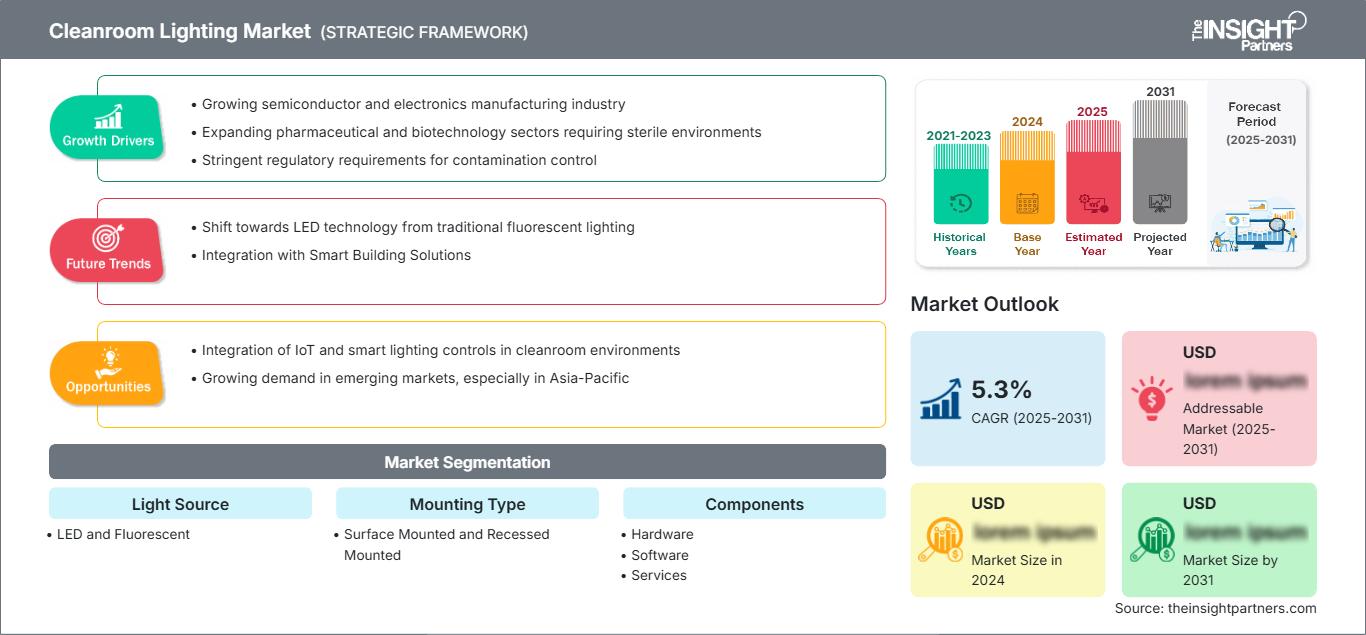
The Cleanroom Lighting market is forecasted to rise from US$ 1.12 billion in 2025 to US$ 1.81 billion in 2034 at a CAGR of 5.45%. Market growth will be driven by increased installation of controlled environments in healthcare/life sciences, food & beverages, and industrial manufacturing that require sealed lighting fixtures, low heat emitting light sources, and appropriate mounting solutions to prevent contamination of process integrity.
North America is poised to retain its status as a high-value market for Cleanroom Lighting, with the Cleanroom Lighting market size driven by an anticipated CAGR of 5.1–5.7% to 2034. The region boasts additions to biologic capabilities, hospital sterile suite modernization projects, and semiconductors' reshoring initiatives. Cleanroom industry standards, including ISO 14644 and GMP, will dictate lighting fixture choices, preferring sealed LED fixtures and low maintenance recessed designs.
Cleanroom Lighting Market Assessment and Insights
- North America held 29–31% share in 2025 and is growing at a CAGR of 5.1–5.7% during 2026–2034, led by sterile drug manufacturing, infection-control investments, and semiconductor cleanroom modernization.
- US accounted for 77–80% of North America in 2025 and is growing at a CAGR of 5.2–5.8% through 2034, supported by biologics and fab investments.
- Europe represented 24–27% share in 2025 and is growing at a CAGR of 4.8–5.4% during 2026–2034, with Germany, the UK, France, Italy, and Spain leading regulated demand.
- Asia Pacific captured 34–37% share in 2025 and is growing at a CAGR of 5.9–6.6% during 2026–2034, driven by China, Japan, South Korea, India, and Australia.
- Largest Segment LED held 70–74% market share in 2025 and is growing at a CAGR of 5.8–6.4% during 2026–2034, replacing fluorescent cleanroom fixtures.
- High Growth Segment Healthcare and Life Sciences held 33–36% market share in 2025 and is growing at a CAGR of 6.0–6.8% during 2026–2034.
- Key companies analyzed in detail: Crompton Greaves Consumer Electricals Limited, Eagle Lighting Australia Pty Ltd, Eaton Corporation plc, Kenall Manufacturing Company, LUG Light Factory Sp. z o.o., Paramount Industries Inc., Signify Holding, Solite Europe Ltd, Terra Universal, Inc., and Wipro Lighting.
Source: The Insight Partners' analysis based on proprietary research, government publications, company annual reports, investor presentations, industry databases, and expert interviews.
The shift in technology has led to changes in procurement ranging from sealed fluorescent lighting to LEDs that have smooth housing, gasketed lenses, corrosion-resistant frames, and digital controls. The production process has also changed in favor of modularity, easy validation, and low maintenance intervals. In the Cleanroom Lighting Market, there will be an increase in variety including pharmaceutical suites, semiconductor fabrication facilities, food safety areas, and precision manufacturing lines.
During the forecast period, new cleanroom complexes that will emerge in countries such as India, Southeast Asia, and Gulf regions are expected to act as a complement to demand that already exists in places such as the US, Germany, Japan, and South Korea. The regulations related to sterile processing, energy efficiency, and worker visibility will contribute to the upgrade in specifications.
Cleanroom Lighting Market Report Scope
| Report Attribute | Details |
|---|---|
| Market size in 2025 | US$ 1.12 Billion |
| Market Size by 2034 | US$ 1.81 Billion |
| Global CAGR (2026 - 2034) | 5.45% |
| Historical Data | 2021-2024 |
| Forecast period | 2026-2034 |
Cleanroom Lighting Market Analysis
Growth in demand occurs as cleanrooms install LED luminaires instead of energy-consuming fluorescent lighting. The development of the Cleanroom Lighting market depends on production continuity, since lighting malfunctions may prevent the release of batches, inspections of wafers, or the sterile packaging. Hardware continues to dominate in this industry; however, the importance of controls and services increases with the implementation of lighting into validated building systems.
In the value chain, there are LED module suppliers, enclosure manufacturers, optical suppliers, cleanroom installation companies, validation specialists, and distributors of lighting fixtures for regulated environments. Among the supply chain elements are aluminum enclosures, polycarbonate optics, electronic drivers, and certification issues. The buyer behavior is moving away from per fixture cost to ingress protection, ISO class appropriateness, cleanliness, and total cost of ownership.
The competitive positioning is influenced by certification depth, project engineering capacity, and capability to service multinational cleanroom construction firms. There are Signify Holding, Eaton Corporation plc, Kenall Manufacturing Company, Wipro Lighting, and Terra Universal, Inc. competing on differentiated sealed luminaires, hazardous locations equipment, and application-specific lighting product lines. From the Cleanroom Lighting market report, it becomes clear that suppliers with integrated controls and validation are at an advantage in pharma and semiconductor projects.
Investment is made in favor of localization, speed of customization and family of products for modular ceilings and walkable plenums. Suppliers like Solite Europe Ltd, LUG Light Factory Sp. z o.o., Paramount Industries Inc., and Eagle Lighting Australia Pty Ltd cater to the needs according to the regional codes, whereas Crompton Greaves Consumer Electricals Limited and Wipro Lighting benefit from the increase in controlled environments in India.
● REPORT CUSTOMIZATION
Tailor This Report To Align With Your Specific Business Requirements
This report can be customized to align precisely with your business objectives, scope, and target markets. Customization options include tailored segmentation, geography, competitive analysis, and strategic insights to support informed decision-making.
Customize This Report →WHAT YOU CAN ADJUST
- ● Segmentations
- ● Geography
- ● Competitive Analysis
- ● Language Preferences
Cleanroom Lighting Market: Strategic Insights
Regional Insights
North America Cleanroom Lighting market
North America had a market share of 29–31% in 2025 and is forecasted to grow at a CAGR of 5.1–5.7% between 2026 and 2034. The North American Cleanroom Lighting market share is supported by the use of pharmaceutical quality systems, biological products manufacturing, cleanrooms in medical devices manufacturing, and capacity building initiatives in semiconductors.
There are preferences for recessed LED lighting in ISO-rated rooms while surface-mounted lights are purchased for retrofits. There is demand in the United States while Canada and Mexico make contributions from healthcare facilities, food processing facilities, and advanced manufacturing industries. North American suppliers are beneficiaries of preferences for shorter delivery times and cleanroom validation services.
U.S. Cleanroom Lighting Market
United States accounted for 77-80% share in North America in 2025, while it is forecasted to increase at a CAGR of 5.2-5.8% till 2034. Demand is prevalent in sterile injectable applications, cell and gene therapy suites, microelectronics, hospital operating room environments, and food safety labs. Purchasers have stipulated sealed luminaires for minimizing particle deposits and cleaning convenience.
Some of the prominent domestic manufacturers are Kenall Manufacturing Company and Terra Universal, Inc., whereas Eaton Corporation plc and Signify Holding hold their participation through overall professional lighting and control systems. Trends prevailing in terms of applications involve tunable-white luminaires for operator ease, walkable plenum fixtures for ease of maintenance, and lighting controls when cleanroom uptime and energy are considerations for purchasing.
Europe Cleanroom Lighting Market
Europe accounts for 24-27% market share in 2025 and will witness a CAGR of 4.8-5.4% between 2026 and 2034. Demand for LED lighting in Germany is driven by pharmaceuticals, medical devices, and precision engineering, whereas the UK derives demand from its life sciences clusters and hospital refurbishments. The need for LED lighting in Europe is geared towards EN compliance in terms of safety, cleanliness, and efficiency.
France, Italy, and Spain derive their demand from the requirements of sterile environments, food industry, and laboratories. Solite Europe Ltd. and LUG Light Factory Sp. z o.o. cater to the specific needs of the region, while Signify Holding caters to the international clients. Retrofits are more common in areas having old fluorescent lighting systems due to higher maintenance and lack of sustainability.
APAC Cleanroom Lighting Market
Asia Pacific region occupied the market share between 34-37% in 2025 and is forecasted to exhibit the highest compound annual growth rate of 5.9-6.6% from 2026 to 2034. China takes the lead position on production of electronic and pharmaceutical products, followed by Japan and South Korea with cleanroom technology.
India and Australia contribute significantly with development in the area of life science, hospitals, and food safety measures. Favorable policies for domestic manufacturing, semiconductor manufacturing, and energy efficient buildings make LED lighting preferable. Wipro Lighting, Crompton Greaves Consumer Electricals Limited, and Eagle Lighting Australia Pty Ltd offer regional supply alternatives.
Middle East & Africa Cleanroom Lighting Market
MEA (Middle East and Africa) region is forecast to achieve a CAGR of 4.6-5.3% from 2026 to 2034. Saudi Arabia stands out in the region by virtue of its healthcare campuses, localization of pharmaceuticals, and diversification of industries. The UAE drives clean room needs in hospitals, laboratories, and specialty manufacturers.
South Africa drives from its medical, food processing, and research facilities, whereas the Rest of MEA drives on a project basis. Energy efficiency is a critical specification consideration since clean rooms work round the clock and need HVAC and lighting systems to be coordinated.
Segmentation Analysis
Light Source
The light source segment is expected to grow at a CAGR of 5.5–6.1% during 2026–2034. The Cleanroom Lighting market scope within light sources is moving toward energy-efficient LED platforms, although fluorescent fixtures remain in legacy facilities. Selection is driven by heat control, maintenance intervals, color rendering, and compatibility with sealed housings.
- LED dominates demand because it reduces relamping frequency, minimizes heat generation, and supports controls integration in continuously operating cleanrooms requiring stable illumination and lower lifecycle costs.
- Fluorescent remains present in older installations where replacement cycles are gradual, but adoption is narrowing as energy mandates and maintenance economics favor LED retrofits.
Mounting Type
The mounting type segment is projected to expand at a CAGR of 5.2–5.8% during 2026–2034. Recessed systems lead new cleanroom construction because they maintain ceiling flushness, while surface-mounted fixtures remain important for retrofit projects. Procurement depends on ceiling design, plenum access, pressure sealing, installation speed, and maintenance approach.
- Surface Mounted systems are favored in retrofits and smaller controlled areas where ceiling modification is limited, enabling faster installation with acceptable sealing and cleaning performance.
- Recessed Mounted systems are preferred in high-grade cleanrooms because flush integration reduces ledges, supports airflow management, and improves compatibility with modular ceiling grids.
Components
The components segment is expected to grow at a CAGR of 5.3–6.0% during 2026–2034. Hardware remains the revenue anchor because luminaires, lenses, drivers, and housings define cleanroom compliance. Software and services gain relevance as operators pursue energy monitoring, predictive maintenance, commissioning documentation, and integration with building management platforms.
- Hardware accounts for core purchasing because validated housings, optics, gaskets, and drivers determine cleanliness compatibility, durability, and long-term fixture reliability.
- Software adoption is rising where operators connect luminaires to controls platforms for dimming, occupancy response, maintenance alerts, and energy reporting.
- Services are strategically important in specification, installation, validation support, and lifecycle maintenance, particularly for pharmaceutical, semiconductor, and hospital cleanroom projects.
Industry Vertical
The industry vertical segment is projected to grow at a CAGR of 5.6–6.3% during 2026–2034. Healthcare and life sciences lead high-specification demand, while industrial manufacturing and food and beverages add scalable adoption. Buyers evaluate cleanliness classification, corrosion resistance, visual comfort, cleaning frequency, and documentation needs.
- Food and Beverages demand is supported by hygienic processing, packaging, and inspection areas where washable luminaires help reduce contamination risk and maintain quality assurance.
- Industrial Manufacturing uses cleanroom lighting in electronics, batteries, optics, and precision assembly, where stable illumination supports inspection accuracy and process repeatability.
- Healthcare and Life Sciences drives premium demand through sterile drug production, laboratories, surgical suites, and medical device manufacturing requiring validated, easy-to-clean lighting systems.
Opportunity Snapshot
| Industry Vertical | Revenue Contribution | Trend Tag | Adoption Stage |
| Food and Beverages | Medium | Hygienic Lines | Scaling |
| Industrial Manufacturing | High | Precision Fabs | Scaling |
| Healthcare and Life Sciences | High | Sterile Suites | Mature |
| Others | Low | Research Labs | Emerging |
Cleanroom Lighting Market Growth Drivers and Impact Analysis
Regulated Sterile Manufacturing Expansion
Pharmaceutical, biotechnology, and medical device producers are expanding controlled environments to support sterile injectables, biologics, diagnostics, and advanced therapies. Lighting is a critical part of these projects because fixtures must not shed particles, harbor contaminants, or create maintenance interruptions inside validated areas. This driver increases demand for sealed LED luminaires, recessed formats, and service support that can be documented during commissioning. The impact is strongest in facilities where batch release, audit readiness, and contamination prevention directly affect revenue continuity and regulatory compliance.
LED Retrofit Economics in Continuous Operations
Cleanrooms operate for long shifts and often require coordinated HVAC, filtration, and lighting performance. Replacing fluorescent systems with LED fixtures reduces heat load, lowers relamping frequency, and improves energy use in environments where access for maintenance can disrupt production. The commercial impact is measurable through lower downtime risk, fewer ceiling interventions, and better compatibility with dimming or monitoring platforms. Facility managers increasingly justify upgrades on lifecycle cost, not only utility savings, which supports recurring retrofit demand across mature cleanroom estates.
Advanced Manufacturing and Food Safety Standards
Electronics, battery, optical, aerospace, and packaged food producers are adopting cleaner production spaces to reduce defects and strengthen quality assurance. Lighting systems influence visibility, inspection accuracy, and surface cleanability, so general industrial luminaires are often insufficient. This driver broadens demand beyond pharmaceuticals and healthcare, especially in Asia Pacific and North America. Suppliers benefit when they offer fixture families that satisfy cleanroom classifications, hazardous-area needs, and washdown requirements, allowing buyers to standardize specifications across multiple production environments.
Cleanroom Lighting Market Future Trends
Human-Centric and Spectrally Tuned Cleanroom Lighting
Cleanroom Lighting market trends are moving toward tunable-white, high-CRI, amber, red, and application-specific spectral options that support operator visibility and process sensitivity. Semiconductor, photolithography, healthcare, and laboratory users increasingly need lighting that balances human performance with material protection. Over time, specification documents are expected to request spectral flexibility alongside sealing, efficiency, and cleanability. This trend should increase average selling values for advanced luminaires and encourage suppliers to differentiate through optics, controls, and validated performance data.
Connected Fixtures Integrated with Facility Data
Connected luminaires are expected to become more common as cleanroom operators digitize maintenance, energy management, and compliance documentation. Lighting data can support fault alerts, runtime tracking, and planned maintenance without unnecessary room entry. Integration with building management systems will be most valuable in large pharmaceutical campuses, semiconductor fabs, and hospitals where thousands of fixtures operate continuously. The trend may also shift supplier competition from product-only sales toward bundled hardware, controls, software, and lifecycle service models.
Cleanroom Lighting Market Opportunities
Retrofit Programs for Legacy Fluorescent Estates
Large installed bases of fluorescent cleanroom fixtures create an actionable opportunity for suppliers, contractors, and energy-service partners. Cleanroom Lighting market Forecasts indicate that retrofit demand will be strongest where facilities face rising maintenance costs, sustainability targets, and pressure to reduce production interruptions. Vendors can capture value by offering drop-in formats, documented equivalency, commissioning assistance, and payback analysis. The most attractive prospects are mature pharmaceutical plants, hospitals, electronics facilities, and food processing sites that cannot easily shut down clean areas for extensive reconstruction.
Localized Supply for Emerging Cleanroom Clusters
New cleanroom construction in India, China, Southeast Asia, Saudi Arabia, and the UAE creates opportunities for manufacturers that can combine global quality standards with local responsiveness. Shorter lead times, regional certifications, and project engineering support are becoming decisive as cleanroom contractors manage tight construction schedules. Companies that invest in local assembly, distributor training, and specification partnerships can improve win rates. This opportunity is particularly relevant for suppliers serving life sciences, electronics, healthcare, and food safety infrastructure in fast-growing industrial corridors.
Recent Developments
- May 2026: BASF introduced a new yellow-light technology with a wavelength cut-off below 530 nm, designed for semiconductor manufacturing. The solution offers greater energy efficiency and lower carbon emissions than conventional fluorescent lamps and LEDs while enabling seamless integration into existing lighting systems.
- May 2026: Utopia Lighting introduced a new cleanroom lay-in luminaire certified by the Fraunhofer IPA for cleanroom compatibility. The fixture is designed to meet stringent contamination-control requirements while delivering reliable, energy-efficient illumination for pharmaceutical, semiconductor, and other controlled environments.
- February 2026: Kenall introduced the SimpleSeal® CSSETO, a top-access cleanroom troffer designed for walkable plenum spaces and composite modular ceilings. The fixture features a flat, flush top surface, dual-side serviceability, and an independently sealed optical chamber to simplify maintenance while maintaining cleanroom integrity.
Frequently Asked Questions

- Comprehensive Market Sizing and Forecast Analysis
- Detailed Segmentation Analysis
- In-Depth Market Dynamics Assessment
- Regional and Country-Level Insights
- Competitive Landscape and Company Benchmarking
- Strategic Business Intelligence
Recent Reports
Testimonials

The Insight Partners provided valuable market intelligence that supported our global go-to-market strategy. Their team was professional, responsive, and attentive to our feedback, providing thoughtful analysis and helpful methodological clarifications throughout the project.
Junmo Kim Chief Financial Officer (CFO), Enertech Co., Ltd.
The Insight Partners' SCADA System Market report is comprehensive, with valuable insights on current trends and future forecasts. The team was highly professional, responsive, and supportive throughout. We are very satisfied and highly recommend their services.
RAN KEDEM Partner, Reali Technologies LTDs
I requested a report on a very specific software market and the team produced the report in a few days. The information was very relevant and well presented. I then requested some changes and additions to the report. The team was again very responsive and I got the final report in less than a week.
JEAN-HERVE JENN Chairman, Future Analytica
We worked with The Insight Partners for an important market study and forecast. They gave us clear insights into opportunities and risks, which helped shape our plans. Their research was easy to use and based on solid data. It helped us make smart, confident decisions. We highly recommend them.
PIYUSH NAGPAL Sr. Vice President, High Beam Global
The Insight Partners delivered insightful, well-structured market research with strong domain expertise. Their team was professional and responsive throughout. The user-friendly website made accessing industry reports seamless. We highly recommend them for reliable, high-quality research services
YUKIHIKO ADACHI CEO, Deep Blue, LLC.
This is the first time I have purchased a market report from The Insight Partners.While I was unsure at first, I visited their web site and felt more comfortable to take the risk and purchase a market report.I am completely satisfied with the quality of the report and customer service. I had several questions and comments with the initial report, but after a couple of dialogs over email with their analyst I believe I have a report that I can use as input to our strategic planning process.Thank you so much for taking the extra time and making this a positive experience.I will definitely recommend your service to others and you will be my first call when we need further market data.
JOHN SUZUKI President and Chief Executive Officer, Board Director, BK Technologies
I wish to appreciate your support and the professionalism you displayed in the course of attending to my request for information regarding to infectious disease IVD market in Nigeria. I appreciate your patience, your guidance, and the fact that you were willing to offer a discount, which eventually made it possible for us to close a deal. I look forward to engaging The Insight Partners in the future, all thanks to the impression you have created in me as a result of this first encounter.
DR CHIJIOKE ONYIA MANAGING DIRECTOR, PineCrest Healthcare Ltd.Reason to Buy
- Informed Decision-Making
- Understanding Market Dynamics
- Competitive Analysis
- Identifying Emerging Markets
- Customer Insights
- Market Forecasts
- Risk Mitigation
- Boosting Operational Efficiency
- Strategic Planning
- Investment Justification
- Tracking Industry Innovations
- Aligning with Regulatory Trends





 Get Free Sample for