
Cloud Enterprise Content Management Market Share, Demand & Growth by 2034
Cloud Enterprise Content Management Market Size and Forecasts (2021–2034), Global and Regional Share, Trends, and Growth Opportunity Analysis Report Coverage : By Component (Solution, Services); Deployment Model (Public Cloud, Private Cloud, and Hybrid Cloud); Oganization Size (SMEs, Large Enterprises); End-Users (BFSI, Medical, and Healthcare, Manufacturing, Retail, and Others); Geography (North America, Europe, Asia-Pacific, Middle East & Africa, South and Central America)
- Status : Data Released
- Report Code : TIPRE00039780
- Category : Technology, Media and Telecommunications
- No. of Pages : 150
- Available Report Formats :


- Last update date : July 30, 2026


2025 Market Size
US$ 37.48 Bn
Base year value
2034 Forecast
US$ 99.58 Bn
Projected by 2034
CAGR 2026-2034
11.47 %
Growth rate
Addressable Market
US$ 603.62 Bn
(2026-2034)
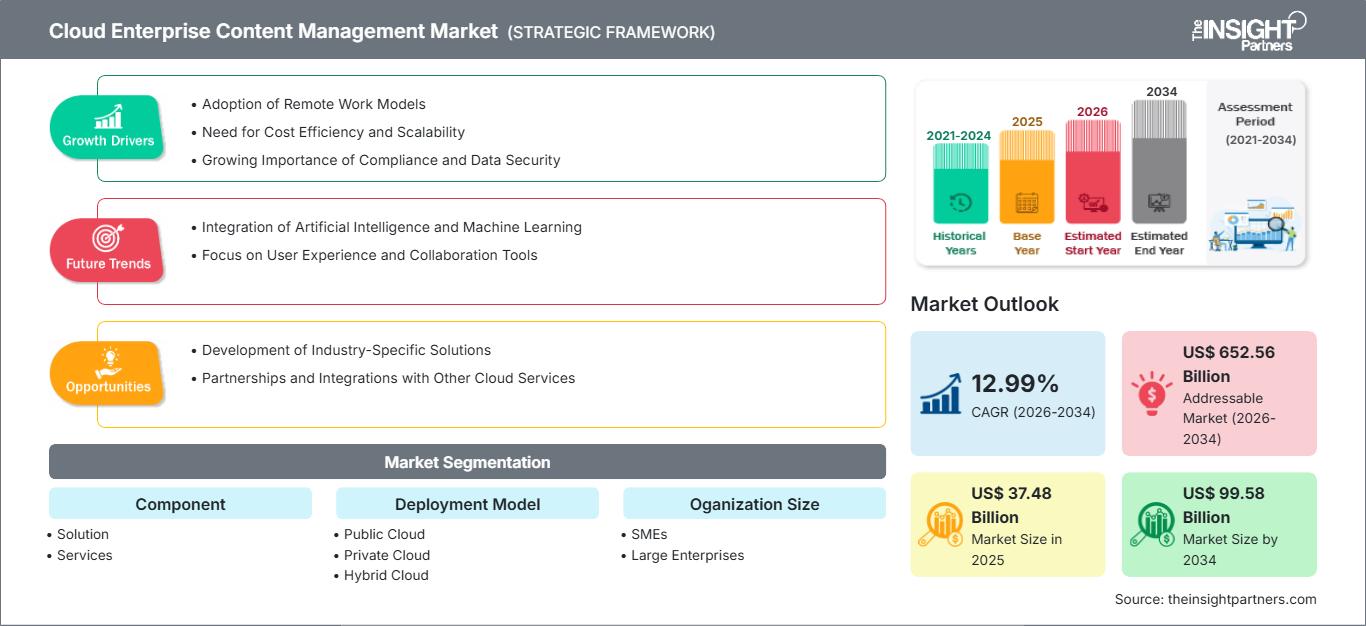
The Cloud Enterprise Content Management market was valued at US$ 37.48 billion in 2025 and is expected to reach US$ 99.58 billion by 2034; it is estimated to record a CAGR of 11.47% during 2026-2034.
Cloud Enterprise Content Management Market Assessment and Insights
- North America: Accounted for 36–39% share in 2025 and is projected to expand at 11.8%–13.5% CAGR during 2026–2034. Enterprise digital transformation, AI-enabled workflow automation, and strict governance regulations continue supporting long-term adoption across regulated industries.
- U.S.: Represented approximately 80–84% of North American revenue in 2025 while expanding at 11.9%–13.4% CAGR. Strong cloud investments, hyperscale infrastructure, and early enterprise AI implementation reinforce regional leadership.
- Europe: Held 25–28% market share in 2025 and is anticipated to grow at 11.4%–12.8% CAGR. Germany, the UK, and France remain leading adopters owing to GDPR compliance, manufacturing digitization, and financial sector modernization.
- Asia Pacific: Accounted for 22–25% share in 2025 while recording the fastest regional expansion of 14.0%–15.8% CAGR. China, Japan, India, South Korea, and Australia continue investing heavily in cloud infrastructure and enterprise digital transformation.
- Largest Segment: Public Cloud represented 45–49% market share in 2025 and is forecast to expand at 12.8%–13.8% CAGR, supported by scalable deployment models, subscription-based pricing, and rapid enterprise migration toward cloud-first IT strategies.
- High Growth Segment: Healthcare is projected to witness 15–18% share in 2025 while growing at 14.5%–16.2% CAGR, driven by electronic health records, digital imaging, regulatory documentation, and secure patient information management requirements.
- Key companies analyzed in detail: Alfresco Software Inc., Box, Inc., DocuWare GmbH, Hewlett Packard Enterprise Development LP, Lexmark International, Inc., Microsoft Corporation, Newgen Software Technologies Limited, Oracle Corporation, Xerox Holdings Corporation, IBM Corporation.
Source: The Insight Partners' analysis based on proprietary research, government publications, company annual reports, investor presentations, industry databases, and expert interviews.
The cloud enterprise content management market has evolved from traditional on-premises document repositories into intelligent cloud-based platforms that combine document lifecycle management, workflow orchestration, records governance, analytics, and artificial intelligence. Increasing enterprise adoption of SaaS applications, hybrid work models, and API-driven digital ecosystems has accelerated platform modernization across industries. Businesses are currently focusing on secure communication of information, document classification through automation, collaboration, and compliance, while minimizing cost and enhancing agility in operations. Innovations continue to happen in the fields of AI content extraction, low-code workflow development, and cloud architecture to revolutionize content management practices around the globe.
Future growth of the market is projected to be driven by higher investments in regions like the Asia Pacific, the Middle East, and Latin America due to increasing initiatives in digital transformation among enterprises and governments. Cloud service providers keep setting up more regional data centers in order to meet the requirements of data residency while securing enterprise deployments. The regulatory focus on information governance, cybersecurity, and privacy will further drive investments in intelligent content management platforms that will enable scalability and automation within businesses.
Cloud Enterprise Content Management Market Report Scope
| Report Attribute | Details |
|---|---|
| Market size in 2025 | US$ 37.48 Billion |
| Market Size by 2034 | US$ 99.58 Billion |
| Global CAGR (2026 - 2034) | 11.47% |
| Historical Data | 2021-2024 |
| Forecast period | 2026-2034 |
Cloud Enterprise Content Management Market Analysis
Digital transformation initiatives remain the primary catalyst supporting the cloud enterprise content management market forecast across both public and private organizations. Enterprises increasingly require centralized platforms capable of managing structured and unstructured information while supporting secure remote collaboration, regulatory compliance, and automated business workflows. Growing adoption of artificial intelligence for document recognition, metadata extraction, and intelligent search has significantly improved operational efficiency. The expansion of cloud infrastructure, combined with increasing demand for business continuity and resilient information management, continues to strengthen enterprise investment in cloud-based content platforms.
The value chain continues evolving through close collaboration among hyperscale cloud providers, software developers, system integrators, cybersecurity vendors, and managed service providers within the cloud enterprise content management market. Organizations increasingly prefer integrated ecosystems that combine enterprise resource planning, customer relationship management, collaboration software, and content governance into unified digital workplaces. This ecosystem approach improves interoperability while reducing implementation complexity and accelerating enterprise-wide digital modernization.
Competitive intensity within the cloud enterprise content management market analysis reflects continuous innovation among established technology providers and specialized software companies. Microsoft Corporation, IBM Corporation, Oracle Corporation, and Hewlett Packard Enterprise Development LP continue expanding intelligent document management capabilities through artificial intelligence, automation, and cloud-native services. Meanwhile, Box, Inc., DocuWare GmbH, Newgen Software Technologies Limited, Alfresco Software Inc., Lexmark International, Inc., and Xerox Holdings Corporation increasingly differentiate their offerings through industry-focused workflow solutions, enhanced compliance capabilities, and advanced content analytics.
Investment activity in the cloud enterprise content management market continues to emphasize artificial intelligence, intelligent process automation, cybersecurity, and industry-specific cloud platforms. Businesses are investing more of their tech budget into scalable models of deployment that use subscription models for minimizing the capital cost but increasing operational agility. Collaboration among the software companies, cloud service providers, and consulting firms is continuously speeding up the process of implementation and allows the company to update its legacy content repositories without disturbing the core business functions of the organization.
● REPORT CUSTOMIZATION
Tailor This Report To Align With Your Specific Business Requirements
This report can be customized to align precisely with your business objectives, scope, and target markets. Customization options include tailored segmentation, geography, competitive analysis, and strategic insights to support informed decision-making.
Customize This Report →WHAT YOU CAN ADJUST
- ● Segmentations
- ● Geography
- ● Competitive Analysis
- ● Language Preferences
Cloud Enterprise Content Management Market: Strategic Insights
Regional Insights
North America Cloud Enterprise Content Management Market
North America accounted for 36–39% of the global cloud enterprise content management market share in 2025 and is projected to register a CAGR of 11.8%–13.5% during 2026–2034. The region benefits from mature cloud infrastructure, high enterprise IT spending, and widespread adoption of digital workplace technologies. Organizations are increasingly replacing legacy content repositories with cloud-native platforms that support secure collaboration, workflow automation, and enterprise-wide governance. In addition, regulatory requirements related to privacy, records retention, and cybersecurity continue to drive investments in scalable content management solutions.
The United States and Canada remain the primary contributors to regional demand in the cloud enterprise content management market, supported by strong hyperscale cloud ecosystems and a large concentration of technology vendors. Financial institutions, healthcare providers, manufacturers, government agencies, and retailers are adopting AI-enabled document processing, automated compliance monitoring, and intelligent search tools to improve efficiency and information management. Continued integration of enterprise content management platforms with ERP, CRM, analytics, and productivity applications is expected to support sustained market growth while enhancing decision-making, security, and digital service delivery across North America.
U.S. Cloud Enterprise Content Management Market
The U.S. represented approximately 80–84% of the North American cloud enterprise content management market in 2025 and is anticipated to expand at a CAGR of 11.9%–13.4% during 2026–2034. The country's leadership is supported by extensive cloud infrastructure, high enterprise software spending, and increasing adoption of artificial intelligence across document-intensive business processes. Organizations are modernizing legacy content repositories to improve operational efficiency, automate workflows, and strengthen regulatory compliance, with particularly strong demand from BFSI, healthcare, government, legal services, and manufacturing sectors.
The presence of major technology providers, including Microsoft Corporation, IBM Corporation, Oracle Corporation, Hewlett Packard Enterprise Development LP, Box, Inc., and Xerox Holdings Corporation, continues to support innovation and market adoption. Enterprises are investing in AI-powered document classification, content discovery, records management, and cloud-based workflow automation to improve productivity and reduce administrative costs. Growing adoption of hybrid cloud environments and integration with ERP, CRM, and productivity platforms is expected to further strengthen the U.S. market position throughout the forecast period.
Europe Cloud Enterprise Content Management Market
Europe accounted for 25–28% of the global market share in 2025 and is projected to expand at a CAGR of 11.4%–12.8% during 2026–2034. This development is further facilitated by the rising digital transformation efforts in the region, greater cloud usage by enterprises, and strict regulation, including the General Data Protection Regulation (GDPR). Enterprises in sectors like financial services, manufacturing, healthcare, and the public sector have been adopting cloud-based content management systems for improved information governance, enhanced data security, and efficient document-centric business processes. The country continues to be the dominant country in the region due to its industrial presence and digitization efforts.
There is still widespread adoption of the technology in the UK as companies adopt new document management software to facilitate a hybrid workplace environment, intelligent workflows, and collaboration. There is also notable growth in France, Italy, and Spain, driven by digital transformation initiatives by governments, increased investment in cloud infrastructures, and adoption of intelligent document processing software in regulated sectors. Regional businesses are focusing on adopting interoperable, scalable, and compliant cloud content management platforms that can easily be integrated with ERP, CRM, and business intelligence tools.
APAC Cloud Enterprise Content Management Market
Asia Pacific accounted for 22–25% of the global cloud enterprise content management market share in 2025 and is projected to record the fastest regional expansion at a CAGR of 14.0%–15.8% during 2026–2034. Rapid enterprise digitalization, expanding cloud infrastructure, and supportive government initiatives promoting digital economies continue to drive demand for cloud enterprise content management solutions. Organizations across manufacturing, BFSI, healthcare, retail, and government sectors are increasingly adopting intelligent document management platforms to improve operational efficiency, strengthen compliance, and enable secure information sharing across distributed business environments. Growing investments in automation, cloud-native applications, and AI-powered content management capabilities are expected to further support the expansion of the regional cloud enterprise content management market share over the forecast period.
China remains the largest regional market due to large-scale enterprise digital transformation and investments in cloud computing. Japan focuses on workflow automation and regulatory compliance, while India benefits from rapid SaaS adoption and expanding IT services. South Korea and Australia continue investing in cloud-first strategies, cybersecurity, and AI-powered enterprise applications, creating favorable conditions for long-term market expansion.
Middle East & Africa Cloud Enterprise Content Management Market
The Middle East & Africa is expected to register a CAGR of 12.2%–13.8% during 2026–2034, supported by accelerating investments in digital government initiatives, enterprise cloud migration, and smart infrastructure projects. Content management systems based on the cloud are becoming more popular in the financial services, energy, health care, and public administration industries as organizations use these tools for regulatory compliance, improved document availability, and greater visibility. Regional investments in data centers also promote cloud-based solutions in terms of security and reliability.
The region's biggest demand comes from Saudi Arabia because of Vision 2030 initiatives, and the United Arab Emirates for its continued development of smart governments and cloud solutions. South Africa also retains importance for the region through enterprise modernization and the digitization of the financial industry.
Segmentation Analysis
Component
The Component segment is expected to expand at a CAGR of 12.7%–13.6% during 2026–2034. The cloud enterprise content management market scope continues to broaden as enterprises increasingly invest in integrated software platforms and consulting services that simplify content governance, automate business workflows, and improve collaboration. Organizations prioritize scalable deployment, cybersecurity, and seamless integration with enterprise applications to maximize operational efficiency.
- Solution – Solutions represent the largest contribution within the component segment as organizations implement document management, records management, workflow automation, collaboration, and intelligent content analytics to improve enterprise productivity and regulatory compliance.
- Services – Services remain strategically important as enterprises require consulting, implementation, migration, integration, managed services, training, and technical support to maximize platform performance and accelerate successful cloud transformation initiatives.
Deployment Model
The Deployment Model segment is anticipated to register a CAGR of 12.8%–13.8% during 2026–2034. Organizations increasingly evaluate deployment strategies based on security, compliance, scalability, operational flexibility, and total cost of ownership. Cloud-native architectures continue enabling enterprises to modernize legacy document repositories while improving collaboration across geographically distributed teams.
- Public Cloud – Public cloud remains the dominant deployment model because of lower infrastructure investment, rapid scalability, subscription-based pricing, continuous software updates, and simplified deployment for enterprises of all sizes.
- Private Cloud – Private cloud deployments continue attracting organizations managing highly sensitive information, particularly within financial services, healthcare, and government sectors, where regulatory compliance and data sovereignty remain critical priorities.
- Hybrid Cloud – Hybrid cloud adoption continues accelerating as organizations combine private infrastructure with public cloud capabilities to optimize workload distribution, improve business continuity, and strengthen enterprise information governance.
Organization Size
The Organization Size segment is projected to grow at a CAGR of 13.0%–14.0% during 2026–2034. Increasing digital transformation initiatives across enterprises of varying sizes continue driving investments in scalable cloud content management platforms. Subscription-based pricing models and flexible deployment options make cloud solutions accessible to organizations with different operational requirements.
- SMEs – Small and medium-sized enterprises increasingly adopt cloud enterprise content management platforms to improve document accessibility, automate workflows, reduce infrastructure costs, and strengthen collaboration without significant capital investment.
- Large Enterprises – Large enterprises remain significant adopters because of extensive compliance requirements, global operations, high document volumes, and continuous investments in enterprise-wide automation and intelligent information governance.
End-Users
The End-Users segment is expected to record a CAGR of 13.4%–14.6% during 2026–2034. Industry-specific compliance requirements, growing digital documentation, and increasing adoption of intelligent workflow automation continue driving demand across multiple verticals. Organizations increasingly integrate AI-enabled content management with core enterprise systems to improve operational performance and regulatory compliance.
- BFSI – Financial institutions increasingly implement intelligent document management to support regulatory reporting, customer onboarding, loan processing, fraud prevention, and secure records management.
- Medical – Medical organizations adopt cloud content management solutions to improve research documentation, laboratory information management, collaboration, and regulatory compliance across healthcare ecosystems.
- Healthcare – Healthcare providers increasingly deploy cloud-based platforms to manage electronic health records, medical imaging, patient documentation, and secure clinical collaboration while maintaining regulatory compliance.
- Manufacturing – Manufacturing companies utilize enterprise content management platforms to manage engineering documentation, quality records, supplier collaboration, product lifecycle information, and operational compliance.
- Retail – Retail organizations leverage cloud content management for supplier documentation, digital contracts, customer records, merchandising content, and omnichannel business process optimization.
Opportunity Snapshot
| End-Users | Revenue Contribution | Trend Tag | Adoption Stage |
| BFSI | High | Digital Banking | Mature |
| Medical | Medium | Clinical Research | Scaling |
| Healthcare | High | Electronic Records | Scaling |
| Manufacturing | Medium | Smart Factory | Scaling |
| Retail | Medium | Omnichannel Content | Mature |
Cloud Enterprise Content Management Market Growth Drivers and Impact Analysis
Accelerating Enterprise Digital Transformation and Cloud Migration
Organizations around the world, irrespective of whether they operate in mature or emerging markets, are increasingly adopting next-generation enterprise content platforms that facilitate secure collaboration, efficient workflow automation, and information governance from within their existing document management systems. The rising trend towards hybrid workforces has been responsible for driving up the need for secure, anywhere and anytime access to enterprise content in compliance with regulatory standards. Cloud deployment simplifies IT infrastructure requirements, saves on maintenance costs, and allows companies to scale operations in a more efficient manner. Continued focus on digital transformation by financial services companies, hospitals, manufacturers, retailers, and governments is further reinforcing market demand. Integration of enterprise content management systems with ERP, CRM, human capital management, and productivity software can also increase efficiency and agility.
Growing Regulatory Compliance and Information Governance Requirements
Enterprises have been working in highly complex regulatory frameworks requiring them to manage, retain, audit, and protect their digital information securely. Financial accounting regulations, healthcare regulations, data privacy regulations, cybersecurity regulations, and corporate governance regulations keep pushing enterprises to update their information management practices. Cloud enterprise content management solutions offer automation of records management, access control, audit capabilities, encryption, and policy-based management of the lifecycle that help enterprises meet regulatory requirements without increasing the overhead. BFSI, healthcare, life sciences, manufacturing, and government sectors are becoming more concerned about having intelligent governance capabilities to reduce business risks and increase transparency. The evolution of global data privacy regulations is yet another factor supporting the enterprise adoption of cloud-based enterprise content management solutions.
Artificial Intelligence Transforming Intelligent Document Processing
Intelligent automation through artificial intelligence (AI) has become one of the key drivers of innovation in enterprise content management, which entails automated categorization of documents, metadata extraction, optical character recognition, intelligent searches, and workflow decision-making. The capabilities provided by the AI enable companies to cut down processing time while improving the quality and availability of the information. It has now become common practice for organizations to use machine learning algorithms to process the unstructured content, uncover business insights, automate approvals, and streamline customer service operations. The use of generative AI together with enterprise content management also makes it possible to implement contextual search and document summarization.
Cloud Enterprise Content Management Market Future Trends
Expansion of AI-Native Content Intelligence Platforms
Artificial intelligence is expected to redefine enterprise content management platforms by enabling intelligent document understanding, semantic search, automated summarization, predictive analytics, and contextual workflow recommendations. Vendors are embedding generative AI capabilities directly into cloud-based platforms to improve employee productivity while simplifying access to enterprise knowledge. Future platforms will increasingly support multilingual content analysis, automated compliance validation, and intelligent decision support. As organizations continue managing rapidly expanding digital information volumes, AI-native content intelligence will become a primary differentiator for enterprise software providers. The cloud enterprise content management market trends indicate increasing investment in responsible AI, explainable automation, and secure enterprise knowledge management throughout the forecast period.
Growing Adoption of Industry-Specific Cloud Content Platforms
Cloud enterprise content management technology vendors have been increasingly launching cloud-based enterprise content management systems that are tailored for highly regulated industries such as financial services, healthcare, government, manufacturing, and life sciences. Such solutions are built on top of predefined compliance controls, workflow templates, industry-focused metadata models, and security features. This approach helps to simplify the implementation process and speed up the digital transformation programs. More and more companies opt for vertical solutions that cater to their specific needs rather than using generic enterprise applications. Collaboration among software vendors, cloud infrastructure providers, and system integrators is likely to drive innovations in this space.
Cloud Enterprise Content Management Market Opportunities
Expansion Across Small and Medium-Sized Enterprises
Small and Medium Enterprises (SMEs) have become one of the most attractive investment areas owing to the fact that cloud subscriptions help mitigate all the usual barriers of implementing ECM among businesses of this size. SMEs tend to transform their business processes into digital ones to provide better services to customers, collaborate better, and comply with new regulations. At the same time, software companies start offering modular, AI-enabled, and low-code solutions, which are easy to implement in a very short period of time. In emerging countries where digital transformation becomes more and more of a strategic focus, solution providers that will be able to offer flexible pricing options and implementation services are sure to enjoy great growth prospects.
Industry-Focused AI and Compliance Solutions
A number of lucrative business opportunities are being created by developing industry-specific content management platforms powered by AI for industries like banking, healthcare, manufacturing, and government, which are subject to regulations. Many companies need intelligent document processing, compliance checking, safe governance of information, and workflow automation, due to rising complexities in running businesses. Companies that are making investments in advanced analytics, generative AI technology, cybersecurity, and cloud-native compliance solutions are set to distinguish themselves in a very competitive environment. Building strategic collaborations with cloud infrastructure suppliers, system integration firms, and consultancies will speed up adoption by enterprises and facilitate the transition from old-school information management systems to newer ones.
Frequently Asked Questions

- Comprehensive Market Sizing and Forecast Analysis
- Detailed Segmentation Analysis
- In-Depth Market Dynamics Assessment
- Regional and Country-Level Insights
- Competitive Landscape and Company Benchmarking
- Strategic Business Intelligence
Recent Reports
Testimonials

The Insight Partners' SCADA System Market report is comprehensive, with valuable insights on current trends and future forecasts. The team was highly professional, responsive, and supportive throughout. We are very satisfied and highly recommend their services.
RAN KEDEM Partner, Reali Technologies LTDs
I requested a report on a very specific software market and the team produced the report in a few days. The information was very relevant and well presented. I then requested some changes and additions to the report. The team was again very responsive and I got the final report in less than a week.
JEAN-HERVE JENN Chairman, Future Analytica
We worked with The Insight Partners for an important market study and forecast. They gave us clear insights into opportunities and risks, which helped shape our plans. Their research was easy to use and based on solid data. It helped us make smart, confident decisions. We highly recommend them.
PIYUSH NAGPAL Sr. Vice President, High Beam Global
The Insight Partners delivered insightful, well-structured market research with strong domain expertise. Their team was professional and responsive throughout. The user-friendly website made accessing industry reports seamless. We highly recommend them for reliable, high-quality research services
YUKIHIKO ADACHI CEO, Deep Blue, LLC.
This is the first time I have purchased a market report from The Insight Partners.While I was unsure at first, I visited their web site and felt more comfortable to take the risk and purchase a market report.I am completely satisfied with the quality of the report and customer service. I had several questions and comments with the initial report, but after a couple of dialogs over email with their analyst I believe I have a report that I can use as input to our strategic planning process.Thank you so much for taking the extra time and making this a positive experience.I will definitely recommend your service to others and you will be my first call when we need further market data.
JOHN SUZUKI President and Chief Executive Officer, Board Director, BK Technologies
I wish to appreciate your support and the professionalism you displayed in the course of attending to my request for information regarding to infectious disease IVD market in Nigeria. I appreciate your patience, your guidance, and the fact that you were willing to offer a discount, which eventually made it possible for us to close a deal. I look forward to engaging The Insight Partners in the future, all thanks to the impression you have created in me as a result of this first encounter.
DR CHIJIOKE ONYIA MANAGING DIRECTOR, PineCrest Healthcare Ltd.Reason to Buy
- Informed Decision-Making
- Understanding Market Dynamics
- Competitive Analysis
- Identifying Emerging Markets
- Customer Insights
- Market Forecasts
- Risk Mitigation
- Boosting Operational Efficiency
- Strategic Planning
- Investment Justification
- Tracking Industry Innovations
- Aligning with Regulatory Trends





 Get Free Sample for