
Cloud Based Data Management Services Market Size, Growth & Demand by 2034
Cloud Based Data Management Services Market Size and Forecasts (2021–2034), Global and Regional Share, Trends, and Growth Opportunity Analysis Report Coverage : By Service Type (Integration Services, Data Security & Backup Services, Quality-as-a-Service ); Service Model (Software-as-a-Service, Platform-as-a-Service, Infrastructure-as-a-Service ); deployment mode: (Public Cloud, Private Cloud); Verticals (BFSI, Government, Healthcare, Telecommunication, IT and ITeS, Retail and eCommerce, Energy and Utilities, Manufacturing, Others)
- Status : Data Released
- Report Code : TIPRE00039776
- Category : Technology, Media and Telecommunications
- No. of Pages : 150
- Available Report Formats :


- Last update date : July 28, 2026


2025 Market Size
US$ 57.32 Bn
Base year value
2034 Forecast
US$ 248.17 Bn
Projected by 2034
CAGR 2026-2034
17.68 %
Growth rate
Addressable Market
US$ 1,269.87 Bn
(2026-2034)
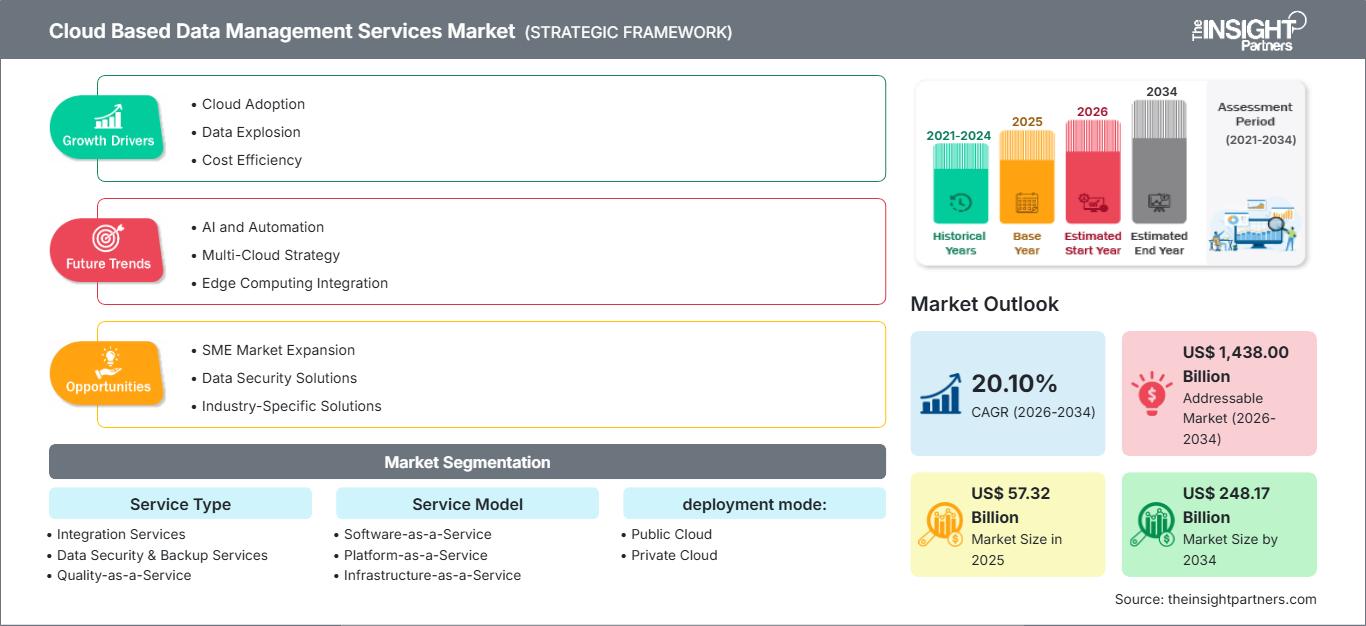
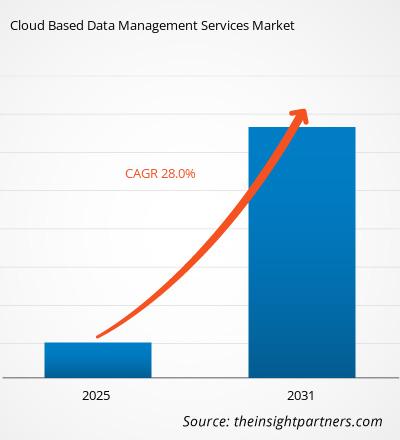
The Cloud Based Data Management Services market was valued at US$ 57.32 billion in 2025 and is expected to reach US$ 248.17 billion by 2034; it is estimated to record a CAGR of 17.68% during 2026-2034.
Cloud Based Data Management Services Market Assessment and Insights
- North America: Holds an estimated 35–39% revenue share in 2025 and is projected to grow at a CAGR of 18.8–19.8% between 2026 and 2034, supported by dense hyperscaler presence and mature enterprise cloud adoption.
- US: Commands approximately 87–91% of North America's share in 2025, expanding at a CAGR of 18.6–19.6% through 2034, led by enterprise cloud migration initiatives.
- Europe: Accounts for approximately 23–27% share in 2025, growing at a CAGR of 20.0–21.2% between 2026 and 2034, with the UK, Germany, and France leading regional deployment through data sovereignty investments.
- Asia Pacific: Represents nearly 22–26% share in 2025 and is forecast to expand at the fastest CAGR of 22.5–24.0% through 2034, led by China, India, and Japan amid rapid enterprise digitalization.
- Largest Segment: The Integration Services segment held an estimated 40–44% market share in 2025 and is projected to grow at a CAGR of 19.8–20.8% between 2026 and 2034, driven by hybrid data pipeline demand.
- High Growth Segment: Platform-as-a-Service holds 27–31% share in 2025 and is the fastest-growing service model, expanding at a CAGR of 22.8–24.2% through 2034, propelled by low-code development adoption.
- Key companies analyzed in detail: International Business Machines Corporation, Fujitsu Limited, Cisco Systems, Inc., Dell Technologies Inc., NetApp, Inc., Informatica Inc., SAS Institute Inc., Actian Corporation, Amazon Web Services, Inc., Oracle Corporation.
Source: The Insight Partners' analysis based on proprietary research, government publications, company annual reports, investor presentations, industry databases, and expert interviews.
Enterprise data infrastructure has seen a significant shift in recent years from isolated on-premises database systems to highly scalable cloud-based platforms that can process both structured and unstructured data in real-time, hybrid environments. This trend is a result of the increased need for enterprises to leverage elastic computing, containers, and automation in their data pipelines instead of legacy batch-based systems for decision-making and lower operational costs in today’s increasingly complex enterprise data ecosystem.
Moving forward, the trend will see increasing use in emerging economies in Southeast Asia, Latin America, and the Middle East as data sovereignty laws are developed, along with increased investment in cloud infrastructure in those regions. Increased investment by vendors in artificial intelligence-powered data quality products, alongside tailwinds in regulation around cross-border data flows, will further support this platform consolidation trend.
Cloud Based Data Management Services Market Report Scope
| Report Attribute | Details |
|---|---|
| Market size in 2025 | US$ 57.32 Billion |
| Market Size by 2034 | US$ 248.17 Billion |
| Global CAGR (2026 - 2034) | 17.68% |
| Historical Data | 2021-2024 |
| Forecast period | 2026-2034 |
Cloud Based Data Management Services Market Analysis
Escalating enterprise data volumes and rising demand for real-time analytics are reinforcing cloud based data management services market growth, as organizations transition legacy infrastructure toward elastic, subscription-based platforms. The ecosystem covers hyperscale cloud service providers, data integration specialists, and system integrators working together for the provision of comprehensive governance, security, and quality solutions for disparate multi-cloud and on-premise data infrastructures.
Market dynamics now tilt in favor of vendors providing modular, API-based solutions that are flexible enough to be deployed under various modes of use. The mid-market specialist companies are teaming up with the large-scale infrastructure providers to tap into scalable computing resources, while the technology companies are integrating the data management solutions directly into the cloud packages.
This cloud based data management services market analysis reveals intensifying competition among hyperscale infrastructure leaders and specialized data integration vendors. Amazon Web Services, Inc. and Oracle Corp. make use of their global data center presence to incorporate governance and security within their current cloud environments, while International Business Machines Corporation and Informatica Inc. engage in competition by means of data integration and hybrid environment expertise.
Interoperability is gaining more importance from the strategic standpoint, with Cisco Systems, Inc. and Dell Technologies Inc. improving their hybrid architectures and edge-to-cloud connectivity solutions. NetApp, Inc. keeps enhancing its unified storage and data fabric solutions, while Fujitsu Ltd., SAS Institute Inc. and Actian Corporation work on analytics-based governance solutions and data quality modules for industries.
● REPORT CUSTOMIZATION
Tailor This Report To Align With Your Specific Business Requirements
This report can be customized to align precisely with your business objectives, scope, and target markets. Customization options include tailored segmentation, geography, competitive analysis, and strategic insights to support informed decision-making.
Customize This Report →WHAT YOU CAN ADJUST
- ● Segmentations
- ● Geography
- ● Competitive Analysis
- ● Language Preferences
Cloud Based Data Management Services Market: Strategic Insights
Regional Insights
North America Cloud Based Data Management Services Market
North America held an estimated 35–39% revenue share of the global cloud based data management services market in 2025 and is projected to grow at a CAGR of 18.8–19.8% between 2026 and 2034. Leadership within the region can be attributed to the heavy concentration of hyperscaler infrastructure, budget allocation for enterprise cloud migrations, and early institutionalization of formal data governance programs in the finance, healthcare, and technology industries that have hybrid data environments.
Drivers for this include increasing enforcement of data privacy regulations, greater artificial intelligence workload deployments requiring extensive data pipelines, and procurement centralization within larger companies. In Canada, there are similar trends developing as a result of the government’s digital infrastructure efforts, and in Mexico, growth in the technology services industry is driving additional regional demand.
U.S. Cloud Based Data Management Services Market
The United States commands approximately 87–91% Cloud Based Data Management Services Market share in North America in 2025 and is forecast to expand at a CAGR of 18.6–19.6% through 2034. This dominance reflects concentrated hyperscale data center investment, extensive enterprise cloud spend across Fortune 500 organizations, and mature managed service provider networks supporting continuous data governance across sprawling multi-cloud infrastructure.
Company presence remains substantial, with Amazon Web Services, Inc., Oracle Corporation, International Business Machines Corporation, and Dell Technologies Inc. maintaining significant domestic operations and enterprise client relationships. Application trends favor AI-augmented data quality platforms, unified governance dashboards, and automated compliance monitoring tools, as large enterprises and federal agencies prioritize scalable, real-time data infrastructure over legacy on-premises database systems amid tightening cybersecurity standards.
Europe Cloud Based Data Management Services Market
Europe accounted for approximately 23–27% share of the global cloud based data management services market in 2025, growing at a CAGR of 20.0–21.2% between 2026 and 2034. Regional momentum is anchored by strong data sovereignty regulation and rising enterprise investment in localized cloud infrastructure, addressing cross-border compliance complexity across diversified manufacturing, financial services, and public sector environments.
The UK leads regional adoption, driven by financial services digitalization and strong managed service provider penetration supporting enterprise governance initiatives. Germany follows closely, propelled by manufacturing sector digitalization and Industry 4.0 integration, requiring robust data pipeline infrastructure. France, Italy, and Spain exhibit steady uptake as national digital sovereignty programs and expanding SME cloud adoption drive demand for regionally compliant data management platforms.
APAC Cloud Based Data Management Services Market
Asia Pacific held nearly 22–26% share of the cloud based data management services market in 2025 and is projected to expand at the fastest regional CAGR of 22.5–24.0% through 2034. China leads adoption through large-scale enterprise digitalization, followed by India's expanding technology services sector, while Japan, South Korea, and Australia contribute steady growth via financial and manufacturing sector cloud modernization.
Industrial and policy drivers include government-led digital economy initiatives, expanding hyperscale data center investment, and rising cybersecurity regulation across telecommunications and BFSI sectors. India's growing IT outsourcing base and China's aggressive cloud infrastructure expansion further reinforce regional platform adoption, positioning APAC as the fastest-growing contributor to global market expansion.
Middle East and Africa Cloud Based Data Management Services Market
The Middle East and Africa region is registering strong momentum, with Saudi Arabia emerging as the leading market amid Vision 2030-aligned digital infrastructure investment and expanding government cloud modernization programs. The region is projected to grow at a CAGR of 19.5–20.6% between 2026 and 2034, supported by rising hyperscale data center construction and expanding public sector compliance requirements.
The UAE follows closely, driven by financial hub digitalization and smart government cloud initiatives requiring centralized data governance. South Africa and the Rest of MEA contribute incremental demand through telecom infrastructure expansion and growing enterprise cloud formalization, as regional organizations increasingly prioritize data security amid tightening cross-border regulatory scrutiny and infrastructure investment. According to the Cloud Based Data Management Services Market report, these trends continue to support broader adoption of cloud-based governance, storage, and compliance solutions across the region.
Segmentation Analysis
Service Type
The Integration Services segment is projected to grow at a CAGR of 19.8–20.8% between 2026 and 2034. This defines the core cloud based data management services market scope, encompassing tools that unify fragmented data sources across hybrid and multi-cloud environments, enabling enterprises to consolidate pipelines, reduce latency, and support real-time analytics across distributed infrastructure.
- Integration Services: Unified data pipeline platforms dominate enterprise procurement, connecting fragmented multi-cloud and on-premises sources while reducing latency across distributed analytics workloads.
- Data Security and Backup Services: Rising cyber threat exposure drives sustained demand for automated encryption, disaster recovery, and compliance-focused backup solutions across regulated industries.
- Quality-as-a-Service: Enterprises increasingly adopt automated data cleansing and validation tools to ensure analytics accuracy, supporting reliable AI model training and reporting outcomes.
Service Model
Platform-as-a-Service is projected to grow at a CAGR of 22.8–24.2% between 2026 and 2034, reflecting Cloud Based Data Management Services Market trends toward greater adoption of managed application environments. Enterprises increasingly favor PaaS offerings to accelerate custom data application development while reducing infrastructure management overhead, positioning this model as the fastest-expanding service category within the broader ecosystem.
- Software-as-a-Service: Fully managed applications dominate small and mid-sized enterprise adoption, offering rapid deployment and reduced technical overhead for standardized data management workflows.
- Platform-as-a-Service: Growing developer demand for managed application environments drives accelerated adoption, supporting custom data pipeline development without an extensive infrastructure management burden.
- Infrastructure-as-a-Service: Large enterprises leverage flexible compute and storage resources to support customized data architecture, maintaining greater control over deployment configurations.
Deployment Mode
Public Cloud deployment is projected to grow at a CAGR of 20.8–21.8% between 2026 and 2034 in the Cloud Based Data Management Services Market, reflecting sustained enterprise preference for scalable, cost-efficient infrastructure. Organizations increasingly favor public cloud environments for elastic workload management, while private cloud retains relevance among highly regulated sectors requiring stringent data residency and control.
- Public Cloud: Scalable, cost-efficient infrastructure dominates enterprise adoption, offering elastic capacity for fluctuating workloads without significant upfront capital infrastructure investment requirements.
- Private Cloud: Regulated industries favor dedicated infrastructure for enhanced data control, supporting stringent compliance and residency requirements across sensitive organizational data environments.
Verticals
The BFSI vertical is projected to grow at a CAGR of 19.5–20.5% between 2026 and 2034 in the Cloud Based Data Management Services Market, reflecting stringent regulatory compliance requirements and extensive legacy data modernization needs driving sustained investment in secure, scalable cloud data governance platforms across global banking and financial services institutions.
- BFSI: Stringent regulatory compliance and extensive legacy modernization needs drive consistent demand for secure, audit-ready cloud data governance platforms across institutions.
- Government: Public sector digitalization and citizen data protection mandates sustain steady adoption of compliance-focused, sovereign-compliant cloud data management solutions.
- Healthcare: Expanding clinical data volumes and regulatory data protection requirements drive rising demand for secure, interoperable cloud data governance platforms.
- Telecommunication: Network data proliferation and 5G infrastructure expansion drive growing demand for real-time data integration and analytics platforms.
- IT and ITeS: High digital maturity and continuous infrastructure modernization sustain leading adoption of advanced multi-cloud data governance solutions.
- Retail and eCommerce: Omnichannel data proliferation and personalization demands drive rising adoption of unified customer data management platforms.
- Energy and Utilities: Grid modernization and IoT sensor data expansion drive growing demand for scalable, real-time data integration infrastructure.
- Manufacturing: Industry 4.0 integration and expanding operational technology data drive rising demand for centralized data governance and analytics platforms.
Opportunity Snapshot
| Verticals | Revenue Contribution | Trend Tag | Adoption Stage |
| BFSI | High | Regulatory Compliance | Mature |
| Government | Medium | Sovereign Cloud | Scaling |
| Healthcare | High | Clinical Interoperability | Scaling |
| Telecommunication | Medium | Network Analytics | Scaling |
| IT and ITeS | High | Multi-Cloud Governance | Mature |
| Retail and eCommerce | Medium | Customer Data Platforms | Scaling |
| Energy and Utilities | Low | Grid Data Integration | Emerging |
| Manufacturing | Medium | Industry 4.0 | Scaling |
Cloud Based Data Management Services Market Growth Drivers and Impact Analysis
Escalating Enterprise Data Volumes Driving Scalable Infrastructure Demand
Enterprises are producing huge amounts of both structured and unstructured data from their customers, processes, and even IoT devices in such quantities that their legacy on-premise database systems can no longer support the increased demands for scale. In doing so, there is a rising need for cloud-native solutions that allow for increasing storage and processing power without needing massive capital expenditure upfront. Enterprises have come to understand that their inability to provide proper infrastructure hinders their analytics capabilities and prevents them from making timely business decisions. With the rise of machine learning and AI, enterprises will need to train their models through large datasets that need to be properly managed.
Intensifying Regulatory Scrutiny Around Data Privacy and Sovereignty
International governments have been implementing tighter data privacy laws with regard to international data transmission, storage, and processing, making companies rely on cloud systems that have good compliance features and data residency tools. Companies that operate in multiple regions find themselves facing the challenge of complying with conflicting laws, which increases their need for platforms that allow automatic compliance checks and data residency tools. This trend is resulting in data management becoming an issue at the board level and beyond, particularly in the BFSI, healthcare, and governmental sectors, where confidential personal data is managed. Cloud vendors with features like automatic audit trails, encryption, and sovereignty cloud systems are seeing disproportionate enterprise interest due to the financial risk involved in breaking such laws.
Accelerating Multi-Cloud and Hybrid Infrastructure Adoption
Organizations are increasingly deploying workloads on multiple cloud platforms and on-premises infrastructures in order to ensure vendor independence, achieve cost savings, and provide resilience to any potential disruptions within service provision. However, such an approach to workload deployment creates a number of data fragmentation issues for which there is currently no remedy; hence, the necessity of platforms that can enable orchestration of data flow and the enforcement of uniform security policies irrespective of the underlying infrastructure becomes even more pressing. Unified data management capabilities have become a valuable source of competitive advantage, allowing faster deployment of analytics capabilities and less redundant operations. The disproportionate demand for vendors offering platform-agnostic solutions is currently driving the Cloud Based Data Management Services Market.
Cloud Based Data Management Services Market Future Trends
AI-Augmented Data Governance and Automated Quality Management
Emerging cloud based data management services market trends indicate deepening integration of artificial intelligence within governance platforms, enabling automated anomaly detection, predictive data quality scoring, and self-healing pipeline architectures. Instead of being dependent upon manual rule setting, future generation platforms will actively find inconsistencies and make suggestions to correct them before any quality problems in data reach downstream analytics and reporting systems. Such an approach will create an edge for AI-powered governance, which will become the key factor that changes vendor and enterprise purchase criteria throughout the forecast period, especially in cases where enterprises manage thousands of data pipelines within multi-cloud/hybrid infrastructures.
Convergence of Data Management With Edge Computing Architectures
There has been an increasing extension of capabilities towards edge computing setups by data management platforms, owing to enterprises seeking to process time-critical data closer to where it originates, instead of funneling all of it through central cloud-based infrastructure. The phenomenon is especially notable for industries like manufacturing, energy, and telecommunication that produce large volumes of IoT sensor data requiring fast analysis. Those vendors that extend their edge-to-cloud data management capabilities using light-weight, distributed processing models stand to gain disproportionate market share, since enterprises are looking at a hybrid governance model of cloud and edge over the coming decade.
Cloud Based Data Management Services Market Opportunities
Expansion Into Underpenetrated Mid-Market and Regional Enterprise Segments
Medium-sized companies located in developing countries offer a huge unexploited potential since, in the past, low financial and technological capacities prevented cloud data management systems from being adopted in comparison with larger multinational. Reduced prices of subscription-based platforms and easy adoption processes allow vendors to take advantage of this new demand through a tiered, scalable model of services suitable for companies without many resources. Managed services providers integrating data governance features into IT management solutions appear to be the most effective distribution channels in order to reach fragmented mid-market segments without IT teams. Platforms developed by vendors that address regional limitations of enterprises can benefit from the digital transformation efforts of such companies.
Vertical-Specific Platform Development for Regulated and Data-Intensive Industries
The healthcare, energy, and governmental sectors offer substantial opportunities to those vendors who have the ability to develop data governance platforms specific to the requirements of each sector. There is an underserved market for vertical data governance platforms that do not adequately cater to the unique requirements in terms of regulatory compliance and technological integration with respect to clinical data or critical infrastructure telemetry. Those vendors who invest in vertical certifications and regulatory compliance are likely to be able to offer premium positioning in these segments. With greater compliance issues in the areas of both health care data privacy and energy infrastructure security becoming common, the platforms with vertical expertise will gain an outsized share in these segments.
Frequently Asked Questions

- Comprehensive Market Sizing and Forecast Analysis
- Detailed Segmentation Analysis
- In-Depth Market Dynamics Assessment
- Regional and Country-Level Insights
- Competitive Landscape and Company Benchmarking
- Strategic Business Intelligence
Recent Reports
Testimonials

The Insight Partners provided valuable market intelligence that supported our global go-to-market strategy. Their team was professional, responsive, and attentive to our feedback, providing thoughtful analysis and helpful methodological clarifications throughout the project.
Junmo Kim Chief Financial Officer (CFO), Enertech Co., Ltd.
The Insight Partners' SCADA System Market report is comprehensive, with valuable insights on current trends and future forecasts. The team was highly professional, responsive, and supportive throughout. We are very satisfied and highly recommend their services.
RAN KEDEM Partner, Reali Technologies LTDs
I requested a report on a very specific software market and the team produced the report in a few days. The information was very relevant and well presented. I then requested some changes and additions to the report. The team was again very responsive and I got the final report in less than a week.
JEAN-HERVE JENN Chairman, Future Analytica
We worked with The Insight Partners for an important market study and forecast. They gave us clear insights into opportunities and risks, which helped shape our plans. Their research was easy to use and based on solid data. It helped us make smart, confident decisions. We highly recommend them.
PIYUSH NAGPAL Sr. Vice President, High Beam Global
The Insight Partners delivered insightful, well-structured market research with strong domain expertise. Their team was professional and responsive throughout. The user-friendly website made accessing industry reports seamless. We highly recommend them for reliable, high-quality research services
YUKIHIKO ADACHI CEO, Deep Blue, LLC.
This is the first time I have purchased a market report from The Insight Partners.While I was unsure at first, I visited their web site and felt more comfortable to take the risk and purchase a market report.I am completely satisfied with the quality of the report and customer service. I had several questions and comments with the initial report, but after a couple of dialogs over email with their analyst I believe I have a report that I can use as input to our strategic planning process.Thank you so much for taking the extra time and making this a positive experience.I will definitely recommend your service to others and you will be my first call when we need further market data.
JOHN SUZUKI President and Chief Executive Officer, Board Director, BK Technologies
I wish to appreciate your support and the professionalism you displayed in the course of attending to my request for information regarding to infectious disease IVD market in Nigeria. I appreciate your patience, your guidance, and the fact that you were willing to offer a discount, which eventually made it possible for us to close a deal. I look forward to engaging The Insight Partners in the future, all thanks to the impression you have created in me as a result of this first encounter.
DR CHIJIOKE ONYIA MANAGING DIRECTOR, PineCrest Healthcare Ltd.Reason to Buy
- Informed Decision-Making
- Understanding Market Dynamics
- Competitive Analysis
- Identifying Emerging Markets
- Customer Insights
- Market Forecasts
- Risk Mitigation
- Boosting Operational Efficiency
- Strategic Planning
- Investment Justification
- Tracking Industry Innovations
- Aligning with Regulatory Trends





 Get Free Sample for