
Change Configuration Management Market Growth, Trends & Forecast by 2034
Change Configuration Management Market Size and Forecasts (2021–2034), Global and Regional Share, Trends, and Growth Opportunity Analysis Report Coverage : By y Components (Software and Services), Deployment (Cloud and On-premise), Organization Size (SME and Enterprises)
- Status : Data Released
- Report Code : TIPRE00039771
- Category : Technology, Media and Telecommunications
- No. of Pages : 150
- Available Report Formats :


- Last update date : July 28, 2026


2025 Market Size
US$ 2.13 Bn
Base year value
2034 Forecast
US$ 4.08 Bn
Projected by 2034
CAGR 2026-2034
7.49 %
Growth rate
Addressable Market
US$ 27.99 Bn
(2026-2034)
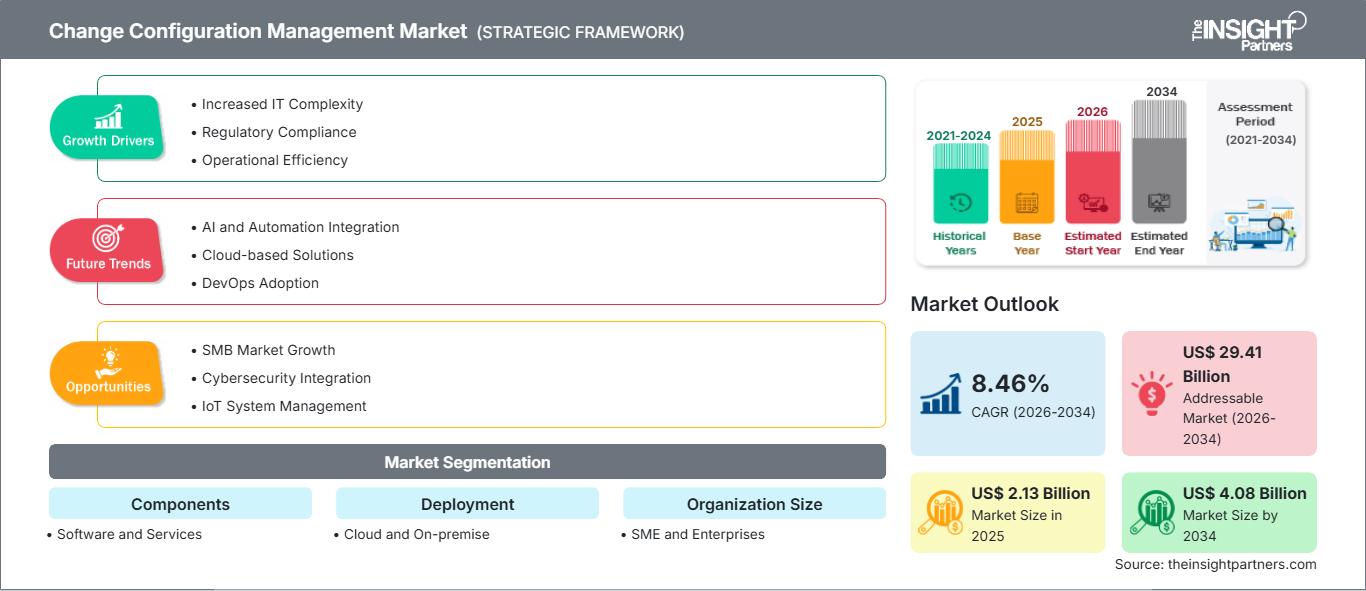
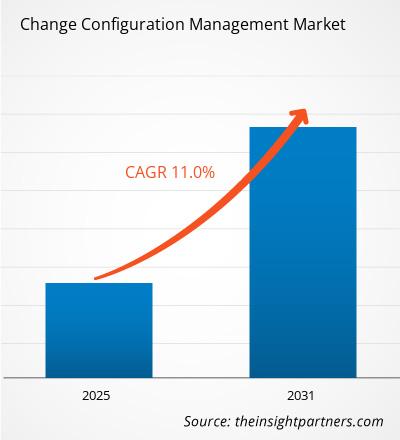
The Change Configuration Management market was valued at US$ 2.13 billion in 2025 and is expected to reach US$ 4.08 billion by 2034; it is estimated to record a CAGR of 7.49% during 2026-2034.
Change Configuration Management Market Assessment and Insights
- North America holds an estimated 34-38% share in 2025 and is projected to grow at a CAGR of 7.8-8.3% between 2026 and 2034, driven by regulatory compliance needs, cloud-first enterprise strategies, and dense vendor ecosystems.
- US accounts for the majority of North American demand, holding roughly 84-88% regional share in 2025 and advancing at a CAGR of 7.7-8.2% between 2026 and 2034.
- Europe commands an estimated 24-28% share in 2025 and is set to grow at a CAGR of 8.0-8.5% between 2026 and 2034, with Germany and the UK leading adoption through manufacturing digitization and financial services modernization.
- Asia Pacific represents an estimated 20-24% share in 2025 and is forecast to expand at a CAGR of 9.3-9.9% between 2026 and 2034, led by China, India, and Japan amid rapid enterprise IT modernization.
- Largest Segment: Software holds an estimated 62-66% share in 2025 and is projected to grow at a CAGR of 8.5-9.0% between 2026 and 2034, reflecting deep enterprise reliance on automated configuration platforms.
- High Growth Segment: Cloud deployment holds an estimated 46-50% share in 2025 and is projected to expand at a CAGR of 9.6-10.1% between 2026 and 2034, outpacing on-premise adoption.
- Key companies analyzed in detail: Microsoft, IBM, Hewlett Packard Enterprise, CA Technologies, ServiceNow, BMC Software, AWS, Chef Software, Puppet, and Codenvy.
Source: The Insight Partners' analysis based on proprietary research, government publications, company annual reports, investor presentations, industry databases, and expert interviews.
Enterprise IT environments have evolved from manually documented configuration records toward automated, version-controlled infrastructure oversight. Early deployments centered on static asset tracking, while contemporary platforms within the change configuration management market integrate continuous compliance monitoring, infrastructure-as-code practices, and real-time drift detection. Production environments now demand configuration accuracy across hybrid and multi-cloud architectures, pushing vendors to embed policy-as-code frameworks and automated remediation into core platform architecture, reducing manual intervention across increasingly distributed enterprise IT estates and multi-vendor technology stacks.
In the future, adoption is anticipated to expand in developing economies in Southeast Asia, Latin America, and the Middle East due to companies upgrading their outdated systems. Increased cyber regulations, data localization policies, and digital transformation programs spearheaded by the governments are anticipated to direct new investments to configuration management solutions, especially midsize enterprises that can leverage such solutions without huge costs incurred.
Change Configuration Management Market Report Scope
| Report Attribute | Details |
|---|---|
| Market size in 2025 | US$ 2.13 Billion |
| Market Size by 2034 | US$ 4.08 Billion |
| Global CAGR (2026 - 2034) | 7.49% |
| Historical Data | 2021-2024 |
| Forecast period | 2026-2034 |
Change Configuration Management Market Analysis
Demand for the change configuration management market growth is intensifying as enterprises manage increasingly distributed hybrid and multi-cloud infrastructures. Organizations require centralized visibility into configuration states to reduce unplanned downtime, avoid configuration drift, and maintain audit readiness across regulated industries such as banking, healthcare, and telecommunications.
The value chain includes platform vendors, systems integrators, managed service providers, and cloud infrastructure partners. The dynamics of the supply side support vendors that have a modular API architecture that can interface with existing DevOps toolchain, since companies want interoperability with their configuration platform and other infrastructure.
Competitive dynamics within the change configuration management market analysis reveal intensifying consolidation, as established IT vendors expand configuration capabilities through platform integration and targeted acquisitions. Microsoft and IBM continue embedding configuration governance into broader cloud and hybrid IT management suites, while ServiceNow and BMC Software strengthen enterprise service management integration.
In terms of investments in infrastructure technologies, the automation-first approach is predominant, with such companies as Hewlett Packard Enterprise, AWS, Chef Software, Puppet, and CA Technologies directing the development process to be aligned with infrastructure as code and policy automation. The company Codenvy keeps promoting the approach, which is focused on developers, meaning that the industry is moving toward integrating configuration management into the software development lifecycle.
● REPORT CUSTOMIZATION
Tailor This Report To Align With Your Specific Business Requirements
This report can be customized to align precisely with your business objectives, scope, and target markets. Customization options include tailored segmentation, geography, competitive analysis, and strategic insights to support informed decision-making.
Customize This Report →WHAT YOU CAN ADJUST
- ● Segmentations
- ● Geography
- ● Competitive Analysis
- ● Language Preferences
Change Configuration Management Market: Strategic Insights
Regional Insights
North America change configuration management Market
North America held an estimated 34-38% share of the change configuration management market share in 2025 and is projected to expand at a CAGR of 7.8-8.3% between 2026 and 2034. The region benefits from mature cloud infrastructure, a dense concentration of enterprise software vendors, and stringent regulatory oversight across finance, healthcare, and government sectors requiring auditable configuration records.
The structural factors are accelerating the usage of hybrid cloud, increasing cybersecurity requirements under frameworks like NIST, and consistent investments by enterprises in the IT modernization process. Public sector digital transformation in Canada adds some demand for the region, while the increasing technology services industry in Mexico boosts regional platform adoption, making North America the leading configuration governance market worldwide.
U.S. change configuration management Market
The United States accounts for approximately 84–88% of North American demand in the Change Configuration Management Market and is projected to grow at a CAGR of 7.7–8.2% between 2026 and 2034. Extensive presence of enterprise software vendors, robust cloud infrastructure investment, and stringent federal compliance mandates across finance, defense, and healthcare sectors sustain consistent platform demand nationwide.
Organizations’ presence is limited to existing headquarters, such as Microsoft, IBM, ServiceNow, BMC Software, and AWS, together with niche vendors like Chef Software and Puppet. There is an ongoing trend in applications to be incorporated into the DevOps pipeline, container management systems, and compliance monitoring systems, due to organizations' preference for automated fixes over configuration audits in light of increased regulation and cloud-native workloads.
Europe change configuration management Market
Europe held an estimated 24–28% share of the Change Configuration Management Market in 2025 and is projected to grow at a CAGR of 8.0–8.5% between 2026 and 2034, with Germany emerging as the leading contributor, supported by manufacturing digitization and stringent GDPR-driven data governance requirements across enterprise IT environments.
There is sustainable demand for configuration management governance in the UK by way of modernizing financial services, along with an increasing managed service provider ecosystem that facilitates mid-market adoption of configuration management governance solutions in London-based technology districts and enterprise clusters across the country.
Germany is a leader in regional adoption through Industry 4.0 manufacturing programs, but France, Italy, and Spain are significant sources of demand as corporations continue to modernize their IT infrastructure. France specializes in public sector compliance tools, Italy in financial services governance, and Spain in mid-size enterprise cloud migration and regulation.
APAC change configuration management Market
Asia Pacific held an estimated 20–24% share of the Change Configuration Management Market in 2025 and is projected to expand at a CAGR of 9.3–9.9% between 2026 and 2034, the fastest among all regions. China leads regional demand through large-scale enterprise cloud migration, expanding domestic technology infrastructure investment, and ongoing digital transformation initiatives across key industries.
Japan and South Korea contribute steady demand through manufacturing and telecommunications modernization, while India's expanding IT services sector and Australia's regulatory tightening around data governance support broader regional adoption. Government-led digital infrastructure policies across the region continue to reinforce enterprise configuration governance investment.
Middle East & Africa change configuration management Market
The Middle East and Africa region is projected to grow at a CAGR of 8.9-9.4% between 2026 and 2034, led by Saudi Arabia amid Vision 2030-aligned digital infrastructure investment and expanding enterprise cloud adoption across banking and energy sectors.
The UAE contributes through smart government initiatives and financial hub digitization, while South Africa and the Rest of MEA see gradual adoption tied to energy sector modernization and expanding telecommunications infrastructure, as regional enterprises prioritize compliance tooling amid tightening data protection regulation.
Segmentation Analysis
Components
The Components segment is projected to grow at a CAGR of 8.6-9.1% between 2026 and 2034. Software dominates enterprise spending as organizations prioritize automated, scalable configuration platforms, while Services demand grows steadily as enterprises seek implementation, integration, and managed support expertise to operationalize complex configuration governance frameworks across distributed IT environments.
- Software: Represents the core platform layer enabling automated configuration tracking, policy enforcement, and drift detection, remaining the preferred investment priority among enterprises modernizing IT governance infrastructure.
- Services: Encompasses consulting, integration, and managed support offerings that help enterprises operationalize configuration platforms, particularly valuable for organizations lacking in-house automation expertise.
Deployment
Within the change configuration management market scope, Deployment is projected to grow at a CAGR of 8.8-9.3% between 2026 and 2034. Cloud deployment increasingly dominates new implementations as enterprises prioritize scalability and remote accessibility, while On-premise deployment retains relevance among highly regulated organizations requiring direct infrastructure control and data residency assurance.
- Cloud: Preferred by enterprises pursuing scalability, faster deployment cycles, and reduced infrastructure overhead, particularly among organizations operating distributed or hybrid IT environments requiring centralized configuration visibility.
- On-premise: Retained by highly regulated industries including defense, banking, and government agencies, requiring strict data residency control and direct infrastructure oversight beyond standard cloud governance frameworks.
Organization Size
Organization Size is projected to grow at a CAGR of 8.3-8.8% between 2026 and 2034. Enterprises continue to dominate platform spending given complex, multi-site infrastructure requirements, while SMEs represent an accelerating adoption segment as vendors introduce scaled-down, cost-efficient configuration governance solutions tailored to smaller IT footprints.
- SME: Increasingly adopts simplified, subscription-based configuration platforms as vendors introduce cost-efficient tooling suited to smaller IT teams and limited in-house automation capabilities.
- Enterprises: Continue driving majority platform spending given complex multi-site infrastructure, extensive regulatory obligations, and dedicated IT governance teams requiring advanced automation and compliance capabilities.
Opportunity Snapshot
| Industry Vertical | Revenue Contribution | Trend Tag | Adoption Stage |
| BFSI | High | Compliance Automation | Mature |
| Healthcare | Medium | Audit Readiness | Scaling |
| IT and Telecommunications | High | DevOps Integration | Mature |
| Government | Medium | Data Residency | Scaling |
| Manufacturing | Medium | Industry 4.0 | Scaling |
| Retail and E-commerce | Low | Omnichannel IT | Emerging |
| Energy and Utilities | Low | Grid Digitization | Emerging |
Change Configuration Management Market Growth Drivers and Impact Analysis
Accelerating Hybrid Cloud Adoption Across Enterprise IT Environments
Firms are operating hybrid and multi-cloud environments, which include cloud computing environments, private data centers, and edge computing environments. The complexity associated with such configurations cannot be effectively managed using manual processes. Automation of configuration governance tools is used to give firms visibility and standardized change controls on all assets. They help firms lower configuration drifts, reduce security threats, and avoid unexpected downtime. Firms operating in the financial sector, healthcare, and government entities that have high audit needs are adopting such automated platforms.
As businesses expand their use of clouds and modernize their existing IT environments, the need for tools that can manage configuration states in heterogeneous infrastructure becomes even more pronounced, helping to fuel growth in the Change Configuration Management Market. In addition to this, there is an increasing focus among businesses on automation, compliance, and integration into DevOps and IT service management processes in order to reduce the time taken for deployments while ensuring compliance standards. The vendors that are catering to these requirements through their interoperable, API-centric, and cloud-native approaches, along with analytics capabilities, are taking up disproportionate market share, as businesses consolidate their governance offerings on a few platforms.
Rising Regulatory Compliance and Cybersecurity Mandates
The broadening regulatory regimes on data privacy, cybersecurity, and operational resilience have forced companies to adopt configuration governance policies. The standards that focus on continuous monitoring, change management, and logging of infrastructure configurations have forced companies to adopt real-time configuration management rather than traditional manual configuration management policies. This has forced the regulated industries, such as banks, insurers, health care providers, and infrastructure operators, to invest continuously in configuration governance solutions.
Regional regulatory divergence, particularly between North American, European, and Asia Pacific frameworks, further increases demand for flexible solutions capable of adapting to jurisdiction-specific compliance requirements and reporting standards. Organizations are increasingly seeking platforms that provide automated policy enforcement, detailed audit trails, and centralized visibility across complex IT environments. As regulatory scrutiny intensifies and cyber risks continue to evolve, configuration governance is becoming a core enterprise risk management function rather than a discretionary IT investment, reinforcing long-term growth in the Change Configuration Management Market across increasingly regulated and interconnected operating environments.
Expanding DevOps and Infrastructure-as-Code Adoption
Software Development for Enterprises Now More Often Follows DevOps Approaches and Infrastructure as Code Practices and Integrates Configuration Management in CI/CD Processes. This is a revolution that turns the governance process into an automated task, which is proactive rather than reactive and enables organizations to benefit from greater consistency, increased speed of deployments, and minimized risks. In such conditions, the growing collaboration between developers and operations teams makes configuration control a priority.
Companies embracing infrastructure as code models need to use configuration systems that can provide versioning, testing, policy checks, and integration into current developer tool chains. With an increase in the speed of releases and the adoption of containers, microservices, and cloud native application architectures, there is an increasing need for platforms that can offer live configuration checks across development, test, and production phases. Automation features will further help reduce errors, improve deployment performance, and facilitate better compliance checks. This makes configuration management an essential part of infrastructure in software engineering practices rather than an ancillary one, thereby helping boost the Change Configuration Management Market.
Change Configuration Management Market Future Trends
Convergence with AI-Driven Predictive Configuration Analytics
The change configuration management market trends increasingly point toward the integration of predictive analytics and machine learning capabilities within governance platforms. Vendors are embedding anomaly detection algorithms capable of identifying configuration drift before operational impact occurs, shifting platforms from reactive remediation toward proactive risk mitigation. This evolution enables enterprises to anticipate infrastructure failures, security vulnerabilities, and compliance gaps ahead of formal audit cycles, reducing operational risk while improving resource allocation efficiency across complex, distributed IT environments requiring continuous configuration oversight and automated intelligent decision support at scale.
Deepening Integration with Security and Zero Trust Architectures
Configuration governance solutions are becoming increasingly aligned with cybersecurity and Zero Trust Architectures because there is an ever-growing understanding of the critical role of configuration integrity as a cornerstone of the security stance. Vendors are now incorporating continuous configuration verification into their security operations workflows, allowing for immediate correlation between configuration and vulnerability exposure. The alignment allows configuration governance solutions to become integral parts of the enterprise security architecture rather than IT operations-focused products, as vendors are partnering across cybersecurity ecosystem players to achieve comprehensive visibility from infrastructure configuration to threats.
Change Configuration Management Market Opportunities
Expansion Among Mid-Market and SME Enterprises
There is a clear chance of leveraging configurability management functionality into smaller and mid-level companies that have not benefited much from expensive and complex platforms before. Providers of streamlined solutions through subscription-based services with less complicated setup processes can benefit from the growing demand of companies that are implementing their digital transformation strategy without having much experience with automation in-house. In addition, the investment in the lower-end levels of platforms, self-service implementation and managed services partnerships will allow vendors to tap into the huge untapped market. With cloud infrastructure prices dropping and mature managed services environments being formed, mid-market enterprises become a realistic prospect for vendors willing to make adjustments.
Emerging Market Infrastructure Modernization Investment
The change configuration management market Forecasts point toward substantial opportunity across emerging economies undertaking large-scale digital infrastructure modernization. Government-led initiatives across Southeast Asia, Latin America, and the Middle East are channeling investment toward enterprise IT governance frameworks as organizations transition from legacy systems toward cloud-native architectures. Vendors establishing early regional partnerships, localized support infrastructure, and compliance tooling aligned with jurisdiction-specific regulatory requirements stand to capture a disproportionate share as these markets mature. Strategic investment in regional data center partnerships and local systems integrator relationships positions vendors favorably ahead of accelerating enterprise adoption across these expanding technology markets.
Frequently Asked Questions

- Comprehensive Market Sizing and Forecast Analysis
- Detailed Segmentation Analysis
- In-Depth Market Dynamics Assessment
- Regional and Country-Level Insights
- Competitive Landscape and Company Benchmarking
- Strategic Business Intelligence
Recent Reports
Testimonials

The Insight Partners' SCADA System Market report is comprehensive, with valuable insights on current trends and future forecasts. The team was highly professional, responsive, and supportive throughout. We are very satisfied and highly recommend their services.
RAN KEDEM Partner, Reali Technologies LTDs
I requested a report on a very specific software market and the team produced the report in a few days. The information was very relevant and well presented. I then requested some changes and additions to the report. The team was again very responsive and I got the final report in less than a week.
JEAN-HERVE JENN Chairman, Future Analytica
We worked with The Insight Partners for an important market study and forecast. They gave us clear insights into opportunities and risks, which helped shape our plans. Their research was easy to use and based on solid data. It helped us make smart, confident decisions. We highly recommend them.
PIYUSH NAGPAL Sr. Vice President, High Beam Global
The Insight Partners delivered insightful, well-structured market research with strong domain expertise. Their team was professional and responsive throughout. The user-friendly website made accessing industry reports seamless. We highly recommend them for reliable, high-quality research services
YUKIHIKO ADACHI CEO, Deep Blue, LLC.
This is the first time I have purchased a market report from The Insight Partners.While I was unsure at first, I visited their web site and felt more comfortable to take the risk and purchase a market report.I am completely satisfied with the quality of the report and customer service. I had several questions and comments with the initial report, but after a couple of dialogs over email with their analyst I believe I have a report that I can use as input to our strategic planning process.Thank you so much for taking the extra time and making this a positive experience.I will definitely recommend your service to others and you will be my first call when we need further market data.
JOHN SUZUKI President and Chief Executive Officer, Board Director, BK Technologies
I wish to appreciate your support and the professionalism you displayed in the course of attending to my request for information regarding to infectious disease IVD market in Nigeria. I appreciate your patience, your guidance, and the fact that you were willing to offer a discount, which eventually made it possible for us to close a deal. I look forward to engaging The Insight Partners in the future, all thanks to the impression you have created in me as a result of this first encounter.
DR CHIJIOKE ONYIA MANAGING DIRECTOR, PineCrest Healthcare Ltd.Reason to Buy
- Informed Decision-Making
- Understanding Market Dynamics
- Competitive Analysis
- Identifying Emerging Markets
- Customer Insights
- Market Forecasts
- Risk Mitigation
- Boosting Operational Efficiency
- Strategic Planning
- Investment Justification
- Tracking Industry Innovations
- Aligning with Regulatory Trends





 Get Free Sample for