
Cloud Orchestration Market Trends, Demand & Growth by 2034
Coverage: By Service (Reporting & Analytics, Cloud Service Automation, Support & Maintenance, Training & Consulting, and Integration), Deployment (Public Cloud, Hybrid Cloud, and Private Cloud), Application (Autoscaling, Compliance Auditing, Provisioning, and Others), Enterprise Size (Small and Medium Enterprise and Large Enterprise), Industry (BFSI, Education, Manufacturing, Government, Media & Entertainment, IT & Telecommunication, and Others), and Geography
- Status : Data Released
- Report Code : TIPTE100000726
- Category : Technology, Media and Telecommunications
- No. of Pages : 150
- Available Report Formats :


- Last update date : August 04, 2026


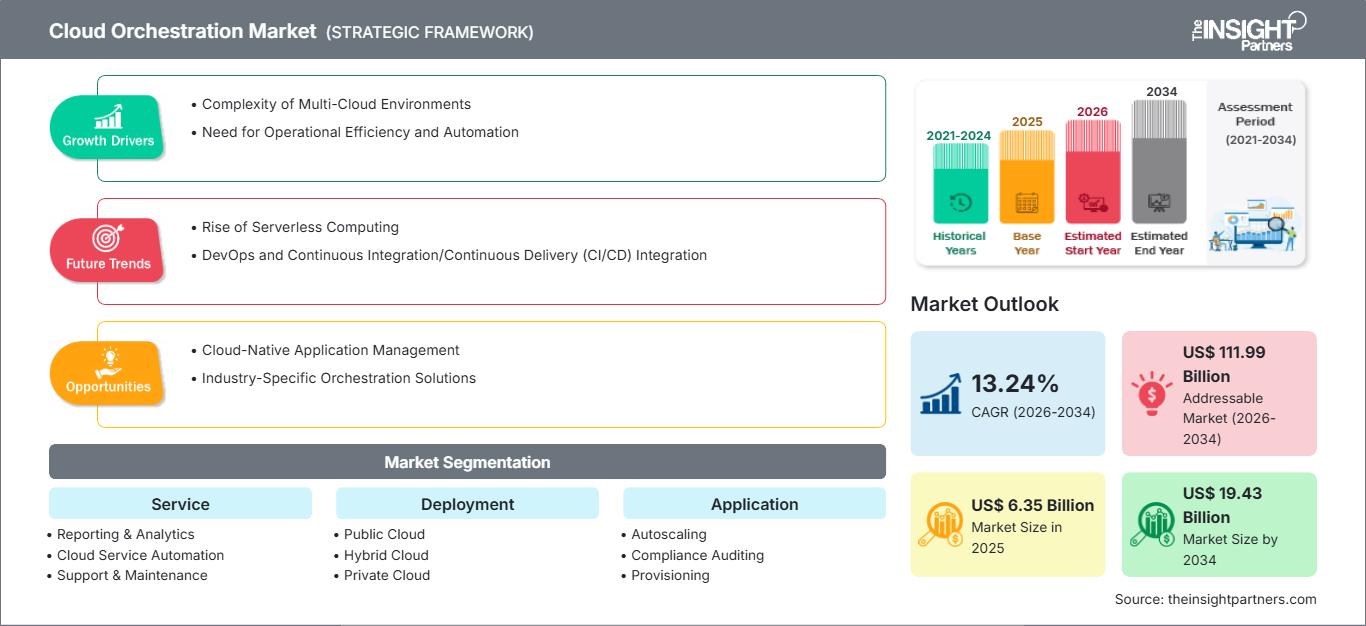
2025 Market Size
US$ 6.35 Bn
Base year value
2034 Forecast
US$ 19.43 Bn
Projected by 2034
CAGR 2026-2034
13.24 %
Growth rate
Addressable Market
US$ 111.99 Bn
(2026-2034)
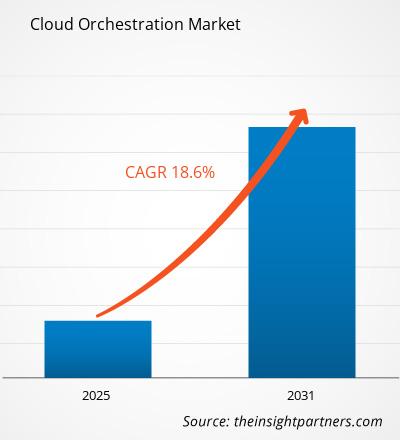
The cloud orchestration market was valued at US$ 6.35 billion in 2025 and is projected to reach US$ 19.43 billion by 2034, expanding at a CAGR of 13.24% during the forecast period from 2026 to 2034. This growth trajectory reflects accelerating enterprise adoption of multi-cloud and hybrid cloud environments, alongside increasing demand for automated provisioning, compliance auditing, and autoscaling capabilities across global IT infrastructures.
North America currently leads the cloud orchestration market in terms of revenue share, supported by mature cloud infrastructure ecosystems and high enterprise readiness for automation technologies. The region is expected to grow at a CAGR between 12–14% through 2034, driven by strong investments in cloud-native architectures and regulatory compliance frameworks across financial services, healthcare, and technology sectors that continue to shape procurement strategies.
Cloud Orchestration Market Assessment and Insights
- North America: Held an estimated 36–38% market share in 2025 and is projected to grow at a CAGR of 12–14% between 2026–2034, underpinned by robust digital transformation initiatives and early adoption of cloud automation platforms.
- US: Accounted for approximately 78–80% of North America’s cloud orchestration market share in 2025, growing at a CAGR of 12–13%, fueled by hyperscaler partnerships and enterprise cloud migration programs.
- Europe: Represented 26–28% of the global market share in 2025, with a CAGR of 11–13%, led by Germany, UK, and France as top adopters due to GDPR-driven compliance automation needs.
- Asia Pacific: Contributed 22–24% to global market share in 2025, expanding at a CAGR of 14–16%, with China, Japan, and India driving demand through government digitization and SME cloud adoption.
- Largest Segment: Cloud Service Automation held 32–34% market share in 2025, growing at a CAGR of 12–14%, as enterprises prioritize end-to-end workflow automation and resource optimization.
- High Growth Segment: Training & Consulting is anticipated to register a CAGR of 15–17% between 2026–2034, starting from 12–14% share in 2025, reflecting skills gap challenges and demand for implementation support.
- Key companies analyzed in detail: Morpheus Data LLC, BMC Software Inc., CloudBolt Software Inc., Cloudify Platform Ltd., Embotics Corporation, IBM, Juniper Networks Inc. (AppFormix), Microsoft Inc., Tata Consultancy Services, VMware Inc.
Source: The Insight Partners' analysis based on proprietary research, government publications, company annual reports, investor presentations, industry databases, and expert interviews.
The cloud orchestration market has evolved from basic infrastructure automation to intelligent, policy-driven orchestration platforms that integrate AI/ML for predictive scaling and anomaly detection. While early efforts were limited to provisioning and monitoring, modern-day platforms have taken on compliance-as-code, FinOps enablement, and serverless orchestration of workflows to cater to the increasingly sophisticated needs of enterprises operating in the world of hybrid/multi-cloud.
Moving ahead, new market areas in APAC and MEA regions would contribute most towards future growth driven by government initiatives to digitally transform and increased SME cloud adoption. Favorable regulations, such as data localization and cybersecurity policies, would drive even more investments into orchestration platforms, especially those catering to the BFSI, healthcare, and public sector domains.
Cloud Orchestration Market Report Scope
| Report Attribute | Details |
|---|---|
| Market size in 2025 | US$ 6.35 Billion |
| Market Size by 2034 | US$ 19.43 Billion |
| Global CAGR (2026 - 2034) | 13.24% |
| Historical Data | 2021-2024 |
| Forecast period | 2026-2034 |
Cloud Orchestration Market Analysis
Demand for cloud orchestration solutions is primarily driven by the proliferation of hybrid and multi-cloud architectures, contributing to the growth of the Cloud Orchestration Market size. Organizations increasingly require centralized management, automated policy enforcement, and dynamic resource allocation capabilities across complex cloud environments. They are also implementing Infrastructure as Code (IaC), CI/CD pipelines, and compliance automation solutions to increase automation, reduce risks of deployments, and speed up development of applications and services.
The supply chain includes cloud service providers, orchestration platform providers, system integrators, and enterprise customers from different industries. The supply chain is driven by collaborations between cloud providers (AWS, Azure, GCP) and orchestration companies that allow users to seamlessly integrate orchestration capabilities with native cloud services without any restrictions on the control plane provided by the vendor. The rapid innovation cycle allows regular updates of orchestration APIs, SDKs, and templates for typical scenarios (disaster recovery, autoscaling, cost optimization).
Competitive positioning in the cloud orchestration market is defined by platform extensibility, integration breadth, and ease of deployment. Prominent vendors like Morpheus Data, BMC Software, and Cloudify differentiate themselves by hybrid cloud capabilities, AI-powered automation, and robust partner ecosystems. Trends in investment include higher levels of mergers and acquisitions; for example, HPE acquired Morpheus Data in 2024 to strategically consolidate cloud management portfolios amid rising demand for cloud management and orchestration across edge/core/public clouds.
Vertical solutions are an important aspect of positioning strategy with vendors designing cloud management software solutions tailored for BFSI, healthcare, and telecommunication verticals to address their specific compliance and performance needs. Self-service provisioning and governance are key strategies adopted by CloudBolt and VMware, while consulting/managed services are a key strategy of IBM and Tata Consulting Services (TCS).
● REPORT CUSTOMIZATION
Tailor This Report To Align With Your Specific Business Requirements
This report can be customized to align precisely with your business objectives, scope, and target markets. Customization options include tailored segmentation, geography, competitive analysis, and strategic insights to support informed decision-making.
Customize This Report →WHAT YOU CAN ADJUST
- ● Segmentations
- ● Geography
- ● Competitive Analysis
- ● Language Preferences
Cloud Orchestration Market: Strategic Insights
Regional Insights
North America cloud orchestration market
North America’s cloud orchestration market is projected to grow at a CAGR of 12–14% from 2026 to 2034, supported by advanced cloud infrastructure maturity and high enterprise readiness for automation technologies. Some structural growth factors are the extensive use of DevOps methods, need for compliance with regulations, and a high prevalence of hyperscalers that help to integrate orchestration solutions with native cloud services effortlessly.
In the region, there is an abundance of cloud-native startups, traditional enterprise software companies, and system integrators providing full-scale orchestration. Leading adopters are financial services, healthcare, and tech sectors focused on automated provisioning, compliance auditing, and cost optimization.
U.S. cloud orchestration market
The U.S. accounts for approximately 78–80% of North America’s market share in 2025, with a CAGR of 12–13% expected through 2034. Company presence is concentrated among global leaders such as Morpheus Data, BMC Software, and VMware, alongside hyperscaler-native tools from AWS, Azure, and GCP that drive competitive innovation and pricing pressure, contributing to growth in the Cloud Orchestration Market size.
Application trends highlight strong demand for autoscaling, compliance auditing, and provisioning automation, particularly among Fortune 500 enterprises and government agencies. The U.S. market also leads in AI-driven orchestration adoption, with organizations leveraging machine learning for predictive scaling, anomaly detection, and resource optimization to enhance operational resilience and reduce cloud spend across hybrid and multi-cloud deployments.
Europe cloud orchestration market
Europe holds 26–28% of the global market share in 2025, expanding at a CAGR of 11–13% through 2034, according to the Cloud Orchestration Market report. The countries at the forefront are Germany, the UK, and France. These nations have stringent compliance policies such as GDPR and NIS2, which necessitate automation of compliance and data governance. This leads to the need for platforms that automate policy enforcement and provide an audit trail.
Germany takes the lead in the adoption of cloud technologies in industrial settings, especially the manufacturing industry and automobile industry. For them, it is all about hybrid cloud orchestration. The UK emphasizes financial services and digitization of the public sector, while France stresses sovereignty-compliant cloud. Italy and Spain have shown increased adoption among small and medium enterprises (SMEs).
APAC cloud orchestration market
Asia Pacific contributes 22–24% to the global share in 2025, with a CAGR of 14–16% projected through 2034, reflecting key Cloud Orchestration Market trends. Top countries are China, Japan, South Korea, India, and Australia, where industrial digitization, cloud initiatives by governments, and cloud uptake by SMEs are the key demand drivers for orchestration platforms that offer scalability and cost-effectiveness.
Drivers are “Made in China 2025,” the Society 5.0 policy in Japan, and the Digital India project, which promote cloud-based solutions and automation. Cybersecurity and data sovereignty concerns prevail in Australia and South Korea, while the Southeast Asia countries push cloud usage via public-private collaborations and innovation ecosystems.
Middle East & Africa cloud orchestration market
The Middle East & Africa cloud orchestration market is anticipated to grow at a CAGR of 15–17% from 2026 to 2034, starting from a smaller base but showing strong momentum. Key players in the region include Saudi Arabia, the UAE, and South Africa, where energy diversity, smart city development, and telecommunications network modernization are key drivers of cloud automation and orchestration.
Contextual relevance to energy and infrastructure includes the Saudi Vision 2030 and the National AI Strategy of the UAE, focusing on digital transformation with cloud computing in the oil and gas industry, logistics, and public services. South Africa is ahead with fintech and e-commerce developments, and the rest of MEA is an emerging market with a mobile-focused digital economy and rising internet usage.
Segmentation Analysis
Service
The Service segment of the cloud orchestration market is projected to grow at a CAGR of 13–15% from 2026 to 2034, driven by increasing demand for end-to-end automation, compliance management, and professional services to support complex cloud deployments. Enterprises prioritize Cloud Service Automation for workflow orchestration, while Reporting & Analytics and Integration services gain traction for visibility and interoperability across hybrid environments.
- Reporting & Analytics enables real-time visibility into resource utilization, cost allocation, and performance metrics, supporting data-driven decision-making and FinOps initiatives across multi-cloud deployments.
- Cloud Service Automation forms the core of orchestration platforms, automating provisioning, scaling, and policy enforcement to reduce manual intervention and accelerate application delivery cycles.
- Support & Maintenance ensures platform reliability, security patching, and performance optimization, critical for enterprise-grade SLAs and continuous operations across distributed cloud infrastructures.
- Training & Consulting addresses skills gaps and implementation complexity, helping organizations design cloud strategies, migrate workloads, and optimize orchestration workflows for maximum ROI.
- Integration facilitates seamless connectivity between orchestration platforms and existing ITSM, DevOps, and security tools, enabling unified governance and operational consistency across heterogeneous environments.
Deployment
The Deployment segment of the cloud orchestration market is expected to grow at a CAGR of 12–14% from 2026 to 2034, with Hybrid Cloud emerging as the dominant model due to its balance of flexibility, control, and compliance capabilities. Public Cloud and Private Cloud deployments also show strong adoption, particularly among SMEs and regulated enterprises, respectively.
- Public Cloud offers scalability and cost-efficiency, appealing to startups and digital-native enterprises seeking rapid deployment without infrastructure overhead, though governance and compliance remain key considerations.
- Hybrid Cloud combines on-premises control with public cloud elasticity, favored by large enterprises and regulated industries requiring data residency, sovereignty, and seamless workload portability across environments.
- Private Cloud provides maximum security and customization, adopted by government agencies, BFSI, and healthcare organizations prioritizing data protection, though higher TCO and management complexity limit broader adoption.
Application
The Application segment of the cloud orchestration market is projected to grow at a CAGR of 13–15% from 2026 to 2034, led by Provisioning and Autoscaling use cases that directly impact operational efficiency and cost optimization. Compliance Auditing gains importance as regulatory frameworks tighten globally, while Other applications support niche workflows and custom integrations.
- Autoscaling dynamically adjusts compute, storage, and network resources based on real-time demand, reducing over-provisioning costs and improving application performance during traffic spikes or seasonal fluctuations.
- Compliance Auditing automates policy enforcement, audit trail generation, and regulatory reporting, critical for BFSI, healthcare, and public sector organizations facing stringent governance and data protection mandates.
- Provisioning automates infrastructure deployment, configuration, and onboarding, accelerating time-to-market for new applications and reducing human error in complex, multi-cloud environments.
- Others include niche applications such as disaster recovery orchestration, workload migration, and custom workflow automation, supporting specialized enterprise needs and industry-specific use cases.
Enterprise Size
The Enterprise Size segment of the cloud orchestration market is anticipated to grow at a CAGR of 12–14% from 2026 to 2034, with Large Enterprises currently holding the majority share due to complex IT landscapes and higher automation budgets. Small and Medium Enterprises show faster growth potential as cloud costs decline and managed services become more accessible.
- Small and Medium Enterprise adoption is accelerating due to affordable SaaS-based orchestration tools, managed services, and increasing awareness of cloud cost optimization benefits, particularly in APAC and MEA regions.
- Large Enterprise remains the dominant segment, driven by complex hybrid cloud architectures, regulatory compliance needs, and strategic investments in cloud-native transformation, with BFSI, manufacturing, and telecom leading adoption.
Opportunity Snapshot
| Service | Revenue Contribution | Trend Tag | Adoption Stage |
| Reporting & Analytics | High | FinOps Integration | Scaling |
| Cloud Service Automation | High | AI-Driven Orchestration | Mature |
| Support & Maintenance | Medium | SLA Assurance | Mature |
| Training & Consulting | Medium | Skills Gap Bridging | Emerging |
| Integration | High | API-First Ecosystems | Scaling |
Cloud Orchestration Market Growth Drivers and Impact Analysis
Rise of Hybrid and Multi-Cloud Architectures
The proliferation of hybrid and multi-cloud architectures is a primary driver of cloud orchestration market growth, as enterprises seek to balance flexibility, cost-efficiency, and regulatory compliance across distributed environments. The orchestration platform helps in managing operations centrally, enforces policies automatically, and allows allocation of resources dynamically.
Businesses have reported drastic improvements in terms of quicker deployment, fewer errors, and better cost savings when using orchestration tools, which have been seen as providing up to 67 percent faster deployment along with 76 percent less time taken for compliance verification. This impact is particularly pronounced in regulated sectors such as BFSI, healthcare, and the public sector, where governance and data sovereignty mandates require robust automation and audit capabilities across hybrid and multi-cloud deployments, supporting the Cloud Orchestration Market forecast.
Regulatory Compliance and Data Governance Mandates
The growing need for regulatory compliance and data governance is spurring the adoption of cloud orchestration solutions that come with built-in policy enforcement, audit trail creation, and automatic reporting features. Compliance regulations like GDPR, HIPAA, and NIS2 mandate companies to have tight control over data location, access, and security configuration in their cloud platforms.
Automation of compliance checks, real-time audit trails creation, and preventing non-compliance via the policy as code feature helps to decrease the compliance check effort by up to 76%. Such a feature is essential for BFSI, healthcare, and government organizations that have to comply with tough governance standards and want to achieve compliance faster than before.
Cost Optimization and Resource Efficiency Demands
Today's firms have been focusing on optimization of costs and better utilization of resources, resulting in increased usage of cloud orchestration systems that provide automated scaling, rightsizing of resources, and FinOps support. Cloud orchestration solutions allow businesses to get rid of over-provisioning of cloud resources, optimize the allocation of workloads, and save cloud costs via automated mechanisms and cost monitoring.
By using cloud orchestration for optimizing costs, businesses have been able to significantly cut down cloud expenses, some reaching even up to 30-40% savings thanks to automated rightsizing and scheduling of workloads. The benefits of using cloud orchestration to reduce cloud expenses have proved to be highly valuable for large corporations and SMEs.
Cloud Orchestration Market Future Trends
AI-Driven Orchestration and Predictive Automation
Intelligent orchestration powered by AI is becoming a growing trend, and orchestration tools will be increasingly relying on machine learning to scale automatically, detect anomalies, and perform self-healing tasks. Intelligent orchestrators can evaluate past use cases and anticipate future needs, adjusting resource management and optimizing costs automatically, without any human input required.
Moreover, generative AI and large language models are already becoming tools for helping with designing workflows and generating playbooks to manage incidents. This trend will only continue as AI technology advances, allowing businesses to automate cloud operations to a degree where almost no human effort is required at all, especially in the case of highly dynamic environments such as e-commerce, streaming, or the Internet of Things.
Edge Computing and Distributed Orchestration
Edge computing integration with cloud orchestration is gaining traction, as enterprises extend automation and governance capabilities to distributed edge environments for low-latency, localized processing. Next-generation orchestration platforms support lightweight distributions like k3s, KubeEdge, and AWS Greengrass, enabling consistent policy enforcement and workload management across edge, core, and cloud infrastructures.
This trend is particularly relevant for industries such as manufacturing, logistics, and telecommunications, where real-time data processing and localized decision-making are critical. As edge deployments scale, orchestration platforms will need to handle intermittent connectivity, limited resources, and diverse hardware, creating new opportunities for vendors specializing in distributed cloud management and edge-native automation solutions.
Cloud Orchestration Market Opportunities
SME Cloud Adoption and Managed Services Expansion
Small and medium enterprises represent a high-growth opportunity for cloud orchestration vendors, as cloud costs decline and managed services become more accessible and affordable. SMEs increasingly recognize the benefits of automation for cost optimization, compliance, and operational efficiency, but lack in-house expertise and resources to implement complex orchestration solutions independently.
Vendors can capitalize on this opportunity by offering simplified, SaaS-based orchestration tools with pre-built templates, guided onboarding, and managed services packages tailored to SME needs. Partnerships with cloud MSPs, system integrators, and hyperscalers can further extend reach, enabling SMEs to leverage enterprise-grade orchestration capabilities without significant upfront investment or ongoing management overhead.
Vertical-Specific Orchestration Solutions
Vertical-specific orchestration solutions present a significant opportunity for vendors to differentiate and capture market share in regulated industries such as BFSI, healthcare, and public sector. These industries face unique compliance, security, and performance requirements that generic orchestration platforms may not fully address, creating demand for tailored solutions with industry-specific workflows, policies, and integrations.
Vendors can develop vertical-specific offerings by partnering with industry associations, regulatory bodies, and system integrators to embed domain expertise into their platforms. This approach not only enhances product relevance and stickiness but also enables premium pricing and stronger customer relationships, as organizations prioritize solutions that understand and address their specific operational and regulatory challenges.
Frequently Asked Questions

- Comprehensive Market Sizing and Forecast Analysis
- Detailed Segmentation Analysis
- In-Depth Market Dynamics Assessment
- Regional and Country-Level Insights
- Competitive Landscape and Company Benchmarking
- Strategic Business Intelligence
Recent Reports
Testimonials

The Insight Partners' SCADA System Market report is comprehensive, with valuable insights on current trends and future forecasts. The team was highly professional, responsive, and supportive throughout. We are very satisfied and highly recommend their services.
RAN KEDEM Partner, Reali Technologies LTDs
I requested a report on a very specific software market and the team produced the report in a few days. The information was very relevant and well presented. I then requested some changes and additions to the report. The team was again very responsive and I got the final report in less than a week.
JEAN-HERVE JENN Chairman, Future Analytica
We worked with The Insight Partners for an important market study and forecast. They gave us clear insights into opportunities and risks, which helped shape our plans. Their research was easy to use and based on solid data. It helped us make smart, confident decisions. We highly recommend them.
PIYUSH NAGPAL Sr. Vice President, High Beam Global
The Insight Partners delivered insightful, well-structured market research with strong domain expertise. Their team was professional and responsive throughout. The user-friendly website made accessing industry reports seamless. We highly recommend them for reliable, high-quality research services
YUKIHIKO ADACHI CEO, Deep Blue, LLC.
This is the first time I have purchased a market report from The Insight Partners.While I was unsure at first, I visited their web site and felt more comfortable to take the risk and purchase a market report.I am completely satisfied with the quality of the report and customer service. I had several questions and comments with the initial report, but after a couple of dialogs over email with their analyst I believe I have a report that I can use as input to our strategic planning process.Thank you so much for taking the extra time and making this a positive experience.I will definitely recommend your service to others and you will be my first call when we need further market data.
JOHN SUZUKI President and Chief Executive Officer, Board Director, BK Technologies
I wish to appreciate your support and the professionalism you displayed in the course of attending to my request for information regarding to infectious disease IVD market in Nigeria. I appreciate your patience, your guidance, and the fact that you were willing to offer a discount, which eventually made it possible for us to close a deal. I look forward to engaging The Insight Partners in the future, all thanks to the impression you have created in me as a result of this first encounter.
DR CHIJIOKE ONYIA MANAGING DIRECTOR, PineCrest Healthcare Ltd.Reason to Buy
- Informed Decision-Making
- Understanding Market Dynamics
- Competitive Analysis
- Identifying Emerging Markets
- Customer Insights
- Market Forecasts
- Risk Mitigation
- Boosting Operational Efficiency
- Strategic Planning
- Investment Justification
- Tracking Industry Innovations
- Aligning with Regulatory Trends





 Get Free Sample for