
Co-Packaged Optics Market Size, Share & Demand by 2034
Co-Packaged Optics Market Size and Forecasts (2021 - 2034), Global and Regional Share, Trends, and Growth Opportunity Analysis Report Coverage : By Type (CPO, NPO), Data Rates (less than 1.6 T & 1.6 T, 3.2 T, 6.4 T), Application (Data Center and High-performance Computing, and Telecommunication and Networking)
- Status : Data Released
- Report Code : TIPRE00039799
- Category : Electronics and Semiconductor
- No. of Pages : 150
- Available Report Formats :


- Last update date : July 31, 2026


2025 Market Size
US$ 160.72 Mn
Base year value
2034 Forecast
US$ 1,387.20 Mn
Projected by 2034
CAGR 2026-2034
27.06 %
Growth rate
Addressable Market
US$ 5,759.08 Mn
(2026-2034)
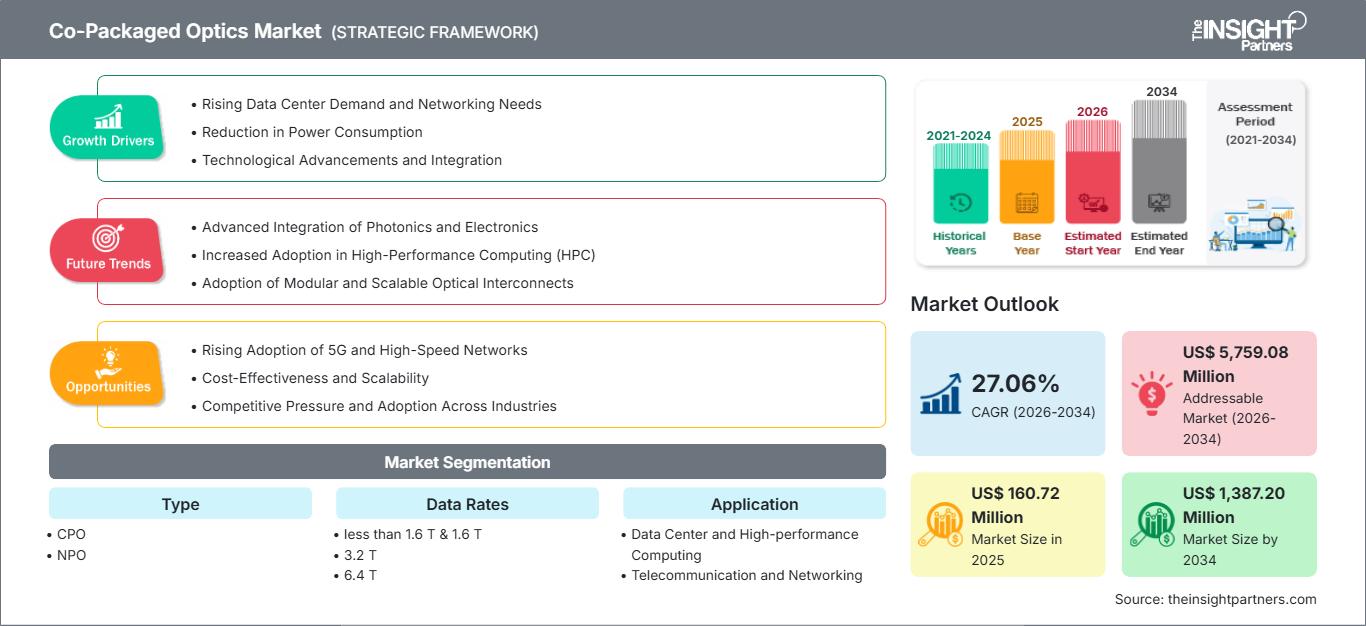
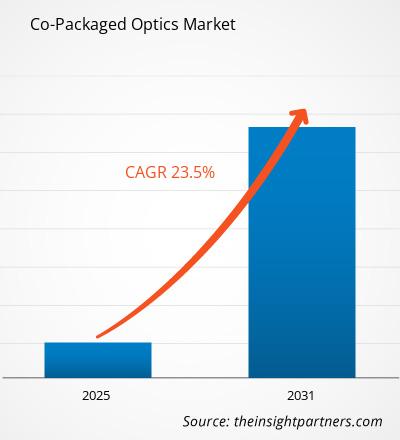
The Co-Packaged Optics Market is estimated at US$ 160.72 Million in 2025, with a forecasted growth to US$ 1,387.20 Million by 2034 at a CAGR of 27.06% from 2026–2034. Adoption will shift from proof of concept in laboratories to AI cluster networking, hyperscale switching, and fabric of high-performance computing applications as bandwidth density, low optical power, and reach losses become major considerations for purchases.
The Co-Packaged Optics Market size is anticipated to grow at a CAGR in the range of 25.8–28.6% during 2026-2034 in the North American region due to cloud infrastructure operators, AI infrastructure providers, and high-end switch vendors facing power and reach issues in pluggable optics technology. Growth factors include local semiconductor packaging capabilities, data centers' investments, and qualification in 51.2 Tb/s and 102.4 Tb/s switches.
Co-Packaged Optics Market Assessment and Insights
- North America: The region holds 36–40% share in 2025 and is forecast to grow at a CAGR of 25.8–28.6% during 2026–2034, driven by hyperscale AI data centers and switch silicon innovation.
- US: The country represents 82–86% of North America in 2025 and is projected to grow at a CAGR of 26.2–29.0% during 2026–2034.
- Europe: Europe accounts for 18–22% share in 2025 and is expected to grow at a CAGR of 23.5–26.4% during 2026–2034, led by Germany, the UK, France, the Netherlands, and Sweden.
- Asia Pacific: Asia Pacific represents 30–34% share in 2025 and is forecast to grow at a CAGR of 28.4–31.2% during 2026–2034, with China, Japan, South Korea, India, and Taiwan expanding photonics supply chains.
- Largest Segment: CPO holds 60–64% market share in 2025 and is expected to grow at a CAGR of 26.0–28.8% during 2026–2034.
- High Growth Segment: 3.2 T holds 24–28% market share in 2025 and is expected to grow at a CAGR of 30.0–33.0% during 2026–2034.
- Key companies analyzed in detail: Broadcom Inc.; Cisco Systems, Inc.; International Business Machines Corporation; Intel Corporation; Microsoft Corporation; TE Connectivity plc; Furukawa Electric Co., Ltd.; Kyocera Corporation; Huawei Technologies Co., Ltd.; Marvell Technology, Inc.
Source: The Insight Partners' analysis based on proprietary research, government publications, company annual reports, investor presentations, industry databases, and expert interviews.
Networking infrastructure is moving from faceplate-pluggable optics towards greater integration of optics and electronics due to the rise of AI training cluster applications and east-west traffic which drive switch radix up. Today's production considerations include silicon photonic wafer fabrication, optical engine design, substrate engineering, laser source separation, fiber management, OSAT ramp, and thermal design. This means that the market of Co-Packaged Optics moves from experimenting with components to systems qualification, and yield, field serviceability and interoperability are key for the productization stage.
Demand going forward will grow due to migration of AI data centers beyond 51.2 Tb/s switching, telecom clouds' need for lower-power optical transport technology, and government support of photonics packaging in national semiconductor programs. Future geographies will become customers through their cloud campuses and electronics manufacturing clusters. Increasing pressure of regulatory and sustainability forces on data center energy efficiency will drive adoption of architectures that reduce power consumption of optical modules but keep link integrity intact.
Co-Packaged Optics Market Report Scope
| Report Attribute | Details |
|---|---|
| Market size in 2025 | US$ 160.72 Million |
| Market Size by 2034 | US$ 1,387.20 Million |
| Global CAGR (2026 - 2034) | 27.06% |
| Historical Data | 2021-2024 |
| Forecast period | 2026-2034 |
Co-Packaged Optics Market Analysis
The demand is created by the presence of AI accelerators, clouds, and high-performance computing, which need shorter electrical interconnects from the switch ASIC to optical ports. Co-packaged optics market growth factors are rising bandwidth per rack, rising port density, and the quest for lowering picowatts per bit. The co-packaged optics supply chain comprises switch silicon, silicon photonics, laser diode, substrate, fiber connectors, heat sink assemblies, contract manufacturing, network software, and hyperscale qualification labs.
The dynamics of supply side favor those suppliers that are capable of matching the capabilities of photonic die, electrical die, packaging, firmware, diagnostics, and service on a single platform qualified platform. The Co-Packaged Optics Market Report shows that the cost is not estimated only for the module but also for switch power, cooling, link availability, reparability, and job interruption risk in the cluster.
Competitive environment consists of the leaders of switch ASICs market, cloud operators, semiconductor companies, connector companies, and photonics platforms vendors. Broadcom Inc., Cisco Systems, Inc., Intel Corporation, Microsoft Corporation, Marvell Technology, Inc., TE Connectivity plc, Furukawa Electric Co., Ltd., Kyocera Corporation, Huawei Technologies Co., Ltd., and International Business Machines Corporation take complementary positions on silicon, systems, research, cabling, and deployment aspects.
Trends of investments include 200 Gbps per lane optics, 3.2 Tbps and 6.4 Tbps interface roadmap, detachable laser technology, and manufacturing process without yield loss scaling. Positioning strategy is moving towards demonstrating reliability in high temperature, ease of field replacement, and ecosystem partnerships. The suppliers able to demonstrate reliability with hyperscale operators could win the designs ahead of volume production.
● REPORT CUSTOMIZATION
Tailor This Report To Align With Your Specific Business Requirements
This report can be customized to align precisely with your business objectives, scope, and target markets. Customization options include tailored segmentation, geography, competitive analysis, and strategic insights to support informed decision-making.
Customize This Report →WHAT YOU CAN ADJUST
- ● Segmentations
- ● Geography
- ● Competitive Analysis
- ● Language Preferences
Co-Packaged Optics Market: Strategic Insights
Regional Insights
North America Co-Packaged Optics Market
North America holds 36–40% share in 2025 and is projected to expand at a CAGR of 25.8–28.6% during 2026–2034. The market share is supported by hyperscale cloud operators, AI model training campuses, switch ASIC innovation, and advanced semiconductor packaging capacity concentrated in the US.
Procurement considerations include the minimization of power, the robustness of the links, use of functional lasers, and thermal design considerations. Cloud providers and network equipment providers in the United States drive the timing of the deployment since they have dense GPU clusters where the cost of electrical interconnection starts to become expensive. This also includes 102.4 Tb/s switching being adopted by regional customers.
U.S. Co-Packaged Optics Market
The US contributes 82-86% of North America’s market demand in 2025 and is expected to have a CAGR of 26.2-29.0% during the period of 2026-2034. The trend of application includes data center and HPC fabrics, AI scale-up networks, cloud switching, and core telecommunications upgrades.
The strength of presence is demonstrated through switch solutions by Broadcom Inc., networking systems by Cisco Systems, Inc., silicon photonics by Intel Corporation, hyperscale systems by Microsoft Corporation, research by International Business Machines Corporation, and optical DSP by Marvell Technology, Inc. The buyers consider proof of qualification, supply chain security, operational monitoring, and ecosystem readiness before using dense clusters for new optical solutions.
Europe Co-Packaged Optics Market
Europe constitutes 18-22% market share for 2025 and is expected to have a growth rate of CAGR of 23.5-26.4% from 2026-2034. Germany is leading in Europe with photonics research, semiconductor equipment demand, and industrial cloud. UK is contributing with networking research and data centers based on AI. France is contributing to sovereign cloud, telecom, and high performance computing.
Italy, Spain, The Netherlands, and Sweden are adding demand in colocation, optical component manufacturing, and telecom infrastructure. Energy efficiency is an important criteria among European buyers due to the power limitations of data center and scrutiny of permits. TE Connectivity plc, Furukawa Electric Co., Ltd., Kyocera Corporation, Cisco Systems, Inc., and Intel Corporation are supporting ecosystems in the region.
APAC Co-Packaged Optics Market
The APAC region holds a share of 30–34% in 2025 and is forecasted to witness a CAGR of 28.4–31.2% from 2026 to 2034. China is a leading country, owing to cloud proliferation, AI infrastructure development, and its own photonic technology plans.
Countries such as Japan, South Korea, Taiwan, India, and Australia contribute towards the growth due to the packaging of semiconductors, manufacture of optical components, sovereign cloud deployments, and HPC centers. The major policies driving the growth are chip localization, AI computing, and energy-conscious infrastructure plans. Major players are Huawei Technologies Co., Ltd., Kyocera Corporation, and Furukawa Electric Co., Ltd.
Middle East & Africa Co-Packaged Optics Market
Middle East & Africa is projected to grow at a CAGR of 21.5–24.2% during 2026–2034. Saudi Arabia is the leading country as AI campuses, sovereign cloud programs, and digital infrastructure investment expand. The UAE supports data center construction, smart government platforms, and regional cloud availability zones.
MEA-Rest follows selective adoption through telecom backbone, cloud enterprise, and research computing. Energy context is essential since energy dense AI centers need good connectivity and cooling systems. The suppliers should ensure that there is a match of technology, integration partner, service capability, and TCO analysis to move from pilot projects to full-scale deployments.
Segmentation Analysis
Type
The Type segment is projected to grow at a CAGR of 26.8–29.6% during 2026–2034 as buyers compare near-package optical integration with fully co-packaged switch architectures. Co-Packaged Optics Market scope includes CPO and NPO designs that reduce electrical channel length, improve bandwidth density, and shift reliability engineering toward package, laser, connector, and thermal interfaces.
- CPO leads deployment interest because optical engines are integrated closest to switch silicon, reducing electrical losses and supporting high-bandwidth AI fabrics where power per bit is critical.
- NPO supports transitional adoption by placing optics near processing packages while retaining comparatively easier service access, making it attractive for staged migration from pluggable modules.
Data Rates
The Data Rates segment is estimated to grow at a CAGR of 27.5–30.5% during 2026–2034 as networks progress from sub-1.6 T links toward 3.2 T and 6.4 T optical interfaces. Adoption is tied to AI cluster scale, switch bandwidth, thermal design, and lane-speed roadmaps that determine whether operators prioritize incremental upgrades or full architectural shifts.
- less than 1.6 T & 1.6 T supports early deployments, testbeds, and incremental upgrades where operators validate packaging, diagnostics, fiber routing, and thermal reliability before committing to higher-density networks.
- 3.2 T is strategically important for near-term AI fabrics because it balances bandwidth uplift, manufacturability, service learning, and compatibility with evolving 200G-per-lane optical roadmaps.
- 6.4 T targets future ultra-dense switching environments where AI training clusters require higher aggregate bandwidth, lower latency, and reduced cabling complexity across large accelerator pools.
Application
The Application segment is projected to grow at a CAGR of 26.5–29.4% during 2026–2034. Data center and high-performance computing environments lead because AI workloads create dense east-west traffic, while telecommunication and networking adoption follows as carriers modernize core transport, routing, and cloud interconnect platforms.
- Data Center and High-performance Computing drives early commercial value because GPU clusters, hyperscale AI campuses, and HPC systems need higher bandwidth density with lower optics power.
- Telecommunication and Networking expands as routers, transport platforms, and metro-cloud nodes seek compact optical interfaces that can lower energy use and improve equipment density.
Opportunity Snapshot
| Application | Revenue Contribution | Trend Tag | Adoption Stage |
| Data Center and High-performance Computing | High | AI Fabrics | Scaling |
| Telecommunication and Networking | Medium | Core Routing | Emerging |
Co-Packaged Optics Market Growth Drivers and Impact Analysis
AI Cluster Bandwidth Density Pressures
Training and inference clusters for artificial intelligence are becoming more dependent on data movement from accelerators to switches to memory, which makes the front panel optics and lengthy electrical pathways obsolete. Co-Packaged Architecture reduces the distance of the electrical pathway, reduces the amount of signal conditioning, and increases the bandwidth of the switch at the given power budget of the racks. The practical implications of this technology are more prominent when the operators consider the performance of the model training, availability, and power consumption per transmitted bit.
Power Efficiency Becomes a Data Center Design Constraint
Higher power prices, delay in grid connection, and lack of cooling capacity in AI campuses have increased the cost of computing. Interconnections based on light fiber that are near the switching silicon are less prone to timing issues and electrical loss, hence, make a viable option in cases where energy availability is an issue. This factor affects the purchasing decision since consumers consider the overall impact of the facilities in addition to just cost of optics. Vendors that assess cooling efficiency, maintenance procedures, and link availability can benefit from this challenge.
Switch Silicon Roadmaps Require Optical Integration
The next-generation switch platforms, which move from 51.2 Tb/s to 102.4 Tb/s and even further, will require a more dense optical interconnect solution without proportionate changes to the faceplate size or thermal budget. The co-package solutions directly address the needs outlined in the roadmaps by combining optical engines with the high-radix ASICs and state-of-the-art substrates. The consequences will be felt through the whole value chain since the cooperation between connector providers, substrate suppliers, laser manufacturers, software teams, and systems integrators should start at earlier stages of development.
Co-Packaged Optics Market Future Trends
Serviceable Laser Architectures Move into Mainstream Designs
Co-Packaged Optics Market trends will increasingly favor detachable or remotely serviceable laser sources as operators demand maintainability at fleet scale. Early concerns that embedded optics could raise replacement cost are being addressed through architectures that separate higher-failure-risk optical power sources from core switching packages. Future systems will likely combine dense optical engines with monitoring firmware, predictive maintenance, and accessible laser modules. This trend should improve buyer confidence, shorten qualification hesitation, and support broader procurement by data center operators that require standard operating procedures for field maintenance.
Photonic-Electronic Co-Design Expands Beyond Switches
Future adoption will extend from switch ASICs toward accelerators, CPUs, memory fabrics, and disaggregated compute systems as optical I/O becomes part of package-level architecture. This shift will require tighter co-design between photonics, advanced packaging, thermal management, and high-speed SerDes. The opportunity is not limited to faster links; it includes new compute topologies with longer reach and lower latency. Suppliers that build reusable photonic chiplet platforms and open interoperability frameworks can influence standards before volume deployments mature.
Co-Packaged Optics Market Opportunities
AI Data Center Qualification Programs
Co-Packaged Optics Market Forecasts point to strong investment potential in qualification programs for AI data center operators that need evidence before shifting from pluggable architectures. Vendors can create value by offering reference designs, thermal validation, link telemetry, repair workflows, and cluster-scale reliability data. The most attractive opportunities sit with operators planning 102.4 Tb/s switching and dense accelerator pools. Suppliers should prioritize joint validation with cloud customers because public performance proof can shorten sales cycles and establish confidence across broader enterprise and colocation buyers.
Telecom Cloud and Routing Modernization
Telecommunication carriers and networking vendors represent a second wave opportunity as core routers, metro aggregation, and cloud interconnect platforms require greater bandwidth density with lower power. Adoption will be slower than hyperscale data centers because carrier networks demand conservative qualification and multi-vendor interoperability. Suppliers can address this by developing near-package optics options, standardized management interfaces, and connector systems compatible with existing operational practices. The opportunity is practical where carriers face facility power limits but must expand traffic capacity for AI services, edge computing, and enterprise cloud connectivity.
Recent Developments
- June 2026: Ayar Labs joined the NVIDIA NVLink Fusion ecosystem, making its co-packaged optics (CPO) solutions optically and electrically compatible with NVIDIA's optical and SerDes technologies. The collaboration enables hyperscalers and system developers to build high-bandwidth, low-latency, and power-efficient rack-scale AI infrastructure around the NVLink Fusion platform, supporting heterogeneous AI architectures and overcoming the scaling limitations of traditional copper interconnects. The move strengthens Ayar Labs' position in next-generation AI connectivity while expanding the NVIDIA NVLink Fusion ecosystem with advanced optical interconnect technology.
- May 2026: Wiwynn announced it would showcase its latest Co-Packaged Optics (CPO) interconnect technologies at Computex 2026 in collaboration with ecosystem partners including Ayar Labs, Global Unichip Corp. (GUC), Browave, Corning, FOCI, Molex, SENKO, and TE Connectivity. The demonstration features a full-stack CPO architecture that integrates optical I/O with AI ASICs, advanced fiber connectivity, and liquid-cooling technologies to enable high-bandwidth, power-efficient, and scalable rack-scale AI infrastructure. The initiative strengthens Wiwynn's strategy to accelerate hyperscale deployment of next-generation AI data centers through ecosystem collaboration and advanced optical interconnect solutions.
- January 2026: Lightmatter partnered with Global Unichip Corp. (GUC) to develop and commercialize Passage 3D Co-Packaged Optics (CPO) solutions for AI hyperscalers. The collaboration combines Lightmatter's silicon photonics-based Passage interconnect platform with GUC's advanced ASIC design, chiplet integration, and packaging expertise to address bandwidth, power, and scalability challenges in next-generation AI and high-performance computing (HPC) infrastructure. The partnership strengthens the companies' ability to deliver high-bandwidth, energy-efficient optical interconnect solutions that enable larger and more scalable AI data center deployments.
Frequently Asked Questions

- Comprehensive Market Sizing and Forecast Analysis
- Detailed Segmentation Analysis
- In-Depth Market Dynamics Assessment
- Regional and Country-Level Insights
- Competitive Landscape and Company Benchmarking
- Strategic Business Intelligence
Recent Reports
Testimonials

The Insight Partners' SCADA System Market report is comprehensive, with valuable insights on current trends and future forecasts. The team was highly professional, responsive, and supportive throughout. We are very satisfied and highly recommend their services.
RAN KEDEM Partner, Reali Technologies LTDs
I requested a report on a very specific software market and the team produced the report in a few days. The information was very relevant and well presented. I then requested some changes and additions to the report. The team was again very responsive and I got the final report in less than a week.
JEAN-HERVE JENN Chairman, Future Analytica
We worked with The Insight Partners for an important market study and forecast. They gave us clear insights into opportunities and risks, which helped shape our plans. Their research was easy to use and based on solid data. It helped us make smart, confident decisions. We highly recommend them.
PIYUSH NAGPAL Sr. Vice President, High Beam Global
The Insight Partners delivered insightful, well-structured market research with strong domain expertise. Their team was professional and responsive throughout. The user-friendly website made accessing industry reports seamless. We highly recommend them for reliable, high-quality research services
YUKIHIKO ADACHI CEO, Deep Blue, LLC.
This is the first time I have purchased a market report from The Insight Partners.While I was unsure at first, I visited their web site and felt more comfortable to take the risk and purchase a market report.I am completely satisfied with the quality of the report and customer service. I had several questions and comments with the initial report, but after a couple of dialogs over email with their analyst I believe I have a report that I can use as input to our strategic planning process.Thank you so much for taking the extra time and making this a positive experience.I will definitely recommend your service to others and you will be my first call when we need further market data.
JOHN SUZUKI President and Chief Executive Officer, Board Director, BK Technologies
I wish to appreciate your support and the professionalism you displayed in the course of attending to my request for information regarding to infectious disease IVD market in Nigeria. I appreciate your patience, your guidance, and the fact that you were willing to offer a discount, which eventually made it possible for us to close a deal. I look forward to engaging The Insight Partners in the future, all thanks to the impression you have created in me as a result of this first encounter.
DR CHIJIOKE ONYIA MANAGING DIRECTOR, PineCrest Healthcare Ltd.Reason to Buy
- Informed Decision-Making
- Understanding Market Dynamics
- Competitive Analysis
- Identifying Emerging Markets
- Customer Insights
- Market Forecasts
- Risk Mitigation
- Boosting Operational Efficiency
- Strategic Planning
- Investment Justification
- Tracking Industry Innovations
- Aligning with Regulatory Trends





 Get Free Sample for