
Commercial Cooking Equipment Market Trends, Share & Demand by 2034
Coverage: By Equipment (Microwaves and Ovens, Grills and Fryers, Steamers and Cookers, Refrigerators, Specialized Kitchen Appliances, Others); End-user (Restaurants and Hotel, Quick Service Restaurants, Commercial Buildings, Others), and Geography (North America, Europe, Asia Pacific, and South and Central America)
- Status : Data Released
- Report Code : TIPRE00018651
- Category : Electronics and Semiconductor
- No. of Pages : 150
- Available Report Formats :


- Last update date : July 28, 2026


2025 Market Size
US$ 16.84 Bn
Base year value
2034 Forecast
US$ 26.93 Bn
Projected by 2034
CAGR 2026-2034
5.35 %
Growth rate
Addressable Market
US$ 198.46 Bn
(2026-2034)
The Commercial Cooking Equipment Market had reached a valuation of US$ 16.84 Billion in 2025 and is likely to increase to US$ 26.93 Billion in 2034; the growth rate is estimated to be at 5.35% for the period between 2026 and 2034. Some of the key factors influencing the market dynamics include kitchen renovations in hotels and restaurants, uniformity in menus and increased throughput.
In North America, the Commercial Cooking Equipment Market size is growing with a 4.9-5.4% CAGR owing to the increasing preference of the operators for energy-efficient ovens, faster cooking systems and integrated controls. Franchisee growth, automation, efficiency norms and demand for quick service restaurants drive the market growth.
Commercial Cooking Equipment Market Assessment and Insights
- North America accounted for 31–33% share in 2025 and is projected to grow at a CAGR range of 4.9–5.4% during 2026–2034, supported by chain restaurant refurbishment and ENERGY STAR-aligned procurement.
- US represented 78–82% of North America in 2025 and is projected to grow at 4.8–5.3% during 2026–2034, led by QSR kitchens and high-speed ovens.
- Europe held 24–26% share in 2025 and is expected to grow at 4.6–5.1% during 2026–2034, with Germany, the UK, France, Italy, and Spain leading replacement demand.
- Asia Pacific represented 28–30% share in 2025 and is projected to grow at 6.0–6.6% during 2026–2034, driven by China, India, Japan, South Korea, and Australia.
- Largest Segment Refrigerators held 26–29% market share in 2025 and is projected to grow at 4.7–5.2% during 2026–2034 as cold-chain compliance remains central.
- High Growth Segment Quick Service Restaurants held 28–31% market share in 2025 and is projected to grow at 6.1–6.8% during 2026–2034 as standardized kitchens scale.
- Key companies analyzed in detail: ACP, Inc., Ali Group S.r.l., Alto-Shaam, Inc., AMTek Microwaves, Bizerba USA Inc., Caddy Corporation, Duke Manufacturing Co., Electrolux AB, R.M Kitchen Equipments Pvt. Ltd., RM GASTRO s.r.o.
Source: The Insight Partners' analysis based on proprietary research, government publications, company annual reports, investor presentations, industry databases, and expert interviews.
With the adoption of technology, professional kitchens have shifted from output-oriented to production-controlled systems. With connected combi ovens, ventless high speed equipment, automated fryers, and digital refrigeration systems becoming more common, there is an increased emphasis on standardization and a reduced reliance on manpower. There is also a trend towards developing equipment based on modular design, energy efficiency, fast recovery, and easy maintenance, owing to purchase criteria becoming more lifecycle-based.
Investments by 2034 will be made in emerging food corridors of urban centers, airport kitchens, institutional catering services, and delivery-focused concepts. Efficiency is the key driver in the US and Europe, rising electricity charges for commercial use, and growing franchised foodservice in Asia Pacific. It follows that the future of the market lies with those manufacturers that offer compliant designs along with reliable after-sales support.
Commercial Cooking Equipment Market Report Scope
| Report Attribute | Details |
|---|---|
| Market size in 2025 | US$ 16.84 Billion |
| Market Size by 2034 | US$ 26.93 Billion |
| Global CAGR (2026 - 2034) | 5.35% |
| Historical Data | 2021-2024 |
| Forecast period | 2026-2034 |
Commercial Cooking Equipment Market Analysis
The Commercial Cooking Equipment Market growth factors include growth in restaurants, hotels, fast food concepts, and facilities with centrally located cooking centers. Customers are looking to replace older cooking equipment with new models that shorten cooking processes, have standardized recipes, and minimize reworking. Kitchens with high energy consumption are required to cut costs related to utility services; hence the need to invest in efficient fryers, combi ovens, and refrigeration systems.
Value chain involves stainless-steel producers, compressor and control suppliers, heating elements suppliers, software suppliers, distributors, installers, and maintenance firms. The supply chain continues to be vulnerable to the prices of metal and electronics, although regional assembling facilities have helped cut down on the lead time required. Purchasing has become a combination of equipment procurement and other services such as training, preventive maintenance, and diagnostics.
The Commercial Cooking Equipment Market analysis indicates a competitive market environment that involves diverse players and specialists who compete by means of performance, coverage, and categories. Ali Group S.r.l. and Electrolux AB gain advantages because of diversified portfolio, whereas ACP, Inc. and Alto-Shaam, Inc. focus on accelerated cooking, connectivity, and holding technology solutions. There are regional specialists like R.M Kitchen Equipments Pvt. Ltd. and RM GASTRO s.r.o. who compete by means of customization and price-sensitive delivery.
The current investment trend is associated with the development of multifunctional platforms, ventless installation, and digital recipe control. Duke Manufacturing Co., Bizerba USA Inc., Caddy Corporation, and AMTek Microwaves occupy themselves with some specific requirements concerning the workflow that include holding, weighing, ventilation, and microwave processes. The key differentiating factors are associated with installed base, compliance documents, training for distributors, and multi-site chains support.
● REPORT CUSTOMIZATION
Tailor This Report To Align With Your Specific Business Requirements
This report can be customized to align precisely with your business objectives, scope, and target markets. Customization options include tailored segmentation, geography, competitive analysis, and strategic insights to support informed decision-making.
Customize This Report →WHAT YOU CAN ADJUST
- ● Segmentations
- ● Geography
- ● Competitive Analysis
- ● Language Preferences
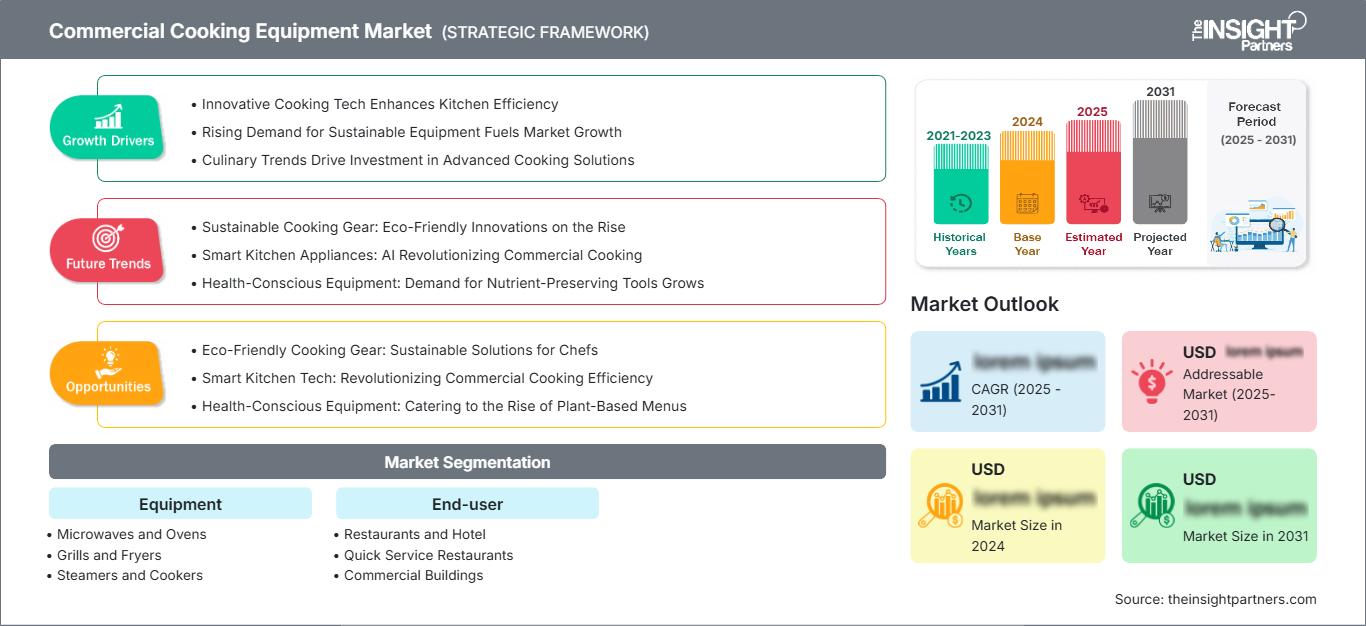
Commercial Cooking Equipment Market: Strategic Insights
Regional Insights
North America Commercial Cooking Equipment Market
North America accounted for 31-33% of worldwide revenues in 2025 and is forecasted to grow at a CAGR of 4.9-5.4% from 2026 to 2034. North American Commercial Cooking Equipment Market Share is driven by the presence of numerous chain restaurants, hotels, airports, healthcare facilities, and institutional catering kitchens. The factors influencing the replacement demand include energy efficiency requirements, labor-saving concerns of operators, and the desire for digitalization.
Structural demand is high in the USA and Canada because of multi-location operations that require similar ovens, fryers, refrigerators, and holding equipment across locations. Energy consumption in commercial kitchens is much higher per square foot compared to general commercial spaces, hence there are energy-saving benefits to be quantified when making purchases. Ventless and programmable cooking units are getting popular in urban areas with space and labor constraints.
U.S. Commercial Cooking Equipment Market
The United States made up 78–82% of North America in 2025 and is projected to grow at a CAGR of 4.8–5.3% between 2026 and 2034. Quick service restaurants, convenience foodservice, stadiums, and hotel renovations contribute to the steady demand. The preferred equipment has the capacity to allow for shorter tickets, safe holding, and digital recipe management.
There is a high level of company presence in this market, including ACP, Inc., Alto-Shaam, Inc., Duke Manufacturing Co., Caddy Corporation, and Bizerba USA Inc., catering to various kitchen process areas. New applications are coming up not only in restaurants but in ghost kitchens, travel centers, and commercial facilities with employee canteens. Throughput per square foot, reliability, and easy training of staff have been factors in choosing equipment.
Europe Commercial Cooking Equipment Market
In 2025, Europe accounted for 24–26% and is expected to grow at a 4.6–5.1% CAGR through 2034, with Germany being the major consumer in the region. In the UK, small and low emission machines are sought after as restaurants solve their issues of energy costs, ventilation in cities, and limited kitchen space. Chain pubs, hotels, and transport facilities prefer programmable ovens and refrigeration systems.
The German market is driven by engineering procurement, institutional catering, and hotel renovation activities. Other major contributors in the region include France, Italy, and Spain, thanks to the foodservice industry associated with tourism, standalone restaurants, and gourmet hospitality kitchens. Suppliers will benefit from having facilities in the region due to buyers’ preferences for CE compliance, servicing capability, energy labels, and multifunctional platform.
APAC Commercial Cooking Equipment Market
The Asia Pacific held 28-30% market share in 2025 and is expected to witness a 6.0-6.6% CAGR during the period of 2026-2034. The region stands to be the fastest growing regional platform. The Asia Pacific is led by demand from China through restaurant chains, hotels, and institutional catering. India is also driven by its foodservice industry formalization that fosters new kitchen installations.
The regions of Japan and South Korea are known for their compact automation, precise cooking, and labor-saving systems. The country of Australia drives demand for commercial cooking equipment in the hospitality industry owing to replacement based on energy efficiency and food safety aspects.
Middle East & Africa Commercial Cooking Equipment Market
Middle East and Africa is expected to grow at a 5.2–5.8% CAGR during 2026–2034, with Saudi Arabia leading regional demand. Hotel construction, airport catering, and tourism projects in Saudi Arabia and the UAE support demand for ovens, fryers, refrigeration, and specialized appliances.
South Africa contributes through restaurant refurbishment and retail foodservice, while the Rest of MEA remains project-led. Energy availability, water constraints, and high ambient temperatures increase the need for durable refrigeration and efficient cooking systems. Buyers prioritize equipment resilience, local service partners, and installation flexibility in mixed-use hospitality infrastructure.
Segmentation Analysis
Equipment
Equipment is projected to expand at a 5.1–5.6% CAGR during 2026–2034 as buyers replace fragmented kitchen assets with integrated, energy-efficient systems. The Commercial Cooking Equipment Market scope within this segment spans cooking, cold storage, holding, and specialized preparation assets. Operators prioritize equipment that improves menu consistency, lowers maintenance exposure, and supports multi-site standardization.
- Microwaves and Ovens remain central to accelerated cooking, reheating, baking, and finishing workflows, particularly where operators need consistent recipes, fast service, and simplified training across multi-unit kitchens.
- Grills and Fryers support high-volume menu items in restaurants and QSR outlets, with demand shaped by recovery speed, oil management, energy efficiency, and compact footprints.
- Steamers and Cookers gain importance in institutional kitchens, hotels, and health-focused menus because they preserve texture, reduce oil use, and enable batch preparation with controlled moisture.
- Refrigerators form the largest equipment sub-segment by operational necessity, supporting food safety, inventory control, cold-chain compliance, and reliable storage for fresh, frozen, and prepared ingredients.
- Specialized Kitchen Appliances include workflow-specific platforms such as holding cabinets, slicers, weighing systems, and high-speed units that improve throughput, reduce waste, and enable menu differentiation.
End-user
End-user demand is forecast to grow at a 5.4–5.9% CAGR during 2026–2034, led by operators that need consistent food quality under labor and space constraints. Restaurants, hotels, QSRs, and commercial buildings differ in purchase cycles, but all emphasize reliability, compliance, and total operating cost. Standardization across chains increasingly influences specification decisions.
- Restaurants and Hotel represent broad demand for ovens, fryers, refrigeration, and preparation systems, with purchases linked to menu diversity, banquet capacity, refurbishment cycles, and guest-service expectations.
- Quick Service Restaurants are the high growth end-user group, requiring compact, programmable, and rapid cooking platforms that support standardized menus, high order volumes, and limited labor availability.
- Commercial Buildings generate steady demand through corporate cafeterias, hospitals, education facilities, and mixed-use developments where food safety, capacity planning, and service uptime guide equipment selection.
Opportunity Snapshot
| End-user | Revenue Contribution | Trend Tag | Adoption Stage |
| Restaurants and Hotel | High | Menu Flex | Mature |
| Quick Service Restaurants | High | Speed Service | Scaling |
| Commercial Buildings | Medium | Staff Dining | Scaling |
Commercial Cooking Equipment Market Growth Drivers and Impact Analysis
Energy Efficiency Regulation Reshapes Procurement
Efficiency mandates are accelerating replacement of older refrigeration, ovens, fryers, and ventilation-dependent cooking lines. In the US, updated federal standards for commercial refrigeration create a clear compliance horizon, while European energy and emissions rules reinforce similar buying behavior. The operational impact is measurable because kitchens are among the most energy-intensive areas in hospitality. Buyers are comparing energy use, recovery time, heat loss, and maintenance needs before purchase, which strengthens demand for certified, digitally controlled, and lower-emission equipment.
Labor Constraints Increase Automation Value
Foodservice operators face persistent staffing pressure, high turnover, and training gaps, especially in high-volume formats. Programmable ovens, automated fryers, connected holding cabinets, and recipe-managed microwaves reduce dependence on highly skilled labor while improving consistency. The impact is strongest in quick service restaurants and hotel banquets, where repeatable output matters more than chef-led customization. Equipment that shortens training time and limits operator error can directly improve throughput, waste control, and service reliability.
Foodservice Expansion Lifts Installed Base
Urbanization, travel recovery, organized retail, and delivery-led formats continue to expand the installed base of commercial kitchens. New hotels, airport terminals, convenience stores, and institutional facilities require cooking, refrigeration, and holding assets from project inception. The Market benefits when chains open standardized outlets because each site requires repeatable equipment packages. This driver also supports distributors, installers, and maintenance providers, creating a broader ecosystem around specification, commissioning, and lifecycle service contracts.
Commercial Cooking Equipment Market Future Trends
Connected Kitchens Become Operating Platforms
Commercial Cooking Equipment Market trends are moving toward connected kitchens that function as operating platforms rather than isolated appliances. Remote diagnostics, recipe libraries, firmware updates, and performance dashboards will help multi-site operators compare locations and reduce downtime. Over the next decade, equipment data may become part of broader restaurant management systems that link inventory, labor planning, energy monitoring, and service alerts. Suppliers able to secure data, integrate controls, and provide actionable insights will gain stronger account retention.
Ventless and Compact Formats Expand Site Flexibility
Ventless and compact cooking systems will gain wider adoption as operators enter smaller urban sites, transport hubs, kiosks, and delivery kitchens. Reduced dependence on traditional hoods can lower installation complexity and make nontraditional foodservice spaces viable. Compact multifunction units also allow operators to broaden menus without expanding back-of-house footprints. This trend supports high-speed ovens, combination steamers, holding systems, and modular refrigeration designed for flexible layouts and faster deployment.
Commercial Cooking Equipment Market Opportunities
QSR Standardization Programs Create Scalable Demand
Quick service restaurant expansion creates a strong opportunity for suppliers that can deliver standardized, serviceable, and digitally programmable equipment packages. Commercial Cooking Equipment Market Forecasts indicate that QSR kitchens will remain a high-return target because chains specify repeatable assets across new stores, remodels, and franchise conversions. Vendors can capture value by bundling ovens, fryers, refrigeration, holding systems, installation support, and preventive maintenance under multi-year agreements that reduce procurement complexity for operators.
Emerging Market Kitchens Need Lifecycle Support
Emerging markets offer opportunity beyond equipment sales because operators often need layout guidance, training, spare parts access, and reliable field service. Suppliers that develop distributor networks in India, Southeast Asia, the Gulf, and Africa can build recurring revenue through maintenance contracts and upgrade cycles. Financing programs may also expand adoption among independent restaurants and smaller hotels. The most attractive positioning combines robust equipment, local service coverage, and practical energy savings that operators can verify.
Recent Developments
- April 2025: ITW Food Equipment Group will participate in the National Restaurant Association (NRA) Show, scheduled from May 17 to 20. The group’s leading brands, including Hobart, Baxter, Traulsen and Vulcan, will share booth 4031 at McCormick Place in Chicago. Visitors are invited to explore the booth and experience equipment innovations developed to help foodservice professionals enhance and streamline their kitchen operations, along with live cooking demonstrations showcasing the capabilities of the solutions.
- June 2026: Cumin Co. Enters Kitchen Knife Segment with Launch of The Quill Collection, Targets Rs 100 Crore ARR. Kitchenware brand Cumin Co. has expanded its product portfolio with the launch of The Quill, its first kitchen knife collection, marking its entry into the kitchen preparation tools segment. The move is part of the company’s strategy to build a wider kitchen ecosystem and support its ambition of achieving Rs 100 crore in annual recurring revenue (ARR).
- June 2026: Meta Hi Tech Kitchen Equipments, the proud distributor of Cosmos by EssEmm Corporation, participated in HRC 2026, held at ExCeL London from March 30 to April 1, 2026. At Stand #S345, the company showcased its latest range of professional kitchen equipment and marked the grand launch of the Cook Wok Prime Mini 25 Litre. The team expressed its gratitude to all visitors who attended the stand and engaged with the brand during one of the UK’s leading hospitality and catering events.
Frequently Asked Questions

- Comprehensive Market Sizing and Forecast Analysis
- Detailed Segmentation Analysis
- In-Depth Market Dynamics Assessment
- Regional and Country-Level Insights
- Competitive Landscape and Company Benchmarking
- Strategic Business Intelligence
Recent Reports
Testimonials

The Insight Partners provided valuable market intelligence that supported our global go-to-market strategy. Their team was professional, responsive, and attentive to our feedback, providing thoughtful analysis and helpful methodological clarifications throughout the project.
Junmo Kim Chief Financial Officer (CFO), Enertech Co., Ltd.
The Insight Partners' SCADA System Market report is comprehensive, with valuable insights on current trends and future forecasts. The team was highly professional, responsive, and supportive throughout. We are very satisfied and highly recommend their services.
RAN KEDEM Partner, Reali Technologies LTDs
I requested a report on a very specific software market and the team produced the report in a few days. The information was very relevant and well presented. I then requested some changes and additions to the report. The team was again very responsive and I got the final report in less than a week.
JEAN-HERVE JENN Chairman, Future Analytica
We worked with The Insight Partners for an important market study and forecast. They gave us clear insights into opportunities and risks, which helped shape our plans. Their research was easy to use and based on solid data. It helped us make smart, confident decisions. We highly recommend them.
PIYUSH NAGPAL Sr. Vice President, High Beam Global
The Insight Partners delivered insightful, well-structured market research with strong domain expertise. Their team was professional and responsive throughout. The user-friendly website made accessing industry reports seamless. We highly recommend them for reliable, high-quality research services
YUKIHIKO ADACHI CEO, Deep Blue, LLC.
This is the first time I have purchased a market report from The Insight Partners.While I was unsure at first, I visited their web site and felt more comfortable to take the risk and purchase a market report.I am completely satisfied with the quality of the report and customer service. I had several questions and comments with the initial report, but after a couple of dialogs over email with their analyst I believe I have a report that I can use as input to our strategic planning process.Thank you so much for taking the extra time and making this a positive experience.I will definitely recommend your service to others and you will be my first call when we need further market data.
JOHN SUZUKI President and Chief Executive Officer, Board Director, BK Technologies
I wish to appreciate your support and the professionalism you displayed in the course of attending to my request for information regarding to infectious disease IVD market in Nigeria. I appreciate your patience, your guidance, and the fact that you were willing to offer a discount, which eventually made it possible for us to close a deal. I look forward to engaging The Insight Partners in the future, all thanks to the impression you have created in me as a result of this first encounter.
DR CHIJIOKE ONYIA MANAGING DIRECTOR, PineCrest Healthcare Ltd.Reason to Buy
- Informed Decision-Making
- Understanding Market Dynamics
- Competitive Analysis
- Identifying Emerging Markets
- Customer Insights
- Market Forecasts
- Risk Mitigation
- Boosting Operational Efficiency
- Strategic Planning
- Investment Justification
- Tracking Industry Innovations
- Aligning with Regulatory Trends





 Get Free Sample for