
Commercial HVAC Market Report 2031 by Segments, Geography, Dynamics, Recent Developments, and Strategic Insights
Coverage: By Equipment Type (Cooling Equipment, Heating Equipment, and Ventilation Equipment), Implementation (New Installation and Retrofit), Application (Office Buildings, Hotels and Restaurants, Transportation Industry, Hospitals and Clinics, and Others), and Geography
- Status : Published
- Report Code : TIPRE00011156
- Category : Electronics and Semiconductor
- No. of Pages : 405
- Available Report Formats :


- Last update date : May 26, 2025


2024 Market Size
US$ 79.30 Bn
Base year value
2031 Forecast
US$ 136.45 Bn
Projected by 2031
CAGR 2025-2031
8.2 %
Growth rate
Addressable Market
US$ 770.30 Bn
(2025-2031)
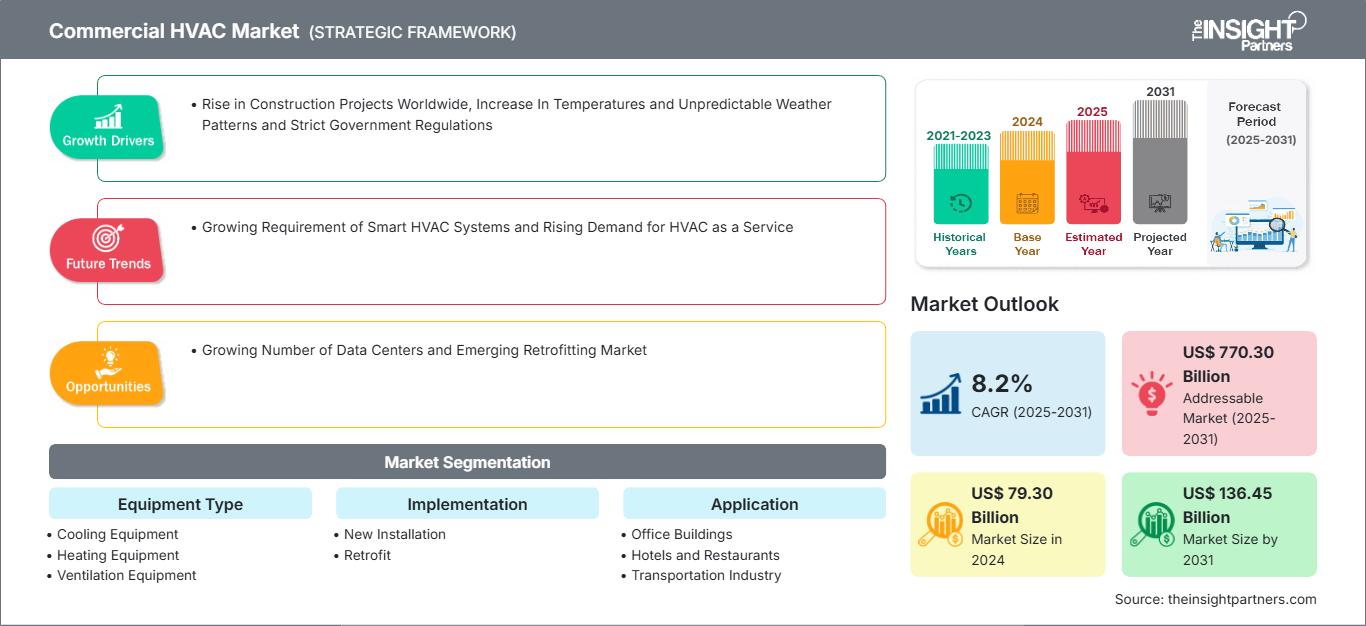
The commercial HVAC market size was valued at US$ 79.30 billion in 2024 and is expected to reach US$ 136.44 billion by 2031; it is estimated to register a CAGR of 8.2% during 2025–2031. The growing requirement for smart HVAC systems and the rising demand for HVAC as a service are likely to remain key market trends.
Commercial HVAC Market Analysis
Commercial HVAC systems are usually much larger than residential ones. Larger properties require more power to adequately heat, cool, and ventilate, and commercial buildings are often far larger than houses. Commercial HVAC systems are generally more complex owing to their larger size and higher power requirements. HVAC demands in a commercial structure might also be more complex, as different parts of a building may require different temperatures and ventilation. Commercial HVAC systems also consist of a packaged unit, with all equipment housed in a single cabinet. This allows the entire unit to be moved or altered as needed to accommodate changing business conditions. Furthermore, they are designed according to the special requirements of large-scale buildings, ensuring high indoor air quality, energy efficiency, and occupant comfort.
Commercial HVAC Market Overview
The growing number of commercial construction projects worldwide is one of the main factors fueling the growth of the commercial HVAC market. Various countries across the world have different commercial construction projects, such as office construction, airport construction, and mall construction. For instance, in Q4 of 2024, the construction of the N3-5 project was started. The project involves the construction of a 13-story office building in Japan. The project is forecasted to be completed in Q4 2026. In addition, as per Copernicus, 2024 was the warmest year in a global temperature record spanning many datasets dating back to 1850. Thus, the rising temperature and weather conditions worldwide are increasing the demand for HVAC systems. Also, the strict laws and regulations by the governments of various countries, particularly regarding the use of refrigerants, are propelling the demand for eco-friendly and smart HVAC systems.
Market Assessment and Insights
- North America dominated the market with 39% share in 2024.
- Asia Pacific is poised to grow at a CAGR of 9.2% over the forecast period.
- United States market is projected to grow at a CAGR of 8.6% over the forecast period.
- By Equipment Type, the Cooling Equipment segment accounted for the largest market share of 58.5% in 2024.
- By Cooling Equipment Type, the Unitary Air Conditioners segment is anticipated to witness the fastest growth, registering a CAGR of 9.7% over the forecast period
- By Heating Equipment Type, the Boilers segment accounted for the largest market share of 51.5% in 2024.
- By Ventilation Equipment Type, the Air Handling Units (AHUs) segment is anticipated to witness the fastest growth, registering a CAGR of 8% over the forecast period
- By Ventilation Systems Type, the Controlled Mechanical Ventilation (CMV) segment accounted for the largest market share of 44.1% in 2024.
- By Implementation, the New Installation segment is anticipated to witness the fastest growth, registering a CAGR of 8.6% over the forecast period
- By Application, the Office Buildings segment accounted for the largest market share of 27.5% in 2024.
- The report profiles key industry players such as Schneider Electric SE, Honeywell International Inc, Mitsubishi Electric Corp, LG Electronics Inc, Daikin Industries Ltd, Carrier Global Corp, Danfoss AS, Lennox International Inc, Trane Technologies Plc, Samsung Electronics Co Ltd, while also analyzing key developments in novel ideas, disruptive products, and innovative services that could reshape the future market and reveal emerging themes across the industry.
Source: The Insight Partners' analysis based on proprietary research, government publications, company annual reports, investor presentations, industry databases, and expert interviews.
● REPORT CUSTOMIZATION
Tailor This Report To Align With Your Specific Business Requirements
This report can be customized to align precisely with your business objectives, scope, and target markets. Customization options include tailored segmentation, geography, competitive analysis, and strategic insights to support informed decision-making.
Customize This Report →WHAT YOU CAN ADJUST
- ● Segmentations
- ● Geography
- ● Competitive Analysis
- ● Language Preferences
Commercial HVAC Market: Strategic Insights
-
Get Top Key Market Trends of this report.This FREE sample will include data analysis, ranging from market trends to estimates and forecasts.
Commercial HVAC Market Drivers and Opportunities
Increase in Temperatures and Unpredictable Weather Patterns
There is a continuous rise in the global temperature. According to Copernicus, 2024 was the warmest year in a global temperature record spanning many datasets dating back to 1850. In 2024, the global average temperature was 15.10°C, which was 0.12°C higher than the previous greatest annual record in 2023. 2024 was also 0.72°C warmer than the 1991–2020 average and 1.60°C higher than the pre-industrial level, marking the first calendar year to exceed 1.5°C above that level. The past ten years have been the warmest on record. From January to June 2024, each month was warmer than the same month in the previous year. In August 2024, the temperature matched the record temperature of August 2023, while the subsequent months from July to December were each the second warmest for the time of year, trailing only the comparable months in 2023. In addition, on July 22, 2024, the daily worldwide average temperature hit a new record high of 17.16°C.
As global temperatures are rising owing to climate change, businesses' cooling requirements are also increasing. This trend is particularly noticeable in urban areas, where the urban heat island effect exacerbates temperature increases. Commercial buildings increasingly require more robust HVAC systems to maintain comfortable indoor settings, resulting in increased demand for energy-efficient solutions. Smart HVAC solutions, which optimize performance based on real-time temperature data, are becoming important for lowering energy costs and improving comfort. Thus, rising temperatures and unpredictable weather conditions are pushing the commercial HVAC market to adopt more modern, efficient, and adaptive solutions. Building owners and managers are increasingly recognizing the need for HVAC systems that can deliver dependable comfort while also satisfying sustainability and regulatory standards.
Emerging Retrofitting Market
Retrofit is the process of updating and modifying existing climate control systems so that they operate more efficiently and have a lower environmental impact. This may include replacing obsolete components, adopting new technologies, and optimizing systems for improved performance. The percentage of savings varies according to numerous aspects, including the type of components. According to research conducted by the United States Department of Energy, improving HVAC systems might result in a 20% to 40% reduction in energy expenses, particularly in commercial buildings. Also, several HVAC companies have indicated that replacing old fans with high-efficiency, variable-speed versions can save 15% to 35% on energy expenses. In addition, upgrading or deploying modern control systems, such as smart thermostats that allow the temperature to be adjusted automatically based on occupant presence and usage patterns, is estimated to save 10% to 30% on energy consumption. According to the American Society of Heating, Refrigerating, and Air-Conditioning Engineers (ASHRAE), building automation systems can integrate all building systems, including HVAC, lighting, and security, allowing for continuous monitoring, real-time diagnostics, and the ability to adjust systems for maximum efficiency. Further, improving or replacing air handling units (AHUs) results in 20% to 30% savings, particularly when heat recovery technology and high-efficiency filters are used.
Hence, as the commercial HVAC industry evolves, the retrofitting segment presents a lucrative opportunity for firms that want to invest in energy-efficient solutions. By adopting retrofitting, firms can not only meet regulatory requirements but also develop a culture of sustainability and creativity. This transformation not only benefits the bottom line but also helps create a greener, more sustainable future.
Commercial HVAC Market Report Segmentation Analysis
Key segments that contributed to the derivation of the commercial HVAC market analysis are equipment type, implementation, and application.
- Based on equipment type, the market is segmented into cooling equipment, heating equipment, and ventilation equipment. The cooling equipment segment is subsegmented into unitary air conditioners, chillers, coolers, VRF systems, and others. The heating equipment segment is further segmented into boilers, heat pumps, furnaces, and space heaters. The ventilation equipment segment is subsegmented into ventilation equipment type and ventilation systems type. The ventilation equipment type segment is further divided into air handling units (AHUs), ventilation fans, air filters and air purifiers, roof vents, and others. Also, the ventilation systems type segment is further divided into controlled mechanical ventilation (CMV), natural ventilation, and hybrid/mixed-mode ventilation. The cooling equipment segment dominated the market in 2024.
- Based on implementation, the market is segmented into new installation and retrofit. The new installation segment dominated the market in 2024.
- Based on application, the market is segmented into office buildings, hotels and restaurants, hospitals and clinics, the transportation industry, and others. The office buildings segment dominated the market in 2024.
Commercial HVAC Market Share Analysis by Geography
- The commercial HVAC market is segmented into five major regions: North America, Europe, Asia Pacific (APAC), the Middle East & Africa (MEA), and South & Central America. North America dominated the commercial HVAC market in 2024. Asia Pacific is the second-largest contributor to the global commercial HVAC market, followed by Europe.
- The commercial HVAC market in North America is segmented into the US, Canada, and Mexico. The commercial HVAC market in North America is primarily driven by increasing commercial infrastructure projects, rapid urbanization, and high construction spending. The region has various construction projects in line. For example, the construction of the Riverwalk San Diego project was initiated in Q1 2023, involving the construction of mixed-use facilities on 80.9 ha of land in California (US). The project also aims to provide better commercial facilities in the region. The project is expected to be completed by Q3 2029. Also, the construction of 2150 Lake Shore Mixed-Use Complex—which involves the construction of 29 buildings ranging from 3 to 67 storeys in Toronto (Ontario, Canada)—began in Q1 2023 and is likely to be completed by Q4 2027. The project will also provide a wide range of commercial and retail facilities with easy accessibility in the region. Thus, the growing construction industry in the region will stimulate the demand for HVAC systems.
Commercial HVAC Market Report Scope
| Report Attribute | Details |
|---|---|
| Market size in 2024 | US$ 79.30 Billion |
| Market Size by 2031 | US$ 136.45 Billion |
| Global CAGR (2025 - 2031) | 8.2% |
| Historical Data | 2021-2023 |
| Forecast period | 2025-2031 |
| Segments Covered |
By Equipment Type
|
| Regions and Countries Covered |
North America
|
| Market leaders and key company profiles |
|
Commercial HVAC Market Players Density: Understanding Its Impact on Business Dynamics
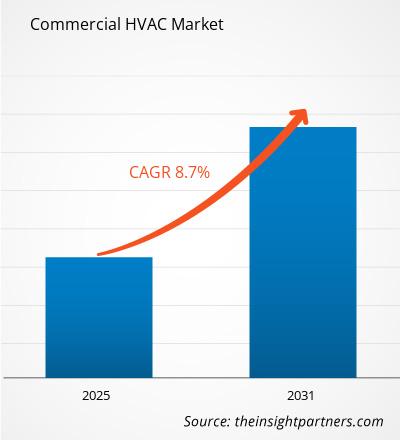
The Commercial HVAC Market is growing rapidly, driven by increasing end-user demand due to factors such as evolving consumer preferences, technological advancements, and greater awareness of the product's benefits. As demand rises, businesses are expanding their offerings, innovating to meet consumer needs, and capitalizing on emerging trends, which further fuels market growth.
Commercial HVAC Market News and Recent Developments
The commercial HVAC market is evaluated by gathering qualitative and quantitative data post primary and secondary research, which includes important corporate publications, association data, and databases. A few of the developments in the commercial HVAC market are listed below:
- Schneider Electric announced that it is planning to invest over US$ 700 million in its U.S. operations through 2027. The company’s investments support the country’s focus on bolstering its energy infrastructure to power AI growth, boost domestic manufacturing, and strengthen energy security. The announcement comes as rising regional demand grows across data centers, utilities, manufacturing, and energy infrastructure segments.
(Source: Schneider Electric, Press Release, March 2025)
- Carrier India launched its first Centre of Excellence dedicated to skill development in the HVAC (Heating, Ventilation, and Air Conditioning) sector. Aligned with its commitment to fostering a skilled and inclusive workforce, Carrier supports initiatives that emphasize STEM education and future-ready capabilities essential for intelligent climate and energy solutions. This initiative, in collaboration with Jamia Millia Islamia's University Polytechnic (JMI), aims to bridge the skill gap in the HVAC industry and empower students with knowledge and practical expertise.
(Source: Carrier, Press Release, April 2025)
Commercial HVAC Market Report Coverage and Deliverables
The "Commercial HVAC Market Size and Forecast (2021–2031)" provides a detailed analysis of the market covering the areas mentioned below:
- Commercial HVAC market size and forecast at global, regional, and country levels for all the key market segments covered under the scope
- Commercial HVAC market trends, as well as market dynamics such as drivers, restraints, and key opportunities
- Detailed PEST and SWOT analysis
- Commercial HVAC market analysis covering key market trends, global and regional framework, major players, regulations, and recent market developments
- Industry landscape and competition analysis covering market concentration, heat map analysis, prominent players, and recent developments for the commercial HVAC market
- Detailed company profiles
Frequently Asked Questions

- Comprehensive Market Sizing and Forecast Analysis
- Detailed Segmentation Analysis
- In-Depth Market Dynamics Assessment
- Regional and Country-Level Insights
- Competitive Landscape and Company Benchmarking
- Strategic Business Intelligence
Recent Reports
Testimonials

The Insight Partners' SCADA System Market report is comprehensive, with valuable insights on current trends and future forecasts. The team was highly professional, responsive, and supportive throughout. We are very satisfied and highly recommend their services.
RAN KEDEM Partner, Reali Technologies LTDs
I requested a report on a very specific software market and the team produced the report in a few days. The information was very relevant and well presented. I then requested some changes and additions to the report. The team was again very responsive and I got the final report in less than a week.
JEAN-HERVE JENN Chairman, Future Analytica
We worked with The Insight Partners for an important market study and forecast. They gave us clear insights into opportunities and risks, which helped shape our plans. Their research was easy to use and based on solid data. It helped us make smart, confident decisions. We highly recommend them.
PIYUSH NAGPAL Sr. Vice President, High Beam Global
The Insight Partners delivered insightful, well-structured market research with strong domain expertise. Their team was professional and responsive throughout. The user-friendly website made accessing industry reports seamless. We highly recommend them for reliable, high-quality research services
YUKIHIKO ADACHI CEO, Deep Blue, LLC.
This is the first time I have purchased a market report from The Insight Partners.While I was unsure at first, I visited their web site and felt more comfortable to take the risk and purchase a market report.I am completely satisfied with the quality of the report and customer service. I had several questions and comments with the initial report, but after a couple of dialogs over email with their analyst I believe I have a report that I can use as input to our strategic planning process.Thank you so much for taking the extra time and making this a positive experience.I will definitely recommend your service to others and you will be my first call when we need further market data.
JOHN SUZUKI President and Chief Executive Officer, Board Director, BK Technologies
I wish to appreciate your support and the professionalism you displayed in the course of attending to my request for information regarding to infectious disease IVD market in Nigeria. I appreciate your patience, your guidance, and the fact that you were willing to offer a discount, which eventually made it possible for us to close a deal. I look forward to engaging The Insight Partners in the future, all thanks to the impression you have created in me as a result of this first encounter.
DR CHIJIOKE ONYIA MANAGING DIRECTOR, PineCrest Healthcare Ltd.Reason to Buy
- Informed Decision-Making
- Understanding Market Dynamics
- Competitive Analysis
- Identifying Emerging Markets
- Customer Insights
- Market Forecasts
- Risk Mitigation
- Boosting Operational Efficiency
- Strategic Planning
- Investment Justification
- Tracking Industry Innovations
- Aligning with Regulatory Trends





 Get Free Sample for