
Composite Cylinder Market Demand, Size & Forecast by 2034
Coverage: By Material (Glass Fiber Components, Carbon Fiber Components, Aramid Fiber Components); End Use (Gas Carriers and Storage, Transportation, Life Support, Others) , and Geography (North America, Europe, Asia Pacific, and South and Central America)
- Status : Data Released
- Report Code : TIPRE00027551
- Category : Chemicals and Materials
- No. of Pages : 150
- Available Report Formats :


- Last update date : September 28, 2026


2025 Market Size
US$ 2.91 Bn
Base year value
2034 Forecast
US$ 5.20 Bn
Projected by 2034
CAGR 2026-2034
6.66 %
Growth rate
Addressable Market
US$ 36.66 Bn
(2026-2034)
The Composite Cylinder market size was valued at US$ 2.91 Billion in 2025 and is projected to reach US$ 5.20 Billion by 2034, expanding at a CAGR of 6.66% during 2026–2034. Growth is supported by rising demand for lightweight high-pressure storage systems across gas transportation, mobility, industrial gases, and hydrogen infrastructure. Increasing preference for fiber-reinforced pressure vessels is also encouraging manufacturers to expand production capabilities and develop higher-pressure solutions.
North America is expected to maintain a substantial position, supported by established compressed gas distribution networks, natural gas vehicle fleets, and increasing hydrogen infrastructure investment. The regional Composite Cylinder market is estimated to expand at a 6.1–6.5% CAGR between 2026 and 2034, with demand benefiting from lightweight storage systems for transportation, industrial gases, and emerging hydrogen applications.
Composite Cylinder Market Assessment and Insights
- North America: North America is estimated to hold a 28–32% Composite Cylinder market share in 2025 and expand at a 6.1–6.5% CAGR between 2026–2034, supported by established CNG infrastructure, industrial gas transportation, hydrogen projects, and adoption of lightweight Type 4 pressure vessels.
- US: The US accounts for approximately 72–76% of North America's 2025 share and is projected to grow at a 6.0–6.4% CAGR between 2026–2034, driven by gas logistics, heavy-duty mobility, and hydrogen storage applications.
- Europe: Europe represents a 25–29% share in 2025 and is projected to record a 6.0–6.4% CAGR between 2026–2034, with Germany, France, the UK, Italy, and Spain supporting demand through hydrogen programs, industrial gas distribution, and alternative-fuel transportation.
- Asia Pacific: Asia Pacific is estimated to command a 31–35% share in 2025 and expand at a 7.2–7.6% CAGR between 2026–2034, led by China, Japan, India, and South Korea, where gas mobility, hydrogen development, and industrial expansion support cylinder adoption.
- Largest Segment: Glass Fiber Components hold an estimated 58–62% market share in 2025, with a 6.1–6.5% CAGR between 2026–2034, benefiting from cost-effective reinforcement and broad pressure-vessel applications.
- High Growth Segment: Carbon Fiber Components account for approximately 26–30% market share in 2025 and are projected to grow at an 8.0–8.5% CAGR between 2026–2034, supported by high-pressure hydrogen and mobility applications.
- Key companies analyzed in detail: Time Technoplast Limited, Hexagon Composites ASA, AMS Composite Cylinders, Luxfer Gas Cylinders, Quantum Technologies, Drägerwerk, Worthington Cylinders, Sinoma, Faber Industries S.p.A., and Aburi Composites.
Source: The Insight Partners' analysis based on proprietary research, government publications, company annual reports, investor presentations, industry databases, and expert interviews.
Manufacturing methods in the Composite Cylinder market have now changed to include automated filament winding, advanced resin technology, improved liner design, and higher pressure Type 3 and Type 4 structures. This leads to a reduction in the weight of the vessel and improves its capacity to hold gas. Composite cylinders are used in a variety of ways including mobile storage cascades, automotive fuel tanks, industrial gases, and hydrogen applications. This makes the industry more diverse, and suppliers are therefore forced to improve their engineering and testing capacities.
For the future, investment in the Composite Cylinder market will be focused on high-pressure vessels, hydrogen capable composite material, and localized manufacturing. The Asian Pacific region becomes important for the development of national gas mobility and hydrogen initiatives while North America and Europe will focus on safety certifications, performance, and integration. The regulatory framework for pressure receptacles and hydrogen transport has led to the creation of standardized designs and certifications.
Composite Cylinder Market Report Scope
| Report Attribute | Details |
|---|---|
| Market size in 2025 | US$ 2.91 Billion |
| Market Size by 2034 | US$ 5.20 Billion |
| Global CAGR (2026 - 2034) | 6.66% |
| Historical Data | 2021-2024 |
| Forecast period | 2026-2034 |
Composite Cylinder Market Analysis
Demands for the Composite Cylinder market are highly linked to the development in compressed gas transport, alternative fuel vehicles, industrial gas delivery, and hydrogen infrastructure. Lightweight cylinders make it possible to improve payload utilization while minimizing weight of the vehicle, thus being an asset in mobile applications. Market environment involves fiber makers, resin providers, liner manufacturers, cylinder winding firms, test agencies, gas delivery companies, vehicles integrators, and infrastructure builders.
The Composite Cylinder market is also driven by supply chain specialization. Carbon fibers continue playing a vital role in applications involving high pressure due to their unique strength-to-weight ratio, whereas glass fibers provide support to applications where cost is crucial. While Type 4 cylinder construction does not rely on metallic liners for their load-bearing function, Type 3 cylinder has a load-bearing metallic liner.
Competitive positioning in the Composite Cylinder market relies on engineering for the application rather than cylinder volume. Hexagon Composites ASA offers a combination of cylinder technology along with fuel systems and gas transport solutions, whereas Time Technoplast Limited has spread into LPG, CNG, oxygen, and hydrogen cylinders. Luxfer Gas Cylinders and AMS Composite Cylinders continue to hold niche positions in high pressure gas storage, whereas Faber Industries S.p.A. offers expertise in pressure vessel technologies for various industries.
Investment in the Composite Cylinder market is increasingly focused on automation, hydrogen readiness, and local capacity. Quantum Technologies invests in advanced compressed gas storage solutions, while Drägerwerk invests in specialized life support and breathing gas applications. Worthington Cylinders, Sinoma, Aburi Composites, and other manufacturers invest in manufacturing volume, material science, certification, and application specificity. Competitive differentiations thus become more dependent on life cycle economics, safety validation, and integration into transport and storage solutions.
● REPORT CUSTOMIZATION
Tailor This Report To Align With Your Specific Business Requirements
This report can be customized to align precisely with your business objectives, scope, and target markets. Customization options include tailored segmentation, geography, competitive analysis, and strategic insights to support informed decision-making.
Customize This Report →WHAT YOU CAN ADJUST
- ● Segmentations
- ● Geography
- ● Competitive Analysis
- ● Language Preferences
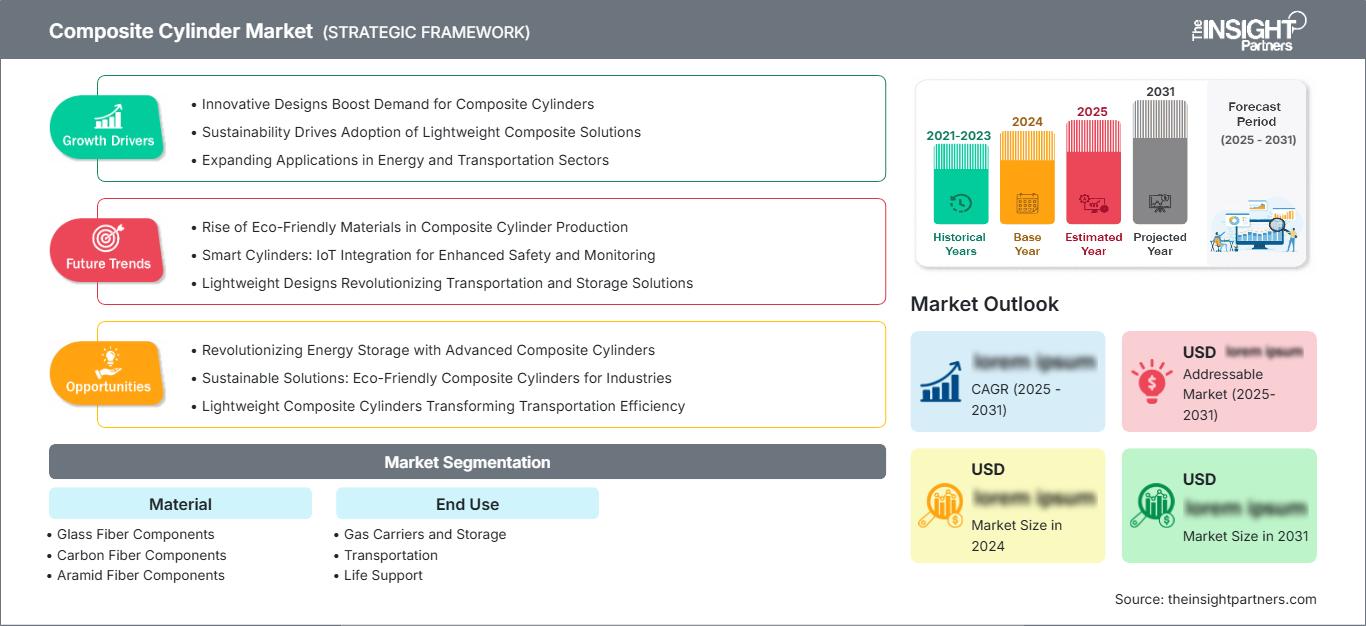
Composite Cylinder Market: Strategic Insights
Regional Insights
North America Composite Cylinder Market
North America holds an estimated 28–32% share in 2025, with a projected 6.1–6.5% CAGR through 2034. This region enjoys mature CNG distribution networks, industrial gas logistics, and investments in hydrogen production and transportation. The US is the leading market owing to its mature natural gas network, heavy-duty trucking industry, and consumption of industrial gases. Composite tanks have become the preferred choice wherever weight savings enhance transportation efficiency.
While Canada brings its experience with industrial gases, hydrogen and clean energy, and Mexico is the supplier of natural gas for mobility and industrial applications. Moreover, the US market enjoys mature testing and certification facilities that help in commercializing high pressure composite tanks. More deployment of hydrogen is raising demands for lightweight Type 4 tanks especially in mobility, mobile storage and distribution. This regional market is thus distinguished by diversified applications of gases as against relying on any one industry.
U.S Composite Cylinder Market
The US represents approximately 72–76% of North America's 2025 share and is expected to expand at a 6.0–6.4% CAGR during 2026–2034. Demand is supported by CNG and renewable natural gas transportation, industrial gas distribution, hydrogen storage, and specialized aerospace applications. Manufacturers of products which are domestically produced and certified can address the needs of fleet owners and gas distributors who need lightweight pressure vessels.
The Composite Cylinder market trends are going to move towards high-pressure and high-capacity vessels. Increasingly, mobile pipeline modules will use Type 4 Composite Cylinders for transporting compressed gases with higher payload effectiveness, and hydrogen will have a requirement for lightweight vessels for both mobility and fixed applications. Aerospace is an upcoming niche application due to its relevance to weight saving.
Europe Composite Cylinder Market
The Composite Cylinder market report shows that Europe accounts for an estimated 25–29% share in 2025 and is projected to grow at a 6.0–6.4% CAGR, with Germany serving as a leading market. These include policies related to hydrogen, decarbonization of industry, alternative fuels in mobility, and existing industrial gases infrastructure. Harmonization of regulations and strict requirements for pressure vessels create an advantage for those suppliers that have good certification and engineering capacity.
Countries of such nations as the United Kingdom, Germany, France, Italy, and Spain could be considered important national markets. Germany, for example, is known for its hydrogen infrastructure and industrial gases market. The UK, on the other hand, is developing hydrogen transport and storage systems. In France, there is support for hydrogen in mobility and decarbonization of industries. In Italy, one could speak about industrial gases and transportation sector. In Spain, hydrogen production and exporting is being developed.
Asia Pacific Composite Cylinder Market
APAC represents approximately 31–35% share in 2025 and is projected to record a 7.2–7.6% CAGR, making it the fastest-growing major region. China is the biggest market due to manufacturing capacity, hydrogen mobility, and compresses gas network. Japan and South Korea will add through hydrogen mobility and energy application, and India is developing its CNG and hydrogen infrastructure.
Australia adds through hydrogen development and industrial gas applications. Local manufacturers have stepped up their production capacity for fiber reinforced cylinders to decrease reliance on imports of pressure cylinders. Hydrogen programs, city gas distribution, and alternative fuel transportation will help improve the demand. The combination of industrial development and clean energy investments provide APAC with wide applications for gas carriers, storage facilities, transportation, and life support equipment.
Middle East and Africa Composite Cylinder Market
The Middle East and Africa market is supported by gas availability, energy infrastructure, industrial development, and emerging hydrogen projects. Saudi Arabia is a leading regional opportunity because of large-scale energy investment, while the UAE is developing hydrogen and advanced mobility initiatives. South Africa contributes through industrial gases, mining, and transportation applications.
The rest of MEA presents opportunities through LPG distribution, industrial gas transportation, mining operations, and infrastructure development. Composite cylinders can provide advantages where transportation efficiency and corrosion resistance are important. Regional adoption remains more application-specific than in North America, Europe, or APAC, but hydrogen investment and modernization of gas infrastructure could broaden demand. The regional market is projected to expand at a 6.5–6.9% CAGR during 2026–2034.
Segmentation Analysis
Material
The Material segment covers glass fiber, carbon fiber, and aramid fiber reinforcement systems used to manufacture lightweight pressure vessels. The segment is projected to expand at a 6.1–6.5% CAGR during 2026–2034. Material selection depends on pressure rating, weight requirements, durability, cost, application environment, and certification requirements. The Composite Cylinder market increasingly differentiates products according to performance requirements rather than basic storage capacity.
- Glass Fiber Components: Glass fiber components maintain broad adoption in cost-sensitive pressure vessels because they provide useful mechanical reinforcement at lower material cost. Their position is supported by LPG, industrial gas, and general storage applications.
- Carbon Fiber Components: Carbon fiber components are strategically important for high-pressure applications requiring substantial weight reduction. Demand is particularly relevant to hydrogen, CNG mobility, aerospace, and advanced mobile storage systems where payload efficiency directly affects operating economics.
- Aramid Fiber Components: Aramid fiber components serve specialized applications requiring high strength, impact resistance, and low weight. Their strategic role is strongest where manufacturers require additional mechanical performance without substantially increasing vessel mass.
End Use
The End Use segment is projected to grow at a 6.4–6.8% CAGR during 2026–2034. Demand is shaped by compressed-gas infrastructure, transportation requirements, and specialized breathing-gas systems. Gas carriers and storage applications provide a large installed base, while transportation and life-support applications create opportunities for higher-value engineered cylinders. The segment's development increasingly depends on pressure ratings, mobility requirements, and safety certification.
- Gas Carriers and Storage: Gas carriers and storage applications represent a core demand base, covering mobile gas modules, industrial storage, LPG, CNG, and hydrogen systems. Lightweight construction can improve payload utilization and reduce transportation requirements.
- Transportation: Transportation applications include vehicle-mounted fuel storage and mobile compressed-gas distribution. Composite construction is strategically valuable because lower vessel weight can increase usable payload and improve vehicle efficiency in demanding mobility applications.
- Life Support: Life-support applications include breathing-air and oxygen cylinders used in medical, firefighting, aerospace, and emergency environments. Reliability, low weight, corrosion resistance, and certification are particularly important purchasing criteria for these applications.
Opportunity Snapshot
| End Use | Revenue Contribution | Trend Tag | Adoption Stage |
|---|---|---|---|
| Gas Carriers and Storage | High | Mobile Storage | Mature |
| Transportation | Medium | Hydrogen Mobility | Scaling |
| Life Support | Low | Lightweight SCBA | Mature |
Composite Cylinder Market Growth Drivers and Impact Analysis
Rising Hydrogen Demand for High-Pressure Gas Storage and Transportation
According to the Composite Cylinder market forecast, hydrogen development is creating a new demand pool for high-pressure Cylinders because gaseous hydrogen requires specialized storage and transport systems. The IEA reported that global hydrogen demand exceeded 97 Mt in 2023, while new applications such as heavy transport and energy storage were still less than 1% of total demand. As hydrogen projects move from demonstration toward commercial deployment, cylinder suppliers can address mobility, mobile storage, distribution, and refueling requirements. Type 4 vessels are particularly relevant because their non-metallic liners and fiber reinforcement support weight reduction. However, high carbon fiber cost remains a constraint. Manufacturers able to automate winding, optimize fiber usage, and qualify vessels for higher pressure levels can improve economics while addressing growing infrastructure requirements.
Growing Adoption of Lightweight Composite Cylinders for Compressed Gas Logistics
COMPRESSED gas transportation is increasingly influenced by payload economics, vehicle efficiency, and logistics costs. Composite cylinders can provide substantial weight advantages compared with conventional steel vessels, allowing mobile storage systems to transport more usable gas within vehicle weight limitations. This is particularly relevant for CNG, renewable natural gas, industrial gases, and hydrogen distribution. Hexagon's Type 4 mobile pipeline technology illustrates how lightweight cylinders can support larger gas payloads and fewer transportation trips. As industrial gas networks expand into regions without extensive pipeline infrastructure, mobile distribution remains important. The market impact extends beyond cylinder sales because lighter vessels can alter trailer design, fleet utilization, maintenance requirements, and total cost of ownership. Suppliers with integrated cylinder and transportation-system capabilities therefore have an advantage.
Growing Adoption of Lightweight Composite Cylinders for Compressed Gas Logistics
Pressure-vessel technology is moving toward greater use of fully or extensively fiber-wrapped architectures. The US Department of Energy identifies Type 3 cylinders as vessels with metallic liners and full composite reinforcement, while Type 4 cylinders use non-metallic liners with continuous fiber reinforcement. Type 4 designs can reduce weight substantially, although manufacturing costs remain higher than conventional metallic alternatives. Continued advances in carbon fiber production, resin systems, liner manufacturing, and automated winding can narrow this cost gap. The commercial impact is strongest in applications where weight directly affects payload, range, or installation flexibility. Certification and lifecycle testing remain critical because pressure vessels must maintain performance under repeated filling, environmental exposure, and mechanical loading.
Composite Cylinder Market Future Trends
Development of Higher-Pressure Composite Cylinders for Hydrogen Mobility
The Composite Cylinder market is expected to move toward higher-pressure vessels designed specifically for hydrogen mobility and distribution. Future products will increasingly combine lightweight liners, optimized carbon fiber winding, improved resin systems, and advanced boss designs to withstand repeated high-pressure cycles. Manufacturers are likely to prioritize automated winding and digital process control because consistent fiber placement directly influences vessel performance and material efficiency. Hydrogen storage requirements will also encourage greater integration between cylinders, valves, regulators, and vehicle systems. Standardization will become more important as international hydrogen trade develops and equipment crosses national borders. Suppliers capable of meeting multiple certification frameworks can reduce qualification duplication and serve global customers more efficiently. This trend should increase the technical value of Composite Cylinders while accelerating differentiation based on pressure, cycle life, and total system weight.
Integration of Digital Monitoring and Lifecycle Management Technologies
Future products are likely to incorporate greater use of sensors, digital inspection, and lifecycle tracking to improve cylinder safety and maintenance planning. Connected systems can capture pressure, temperature, usage cycles, and inspection information, allowing operators to identify abnormal operating conditions earlier. For mobile gas carriers, digital monitoring can also support fleet management by linking cylinder condition with vehicle utilization and maintenance schedules. Requalification technologies are expected to become increasingly important as installed cylinder populations expand. Manufacturers and service providers may therefore compete across the complete lifecycle rather than at the initial equipment sale. Digital records can also simplify regulatory compliance and asset traceability for fleets operating across multiple jurisdictions. The result could be a shift toward service-based business models covering inspection, requalification, data management, and eventual replacement.
Composite Cylinder Market Opportunities
Expansion of Local Composite Cylinder Manufacturing in Emerging Hydrogen Markets
The Composite Cylinder market offers investment opportunities in countries developing domestic hydrogen and compressed-gas infrastructure. Local manufacturing can reduce transportation costs for large pressure vessels, shorten delivery times, and improve access to national certification programs. India, China, South Korea, Australia, and selected Middle Eastern economies are developing hydrogen ecosystems that can support localized cylinder production. Investors can target filament winding, liner manufacturing, carbon fiber processing, testing, and assembly rather than establishing complete integrated operations immediately. Partnerships with gas distributors, vehicle manufacturers, and hydrogen developers can provide demand visibility before large capacity additions are made. Companies entering these markets should prioritize internationally recognized certification, flexible production lines, and designs capable of serving CNG and hydrogen applications to reduce exposure to fluctuations in any single technology segment.
Integration of Composite Cylinders with Mobile Storage and Refueling Systems
A second opportunity lies in combining Composite Cylinders with complete mobile storage, transport, and refueling systems. Customers increasingly evaluate gas transportation according to delivered cost rather than cylinder purchase price alone. Suppliers can therefore capture additional value through integrated trailers, cascades, valves, monitoring systems, maintenance, and requalification services. This approach is particularly relevant for hydrogen and industrial gases, where infrastructure gaps require flexible mobile distribution. The IEA reported that nearly 45% of low-emissions hydrogen from announced production projects is intended for export, highlighting the future importance of transport infrastructure. Companies able to provide certified storage and transportation packages can address this requirement while improving customer integration. Such strategies also create recurring revenue through inspection, servicing, and replacement programs.
Recent Developments
- July 2026: Hexagon Agility, a business of Hexagon Composites and the world's leading provider of compressed natural gas (CNG) fuel systems, has signed an exclusive long-term agreement with IVECO BUS, a global leader in commercial vehicles, for the delivery of CNG fuel systems for transit buses globally. The three-year agreement covers the exclusive supply of Hexagon Agility’s fuel systems and Type 4 carbon fiber cylinders across IVECO’s CNG bus range.
- April 2026: Time Technoplast Limited received approval for its hydrogen cylinder design for buses, trucks, and trailers. The company stated that its composite segment recorded revenue of Rs 555 crore during 9MFY26 and highlighted its automated facility for CNG and hydrogen cylinders and cascade systems, strengthening its position in high-pressure composite storage for mobility applications.
Frequently Asked Questions

- Comprehensive Market Sizing and Forecast Analysis
- Detailed Segmentation Analysis
- In-Depth Market Dynamics Assessment
- Regional and Country-Level Insights
- Competitive Landscape and Company Benchmarking
- Strategic Business Intelligence
Recent Reports
Testimonials

The Insight Partners' SCADA System Market report is comprehensive, with valuable insights on current trends and future forecasts. The team was highly professional, responsive, and supportive throughout. We are very satisfied and highly recommend their services.
RAN KEDEM Partner, Reali Technologies LTDs
I requested a report on a very specific software market and the team produced the report in a few days. The information was very relevant and well presented. I then requested some changes and additions to the report. The team was again very responsive and I got the final report in less than a week.
JEAN-HERVE JENN Chairman, Future Analytica
We worked with The Insight Partners for an important market study and forecast. They gave us clear insights into opportunities and risks, which helped shape our plans. Their research was easy to use and based on solid data. It helped us make smart, confident decisions. We highly recommend them.
PIYUSH NAGPAL Sr. Vice President, High Beam Global
The Insight Partners delivered insightful, well-structured market research with strong domain expertise. Their team was professional and responsive throughout. The user-friendly website made accessing industry reports seamless. We highly recommend them for reliable, high-quality research services
YUKIHIKO ADACHI CEO, Deep Blue, LLC.
This is the first time I have purchased a market report from The Insight Partners.While I was unsure at first, I visited their web site and felt more comfortable to take the risk and purchase a market report.I am completely satisfied with the quality of the report and customer service. I had several questions and comments with the initial report, but after a couple of dialogs over email with their analyst I believe I have a report that I can use as input to our strategic planning process.Thank you so much for taking the extra time and making this a positive experience.I will definitely recommend your service to others and you will be my first call when we need further market data.
JOHN SUZUKI President and Chief Executive Officer, Board Director, BK Technologies
I wish to appreciate your support and the professionalism you displayed in the course of attending to my request for information regarding to infectious disease IVD market in Nigeria. I appreciate your patience, your guidance, and the fact that you were willing to offer a discount, which eventually made it possible for us to close a deal. I look forward to engaging The Insight Partners in the future, all thanks to the impression you have created in me as a result of this first encounter.
DR CHIJIOKE ONYIA MANAGING DIRECTOR, PineCrest Healthcare Ltd.Reason to Buy
- Informed Decision-Making
- Understanding Market Dynamics
- Competitive Analysis
- Identifying Emerging Markets
- Customer Insights
- Market Forecasts
- Risk Mitigation
- Boosting Operational Efficiency
- Strategic Planning
- Investment Justification
- Tracking Industry Innovations
- Aligning with Regulatory Trends





 Get Free Sample for