
Compressible Cartons Market Growth, Trends & Forecast by 2034
Coverage: By Type (Paper and paperboard, Plastic, Polyethylene (PE), Polypropylene (PP), Aluminum, Others); End-use industry (Food, Beverages) , and Geography (North America, Europe, Asia Pacific, and South and Central America)
- Status : Data Released
- Report Code : TIPRE00027413
- Category : Chemicals and Materials
- No. of Pages : 150
- Available Report Formats :


- Last update date : August 24, 2026


2025 Market Size
US$ 1.34 Bn
Base year value
2034 Forecast
US$ 2.67 Bn
Projected by 2034
CAGR 2026-2034
7.96 %
Growth rate
Addressable Market
US$ 18.04 Bn
(2026-2034)
The Compressible Cartons Market offers the structural framework of packaging solutions that can help in minimizing material usage, logistics optimization, and effective filling, storing, and transporting of goods. Market value of Compressible Cartons Market was US$ 1.34 Billion in 2025 and is anticipated to grow up to US$ 2.67 Billion by 2034 at a CAGR of 7.96% during 2026-2034. This growth is influenced by packaging efficiency, material innovations, and changes in food formats.
Compressible Cartons Market size in North America region can be attributed to advanced food distribution, beverage innovations, and packaging efficiencies driven by retailers. This regional market is likely to grow at a CAGR of 6.8% to 7.5% in 2026-2034 on account of material efficiency initiatives, food service requirements, and filling and converting automation capacity additions, while retail specifications determine materials. Retail specifications influence purchases.
Compressible Cartons Market Assessment and Insights
- North America: North America held a 29–33% share in 2025 and is expected to grow at a 6.8–7.5% CAGR between 2026–2034, supported by advanced converting capacity, large beverage producers, and retailer packaging specifications.
- US: The US represented 76–80% of North America in 2025 and is projected to expand at a 6.9–7.6% CAGR between 2026–2034, led by foodservice, dairy, and shelf-stable beverage applications.
- Europe: Europe accounted for a 24–28% share in 2025 and is expected to register a 6.3–7.1% CAGR between 2026–2034, with Germany, the UK, France, Italy, and Spain supporting demand through circularity policies and established carton infrastructure.
- Asia Pacific: Asia Pacific represented a 30–34% share in 2025 and is projected to grow at a 8.1–9.0% CAGR between 2026–2034, led by China, India, Japan, South Korea, and Australia as packaged food and beverage consumption expands.
- Largest Segment: Paper and paperboard represented a 58–62% market share in 2025 and is expected to grow at a 7.1–7.8% CAGR during 2026–2034, reflecting fiber-based packaging preference.
- High Growth Segment: Beverages represented a 42–46% market share in 2025 and is expected to grow at a 8.4–9.2% CAGR during 2026–2034, supported by liquid packaging conversion.
- Key companies analyzed in detail: Stora Enso Oyj, Visy Industries Pty Ltd, Ingersoll Paper Box, TigerPress, Smurfit Westrock plc, Tetra Pak International S.A., Elopak ASA, SIG Group AG, International Paper Company, and Mondi plc.
Source: The Insight Partners' analysis based on proprietary research, government publications, company annual reports, investor presentations, industry databases, and expert interviews.
According to the Compressible Cartons Market report, the overall packaging market has moved from using traditional, rigid carton structures to those that use lightweight and more advanced structures with the combination of paperboard along with polymer and aluminum barriers. Converters are now working on optimizing grammage, folding characteristics, sealing effectiveness, and barrier effectiveness at once. The beverage cartons are important technologies to use as aseptic and chilled beverage types need oxygen, moisture, and light barriers. All these demands have led suppliers to focus on better material compatibility along with good machinability and faster filling lines.
Future investments will focus on high-yield fiber materials, lower material structures, recyclable barrier system and localized converting capacity. Emerging markets in South and Southeast Asia, Latin America, and some selected Middle Eastern countries have potential to expand the capacity of converters as packaged beverages and processed food products reach modern retail channels. European packaging laws are also adding the value of recyclability, traceability, and simple material mix in beverage packaging market. Therefore, suppliers who can provide boards, coatings, converting, and filling lines will be more influential in decision-making process.
Compressible Cartons Market Report Scope
| Report Attribute | Details |
|---|---|
| Market size in 2025 | US$ 1.34 Billion |
| Market Size by 2034 | US$ 2.67 Billion |
| Global CAGR (2026 - 2034) | 7.96% |
| Historical Data | 2021-2024 |
| Forecast period | 2026-2034 |
Compressible Cartons Market Analysis
The drivers of demand are the requirements to transport food and beverages quickly and efficiently, to keep packaging weight down, minimize storage space, and protect the products. These growth drivers in the market of compressible cartons are supported by converters, board makers, coatings, polymers, filling machines, food processors, beverage makers, retailers, and disposal solutions. The supply chain goes beyond manufacturing the cartons, and performance is determined by board choice, barrier technology, printing, sealing, filling, distribution, and disposal technologies.
On the supply side, there are factors such as fiber availability, costs of polymers and aluminum, energy costs, and utilization at the converters. Integrated producers will be able to control the material specifications better, while the independent converters will compete by providing the flexibility of formats, quality of printing, regional availability, and quick changes. The demand for beverage cartons gives a scale advantage, since fast filling systems require standardized specifications. Food applications give scope for custom shapes, opening mechanisms, and barriers.
Positioning within the Compressible Cartons Market increasingly revolves around control of the entire packaging system, not just carton conversion. Stora Enso Oyj integrates its board business with packaging knowledge, whereas Visy Industries Pty Ltd stresses the integration of fiber and packaging operations. The competition between Smurfit Westrock plc and International Paper Company occurs through wide-ranging converting and paper packaging products. Elopak ASA, SIG Group AG, and Tetra Pak International S.A. are pertinent to the issue where carton constructions are associated with filling systems and the application of liquid foods.
The specialized suppliers, such as Ingersoll Paper Box and TigerPress, may use their differentiation by developing tailor-made cartons and customer support, whereas Mondi plc benefits from the scope in paper and flexible packaging. The investments are made into lightweight board, barrier coatings, automation, and regional capacity. Cooperation with the suppliers is vital since the construction of new cartons necessitates qualification at all levels of material suppliers, converters, equipment suppliers, and brand owners.
● REPORT CUSTOMIZATION
Tailor This Report To Align With Your Specific Business Requirements
This report can be customized to align precisely with your business objectives, scope, and target markets. Customization options include tailored segmentation, geography, competitive analysis, and strategic insights to support informed decision-making.
Customize This Report →WHAT YOU CAN ADJUST
- ● Segmentations
- ● Geography
- ● Competitive Analysis
- ● Language Preferences
Compressible Cartons Market: Strategic Insights
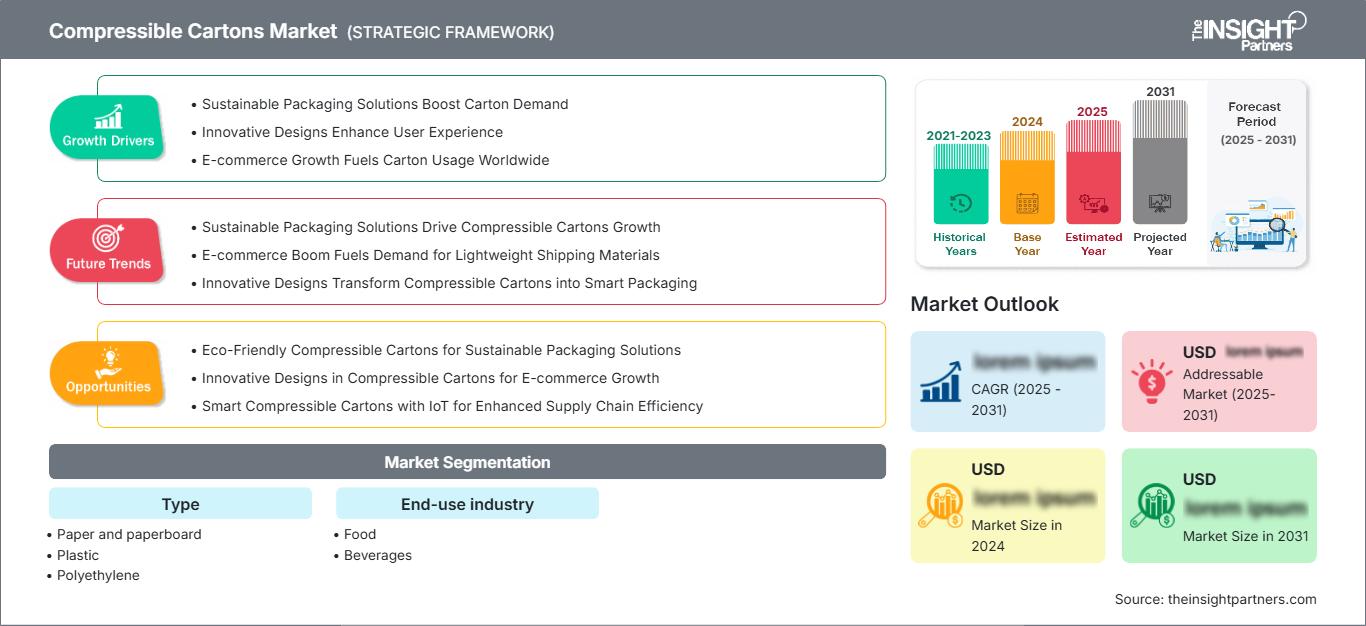
Regional Insights
North America Compressible Cartons Market
North America has a market share of 29–33% in 2025 and is projected to register a CAGR of 6.8–7.5% over 2034. US is the major consumer in the region due to large-scale food and beverage processing, packaging operations, organized retailing, and carton conversion facilities. Purchasing considerations in the region are increasingly influenced by material saving, packaging automation, and specification requirements from retailers.
There is an emphasis on lightweighting, pallet efficiency, shelf-life performance, and compatibility with automated filling in the region. Big food and beverage manufacturers also specify packaging requirements to save on material usage and transportation logistics. High growth is expected where there is scope for paperboard pack formats that can offer equivalent barrier and stacking properties compared to rigid packs without any impact on line speeds.
U.S. Compressible Cartons Market
The U.S. had around 76% to 80% share of North America demand in 2025 and was forecasted to show growth at a rate of 6.9% to 7.6% CAGR up till 2034. The main applications were food, dairy, juices, beverages, and food service, where packaging design is driven by national retailer's needs.
Smurfit Westrock plc, International Paper Company, and other packaging manufacturers provided wide converting and distribution capabilities, while Tetra Pak International S.A., Elopak ASA, and SIG Group AG are key players in the field of liquid food carton systems. Higher importance was seen in those constructions that allow better cube efficiency, lower material intensity, and automated filling processes. Domestic production could increase supply chain flexibility for beverage and food companies with high carton consumption.
Europe Compressible Cartons Market
The Compressible Cartons Market share in Europe was 24–28% in 2025 and is forecast to expand at a 6.3–7.1% CAGR through 2034, with Germany representing a leading national market. UK benefits from mature grocery distribution, while Germany has strong industrial packaging capabilities.
France, Italy, and Spain provide additional demand through dairy, beverages, prepared foods, and export-oriented food processing. European regulation increasingly rewards material efficiency, recyclability, and transparent packaging composition, encouraging suppliers to redesign barrier structures and reduce unnecessary layers. Stora Enso Oyj, Elopak ASA, SIG Group AG, and Tetra Pak International S.A. maintain strong strategic relevance across the region.
APAC Compressible Cartons Market
Asia Pacific accounted for 30–34% in 2025 and has potential to exhibit a 8.1–9.0% CAGR during 2034. The key countries include China, Japan, India, South Korea, and Australia. Growth in penetration of processed foods and beverage processing contributes to carton consumption.
Growing industrial growth, development of modern retail, and investment in domestic packaging capabilities increase adoption. India plays a vital role in that both dairy products and non-carbonated beverages are growing along with conversion and filling capabilities in the region. China has its manufacturing economy working on its side, while Japan and South Korea focus on high performance packaging solutions.
Middle East & Africa Compressible Cartons Market
Demand in Middle East & Africa is projected to record a 6.0-6.8% CAGR up to 2034 with leadership coming from Saudi Arabia and UAE in the Gulf region as well as South Africa being a significant African converting base. The MEA region is smaller compared to Asia Pacific, Europe, and North America.
Energy-intensive manufacturing, imported packaging, food security initiatives, and increasing beverage processing will drive purchases. Infrastructure development programs in the Gulf region favor advanced food manufacturing and distribution operations, whereas South Africa offers a fairly developed converting market. The Rest of MEA region is associated with urbanization, packed dairy products, juices, and shelf stable foods.
Segmentation Analysis
Type
Type remains a central determinant of performance because carton behavior depends on stiffness, barrier properties, sealability, and material recovery. The segment is expected to expand at a 7.7–8.3% CAGR during 2026–2034. Paper-based structures should retain the largest position, while polymer and aluminum layers remain important where product protection requires specialized barriers. The Compressible Cartons Market scope therefore depends on balancing lightweighting with functional performance.
- Paper and paperboard: This leading category remains important because fiber structures support lightweighting and established converting. Demand is strongest where brands prioritize renewable feedstocks and efficient transport.
- Plastic: Plastic structures provide flexibility, moisture resistance, and sealing performance, making them relevant for applications requiring higher forming tolerance and resistance to wet environments.
- Polyethylene: Polyethylene is important as a sealing and barrier layer, particularly where heat sealing, moisture resistance, and compatibility with high-speed filling equipment are required.
- Polypropylene: Polypropylene supports applications requiring higher temperature resistance, stiffness, or specialized barrier performance. Its role is influenced by processing requirements and the need to balance durability with material reduction.
- Aluminum: Aluminum provides strong light, oxygen, and moisture barrier performance. Its strategic value is highest in sensitive food and beverage applications where extended shelf life can justify multilayer construction.
End-use industry
End-use industry determines carton specifications through product characteristics, distribution conditions, filling technology, and shelf-life requirements. The segment is projected to grow at 7.6–8.5% during 2026–2034. Beverages should remain the faster-expanding application because liquid products require high-speed filling and dependable barrier systems.
- Food: Food applications include dairy, sauces, prepared foods, dry products, and shelf-stable categories. Purchasing decisions prioritize product protection, stacking efficiency, opening convenience, print quality, and compliance with food-contact requirements.
- Beverages: Beverage demand is strategically important because milk, juice, plant-based drinks, and other liquid products require high-speed filling and dependable barrier systems. Carton formats can also improve transport efficiency and shelf presentation.
Opportunity Snapshot
| End-use industry | Revenue Contribution | Trend Tag | Adoption Stage |
| Food | High | Shelf Stability | Mature |
| Beverages | High | Liquid Cartons | Scaling |
Compressible Cartons Market Growth Drivers and Impact Analysis
Lightweighting and transport-efficiency requirements
Packaging buyers increasingly evaluate cartons through total logistics performance rather than material cost alone. Lower basis weight, compact folding, improved pallet utilization, and reduced secondary packaging can lower transport requirements while preserving product protection. This driver affects board specifications, carton geometry, and converter equipment simultaneously. It also creates a commercial advantage for suppliers capable of achieving stiffness with less material through fiber engineering, coating optimization, and structural design. In beverage applications, lightweighting can influence filling-line throughput because dimensional consistency and seal integrity must remain within narrow tolerances. For food producers, improved cube efficiency can reduce warehouse and distribution costs. Consequently, procurement teams are more likely to compare packaging on total delivered cost, material intensity, and operational compatibility rather than price per carton alone, encouraging sustained investment in higher-performance structures.
Recyclability and packaging material simplification
Recyclability requirements are shifting product development toward structures that are easier to identify, collect, sort, and process after use. This creates pressure to reduce unnecessary material combinations and improve compatibility between paperboard, polymers, coatings, inks, and closures. For carton suppliers, the commercial impact extends beyond material selection because redesign can require new converting tools, filling trials, testing protocols, and customer approvals. European policy is particularly influential, but multinational brands increasingly apply common packaging principles across regions. Suppliers that can demonstrate functional performance while simplifying construction may shorten qualification cycles and reduce future compliance risk. The driver also encourages investment in barrier coatings and fiber-based alternatives that can preserve moisture and oxygen protection without relying on complex multilayer assemblies. Over time, material simplification should become a specification criterion alongside cost, strength, appearance, and shelf life.
Expansion of packaged food and beverage processing
Growing processed-food and beverage output expands the addressable requirement for standardized, high-throughput carton formats. Urbanization, modern retail, cold-chain development, and demand for shelf-stable products increase the need for packaging that can withstand transportation, warehousing, and automated filling. Beverage producers are particularly important because high-volume lines create recurring demand for standardized carton dimensions and dependable sealing performance. Food manufacturers add diversity through multiple pack sizes, product viscosities, and storage conditions, increasing the need for flexible converting. The impact is strongest in emerging economies where local filling capacity and organized retail are expanding simultaneously. Packaging suppliers can therefore gain share by combining regional manufacturing with technical support for filling-line qualification. This driver also strengthens demand for scalable designs that can serve multiple brands and product categories without extensive equipment modification.
Compressible Cartons Market Future Trends
Fiber-engineered barrier systems
The Compressible Cartons Market trends point toward future carton development that will increasingly use engineered fiber structures and thin functional coatings to deliver barrier performance with lower material complexity. Research and commercial trials are likely to focus on dispersion coatings, water-based formulations, mineral enhancements, and optimized polymer layers that maintain resistance to moisture, oxygen, grease, and light. The objective will be the minimum material combination that meets shelf-life and processing requirements. Barrier performance will become more measurable through standardized testing, allowing converters and brand owners to compare structures using functional metrics rather than broad material labels. Such developments may expand carton use in categories traditionally dominated by rigid plastic or other barrier packaging formats.
Digitized and flexible carton production
Digital workflow integration is expected to reshape carton production by improving artwork management, inspection, traceability, and short-run economics. Automated vision systems can identify print, fold, seal, and dimensional defects earlier, reducing material waste and improving line consistency. Digital printing can support regional launches, seasonal products, promotional packs, and smaller customer orders without the same plate and setup requirements associated with conventional processes. As brand portfolios become more fragmented, this flexibility can help converters maintain equipment utilization while accommodating more stock-keeping units. Data from production systems may increasingly connect machine performance with quality records and customer specifications, enabling predictive maintenance and faster root-cause analysis. The trend is especially relevant to converters serving food and beverage companies that need frequent artwork changes while maintaining strict packaging consistency and regulatory control.
Compressible Cartons Market Opportunities
Localized converting capacity in emerging markets
Investors can target localized carton converting and finishing capacity in markets where food and beverage production is expanding faster than specialized packaging supply. Establishing regional operations can reduce import dependence, shorten lead times, lower freight exposure, and enable closer technical support for filling-line customers. Attractive locations should combine growing packaged-food output with reliable utilities, skilled converting labor, logistics connectivity, and access to board or polymer inputs. Partnerships with filling-equipment suppliers can further improve customer acquisition because packaging qualification often occurs alongside equipment commissioning. The strongest opportunity is likely to occur where local producers are moving from basic packaging toward higher-value formats requiring consistent dimensions, improved shelf life, and stronger retail presentation.
Integrated recyclable carton platforms
A second opportunity lies in integrated carton platforms that combine board development, barrier technology, converting, filling compatibility, and end-of-life validation. Customers increasingly need evidence that a redesigned pack performs reliably throughout distribution while meeting recycling requirements after use. Suppliers can address this need by offering tested material systems rather than isolated board or coating products. Strategic investments in laboratories, pilot filling equipment, and application-development centers can reduce the time required for customer qualification. Collaboration with recyclers and packaging recovery organizations can strengthen claims concerning actual end-of-life performance. The Compressible Cartons Market Forecasts indicate that suppliers able to connect material innovation with practical converting and filling requirements can capture higher-value projects. This opportunity is particularly relevant to multinational food and beverage companies seeking common packaging architectures across several markets while adapting materials to local recovery infrastructure.
Recent Developments
- August 2026: Jaipur-based packaging company, Miracle Group, expanded manufacturing footprint and strengthened its portfolio across cartons, flexible packaging, corrugated boxes, labels and rigid packaging.
- June 2026: Hotpack Global partnered with Malaysia-based HZ Corporation to establish HZP Eco Packaging, a joint venture focused on expanding paper-based foodservice packaging across the Middle East, Southeast Asia, Australia, New Zealand, and North America. The partnership combines Hotpack’s international distribution network and foodservice packaging portfolio with HZ Corporation’s manufacturing expertise in paper-based packaging. The initial product portfolio will include paper cups, folding cartons, paper bags, and related foodservice packaging products, targeting quick-service restaurants, coffee brands, airlines, catering companies, and food delivery platforms.
Frequently Asked Questions

- Comprehensive Market Sizing and Forecast Analysis
- Detailed Segmentation Analysis
- In-Depth Market Dynamics Assessment
- Regional and Country-Level Insights
- Competitive Landscape and Company Benchmarking
- Strategic Business Intelligence
Recent Reports
Testimonials

The Insight Partners' SCADA System Market report is comprehensive, with valuable insights on current trends and future forecasts. The team was highly professional, responsive, and supportive throughout. We are very satisfied and highly recommend their services.
RAN KEDEM Partner, Reali Technologies LTDs
I requested a report on a very specific software market and the team produced the report in a few days. The information was very relevant and well presented. I then requested some changes and additions to the report. The team was again very responsive and I got the final report in less than a week.
JEAN-HERVE JENN Chairman, Future Analytica
We worked with The Insight Partners for an important market study and forecast. They gave us clear insights into opportunities and risks, which helped shape our plans. Their research was easy to use and based on solid data. It helped us make smart, confident decisions. We highly recommend them.
PIYUSH NAGPAL Sr. Vice President, High Beam Global
The Insight Partners delivered insightful, well-structured market research with strong domain expertise. Their team was professional and responsive throughout. The user-friendly website made accessing industry reports seamless. We highly recommend them for reliable, high-quality research services
YUKIHIKO ADACHI CEO, Deep Blue, LLC.
This is the first time I have purchased a market report from The Insight Partners.While I was unsure at first, I visited their web site and felt more comfortable to take the risk and purchase a market report.I am completely satisfied with the quality of the report and customer service. I had several questions and comments with the initial report, but after a couple of dialogs over email with their analyst I believe I have a report that I can use as input to our strategic planning process.Thank you so much for taking the extra time and making this a positive experience.I will definitely recommend your service to others and you will be my first call when we need further market data.
JOHN SUZUKI President and Chief Executive Officer, Board Director, BK Technologies
I wish to appreciate your support and the professionalism you displayed in the course of attending to my request for information regarding to infectious disease IVD market in Nigeria. I appreciate your patience, your guidance, and the fact that you were willing to offer a discount, which eventually made it possible for us to close a deal. I look forward to engaging The Insight Partners in the future, all thanks to the impression you have created in me as a result of this first encounter.
DR CHIJIOKE ONYIA MANAGING DIRECTOR, PineCrest Healthcare Ltd.Reason to Buy
- Informed Decision-Making
- Understanding Market Dynamics
- Competitive Analysis
- Identifying Emerging Markets
- Customer Insights
- Market Forecasts
- Risk Mitigation
- Boosting Operational Efficiency
- Strategic Planning
- Investment Justification
- Tracking Industry Innovations
- Aligning with Regulatory Trends





 Get Free Sample for