
Computational Photography Market Size, Growth & Demand by 2034
Coverage: by Offering (Camera Modules, Software); Type (Single and Dual-Lens Camera, 16-Lens Camera, Others); Product (Smartphone Cameras, Standalone Cameras, Machine Vision Cameras); Application (3D Imaging, Virtual Reality, Augmented Reality, Mixed Reality) , and Geography (North America, Europe, Asia Pacific, and South and Central America)
- Status : Data Released
- Report Code : TIPRE00012285
- Category : Electronics and Semiconductor
- No. of Pages : 150
- Available Report Formats :


- Last update date : August 05, 2026


2025 Market Size
US$ 14.75 Bn
Base year value
2034 Forecast
US$ 50.89 Bn
Projected by 2034
CAGR 2026-2034
14.75 %
Growth rate
Addressable Market
US$ 281.10 Bn
(2026-2034)
The Computational Photography Market was assessed at US$ 14.75 Billion in 2025 and estimated to reach US$ 50.89 Billion by 2034, registering a CAGR of 14.75% during 2026–2034. This market consists of camera modules and software that involve optics, sensors, image signal processing, artificial intelligence, and multiple frames algorithm to enhance the image quality through smartphones, stand-alone cameras, machine vision cameras, and immersive imaging applications.
North America continues to be a high-value imaging ecosystem due to the premium smartphones, creator's suite, autonomy systems, and development of AR. The Computational Photography Market size in this region is anticipated to grow at a CAGR range of 13.8–15.2% during 2026–2034 driven by the adoption of AI chips, robust software monetization, and enterprise applications in camera intelligence.
Computational Photography Market Assessment and Insights
- North America: The region holds 34–38% Computational Photography Market share in 2025 and grows at a CAGR range of 13.8–15.2% during 2026–2034, led by premium smartphones, AI imaging software, and spatial computing investment.
- US: The country represents 78–82% of North America in 2025 and grows at a CAGR range of 13.9–15.3% during 2026–2034, supported by platform and chip leadership.
- Europe: The region accounts for 20–24% share in 2025 and grows at a CAGR range of 12.6–14.0% during 2026–2034, with Germany, the UK, France, Italy, and Spain leading adoption.
- Asia Pacific: The region holds 30–34% share in 2025 and grows at a CAGR range of 15.6–17.2% during 2026–2034, led by China, Japan, South Korea, India, and Taiwan.
- Largest Segment: Smartphone Cameras holds 56–60% market share in 2025 and grows at a CAGR range of 13.4–14.8% during 2026–2034 due to mass mobile integration.
- High Growth Segment: Software holds 36–40% market share in 2025 and grows at a CAGR range of 16.2–18.0% during 2026–2034 as AI imaging pipelines scale.
- Key companies analyzed in detail: Apple Inc.; Adobe Inc.; Samsung Electronics Co., Ltd.; Qualcomm Technologies, Inc.; NVIDIA Corporation; Canon Inc.; Nikon Corporation; Light Labs Inc.; Algolux Inc.; ALMALENCE INC.
Source: The Insight Partners' analysis based on proprietary research, government publications, company annual reports, investor presentations, industry databases, and expert interviews.
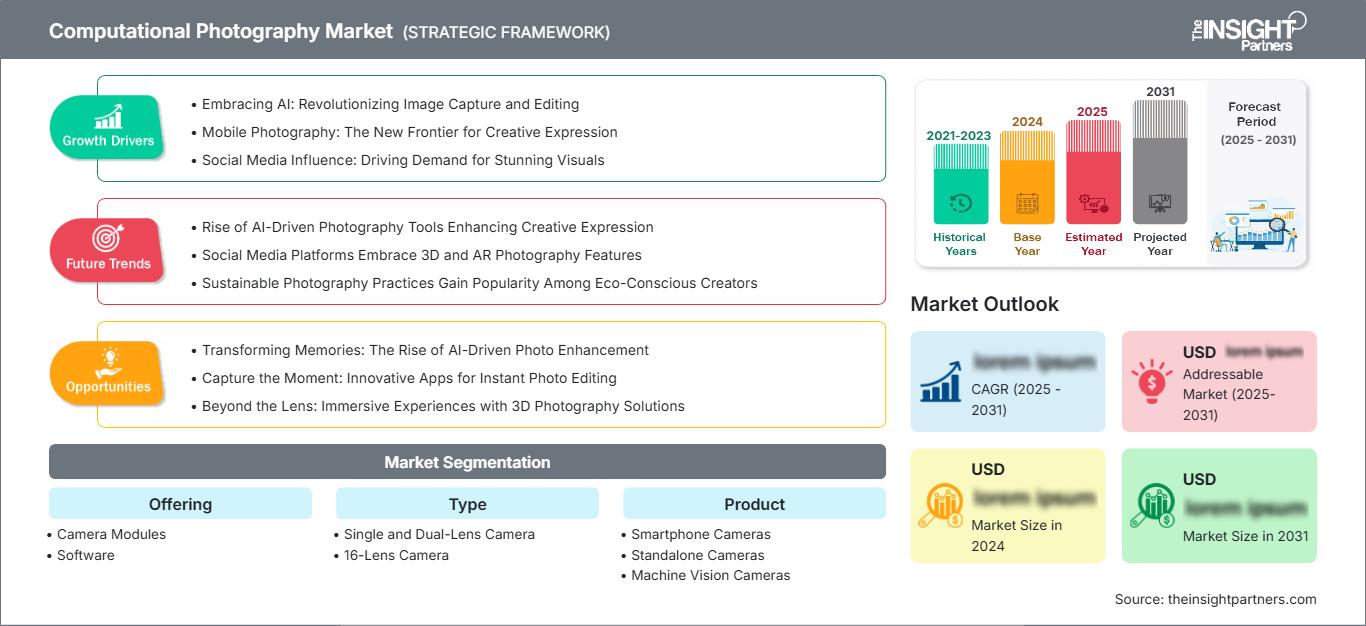
Computational photography has transitioned from post-processing of captured photos to on-device intelligence in real time. Multi-camera fusion, neural denoising, HDR, depth mapping, and semantic segmentation have become as significant for the design of devices as the number of lenses and sensors. Production cycles are increasingly becoming an interconnected cycle involving module manufacturers, semiconductor providers, OS designers, and application software developers, leading to greater integration of optics, image signal processors, neural accelerators, and post-processing.
Growing demand is expected as new geographies adopt smartphones with AI capabilities, and businesses leverage camera intelligence in inspection, logistics, robotics, and training systems. According to the ITU, in 2025, there were over 5.8 billion people accessing the Internet, thus increasing the pool of potential customers. Privacy laws and the growing importance of on-device processing would create favorable conditions for vendors offering rapid photo enhancement without reliance on cloud technology.
Computational Photography Market Report Scope
| Report Attribute | Details |
|---|---|
| Market size in 2025 | US$ 14.75 Billion |
| Market Size by 2034 | US$ 50.89 Billion |
| Global CAGR (2026 - 2034) | 14.75% |
| Historical Data | 2021-2024 |
| Forecast period | 2026-2034 |
Computational Photography Market Analysis
Drivers include smartphone manufacturers that require noticeable camera differentiation without commensurate increases in the optical stack thickness, battery drain, or bill of materials costs. The prospects of the Computational Photography Market are further strengthened by the emergence of creator-economy workflows, AI-enabled photo editing, video stabilization, depth-sensing capabilities, and applications of machine vision in unfavorable lighting or motion conditions.
It encompasses manufacturers of CMOS sensors, optics, camera modules, chipsets, algorithms, smartphones brands, application providers, cloud computing companies, and industry integrators. The supply chain will rely on the availability of AI accelerators, capabilities of mobile GPUs, yields of CMOS sensors, optics miniaturization and software engineering efforts. The purchasing criteria include performance in low light, color accuracy, latency, power consumption, depth sensing, privacy features, and support for photo editing environments.
The Computational Photography market analysis indicates the competition among ecosystem players for devices, experts in imaging software, semiconductor players, and camera manufacturers. Apple Inc., Samsung Electronics Co., Ltd., Qualcomm Technologies, Inc., and NVIDIA Corporation compete in terms of silicon and platform optimization, while Adobe Inc., Canon Inc., Nikon Corporation, Light Labs Inc., Algolux Inc., and ALMALENCE INC. compete in the areas of workflow, algorithms, optics, and specialty imaging performance.
Key investment areas are learned ISP architectures, multi-frame raw processing, neural rendering, image verification, augmented reality depth pipelines, and domain-specific vision solutions. The market participants’ strategic positioning varies according to the channel – handset OEMs value integrated camera experience, software players capitalize on editing and workflow intelligence, semiconductor players offer AI-enabled imaging compute solutions, and industrial vendors rely on repeatability and calibration.
● REPORT CUSTOMIZATION
Tailor This Report To Align With Your Specific Business Requirements
This report can be customized to align precisely with your business objectives, scope, and target markets. Customization options include tailored segmentation, geography, competitive analysis, and strategic insights to support informed decision-making.
Customize This Report →WHAT YOU CAN ADJUST
- ● Segmentations
- ● Geography
- ● Competitive Analysis
- ● Language Preferences
Computational Photography Market: Strategic Insights
Regional Insights
North America Computational Photography Market
North America possesses market share of 34–38% in 2025, with forecasted growth in the range of 13.8–15.2% CAGR during 2026–2034. Factors such as premium smartphones, AI software, advanced semiconductor technologies, augmented reality, and camera analytics for business purposes help North America’s market share.
North America gets advantage through developer networks, content generation tools, AI infrastructure from cloud to edge computing, and adoption of privacy-preserving processing on devices. Companies such as Qualcomm Technologies, Inc., Apple Inc., Adobe Inc., NVIDIA Corporation, Light Labs Inc., Algolux Inc., and ALMALENCE INC. have made North America well-balanced in terms of silicon, software, algorithms, and specialized imaging systems.
U.S. Computational Photography Market
The U.S. represents 78–82% of North America in 2025 and is expected to grow at a CAGR range of 13.9–15.3% during 2026–2034. Company presence is concentrated across platform design, mobile imaging software, AI accelerators, cloud services, professional editing, autonomous systems, and venture-backed camera intelligence companies serving consumers and enterprises.
Application trends center on smartphone capture, generative editing, 3D scanning, AR visualization, medical imaging support, industrial inspection, and automotive perception. Apple Inc., Adobe Inc., Qualcomm Technologies, Inc., NVIDIA Corporation, and Light Labs Inc. influence adoption by linking imaging pipelines with operating systems, AI frameworks, developer tools, and premium device experiences.
Europe Computational Photography Market
Europe accounts for 20–24% share in 2025 and grows at a CAGR range of 12.6–14.0% during 2026–2034. Germany is the leading country because automotive vision, industrial machine vision, optics engineering, and manufacturing automation create demand for robust computational imaging beyond consumer devices.
The UK supports software-led imaging, media production, and AR design, while France, Italy, and Spain add demand from security, cultural digitization, retail visualization, medical imaging support, and creator tools. European adoption is shaped by privacy regulation, data governance, and preference for auditable AI pipelines, encouraging on-device processing and explainable workflow controls.
APAC Computational Photography Market
Asia Pacific has a market share of 30-34% in 2025 and will register a CAGR range of 15.6-17.2% in the period from 2026-2034. China takes the lead with the size of smartphone production, camera modules, AI applications, and machine vision. Japan and South Korea provide image sensors, optics, and strengths in consumer electronics.
India, Taiwan, and Australia make a contribution with increasing mobile user base, semiconductor industry, smart manufacturing, and digital content generation. Supportive policies to encourage electronics manufacturing, 5G, and industrial automation will result in the demand for AI-ready camera modules. It is favorable for the Computational Photography Market when local device makers use cheap sensors.
Middle East & Africa Computational Photography Market
The Middle East & Africa region will register CAGR of 11.8–13.2% over 2026–2034. UAE drives selective use via its initiatives in smart cities, security systems, tourism, visualization in retail and expensive smartphones, whereas Saudi Arabia associates demands with development of infrastructure and digital solutions.
Further growth of South Africa and Rest of MEA will be due to applications in surveillance, mobile content creation, medical imaging support, and industrial monitoring. Increasing energy and infrastructure developments stimulate the requirement for robust camera intelligence with challenges posed by lightening, dust, and distances for traditional camera. Growth will hinge upon connectivity, affordability, integration, and availability of AI specialists.
Segmentation Analysis
Offering
Offering is projected to grow at a CAGR range of 14.1–15.8% during 2026–2034. The Computational Photography Market scope by offering is shaped by the balance between physical camera module upgrades and software-defined image enhancement. Camera modules remain essential for capture quality, while software increasingly determines differentiation through neural denoising, HDR fusion, depth estimation, super-resolution, and editing automation.
- Camera Modules: Camera modules dominate hardware revenue because smartphones, industrial cameras, and immersive devices require compact optics, sensors, autofocus, stabilization, and calibrated multi-camera assemblies.
- Software: Software is the fastest scaling layer as AI pipelines, learned ISPs, editing automation, depth processing, and device-specific tuning create recurring value beyond hardware refresh cycles.
Type
Type is expected to grow at a CAGR range of 13.5–15.1% during 2026–2034. Single and dual-lens systems retain broad adoption because they meet cost, power, and space constraints in mainstream devices. Higher lens-count architectures serve specialized depth capture, light-field reconstruction, and advanced 3D imaging where richer angular data improves post-capture control and scene understanding.
- Single and Dual-Lens Camera: Single and dual-lens designs remain widely deployed because they balance image quality, processing load, device thickness, and cost for smartphones and compact cameras.
- 16-Lens Camera: Multi-lens architectures support depth-rich capture, refocusing, 3D reconstruction, and specialty imaging, but adoption is concentrated where premium capability justifies complexity.
Product
Product is forecast to grow at a CAGR range of 14.0–15.6% during 2026–2034. Smartphone cameras represent the largest product base because imaging remains a primary purchase criterion. Standalone cameras adopt computational tools to improve RAW workflows and stabilization, while machine vision cameras use algorithms to enhance inspection accuracy, edge interpretation, and operational reliability.
- Smartphone Cameras: Smartphone cameras lead demand because billions of users rely on mobile imaging for communication, social content, commerce, identity, and everyday documentation.
- Standalone Cameras: Standalone cameras use computational functions to improve autofocus, stabilization, subject recognition, RAW processing, and hybrid creator workflows without abandoning optical quality.
- Machine Vision Cameras: Machine vision cameras gain strategic importance in factories, logistics, robotics, healthcare support, and security where algorithms improve detection under variable lighting.
Application
Application is projected to grow at a CAGR range of 14.6–16.4% during 2026–2034. Adoption is expanding from photographic enhancement to spatial understanding. 3D imaging supports mapping and measurement, virtual reality and augmented reality require low-latency scene capture, and mixed reality depends on accurate alignment between cameras, sensors, rendering engines, and user interaction.
- 3D Imaging: 3D imaging uses depth sensing, reconstruction, and multi-view capture to support measurement, scanning, mapping, digital twins, and product visualization workflows.
- Virtual Reality: Virtual reality benefits from computational capture for realistic environments, avatars, passthrough improvement, and content creation where latency and visual consistency matter.
- Augmented Reality: Augmented reality relies on camera intelligence for object recognition, depth alignment, occlusion, lighting estimation, and stable placement of digital content.
- Mixed Reality: Mixed reality combines real-time capture, spatial mapping, hand tracking, and rendering synchronization to support enterprise training, design collaboration, and immersive communication.
Opportunity Snapshot
| Application | Revenue Contribution | Trend Tag | Adoption Stage |
| 3D Imaging | High | Depth Mapping | Scaling |
| Virtual Reality | Medium | Immersive Capture | Scaling |
| Augmented Reality | High | Scene Anchoring | Scaling |
| Mixed Reality | Medium | Spatial Fusion | Emerging |
Computational Photography Market Growth Drivers and Impact Analysis
AI-Enabled Smartphone Differentiation
Camera experience plays an important role for smartphone companies in justifying their high prices, and computational photography provides them with a scalable solution to improve low light performance, portrait isolation, HDR video, zooming, stabilization, and generative image editing. Its importance can be seen from product roadmaps where increasing space is allotted to neural engines and ISPs. With the narrowing of hardware gaps between smartphones, competition occurs on the basis of pipeline quality, color science, privacy, and convenience of image editing. This creates more demand for camera modules designed for AI applications, SDKs, and chipsets.
Machine Vision and Edge AI Expansion
Today’s factories, warehouses, hospitals, farms, and logistics operations all require cameras that are capable of understanding their surroundings rather than simply capturing them. The role of computational photography is to increase the precision of image analysis by removing lighting variations, noise, recreating depth, and sharpening objects before applying machine learning algorithms to them. This approach works best when there are significant consequences associated with a stoppage, a defect not being identified, or incorrectly classifying an item. Edge computing can decrease both bandwidth consumption and the privacy risks associated with sending visual data elsewhere.
Immersive Computing Requires Spatial Capture
Cameras are essential for AR, VR, and mixed reality hardware for depth sensing, mapping of rooms, hand and eye tracking, passthrough video, and realistic lighting. The computational approach is used to transform data from the sensors into a spatial model allowing digital information to become static and believable. The scope goes beyond the entertainment industry and includes training, design reviews, technical support, retail visualization, and educational applications. The hardware manufacturers require fast processing pipeline with cameras, inertial sensors, graphics processor, and machine learning models. It drives the need for software optimization and specialized components for headsets.
Computational Photography Market Future Trends
Learned ISP Pipelines Move Into Devices
Computational Photography Market trends will increasingly favor learned ISP models that replace fixed processing steps with neural networks trained on RAW-to-RGB reconstruction, denoising, tone mapping, and color correction. Research demonstrations show that efficient models can process high-resolution images on mobile GPUs with practical latency, making software quality a more dynamic differentiator. The next phase will combine model compression, device-specific tuning, and privacy-preserving training so vendors can improve image quality through updates. This trend will also support professional mobile workflows where users want natural texture, controllable color, and RAW flexibility.
Authenticity and Provenance Become Imaging Features
As generative editing becomes common, buyers will value tools that distinguish captured pixels, computational enhancement, and synthetic alteration. Future imaging pipelines are likely to embed provenance metadata, tamper indicators, and secure processing records at capture or export. This will matter for journalism, insurance, law enforcement, healthcare, and enterprise documentation where visual evidence must remain trusted. Companies that integrate authentication without disrupting creative workflows can create a defensible software layer. The trend also supports regulatory readiness as governments and platforms increase attention to deepfakes and manipulated media.
Computational Photography Market Opportunities
Vertical Software for Industrial Vision
Computational Photography Market Forecasts support investment in vertical imaging software for factories, logistics hubs, healthcare equipment, agriculture, and security systems. Buyers in these settings need repeatable performance under variable light, motion, distance, and surface conditions. Vendors can capture value by bundling calibrated camera modules, preprocessing algorithms, edge AI models, dashboards, and maintenance tools. The most attractive opportunities are applications where improved image quality directly reduces inspection errors, manual review, waste, or downtime. Partnerships with system integrators and equipment manufacturers can shorten adoption cycles and create recurring software revenue.
Creator Workflow Integration Across Capture and Editing
Creator tools create an actionable opportunity because mobile capture, RAW enhancement, generative editing, color grading, and social publishing are converging. Software providers can link camera apps, cloud libraries, desktop editors, and marketplace assets so users keep image quality and metadata across the workflow. The value proposition is stronger when tools preserve natural texture, provide reversible edits, and automate repetitive corrections. Camera brands and smartphone vendors can partner with editing platforms to retain professionals and advanced hobbyists who want portability without losing control.
Recent Developments
- July 2026: MediaTek outlined its next-generation smartphone imaging technology roadmap at its “Beyond the Lens” Tech Day in New Delhi, highlighting advancements enabled by its latest Dimensity 9500 and Dimensity 8500 series chipsets. The company showcased innovations including 18EV HDR Fusion for enhanced dynamic range, 4K120 Super EIS for stabilized high-resolution video capture, and AI-powered imaging capabilities that combine advanced camera sensors with powerful ISP processing to improve smartphone photography and videography experiences.
- July 2025: FRAMOS highlighted the role of high-fidelity computational photography without AI in professional imaging systems, emphasizing that traditional image processing algorithms remain highly relevant for real-time applications such as broadcast cameras. The article showcased how careful system design, image-quality benchmarking, hardware measurement, and advanced image signal processing (ISP) tuning can deliver high-quality imaging performance without relying on deep learning, enabling faster, more reliable, and predictable vision systems.
- June 2025: Adobe launched Project Indigo, an experimental computational photography camera app for iPhones developed by Adobe Labs and led by former Google Pixel camera technology pioneers Marc Levoy and Florian Kainz. The app uses multi-frame image capture and computational processing to create high-quality photos with lower noise, improved dynamic range, and a natural DSLR-like look, while offering manual controls for focus, shutter speed, ISO, and white balance. Project Indigo is available free of charge and is designed as a platform for exploring future mobile photography and AI-driven imaging technologies.
Frequently Asked Questions

- Comprehensive Market Sizing and Forecast Analysis
- Detailed Segmentation Analysis
- In-Depth Market Dynamics Assessment
- Regional and Country-Level Insights
- Competitive Landscape and Company Benchmarking
- Strategic Business Intelligence
Recent Reports
Testimonials

The Insight Partners provided valuable market intelligence that supported our global go-to-market strategy. Their team was professional, responsive, and attentive to our feedback, providing thoughtful analysis and helpful methodological clarifications throughout the project.
Junmo Kim Chief Financial Officer (CFO), Enertech Co., Ltd.
The Insight Partners' SCADA System Market report is comprehensive, with valuable insights on current trends and future forecasts. The team was highly professional, responsive, and supportive throughout. We are very satisfied and highly recommend their services.
RAN KEDEM Partner, Reali Technologies LTDs
I requested a report on a very specific software market and the team produced the report in a few days. The information was very relevant and well presented. I then requested some changes and additions to the report. The team was again very responsive and I got the final report in less than a week.
JEAN-HERVE JENN Chairman, Future Analytica
We worked with The Insight Partners for an important market study and forecast. They gave us clear insights into opportunities and risks, which helped shape our plans. Their research was easy to use and based on solid data. It helped us make smart, confident decisions. We highly recommend them.
PIYUSH NAGPAL Sr. Vice President, High Beam Global
The Insight Partners delivered insightful, well-structured market research with strong domain expertise. Their team was professional and responsive throughout. The user-friendly website made accessing industry reports seamless. We highly recommend them for reliable, high-quality research services
YUKIHIKO ADACHI CEO, Deep Blue, LLC.
This is the first time I have purchased a market report from The Insight Partners.While I was unsure at first, I visited their web site and felt more comfortable to take the risk and purchase a market report.I am completely satisfied with the quality of the report and customer service. I had several questions and comments with the initial report, but after a couple of dialogs over email with their analyst I believe I have a report that I can use as input to our strategic planning process.Thank you so much for taking the extra time and making this a positive experience.I will definitely recommend your service to others and you will be my first call when we need further market data.
JOHN SUZUKI President and Chief Executive Officer, Board Director, BK Technologies
I wish to appreciate your support and the professionalism you displayed in the course of attending to my request for information regarding to infectious disease IVD market in Nigeria. I appreciate your patience, your guidance, and the fact that you were willing to offer a discount, which eventually made it possible for us to close a deal. I look forward to engaging The Insight Partners in the future, all thanks to the impression you have created in me as a result of this first encounter.
DR CHIJIOKE ONYIA MANAGING DIRECTOR, PineCrest Healthcare Ltd.Reason to Buy
- Informed Decision-Making
- Understanding Market Dynamics
- Competitive Analysis
- Identifying Emerging Markets
- Customer Insights
- Market Forecasts
- Risk Mitigation
- Boosting Operational Efficiency
- Strategic Planning
- Investment Justification
- Tracking Industry Innovations
- Aligning with Regulatory Trends





 Get Free Sample for