
Computing Mouse Market Growth, Trends & Demand by 2034
Coverage: by Type (Wireless Mouse, and Wired Mouse); Application (Business sector, and Consumer sector); and Product (Optical Mouse, Mechanical Mouse, 3-D Mouse, and Gaming Mouse), and Geography (North America, Europe, Asia Pacific, and South and Central America)
- Status : Data Released
- Report Code : TIPTE00002051
- Category : Electronics and Semiconductor
- No. of Pages : 150
- Available Report Formats :


- Last update date : July 28, 2026


2025 Market Size
US$ 3.54 Bn
Base year value
2034 Forecast
US$ 6.85 Bn
Projected by 2034
CAGR 2026-2034
7.63 %
Growth rate
Addressable Market
US$ 46.85 Bn
(2026-2034)
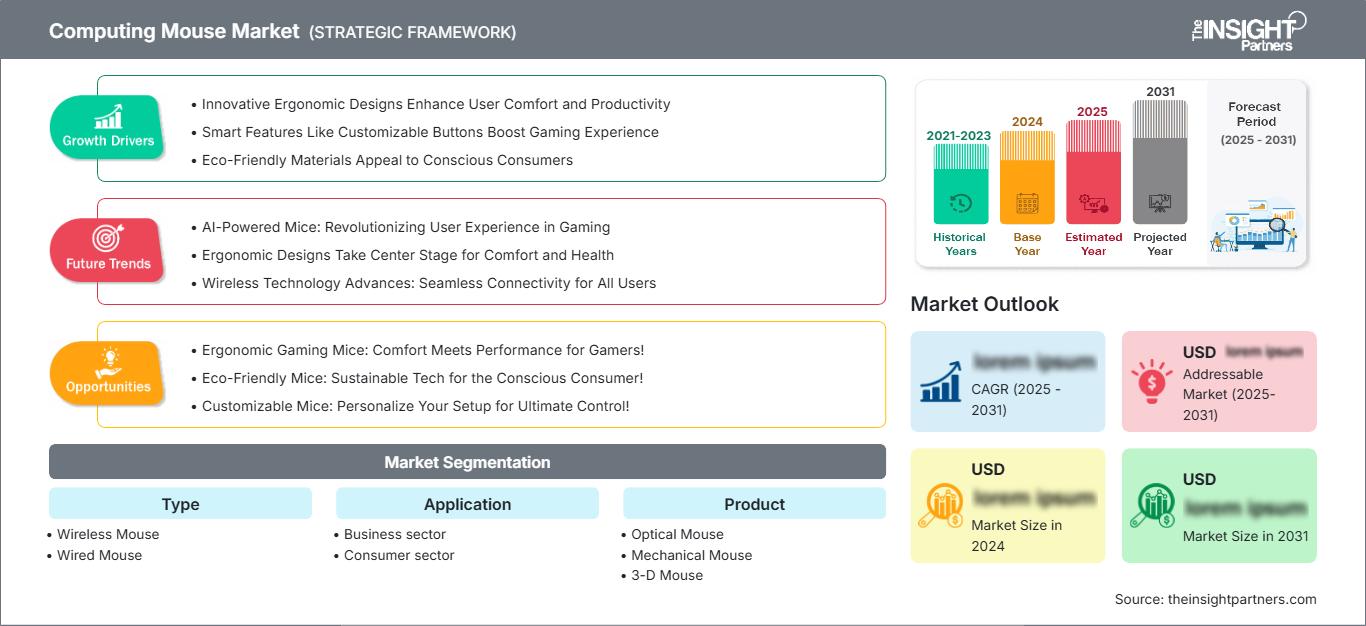
The Computing Mouse market size was recorded at US$ 3.54 billion in 2025 and will further grow to US$ 6.85 billion till 2034, growing at a CAGR of 7.63% in the period 2026 to 2034. Factors impacting the market include demand for replacements, superior gaming mouse, refresh cycles in enterprises, as well as increased preference for wireless, ergonomic and application specific pointing devices.
In North America, the demand for computing mice is estimated to grow at a CAGR rate of 6.8–7.8%. Hybrid working, enterprise standards, educational technology, and premium gaming peripherals will ensure repeat purchases. Factors impacting the Computing Mouse market size in North America include strong PC ownership rate, advanced eCommerce infrastructure, and established installed base which prefers comfort, sensor precision, and multiple devices connectivity.
Computing Mouse Market Assessment and Insights
- North America held 31–35% share in 2025 and is growing at a CAGR of 6.8–7.8% during 2026–2034, supported by hybrid work, gaming upgrades, and enterprise procurement.
- US represented 78–82% of North America in 2025 and is growing at a CAGR of 6.9–7.9%, led by corporate, education, and gaming demand.
- Europe accounted for 22–26% share in 2025 and is advancing at a CAGR of 6.1–7.1%, with Germany, the UK, France, Italy, and Spain leading replacement purchases.
- Asia Pacific captured 32–36% share in 2025 and is expanding at a CAGR of 8.4–9.4%, led by China, Japan, South Korea, India, and Australia.
- Largest Segment Wireless Mouse held 56–60% market share in 2025 and is growing at a CAGR of 8.0–9.0%, driven by cable-free workspaces and laptop adoption.
- High Growth Segment Gaming Mouse held 18–22% of the Computing Mouse Market share in 2025 and is growing at a CAGR of 9.6–10.8%, supported by esports and premium sensor upgrades.
- Key companies analyzed in detail: Dell Technologies Inc., Microsoft Corporation, HP Inc., Logitech International S.A., Turtle Beach Corporation, Razer Inc., Mad Catz Global Limited, SteelSeries ApS, Mionix AB, and A4Tech Co., Ltd.
Source: The Insight Partners' analysis based on proprietary research, government publications, company annual reports, investor presentations, industry databases, and expert interviews.
Mice have evolved from simple mechanical tracking to optical tracking, low latency wireless connectivity, programmability, rechargeable power solutions, and ergonomic designs. This development process is captured by the market through expansion into different product lines, ranging from standard office mice to gaming and design-oriented mice. The production process is still highly centralized in Asian electronics hubs, but differentiation is increasingly driven by customization of sensors, software platforms, longevity assertions, and channel strategy.
Demand will be driven by growing populations of laptops, gaming clans, digital learning, and business space transformation. Firms are expected to spend in research in making their products light, efficient in battery consumption, silent key mechanisms, recyclable materials, and interoperable among different devices. Environmental laws about electronic waste and sustainability reporting will also drive some design decisions, particularly in Europe and North America where procurement offices consider repairability and package impact.
Computing Mouse Market Report Scope
| Report Attribute | Details |
|---|---|
| Market size in 2025 | US$ 3.54 Billion |
| Market Size by 2034 | US$ 6.85 Billion |
| Global CAGR (2026 - 2034) | 7.63% |
| Historical Data | 2021-2024 |
| Forecast period | 2026-2034 |
Computing Mouse Market Analysis
Computing Mouse Market growth relies on the sustained importance of PCs for office productivity, education, design, and games. While touch screens and touch pads are popular, there are still plenty of people who want to use a mouse separately because of its precision, convenience, and speed of usage. The highest demand for mouse comes from laptops together with docking stations, additional monitors, and convertible desks.
Supply side includes plastic components, printed circuit boards, optical sensors, mechanical switches, radio chips, battery power, and manufacturing capacities. Specifications that become standard include optical technology, Bluetooth technology, 2.4 GHz receivers, and USB-C connectors. Companies compete through combination of price, comfort, and reliability. Retailers and online marketplaces affect visibility through bundles and reviews.
The Computing Mouse Market Report reveals competitive environment comprising of global PC companies, productivity-oriented firms and gaming peripherals makers. Dell Technologies Inc., Microsoft Corporation and HP Inc. rely on corporate partnerships and PC packages. Logitech International S.A. is prominent due to wide distribution, whereas Razer Inc., SteelSeries ApS, Turtle Beach Corporation, Mad Catz Global Limited, Mionix AB and A4Tech Co., Ltd. target gamers and budget users.
Innovation focus moves to software-based customizability, esport brand presence, sustainability and productivity for various devices. The former segment relies on such features as sensor accuracy, weight optimization, polling rate and switch lifetime as rationales for high price level. Value offerings compete with budget pricing and availability, especially in developing countries. Hence, strategic positioning relies on channel reach, innovation pace, community involvement and post-purchase software solutions.
● REPORT CUSTOMIZATION
Tailor This Report To Align With Your Specific Business Requirements
This report can be customized to align precisely with your business objectives, scope, and target markets. Customization options include tailored segmentation, geography, competitive analysis, and strategic insights to support informed decision-making.
Customize This Report →WHAT YOU CAN ADJUST
- ● Segmentations
- ● Geography
- ● Competitive Analysis
- ● Language Preferences
Computing Mouse Market: Strategic Insights
Regional Insights
North America Computing Mouse Market
North America held 31–35% share in 2025 and is projected to grow at a CAGR of 6.8–7.8% through 2034. The market share in the region is supported by high PC ownership, corporate refresh programs, premium gaming adoption, and strong demand for ergonomic devices that reduce fatigue in hybrid work environments.
Commercial purchasing will continue to be significant since organizations have standardized their keyboards, mice, docking stations, and monitors among their employees. Gamers and content creators have an elite demand for wireless, lightweight versions, along with optical sensors and programmable buttons. There is wide availability at retail, e-commerce, and direct brand stores. Sustainable practices affect packaging, batteries, and recycling of materials.
U.S. Computing Mouse Market
The US accounts for 78-82% share of North America and will register a CAGR of 6.9-7.9%. Factors that support demand include spending on enterprise IT, initiatives in schools/universities to provide devices, participation in esports, and upgrades of the home office space. The main market players with high brand recognition include Logitech International S.A., Microsoft Corporation, Dell Technologies Inc., HP Inc., Razer Inc., and SteelSeries ApS.
Current trends include a move towards wireless productivity mice, quiet-click options, gaming mice that can switch DPI, and mice for multiple devices due to switching between laptops, tablets, and desktops. Enterprise purchases focus on reliability and customer service while consumer purchases focus on performance of the sensors, battery duration, ergonomics, and price.
Europe Computing Mouse Market
The Europe region accounts for 22–26% market share in 2025 and is projected to have a CAGR of 6.1–7.1%. In terms of regional demand, Germany is leading due to enterprise IT, manufacturing offices, and gaming communities. The UK contributes demand from online purchases and hybrid work. Meanwhile, France increases demand from education, public administration, and professional services users.
Meanwhile, Italy and Spain are rising up due to small business digitization, consumer electronics, and gaming peripherals. Consumers in Europe are becoming increasingly conscious about energy-efficient, low noise switching, comfort, and sustainable packaging. Although there is lower growth in comparison to Asia Pacific, the replacement cycles are reliable since both office, school, and home users upgrade from wired to wireless ergonomic products.
APAC Computing Mouse Market
The Asia Pacific region had a market share of 32%-36% in 2025 and is expected to witness a CAGR of 8.4%-9.4%. China dominates the market owing to manufacturing capacity, e-commerce penetration, gaming popularity, and PC accessory exports. Japan and South Korea contribute to premium gaming and office accessories. India has seen high growth due to education, IT services, and online retail.
Australia is a smaller market that has a high adoption rate of hybrid work and gaming accessories. Policy support in the region for manufacturing, electronic manufacturing, and education makes the products more available. APAC is also crucial for components and manufactured goods to provide cost and time advantages to brands.
Middle East & Africa Computing Mouse Market
MEA Growth Rate of 6.5-7.5% Projected as Saudi Arabia, UAE, and South Africa Upgrade IT Infrastructure, Educational Tools, Gaming Venues, and Businesses. Adoption by the UAE is leading the region via Retail, Gaming Venues, and Corporate IT Expenditure.
Programs for energy diversification and development of Smart Cities result in demand for workstations, control rooms, and office peripherals. In South Africa, contributions from corporations, educational, and retail channels drive sales; in the rest of the MEA price sensitivity persists.
Segmentation Analysis
Type
Type is expected to grow at a CAGR of 7.2–8.2% from 2026 to 2034 as the Computing Mouse Market scope spans both wired reliability and wireless flexibility. Buyers choose based on latency tolerance, desk setup, battery preference, price, and mobility needs. Wireless models are gaining share, while wired products remain relevant in budget, institutional, and competitive gaming contexts.
- Wireless Mouse products lead demand because laptop users, hybrid workers, and gamers prefer uncluttered desks, Bluetooth pairing, USB receivers, rechargeable batteries, and multi-device switching across personal and professional environments.
- Wired Mouse devices remain important for cost-sensitive buyers, schools, shared workstations, internet cafes, and latency-conscious gamers who value plug-and-play reliability, no battery management, and lower replacement costs.
Application
Application demand is forecast to grow at a CAGR of 7.0–8.0% during 2026–2034 as business and consumer users increase spending on comfort, precision, and device compatibility. Corporate buyers prioritize durability and fleet consistency, while consumers seek gaming performance, aesthetics, portability, and ergonomic support for longer daily computing sessions.
- Business sector demand is driven by office refresh cycles, hybrid work, education procurement, and productivity setups where reliability, comfort, warranty coverage, and standardized device management influence purchasing decisions.
- Consumer sector purchases are shaped by gaming, online learning, creator work, and home-office upgrades, with users comparing design, sensor performance, wireless range, silent clicks, and software customization.
Product
Product is expected to grow at a CAGR of 7.5–8.5% from 2026 to 2034 as manufacturers differentiate by sensing technology, use case, and performance tier. Optical mice dominate mainstream purchases, gaming mice command premium pricing, mechanical designs persist in entry-level contexts, and 3-D mice serve specialized design and engineering workflows.
- Optical Mouse products represent the mainstream category because optical sensors provide accurate tracking, low maintenance, broad surface compatibility, and cost efficiency for office, education, home, and general computing users.
- Mechanical Mouse products have limited but continuing demand in legacy systems, basic low-cost channels, and replacement environments where simplicity, low pricing, and existing user familiarity matter more than advanced performance.
- 3-D Mouse devices serve engineers, designers, architects, and CAD professionals who require spatial control, workflow efficiency, and specialized navigation for modeling, simulation, and visualization applications.
- Gaming Mouse products are strategically important because high DPI sensors, low latency, programmable buttons, lightweight shells, and esports branding support premium margins and faster upgrade cycles.
Opportunity Snapshot
| Application | Revenue Contribution | Trend Tag | Adoption Stage |
| Business sector | High | Hybrid Desks | Mature |
| Consumer sector | High | Esports Gear | Scaling |
Computing Mouse Market Growth Drivers and Impact Analysis
Hybrid Work Expands Demand for Ergonomic Wireless Devices
Hybrid working has resulted in more users having dual-office-and-home setups, leading to greater demand for external mice as well as laptops, displays, keyboards, and docks. The greatest effect on the market comes in wireless mice, silent-click mice, and ergonomic mice because workers are spending more time on video calls, spreadsheets, design software, and collaborative software. Organizations are now standardizing their accessory kits in order to maximize productivity and minimize worker discomfort complaints. This shift to corporate replacement schedules has made it possible for brands that offer durable, guaranteed, and available products to capitalize on repeat business.
Gaming and Esports Raise Performance Expectations
Games have turned the mouse from an elementary peripheral device into one that is performance-based and based on factors such as accuracy of the sensor, polling frequency, weight, longevity of the switch, and customization software. Both gamers and streamers set the tone for the wider market, ensuring that things such as variable DPI, programmable buttons, low latency wireless technology, and lightweight casing become part of the general awareness. As a result, higher prices can be commanded, and there is an increased pace of upgrades when compared to office peripherals.
Digital Education and Emerging Markets Broaden Replacement Demand
Computerization through digital learning, government computer laboratories, and increased availability of internet are increasing the demand for mice in emerging economies. Educational institutions, training facilities, and inexpensive PCs need robust equipment that can endure communal use and minimal servicing. Furthermore, the emerging middle class is trading in their bundled wire versions in favor of wireless or ergonomically designed devices due to the proliferation of online education and home-based computing. The consequence is an increased potential in the mid-range market segment, where A4Tech Co., Ltd., HP Inc., Dell Technologies Inc., among others, can contend.
Computing Mouse Market Future Trends
Sustainable Materials Become a Procurement Differentiator
Computing Mouse Market trends will increasingly reflect sustainability requirements as corporate and public buyers evaluate recycled plastics, packaging reduction, repairability, and battery design. Brands are expected to publish clearer environmental specifications and use sustainability claims to differentiate mid-range and premium devices. This trend will not replace performance as a buying factor, but it will influence tenders, retail positioning, and enterprise accessory bundles. Suppliers that combine comfort, durability, and credible material choices can improve acceptance among organizations seeking to reduce electronics waste and meet internal reporting goals.
Multi-Device Control Becomes Standard in Premium Productivity
Premium productivity mice are moving toward seamless switching across laptops, tablets, desktops, and operating systems. Users increasingly expect one device to support office work, travel, home setups, and personal entertainment without repeated pairing steps. Over the forecast period, software profiles, gesture controls, cloud settings, and cross-device copy functions will become stronger differentiators. This trend benefits suppliers with mature companion applications and firmware support. It also narrows the gap between office and creator devices, as professionals seek precision, comfort, and workflow continuity in one product.
Computing Mouse Market Opportunities
Premium Ergonomic Products for Enterprise Fleets
Large organizations represent a practical investment opportunity because they buy accessories in volume and increasingly link device quality with employee productivity. Computing Mouse Market Forecasts indicate that ergonomic wireless products can gain traction when vendors package them with keyboards, docks, and support services. Suppliers should target IT procurement teams with evidence on durability, compatibility, warranty handling, and total cost of ownership. The opportunity is strongest in finance, technology, healthcare administration, education, and public-sector offices where long screen time makes comfort and reliability important purchasing criteria.
Gaming Mouse Expansion in Tier-Two Cities
Gaming adoption in tier-two cities across Asia, Latin America, and the Middle East creates an opportunity for accessible performance mice positioned below flagship price points. Consumers in these markets want visible gaming features, reliable sensors, RGB lighting, and wireless options, but affordability remains critical. Brands can expand through online marketplaces, local esports events, influencer partnerships, and distributor-led warranty support. This opportunity is distinct from mature premium markets because success depends on value engineering, localized marketing, and product availability rather than only advanced specifications or elite esports sponsorships.
Recent Developments
- April 2026: SteelSeries ApS the company unveiled the Aerox 3 Wireless Gen 2 series mice with 4K Fast wireless performance, improved battery life, lightweight construction, and updated software support for gaming users seeking responsive, cable-free control.
- September 2025: Logitech International S.A. introduced the PRO X2 SUPERSTRIKE Gaming Mouse at Logitech G PLAY 2025, highlighting a haptic inductive trigger system and a broader gaming portfolio refresh aimed at competitive and enthusiast users.
- May 2025: SteelSeries ApS launched the Rival 3 Gen 2 and Rival 3 Wireless Gen 2 gaming mice, adding faster click latency, updated optical sensors, longer switch durability, and accessible pricing for entry-level PC gamers.
Frequently Asked Questions

- Comprehensive Market Sizing and Forecast Analysis
- Detailed Segmentation Analysis
- In-Depth Market Dynamics Assessment
- Regional and Country-Level Insights
- Competitive Landscape and Company Benchmarking
- Strategic Business Intelligence
Recent Reports
Testimonials

The Insight Partners' SCADA System Market report is comprehensive, with valuable insights on current trends and future forecasts. The team was highly professional, responsive, and supportive throughout. We are very satisfied and highly recommend their services.
RAN KEDEM Partner, Reali Technologies LTDs
I requested a report on a very specific software market and the team produced the report in a few days. The information was very relevant and well presented. I then requested some changes and additions to the report. The team was again very responsive and I got the final report in less than a week.
JEAN-HERVE JENN Chairman, Future Analytica
We worked with The Insight Partners for an important market study and forecast. They gave us clear insights into opportunities and risks, which helped shape our plans. Their research was easy to use and based on solid data. It helped us make smart, confident decisions. We highly recommend them.
PIYUSH NAGPAL Sr. Vice President, High Beam Global
The Insight Partners delivered insightful, well-structured market research with strong domain expertise. Their team was professional and responsive throughout. The user-friendly website made accessing industry reports seamless. We highly recommend them for reliable, high-quality research services
YUKIHIKO ADACHI CEO, Deep Blue, LLC.
This is the first time I have purchased a market report from The Insight Partners.While I was unsure at first, I visited their web site and felt more comfortable to take the risk and purchase a market report.I am completely satisfied with the quality of the report and customer service. I had several questions and comments with the initial report, but after a couple of dialogs over email with their analyst I believe I have a report that I can use as input to our strategic planning process.Thank you so much for taking the extra time and making this a positive experience.I will definitely recommend your service to others and you will be my first call when we need further market data.
JOHN SUZUKI President and Chief Executive Officer, Board Director, BK Technologies
I wish to appreciate your support and the professionalism you displayed in the course of attending to my request for information regarding to infectious disease IVD market in Nigeria. I appreciate your patience, your guidance, and the fact that you were willing to offer a discount, which eventually made it possible for us to close a deal. I look forward to engaging The Insight Partners in the future, all thanks to the impression you have created in me as a result of this first encounter.
DR CHIJIOKE ONYIA MANAGING DIRECTOR, PineCrest Healthcare Ltd.Reason to Buy
- Informed Decision-Making
- Understanding Market Dynamics
- Competitive Analysis
- Identifying Emerging Markets
- Customer Insights
- Market Forecasts
- Risk Mitigation
- Boosting Operational Efficiency
- Strategic Planning
- Investment Justification
- Tracking Industry Innovations
- Aligning with Regulatory Trends





 Get Free Sample for