
Connected Cameras Market Size, Growth & Trends by 2034
Coverage: By Type (Wi-Fi, Near Field Communications, Bluetooth, Internet Protocol); Application (Photography, Surveillance, Navigation) , and Geography (North America, Europe, Asia Pacific, and South and Central America)
- Status : Data Released
- Report Code : TIPRE00017496
- Category : Electronics and Semiconductor
- No. of Pages : 150
- Available Report Formats :


- Last update date : August 06, 2026


2025 Market Size
US$ 9.61 Bn
Base year value
2034 Forecast
US$ 31.03 Bn
Projected by 2034
CAGR 2026-2034
13.91 %
Growth rate
Addressable Market
US$ 175.41 Bn
(2026-2034)
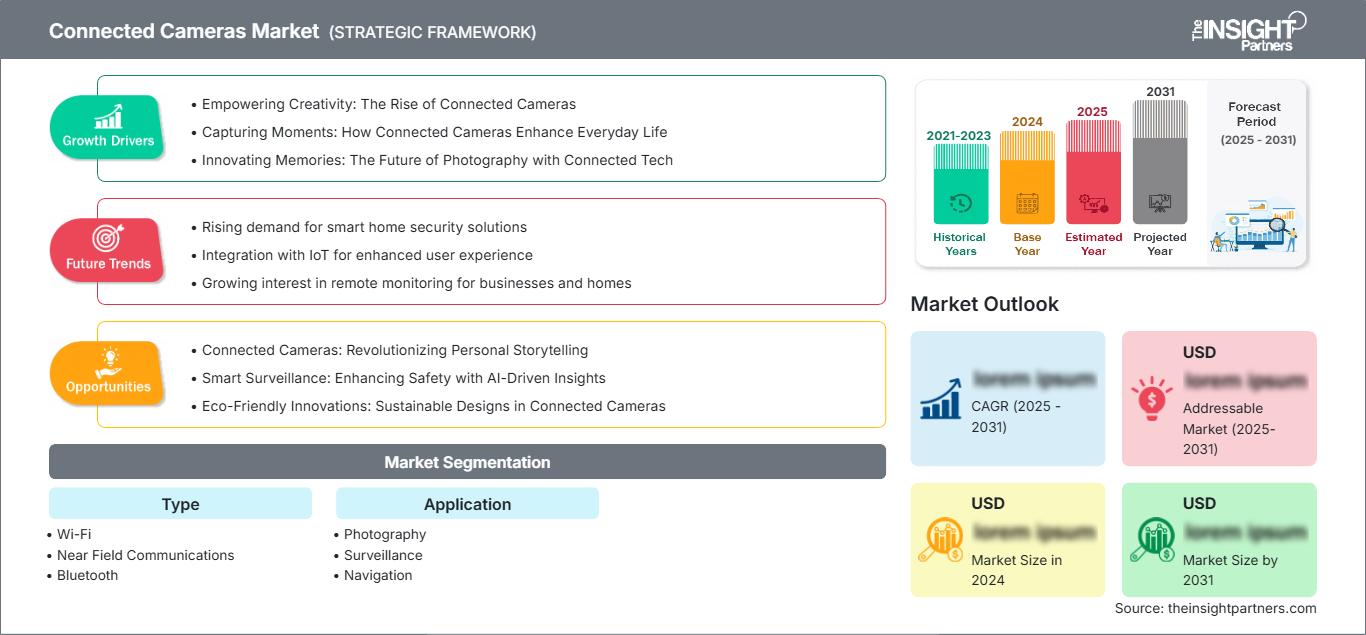
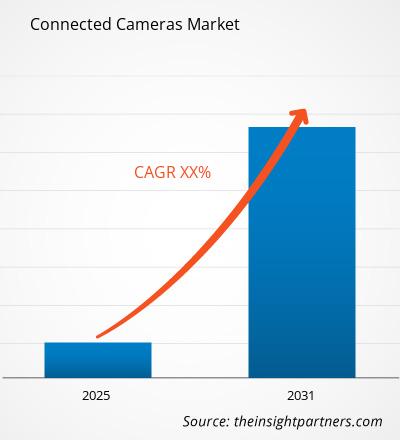
The Connected Cameras Market size is estimated to be valued at US$ 9.61 Billion in 2025 and forecast to be worth US$ 31.03 Billion by 2034, growing at a CAGR of 13.91% between 2026-2034. The demand for connected cameras is increasing owing to the transition of imaging, surveillance, and mobility technologies from isolated hardware to networked devices for live viewing, cloud storage, mobile management, and edge processing.
North America continues to be an important region with respect to value, and the size of the Connected Cameras Market in North America driven by smart homes, commercial security, and cloud video services. Growth in North America is estimated at a CAGR of 12.8%-14.2% between 2026-2034 on account of broadband connectivity, consumer subscriptions, AI alerts, and enterprise migration from analog to IP and Wi-Fi connected cameras.
Connected Cameras Market Assessment and Insights
- North America accounted for 34–38% share in 2025 and is expected to grow at a 12.8–14.2% CAGR between 2026–2034, supported by smart home monitoring, enterprise security upgrades, and cloud video subscriptions.
- US represented 78–82% of North America in 2025 and is projected to grow at a 12.5–13.8% CAGR between 2026–2034, led by residential surveillance and connected retail security.
- Europe held 22–26% share in 2025 and is forecast to grow at an 11.6–13.0% CAGR between 2026–2034, with the UK, Germany, and France leading adoption.
- Asia Pacific captured 27–31% share in 2025 and is projected to expand at a 14.8–16.3% CAGR between 2026–2034, led by China, Japan, South Korea, and India.
- Largest Segment Wi-Fi held 46–50% market share in 2025 and is expected to grow at a 13.0–14.4% CAGR between 2026–2034 due to low-cost installation and app-based monitoring.
- High Growth Segment Surveillance held 43–47% market share in 2025 and is forecast to grow at a 15.2–16.8% CAGR between 2026–2034 as AI alerts and remote monitoring scale.
- Key companies analyzed in detail: Arlo Technologies, Inc.; Axon Enterprise, Inc.; B-Cam Ltd.; Canon Inc.; Dropcam, Inc.; Lorex Technology Inc.; Nikon Corporation; Polaroid International B.V.; Samsung Electronics Co., Ltd.; Sony Corporation.
Source: The Insight Partners' analysis based on proprietary research, government publications, company annual reports, investor presentations, industry databases, and expert interviews.
The evolution in the market is from simple connected imaging to comprehensive video ecosystems with a managed service of sensors, processors, radios, storage, and analytics. Wi-Fi and IP designs predominate due to the reduction in cabling, firmware upgrade capability, and post-installation software differentiation. Production trends are also evolving, with camera manufacturers focusing on CMOS sensors, high resolution, embedded AI, and cybersecurity in order to meet consumer and institutional buying requirements.
According to the Connected Cameras Market forecasts, in the future, the demands for growth are expected to come from urban security schemes, retrofit smart buildings, fleet logging, and connected navigation applications. Financial resources will be allocated towards subscription software, edge analytics, encrypted cloud storage, and cross-device interoperability. Privacy and data storage regulations are expected to drive interest towards vendors who offer transparency, regional data hosting, and enterprise-level access control, particularly in North America and Europe.
Connected Cameras Market Report Scope
| Report Attribute | Details |
|---|---|
| Market size in 2025 | US$ 9.61 Billion |
| Market Size by 2034 | US$ 31.03 Billion |
| Global CAGR (2026 - 2034) | 13.91% |
| Historical Data | 2021-2024 |
| Forecast period | 2026-2034 |
Connected Cameras Market Analysis
The Connected Cameras market grows due to the growing need for remote visibility, fast response to emergencies and high-quality pictures in homes, logistics facilities, retail stores, cars and infrastructures. Consumers are more interested in devices providing HD quality images along with mobile notifications and analytics in the cloud. With the development of network infrastructure, the choice of the product is no longer determined by its price but by the overall cost-effectiveness of the solution.
The connected cameras market consists of producers of sensors, lenses, chipsets, wireless modules, cloud infrastructure, device brands, installers and software subscriptions. The supply chain gives preference to companies capable of ensuring a sustainable balance between the availability of components, security and service revenue. In addition, camera makers are changing their product design, making it more efficient in terms of power consumption, edge analytics and ease of installation.
The competitive positioning within the analysis of the Connected Cameras Market is based on the broadness of the ecosystem, AI accuracy, brand trust, and channels. Arlo Technologies, Inc. and Lorex Technology Inc. focus on connected security solutions, while Canon Inc., Nikon Corporation, and Sony Corporation remain strong with imaging solutions. Samsung Electronics Co., Ltd. offers solutions for connectivity between devices, while Axon Enterprise, Inc. offers evidence management solutions.
The investments are likely to be driven by hardware software integration, cloud-based storage, and artificial intelligence assistance for event classification as sources for margin growth. The companies are employing partnering, bundling, and renewal strategies to generate recurring revenues. The competitive differentiation will be more based on the capabilities for privacy management, minimal false alert rates, compatibility with smart homes, and provision of products suitable for self-installation and managed deployments.
● REPORT CUSTOMIZATION
Tailor This Report To Align With Your Specific Business Requirements
This report can be customized to align precisely with your business objectives, scope, and target markets. Customization options include tailored segmentation, geography, competitive analysis, and strategic insights to support informed decision-making.
Customize This Report →WHAT YOU CAN ADJUST
- ● Segmentations
- ● Geography
- ● Competitive Analysis
- ● Language Preferences
Connected Cameras Market: Strategic Insights
Regional Insights
North America Connected Cameras Market
North America contributed 34-38% of the 2025 revenue and will show 12.8-14.2% CAGR during 2026-2034. The North America Connected Cameras Market share is bolstered by the presence of strong broadband infrastructure, high smart home subscriptions, loss prevention in retail stores, and updates to public safety systems. Consumers are increasingly demanding wireless cameras with artificial intelligence-powered alerts, while businesses want visibility across multiple sites, audit trails, and secure cloud storage capabilities.
Other factors aiding adoption include interest from insurance companies in monitoring properties, greater concerns about package security during delivery, and migration from DVRs to IP systems among enterprises. Firms can take advantage of existing e-commerce platforms, network of installers, and subscription services. Issues such as privacy and cybersecurity may affect buying decisions, leading to a preference for firms offering encryption, permissions management, and clear data retention policies.
U.S. Connected Cameras Market
The US had a share of 78–82% in North America in 2025, and is expected to exhibit growth at a CAGR of 12.5–13.8% from 2026 to 2034. The use cases span wide ranging applications, including residential single-family homes, small business premises, educational institutions, logistics facilities, and law-enforcement-related evidence gathering processes. Arlo Technologies, Inc., Axon Enterprise, Inc., Lorex Technology Inc., Canon Inc., Samsung Electronics Co., Ltd., and Sony Corporation all have notable presence in the market through retail, enterprise, and professional sales channels.
Trends in applications indicate that surveillance is the major application leading in purchase consideration, followed by photography, as well as capturing footage in navigation purposes in cars, unmanned aerial vehicles (UAVs), and portable consumer devices. The factors driving decisions include cloud services, 4K recordings, detection of people and vehicles, and two-way audio.
Europe Connected Cameras Market
The Europe segment occupied a 22-26% market share in 2025 and is projected to achieve a CAGR of 11.6-13.0% from 2026 to 2034. It is dominated by the UK, Germany, and France. The United Kingdom enjoys the advantage of adopting smart home security and retail surveillance systems.
Germany focuses on industrial quality, privacy, and connectivity in its buildings. France, Italy, and Spain have increased their footprint through residential surveillance, tourism infrastructure, retail chains, and citywide safety schemes. Privacy-related regulations like GDPR influence product design, thus, privacy dashboard features, localized data storage, and encryption become important. Europeans are ready to embrace camera connectivity solutions with high image quality and post-sales support.
APAC Connected Cameras Market
APAC will have a market share of 27%-31% in 2025 and will witness a 14.8%-16.3% CAGR from 2026 to 2034. APAC is dominated by China because of manufacturing capabilities, smart cities, and consumer electronic devices. Japan and South Korea contribute with their capabilities in premium imaging systems, automotive recording, and connected homes.
India and Australia contribute by adding momentum to the growth through urban housing, logistics security, commercial real estate, and infrastructure upgradation. Industrial users are incorporating IP and WiFi-based devices in their remote operations. Safe city policies will aid the growth of this segment because of increasing investments in surveillance systems.
Middle East & Africa Connected Cameras Market
MEA is forecast to experience growth in the range of 12.0-13.6% CAGR over 2026-2034, being driven mainly by Saudi Arabia and UAE markets. There is a need for monitoring systems in infrastructure, smart city development, energy installations, transport hubs, and hospitality sites in this region. South Africa contributes to market growth due to the demand for retail security systems and commercial facilities protection.
Adoption rate within the rest of MEA region is rather inconsistent due to different levels of broadband deployment, budget limitations, and maintenance resources. However, more premium projects start requesting IP camera technology, cloud connectivity, and control room integration. Ruggedness, nighttime imaging ability, and remote access are crucial for energy companies and infrastructural projects.
Segmentation Analysis
Type
Type is expected to grow at a 13.2–14.8% CAGR during 2026–2034 as buyers select connectivity based on range, power use, installation complexity, and data throughput. The Connected Cameras Market scope across type shows Wi-Fi leading residential and small business deployment, while IP remains critical for enterprise networks, structured cabling, and high-reliability surveillance environments.
- Wi-Fi cameras remain the largest type, supported by quick installation, mobile app pairing, and strong consumer familiarity across homes, small offices, and light commercial monitoring applications.
- Near Field Communications supports secure pairing, device authentication, and short-range configuration, making it strategically useful for simplified onboarding rather than continuous high-bandwidth video transmission.
- Bluetooth is important for setup, accessory control, and low-power communication in compact devices, especially where cameras interact with mobile apps or nearby connected equipment.
- Internet Protocol cameras remain essential for enterprise-grade surveillance, multi-camera networks, and managed video systems requiring stable connectivity, centralized control, and higher data security.
Application
Application is forecast to grow at a 13.9–15.5% CAGR between 2026–2034, reflecting widening use beyond image capture into active monitoring and situational awareness. Surveillance leads adoption because connected cameras provide deterrence, real-time evidence, and remote access, while photography and navigation gain from wireless transfer, geotagging, vehicle recording, and mobile content workflows.
- Photography benefits from wireless transfer, cloud backup, remote shooting, and social sharing workflows, keeping connected features relevant for professional creators and advanced consumer cameras.
- Surveillance is the largest application, driven by home security, retail monitoring, logistics visibility, smart buildings, and the need for event-based alerts with stored video evidence.
- Navigation is gaining strategic importance in vehicles, drones, robotics, and mobility devices where cameras support visual guidance, route recording, hazard detection, and situational awareness.
Opportunity Snapshot
| Application | Revenue Contribution | Trend Tag | Adoption Stage |
| Photography | Medium | Cloud Capture | Mature |
| Surveillance | High | AI Alerts | Scaling |
| Navigation | Medium | Visual Guidance | Emerging |
Connected Cameras Market Growth Drivers and Impact Analysis
Shift from Standalone Cameras to Managed Video Services
Connected devices are increasingly sold with storage, monitoring, AI detection, and emergency response features rather than as one-time hardware purchases. This changes vendor economics by extending revenue beyond the initial sale and gives buyers a clearer upgrade path for analytics, retention, and multi-user access. The impact is strongest in home security, retail, and small business environments where users want professional-grade functionality without complex infrastructure. Subscription-led models also encourage regular firmware updates, improved cybersecurity, and deeper engagement with companion applications.
AI-Based Event Detection Reducing Monitoring Burden
Video users face alert fatigue when cameras capture irrelevant motion from weather, animals, vehicles, or routine foot traffic. AI-enabled classification addresses this issue by prioritizing events involving people, vehicles, packages, sounds, or defined zones. The commercial impact is meaningful because better alert accuracy improves trust, reduces manual review time, and makes connected cameras more practical for multi-site operations. As edge chips become cheaper, analytics will move closer to the device, lowering latency and supporting privacy-sensitive deployments.
Expansion of Smart Infrastructure and Connected Buildings
Smart cities, logistics hubs, campuses, and connected buildings require video endpoints that can communicate with access control, alarms, lighting, and facility management platforms. This need supports IP cameras, Wi-Fi devices, and cloud-managed systems that provide real-time visibility across distributed sites. The market impact includes larger deployment sizes, higher service revenue, and stronger demand for cybersecurity certifications. Infrastructure buyers are also more likely to specify interoperability, long product support cycles, and centralized device management.
Connected Cameras Market Future Trends
Edge Intelligence Becoming a Standard Feature
Connected Cameras Market trends indicate that more processing will occur inside the device rather than only in the cloud. Edge intelligence can support faster alerts, lower bandwidth use, and stronger privacy controls because selected analysis happens before video leaves the camera. This shift will influence product design, with vendors competing on chip efficiency, thermal management, and model accuracy. Over time, buyers will treat on-device detection, local encryption, and selective upload as baseline expectations rather than premium differentiators.
Interoperability Across Smart Device Ecosystems
Camera buyers increasingly expect devices to work with smart speakers, locks, lighting, alarms, displays, and mobile applications from multiple vendors. Interoperability will therefore become a competitive requirement, especially in homes and small enterprises where users combine products over time. Vendors that simplify setup, permission sharing, and automation rules can reduce churn and improve service adoption. The trend will also encourage partnerships between camera brands, cloud platforms, chipset providers, and home automation ecosystems.
Connected Cameras Market Opportunities
Subscription Bundles for Residential and Small Business Users
Service packaging offers a practical route for vendors to increase recurring revenue while making advanced monitoring accessible to nontechnical users. Bundles that combine cameras, cloud retention, AI alerts, replacement coverage, and optional professional response can simplify purchasing and reduce churn. Small businesses are especially attractive because they need evidence retention, after-hours alerts, and multi-user access but often lack dedicated security teams. Channel partners can also create value through installation, training, and periodic system health checks.
Enterprise Migration from Analog CCTV to IP Video
Many commercial, municipal, and industrial sites still operate mixed analog and digital surveillance estates. Migration to IP video creates opportunities for camera vendors, system integrators, storage providers, and cybersecurity specialists. Buyers gain remote access, scalable storage, higher-resolution feeds, and easier analytics integration, while vendors benefit from larger project sizes and service contracts. The best-positioned suppliers will offer phased upgrade paths, backward compatibility, secure device management, and clear total-cost-of-ownership arguments for budget-constrained infrastructure owners.
Recent Developments
- June 2026: Godrej Enterprises Group launched a new range of connected Wi-Fi and 4G security cameras featuring AI-powered monitoring, BIS-ER certification and cloud-enabled security. The portfolio is designed for homes and businesses, offering real-time remote surveillance, intelligent alerts and compliant security solutions.
- June 2025: Samsara introduced its 360° Camera for operated equipment and expanded its AI Multicam and Two-Way Voice capabilities for the AI Dash Cam. The new offerings improve visibility around heavy equipment, enhance driver safety and support fleet operations with AI-powered incident detection and real-time communication.
- July 2025: Qubo expanded its AI Guard-powered security camera portfolio and introduced the Dashcam Pro 2K. The company reported achieving ₹350 crore in annual revenue, driven by growing demand for AI-enabled smart home security and connected automotive products.
Frequently Asked Questions

- Comprehensive Market Sizing and Forecast Analysis
- Detailed Segmentation Analysis
- In-Depth Market Dynamics Assessment
- Regional and Country-Level Insights
- Competitive Landscape and Company Benchmarking
- Strategic Business Intelligence
Recent Reports
Testimonials

The Insight Partners' SCADA System Market report is comprehensive, with valuable insights on current trends and future forecasts. The team was highly professional, responsive, and supportive throughout. We are very satisfied and highly recommend their services.
RAN KEDEM Partner, Reali Technologies LTDs
I requested a report on a very specific software market and the team produced the report in a few days. The information was very relevant and well presented. I then requested some changes and additions to the report. The team was again very responsive and I got the final report in less than a week.
JEAN-HERVE JENN Chairman, Future Analytica
We worked with The Insight Partners for an important market study and forecast. They gave us clear insights into opportunities and risks, which helped shape our plans. Their research was easy to use and based on solid data. It helped us make smart, confident decisions. We highly recommend them.
PIYUSH NAGPAL Sr. Vice President, High Beam Global
The Insight Partners delivered insightful, well-structured market research with strong domain expertise. Their team was professional and responsive throughout. The user-friendly website made accessing industry reports seamless. We highly recommend them for reliable, high-quality research services
YUKIHIKO ADACHI CEO, Deep Blue, LLC.
This is the first time I have purchased a market report from The Insight Partners.While I was unsure at first, I visited their web site and felt more comfortable to take the risk and purchase a market report.I am completely satisfied with the quality of the report and customer service. I had several questions and comments with the initial report, but after a couple of dialogs over email with their analyst I believe I have a report that I can use as input to our strategic planning process.Thank you so much for taking the extra time and making this a positive experience.I will definitely recommend your service to others and you will be my first call when we need further market data.
JOHN SUZUKI President and Chief Executive Officer, Board Director, BK Technologies
I wish to appreciate your support and the professionalism you displayed in the course of attending to my request for information regarding to infectious disease IVD market in Nigeria. I appreciate your patience, your guidance, and the fact that you were willing to offer a discount, which eventually made it possible for us to close a deal. I look forward to engaging The Insight Partners in the future, all thanks to the impression you have created in me as a result of this first encounter.
DR CHIJIOKE ONYIA MANAGING DIRECTOR, PineCrest Healthcare Ltd.Reason to Buy
- Informed Decision-Making
- Understanding Market Dynamics
- Competitive Analysis
- Identifying Emerging Markets
- Customer Insights
- Market Forecasts
- Risk Mitigation
- Boosting Operational Efficiency
- Strategic Planning
- Investment Justification
- Tracking Industry Innovations
- Aligning with Regulatory Trends





 Get Free Sample for