
Connected Living Room Market Demand, Size & Forecast by 2034
Coverage: by Product Type (Smart TVs, Gaming Consoles, Computer and Laptop, Smart Speakers, Smartphones and Tablets, Security system, Lighting system); Component (Sensors, Thermostats, Cameras, Communication Device, Others); and Geography (North America, Europe, Asia Pacific, and South and Central America)
- Status : Data Released
- Report Code : TIPRE00008303
- Category : Electronics and Semiconductor
- No. of Pages : 150
- Available Report Formats :


- Last update date : July 31, 2026


2025 Market Size
US$ 64.06 Bn
Base year value
2034 Forecast
US$ 145.49 Bn
Projected by 2034
CAGR 2026-2034
9.54 %
Growth rate
Addressable Market
US$ 934.64 Bn
(2026-2034)
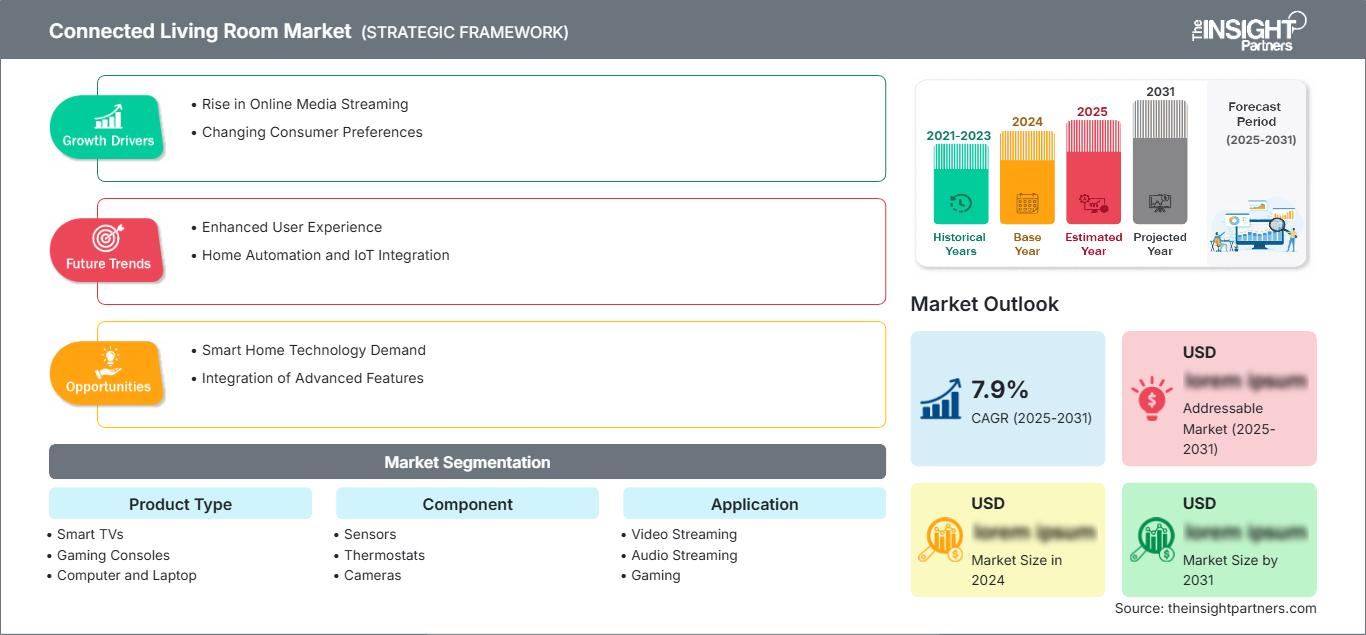
The Connected Living Room Market had a valuation of US$ 64.06 Billion in 2025 and is predicted to attain a value of US$ 145.49 Billion by 2034, at a CAGR of 9.54% from 2026–2034. Factors that fuel the demand include the integration of smart TVs, gaming consoles, speakers, mobile phones, security systems, lighting controls, sensors, thermostats, cameras, and communication devices.
The North American region is predicted to record a CAGR between 8.4–9.0%, due to the growth of broadband households, high-level streaming activity, and smart homes. Market size in North America for the Connected Living Room Market size is driven by high smart TV replacement rates, console-driven gaming activities, and increasing use of speakers, cameras, lighting, and thermostats as a living room control point.
Connected Living Room Market Assessment and Insights
- North America: The region holds 30–33% share in 2025 and grows at a CAGR range of 8.4–9.0% during 2026–2034, driven by premium streaming, console gaming, voice control, and security integration.
- US: The country represents 78–82% of North America in 2025 and grows at a CAGR range of 8.5–9.1% during 2026–2034, led by connected TV and smart-speaker adoption.
- Europe: The region accounts for 22–25% share in 2025 and grows at a CAGR range of 8.0–8.7% during 2026–2034, with the UK, Germany, France, Italy, and Spain leading adoption.
- Asia Pacific: The region holds 34–37% share in 2025 and grows at a CAGR range of 10.2–10.9% during 2026–2034, led by China, Japan, South Korea, India, and Australia.
- Largest Segment: Smart TVs hold 29–32% market share in 2025 and grow at a CAGR range of 8.6–9.2% during 2026–2034 through streaming and operating-system monetization.
- High Growth Segment: Smart Speakers hold 11–14% market share in 2025 and grow at a CAGR range of 11.0–11.8% during 2026–2034 as voice-led automation expands.
- Key companies analyzed in detail: ARRIS International Limited; BenQ Corporation; Hitachi, Ltd.; Koninklijke Philips N.V.; LG Electronics Inc.; Motorola Mobility LLC; Nintendo Co., Ltd.; Panasonic Holdings Corporation; Samsung Electronics Co., Ltd.; Sony Group Corporation.
Source: The Insight Partners' analysis based on proprietary research, government publications, company annual reports, investor presentations, industry databases, and expert interviews.
The evolution of devices will change the living room from being an entertainment screen room to a platform-controlled household. The smart TV will be used for playing videos, games, ads, online shopping, and device management using the interface on display panels, while other control will come from speakers, cell phones, cameras, and lighting systems outside of the remotes domain. The production issues will become more about manufacturers that have technologies of display panels, chipsets, software platforms, and cyber-secure infrastructure that would allow providing continued service after selling hardware products.
In the next ten years, the market needs will evolve because of the adoption of smart devices by the new residents of Asian cities, the integration of North American apartments, and the modernization of current North American households with AI-enabled devices. The investment will go to the processes of standardization, user control, cloud gaming solutions, and energy-saving automation. The issues of cybersecurity, data utilization, and wireless spectrum reliability will be relevant for the development of products, especially those utilizing camera, voice, and sensors technologies.
Connected Living Room Market Report Scope
| Report Attribute | Details |
|---|---|
| Market size in 2025 | US$ 64.06 Billion |
| Market Size by 2034 | US$ 145.49 Billion |
| Global CAGR (2026 - 2034) | 9.54% |
| Historical Data | 2021-2024 |
| Forecast period | 2026-2034 |
Connected Living Room Market Analysis
Drivers for Connected Living Room include households desiring integration of entertainment, games, communication, security, lighting, and control of comfort via fewer interfaces. Additional drivers include operating systems for smart TVs, Wi-Fi 6 & 7 routers, faster broadband, streaming video service subscriptions, cloud gaming, and Matter-compliant smart home products. The ecosystem consists of display vendors, console vendors, app developers, sensor vendors, broadband equipment vendors, retailers, installers, and platform operators.
Supply enablers are dependent upon the availability of panels, semiconductors, wireless modules, cloud-based services, and software update capabilities. Smart TVs and game consoles will increase the value density of connected living room market, whereas cameras, thermostats, lighting solutions, and speakers are contributing towards increasing the number of devices in households. ARRIS International Limited offers connectivity infrastructure services, whereas LG Electronics Inc., Samsung Electronics Co., Ltd. and Sony Group Corporation offer screen-driven experiences.
Competitive positioning in Connected Living Room Market report includes interfaces, content ecosystems, device compatibility, and recurring service revenue model. Nintendo Co., Ltd. and Sony Group Corporation impact gaming driven engagement model, whereas BenQ Corporation, Hitachi, Ltd., Koninklijke Philips N.V., Panasonic Holdings Corporation, Motorola Mobility LLC, and Samsung Electronics Co., Ltd. have a presence in displays, devices, lighting, mobility, and home electronics segments.
Some of the investment areas that can make a difference include personalized AI, low latency gaming, privacy first cameras, device dashboard experience, and cross-device content experience. Platform owners are trying to convert their hardware installed base into advertising, application, cloud, and service revenues.
● REPORT CUSTOMIZATION
Tailor This Report To Align With Your Specific Business Requirements
This report can be customized to align precisely with your business objectives, scope, and target markets. Customization options include tailored segmentation, geography, competitive analysis, and strategic insights to support informed decision-making.
Customize This Report →WHAT YOU CAN ADJUST
- ● Segmentations
- ● Geography
- ● Competitive Analysis
- ● Language Preferences
Connected Living Room Market: Strategic Insights
Regional Insights
North America Connected Living Room Market
The North American market occupies the segment of 30–33% of 2025 and is expected to see a growth rate of CAGR range of 8.4–9.0% during 2026–2034. The Connected Living Room Market share can be attributed to high access to broadband, use of subscription videos, high penetration of smart speakers, active participation in gaming, and early adoption of connected security products.
The region enjoys a structural advantage owing to availability of established retail infrastructure, software updates, and willingness of consumers to pay for premium display. The presence of high installed bases provides the benefit of repeat purchases of televisions, gaming consoles, routers, smartphones, cameras, and lighting appliances. The U.S. Consumer Technology Association has recently cited revenues in the excess of US$ 500 billion in consumer technology.
U.S. Connected Living Room Market
The U.S. constitutes 78 to 82 percent of North America in 2025 and experiences a CAGR of 8.5 to 9.1 percent between 2026 and 2034. The demand is focused on smart televisions, game consoles, streaming services, smart speakers, cameras, and connected lights. Samsung Electronics Co., Ltd., LG Electronics Inc., Sony Group Corporation, Nintendo Co., Ltd., and Motorola Mobility LLC are highly visible among consumers.
Application trends consist of cloud gaming via smart TV sets, second-screen controls using smartphone, content search using voice, and home surveillance using camera. Smart speakers control lighting and thermostats, and the routers and communication systems help maintain multiple streams. Adoption trends in the U.S. are also influenced by privacy issues, subscription fatigue, and need for interoperability.
Europe Connected Living Room Market
Europe holds a market share of 22–25% in 2025, growing at a CAGR of 8.0–8.7% during 2026–2034. The UK dominates due to streaming, gaming consoles, and the popularity of smart speakers, due to abundant availability of broadband internet connections and advanced online sales networks. Germany is next due to demand for environmentally friendly devices, high-end televisions, and privacy-conscious smart homes.
France, Italy, and Spain play their part due to IPTV packages, home renovations, and an increase in the demand for lighting systems, security cameras, and smart speakers. Europe’s focus on data security, eco-design, and cyber security drives device makers to offer transparency in software updates and energy conservation features. The key vendors include Koninklijke Philips N.V., Sony Group Corporation, Samsung Electronics Co., Ltd., LG Electronics Inc., and Panasonic Holdings Corporation.
APAC Connected Living Room Market
APAC region has 34-37% market share by 2025 and is expected to grow in the range of 10.2-10.9% CAGR during 2026-2034. APAC region is led by China due to smart TVs' size, domestic platforms, and manufacturing capabilities. Countries like Japan and South Korea contribute premium displays, gaming consoles, and advanced home electronics whereas India grows through cheap smart TVs and smartphones.
Australia provides premium quality content streaming service as well as connected speaker devices. Industry drivers consist of panel manufacturing, semiconductors packaging, broadband Internet connectivity, and local application ecosystems. The APAC region enjoys governmental support towards building digital infrastructure and electronics manufacturing. Among the listed organizations are Samsung Electronics Co., Ltd., LG Electronics Inc., Sony Group Corporation, Nintendo Co., Ltd., Panasonic Holdings Corporation, and Hitachi, Ltd.
Middle East & Africa Connected Living Room Market
MEA & Africa will witness a CAGR growth rate between 7.1% and 7.8% for 2026-2034. Saudi Arabia represents a prominent nation owing to its smart city initiatives, premium housing, entertainment, and electronics retailing. In addition, UAE contributes to affluent households, hospitality, and regional distribution. Whereas South Africa contributes towards smart TV and security.
The rest of MEA demand continues to be import-driven and based on broadband availability, disposable income, and energy availability. The energy and infrastructure landscape is significant since connected living room requires Wi-Fi connectivity and power availability. Companies which provide durable devices, localized content, and customer support network perform well than mere hardware providers.
Segmentation Analysis
Product Type
Product Type is projected to grow at a CAGR range of 9.1–9.8% during 2026–2034. Connected Living Room Market scope is defined by the interaction of screens, consoles, mobile devices, speakers, lighting, and security products that create a shared control environment. Adoption depends on interoperability, app availability, refresh cycles, broadband quality, and perceived household convenience.
- Smart TVs: Smart TVs hold the largest product position because they combine streaming, operating systems, gaming access, voice search, advertising inventory, and home-control dashboards in a single household screen.
- Gaming Consoles: Gaming consoles remain strategically important for high-engagement households, supporting subscriptions, multiplayer communities, streaming apps, cloud gaming, and peripheral ecosystems tied to premium displays.
- Computer and Laptop: Computers and laptops extend the living room through casting, hybrid work, video calls, media libraries, and second-screen control, especially in households with shared entertainment spaces.
- Smart Speakers: Smart speakers are gaining importance as voice-control gateways for music, lighting, thermostats, cameras, TVs, and routines, improving convenience across mixed-device homes.
- Smartphones and Tablets: Smartphones and tablets function as control surfaces for casting, subscriptions, security alerts, gaming companions, and device setup, making them essential to living-room orchestration.
- Security system: Security systems add cameras, alerts, motion detection, and doorbell feeds into entertainment screens, strengthening household value by combining safety with daily device engagement.
- Lighting system: Lighting systems support ambience, energy management, gaming scenes, movie modes, and voice-triggered routines, making them practical add-ons for connected living rooms.
Component
Component is expected to grow at a CAGR range of 9.4–10.1% during 2026–2034. Component demand reflects the need to sense occupancy, regulate comfort, capture video, and connect devices reliably. Sensors, thermostats, cameras, and communication devices increasingly influence the quality of user experience because entertainment, security, and automation now operate through shared home networks.
- Sensors: Sensors detect motion, light, occupancy, and environmental conditions, enabling automated routines that adjust media, lighting, security, and comfort without requiring continuous manual control.
- Thermostats: Thermostats connect energy management with entertainment routines, allowing households to coordinate comfort settings with occupancy, time of day, and voice-controlled automation.
- Cameras: Cameras support security feeds, door monitoring, room awareness, and alerts on TVs or mobile devices, making visual monitoring part of the living-room experience.
- Communication Device: Communication devices, including routers and gateways, provide the connectivity backbone for streaming, gaming, voice assistants, lighting, sensors, cameras, and mobile controls.
Opportunity Snapshot
| Product Type | Revenue Contribution | Trend Tag | Adoption Stage |
| Smart TVs | High | AI Screens | Mature |
| Gaming Consoles | High | Cloud Gaming | Scaling |
| Computer and Laptop | Medium | Second Screen | Mature |
| Smart Speakers | Medium | Voice Hub | Scaling |
| Smartphones and Tablets | Medium | App Control | Mature |
| Security system | Medium | Camera Feeds | Scaling |
| Lighting system | Low | Scene Lighting | Scaling |
Connected Living Room Market Growth Drivers and Impact Analysis
Smart TV Platforms Becoming Household Operating Systems
Smart TVs are evolving into household operating systems rather than isolated displays. They aggregate streaming apps, voice search, gaming services, advertising, shoppable content, security feeds, and device dashboards. This increases the value of large-screen ownership and encourages households to replace older displays with connected models that receive software updates. The market impact is stronger demand for premium processors, Wi-Fi performance, app certification, and operating-system partnerships. Vendors that control the screen interface can influence accessory purchases, subscription discovery, and home automation behavior, making smart TVs the anchor product for the Connected Living Room Market.
Voice Control and Interoperability Reducing User Friction
Voice control reduces friction in homes with multiple devices, subscriptions, and remotes. Smart speakers and TV microphones allow users to search content, adjust lights, control thermostats, view cameras, and launch routines without navigating separate apps. Interoperability standards such as Matter strengthen this driver by improving cross-brand setup and device discovery. The commercial impact is higher attach rates for lighting, security, sensors, and thermostats after a household already owns a smart display or speaker. Suppliers that simplify installation and protect user data can convert convenience into sustained platform loyalty.
Gaming and Streaming Raising Network Performance Requirements
Gaming and streaming are raising expectations for low latency, high resolution, and reliable multi-device performance. Households may stream 4K video, run cloud gaming sessions, cast from smartphones, and operate cameras or speakers on the same network. This increases demand for communication devices, mesh routers, Wi-Fi 6E and Wi-Fi 7 upgrades, and TVs or consoles optimized for high refresh rates. The market impact extends beyond entertainment hardware because networking quality determines whether connected lighting, security, and voice assistants feel dependable. Broadband and device vendors therefore become part of the living-room value chain.
Connected Living Room Market Future Trends
AI-Personalized Screens and Contextual Home Control
Connected Living Room Market trends will increasingly center on AI-personalized screens that understand content preferences, room conditions, device status, and user routines. Future TVs may recommend shows, adjust picture and audio settings, suggest energy actions, and display security alerts based on contextual signals from sensors, cameras, and thermostats. This trend will shift differentiation from panel quality alone to intelligent orchestration across the household. Vendors must balance personalization with privacy, giving users clear controls over data processing, voice history, camera access, and cross-device learning.
Cloud Gaming and App-Native Entertainment Expansion
Cloud gaming and app-native entertainment will reduce dependence on separate hardware while increasing the importance of displays, controllers, and broadband quality. Smart TVs are expected to host more gaming services, fitness apps, video conferencing, and interactive content without requiring additional boxes. Consoles will remain important for premium gaming, but platform competition will expand across operating systems and subscription bundles. This trend creates opportunities for display makers, router suppliers, and content platforms that can deliver stable performance, low latency, and easy account management across household users.
Connected Living Room Market Opportunities
Retrofit Bundles for Existing Broadband Homes
Connected Living Room Market Forecasts point to a strong opportunity in retrofit bundles for households that already have broadband but lack integrated devices. Retailers, telecom operators, and electronics brands can package smart TVs, speakers, cameras, lighting kits, and routers with guided setup and subscription offers. This lowers adoption friction and improves perceived value because consumers receive entertainment, control, and security benefits together. The most attractive targets are renters, apartment owners, and hybrid-work households that want convenience without major construction. Service plans, installation support, and privacy assurances can improve conversion rates.
Secure Living-Room Platforms for Family and Senior Use
Family and senior-focused living-room platforms offer a distinct opportunity because connected devices can combine entertainment, reminders, video calls, lighting automation, and security alerts. Vendors can differentiate through simple interfaces, large text, trusted contacts, fall-aware sensors, camera privacy shutters, and caregiver notifications that users can control. This opportunity is investment-oriented because it supports hardware sales, cloud services, and partnerships with telecom providers or home-care organizations. Successful products must avoid complexity, minimize false alerts, and provide transparent consent settings, especially where cameras, microphones, and household behavior data are involved.
Recent Developments
- July 2026: Beanfield and 1VALET expanded their partnership to deliver advanced smart building connectivity solutions for multi-dwelling residential communities across Canada. The enhanced collaboration integrates Beanfield’s 100% fibre-optic internet network with 1VALET’s property technology platform, enabling residents to access high-speed internet, smart home automation, secure building access, visitor management, and digital property services through a unified connected living experience while simplifying operations for property managers.
- December 2025: Samsung announced its AI-Connected Living lineup ahead of CES 2026, introducing upgraded AI-powered home appliances, including the Bespoke AI AirDresser, Bespoke AI Laundry Combo, WindFree Air Conditioner, and Bespoke AI Jet Bot Steam Ultra robot vacuum. The new portfolio leverages advanced AI to enhance fabric care, energy-efficient climate control, intelligent cleaning, and personalized home automation, delivering a smarter, more connected living experience.
- December 2024: Samsung showcased its AI Home Experience in Dubai, demonstrating the future of connected living through an AI-powered smart home ecosystem. The showcase highlighted seamless interoperability across connected devices, AI-driven automation, SmartThings integration, energy management, enhanced home security, and personalized user experiences, enabling smarter, more efficient, and sustainable living for households across the Middle East.
Frequently Asked Questions

- Comprehensive Market Sizing and Forecast Analysis
- Detailed Segmentation Analysis
- In-Depth Market Dynamics Assessment
- Regional and Country-Level Insights
- Competitive Landscape and Company Benchmarking
- Strategic Business Intelligence
Recent Reports
Testimonials

The Insight Partners' SCADA System Market report is comprehensive, with valuable insights on current trends and future forecasts. The team was highly professional, responsive, and supportive throughout. We are very satisfied and highly recommend their services.
RAN KEDEM Partner, Reali Technologies LTDs
I requested a report on a very specific software market and the team produced the report in a few days. The information was very relevant and well presented. I then requested some changes and additions to the report. The team was again very responsive and I got the final report in less than a week.
JEAN-HERVE JENN Chairman, Future Analytica
We worked with The Insight Partners for an important market study and forecast. They gave us clear insights into opportunities and risks, which helped shape our plans. Their research was easy to use and based on solid data. It helped us make smart, confident decisions. We highly recommend them.
PIYUSH NAGPAL Sr. Vice President, High Beam Global
The Insight Partners delivered insightful, well-structured market research with strong domain expertise. Their team was professional and responsive throughout. The user-friendly website made accessing industry reports seamless. We highly recommend them for reliable, high-quality research services
YUKIHIKO ADACHI CEO, Deep Blue, LLC.
This is the first time I have purchased a market report from The Insight Partners.While I was unsure at first, I visited their web site and felt more comfortable to take the risk and purchase a market report.I am completely satisfied with the quality of the report and customer service. I had several questions and comments with the initial report, but after a couple of dialogs over email with their analyst I believe I have a report that I can use as input to our strategic planning process.Thank you so much for taking the extra time and making this a positive experience.I will definitely recommend your service to others and you will be my first call when we need further market data.
JOHN SUZUKI President and Chief Executive Officer, Board Director, BK Technologies
I wish to appreciate your support and the professionalism you displayed in the course of attending to my request for information regarding to infectious disease IVD market in Nigeria. I appreciate your patience, your guidance, and the fact that you were willing to offer a discount, which eventually made it possible for us to close a deal. I look forward to engaging The Insight Partners in the future, all thanks to the impression you have created in me as a result of this first encounter.
DR CHIJIOKE ONYIA MANAGING DIRECTOR, PineCrest Healthcare Ltd.Reason to Buy
- Informed Decision-Making
- Understanding Market Dynamics
- Competitive Analysis
- Identifying Emerging Markets
- Customer Insights
- Market Forecasts
- Risk Mitigation
- Boosting Operational Efficiency
- Strategic Planning
- Investment Justification
- Tracking Industry Innovations
- Aligning with Regulatory Trends





 Get Free Sample for