
Construction Camera Market Growth, Trends & Demand by 2034
Coverage: By Product Type (Fixed Camera, PTZ Camera, Others); Power (AC Power Driven, Solar Power Driven, DC Power Driven); Application (Jobsite Progress Monitoring, Security and Surveillance, Marketing and Promotion, Others), and Geography (North America, Europe, Asia Pacific, and South and Central America)
- Status : Data Released
- Report Code : TIPRE00014083
- Category : Electronics and Semiconductor
- No. of Pages : 150
- Available Report Formats :


- Last update date : July 31, 2026


2025 Market Size
US$ 346.22 Mn
Base year value
2034 Forecast
US$ 686.56 Mn
Projected by 2034
CAGR 2026-2034
7.90 %
Growth rate
Addressable Market
US$ 4,645.56 Mn
(2026-2034)
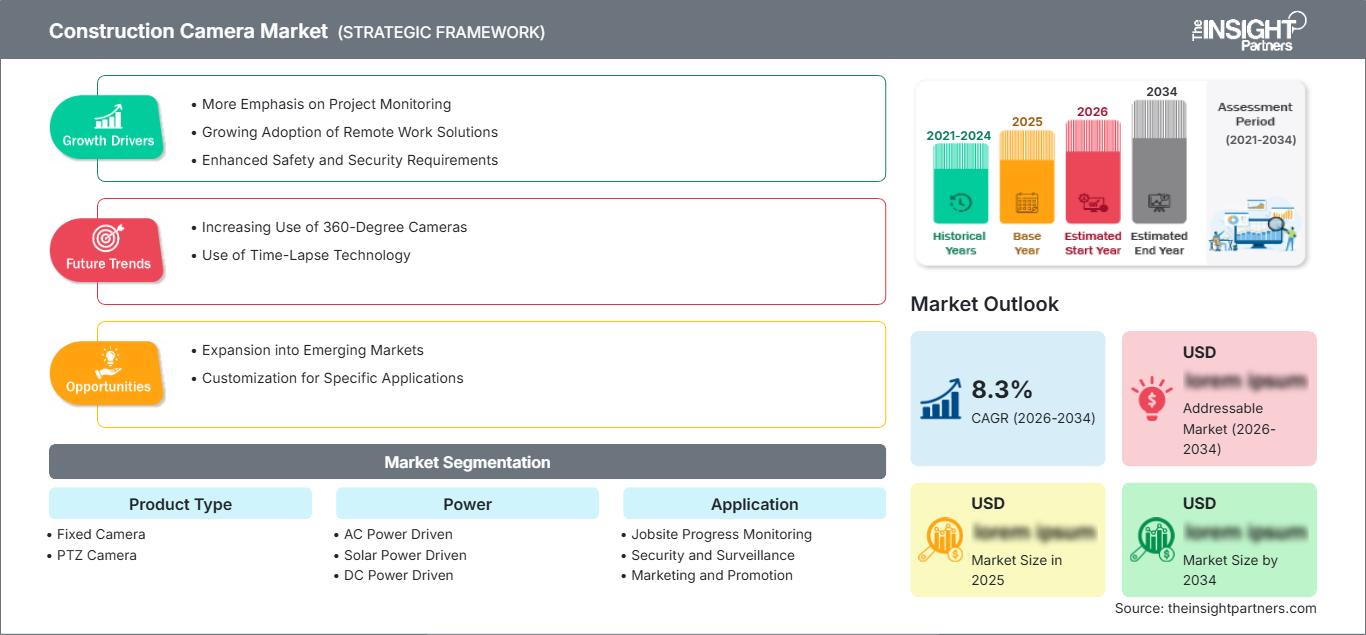
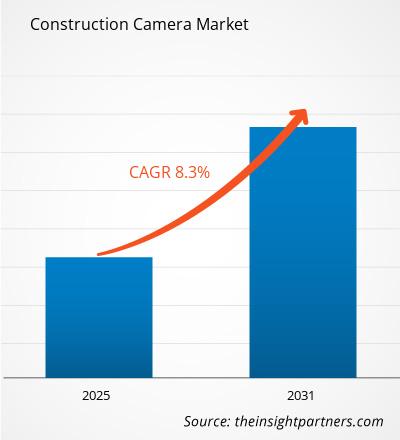
The Construction Camera Market has a valuation of US$ 346.22 Million in 2025 and is expected to achieve US$ 686.56 Million in 2034 at a CAGR of 7.90% during 2026-2034. The market demand is driven by fixed camera technology, PTZ camera technology, AC-powered construction cameras, solar-powered construction cameras, and DC-powered construction cameras that assist with monitoring project progress, surveillance and security, marketing, and promotion.
The Construction Camera Market size in North America is fueled by the 7.2–8.0% CAGR owing to increasing investments in public infrastructure construction projects, private megaprojects, documentation by insurance companies, and remote ownership. Cloud-based video platforms, artificial intelligence-based site visibility, and solar constructions are driving demand in the region since they enable contractors to keep track of scattered sites without permanent power or constant physical presence.
Construction Camera Market Assessment and Insights
- North America: North America held a 34–37% share in 2025 and is growing at a 7.2–8.0% CAGR between 2026–2034, supported by infrastructure renewal, contractor digitization, and insurance-backed site monitoring.
- US: The US represented 78–82% of North America in 2025 and is growing at a 7.3–8.1% CAGR between 2026–2034, led by commercial, infrastructure, and multi-site contractor adoption.
- Europe: Europe accounted for a 22–25% share in 2025 and is growing at a 6.8–7.6% CAGR between 2026 and 2034, with the UK, Germany, France, Italy, and Spain leading regulated site documentation.
- Asia Pacific: Asia Pacific held a 27–30% share in 2025 and is growing at an 8.6–9.5% CAGR between 2026 and 2034, driven by China, Japan, South Korea, India, and Australia infrastructure programs.
- Largest Segment: Fixed Camera led with a 61–65% market share in 2025 and a 7.1–7.8% CAGR between 2026–2034, reflecting broad use in continuous progress documentation.
- High Growth Segment: Solar Power Driven held a 28–32% market share in 2025 and is growing at a 9.0–10.2% CAGR between 2026 and 2034 due to remote jobsites.
- Key companies analyzed in detail: Brinno Incorporated, CamDo Solutions Inc., EarthCam, Inc., ECAMSECURE, iBEAM Systems, Inc., OxBlue Corporation, Sensera Systems, Inc., TrueLook, Inc., US Relay Corporation, Multivista Systems LLC, Evercam Limited, and Johnson Controls International plc.
Source: The Insight Partners' analysis based on proprietary research, government publications, company annual reports, investor presentations, industry databases, and expert interviews.
Advancements in technology are seeing the development of construction cameras shifting from simple time-lapse cameras to a visual intelligence system which can connect online. Technology trends in the Construction Camera Market include high-resolution sensors, PTZ automation, cloud dashboards, cellular connections, solar energy kits, and integration of software with construction management systems. Manufacturing trends in production increasingly incorporate tough casing, battery performance, weather resistance, image processing, cybersecurity, and subscription service models where camera technology becomes a documentation service.
Demand for construction cameras in the future is likely to be affected by the pipeline projects, city renewal projects, shortage of construction workers, demands of the insurance companies, and demands by owners who need proof of progress made. New geographies are taking up the camera systems as large-scale projects become widespread in transport, energy, residential, and commercial projects.
Construction Camera Market Report Scope
| Report Attribute | Details |
|---|---|
| Market size in 2025 | US$ 346.22 Million |
| Market Size by 2034 | US$ 686.56 Million |
| Global CAGR (2026 - 2034) | 7.90% |
| Historical Data | 2021-2024 |
| Forecast period | 2026-2034 |
Construction Camera Market Analysis
The Construction Camera Market share is positively affected by increased need for real-time site visualization, improved documentation of disputes, better scheduling management, and reduction of supervision costs. In more cases, the owners, contractors, insurance firms, and managers use cameras to prove what is happening on-site, track the deliveries, maintain safety precautions, and inform the investors about the progress. The supply chain includes manufacturers of the cameras, solar kits, cell network providers, cloud computing software firms, installers, construction software firms, general contractors, developers, and facilities owners.
The supply dynamics are driven by sensors, availability of LTE/5G networks, hardware manufacturing, batteries supply, and software capability. More customers are looking forward to integrated services including installation, hosting, analysis, timelapse creation, alerts, and storage of media. The market has been driven by the construction spending in the US, which amounts to more than US$ 2.15 trillion per year in April 2025.
The construction camera market report is characterized by a competitive environment where competition will be based on platform depth, camera ruggedness, AI analytics, integrations, and responsiveness to customer queries. Companies including EarthCam, Inc., OxBlue Corporation, TrueLook, Inc., Sensera Systems, Inc., and Multivista Systems LLC are involved in competition within the cloud-powered progress documentation market. Meanwhile, companies including Brinno Incorporated, CamDo Solutions Inc., iBEAM Systems, Inc., ECAMSECURE, and US Relay Corporation meet time-lapse, security, and connectivity needs.
Investments should be made in material recognition powered by AI, automation in the form of reports, solar power for uptime maintenance, dashboard integration for multi-cameras, and a subscription model as a means of reducing procurement process pain points. The companies Johnson Controls International plc and Evercam Limited enhance the visual monitoring industry through security solutions, software, and project documentation capabilities.
● REPORT CUSTOMIZATION
Tailor This Report To Align With Your Specific Business Requirements
This report can be customized to align precisely with your business objectives, scope, and target markets. Customization options include tailored segmentation, geography, competitive analysis, and strategic insights to support informed decision-making.
Customize This Report →WHAT YOU CAN ADJUST
- ● Segmentations
- ● Geography
- ● Competitive Analysis
- ● Language Preferences
Construction Camera Market: Strategic Insights
Regional Insights
North America Construction Camera Market
North America accounted for a 34–37% share in 2025 and is expected to grow at a 7.2–8.0% CAGR during 2026–2034. Construction Camera Market share is supported by large construction spending, federal infrastructure programs, insurer interest in jobsite evidence, and contractor adoption of cloud-based project controls. The region’s installed base is strong across commercial buildings, highways, healthcare, education, energy, and large residential developments.
Structural motivators comprise requirements for site-wide supervision, theft prevention, a lack of laborers, and reporting by owners on milestones. The contractors utilize both PTZ and stationary cameras to document their construction progress, perform safety reviews, and conduct marketing campaigns, among others. Good suppliers of earthcam solutions are EarthCam, Inc., OxBlue Corporation, TrueLook, Inc., Sensera Systems, Inc., ECAMSECURE, and US Relay Corporation.
U.S. Construction Camera Market
The US held a market share of 78-82% of North America in 2025 and grows at CAGR between 7.3 and 8.1% over 2026-2034. The demand is driven by substantial construction projects of both public and private nature, covering transportation, manufacturing, data centers, educational institutions, and healthcare facilities. Camera systems help to monitor the progress, cut down trips to remote places, prevent theft, provide documentation for insurance purposes, and produce marketing-quality time-lapse.
Leading companies in the segment include EarthCam, Inc., OxBlue Corporation, TrueLook, Inc., ECAMSECURE, Sensera Systems, Inc., and US Relay Corporation. The application trends are jobsite progress tracking for complex projects, security and surveillance for unmanned sites, and marketing and promotion to attract investors and tenants to developments.
Europe Construction Camera Market
The Europe segment occupied 22–25% of the market in 2025 and is estimated to experience a 6.8–7.6% CAGR from 2026 to 2034. The UK occupies the first place in terms of technology adoption by means of commercial development, infrastructure, and project documentation. Germany is second as a result of industrial, transportation, energy, and commercial projects, where clarity and schedule assurance matter.
Also contributing to the uptake of the technology through urban renewal, transportation infrastructure modernization, renewable construction, and hotel assets that need to be documented visually are France, Italy, and Spain. The General Data Protection Regulation increases the need for access control, retention policies, and proper camera placement. Evercam Limited, Multivista Systems LLC, EarthCam, Inc., and Johnson Controls International plc will help to meet the regional needs.
APAC Construction Camera Market
APAC had a market share of 27–30% in 2025 and will grow at a CAGR of 8.6–9.5% from 2026 to 2034. China is ahead in terms of its infrastructure, rails, energy, and urban constructions, and Japan & South Korea use cameras to ensure quality in technologically advanced worksites.
India & Australia are expanding their usage through smart city initiatives, road constructions, logistics, data centers, and mining-related infrastructure development. The factors driving demand include digital construction, safety management, and project transparency. Some companies like Brinno Incorporated, EarthCam, Inc., Johnson Controls International plc, and local integrators provide demand impetus.
Middle East & Africa Construction Camera Market
MEA & Africa market will record 6.5%–7.3% CAGR growth between 2026 and 2034. Saudi Arabia is dominant in terms of giga projects, tourist facilities, utility and transport initiatives, whereas the UAE facilitates deployment through commercial skyscrapers, data centers, logistics facilities and hospitality projects.
Demand in South Africa and the rest of MEA is influenced by energy, mining, telecom, and public infrastructure projects. High camera deployment is seen in areas where security, progress monitoring, and stakeholder coordination become possible with cameras, thereby eliminating the need to visit sites frequently. Solar-powered cameras are key in construction projects that have power constraints.
Segmentation Analysis
Product Type
The Product Type segment is forecast to grow at a 7.4–8.2% CAGR during 2026–2034. Construction Camera Market scope by product type reflects the balance between low-maintenance continuous views and flexible remote inspection. Fixed cameras dominate long-duration monitoring where consistent framing is essential, while PTZ cameras serve dynamic jobsites that need zoom, rotation, and active security observation across changing work zones.
- Fixed Camera: Fixed cameras hold the strongest market position because they provide stable, consistent views for time-lapse records, owner updates, claim evidence, and routine progress verification across long project timelines.
- PTZ Camera: PTZ cameras support active supervision, perimeter review, and targeted inspection by allowing remote operators to pan, tilt, and zoom across equipment, access points, work areas, and safety-critical zones.
Power
The Power segment is projected to grow at a 7.8–8.7% CAGR during 2026–2034. Power selection determines uptime, installation cost, site flexibility, and service needs. AC-powered units fit long-term projects with reliable grid access, solar systems enable remote deployment, and DC-powered units support temporary or mobile setups where contractors need flexible monitoring without permanent electrical infrastructure.
- AC Power Driven: AC-powered systems remain preferred on urban, commercial, and institutional projects where stable electricity enables continuous streaming, high-resolution capture, lighting integration, and lower battery maintenance.
- Solar Power Driven: Solar-powered cameras are strategically important for road, utility, mining, residential, and early-stage sites where grid power is unavailable or costly, enabling fast deployment and remote visibility.
- DC Power Driven: DC-powered units serve mobile trailers, temporary installations, and hybrid backup use cases where portability, battery support, and rapid repositioning are more important than permanent site wiring.
Application
The Application segment is expected to grow at a 7.6–8.5% CAGR during 2026–2034. Application demand is led by jobsite progress monitoring because owners require objective visual evidence of milestones, sequencing, and work completion. Security and surveillance use is rising with theft and vandalism risks, while marketing and promotion support public-facing project storytelling, leasing campaigns, and investor communication.
- Jobsite Progress Monitoring: Progress monitoring is the core application because daily imagery supports schedule verification, contractor coordination, dispute reduction, owner reporting, and time-lapse documentation for complex construction programs.
- Security and Surveillance: Security use is expanding as cameras help deter theft, detect after-hours movement, document incidents, and support insurers, especially on equipment-heavy or unattended jobsites.
- Marketing and Promotion: Marketing applications use curated live views, milestone visuals, and time-lapse videos to inform investors, tenants, communities, and public agencies about project progress and completion narratives.
Opportunity Snapshot
| Application | Revenue Contribution | Trend Tag | Adoption Stage |
| Jobsite Progress Monitoring | High | Visual Proof | Mature |
| Security and Surveillance | High | Theft Alerts | Scaling |
| Marketing and Promotion | Medium | Time Lapse | Scaling |
Construction Camera Market Growth Drivers and Impact Analysis
Remote Project Visibility Becomes a Baseline Requirement
Contractors and owners find themselves handling more distributed portfolios which cannot be monitored using just site visits. Cameras save on time spent traveling, generate daily photographic documentation and enable executives, architects, bankers and project managers to monitor progress from a unified interface. The effect of this driving factor is that procurement shifts from being about just the equipment to taking into consideration the availability, accessibility through the cloud, imaging quality, storage capabilities and project workflow integration of the cameras. The implication of this in practice is quicker problem escalation, increased responsibility regarding schedules and better collaboration between on-ground and off-ground project personnel.
Security Risk and Insurance Documentation Increase Deployment
On construction sites, there are many expensive pieces of equipment, materials, temporary power facilities, and partially built buildings that are susceptible to being stolen or damaged due to vandalism, weather conditions, or intrusion. With camera solutions installed, there is prevention from theft, documentation of any events that occur at such a location, and a backup in case of insurance claims. As a result, the driver drives demand for night vision, motion alerts, PTZ capabilities, cloud storage, and fast alerting processes. The market effect can be seen in cases where camera installations are justified by savings on potential loss and faster investigations.
Digital Construction Platforms Pull Cameras into Workflows
Construction teams increasingly want imagery inside the same systems used for daily logs, RFIs, change orders, schedules, and BIM coordination. Camera integrations reduce the friction between field observation and project decision-making by linking timestamps to work packages, weather conditions, deliveries, and subcontractor activity. This driver shifts the Construction Camera Market from standalone devices toward software-enabled visual data infrastructure. The impact is stronger retention for vendors that provide APIs, dashboards, mobile access, and searchable archives. As visual records become embedded in claims management, quality review, and stakeholder reporting, camera platforms gain strategic importance beyond marketing time-lapse production.
Construction Camera Market Future Trends
AI-Based Visual Analytics Shift Cameras from Recording to Insight
Construction Camera Market trends point toward AI models that identify materials, equipment, site readiness, PPE presence, restricted-zone activity, and visible progress indicators from image streams. Future platforms will generate exception-based alerts instead of requiring teams to manually review long video archives. This trend will improve the value of fixed and PTZ systems by converting imagery into searchable operational intelligence. Adoption will depend on accuracy, privacy safeguards, and integration with contractor workflows. Vendors that deliver transparent AI outputs, configurable alert thresholds, and audit-ready reports can differentiate themselves as construction teams seek measurable productivity, safety, and documentation outcomes.
Solar and Cellular Bundles Expand Monitoring Beyond Powered Sites
Future deployments will increasingly combine solar panels, battery management, rugged enclosures, and cellular connectivity to monitor sites before permanent utilities are installed. This trend is important for highways, utilities, renewable energy, land development, and remote infrastructure where early visibility improves security and coordination. Vendors will compete on uptime prediction, low-power imaging, weather tolerance, and field service responsiveness. As contractors standardize these bundles, cameras will be installed earlier in project lifecycles, extending subscription duration and increasing total revenue per site while improving oversight during high-risk mobilization phases.
Construction Camera Market Opportunities
Portfolio-Level Monitoring Contracts with Large Contractors
Construction Camera Market Forecasts indicate an opportunity for vendors to sell portfolio-level monitoring contracts instead of project-by-project camera rentals. Large contractors need standardized visibility, reporting, storage, and security policies across dozens of jobsites. Suppliers can create multi-site dashboards, enterprise pricing, reusable hardware pools, and centralized support models that simplify procurement. The opportunity is action-oriented because it increases customer retention and reduces deployment friction for repeat projects. Vendors should prioritize account-based service teams, integration with contractor software stacks, and analytics templates that help executives compare progress, risk, and site activity across geographic regions.
Owner-Facing Visual Communication for Public and Private Assets
Project owners, municipalities, universities, hospitals, and developers need transparent communication with boards, investors, tenants, and communities. Camera vendors can package curated live views, milestone galleries, and approved time-lapse assets as communication tools that complement progress monitoring and security. This opportunity is distinct because the buyer value is not only operational control but trust-building and stakeholder engagement. Suppliers can invest in branded portals, permission-based sharing, privacy controls, and content workflows that turn jobsite imagery into controlled public updates. Strong execution can expand revenue beyond construction teams into marketing, public affairs, and asset owner budgets.
Recent Developments
- June 2026: Sitemetric launched its AI Camera for Construction, an AI-powered worksite monitoring solution designed specifically for construction environments. The platform delivers real-time detection of PPE compliance, falls, badge verification, restricted zone breaches, fire hazards, and vehicle activity, while integrating AI-powered alerts, 24/7 remote monitoring, onsite response teams, and a unified construction intelligence platform to enhance jobsite safety, security, compliance, and operational visibility.
- March 2026: March Networks and VIVOTEK merged their branded video security businesses to create a stronger end-to-end video surveillance portfolio spanning cloud, hybrid, and on-premises environments. The combined organization integrates March Networks’ enterprise video management, AI analytics, and business intelligence capabilities with VIVOTEK’s AI-enabled IP cameras and direct-to-cloud video technologies, expanding global scale, accelerating innovation, and delivering more comprehensive intelligent security solutions while maintaining existing brands, support teams, and technology platform
- March 2023: EarthCam launched the IoT StreamCam 4K, an IoT-connected construction camera that combines live 4K video streaming with support for up to eight wireless IoT sensors over a single 4G LTE connection. Designed for interior construction projects, the solution provides AI-powered analytics, real-time alerts for flood, smoke, and glass breakage, continuous video recording, 4K time-lapse, and seamless integration with leading construction management platforms to improve jobsite monitoring, safety, and project visibility.
Frequently Asked Questions

- Comprehensive Market Sizing and Forecast Analysis
- Detailed Segmentation Analysis
- In-Depth Market Dynamics Assessment
- Regional and Country-Level Insights
- Competitive Landscape and Company Benchmarking
- Strategic Business Intelligence
Recent Reports
Testimonials

The Insight Partners' SCADA System Market report is comprehensive, with valuable insights on current trends and future forecasts. The team was highly professional, responsive, and supportive throughout. We are very satisfied and highly recommend their services.
RAN KEDEM Partner, Reali Technologies LTDs
I requested a report on a very specific software market and the team produced the report in a few days. The information was very relevant and well presented. I then requested some changes and additions to the report. The team was again very responsive and I got the final report in less than a week.
JEAN-HERVE JENN Chairman, Future Analytica
We worked with The Insight Partners for an important market study and forecast. They gave us clear insights into opportunities and risks, which helped shape our plans. Their research was easy to use and based on solid data. It helped us make smart, confident decisions. We highly recommend them.
PIYUSH NAGPAL Sr. Vice President, High Beam Global
The Insight Partners delivered insightful, well-structured market research with strong domain expertise. Their team was professional and responsive throughout. The user-friendly website made accessing industry reports seamless. We highly recommend them for reliable, high-quality research services
YUKIHIKO ADACHI CEO, Deep Blue, LLC.
This is the first time I have purchased a market report from The Insight Partners.While I was unsure at first, I visited their web site and felt more comfortable to take the risk and purchase a market report.I am completely satisfied with the quality of the report and customer service. I had several questions and comments with the initial report, but after a couple of dialogs over email with their analyst I believe I have a report that I can use as input to our strategic planning process.Thank you so much for taking the extra time and making this a positive experience.I will definitely recommend your service to others and you will be my first call when we need further market data.
JOHN SUZUKI President and Chief Executive Officer, Board Director, BK Technologies
I wish to appreciate your support and the professionalism you displayed in the course of attending to my request for information regarding to infectious disease IVD market in Nigeria. I appreciate your patience, your guidance, and the fact that you were willing to offer a discount, which eventually made it possible for us to close a deal. I look forward to engaging The Insight Partners in the future, all thanks to the impression you have created in me as a result of this first encounter.
DR CHIJIOKE ONYIA MANAGING DIRECTOR, PineCrest Healthcare Ltd.Reason to Buy
- Informed Decision-Making
- Understanding Market Dynamics
- Competitive Analysis
- Identifying Emerging Markets
- Customer Insights
- Market Forecasts
- Risk Mitigation
- Boosting Operational Efficiency
- Strategic Planning
- Investment Justification
- Tracking Industry Innovations
- Aligning with Regulatory Trends





 Get Free Sample for