
Consumer Active Optical Cable Market Demand, Trends & Forecast by 2034
Coverage: By Technology (HDMI, Ethernet, InfiniBand, DisplayPort, USB); Connector Type (SFP, CFP, Others) , and Geography (North America, Europe, Asia Pacific, and South and Central America)
- Status : Data Released
- Report Code : TIPRE00007776
- Category : Electronics and Semiconductor
- No. of Pages : 150
- Available Report Formats :


- Last update date : July 28, 2026


2025 Market Size
US$ 1.41 Bn
Base year value
2034 Forecast
US$ 4.70 Bn
Projected by 2034
CAGR 2026-2034
14.31 %
Growth rate
Addressable Market
US$ 26.27 Bn
(2026-2034)
The Consumer Active Optical Cable Market size in 2025 was recorded to be US$ 1.41 billion and will increase to reach US$ 4.70 billion by 2034 at a CAGR of 14.31% between 2026 and 2034. The market size for market has increased owing to the demand for higher resolution display, gaming consoles, small form factor data devices, and short reach optical interconnects.
In North America, the market is expected to grow at a CAGR between 13.4% and 14.6% owing to home entertainment, cloud gaming, prosumer workstations, and edge computing deployments increasing bandwidth requirements. The Consumer Active Optical Cable Market growth will be augmented by the substitution of heavy copper cables, wider adoption of 4K/8K displays, and demand for reliable performance of cables in longer distances.
Consumer Active Optical Cable Market Assessment and Insights
- North America held 32–36% share in 2025 and is growing at a CAGR of 13.4–14.6% during 2026–2034, supported by gaming, premium audiovisual installations, and compact optical networking.
- US represented 78–82% of North America in 2025 and is growing at a CAGR of 13.6–14.8%, led by home theaters, data-rich creator setups, and device upgrades.
- Europe accounted for 22–26% share in 2025 and is advancing at a CAGR of 12.4–13.8%, with Germany, the UK, France, Italy, and Spain leading professional audiovisual adoption.
- Asia Pacific captured 30–34% share in 2025 and is expanding at a CAGR of 15.2–16.8%, led by China, Japan, South Korea, India, and Australia.
- Largest Segment HDMI held 34–38% market share in 2025 and is growing at a CAGR of 13.2–14.4%, supported by long-reach video links and high-resolution displays.
- High Growth Segment USB held 12–16% market share in 2025 and is growing at a CAGR of 16.0–17.6%, driven by docking, VR, imaging, and creator peripherals.
- Key companies analyzed in detail: 3M Company, EMCORE Corporation, Coherent Corp., Molex, LLC, Shenzhen Sopto Technology Co., Ltd., TE Connectivity Ltd., The Siemon Company, Broadcom Inc., Amphenol FCI, and Sumitomo Electric Industries, Ltd.
Source: The Insight Partners' analysis based on proprietary research, government publications, company annual reports, investor presentations, industry databases, and expert interviews.
From their origins as niche accessories to long-distance displays, consumer optical interconnects are maturing into viable alternatives to copper wire in applications where signal purity, reduced cable mass, and electromagnetic resistance are required. The Consumer Active Optical Cable Market embodies the development of optical engines with embedded optics, smaller and lighter connector housing, reduced power consumption, and automated cable assembly. Manufacturing is localized in areas of electronics manufacturing concentration, but quality control is moving towards certification by protocols, bend resistance, robust connectors, and interoperability testing.
Future demand will be determined by improved video resolution, AI-driven personal computers, faster home networks, and reduced infrastructure requirements in studios. Cables with low latency, plug-and-play, and performance over greater distance will attract investment. New geographies will provide increased volume through market penetration of consumer electronics, whereas established geographies will benefit from certified products and easier installation.
Consumer Active Optical Cable Market Report Scope
| Report Attribute | Details |
|---|---|
| Market size in 2025 | US$ 1.41 Billion |
| Market Size by 2034 | US$ 4.70 Billion |
| Global CAGR (2026 - 2034) | 14.31% |
| Historical Data | 2021-2024 |
| Forecast period | 2026-2034 |
Consumer Active Optical Cable Market Analysis
The factors driving the growth of the Consumer Active Optical Cable Market include the increased bandwidth demands due to 4K/8K videos, low latency gaming, virtual reality headsets, creator computers, and smaller data devices. Active optical technology uses the process of converting electric signals to light inside the cable, which provides greater reach and lesser losses than copper cables. According to industry sources, cloud-based services, 5G, HD videos, and data centers represent the core catalysts behind the demand for active optical cables.
The supply chain relies on optical engine, drivers, fiber assemblies, connector shell, firmware, and protocol certification. Companies need to manage insertion loss, heat dissipation, bend radius, and connector durability at an affordable consumer price point. The supply chain includes companies providing cables, components, electronics, distribution, installation, and e-commerce companies.
Consumer Active Optical Cable market report presents the competition between diversified connectivity providers and optical experts. 3M Company, Molex, LLC, TE Connectivity Ltd., Sumitomo Electric Industries, Ltd., and The Siemon Company provide the expertise in enterprise-level technology, while EMCORE Corporation, Coherent Corp., Broadcom Inc., Shenzhen Sopto Technology Co., Ltd., and Amphenol FCI provide the ecosystem for optical components, modules, and connectors.
The money is flowing into expanded beam connectivity, standardization of high-density optical interfaces, and interoperability in cable assembly solutions for AI-capable and media-rich environments. Recent industry initiatives to create standards for expanded beam optical connectivity imply a shift toward scalable physical-layer design solutions. Companies with certification expertise, manufacturing consistency, and channel presence can market consumer AOCs as reliability enhancements rather than accessories.
● REPORT CUSTOMIZATION
Tailor This Report To Align With Your Specific Business Requirements
This report can be customized to align precisely with your business objectives, scope, and target markets. Customization options include tailored segmentation, geography, competitive analysis, and strategic insights to support informed decision-making.
Customize This Report →WHAT YOU CAN ADJUST
- ● Segmentations
- ● Geography
- ● Competitive Analysis
- ● Language Preferences
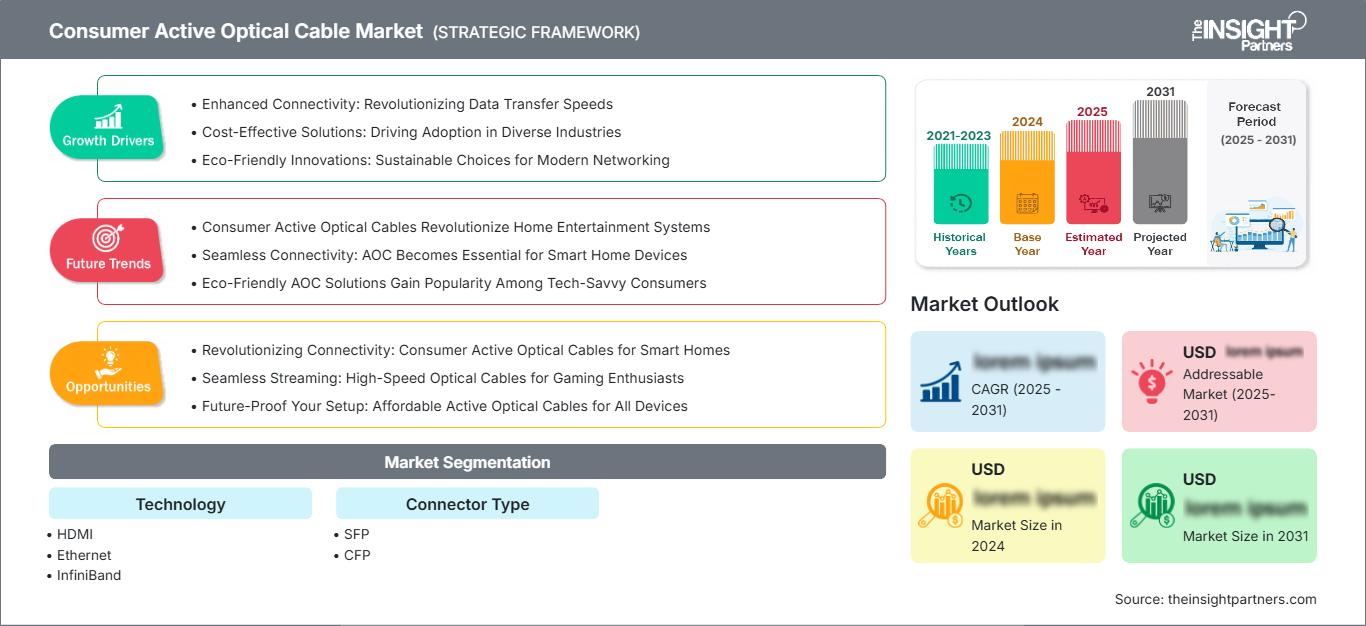
Consumer Active Optical Cable Market: Strategic Insights
Regional Insights
North America Consumer Active Optical Cable Market
North America held 32–36% share in 2025 and is projected to grow at a CAGR of 13.4–14.6% through 2034. The Consumer Active Optical Cable Market share is supported by premium home theaters, gaming rooms, prosumer video workflows, and compact server or workstation setups that require longer cable runs without signal degradation.
Adoption is strongest where installers and consumers need HDMI, DisplayPort, USB, and Ethernet performance beyond copper limitations. Retail and online channels promote lightweight cables for wall routing, conference spaces, and creator studios. Demand also benefits from AI-enabled PCs, cloud gaming, and high-bandwidth displays, although buyers remain sensitive to certification, return rates, and compatibility.
U.S. Consumer Active Optical Cable Market
The US represented 78–82% of North America in 2025 and is expected to grow at a CAGR of 13.6–14.8%. Demand is reinforced by high spending on gaming hardware, large-format displays, home offices, and professional content creation. 3M Company, Molex, LLC, TE Connectivity Ltd., Coherent Corp., Broadcom Inc., and The Siemon Company maintain relevant technology or channel presence.
Application trends are shifting toward long-reach HDMI for media rooms, DisplayPort for high-refresh monitors, USB for docking and imaging devices, and Ethernet AOCs for compact network upgrades. System integrators value reduced cable bulk and electromagnetic immunity. Buyers increasingly compare total installation reliability instead of only cable price, improving acceptance of premium optical options.
Europe Consumer Active Optical Cable Market
The share of Europe was estimated to be in the range of 22-26%, and is expected to rise further at a CAGR of 12.4-13.8%. Germany takes the lead in this region due to electronics requirement driven by engineering, broadcasting, game computers, and structured cabling know-how. The UK adds the home theater requirement and that of creators, while France contributes through digital signage, media production, and audiovisual installations.
Italy and Spain have become emerging markets due to the demand for smart home installations, retail displays, and audiovisual upgrades in hospitality due to which longer cable runs are required. Safety, longevity, and energy savings are the priorities of the European buyers. The distributors are looking for interoperable product lines that eliminate callbacks.
APAC Consumer Active Optical Cable Market
Share of Asia Pacific was 30–34% in 2025, growing with a CAGR of 15.2–16.8%. The dominance of China is due to electronic manufacturing, gaming hardware, and displays manufacturing. Premium audiovisual products are supported by Japan and South Korea, while India and Australia add value due to the growth of online electronics channels, broadband internet, and creator economy.
Regulatory policies for electronics localization and fiber-based networks help the region improve the supply and demand for the cable market. Proximity to cable assembly, components sourcing, and fast product iterations is another advantage of APAC. Local brands compete with price, whereas export-driven brands have to ensure protocol compliance and stability of operation through all mentioned interfaces.
Middle East & Africa Consumer Active Optical Cable Market
MEA (Middle East & Africa) will experience 11.6%-13.0% CAGR because countries like Saudi Arabia, the UAE, South Africa, and others in the region will be investing in smart homes, luxury retail, gaming areas, and digital signage. The UAE drives adoption via luxury residential projects, hospitality projects, and luxury electronic retailing.
Optical cabling demand gets indirect boost via diversification of energy sources and smart city initiatives in public places, learning areas, and entertainment zones. South Africa will contribute via organized retail and professional audio visual routes, while MEA as a whole is price sensitive. Distribution training, installation assistance, and certified product lines are crucial for overcoming compatibility issues.
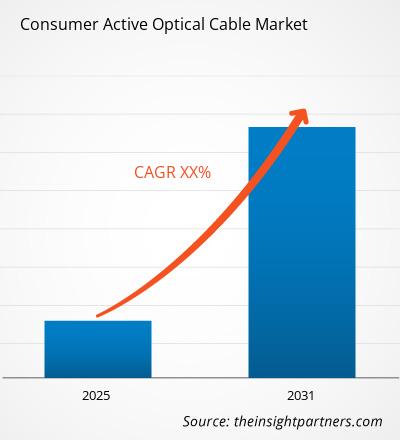
Segmentation Analysis
Technology
Technology is expected to grow at a CAGR of 14.0–15.4% from 2026 to 2034 as the Consumer Active Optical Cable Market scope spans video, networking, storage, and peripheral connectivity. Buyers evaluate bandwidth, reach, latency, power draw, heat, and plug compatibility before purchase. HDMI remains dominant for displays, while USB and Ethernet gain relevance across compact computing and connected device ecosystems.
- HDMI holds the strongest position because long-distance television, projector, gaming, and home-theater installations require reliable high-resolution video transmission without bulky copper routing or visible signal degradation.
- Ethernet serves compact networking, media servers, and high-speed home or studio links where optical cables reduce electromagnetic interference and support stable data movement over longer internal routes.
- InfiniBand is niche in consumer-facing use but strategically important for advanced workstations, AI hobbyist clusters, and prosumer computing setups requiring very low-latency high-throughput interconnects.
- DisplayPort supports high-refresh monitors, gaming PCs, workstations, and multi-display creative environments where users need consistent bandwidth for resolution, color depth, and frame-rate stability.
- USB is gaining momentum across docking stations, VR headsets, cameras, imaging peripherals, and creator accessories because active optical designs extend reach without sacrificing compact setup flexibility.
Connector Type
Connector Type demand is forecast to grow at a CAGR of 13.6–15.0% during 2026–2034 as form-factor selection determines compatibility, serviceability, and channel reach. SFP dominates compact networking and modular equipment, while CFP remains relevant where higher-capacity links and specialized systems justify larger connector footprints. Buyers favor connectors with proven interoperability, diagnostics, and supplier availability.
- SFP is widely used in compact networking equipment, media converters, and modular consumer-adjacent systems where hot-pluggable design, availability, and familiar service practices improve adoption confidence.
- CFP addresses higher-capacity optical link requirements in specialized environments, offering strategic relevance where bandwidth density, thermal management, and performance headroom outweigh compactness considerations.
Opportunity Snapshot
| Technology | Revenue Contribution | Trend Tag | Adoption Stage |
| HDMI | High | 8K Video | Mature |
| Ethernet | Medium | Home LAN | Scaling |
| InfiniBand | Low | AI Clusters | Emerging |
| DisplayPort | Medium | High Refresh | Scaling |
| USB | Medium | Creator Docking | Scaling |
Consumer Active Optical Cable Market Growth Drivers and Impact Analysis
High-Resolution Video Raises Long-Reach Connectivity Needs
Demand from consumers for 4K, 8K, high-refresh gaming and large-format screens has meant that cables which can maintain the integrity of the signals over long distances are needed. Cables made out of copper might turn out to be heavy and distance limited, and prone to interference when they are wall-mounted, ceiling-mounted, or in multiple room arrangements. Optical cables offer a solution in terms of making it possible to route efficiently with HDMI and DisplayPort applications. The market impact is especially important in terms of home theater systems, gaming systems, conference rooms, and studios where the success of the installation is key to cost-effectiveness.
Compact Computing and Creator Workflows Expand USB Demand
Developers, gamers, remote workers, and power users find themselves linking cameras, capture cards, docking stations, monitors, virtual reality devices, and storage devices within a confined workspace. Active optical cables powered by USB help to place the gear farther apart from each other without having to use bulky copper cables. This new technology will drive more interest in using the cables over just video cables due to the expansion of an ecosystem for peripherals. Companies that can make sure their products work well with all versions of USB, power configurations, and device types can ease the concerns of consumers.
AI and Edge Devices Increase Bandwidth Density at Home
Computers using AI technologies, personal servers, portable NAS, and edge computing machines are taking high bandwidth applications into homes, studios, and small offices. They will have local network traffic for activities such as video editing, model testing, games, backups, and media streaming. Active optical cables can form stable optical connections on a short reach basis where there is electromagnetic interference from dense electronics or neat cabling is required by the user. The effect may be slow but significant because consumer hardware is becoming professional. Optical connectivity firms which are able to meet the needs of the professional consumer can tap into early adopters.
Consumer Active Optical Cable Market Future Trends
Protocol-Certified Optical Cables Become Retail Differentiators
Consumer Active Optical Cable Market trends will increasingly favor visible certification, verified bandwidth claims, and clearer compatibility labeling. As users connect expensive displays, gaming consoles, docks, and VR devices, failure tolerance declines. Retailers and installers will prefer products that specify resolution, refresh rate, cable length, connector orientation, and device compatibility without ambiguity. This trend can reduce returns and strengthen trust in premium AOCs. Vendors may also package cables by use case rather than only by protocol, helping consumers select options for 8K rooms, creator desks, or gaming setups. Certification-led merchandising will become a practical response to confusion caused by visually similar but technically different cables.
Expanded Beam and Ruggedized Designs Move Downstream
Optical technology that utilizes expanded beam connections and rugged connector design, created for the data center environment, is expected to impact high-end consumer and pro audio visual products. Better coupling, decreased contamination sensitivity, and speed of installation can be important factors in places where equipment gets handled or routed repeatedly, posing a risk of failure. The development is not going to take off and substitute traditional consumer-grade cables any time soon, but it will offer a higher grade of performance. Optical technology companies that are involved in the ecosystem of optical standards will benefit from creating differentials on the consumer and professional level.
Consumer Active Optical Cable Market Opportunities
Premium AV Installation Channels
Professional AV installers represent a focused opportunity because they select cables based on reliability, routing ease, warranty risk, and customer satisfaction. Consumer Active Optical Cable Market Forecasts support demand for HDMI and DisplayPort AOCs in media rooms, luxury apartments, classrooms, retail screens, and hospitality displays. Vendors should prioritize installer education, clear length guidance, durable packaging, and compatibility documentation. Channel programs can reduce returns by aligning cable choice with project conditions, including bends, conduits, and device placement. This opportunity is attractive because installers can standardize trusted products across projects, creating repeat purchases rather than one-time consumer experimentation.
Creator and Prosumer Device Bundling
Bundling of devices is an effective way out for both manufacturers and cable providers. High-quality monitors, virtual reality headsets, docking stations, capture cards, cameras, and small-sized storage devices all require stable, high-speed connections; but usually, the cables are purchased separately. Thus, the bundling of certified active optical cables may decrease the difficulties in the installation process and guarantee the protection of the company’s brand image for device manufacturers. For the suppliers, co-marketing and white labeling are the best ways to go.
Recent Developments
- May 2026: 3M Company joined a multi-source agreement with Molex, Sumitomo Electric Industries, Ltd., TE Connectivity Ltd., and other technology companies to advance open expanded beam optical connectivity specifications for AI infrastructure, supporting more interoperable and scalable optical interconnect deployment.
- March 2026: MediaTek, Microsoft Research, and other suppliers have successfully designed a next-generation Active Optical Cable (AOC) powered by miniaturized MicroLED light sources. This revolutionary design of an Active MicroLED Cable can significantly improve power efficiency in data centers compared to current technologies. The use of an Active MicroLED Cable would also deliver high-reliability like copper but at a much farther reach.
- March 2025: Sumitomo Electric Industries, Ltd. entered an assembly agreement with 3M Company to offer optical fiber connectivity products using 3M Expanded Beam Optical Interconnect technology, including 12- and 16-fiber EBO cable assemblies for hyperscale data center and edge computing environments.
Frequently Asked Questions

- Comprehensive Market Sizing and Forecast Analysis
- Detailed Segmentation Analysis
- In-Depth Market Dynamics Assessment
- Regional and Country-Level Insights
- Competitive Landscape and Company Benchmarking
- Strategic Business Intelligence
Recent Reports
Testimonials

The Insight Partners' SCADA System Market report is comprehensive, with valuable insights on current trends and future forecasts. The team was highly professional, responsive, and supportive throughout. We are very satisfied and highly recommend their services.
RAN KEDEM Partner, Reali Technologies LTDs
I requested a report on a very specific software market and the team produced the report in a few days. The information was very relevant and well presented. I then requested some changes and additions to the report. The team was again very responsive and I got the final report in less than a week.
JEAN-HERVE JENN Chairman, Future Analytica
We worked with The Insight Partners for an important market study and forecast. They gave us clear insights into opportunities and risks, which helped shape our plans. Their research was easy to use and based on solid data. It helped us make smart, confident decisions. We highly recommend them.
PIYUSH NAGPAL Sr. Vice President, High Beam Global
The Insight Partners delivered insightful, well-structured market research with strong domain expertise. Their team was professional and responsive throughout. The user-friendly website made accessing industry reports seamless. We highly recommend them for reliable, high-quality research services
YUKIHIKO ADACHI CEO, Deep Blue, LLC.
This is the first time I have purchased a market report from The Insight Partners.While I was unsure at first, I visited their web site and felt more comfortable to take the risk and purchase a market report.I am completely satisfied with the quality of the report and customer service. I had several questions and comments with the initial report, but after a couple of dialogs over email with their analyst I believe I have a report that I can use as input to our strategic planning process.Thank you so much for taking the extra time and making this a positive experience.I will definitely recommend your service to others and you will be my first call when we need further market data.
JOHN SUZUKI President and Chief Executive Officer, Board Director, BK Technologies
I wish to appreciate your support and the professionalism you displayed in the course of attending to my request for information regarding to infectious disease IVD market in Nigeria. I appreciate your patience, your guidance, and the fact that you were willing to offer a discount, which eventually made it possible for us to close a deal. I look forward to engaging The Insight Partners in the future, all thanks to the impression you have created in me as a result of this first encounter.
DR CHIJIOKE ONYIA MANAGING DIRECTOR, PineCrest Healthcare Ltd.Reason to Buy
- Informed Decision-Making
- Understanding Market Dynamics
- Competitive Analysis
- Identifying Emerging Markets
- Customer Insights
- Market Forecasts
- Risk Mitigation
- Boosting Operational Efficiency
- Strategic Planning
- Investment Justification
- Tracking Industry Innovations
- Aligning with Regulatory Trends





 Get Free Sample for