
Consumer Camera Drones Market Demand, Share & Growth by 2034
Coverage: by Type, Payloads and Application, and Geography (North America, Europe, Asia Pacific, and South and Central America)
- Status : Data Released
- Report Code : TIPTE100000404
- Category : Electronics and Semiconductor
- No. of Pages : 150
- Available Report Formats :


- Last update date : July 28, 2026


2025 Market Size
US$ 5.42 Bn
Base year value
2034 Forecast
US$ 13.71 Bn
Projected by 2034
CAGR 2026-2034
10.86 %
Growth rate
Addressable Market
US$ 84.60 Bn
(2026-2034)
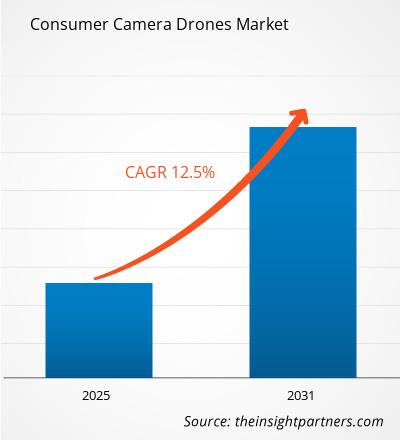
The Consumer Camera Drones Market value was US$ 5.42 Bn in 2025 and is expected to grow up to US$ 13.71 Bn by 2034; the market is expected to see a CAGR of 10.86% between 2026 and 2034. Some of the factors driving the demand for the product are small imaging technology, better flight control, economic for creators, and aerial images usage.
North America is expected to maintain its status as a high revenue-generating market segment, with regional expansion backed by growth rates between 9.8% and 10.6% during 2034. Factors influencing the Consumer Camera Drones Market size in the region include maturity of drone registration programs for recreational drones, robust demand from creators, and more clarity on operating rules for small drones in the US and Canada.
Consumer Camera Drones Market Assessment and Insights
- North America accounted for 34–37% share in 2025 and is projected to grow at a CAGR of 9.8–10.6% during 2026–2034, led by content creation, hobbyist replacement cycles, and structured airspace compliance.
- US represented 78–82% of North America in 2025 and is forecast to grow at a CAGR of 9.9–10.7% through 2034, supported by strong retail channels.
- Europe held 23–26% share in 2025 and is expected to expand at a CAGR of 9.1–9.9% from 2026 to 2034, with Germany, the UK, and France leading regulated adoption.
- Asia Pacific captured 28–31% share in 2025 and is anticipated to record a CAGR of 12.2–13.1% during 2026–2034, led by China, Japan, South Korea, India, and Australia.
- Largest Segment Multirotor System held 71–75% market share in 2025 and is projected to grow at a CAGR of 10.4–11.2% through 2034 due to portability and ease of flight.
- High Growth Segment Precision Agriculture represented 9–12% share in 2025 and is expected to grow at a CAGR of 13.4–14.2% as imaging supports crop scouting.
- Key companies analyzed in detail: SZ DJI Technology Co., Ltd.; Parrot Drone SAS; Denel SOC Ltd.; Aurora Flight Sciences Corporation; Draganfly Inc.; Lockheed Martin Corporation; Elbit Systems Ltd.; Northrop Grumman Corporation; General Dynamics Corporation; BAE Systems plc.
Source: The Insight Partners' analysis based on proprietary research, government publications, company annual reports, investor presentations, industry databases, and expert interviews.
Product evolution is evolving from remote control to stable cameras with automatic target tracking, obstacle detection, and dynamic range photography. The forces driving production would support modularity of gimbals, downsized frames, and greater software integrations, with the suppliers competing over battery endurance, payload capacity, and safe learning flight options. All of which make the Consumer Camera Drones Market more reliant on the optics, chipsets, navigation algorithms, and post-purchase service ecosystems than on airframes alone.
Upcoming demand will be driven by creators in new cities, agricultural digitalization, tourism marketing, and public utility infrastructure monitoring. Investments would be made in sub-250 gram airframes, application-based photo/video editing solutions, and even insurance/training packages. Regulatory headwinds such as improved drone registration, remote identification, and piloting would eliminate the associated risks, opening up more opportunities for hobbyists and semi-professionals in the market.
Consumer Camera Drones Market Report Scope
| Report Attribute | Details |
|---|---|
| Market size in 2025 | US$ 5.42 Billion |
| Market Size by 2034 | US$ 13.71 Billion |
| Global CAGR (2026 - 2034) | 10.86% |
| Historical Data | 2021-2024 |
| Forecast period | 2026-2034 |
Consumer Camera Drones Market Analysis
Consumer Camera Drones Market growth is fuelled by aerial photography, travel videos, real estate pictures, sports videos, and cheap surveys. Consumers now evaluate the quality of stabilization, camera sensor size, flight duration, and automatic home return function instead of considering the cost factor alone. The market consists of camera module suppliers, battery providers, flight software companies, retailers, training services, and repair facilities that have an impact on lifetime value.
The supply aspect is still contingent upon lithium batteries, semiconductor availability, and the use of radio modules that comply with regulations. Multirotor drones dominate due to their ability to take off vertically, small storage size, and stable hovering. However, more advanced resolution requires additional computational power and temperature control; thus, the use of efficient chipsets and programming is necessary. This will be an advantage to companies producing their own hardware-software solution.
According to the Consumer Camera Drones Market report, there is a segmented competition structure. Leading the consumer imaging segment is SZ DJI Technology Co., Ltd.; Parrot Drone SAS, Draganfly Inc., and Aurora Flight Sciences Corporation enhance the credibility of specialization. Defense-oriented firms such as Lockheed Martin Corporation, Elbit Systems Ltd., Northrop Grumman Corporation, General Dynamics Corporation, BAE Systems plc, and Denel SOC Ltd. add adjacent competencies in autonomy, sensors, and unmanned systems.
Investment focus is moving towards safe autonomous flight, improved low-light image quality, and easy post-processing. The companies are trying to position themselves according to creator workflow, enterprise cross-use, and regulatory compliance lightweight design. Differentiation in this case becomes increasingly software-driven, accessories ecosystem, controllers ergonomics, and regulatory support within particular jurisdictions.
● REPORT CUSTOMIZATION
Tailor This Report To Align With Your Specific Business Requirements
This report can be customized to align precisely with your business objectives, scope, and target markets. Customization options include tailored segmentation, geography, competitive analysis, and strategic insights to support informed decision-making.
Customize This Report →WHAT YOU CAN ADJUST
- ● Segmentations
- ● Geography
- ● Competitive Analysis
- ● Language Preferences
Consumer Camera Drones Market: Strategic Insights
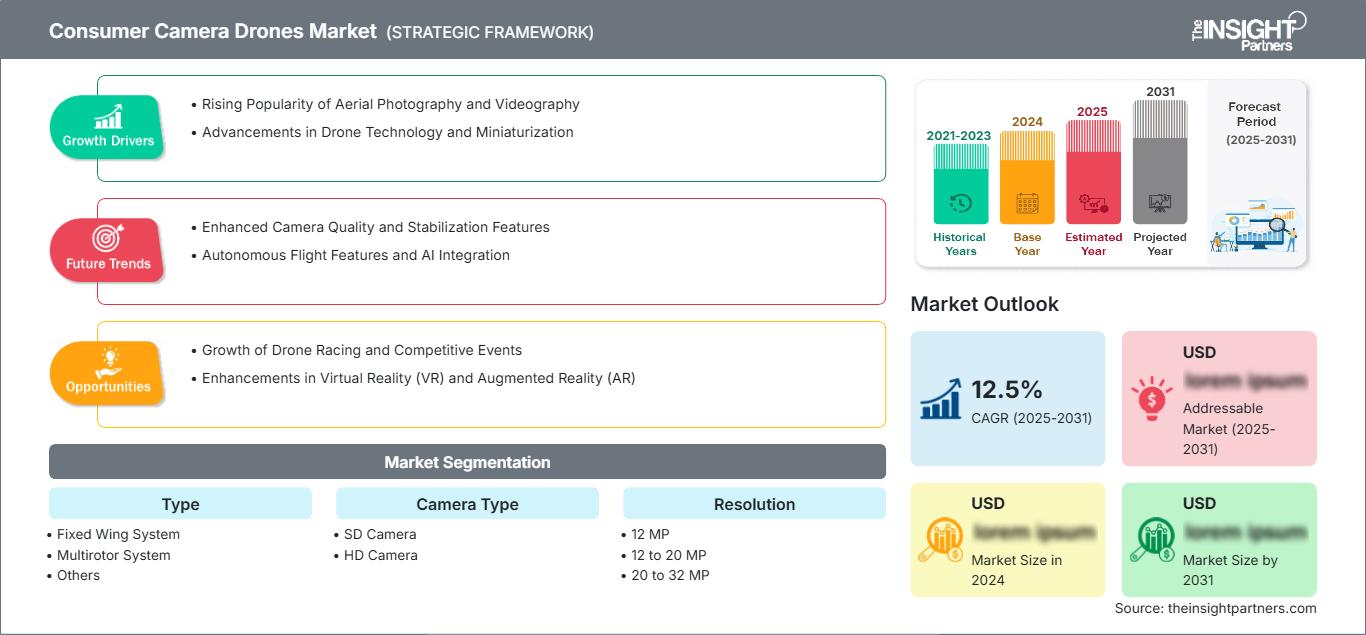
Regional Insights
North America Consumer Camera Drones Market
North America held 34–37% share in 2025 and is forecast to grow at a CAGR of 9.8–10.6% from 2026 to 2034. The Consumer Camera Drones Market share reflects high spending on prosumer electronics, mature online retail channels, and broad use of drones for social media, real estate, inspection-adjacent photography, and outdoor recreation.
Regional momentum is reinforced by FAA-led operational clarity, strong replacement demand, and camera-first product launches. Canada adds demand through tourism, mapping, and agricultural scouting, while Mexico supports entry-level adoption. High average selling prices and strong accessory attachment rates keep North America a value-heavy region despite faster volume growth elsewhere.
U.S. Consumer Camera Drones Market
The USA constitutes 78–82% of North America in 2025 and is expected to register growth of 9.9–10.7% CAGR between 2026-2034. The applications of demand include content creators, outdoor sports enthusiasts, real estate experts, and small enterprises that require cheaper aerial images without enterprise drones.
The presence of companies includes wide distribution of DJI products and knowledge on unmanned systems in the USA that helps in innovations in the sector. Application trends will include 4K and better cameras, AI-enabled subject tracking, portable travel drones, and safer beginner options. Retail cycles will be shorter due to better cameras, autonomy of flights, and lightweight compliant aircraft.
Europe Consumer Camera Drones Market
Share of Europe was 23-26% in 2025, and it will grow at a CAGR of 9.1-9.9% until 2034. Germany leads the region, backed by robust electronics sales, engineering-driven uptake, and professional creators' requirements. The UK has media production, sport cinematography, and recreational flights community.
France is aided by Parrot Drone SAS legacy, tourism photography, and government understanding of unmanned systems. Italy and Spain contribute via tourism, event, beach tourism, and real estate. EU regulation alignment improves consistency, while high privacy standards and restricted urban flights make uptake more compliance-oriented than North America.
APAC Consumer Camera Drones Market
Market shares of APAC were 28–31% in 2025 and are forecasted to increase at a rate of CAGR of 12.2–13.1% from 2026 to 2034. China dominates due to its manufacturing capacity, component networks, and brand dominance whereas Japan and South Korea cater to premium imaging needs.
Countries like India, Australia, and Southeast Asia bring in further opportunities for growth due to agriculture, tourism, infrastructure imaging, and creator-driven e-commerce. Regulatory environments are taking shape and efforts to make the technology accessible domestically by way of assembly have improved as well.
Middle East & Africa Consumer Camera Drones Market
In Middle East & Africa, the CAGR for the period till 2034 will be 10.1% to 10.9%, led by adoption in Saudi Arabia and UAE. Imaging from energy platforms, development of smart cities, marketing of tourism destinations, and construction monitoring drives demand for steady imagery from the skies.
While South Africa has applications in recreation, wildlife, agriculture, and media, the Rest of MEA has yet to develop. Regulatory clearances, import prices, and training act as barriers to adoption, but investments in infrastructure and need for commercial photography will keep the market growing slowly.
Segmentation Analysis
Type
The Type segment is expected to grow at a CAGR of 10.2–11.0% during 2026–2034. Consumer Camera Drones Market scope across type categories is shaped by flight stability, endurance, maneuverability, and ease of storage. Multirotor designs remain preferred for consumer photography because they support hovering, vertical takeoff, and simplified controls, while fixed-wing systems serve niche long-range imaging needs.
- Fixed Wing System serves users requiring longer flight paths, wider area coverage, and efficient forward motion, though limited hovering capability keeps adoption lower in mainstream consumer photography.
- Multirotor System dominates demand because it supports vertical takeoff, stable hovering, compact design, and intuitive controls, making it the preferred format for creators and recreational pilots.
Camera Type
The Camera Type segment is projected to grow at a CAGR of 10.5–11.3% from 2026 to 2034. Demand is moving toward higher-definition capture as users expect smoother video, better color, and easier social publishing. SD camera models remain price-accessible, but HD camera configurations are increasingly treated as the minimum requirement for meaningful aerial content.
- SD Camera remains relevant in entry-level drones for beginners, children, and casual recreational users where affordability, basic image capture, and low replacement cost matter most.
- HD Camera attracts creators and prosumer buyers seeking clearer video, improved stabilization, and stronger compatibility with digital platforms, editing tools, and commercial visual content needs.
Resolution
The Resolution segment is anticipated to grow at a CAGR of 10.8–11.6% during 2026–2034. Higher megapixel counts are becoming central to product differentiation as users crop, stabilize, and repurpose aerial content across platforms. Mid-to-high resolution models are gaining share because they balance file size, sensor cost, low-light performance, and editing flexibility.
- 12 MP remains a practical baseline for compact and entry-level drones, offering acceptable still imagery while controlling sensor cost, processing demand, and battery consumption.
- 12 to 2 MP serves value-focused buyers where basic imaging and affordability matter, although confusing specification ranges often require clearer retail positioning and consumer education.
- 2 to 32 MP supports mainstream adoption as users seek improved detail for travel, events, real estate, and social publishing without paying premium professional prices.
- 32 MP and above addresses advanced creators who need cropping flexibility, higher dynamic range, sharper stills, and stronger post-production quality for commercial-facing content.
Application
The Application segment is expected to grow at a CAGR of 11.1–11.9% from 2026 to 2034. Demand is broadening from leisure imaging toward practical monitoring, farm scouting, and security-adjacent uses. Aerial photography remains the anchor application, while surveillance and precision agriculture create higher-value use cases that support repeat purchases and accessory upgrades.
- Ariel Photography remains the largest application as creators, travelers, real estate agents, and event professionals use drones to capture differentiated visuals with lower operating cost.
- Surveillance gains traction where users need quick visual awareness for property, events, farms, and remote assets, although privacy and local rules influence adoption.
- Precision Agriculture is the fastest-growing application as growers use aerial imagery for crop scouting, irrigation checks, pest observation, and field-level decision support.
Opportunity Snapshot
| Application | Revenue Contribution | Trend Tag | Adoption Stage |
| Ariel Photography | High | Creator Capture | Mature |
| Surveillance | Medium | Asset Watch | Scaling |
| Precision Agriculture | Medium | Crop Scouting | Scaling |
| Others | Low | Recreation Use | Emerging |
Consumer Camera Drones Market Growth Drivers and Impact Analysis
Creator Economy Demand for Differentiated Aerial Visuals
Short video content, travel journalism, real estate videos, and event recording have created demand for small aerial photography cameras that generate unique viewpoints without the use of helicopters or cranes. This is evident from changes in product development, whereby automatic tracking, shooting in the vertical direction, and fast editing processes are becoming basic requirements in purchasing these devices. This creates new demand for drone cameras by widening the target market to include not only enthusiasts but also freelance journalists, agencies, tourism, and real estate firms. Moreover, it increases replacement rates due to productivity-related factors.
Improving Safety Automation and Beginner Accessibility
First-time users face less of a barrier due to obstacle detection, automated return to home functionality, propeller guards, geofencing, and flight instructions via apps. The market impact will be greatest on light multirotor drones because it will help increase consumer confidence by providing a safe way to operate them and minimize the risk for family, travel, and small business applications. Easier demonstrations and fewer problems for retailers also result from increased automation. Consumers are increasingly seeing the drones as photography equipment rather than complicated airplanes as a result of automation advancements.
Expanding Practical Use in Agriculture and Asset Monitoring
Activities such as farm scouting, irrigation inspection, fence inspection, roof inspection, and distant property surveillance are transforming consumer camera drones into practical monitoring devices that cost little. The impact is not restricted to large organizations as even small farms and businesses can afford to purchase drones when each use saves on travel time and/or improves image acquisition. The importance of precision farming in particular is clear as images can be used to determine what needs to be visited in the field and reduce uncertainties. This creates a need for accessories which earn more per user.
Consumer Camera Drones Market Future Trends
AI-Assisted Filming Becomes a Standard Feature
Consumer Camera Drones Market trends will increasingly center on AI-assisted filming, where drones identify subjects, plan smoother paths, avoid obstacles, and recommend shots automatically. This will change buying behavior by making software intelligence as important as lens size or flight time. Future models are expected to package automated framing, voice prompts, creator templates, and cloud editing into lower-price tiers. As AI features mature, casual users will capture more professional-looking footage, while advanced users will shorten editing cycles and reduce reshoots across travel, sports, real estate, and event applications.
Lightweight Compliance-Ready Drone Platforms Scale Up
The sub-250 g category and similar light weight models will be increasingly important because consumers will demand drones that can perform well while being compliant with simple regulations. The manufacturers will give priority to light-weight batteries, folding airframes, efficient chips, and light weight gimbals to maintain the quality of images with minimal operational inconvenience. This is expected to help increase the popularity of lightweight platforms among tourists, novices, and people living in urban areas. With time, such lightweight drones may also allow for modular accessories.
Consumer Camera Drones Market Opportunities
Bundled Creator Kits for Prosumer Buyers
Consumer Camera Drones Market Forecasts indicate a clear opportunity for bundled creator kits that combine drones, spare batteries, memory cards, filters, cases, editing subscriptions, and beginner training. Retailers and manufacturers can raise average order value by packaging workflow completeness rather than selling aircraft alone. This approach is especially attractive for travel creators, real estate agents, wedding videographers, and small businesses that want predictable output quality. Bundles also reduce purchase hesitation because buyers can see a complete operating setup, improving conversion and supporting stronger brand loyalty after the first flight experience.
Localized Training, Repair, and Compliance Services
Service ecosystems represent a strong opportunity because many buyers need guidance on safe flying, local rules, maintenance, and image workflows. Manufacturers, retailers, and training providers can develop localized programs covering registration basics, battery care, privacy-aware operation, and practical filming. Repair networks are also important because crashes and gimbal damage remain common ownership risks. Stronger service availability can improve retention, reduce product returns, and create recurring revenue. In developing markets, these services may be as important as hardware pricing for building durable adoption.
Recent Developments
- April 2026: DJI, the global leader in civilian drones and creative camera technology, has launched the Lito series, a new lineup of entry-level aerial camera drones designed for aspiring creators taking their first steps into aerial photography. The series makes high-altitude photography more accessible and beginner-friendly from the start. Offering an affordable price point along with a balanced set of features, the Lito X1 and Lito 1 deliver a combination of strong performance and value. The new camera drones are designed for young newcomers who want to capture campus life, outdoor adventures, and creative moments with ease, without compromising on quality.
- January 2025 DJI, the global leader in civilian drones and creative camera technology, has introduced DJI Flip, a new series of all-in-one vlog camera drones. Weighing less than 249g, the compact drone features foldable, full-coverage propeller guards designed to provide safer and more reliable flights. Equipped with a 1/1.3-inch CMOS sensor, DJI Flip allows photographers to capture detailed 48MP photos and 4K videos with just a single tap. With comprehensive protection features built in, the drone enables even beginner pilots to confidently take to the skies and create high-quality aerial content.
- July 2026: DJI, the global leader in civilian drones and creative camera technology, has released new long-duration surveying footage of the Khumbu Icefall on Mount Everest (Mount Qomolangma). The video case study highlights how Nepalese drone company Airlift Technology carried out aerial surveying operations at altitudes exceeding 6,000 meters and in temperatures below -20°C. The surveying workflow involved three key components: collecting aerial data using a DJI Matrice 4E, creating 3D models with DJI Terra, and conducting day-by-day comparative analysis. Using these high-precision 3D models, icefall doctors were able to identify the locations of every crevasse, surface displacement, and serac between Base Camp and Camp 1 before setting foot on the ice.
Frequently Asked Questions

- Comprehensive Market Sizing and Forecast Analysis
- Detailed Segmentation Analysis
- In-Depth Market Dynamics Assessment
- Regional and Country-Level Insights
- Competitive Landscape and Company Benchmarking
- Strategic Business Intelligence
Recent Reports
Testimonials

The Insight Partners provided valuable market intelligence that supported our global go-to-market strategy. Their team was professional, responsive, and attentive to our feedback, providing thoughtful analysis and helpful methodological clarifications throughout the project.
Junmo Kim Chief Financial Officer (CFO), Enertech Co., Ltd.
The Insight Partners' SCADA System Market report is comprehensive, with valuable insights on current trends and future forecasts. The team was highly professional, responsive, and supportive throughout. We are very satisfied and highly recommend their services.
RAN KEDEM Partner, Reali Technologies LTDs
I requested a report on a very specific software market and the team produced the report in a few days. The information was very relevant and well presented. I then requested some changes and additions to the report. The team was again very responsive and I got the final report in less than a week.
JEAN-HERVE JENN Chairman, Future Analytica
We worked with The Insight Partners for an important market study and forecast. They gave us clear insights into opportunities and risks, which helped shape our plans. Their research was easy to use and based on solid data. It helped us make smart, confident decisions. We highly recommend them.
PIYUSH NAGPAL Sr. Vice President, High Beam Global
The Insight Partners delivered insightful, well-structured market research with strong domain expertise. Their team was professional and responsive throughout. The user-friendly website made accessing industry reports seamless. We highly recommend them for reliable, high-quality research services
YUKIHIKO ADACHI CEO, Deep Blue, LLC.
This is the first time I have purchased a market report from The Insight Partners.While I was unsure at first, I visited their web site and felt more comfortable to take the risk and purchase a market report.I am completely satisfied with the quality of the report and customer service. I had several questions and comments with the initial report, but after a couple of dialogs over email with their analyst I believe I have a report that I can use as input to our strategic planning process.Thank you so much for taking the extra time and making this a positive experience.I will definitely recommend your service to others and you will be my first call when we need further market data.
JOHN SUZUKI President and Chief Executive Officer, Board Director, BK Technologies
I wish to appreciate your support and the professionalism you displayed in the course of attending to my request for information regarding to infectious disease IVD market in Nigeria. I appreciate your patience, your guidance, and the fact that you were willing to offer a discount, which eventually made it possible for us to close a deal. I look forward to engaging The Insight Partners in the future, all thanks to the impression you have created in me as a result of this first encounter.
DR CHIJIOKE ONYIA MANAGING DIRECTOR, PineCrest Healthcare Ltd.Reason to Buy
- Informed Decision-Making
- Understanding Market Dynamics
- Competitive Analysis
- Identifying Emerging Markets
- Customer Insights
- Market Forecasts
- Risk Mitigation
- Boosting Operational Efficiency
- Strategic Planning
- Investment Justification
- Tracking Industry Innovations
- Aligning with Regulatory Trends





 Get Free Sample for