
Consumer Drones Market Share, Size & Demand by 2034
Coverage: By Product Type (Rotary Blade, Fixed Wing, Hybrid); Technology (Remotely Operated, Semi autonomous and Autonomous); Application (Hobbyist and Gaming, Aerial Photography) , and Geography (North America, Europe, Asia Pacific, and South and Central America)
- Status : Data Released
- Report Code : TIPEL100001351
- Category : Electronics and Semiconductor
- No. of Pages : 150
- Available Report Formats :


- Last update date : July 31, 2026


2025 Market Size
US$ 6.11 Bn
Base year value
2034 Forecast
US$ 20.03 Bn
Projected by 2034
CAGR 2026-2034
14.10 %
Growth rate
Addressable Market
US$ 112.62 Bn
(2026-2034)
The Consumer Drones Market was valued at US$ 6.11 Billion in 2025 and estimated to grow to US$ 20.03 Billion by 2034 at a CAGR of 14.10% from 2026 to 2034. The market encompasses recreational and prosumer drones, which are used for leisure flight, games, and content generation. These products are influenced by the quality of cameras, level of autonomy, performance of batteries, safety features, and pricing aspects.
In terms of geography, North America continues to be a premium consumer market for consumer drones as recreational pilots and content producers purchase high-end products to enable easy image capture and control. The Consumer Drones Market size is anticipated to grow at a CAGR range of 13.2-14.6% from 2026 to 2034, driven by FAA registration regulations, Remote ID knowledge, higher income levels, and stabilized imaging requirements of travelers, outdoor games, real estate, and social media content creation.
Consumer Drones Market Assessment and Insights
- North America: The region holds 31–35% share in 2025 and grows at a CAGR range of 13.2–14.6% during 2026–2034, led by creator adoption, recreational registrations, and premium camera drone upgrades.
- US: The country represents 79–83% of North America in 2025 and grows at a CAGR range of 13.3–14.7% during 2026–2034, supported by strong retail and creator ecosystems.
- Europe: The region accounts for a 21–25% share in 2025 and grows at a CAGR range of 12.3–13.7% during 2026–2034, with Germany, the UK, France, Italy, and Spain leading adoption.
- Asia Pacific: The region holds a 32–36% share in 2025 and grows at a CAGR range of 15.1–16.8% during 2026–2034, led by China, Japan, South Korea, India, and Australia.
- Largest Segment: Rotary Blade holds 73–77% market share in 2025 and grows at a CAGR range of 13.6–15.0% during 2026–2034 due to compact design and imaging flexibility.
- High Growth Segment: Autonomous drones hold 18–22% market share in 2025 and grow at a CAGR range of 16.8–18.6% during 2026–2034 as obstacle avoidance and tracking improve.
- Key companies analyzed in detail: 3D Robotics, Inc.; Guangzhou Walkera Technology Co., Ltd.; Hobbico, Inc.; Yuneec International Co. Ltd.; Horizon Hobby, LLC; PowerVision Robot Corporation; EHang Holdings Limited; Shantou SYMA Model Aircraft Industrial Co., Ltd.; Shenzhen Jianjian Technology Co., Ltd.; Delair SAS.
Source: The Insight Partners' analysis based on proprietary research, government publications, company annual reports, investor presentations, industry databases, and expert interviews.
Drones have evolved from simple RC toys into stabilized aircraft with gimbals, GPS tracking, automatic return to home features, obstacle detection, and automation of flight modes. The production process involves light-weight frames, brushless motors, lithium batteries, image sensors, and app capabilities, as well as regulatory compliance technologies. As the producers become better at making drones portable, serviceable, quiet, and easy to fly, they will optimize their firmware to avoid crashes and get higher-quality videos.
The demand from future consumers will come from young creators, tourists, athletes, and small business owners who want to take high-quality aerial videos without having to be professional pilots. New geographies will profit from the smartphone-based controlling, e-commerce sales, and reduced cost of entry. Regulations become more predictable as the aviation authorities define requirements regarding registration, remote identification, and geofencing.
Consumer Drones Market Report Scope
| Report Attribute | Details |
|---|---|
| Market size in 2025 | US$ 6.11 Billion |
| Market Size by 2034 | US$ 20.03 Billion |
| Global CAGR (2026 - 2034) | 14.10% |
| Historical Data | 2021-2024 |
| Forecast period | 2026-2034 |
Consumer Drones Market Analysis
Demand comes from enthusiasts, travel content providers, vloggers, users of outdoor sports gear, and prosumers for obtaining cinematic aerial videos at reasonable prices. There is a positive outlook about the consumer drones market considering 4K and 8K cameras, folding frame, increased endurance, target tracking, first-person view technology, and auto pilot feature, which help in reducing the piloting efforts.
The supply chain consists of suppliers of motors, batteries, camera modules, flight control systems, GPS, and inertia sensors, software developers, online retailers, training institutes, and repair shops. Supply chain depends upon the availability of lithium batteries, the cost of imaging sensors, the availability of lightweight plastics, wireless connectivity, and the rate of firmware updates. Buying decisions depend upon the safety features, image stabilization features, endurance, portability, after sales service and compliance.
Consumer Drones Market report provides for competition among well-known hobby brand producers, imaging-focused players, and autonomy-based manufacturers. The competing entities include 3D Robotics, Inc., Guangzhou Walkera Technology Co., Ltd., Yuneec International Co. Ltd., PowerVision Robot Corporation, EHang Holdings Limited, and Delair SAS through flight stability, camera capabilities, application control, and niche applications. Horizon Hobby, LLC, Hobbico, Inc., Shantou SYMA Model Aircraft Industrial Co., Ltd., and Shenzhen Jianjian Technology Co., Ltd. target beginner and enthusiast markets.
Investment areas may be seen to comprise autonomous navigation, safer propellers, battery optimization, radio connectivity, low-light sensors, FPV accessories, and editing-friendly workflow. Positioning strategy changes on account of different channels. Premium channels give attention to the issues of imaging and reliability, toy channels place an emphasis on price considerations, while specialist channels target mapping and inspection-related applications.
● REPORT CUSTOMIZATION
Tailor This Report To Align With Your Specific Business Requirements
This report can be customized to align precisely with your business objectives, scope, and target markets. Customization options include tailored segmentation, geography, competitive analysis, and strategic insights to support informed decision-making.
Customize This Report →WHAT YOU CAN ADJUST
- ● Segmentations
- ● Geography
- ● Competitive Analysis
- ● Language Preferences
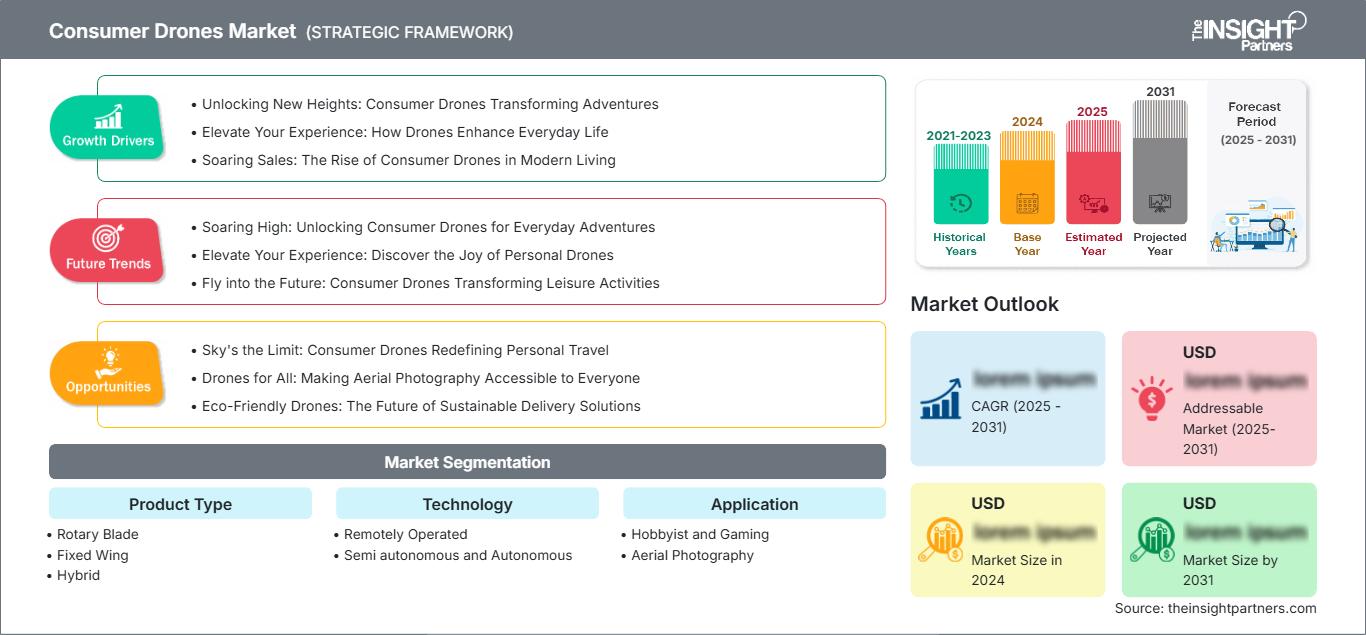
Consumer Drones Market: Strategic Insights
Regional Insights
North America Consumer Drones Market
North America holds a 31–35% share in 2025 and is projected to grow at a CAGR range of 13.2–14.6% during 2026–2034. Consumer Drones Market share is supported by recreational pilot registration, content creation, outdoor recreation, real estate imagery, and premium retail channels that accelerate replacement purchases.
Regional adoption can benefit from FAA remote identification regulation, a high level of penetration of e-commerce services, the formation of club hobbies, and a willingness to pay for safety-related attributes. Consumer demand is focused on foldable rotors, FPV drones, and camera drones employed in traveling, sports, parties, social media, and professional content creation.
U.S. Consumer Drones Market
The United States is made up of 79-83% of North America in 2025 and projected to expand at a CAGR of 13.3-14.7% in 2026-2034. The presence of the company covers retail distribution networks, hobby networks, online platforms, flight training, repair services, and software solutions for editing, planning, and safety compliance.
Trends within application involve aerial photography, FPV entertainment, vacation video recording, real estate marketing, science education for the youth generation, and making money from creators. Companies such as 3D Robotics, Inc., Horizon Hobby, LLC, and conventional hobby distributors are leading in the enthusiast categories, whereas imported products provide good camera quality and autonomy.
Europe Consumer Drones Market
Europe represents the 21%-25% share in 2025 and is projected to register a CAGR of 12.3%-13.7% between 2026 and 2034. The dominant country is Germany because of a well-disciplined culture of recreational aviation, electronics retail sales, outdoor tourism, and requirements for imaging platforms.
The UK plays a role in increasing the demand of creators and the FPV community, and tourism, lifestyle, and hobbies are provided by France, Italy, and Spain. Harmonized laws set by EASA, registration of operators, and classification of drones help to ensure safety and responsibility, even though they are mainly concerned with privacy and restricted urban flights.
APAC Consumer Drones Market
Asia Pacific enjoys a market share of 32–36% by 2025 and a compound annual growth rate of 15.1–16.8%. China dominates due to its large-scale production, availability of components, product update cycles, and developed consumer electronics supply chain, complemented by Japan and South Korea due to their expertise in imaging and robotics.
India and Australia also help due to outdoor activities, creators, online sales, and drone training. Better policy clarity, electronics manufacturing incentives, and greater consumption of smartphone video make the situation favorable for the Consumer Drones Market Growth. This market is favored when regional brands offer affordable hardware coupled with stable applications.
Middle East & Africa Consumer Drones Market
MEA & Africa is expected to record a CAGR between 11.5% and 12.9% in the period 2026–2034. In the MEA region, the UAE stands out for selective adoption, mainly through tourism, luxury shopping, creator events, and smart city visibility. Saudi Arabia connects demand to entertainment, infrastructure documentation, and outdoor recreation.
The demands of South Africa and RoW MEA come from adventure tourism, learning, security hobbyist activities, and social networking sites. Applications in energy and infrastructure may lead to a prosumer crossover situation, but cost, tariffs, weather, and airspace clearances can influence purchase and post-sale needs.
Segmentation Analysis
Product Type
Product Type is projected to grow at a CAGR range of 13.9–15.4% during 2026–2034. The Consumer Drones Market scope by product type is shaped by flight stability, payload capacity, endurance, and ease of launch. Rotary blade drones dominate recreational and imaging use, fixed-wing designs serve longer-range enthusiast missions, and hybrid platforms address users seeking vertical takeoff with improved distance capability.
- Rotary Blade: Rotary blade drones lead demand because they hover precisely, launch in confined spaces, carry stabilized cameras, and suit beginners, creators, gamers, and recreational pilots.
- Fixed Wing: Fixed wing models attract advanced hobbyists needing longer endurance, wider area coverage, and efficient gliding performance, although launch space and landing requirements limit mass-market use.
- Hybrid: Hybrid drones remain niche but strategically important because they combine vertical takeoff with improved range, appealing to prosumers exploring mapping, travel filming, and experimentation.
Technology
Technology is expected to grow at a CAGR range of 14.2–15.9% during 2026–2034. Technology adoption is moving from manual control toward assisted and autonomous functions. Remotely operated drones remain important for entry-level users, semi autonomous models improve safety and framing, and autonomous drones gain traction as obstacle avoidance, subject tracking, and route planning become standard in premium products.
- Remotely Operated: Remotely operated drones retain broad appeal among beginners and hobby pilots because they offer direct control, lower prices, simple maintenance, and accessible learning experiences.
- Semi autonomous: Semi autonomous drones support safer recreational flying through altitude hold, return-to-home, waypoint assistance, image stabilization, and basic tracking that reduce operator workload.
- Autonomous: Autonomous drones are strategically important for premium users because obstacle sensing, intelligent follow modes, automated shots, and route planning improve safety and content quality.
Application
Application is forecast to grow at a CAGR range of 14.5–16.2% during 2026–2034. Application demand is concentrated in recreational engagement and visual content creation. Hobbyist and gaming use supports entry-level sales and FPV experimentation, while aerial photography generates higher average selling prices because users pay for camera resolution, gimbal quality, intelligent shots, and post-production compatibility.
- Hobbyist and Gaming: Hobbyist and gaming demand is driven by recreational flying, FPV racing, STEM learning, gifting, and beginner experimentation where durability and price matter.
- Aerial Photography: Aerial photography attracts creators, travelers, real estate users, and prosumers seeking stabilized high-resolution video, automated framing, smooth flight paths, and portable equipment.
Opportunity Snapshot
| Application | Revenue Contribution | Trend Tag | Adoption Stage |
| Hobbyist and Gaming | Medium | FPV Play | Scaling |
| Aerial Photography | High | Cinematic Capture | Mature |
Consumer Drones Market Growth Drivers and Impact Analysis
Creator Economy Expands Aerial Content Demand
The use cases of short videos, travel-related content, sports footage, and real estate marketing are opening up the market to new buyers who go beyond hobbyists with their radio-controlled drones. Drones give content creators the ability to capture the kind of footage that would need a crane, helicopter, or other specialized team for before, making it more affordable to differentiate with video content. This effect is particularly noticeable in the case of small drones with stable cameras, object tracking capabilities, transfer apps, and templates for social networks.
Autonomy and Safety Features Lower Entry Barriers
Drones that offer features like obstacle detection and avoidance, return to home, altitude hold, geofencing, remote identification capabilities, and smart flight modes provide ease of use for new drone owners. These functions not only minimize crash fears but also ensure the safety of individuals and assets around the drone and help users adhere to the airspace rules. The influence of these features in the market can be seen through premiumization, as buyers will pay a higher price for drones that are capable of following subjects, framing scenes, and handling signal loss.
Battery and Imaging Improvements Support Upgrades
Flight duration, fast charging capabilities, improved gimbals, improved sensor quality, and better image stabilization increase the practical utility of drones used for recreation. People whose flights were earlier constrained by time and daylight hours now have an opportunity to record smooth video during travel, events, sports, and outdoor activities. It even affects accessories, extra batteries, maintenance programs, memory devices, and training programs. Battery power is important since each added minute of safe flight provides more opportunities. Improved imaging also encourages replacement due to comparison with smartphone and action camera video.
Consumer Drones Market Future Trends
AI-Assisted Flight Becomes Standard
Consumer Drones Market trends will increasingly favor AI-assisted flight that simplifies framing, subject tracking, obstacle avoidance, and scene selection. Future consumer models are expected to behave less like manually piloted aircraft and more like mobile camera assistants. This shift will help beginners capture polished video while allowing advanced users to focus on creative direction. Manufacturers will differentiate through reliable computer vision, low-latency processors, privacy-aware data handling, and safety logs. The trend also supports subscription software, cloud editing, and automated highlight generation for creators.
Sub-250 Gram Platforms Gain Strategic Weight
Lightweight drones below common registration or operational thresholds will remain strategically important as buyers look for fewer barriers, safer handling, and easier travel. Engineering focus will shift toward extracting premium imaging and autonomy from smaller frames without sacrificing wind resistance or flight time. This trend will influence material selection, motor efficiency, battery chemistry, and folding designs. Retailers can position compact drones as everyday creator tools, while manufacturers use software stabilization and sensor fusion to overcome physical limitations in smaller aircraft.
Consumer Drones Market Opportunities
Creator Bundles and Education-Led Retail
Consumer Drones Market Forecasts support investment in bundled offerings that combine drones, spare batteries, propeller guards, editing tools, storage, insurance, and training content. Many buyers hesitate because they are unsure about rules, flight safety, and editing workflows. Retailers and manufacturers can raise conversion by packaging education with hardware and by offering guided onboarding through apps, videos, and local communities. The opportunity is especially attractive for aerial photography users who value predictable results and for parents or schools seeking safer entry points into STEM-oriented flying.
Localized Compliance and After-Sales Platforms
Compliance uncertainty creates an opportunity for brands that localize airspace guidance, registration reminders, firmware updates, spare parts, and repair support. Consumer users often need simple explanations rather than technical aviation manuals. App-based checklists, geofencing alerts, service subscriptions, and quick replacement programs can reduce misuse and improve ownership satisfaction. This approach also helps manufacturers strengthen relationships after the first purchase, creating repeat demand for accessories, upgrades, and training. Markets with evolving drone rules may reward suppliers that treat compliance as part of the product experience.
Recent Developments
- June 2026: Thales and Visionary Machines announced a collaboration to develop advanced passive drone detection capabilities for counter-uncrewed aerial systems (C-UAS). The partnership combines Thales’ expertise in defence systems and airspace security with Visionary Machines’ Pandion Sentinel passive 3D optical sensing technology, enabling detection, tracking, and identification of drones without emitting detectable signals. The integrated solution aims to improve protection against evolving drone threats for defence, critical infrastructure, and security applications.
- April 2026: DJI launched the Lito Series, featuring the beginner-friendly Lito X1 and Lito 1 camera drones designed to make aerial photography more accessible for first-time drone users and aspiring creators. The new drones combine high-quality aerial imaging, omnidirectional obstacle sensing for safer flights, compact designs, and user-friendly features to help capture outdoor adventures, daily moments, and creative content with greater ease.
- January 2026: ZenaTech expanded its Drone as a Service (DaaS) business by completing its latest acquisition of L.D. King, Inc., a California-based civil engineering and land surveying firm. The acquisition strengthens ZenaTech’s AI drone capabilities for applications including wildfire management, public works, infrastructure inspection, and precision surveying by integrating drone-based data collection and analytics into established surveying workflows. The transaction marked ZenaTech’s 20th acquisition in its first year of executing its DaaS expansion strategy.
Frequently Asked Questions

- Comprehensive Market Sizing and Forecast Analysis
- Detailed Segmentation Analysis
- In-Depth Market Dynamics Assessment
- Regional and Country-Level Insights
- Competitive Landscape and Company Benchmarking
- Strategic Business Intelligence
Recent Reports
Testimonials

The Insight Partners' SCADA System Market report is comprehensive, with valuable insights on current trends and future forecasts. The team was highly professional, responsive, and supportive throughout. We are very satisfied and highly recommend their services.
RAN KEDEM Partner, Reali Technologies LTDs
I requested a report on a very specific software market and the team produced the report in a few days. The information was very relevant and well presented. I then requested some changes and additions to the report. The team was again very responsive and I got the final report in less than a week.
JEAN-HERVE JENN Chairman, Future Analytica
We worked with The Insight Partners for an important market study and forecast. They gave us clear insights into opportunities and risks, which helped shape our plans. Their research was easy to use and based on solid data. It helped us make smart, confident decisions. We highly recommend them.
PIYUSH NAGPAL Sr. Vice President, High Beam Global
The Insight Partners delivered insightful, well-structured market research with strong domain expertise. Their team was professional and responsive throughout. The user-friendly website made accessing industry reports seamless. We highly recommend them for reliable, high-quality research services
YUKIHIKO ADACHI CEO, Deep Blue, LLC.
This is the first time I have purchased a market report from The Insight Partners.While I was unsure at first, I visited their web site and felt more comfortable to take the risk and purchase a market report.I am completely satisfied with the quality of the report and customer service. I had several questions and comments with the initial report, but after a couple of dialogs over email with their analyst I believe I have a report that I can use as input to our strategic planning process.Thank you so much for taking the extra time and making this a positive experience.I will definitely recommend your service to others and you will be my first call when we need further market data.
JOHN SUZUKI President and Chief Executive Officer, Board Director, BK Technologies
I wish to appreciate your support and the professionalism you displayed in the course of attending to my request for information regarding to infectious disease IVD market in Nigeria. I appreciate your patience, your guidance, and the fact that you were willing to offer a discount, which eventually made it possible for us to close a deal. I look forward to engaging The Insight Partners in the future, all thanks to the impression you have created in me as a result of this first encounter.
DR CHIJIOKE ONYIA MANAGING DIRECTOR, PineCrest Healthcare Ltd.Reason to Buy
- Informed Decision-Making
- Understanding Market Dynamics
- Competitive Analysis
- Identifying Emerging Markets
- Customer Insights
- Market Forecasts
- Risk Mitigation
- Boosting Operational Efficiency
- Strategic Planning
- Investment Justification
- Tracking Industry Innovations
- Aligning with Regulatory Trends





 Get Free Sample for