
Contactless Biometrics Market Share, Growth & Forecast by 2034
Coverage: by Offering (Hardware, Software, Services); Application (Face Recognition, Fingerprint Recognition, Iris Recognition, Voice Recognition, Hand Geometry, Others); End-user (BFSI , Defense and Security, Government, Transport and Logistics , Retail and Ecommerce, Others) , and Geography (North America, Europe, Asia Pacific, and South and Central America)
- Status : Data Released
- Report Code : TIPRE00011170
- Category : Electronics and Semiconductor
- No. of Pages : 150
- Available Report Formats :


- Last update date : July 28, 2026


2025 Market Size
US$ 20.5 Bn
Base year value
2034 Forecast
US$ 46.37 Bn
Projected by 2034
CAGR 2026-2034
9.49 %
Growth rate
Addressable Market
US$ 298.33 Bn
(2026-2034)
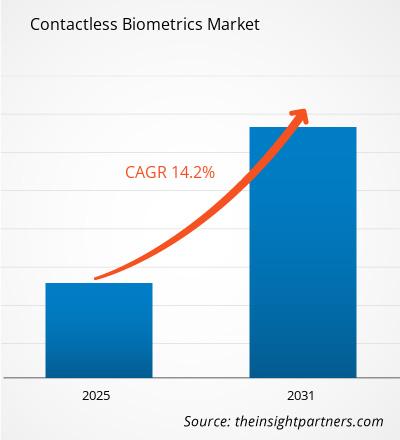
The global Contactless Biometrics market was valued at US$ 20.5 billion in 2025 and is expected to reach US$ 46.37 billion by 2034; it is estimated to record a CAGR of 9.49% during 2026-2034.
Contactless Biometrics Market Assessment and Insights
- North America held 34–38% share in 2025 and is growing at a CAGR of 10.0–11.2% during 2026–2034, supported by airport biometrics, government security modernization, and BFSI identity assurance.
- US represented 78–82% of North America in 2025 and is growing at a CAGR of 10.2–11.4%, led by border processing, banking authentication, and enterprise access.
- Europe accounted for 24–28% share in 2025 and is advancing at a CAGR of 9.2–10.4%, with the UK, Germany, France, Italy, and Spain leading privacy-governed adoption.
- Asia Pacific captured 25–29% share in 2025 and is expanding at a CAGR of 11.6–12.8%, led by China, Japan, South Korea, India, and Australia.
- Largest Segment Face Recognition held 36–40% market share in 2025 and is growing at a CAGR of 10.6–11.8%, supported by cameras, AI matching, and travel use cases.
- High Growth Segment Iris Recognition held 13–17% market share in 2025 and is growing at a CAGR of 12.4–13.8%, driven by high-assurance access and border security.
- Key companies analyzed in detail: HID Global Corporation, BIO-key International, Inc., NEC Corporation, Thales S.A., Fulcrum Biometrics, LLC, Nuance Communications, Inc., Precise Biometrics AB, Qualcomm Technologies, Inc., DERMALOG Identification Systems GmbH, Daon, Inc.
Source: The Insight Partners' analysis based on proprietary research, government publications, company annual reports, investor presentations, industry databases, and expert interviews.
The contactless biometric market now encompasses an entire identity ecosystem made up of cameras, sensors, liveness detection, matching processes, secure devices, and workflow management. The Contactless Biometrics Market indicates a move towards multimodal identity, edge artificial intelligence, privacy aware enrollment, and credential interoperability. The production factors include optical elements, secure chips, software validation, biometric databases, and integration partners who can deploy the solution in public and commercial high throughput environments.
Demand for future times will come from digital identity solutions, automation of passenger processing, fraud prevention policies, and enterprise security improvements. New emerging markets will gain value from e-government projects and mobile payments systems whereas mature markets will focus on precision, consent management, cyber security, and live detection capabilities. Investments will go to software and hardware platforms that will minimize queues without losing the aspect of identity verification.
Contactless Biometrics Market Report Scope
| Report Attribute | Details |
|---|---|
| Market size in 2025 | US$ 20.5 Billion |
| Market Size by 2034 | US$ 46.37 Billion |
| Global CAGR (2026 - 2034) | 9.49% |
| Historical Data | 2021-2024 |
| Forecast period | 2026-2034 |
Contactless Biometrics Market Analysis
Contactless Biometrics Market growth drivers include increasing incidence of identity fraud, password fatigue, and the need for secure authentication through non-physical interactions. Biometrics adoption at airports and borders is growing due to IATA’s emphasis on contactless travel and digital identity. BFSI enterprises utilize voice, facial, and fingerprint biometrics to prevent account takeover and expedite the customer onboarding process.
This market includes sensor vendors, camera module manufacturers, algorithms providers, secure processors, enrollment systems, systems integrators, cloud-based identity services, and governed end-users. The supply chain dynamics will be affected by the effectiveness of the AI models, demographic fairness testing, cybersecurity accreditation, and operational environment including lighting, mobility, mask-wearing, and volume. Firms combining hardware robustness with software ready to govern will gain an advantage in securing high-value deals.
The Contactless Biometrics market report includes competition among the biometric experts and diversified tech companies. HID Global Corporation, NEC Corporation, Thales S.A., Daon, Inc., and DERMALOG Identification Systems GmbH are involved in the competition in governmental, border control, and enterprise identity deployments. The capabilities of secure mobile processing are provided by Qualcomm Technologies, Inc., while BIO-key International, Inc., Precise Biometrics AB, Fulcrum Biometrics, LLC, and Nuance Communications, Inc. offer authentication, fingerprint, enrollment, and voice biometric technologies.
The strategic positioning of the company becomes more and more focused on performance in real-life scenarios, liveness detection capability, privacy framework, and platform adaptability. Purchasers switch their preference from standalone reader solutions to platforms that allow deploying mobile credentials, identity verification via cloud, multimodal match, and auditing capability.
● REPORT CUSTOMIZATION
Tailor This Report To Align With Your Specific Business Requirements
This report can be customized to align precisely with your business objectives, scope, and target markets. Customization options include tailored segmentation, geography, competitive analysis, and strategic insights to support informed decision-making.
Customize This Report →WHAT YOU CAN ADJUST
- ● Segmentations
- ● Geography
- ● Competitive Analysis
- ● Language Preferences
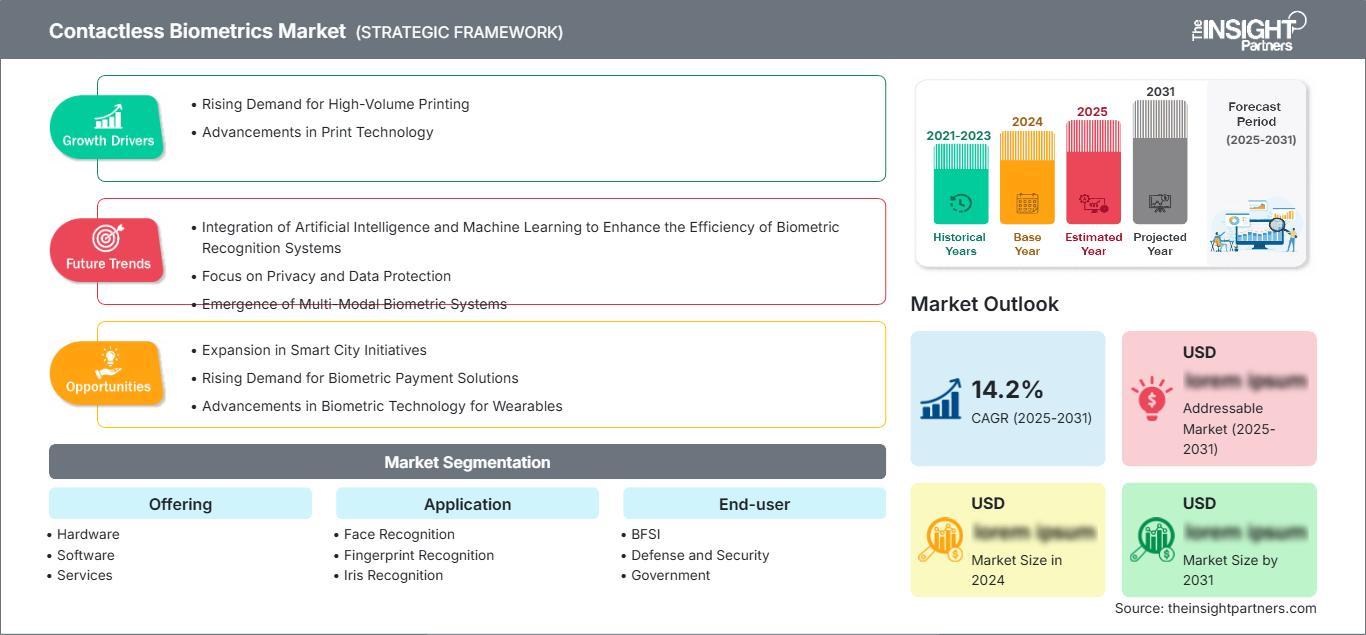
Contactless Biometrics Market: Strategic Insights
Regional Insights
North America Contactless Biometrics Market
North America held 34–38% share in 2025 and is projected to grow at a CAGR of 10.0–11.2% through 2034. The Contactless Biometrics Market share is supported by airport biometric boarding, federal identity programs, enterprise access control, and financial institutions replacing passwords with stronger authentication. IATA’s 2025 contactless travel directory reinforces the region’s investment case.
Demands arise in face recognition, voice verification, and contactless fingerprints in high security and high volume scenarios. The United States leads with its government agencies and banks, whereas Canada generates more demand due to its border modernization and digital identity initiatives. Liveness detection, consent process, interoperability, and bias testing are among the concerns of buyers as deployment depends on their acceptance and regulations.
U.S. Contactless Biometrics Market
The United States comprised 78% to 82% of the total population of North America in 2025, with a CAGR of 10.2% to 11.4%. This can be further fueled by airport exit entry processes, financial fraud controls, contact center voice biometric processes, and enterprise security initiatives. The companies having technologies/deployments include NEC Corporation, HID Global Corporation, Daon, Inc., Qualcomm Technologies, Inc., BIO-key International, Inc., and Fulcrum Biometrics, LLC.
Applications are most demanded in face recognition technology for travel/identity access control purposes, voice recognition technology for call centers, and fingerprint recognition technology for identity verification. The financial services sector and government agencies need results that are auditable, while retail/e-commerce applications are concerned about more user-friendly verification. Providers need to consider privacy communications and cybersecurity.
Europe Contactless Biometrics Market
Europe accounted for 24–28% market share in 2025 and is expected to witness CAGR growth of 9.2–10.4%. Leading regional implementation comes from Germany via its secure identity infrastructure, industrial access control, and biometric border control technology. The UK has been enabling its market by airport automation and anti-financial crime capabilities, while France adds through public security and digital identity transformation.
Both Italy and Spain have seen an increase in usage through government initiatives in areas such as transit, retail banking, and service delivery. European procurement processes are aware of privacy issues. The buyers are interested in the GDPR, data minimization, template protection, and retention policy. The suppliers that can demonstrate lawful processing, Europe hosting, and accuracy among different groups would gain from this.
APAC Contactless Biometrics Market
Asia Pacific has a 25-29% share in 2025 and will have a CAGR of 11.6-12.8%. China dominates due to its investments in smart city security, authentication of payments, and deployment of infrastructures. Japan and South Korea provide advanced devices, whereas India and Australia drive demand via their efforts towards digital identity, travel upgrades, and financial inclusion initiatives.
Government policies that promote the production of electronic devices and national ID solutions enhance the supply in the region. APAC region advantages are its large mobile population, growing airport traffic, and development of e-government services; however, cost sensitivity and differences in data policies influence procurement. The vendors should localize their algorithms, follow sovereign data policies, and implement high throughput solutions in logistics, BFSI, and retail environments.
Middle East & Africa Contactless Biometrics Market
Middle East & Africa is projected to grow at a CAGR of 8.6–9.8% as Saudi Arabia, the UAE, South Africa, and the rest of MEA invest in smart airports, digital public services, and critical infrastructure security. The UAE leads adoption through premium travel infrastructure and biometric border initiatives.
Energy diversification, smart city initiatives, and logistics corridors facilitate biometrics at airports, seaports, government offices, and enterprise sites. South Africa is active in banking identity solutions and demand from the private sector for security services. MEA as a whole is procurement-focused, so scalable software, robust readers, and technical support are key.
Segmentation Analysis
Offering
Offering is expected to grow at a CAGR of 10.1–11.3% from 2026 to 2034 as the Contactless Biometrics Market scope spans cameras, scanners, secure processors, algorithm software, enrollment platforms, and managed identity services. Hardware remains essential for capture quality, software drives matching and liveness value, and services help regulated buyers deploy, audit, and maintain biometric workflows.
- Hardware includes cameras, iris scanners, touchless fingerprint devices, microphones, and secure processing modules. Demand is strongest where capture quality, ruggedization, and throughput determine authentication reliability.
- Software provides matching engines, liveness detection, orchestration, template protection, and analytics. It is strategically important because accuracy, bias mitigation, and integration flexibility influence deployment outcomes.
- Services cover consulting, integration, enrollment support, maintenance, and managed authentication. Services become critical when buyers require compliance documentation, workflow design, and long-term system optimization.
Application
Application is projected to grow at a CAGR of 10.5–11.7% during 2026–2034 as biometric use expands from security checkpoints into digital onboarding, payments, workplace access, and customer verification. Face recognition leads because cameras are widely available, while iris and voice recognition address high-assurance and remote authentication needs. Hand geometry remains niche but useful in controlled access environments.
- Face Recognition leads deployment because it supports fast, camera-based verification in airports, offices, stores, and mobile devices. Its strategic importance rises when paired with liveness detection.
- Fingerprint Recognition remains important for identity verification and mobile authentication, with touchless capture reducing hygiene concerns while preserving familiarity across government and BFSI use cases.
- Iris Recognition serves high-assurance environments where accuracy and resistance to spoofing are priorities, including border control, defense facilities, and secure access programs.
- Voice Recognition is used in call centers, banking, and remote service channels, where passive authentication can reduce fraud checks and improve customer experience.
- Hand Geometry supports controlled physical access applications where repeat users and stable environments make geometric verification practical, especially in enterprise and infrastructure settings.
End-user
End-user is expected to grow at a CAGR of 10.2–11.5% from 2026 to 2034 as adoption broadens across regulated sectors and customer-facing channels. Government and defense prioritize assurance and scale, BFSI emphasizes fraud reduction, transport seeks throughput improvement, and retail uses biometrics selectively for loyalty, age verification, and frictionless checkout.
- BFSI uses face, voice, and fingerprint authentication for onboarding, payment approval, branch access, and call center verification, reducing reliance on passwords and knowledge-based checks.
- Defense and Security requires high-assurance multimodal systems for facility access, personnel verification, and watchlist screening where spoof resistance and audit trails are essential.
- Government deploys biometric identity for border control, civil ID, public service access, and law enforcement workflows, making governance, consent, and data protection central.
- Transport and Logistics applies biometrics in airports, seaports, warehouses, and fleet facilities to accelerate passenger, worker, and cargo-related identity checks.
- Retail and Ecommerce uses biometric verification for account access, payments, loyalty, and fraud reduction, but adoption depends on consumer trust and clear opt-in experiences.
Opportunity Snapshot
| End-user | Revenue Contribution | Trend Tag | Adoption Stage |
| BFSI | High | Fraud Defense | Scaling |
| Defense and Security | High | Secure Access | Mature |
| Government | High | Digital ID | Scaling |
| Transport and Logistics | Medium | Frictionless Travel | Scaling |
| Retail and Ecommerce | Medium | Trusted Checkout | Emerging |
Contactless Biometrics Market Growth Drivers and Impact Analysis
Digital Identity Programs Accelerate Touch-Free Verification
National digital ID systems, airport renovation efforts, and e-government systems are bringing biometric technology from security add-ons to a crucial piece of public infrastructure. Biometric systems that enable contactless registration and authentication mean less document handling, quicker access to services, and identity verification on a massive scale by agencies. The bottom-line implications are increased market demand in terms of purchasing processes involving face recognition, iris scanning, fingerprinting, and multimodal solutions. IATA's contactless travel plans and the increasing trend towards digital credentials create additional pressure on the demand side for interoperable biometric technology. The biggest market opportunities will come from the needs of governments to ensure both security and convenience of citizens, but vendors will have to demonstrate their ability to control privacy.
Financial Fraud Pressure Raises Authentication Investment
BFSI entities are getting rid of passwords, one-time codes, and knowledge-based questions since even with the stolen credentials, there is vulnerability. The advantage of the contactless biometric solution lies in the fact that transactions become connected to certain identity characteristics, which do not require long verification processes for customers. Voice biometrics help to verify the caller passively, while face biometrics are used in mobile account opening and fingerprint biometrics can be used for authorizing risky transactions. In practical terms, this means less risks of fraud, fast journeys, and better compliance records. Banks will need vendors that will have such features as liveness detection, template protection, device binding, and risk scoring.
High-Throughput Facilities Need Faster Access Control
Airports, ports, campuses, manufacturing facilities, stadia, and logistics centers require identity verifications without causing any bottleneck. Biometric-based contactless access systems enable authorized individuals to navigate through checkpoints without any form of physical inspection or interaction. The market potential will be more relevant in the areas where there is need to improve efficiency, hygiene, and security. Facial and iris scanning technology enables identification of people on the move, while multimodal systems minimize false rejections in difficult conditions. Consumers will gauge the value of such solutions by reduced queues, guard efficiency, and risk prevention besides the cost of the solution.
Contactless Biometrics Market Future Trends
Multimodal Identity Becomes the Default for High-Assurance Use
Contactless Biometrics Market trends will increasingly favor multimodal systems that combine face, iris, voice, or fingerprint signals to improve assurance and reduce failure rates. Single-mode authentication can struggle with lighting, noise, presentation attacks, or user variability, while multimodal workflows provide fallback and stronger confidence scoring. Future deployments will use adaptive authentication, selecting the biometric method based on risk, environment, and user consent. This shift will increase demand for orchestration software, secure template management, and hardware bundles that support multiple capture options. Buyers will also expect transparent performance reporting, especially for public-sector and financial applications where fairness and auditability determine acceptance.
Edge AI and Privacy-Preserving Matching Gain Priority
Future systems will process more biometric data on devices or controlled edge infrastructure to reduce latency, bandwidth exposure, and privacy concerns. Edge AI can improve liveness detection, match speed, and real-time decisioning at airport gates, enterprise doors, and mobile authentication points. Privacy-preserving architectures will also grow as regulators and consumers question centralized biometric databases. Vendors will invest in encrypted templates, on-device matching, federated learning, and consent dashboards. This trend changes purchasing criteria: buyers will ask not only whether systems are accurate, but where data is processed, how long it is retained, and how breaches or misuse are prevented.
Contactless Biometrics Market Opportunities
Airport and Border Automation Platforms
Contactless Biometrics Market Forecasts support investment in airport and border automation platforms that combine biometric enrollment, live capture, document verification, and passenger flow orchestration. Airlines, airports, and border agencies need systems that reduce queues while meeting security obligations. Vendors can target bag drop, lounge access, security entry, boarding, immigration, and staff access use cases with interoperable biometric services. The opportunity is attractive because every added touchpoint increases platform value and recurring support needs. Suppliers should prioritize open standards, traveler eligibility logic, cybersecurity, and consent management. Partnerships with airport IT integrators and identity credential providers will be essential for scalable deployment.
Biometric Authentication for Digital Banking Channels
Digital banking creates a strong opportunity for biometric authentication that balances fraud prevention and customer convenience. Banks can use face recognition for onboarding, voice recognition for call centers, and fingerprint or device-bound biometrics for transaction approval. The investment case strengthens when biometric signals are integrated with behavioral analytics, device intelligence, and risk scoring. Vendors should offer modular APIs, compliance reporting, and fallback workflows for customers who cannot or do not want to use biometrics. The opportunity is global because mobile banking penetration is rising in mature and emerging markets. Trust, transparent consent, and measurable fraud reduction will determine long-term adoption.
Recent Developments
- December 2025: NEC Corporation developed walk-through face and iris multimodal biometric authentication technology using a single compact camera, enabling high-speed verification of moving users. NEC stated that proof-of-concept trials would begin in fiscal 2026, targeting critical facilities that require stringent identity verification and congestion reduction.
- April 2025: IATA released its Contactless Travel Directory to help airlines identify biometric touchpoints across airport networks and accelerate interoperable contactless travel services. The directory supports bag drop, lounge access, security access, screening, and boarding use cases through location eligibility information and technical protocols.
- February 2025: SITA reported that biometric check-in and bag drop would be available at more than half of global airports by 2026, with airlines and airports increasing investment in biometric identity management. The findings highlighted expected improvements in processing times, wait-time reduction, and digital identity adoption.
Frequently Asked Questions

- Comprehensive Market Sizing and Forecast Analysis
- Detailed Segmentation Analysis
- In-Depth Market Dynamics Assessment
- Regional and Country-Level Insights
- Competitive Landscape and Company Benchmarking
- Strategic Business Intelligence
Recent Reports
Testimonials

The Insight Partners' SCADA System Market report is comprehensive, with valuable insights on current trends and future forecasts. The team was highly professional, responsive, and supportive throughout. We are very satisfied and highly recommend their services.
RAN KEDEM Partner, Reali Technologies LTDs
I requested a report on a very specific software market and the team produced the report in a few days. The information was very relevant and well presented. I then requested some changes and additions to the report. The team was again very responsive and I got the final report in less than a week.
JEAN-HERVE JENN Chairman, Future Analytica
We worked with The Insight Partners for an important market study and forecast. They gave us clear insights into opportunities and risks, which helped shape our plans. Their research was easy to use and based on solid data. It helped us make smart, confident decisions. We highly recommend them.
PIYUSH NAGPAL Sr. Vice President, High Beam Global
The Insight Partners delivered insightful, well-structured market research with strong domain expertise. Their team was professional and responsive throughout. The user-friendly website made accessing industry reports seamless. We highly recommend them for reliable, high-quality research services
YUKIHIKO ADACHI CEO, Deep Blue, LLC.
This is the first time I have purchased a market report from The Insight Partners.While I was unsure at first, I visited their web site and felt more comfortable to take the risk and purchase a market report.I am completely satisfied with the quality of the report and customer service. I had several questions and comments with the initial report, but after a couple of dialogs over email with their analyst I believe I have a report that I can use as input to our strategic planning process.Thank you so much for taking the extra time and making this a positive experience.I will definitely recommend your service to others and you will be my first call when we need further market data.
JOHN SUZUKI President and Chief Executive Officer, Board Director, BK Technologies
I wish to appreciate your support and the professionalism you displayed in the course of attending to my request for information regarding to infectious disease IVD market in Nigeria. I appreciate your patience, your guidance, and the fact that you were willing to offer a discount, which eventually made it possible for us to close a deal. I look forward to engaging The Insight Partners in the future, all thanks to the impression you have created in me as a result of this first encounter.
DR CHIJIOKE ONYIA MANAGING DIRECTOR, PineCrest Healthcare Ltd.Reason to Buy
- Informed Decision-Making
- Understanding Market Dynamics
- Competitive Analysis
- Identifying Emerging Markets
- Customer Insights
- Market Forecasts
- Risk Mitigation
- Boosting Operational Efficiency
- Strategic Planning
- Investment Justification
- Tracking Industry Innovations
- Aligning with Regulatory Trends





 Get Free Sample for