
Controlled Environment Agriculture Market Size, Trends & Growth by 2034
Coverage: By Growing Method (Hydroponic, Aquaponics, Aeroponics, Others); Components (Lighting, Growing Media, Nutrients, Others) , and Geography (North America, Europe, Asia Pacific, and South and Central America)
- Status : Data Released
- Report Code : TIPRE00021521
- Category : Electronics and Semiconductor
- No. of Pages : 150
- Available Report Formats :


- Last update date : July 27, 2026


2025 Market Size
US$ 34.37 Bn
Base year value
2034 Forecast
US$ 65.42 Bn
Projected by 2034
CAGR 2026-2034
7.41 %
Growth rate
Addressable Market
US$ 449.80 Bn
(2026-2034)
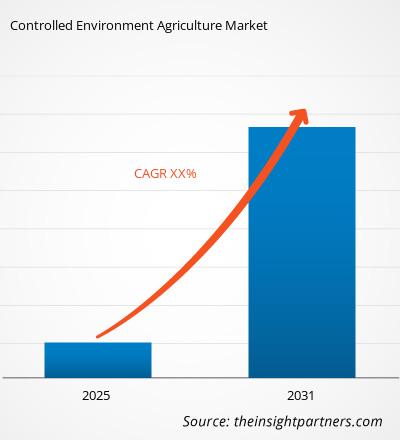
The Controlled Environment Agriculture market was valued at US$ 34.37 billion in 2025 and is expected to reach US$ 65.42 billion by 2034; it is estimated to record a CAGR of 7.41% during 2026-2034.
Controlled Environment Agriculture Market Assessment and Insights
- North America held 32–36% share in 2025 and is growing at a CAGR of 7.6–8.4% during 2026–2034, led by greenhouse scale, vertical farm specialization, and retailer-led local sourcing.
- US represented 78–82% of North American revenue in 2025 and is growing at a CAGR of 7.8–8.6% during 2026–2034, supported by premium greens, microgreens, and institutional buyers.
- Europe accounted for 24–28% share in 2025 and is growing at a CAGR of 7.0–7.8% during 2026–2034, with the Netherlands, Germany, France, Spain, and the UK leading adoption.
- Asia Pacific held 27–31% share in 2025 and is growing at a CAGR of 9.0–9.8% during 2026–2034, led by China, Japan, South Korea, India, and Australia.
- Largest Segment Hydroponic held 52–56% market share in 2025 and is growing at a CAGR of 8.0–8.8% during 2026–2034 due to commercial maturity.
- High Growth Segment Aeroponics represented 16–20% market share in 2025 and is growing at a CAGR of 10.2–11.0% during 2026–2034, supported by water efficiency and root-zone oxygenation.
- Key companies analyzed in detail: New AeroFarms, Inc.; American Hydroponics; EVERLIGHT ELECTRONICS CO., LTD.; Freight Farms, Inc.; Green Sense Farms Holdings, Inc.; Grow Pod Solutions, LLC; Illumitex Inc.; Innovation Agri-Tech Group; Nelson and Pade, Inc.; Pentair Aquatic Eco-Systems, Inc.
Source: The Insight Partners' analysis based on proprietary research, government publications, company annual reports, investor presentations, industry databases, and expert interviews.
From the experimental indoor agriculture plots into the engineered food platforms incorporating agronomy, automation, lighting and resource management; the focus of controlled agriculture has come a long way. From yield only objectives towards reliable product quality, labor productivity and low water use; the market has been moving towards a combination of enhanced climate control from greenhouse operations and high value crops with high turns from vertical farms.
The future growth is bound to be dictated by food security for cities, resilient food supply chains, and supportive agricultural policies in water-scarce regions. Investors are becoming increasingly more discerning, favoring operations that have their economics sorted out, secured offtake deals and proven models. New regions will adopt modular solutions when land shortages, import dependence and food safety concerns drive up capital costs.
Controlled Environment Agriculture Market Report Scope
| Report Attribute | Details |
|---|---|
| Market size in 2025 | US$ 34.37 Billion |
| Market Size by 2034 | US$ 65.42 Billion |
| Global CAGR (2026 - 2034) | 7.41% |
| Historical Data | 2021-2024 |
| Forecast period | 2026-2034 |
Controlled Environment Agriculture Market Analysis
Market drivers include the need for low-pesticide produce, supply reliability, and effective water usage. The value chain participants are LED makers, nutrient manufacturers, growing medium suppliers, sensors, control technology companies, farm design consultants, seed experts, farm operators, distributors, and retailers. The market is in greater demand when leafy greens, herbs, seedlings, and special crops require year-round production close to consumers.
Supply chain is influenced by electricity price, workforce availability, seed genetics, nutrient cost, and equipment performance. Governments will continue to focus on energy efficiency in buildings and industry, and lighting and climate control will remain critical factors in farm economics. Farm operators evaluate grams per kilowatt-hour, crop cycle duration, pack-out percentage, and distribution distance while choosing production technologies.
The Controlled Environment Agriculture market analysis shows a highly competitive market environment among farm players, equipment experts, and system integrators. New AeroFarms, Inc. is specialized in aeroponic microgreens, Freight Farms, Inc. specializes in container farming, and American Hydroponics helps develop the infrastructure for hydroponics. EVERLIGHT ELECTRONICS CO., LTD. and Illumitex Inc. are involved in lighting needs and Pentair Aquatic Eco-Systems, Inc. is a player in aquaponics and water systems.
Current investment trends point toward a farm that is more focused on crops, more disciplined about automation, and driven by retail demand rather than crop diversification. Examples of specialist players in the market include Green Sense Farms Holdings, Inc., Grow Pod Solutions, LLC, Innovation Agri-Tech Group, and Nelson and Pade, Inc.
● REPORT CUSTOMIZATION
Tailor This Report To Align With Your Specific Business Requirements
This report can be customized to align precisely with your business objectives, scope, and target markets. Customization options include tailored segmentation, geography, competitive analysis, and strategic insights to support informed decision-making.
Customize This Report →WHAT YOU CAN ADJUST
- ● Segmentations
- ● Geography
- ● Competitive Analysis
- ● Language Preferences
Controlled Environment Agriculture Market: Strategic Insights
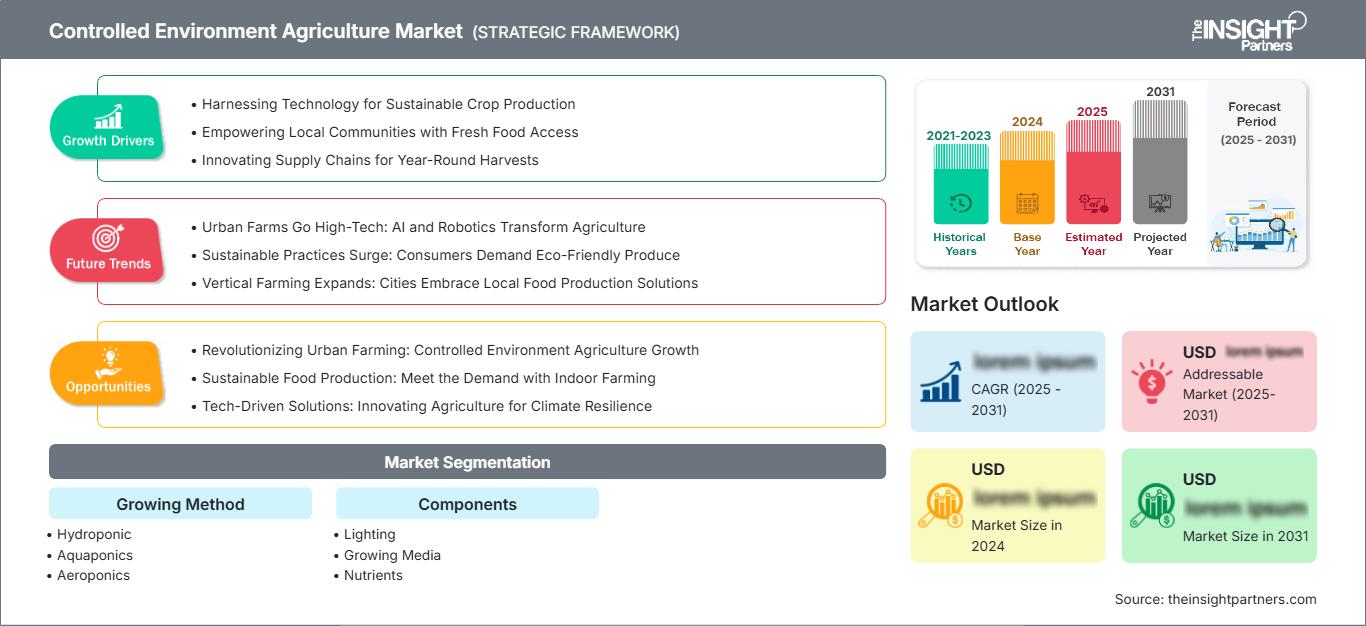
Regional Insights
North America Controlled Environment Agriculture Market
North America accounted for 32–36% of Controlled Environment Agriculture Market share in 2025 and is projected to grow at a CAGR of 7.6–8.4% during 2026–2034. Demand is supported by high-value produce, greenhouse automation, local sourcing programs, and water-efficient systems serving retailers, restaurants, institutional foodservice, and specialty distributors.
The region also benefits from university extension networks, investor experience, and established cold-chain infrastructure. Operators are concentrating on crops that match premium pricing and rapid turnover, including leafy greens, herbs, and microgreens. Market adoption remains disciplined as energy cost, financing terms, and labor productivity determine commercial viability.
U.S. Controlled Environment Agriculture Market Market
The United States constituted 78% to 82% of North America’s revenue share in 2025, and growth is projected to be at a CAGR of 7.8% to 8.6% between 2026 and 2034. The application areas in demand are microgreens, lettuce, herbs, seedlings, and specialty crops, where shelf life, locality, food safety, and delivery are critical.
Some of the leading players in the market, such as new AeroFarms, Inc., Freight Farms, Inc., American Hydroponics, and Grow Pod Solutions, LLC, remain active in farm management and equipment supply. There have been trends in retail packaged greens, food service institutions, nursery production, and distribution farms.
Europe Controlled Environment Agriculture Market Market
Market share in Europe is forecast to be 24–28%, with a growth rate of 7.0–7.8% during 2026-2034. Leading European countries are the Netherlands with greenhouse clusters, automation skills, and export-driven horticulture; Germany, which creates additional demand through its retail quality standards and energy-efficient greenhouse modernization; and the UK with urban farming near consumption points.
Further development in France, Italy, and Spain is driven by protected horticulture, water stress issues, and availability of fresh produce supply solutions. Heat recovery, energy-efficient LED light sources, nutrient recovery, and traceability are key concerns for European producers due to high energy prices and sustainability performance reporting.
APAC Controlled Environment Agriculture Market Market
Asia Pacific accounted for 27–31% share in 2025 and is projected to grow at a CAGR of 9.0–9.8% during 2026–2034. China leads through urban food demand, greenhouse expansion, and equipment manufacturing scale.
Japan and South Korea support plant factories and automation, while India and Australia add growth through water constraints, food safety, and high-value horticulture. Policy emphasis on efficient agriculture, domestic food supply, and technology-led farming supports adoption, although power cost and skilled operations remain gating factors.
Middle East & Africa Controlled Environment Agriculture Market Market
The Middle East & Africa market is projected to grow at a CAGR of 8.4–9.2% during 2026–2034. Saudi Arabia leads as food security strategies, greenhouse projects, and import substitution encourage protected cultivation under arid conditions.
The UAE supports premium controlled farms through logistics, retail, and hospitality demand, while South Africa and Rest of MEA rely on greenhouse upgrades and water-efficient production. Energy availability, cooling load, desalination links, and infrastructure financing shape deployment economics across the region.
Segmentation Analysis
Growing Method
Growing Method is projected to grow at a CAGR of 8.4–9.2% during 2026–2034. The Controlled Environment Agriculture Market scope includes hydroponic, aquaponics, and aeroponics systems selected according to crop type, water strategy, nutrient control, capital cost, and operator skill. Commercial growers favor methods that improve yield consistency, shorten cycles, and match available technical support.
- Hydroponic systems lead adoption because nutrient delivery is proven, scalable, and suitable for lettuce, herbs, tomatoes, and seedlings across greenhouses and indoor farms.
- Aquaponics combines fish and plant production, attracting education, community farms, and specialty producers seeking nutrient recycling, but operational balance requires stronger biological management.
- Aeroponics supports high oxygen availability and efficient water use, making it strategically relevant for microgreens, leafy greens, propagation, and research-intensive production environments.
Components
Components is forecast to grow at a CAGR of 8.1–8.9% during 2026–2034. Lighting, growing media, and nutrients determine farm productivity because they directly influence photosynthesis, root health, and crop quality. Buyers compare energy efficiency, crop recipes, material consistency, and supplier reliability when designing controlled production systems.
- Lighting represents a critical cost and yield lever, with LED spectra, dimming, photoperiod control, and heat management influencing crop quality and electricity intensity.
- Growing Media supports root anchorage, water retention, and aeration, making consistency important for germination, transplant success, disease control, and repeatable crop performance.
- Nutrients are strategically important because formulations affect growth speed, flavor, plant health, and runoff management across hydroponic, aquaponics, and aeroponics operations.
Opportunity Snapshot
| Growing Method | Revenue Contribution | Trend Tag | Adoption Stage |
| Hydroponic | High | Leafy Greens | Mature |
| Aquaponics | Medium | Nutrient Loop | Emerging |
| Aeroponics | Medium | Root Oxygen | Scaling |
Controlled Environment Agriculture Market Growth Drivers and Impact Analysis
Water scarcity strengthens controlled cultivation economics
Water stress is pushing growers, retailers, and governments toward production systems that recycle nutrient solution and reduce field exposure. Hydroponic and aeroponic facilities can use substantially less water than open-field production when designed with closed-loop irrigation, leak monitoring, and optimized crop recipes. The market impact is strongest in arid regions, urban zones, and countries dependent on fresh produce imports. Buyers are willing to evaluate higher capital costs when systems improve supply reliability, limit weather losses, and support measurable sustainability targets.
Retailers demand predictable local supply
Supermarkets and foodservice buyers increasingly seek fresh greens with consistent quality, shorter lead times, and reduced spoilage. Controlled farms address this requirement by locating production closer to demand centers and scheduling crop cycles around contracted volumes. The impact is a shift from speculative output toward planned supply programs that improve shelf availability and reduce logistics risk. Operators that demonstrate food safety, traceability, and stable pack-out rates can secure repeat orders, while underperforming farms face pressure from energy costs and retail price discipline.
LED efficiency improves production feasibility
Lighting remains one of the largest operating costs in indoor cultivation, so improvements in LED efficacy, spectrum tuning, and control software directly affect farm economics. Better lighting allows operators to raise yield density, optimize crop morphology, and reduce waste heat management challenges. This driver supports adoption of multilayer farms and hybrid greenhouses where supplemental light extends production windows. Suppliers that combine fixtures, crop recipes, and analytics can create stronger customer retention because lighting decisions influence both capital expenditure and recurring electricity cost.
Controlled Environment Agriculture Market Future Trends
Crop-specific automation becomes the operating standard
Controlled Environment Agriculture Market trends point toward automation designed around specific crops rather than generic farm layouts. Future systems will integrate seeding, transplanting, imaging, nutrient dosing, harvesting, and packing around known crop cycles and labor bottlenecks. This will help operators improve yield predictability, reduce manual handling, and collect data for continuous recipe improvement. The trend favors suppliers that understand agronomy and machinery together, because farm profitability increasingly depends on matching equipment design with realistic throughput, crop value, and operator skill.
Hybrid greenhouses gain investment preference
Investors are likely to favor hybrid greenhouse models that combine sunlight, supplemental LEDs, automation, and climate control instead of fully enclosed farms for every crop. These facilities can reduce energy intensity while maintaining stronger control than open-field agriculture. The approach is especially relevant for tomatoes, cucumbers, leafy greens, and propagation where scale and margin discipline matter. Over the forecast period, project financing will increasingly reward designs that prove energy resilience, offtake certainty, and clear crop-level profitability before expansion capital is released.
Controlled Environment Agriculture Market Opportunities
Modular farms for institutions and remote communities
Controlled Environment Agriculture Market Forecasts support investment in modular farms serving schools, universities, hospitals, defense sites, islands, mining camps, and remote communities. These customers value predictable local produce where transport costs, weather risk, or food access constraints are material. Vendors can bundle containers, training, crop plans, maintenance, and data support into service-led contracts. The opportunity depends on simplifying operations for non-specialist users while proving crop consistency, energy needs, and total cost per serving against imported produce.
Specialty crop production for premium channels
Specialty crops create attractive opportunities because they can justify controlled production through freshness, flavor, nutrition, and differentiated branding. Microgreens, herbs, edible flowers, seedlings, and premium leafy greens fit shorter cycles and higher price points than commodity vegetables. Operators can target chefs, retailers, meal-kit companies, and health-focused consumers with consistent quality and traceability. Successful projects will require disciplined crop selection, packaging strategy, channel partnerships, and operational data that confirms repeatable margins before capacity is expanded.
Recent Developments
- June 2026: WUR launches international network for controlled environment agriculture. Wageningen University & Research (WUR) is launching HortINspire: a new international network for protected cultivation. The network brings together growers, companies, knowledge institutions and other parties around the world to share knowledge and practical experience more quickly and make it easier to apply. HortINspire will be presented on 10 June during GreenTech in Amsterdam.
- April 2026: Premier Tech announced the launch of its Business Group Premier Tech Controlled Culture, bringing together the full scope of the company’s technology portfolio and expertise to help redefine the controlled environment agriculture (CEA) industry. The entry into this new industry is supported by two asset-based acquisitions: Inno-3B, a Canada-based manufacturer of automated, modular vertical farming systems, and Artechno, from the Netherlands, also a supplier of vertical farming solutions, water filtration and disinfection systems as well as irrigation systems. Together, these acquisitions position Premier Tech to deliver integrated, end-to-end automated solutions for growers and producers looking to deploy vertical farming solutions. They also enable Premier Tech Controlled Culture to support projects around the world with a product portfolio meeting both North American as well as European standards.
- July 2025: Jiffy Group announced the launch of Jiffy Gel, a new revolutionary gel-based substrate designed to deliver superior performance, minimize pathogen risk, improve sustainability, and offering on-site production. Made from bio-based materials and essential plant macro- and micronutrients, Jiffy Gel is an innovation that transforms the meaning of plant production.
Frequently Asked Questions

- Comprehensive Market Sizing and Forecast Analysis
- Detailed Segmentation Analysis
- In-Depth Market Dynamics Assessment
- Regional and Country-Level Insights
- Competitive Landscape and Company Benchmarking
- Strategic Business Intelligence
Recent Reports
Testimonials

The Insight Partners' SCADA System Market report is comprehensive, with valuable insights on current trends and future forecasts. The team was highly professional, responsive, and supportive throughout. We are very satisfied and highly recommend their services.
RAN KEDEM Partner, Reali Technologies LTDs
I requested a report on a very specific software market and the team produced the report in a few days. The information was very relevant and well presented. I then requested some changes and additions to the report. The team was again very responsive and I got the final report in less than a week.
JEAN-HERVE JENN Chairman, Future Analytica
We worked with The Insight Partners for an important market study and forecast. They gave us clear insights into opportunities and risks, which helped shape our plans. Their research was easy to use and based on solid data. It helped us make smart, confident decisions. We highly recommend them.
PIYUSH NAGPAL Sr. Vice President, High Beam Global
The Insight Partners delivered insightful, well-structured market research with strong domain expertise. Their team was professional and responsive throughout. The user-friendly website made accessing industry reports seamless. We highly recommend them for reliable, high-quality research services
YUKIHIKO ADACHI CEO, Deep Blue, LLC.
This is the first time I have purchased a market report from The Insight Partners.While I was unsure at first, I visited their web site and felt more comfortable to take the risk and purchase a market report.I am completely satisfied with the quality of the report and customer service. I had several questions and comments with the initial report, but after a couple of dialogs over email with their analyst I believe I have a report that I can use as input to our strategic planning process.Thank you so much for taking the extra time and making this a positive experience.I will definitely recommend your service to others and you will be my first call when we need further market data.
JOHN SUZUKI President and Chief Executive Officer, Board Director, BK Technologies
I wish to appreciate your support and the professionalism you displayed in the course of attending to my request for information regarding to infectious disease IVD market in Nigeria. I appreciate your patience, your guidance, and the fact that you were willing to offer a discount, which eventually made it possible for us to close a deal. I look forward to engaging The Insight Partners in the future, all thanks to the impression you have created in me as a result of this first encounter.
DR CHIJIOKE ONYIA MANAGING DIRECTOR, PineCrest Healthcare Ltd.Reason to Buy
- Informed Decision-Making
- Understanding Market Dynamics
- Competitive Analysis
- Identifying Emerging Markets
- Customer Insights
- Market Forecasts
- Risk Mitigation
- Boosting Operational Efficiency
- Strategic Planning
- Investment Justification
- Tracking Industry Innovations
- Aligning with Regulatory Trends





 Get Free Sample for