
Crop Monitoring Market Trends, Share & Demand by 2034
Coverage: by Offering (Hardware, Software, Services); Technology (Sensing and Imagery, Variable Rate Technology, Automation and Robotics); Farm Type (Small, Medium, Large); Application (Field Mapping, Crop Scouting and Monitoring, Soil Monitoring, Yield Mapping and Monitoring, Variable Rate Application, Weather Tracking and Forecasting, Others), and Geography (North America, Europe, Asia Pacific, and South and Central America)
- Status : Data Released
- Report Code : TIPRE00013575
- Category : Electronics and Semiconductor
- No. of Pages : 150
- Available Report Formats :


- Last update date : August 06, 2026


2025 Market Size
US$ 4.31 Bn
Base year value
2034 Forecast
US$ 13.31 Bn
Projected by 2034
CAGR 2026-2034
13.36 %
Growth rate
Addressable Market
US$ 76.48 Bn
(2026-2034)
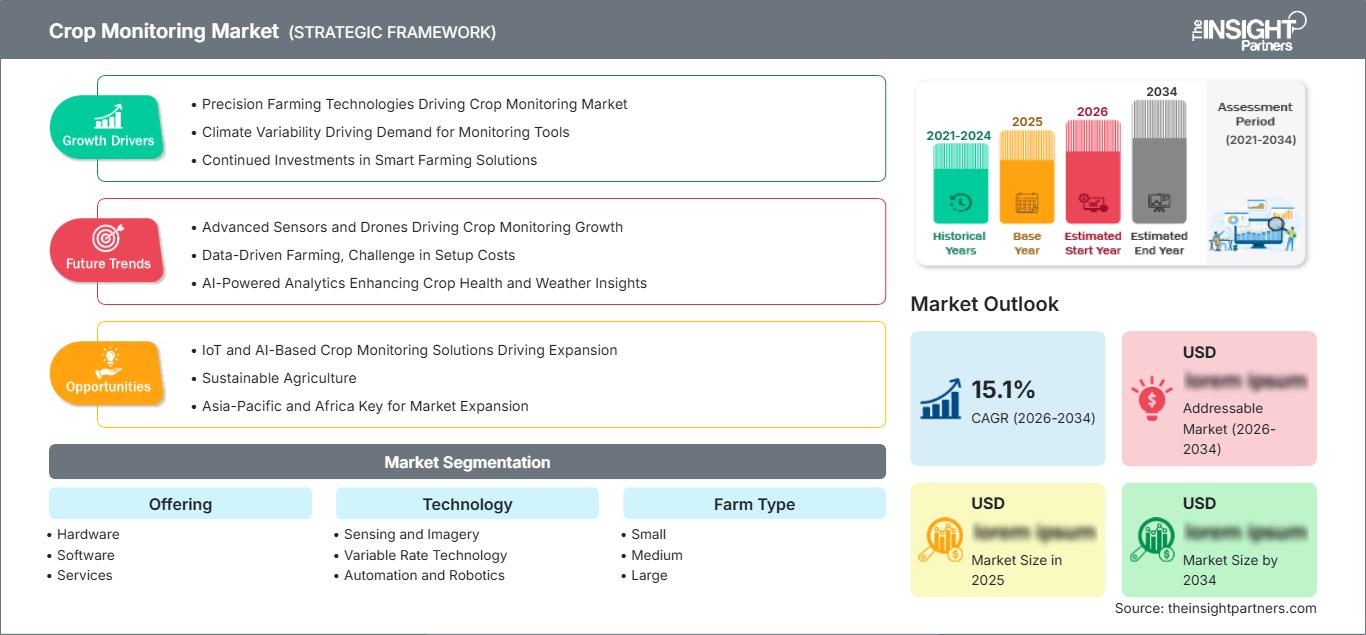
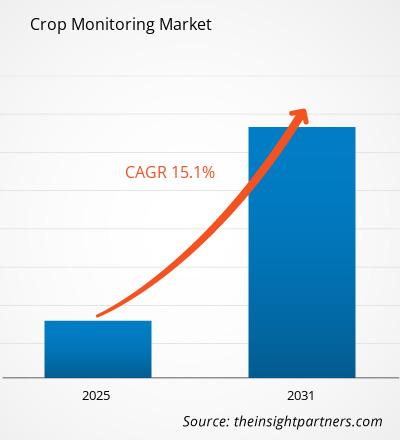
The Crop Monitoring Market size stood at US$ 4.31 Billion in 2025 and will reach US$ 13.31 Billion by 2034 with a CAGR of 13.36% over the period 2026-2034. It comprises hardware, software, and services that facilitate observation of the state of crops, soil, variability in the field, exposure to climate, and yield performance through sensors, imaging, automation, analytics, and farm connectedness.
In North America, the market is progressing from yield monitoring to decision-making systems that link agronomy, equipment management, and input sourcing. Growth of the Crop Monitoring Market in the region is estimated at a CAGR of 12.8-14.2% during the forecast period 2026-2034 on account of large-scale farms, retail-driven precision services, USDA incentives, and water, fertilizer, and pesticides efficiencies.
Crop Monitoring Market Assessment and Insights
- North America: The region holds 29–33% share in 2025 and grows at a CAGR range of 12.8–14.2% during 2026–2034, led by connected equipment, retailer analytics, and input optimization.
- US: The country represents 78–82% of North America in 2025 and grows at a CAGR range of 12.9–14.3% during 2026–2034, supported by large row-crop acreage.
- Europe: The region accounts for 22–26% share in 2025 and grows at a CAGR range of 11.7–13.1% during 2026–2034, with Germany, France, the UK, Italy, and Spain leading adoption.
- Asia Pacific: The region holds 27–31% share in 2025 and grows at a CAGR range of 14.6–16.4% during 2026–2034, led by China, India, Japan, Australia, and South Korea.
- Largest Segment: Software holds 41–45% market share in 2025 and grows at a CAGR range of 13.8–15.2% during 2026–2034 due to analytics-led farm decisions.
- High Growth Segment: Automation and Robotics holds 14–18% market share in 2025 and grows at a CAGR range of 16.1–18.0% during 2026–2034 as autonomous scouting expands.
- Key companies analyzed in detail: Ag Leader Technology, Inc.; Agroop, Lda.; Cropio Group; Earth Observing System Data Analytics, Inc.; PrecisionHawk, Inc.; Taranis Visual Ltd.; The Climate Corporation; Topcon Corporation; Trimble Inc.; Yara International ASA.
Source: The Insight Partners' analysis based on proprietary research, government publications, company annual reports, investor presentations, industry databases, and expert interviews.
The development of crop monitoring has changed from field walk-throughs and seasonally created yield maps to constant multi-source intelligence based on satellite imagery, drone data, sensor technology, weather data, and equipment data. Production processes are now highly dependent on interoperable hardware, agronomy software, cloud analytics, and application machinery. The market for Crop Monitoring is affected by farm labor shortage, climatic diversity, and the requirement for input efficiency tracking for food processors, banks, insurance companies, and sustainability projects.
The future demand for Crop Monitoring solutions will become more extensive due to the adoption of inexpensive imagery, mobile advisory services, and pay-per-acre model instead of capital-intensive technologies. The investments are directed at AI agronomy, robotics, and local advisory services for small- and medium-scale farmers. Moreover, regulatory trends are also important as they motivate water conservation, fertilizer stewardship, traceability, and climate-smart agriculture.
Crop Monitoring Market Report Scope
| Report Attribute | Details |
|---|---|
| Market size in 2025 | US$ 4.31 Billion |
| Market Size by 2034 | US$ 13.31 Billion |
| Global CAGR (2026 - 2034) | 13.36% |
| Historical Data | 2021-2024 |
| Forecast period | 2026-2034 |
Crop Monitoring Market Analysis
Growth in the Demand is fueled by the need to detect stresses earlier, time irrigation better, manage inputs more effectively, and get better yield forecasts. The Crop Monitoring Market’s growth is powered by multispectral imaging, soil moisture sensors, machine vision, and cloud-based dashboards that translate field variability into actionable recommendations for scouting, spraying, fertilization, and harvesting.
The ecosystem comprises makers of sensors, drone operators, providers of satellite data, agronomists, OEMs of equipment, connectivity companies, software developers, and farm retailers. Supply depends on the performance of the GNSS system, quality of sensor calibration, availability of rural broadband, the cost of cloud processing, and clear ownership of the data.
The Crop Monitoring Market competive analysis reveals rivalry amongst machinery connected solutions, satellite analytics firms, agronomy software solutions and nutrition management firms. Competition from Ag Leader Technology, Inc., Trimble Inc., Topcon Corporation, The Climate Corporation and Yara International ASA is based on machinery connections and agronomy processes, whereas Agroop, Lda., Cropio Group, Earth Observing System Data Analytics, Inc., PrecisionHawk, Inc. and Taranis Visual Ltd. offer enhanced imagery, scouting via AI and remote analytics.
Funding considerations revolve around AI-based disease detection, satellite tasking, autonomous field robots, cloud-based sensor security, variable rate prescription engine and advisory services specific to regional crops. Positioning strategy varies depending on customer size, where large farms require integration with fleets and company databases, whereas small farms require subscription-based model and services-oriented monitoring with minimal capital required upfront.
● REPORT CUSTOMIZATION
Tailor This Report To Align With Your Specific Business Requirements
This report can be customized to align precisely with your business objectives, scope, and target markets. Customization options include tailored segmentation, geography, competitive analysis, and strategic insights to support informed decision-making.
Customize This Report →WHAT YOU CAN ADJUST
- ● Segmentations
- ● Geography
- ● Competitive Analysis
- ● Language Preferences
Crop Monitoring Market: Strategic Insights
Regional Insights
North America Crop Monitoring Market
North America holds 29–33% share in 2025 and is projected to grow at a CAGR range of 12.8–14.2% during 2026–2034. Crop Monitoring Market share is supported by large field operations, precision agriculture retailers, crop insurance linkages, irrigation districts, and higher adoption of yield monitors, soil mapping, and remote sensing.
Regional demand benefits from USDA-backed conservation practices, farm consolidation, and retailer service models that translate imagery into prescriptions. The U.S. and Canada also have strong machinery ecosystems, enabling Crop Monitoring Market vendors to connect scouting data with planters, sprayers, combines, and nutrient management platforms across corn, soybean, wheat, cotton, and specialty crop operations.
U.S. Crop Monitoring Market Market
North America comprises about 78–82% of the U.S. and will experience growth at a rate of 12.9–14.3% through the period of 2026 to 2034 at a compound annual growth rate (CAGR). Adoption levels are highest in row crops and irrigation, where variable-rate application, soil testing, and yield mapping affect input costs and margins.
Some of the companies operating in the market include Ag Leader Technology, Inc., Trimble Inc., The Climate Corporation, PrecisionHawk, Inc., and Earth Observing System Data Analytics, Inc. Applications include crop scouting and monitoring, weather, variable rates, and yield analysis. Retail agronomists play a significant role because farmers like applications that are customized to their local area.
Europe Crop Monitoring Market Market
Share of Europe is estimated to be 22-26% in 2025 and will record CAGR of 11.7-13.1% in 2026-2034. Germany stands out as the dominant player since machinery accuracy, collaboration in agronomy, and nutrient management systems ensure verifiable field data. France contributes towards wide scale arable land monitoring while the UK focuses on productivity and compliance.
Horticulture, vineyards, orchards and water intensive agriculture with crop scouting and soil monitoring help in Italy and Spain in increasing the demand for such platforms. The EU laws on sustainability, farming data programs and reduction of pesticides help in market adoption although fragmentation in farms and reluctance in sharing data may hamper platform aggregation.
APAC Crop Monitoring Market Market
The Asia Pacific region enjoys a market share of 27-31% in 2025 and experiences a CAGR of 14.6-16.4% from 2026 to 2034. China is the leader in terms of adoption due to digital agriculture pilot projects, drones, satellite imagery, and the government's interest in food security. Japan and South Korea utilize crop monitoring to protect valuable crops and save on labor.
India and Australia provide unique opportunities in their own ways: India prefers mobile advisory, weather forecasting, and smallholder services, whereas Australia prefers broadacre analytics and remote monitoring. Support from governments and agritech companies for digital agriculture, climate resiliency, and rural connectivity drives the Crop Monitoring Market.
Middle East & Africa Crop Monitoring Market Market
The forecast for the Middle East & Africa is pegged at a CAGR of 10.9-12.5%. The leaders in selective adoption are Saudi Arabia and the UAE based on the basis of controlled agriculture, water efficiency initiatives, and food security investments, while South Africa facilitates more commercial farm uses.
Rest of MEA demand will be dependent on irrigation modernization, resilience initiatives by donors, and reduction in crop loss. Energy availability and infrastructure influence the application due to the need for sensors, connectivity, and maintenance service coverage. Adoption becomes easier when monitoring becomes part of agronomy and finance initiatives.
Segmentation Analysis
Offering
Offering is projected to grow at a CAGR range of 13.5–15.0% during 2026–2034. The Crop Monitoring Market scope by offering is shaped by the balance between capital equipment and recurring analytics. Software leads value creation because it converts sensor, imagery, and machinery data into decisions, while services help farms interpret alerts, calibrate systems, and integrate monitoring into seasonal agronomy.
- Hardware: Hardware demand includes sensors, drones, weather stations, GNSS receivers, cameras, and controllers that capture field-level information and support equipment-linked decisions across crop stages.
- Software: Software holds the strongest position because analytics platforms, dashboards, prescription maps, and mobile alerts translate raw observations into practical agronomic actions for growers.
- Services: Services are strategically important for farms lacking in-house data expertise, covering imagery interpretation, scouting support, calibration, training, and advisory recommendations.
Technology
Technology is expected to grow at a CAGR range of 13.7–15.5% during 2026–2034. Technology adoption is shifting from observation toward execution. Sensing and imagery remain foundational for crop condition awareness, variable rate technology converts insights into input efficiency, and automation and robotics create faster, repeatable scouting and application workflows in labor-constrained farming systems.
- Sensing and Imagery: This technology anchors monitoring by combining satellite, drone, camera, soil, and weather data to identify crop stress, field variability, and intervention priorities.
- Variable Rate Technology: Variable rate systems are strategically important because they convert monitoring outputs into seed, fertilizer, irrigation, and chemical prescriptions that reduce waste.
- Automation and Robotics: Automation and robotics are gaining momentum as autonomous scouting, machine vision, and robotic weeding improve labor efficiency and response speed.
Farm Type
Farm Type is forecast to grow at a CAGR range of 12.9–14.4% during 2026–2034. Farm size affects adoption model more than technology need. Large farms deploy integrated systems across fleets and acreage, medium farms adopt service-supported analytics, and small farms favor mobile-first, low-cost monitoring that provides timely alerts without complex implementation.
- Small: Small farms prefer affordable mobile tools, shared drone services, and advisory subscriptions that reduce crop loss without requiring advanced equipment ownership.
- Medium: Medium farms adopt monitoring when software, equipment compatibility, and local agronomy services prove savings in fertilizer, irrigation, and crop protection.
- Large: Large farms drive enterprise deployments because high acreage magnifies the value of automation, variable-rate decisions, yield mapping, and centralized data management.
Application
Application is projected to grow at a CAGR range of 13.6–15.4% during 2026–2034. Application demand is strongest where monitoring improves intervention timing and revenue protection. Field mapping establishes baseline variability, crop scouting supports pest and disease response, soil monitoring guides water and nutrient plans, and yield mapping closes the loop for future prescriptions.
- Field Mapping: Field mapping creates spatial baselines for soil zones, elevation, drainage, boundaries, and variability that guide future monitoring and variable-rate planning.
- Crop Scouting and Monitoring: Crop scouting and monitoring represent a core use case because early detection of stress, pests, weeds, and disease protects yield potential.
- Soil Monitoring: Soil monitoring supports moisture, temperature, nutrient, and salinity decisions, helping growers align irrigation and fertilizer timing with crop needs.
- Yield Mapping and Monitoring: Yield mapping links harvest performance to field variability, enabling better hybrid selection, input planning, and profitability analysis for the next season.
- Variable Rate Application: Variable rate application is important because it turns monitoring intelligence into targeted seeding, fertilizer, irrigation, and crop protection actions.
- Weather Tracking and Forecasting: Weather tracking and forecasting help growers anticipate frost, heat, rainfall, disease pressure, and spray windows that influence operational timing.
Opportunity Snapshot
| Application | Revenue Contribution | Trend Tag | Adoption Stage |
| Field Mapping | Medium | Zone Design | Mature |
| Crop Scouting and Monitoring | High | AI Scouting | Scaling |
| Soil Monitoring | High | Water Insight | Scaling |
| Yield Mapping and Monitoring | Medium | Harvest Data | Mature |
| Variable Rate Application | High | Input Precision | Scaling |
| Weather Tracking and Forecasting | Medium | Risk Alerts | Scaling |
| Others | Low | Custom Tools | Emerging |
Crop Monitoring Market Growth Drivers and Impact Analysis
Input Efficiency Becomes a Margin Priority
The expenses associated with fertilizers, pest control, fuels, and irrigation have resulted in the need for precision at the field level to become financially prudent for farmers. Field management tools will allow farmers to determine what inputs are needed and where they are not, thus improving gross margin discipline and meeting the sustainability requirements of processors and the government. The effect is best felt where satellite images, soil information, and yield maps are linked to variable rate equipment, since the suggestions made will be turned into action.
Climate Variability Raises the Value of Early Warning
Higher frequency of heat, drought, rainfall variability, and pests is elevating the importance of crop intelligence in real-time. With monitoring systems, farmers can spot signs of moisture stress, disease, nutritional deficiency, and weather threats before they cause any damage. The result is tangible application in areas such as irrigation management, fungicide application, replanting and harvesting. There is also increased visibility for food businesses and insurers in terms of risk associated with production. In light of growing climatic uncertainty, the Crop Monitoring Market is less of a luxury than ever before.
Connected Machinery Enables Closed-Loop Agronomy
The farm equipment is evolving into an information collection and execution system rather than just being a piece of operational equipment. Today’s planters, sprayers, spreaders, and combines record location-based information which can then be compared against imagery, soil sampling, weather, and resulting yields. Closed-loop system will enhance the quality of decision making since the farmers will be able to verify that their prescriptions have led to some outcomes. It will be even more beneficial to large and medium-sized farms which already utilize guidance, section control, and telematics.
Crop Monitoring Market Future Trends
AI Agronomy Moves from Alerts to Recommendations
Crop Monitoring Market trends will increasingly favor AI systems that move beyond flagging abnormal vegetation indices toward ranked recommendations. Future platforms will combine crop stage, hybrid, soil type, weather forecast, historical yield, and pest models to prioritize actions by economic impact. This shift will reduce alert fatigue and make monitoring more useful for farmers with limited time. Vendors will differentiate through transparent models, local agronomic validation, and explainable recommendations that advisors can trust when advising input timing, irrigation changes, and scouting routes.
Robotic Scouting Expands Across Specialty Crops
Robotic scouting will gain momentum in orchards, vineyards, vegetables, and controlled agriculture where labor availability and crop value justify frequent observation. Ground robots and autonomous platforms can capture close-range images, disease symptoms, canopy conditions, and fruit development more consistently than occasional manual scouting. Future value will come from linking robotics with prescriptions, labor planning, and harvest forecasting. The trend will also push vendors to improve battery life, rugged navigation, edge processing, and crop-specific image libraries that reduce false positives.
Crop Monitoring Market Opportunities
Service-Led Models for Small and Medium Farms
Crop Monitoring Market Forecasts support investment in service-led models that bundle imagery, scouting, recommendations, and seasonal support for growers unwilling to buy complex systems. Providers can sell per-acre monitoring, crop-specific alerts, and advisory packages through cooperatives, input retailers, and rural finance channels. This approach lowers adoption barriers, improves trust, and makes digital agriculture relevant to farms without dedicated data teams. The strongest opportunities are in regions where small and medium farms face climate stress but still need localized advice, language support, and clear return-on-investment evidence.
Data Partnerships Across Food Value Chains
Food processors, retailers, insurers, lenders, and carbon programs increasingly need verified field data without overburdening farmers. Monitoring platforms can create value by translating agronomic observations into auditable records for input efficiency, water stewardship, crop risk, and sustainability claims. The opportunity lies in secure data-sharing frameworks that let growers control permissions while monetizing better documentation. Vendors that provide trusted analytics, privacy controls, and integration with farm management systems can become infrastructure partners rather than standalone software suppliers.
Recent Developments
- July 2026: The Federal Government of Nigeria launched a satellite-based AI crop monitoring system in partnership with Morocco to enhance agricultural intelligence and food security. The initiative uses satellite imagery, artificial intelligence, and remote sensing technologies to monitor crop conditions, assess agricultural productivity, support climate-resilient farming practices, and provide data-driven insights for farmers, policymakers, and agricultural stakeholders. The collaboration strengthens Nigeria–Morocco cooperation in agri-tech innovation and aims to improve crop forecasting, resource management, and sustainable agricultural development.
- March 2026: CropX Technologies launched CropX Vision, an AI-powered vineyard monitoring solution that measures vine water stress using a single canopy image captured through a smartphone. The technology uses advanced computer vision and agronomic modeling to provide plant-level water stress insights across entire vineyard blocks, helping growers make faster and more precise irrigation decisions. Building on field-tested canopy sensing technology from Tule Technologies, CropX Vision enables scalable vineyard management, improved water-use efficiency, and optimized crop quality without the need for traditional pressure chamber measurements.
- March 2025: Walmart partnered with Cropin, an AI-powered agriculture intelligence platform, to enhance produce supply chain visibility through advanced crop monitoring technologies. The collaboration uses artificial intelligence, data analytics, and remote sensing to improve yield forecasting, monitor crop health, predict seasonal transitions, and provide localized insights into agricultural conditions. The initiative aims to strengthen Walmart’s fresh produce sourcing, improve supply reliability, reduce food waste, and support more resilient and sustainable food supply chains.
Frequently Asked Questions

- Comprehensive Market Sizing and Forecast Analysis
- Detailed Segmentation Analysis
- In-Depth Market Dynamics Assessment
- Regional and Country-Level Insights
- Competitive Landscape and Company Benchmarking
- Strategic Business Intelligence
Recent Reports
Testimonials

The Insight Partners' SCADA System Market report is comprehensive, with valuable insights on current trends and future forecasts. The team was highly professional, responsive, and supportive throughout. We are very satisfied and highly recommend their services.
RAN KEDEM Partner, Reali Technologies LTDs
I requested a report on a very specific software market and the team produced the report in a few days. The information was very relevant and well presented. I then requested some changes and additions to the report. The team was again very responsive and I got the final report in less than a week.
JEAN-HERVE JENN Chairman, Future Analytica
We worked with The Insight Partners for an important market study and forecast. They gave us clear insights into opportunities and risks, which helped shape our plans. Their research was easy to use and based on solid data. It helped us make smart, confident decisions. We highly recommend them.
PIYUSH NAGPAL Sr. Vice President, High Beam Global
The Insight Partners delivered insightful, well-structured market research with strong domain expertise. Their team was professional and responsive throughout. The user-friendly website made accessing industry reports seamless. We highly recommend them for reliable, high-quality research services
YUKIHIKO ADACHI CEO, Deep Blue, LLC.
This is the first time I have purchased a market report from The Insight Partners.While I was unsure at first, I visited their web site and felt more comfortable to take the risk and purchase a market report.I am completely satisfied with the quality of the report and customer service. I had several questions and comments with the initial report, but after a couple of dialogs over email with their analyst I believe I have a report that I can use as input to our strategic planning process.Thank you so much for taking the extra time and making this a positive experience.I will definitely recommend your service to others and you will be my first call when we need further market data.
JOHN SUZUKI President and Chief Executive Officer, Board Director, BK Technologies
I wish to appreciate your support and the professionalism you displayed in the course of attending to my request for information regarding to infectious disease IVD market in Nigeria. I appreciate your patience, your guidance, and the fact that you were willing to offer a discount, which eventually made it possible for us to close a deal. I look forward to engaging The Insight Partners in the future, all thanks to the impression you have created in me as a result of this first encounter.
DR CHIJIOKE ONYIA MANAGING DIRECTOR, PineCrest Healthcare Ltd.Reason to Buy
- Informed Decision-Making
- Understanding Market Dynamics
- Competitive Analysis
- Identifying Emerging Markets
- Customer Insights
- Market Forecasts
- Risk Mitigation
- Boosting Operational Efficiency
- Strategic Planning
- Investment Justification
- Tracking Industry Innovations
- Aligning with Regulatory Trends





 Get Free Sample for