
Customer Relationship Management Market Size, Growth & Demand by 2034
Coverage: By Applications (Marketing, Sales, Customer support and service, Others); Deployment Type (On Demand (SaaS and PaaS), On Premise, Hybrid); Solutions (Social Monitoring, Social Mapping, Social Middleware, Social Management, Social Measurement); Users (Small and Medium Businesses (SMB), Enterprises); Verticals (Academia and Government, Automotive, Transportation and Logistics, BFSI, Consumer Goods and Retail, Healthcare) , and Geography (North America, Europe, Asia Pacific, and South and Central America)
- Status : Data Released
- Report Code : TIPRE00021378
- Category : Technology, Media and Telecommunications
- No. of Pages : 150
- Available Report Formats :


- Last update date : July 30, 2026


2025 Market Size
US$ 86.22 Bn
Base year value
2034 Forecast
US$ 284.8 Bn
Projected by 2034
CAGR 2026-2034
14.20 %
Growth rate
Addressable Market
US$ 1,597.36 Bn
(2026-2034)
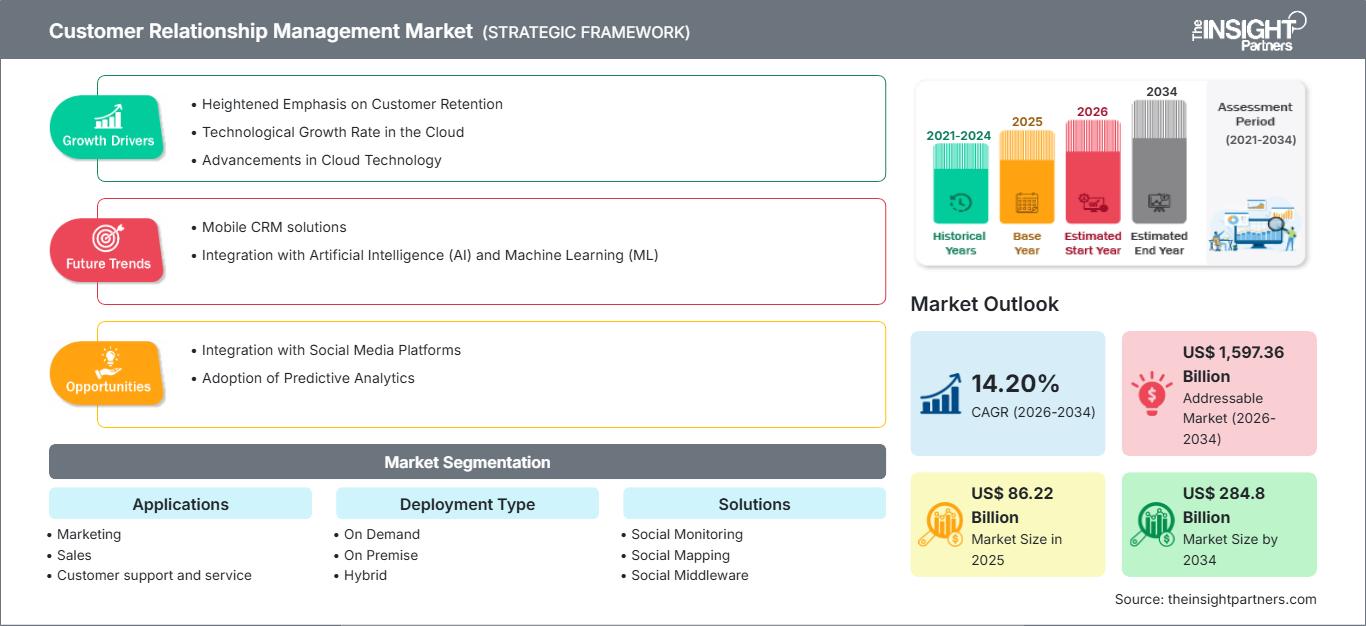
The customer relationship management market was valued at US$ 86.22 Billion in 2025 and is projected to reach US$ 284.8 Billion by 2034, expanding at a CAGR of 14.20% between 2026 and 2034. It is largely driven by organizations that consolidate disconnected point tools into unified, AI-enabled customer platforms.
North America is estimated to grow at a CAGR of 13–15% through 2034 in the customer relationship management market size, propelled by dense enterprise software spending and early adoption of AI-native sales and service automation. Large financial services, retail, and technology enterprises headquartered across the region continue to expand platform investment as customer engagement increasingly shifts toward agentic, always-on interaction management.
Customer Relationship Management Market Assessment and Insights
- North America: Captured an estimated 38-42% share of the market in 2025 and is projected to expand at a CAGR between 13-15% from 2026 to 2034, supported by dense enterprise software spending, deep systems-integrator presence, and early adoption of agentic AI across major sales and service organizations.
- US: Accounted for roughly 84-88% of the North America market in 2025 and is expected to grow at a CAGR between 13-15% through 2034, driven by concentrated technology, retail, and financial services demand.
- Europe: Held an estimated 24-28% share in 2025 and is projected to grow at a CAGR of 14-16% between 2026 and 2034, with the United Kingdom and Germany leading regional demand as enterprises modernize customer engagement under stricter data privacy frameworks.
- Asia Pacific: Captured an estimated 20-24% share in 2025 and is expected to expand at the fastest regional CAGR of 16-18% between 2026 and 2034, led by China and India as digital-first enterprises scale customer data platform investment.
- Largest Segment: On-Demand deployment held an estimated 68-72% share of the market in 2025 and is projected to grow at a CAGR of 15-17% through 2034, reflecting enterprise preference for elastic, subscription-based platforms.
- High Growth Segment: Small and Medium Businesses held an estimated 30-34% share in 2025 and are projected to expand at the fastest CAGR of 17-19% through 2034, as smaller organizations adopt affordable, AI-assisted customer engagement tools.
- Key companies analyzed in detail: SAP SE, Oracle Corporation, Salesforce, Inc., Amdocs Limited, IBM Corporation, Jive Software, Adobe Inc., Microsoft Corporation, Keap, and Infor Inc.
Source: The Insight Partners' analysis based on proprietary research, government publications, company annual reports, investor presentations, industry databases, and expert interviews.
The customer relationship management market has evolved from static contact databases and standalone sales tracking spreadsheets into comprehensive platforms spanning marketing automation, sales pipeline management, and service case resolution. Early adoption concentrated among large enterprises seeking centralized customer records, before cloud delivery and API-driven integration extended adoption into mid-market and smaller organizations. Vendors progressively layered analytics, workflow automation, and generative AI onto core contact and opportunity management functionality, converting customer relationship management tools from reference systems into active, decision-driving platforms.
Looking ahead, customer relationship management market expansion will increasingly draw from emerging retail and financial hubs across Southeast Asia, Latin America, and the Gulf region, where digital-native enterprises are scaling customer bases without legacy infrastructure constraints. Regulatory tailwinds around data residency and consumer privacy protection are prompting vendors to expand regional hosting options, while continued investment activity consolidates adjacent point solutions into broader, AI-native customer platforms spanning the full engagement lifecycle.
Customer Relationship Management Market Report Scope
| Report Attribute | Details |
|---|---|
| Market size in 2025 | US$ 86.22 Billion |
| Market Size by 2034 | US$ 284.8 Billion |
| Global CAGR (2026 - 2034) | 14.20% |
| Historical Data | 2021-2024 |
| Forecast period | 2026-2034 |
Customer Relationship Management Market Analysis
Demand for customer relationship management market solutions is intensifying as enterprises treat unified customer visibility as a board-level priority rather than a departmental preference. Sales, marketing, and service organizations now find the need for centralized information on their customers' history, sentiments, and transactions more critical than ever, given that point solutions lack this ability. Higher expectations of personalized and real-time engagement from consumers further support the need for a centralized solution that enables orchestration of all interactions through each touchpoint.
In terms of the ecosystem, there are multiple players, including platform vendors, systems integrators, and new AI models that have become a part of lead scoring, case routing, and campaign personalization processes. Supply-side trends suggest that vendors should have an open integration framework because enterprises tend to build their toolchains by combining their core platforms with commerce, communication, and data platforms.
Competitive intensity in the customer relationship management market analysis reflects a bifurcated landscape between platform incumbents and specialized challengers. Salesforce, Inc. and Microsoft Corporation leverage their extensive enterprise reach through sales and services cloud integration, whereas SAP SE, Oracle Corporation, and IBM Corporation have positioned themselves around enterprise-grade governance and integration capabilities. Adobe Inc., Amdocs Limited, Jive Software, Keap, and Infor Inc. remain relevant due to their niche marketing, telecommunication, collaboration, and small business applications, respectively.
The investment trends within the competitive landscape have been driven towards AI which can function autonomously to answer customers' queries and facilitate the entire sales process. The strategic position of the vendors is more reliant on the scope of ecosystems, as vendors like Salesforce, Inc. and Microsoft Corporation are making acquisitions and partnerships in the realm of conversational AI and cross-platform data access capabilities.
● REPORT CUSTOMIZATION
Tailor This Report To Align With Your Specific Business Requirements
This report can be customized to align precisely with your business objectives, scope, and target markets. Customization options include tailored segmentation, geography, competitive analysis, and strategic insights to support informed decision-making.
Customize This Report →WHAT YOU CAN ADJUST
- ● Segmentations
- ● Geography
- ● Competitive Analysis
- ● Language Preferences
Customer Relationship Management Market: Strategic Insights
Regional Insights
North America Customer Relationship Management Market
North America remains the largest contributor to the global customer relationship management market, supported by a dense concentration of enterprise software vendors, mature cloud adoption, and early institutional investment in agentic AI capabilities. The market will have access to ample venture capital funding available for start-ups focusing on sales and service-related AI platforms in addition to existing players in the technology space who consider unified customer platforms essential for their business.
Some of the structural growth drivers would be increasing usage of AI by companies in sales and service processes, consolidation of point tools into unified customer platforms, and the growing need for auditable engagement systems in regulated industries. The market is expected to grow at a CAGR of 13-15% between 2026 and 2034, with more mid-market businesses adopting customer engagement features in sales beyond basic tracking into service and marketing.
U.S. Customer Relationship Management Market
The United States dominates the North America customer relationship management market, accounting for an estimated 84-88% regional share in 2025, reflecting concentrated enterprise software spending and the domestic headquarters presence of leading vendors, including Salesforce, Inc., Microsoft Corporation, and Oracle Corporation. Technology, retail, and financial services enterprises represent the deepest adoption base, with large organizations increasingly standardizing on unified platforms spanning marketing, sales, and service functions.
Application trends within the U.S. market skew toward large enterprise deployments integrating customer data with broader commerce and communication systems, though small and mid-sized businesses are adopting cloud-based platforms at an accelerating pace. The country is expected to grow at a CAGR between 13-15% through 2034, supported by continued vendor R&D investment, deep systems-integrator presence, and early access to agentic AI capabilities.
Europe Customer Relationship Management Market
Europe held an estimated 24-28% share of the customer relationship management market in 2025, with adoption concentrated among financial services, retail, and manufacturing enterprises pursuing coordinated digital customer engagement strategies. Demand in the region is impacted by the need for data residency according to GDPR rules and thus is expected to be impacted by vendor offerings of European-hosted solutions, as well as the public sector digital services program investments in capability building for citizen relationship management within the region. The region is forecast to grow at a CAGR of 14-16% from 2026 to 2034.
The United Kingdom dominates regional demand due to the presence of financial services and technology companies, combined with a robust offering of systems integrators to facilitate enterprise-level implementation. The second-largest market in the region is Germany, with the adoption being fueled by manufacturers and retailers implementing customer engagement on both sales and service sides of the business. Other countries include France, Italy, and Spain, which provide an increasing number of midsize companies adopting customer engagement.
APAC Customer Relationship Management Market
Asia Pacific held an estimated 20-24% share of the customer relationship management market in 2025 and is projected to expand at the fastest regional CAGR of 16-18% between 2026 and 2034. China leads regional demand, supported by large domestic technology enterprises and expanding e-commerce platforms, while Japan and South Korea contribute steady demand from established retail and financial services sectors pursuing unified customer engagement.
India represents the fastest-growing country market within the region, driven by its expanding digital-native enterprise base and growing systems-integrator sector, while Australia sustains demand through financial services and retail digitization. Industrial policy support for domestic digital enterprise growth across China and India, combined with rising enterprise cloud adoption, continues to reinforce regional growth momentum.
Middle East & Africa Customer Relationship Management Market
The Middle East & Africa region represented a smaller but steadily expanding share of the customer relationship management market in 2025, projected to grow at a CAGR between 15-17% through 2034. Saudi Arabia leads regional demand, supported by national digital transformation programs and large-scale retail and financial sector modernization initiatives that increasingly incorporate unified customer engagement practices into enterprise operations.
The United Arab Emirates follows closely, driven by its concentrated financial services and retail sector alongside government-led digital government and smart-city initiatives. South Africa and the Rest of MEA contribute incremental demand as regional enterprises in banking and telecommunications begin standardizing customer engagement platforms, with infrastructure investment programs continuing to support gradual regional adoption through the forecast period.
Segmentation Analysis
Applications
The Applications segment is projected to grow at a CAGR between 14-16% from 2026 to 2034. Sales applications continue to anchor enterprise investment as organizations prioritize pipeline visibility and forecasting accuracy, while Marketing and Customer support and service applications are expanding steadily as enterprises consolidate campaign management and case resolution onto unified platforms, broadening the scope of the customer relationship management market across the full engagement lifecycle.
- Marketing: Supports campaign planning, audience segmentation, and personalization workflows that help enterprises coordinate outreach across multiple channels and customer segments.
- Sales: Anchors pipeline management, forecasting, and opportunity tracking functionality that enterprise sales organizations rely on for revenue visibility and forecasting accuracy.
- Customer support and service: Enables case management, ticket routing, and resolution tracking functionality that service organizations use to maintain consistent customer response quality.
Deployment Type
The Deployment Type segment is projected to grow at a CAGR of 15–17% from 2026 to 2034 and represents a significant Customer Relationship Management Market share. On-Demand deployment dominates enterprise purchasing as organizations favor subscription-based infrastructure offering continuous feature delivery, while Hybrid deployment is gaining traction among regulated enterprises balancing cloud agility with selective on-premise data control, and On-Premise deployment persists among a narrower base of highly regulated organizations.
- On Demand: Preferred by fast-scaling enterprises seeking rapid deployment, continuous AI feature updates, and reduced internal infrastructure ownership across distributed sales and service teams.
- On Premise: Retained primarily by regulated financial institutions and government agencies requiring strict data sovereignty and internal infrastructure control.
- Hybrid: Adopted by enterprises balancing cloud scalability with selective on-premise retention of sensitive customer records and regulated data workloads.
Solutions
The Solutions segment is projected to grow at a CAGR of 13–15% from 2026 to 2034, as highlighted in the Customer Relationship Management Market report. Social Management and Social Monitoring capabilities lead enterprise adoption as organizations increasingly treat social channels as core customer engagement touchpoints requiring coordinated oversight, while Social Measurement, Social Mapping, and Social Middleware solutions support the underlying analytics and integration infrastructure connecting social data with broader enterprise customer records.
- Social Monitoring: Tracks brand mentions and customer sentiment across social channels, enabling enterprises to identify emerging issues and engagement opportunities in real time.
- Social Mapping: Identifies relationships and influence patterns among customer and prospect networks, supporting targeted engagement and referral-based sales strategies.
- Social Middleware: Provides integration infrastructure connecting social data sources with core customer relationship management records and enterprise systems.
- Social Management: Supports coordinated publishing, response, and workflow management across social channels within unified customer engagement platforms.
- Social Measurement: Delivers analytics and reporting capabilities that quantify social engagement impact on broader sales and service outcomes.
Users
The Users segment is projected to grow at a CAGR between 17-19% from 2026 to 2034. Small and Medium Businesses represent the fastest-growing buyer group as affordable, AI-assisted platforms lower the barrier to entry for smaller sales and service teams, while Enterprises continue to anchor overall market revenue through complex, multi-department deployments requiring deeper governance and integration capabilities.
- Small and Medium Businesses: Adopts streamlined, cost-effective platforms prioritizing ease of setup, core contact and pipeline management, and rapid onboarding without dedicated administrative resources.
- Enterprises: Deploys platforms across multi-department operations requiring centralized governance, advanced analytics, and integration with broader commerce and communication systems.
Verticals
The Verticals segment is expanding at a CAGR of 13.5–15.5% during 2026–2034, driven by industry-specific requirements for customer engagement and data management. CRM solutions are increasingly tailored to meet sector-specific needs.
• Academia and Government: Utilizing CRM for citizen engagement and administrative efficiency, improving service delivery and communication.
• Automotive: Leveraging CRM to enhance customer experience and manage dealer networks effectively.
• Transportation and Logistics: Improving customer tracking and service delivery through integrated CRM platforms.
• BFSI: Enhancing customer relationship management through analytics-driven insights and regulatory compliance.
• Consumer Goods and Retail: Driving personalized marketing and customer engagement strategies.
• Healthcare: Improving patient engagement and operational efficiency through CRM integration.
Opportunity Snapshot
| Application | Revenue Contribution | Trend Tag | Adoption Stage |
| Marketing | Medium | Campaign Personalization | Scaling |
| Sales | High | Pipeline Forecasting | Mature |
| Customer support and service | High | Case Auto-Routing | Scaling |
Customer Relationship Management Market Growth Drivers and Impact Analysis
Consolidation of Sales, Marketing, and Service on Unified Platforms
Companies are increasingly integrating their formerly standalone sales, marketing, and service processes into CRM solutions, thereby eradicating disparate data and inconsistent customer engagements. The convergence has expanded the buyer group from sales executives to chief marketing and customer experience officers who want cohesive visibility of the entire customer journey. Software vendors have accommodated this by building campaign management, case management, and pipeline management functionalities on a common data platform rather than using separate departmental solutions. This has had a substantial effect on the average enterprise deal size, since CRM systems have evolved from having sales-only licenses to being deployed company-wide for marketing, sales, and service purposes. This development is especially true in retail and financial services companies, as CRM platforms have become central to their customer strategy, alongside pipeline management.
Agentic AI Reducing Manual Sales and Service Workloads
Generative and agentic AI capabilities built natively into CRM systems are helping cut back the amount of labor previously required for such processes as lead qualification, case prioritization, and account discovery. Instead of merely assessing the vendor’s ability to offer contact management capabilities in today’s environment, enterprise customers are now evaluating them based on the level of native AI agents that can resolve issues independently and engage the customer proactively, as those capabilities now constitute table stakes for all vendors. It leads to a reduction of the amount of time the sales and service organizations spend on administrative work, giving them more time for relationship building and account planning. Companies like Salesforce, Inc., and Microsoft Corporation have chosen to prioritize their agentic AI capabilities within their core workflows, showing that AI is now becoming a point of differentiation.
Regulatory Pressure Driving Governance-Grade Platform Adoption
Companies that are working within regulated sectors, including banking, healthcare, and government, are increasingly finding the need for customer relationship management platforms that will enable them to provide audit trail support, consent management, and compliance reporting, together with engagement capabilities. This has made it possible for governance capability to become one of the key factors when choosing platform vendors for large regulated enterprises, especially since such companies prefer proven platform vendors with security certifications. Data residency needs, which are becoming more pronounced in the case of Europe due to GDPR, and in the Asia Pacific due to local data protection legislation, have forced platform vendors to build hosting capabilities in the region to be viable for regulated enterprises.
Customer Relationship Management Market Future Trends
Convergence of Customer Data With Broader Enterprise Intelligence
Customer relationship management market trends point toward growing convergence between core engagement data and broader enterprise intelligence systems, including commerce, finance, and supply chain platforms. Vendors are increasingly building unified data models connecting customer sentiment and transaction signals directly to operational systems, enabling real-time visibility into how customer interactions influence revenue and retention outcomes across the enterprise. This convergence is reducing the historical divide between sales-owned customer data and enterprise-owned operational data, allowing organizations to personalize engagement based on unified signals rather than siloed departmental insights. Over the coming years, this trend is expected to reshape enterprise procurement patterns, favoring vendors capable of spanning both customer engagement and broader operational intelligence layers within a single connected platform.
Rise of Autonomous Agents Managing Full Sales and Service Cycles
As organizations expand their use of AI solutions, there is an increasing trend in customer relationship management systems where autonomous agents can handle complete customer lifecycle processes from lead management to problem resolution, where humans will be needed only for handling exceptions. This is enabling organizational leaders to divert sales and service staff from mundane sales and service tasks to strategic account planning as the autonomous agents take care of higher volume and routine interactions. This is going to become a standard platform feature over the next few years, not a distinguishing one, and platform companies will have to develop new governance models that make every autonomous action accountable to a human decision-maker.
Customer Relationship Management Market Opportunities
Mid-Market Expansion Through Simplified, AI-Guided Onboarding
A substantial customer relationship management market forecast opportunity exists among small and mid-sized organizations that have historically avoided enterprise-grade platforms due to configuration complexity and cost. Vendors that invest in AI-guided onboarding, pre-built workflow templates, and simplified administrative interfaces stand to capture this underpenetrated segment, which represents a meaningfully larger population of organizations than the large-enterprise accounts most vendors have historically targeted. Reduced implementation timelines lower the total cost of adoption for smaller buyers, directly expanding the addressable customer base. Vendors pursuing this opportunity should prioritize usage-based pricing models and self-service trial experiences over traditional enterprise sales-led motions, enabling faster customer acquisition velocity. Early movers capturing this segment now stand to benefit from long-term account expansion as these organizations scale headcount and sales sophistication, reinforcing durable recurring revenue growth over time.
Vertical-Specific Compliance Modules for Regulated Industries
A significant investment opportunity exists in developing vertical-specific compliance modules tailored to the approval workflows, terminology, and regulatory requirements of industries including banking, healthcare, and government. Rather than offering generalized engagement functionality requiring extensive customization, vendors that pre-build industry-specific templates, compliance reporting modules, and integration connectors for sector-specific systems can meaningfully reduce enterprise sales cycles and implementation risk. This approach allows vendors to command premium pricing relative to horizontal offerings while building defensible competitive moats through deep vertical domain expertise that generalist competitors cannot easily replicate. Enterprises within regulated sectors have consistently demonstrated a willingness to pay higher licensing rates for platforms that reduce internal compliance engineering burden, making this an economically attractive avenue for vendors seeking higher-margin regulated industry accounts.
Frequently Asked Questions

- Comprehensive Market Sizing and Forecast Analysis
- Detailed Segmentation Analysis
- In-Depth Market Dynamics Assessment
- Regional and Country-Level Insights
- Competitive Landscape and Company Benchmarking
- Strategic Business Intelligence
Recent Reports
Testimonials

The Insight Partners' SCADA System Market report is comprehensive, with valuable insights on current trends and future forecasts. The team was highly professional, responsive, and supportive throughout. We are very satisfied and highly recommend their services.
RAN KEDEM Partner, Reali Technologies LTDs
I requested a report on a very specific software market and the team produced the report in a few days. The information was very relevant and well presented. I then requested some changes and additions to the report. The team was again very responsive and I got the final report in less than a week.
JEAN-HERVE JENN Chairman, Future Analytica
We worked with The Insight Partners for an important market study and forecast. They gave us clear insights into opportunities and risks, which helped shape our plans. Their research was easy to use and based on solid data. It helped us make smart, confident decisions. We highly recommend them.
PIYUSH NAGPAL Sr. Vice President, High Beam Global
The Insight Partners delivered insightful, well-structured market research with strong domain expertise. Their team was professional and responsive throughout. The user-friendly website made accessing industry reports seamless. We highly recommend them for reliable, high-quality research services
YUKIHIKO ADACHI CEO, Deep Blue, LLC.
This is the first time I have purchased a market report from The Insight Partners.While I was unsure at first, I visited their web site and felt more comfortable to take the risk and purchase a market report.I am completely satisfied with the quality of the report and customer service. I had several questions and comments with the initial report, but after a couple of dialogs over email with their analyst I believe I have a report that I can use as input to our strategic planning process.Thank you so much for taking the extra time and making this a positive experience.I will definitely recommend your service to others and you will be my first call when we need further market data.
JOHN SUZUKI President and Chief Executive Officer, Board Director, BK Technologies
I wish to appreciate your support and the professionalism you displayed in the course of attending to my request for information regarding to infectious disease IVD market in Nigeria. I appreciate your patience, your guidance, and the fact that you were willing to offer a discount, which eventually made it possible for us to close a deal. I look forward to engaging The Insight Partners in the future, all thanks to the impression you have created in me as a result of this first encounter.
DR CHIJIOKE ONYIA MANAGING DIRECTOR, PineCrest Healthcare Ltd.Reason to Buy
- Informed Decision-Making
- Understanding Market Dynamics
- Competitive Analysis
- Identifying Emerging Markets
- Customer Insights
- Market Forecasts
- Risk Mitigation
- Boosting Operational Efficiency
- Strategic Planning
- Investment Justification
- Tracking Industry Innovations
- Aligning with Regulatory Trends





 Get Free Sample for