
Data Center Chip Market Demand, Size & Forecast by 2034
Coverage: By Chip Type (Central Processing Unit, Graphics Processing Unit, Application-Specific Integrated Circuit, Field-Programmable Gate Array, Others); End-user (BFSI, Healthcare, Retail, Telecommunications, Media and Entertainment, Energy and Utilities, Others); Data Center Type (Small and Medium Data Centers, Large Data Centers), and Geography (North America, Europe, Asia Pacific, and South and Central America)
- Status : Data Released
- Report Code : TIPRE00004483
- Category : Electronics and Semiconductor
- No. of Pages : 150
- Available Report Formats :


- Last update date : August 05, 2026


2025 Market Size
US$ 25.03 Bn
Base year value
2034 Forecast
US$ 69.24 Bn
Projected by 2034
CAGR 2026-2034
11.97 %
Growth rate
Addressable Market
US$ 413.58 Bn
(2026-2034)
The Data Center Chip Market size reached US$ 25.03 Billion in 2025 and is expected to reach US$ 69.24 Billion by 2034, exhibiting a CAGR of 11.97% during 2026-2034. Growing demands are fueled by increasing AI workloads, cloud capacity growth, energy efficiency, and changing from a general-purpose server architecture to workload-specific computing platforms.
North America continues to be the most developed deployment platform with the support of hyperscale cloud, enterprise AI, sovereign compute, and semiconductors in design. Growth in North America is expected to occur in the range of 10.8-12.2%, with the development of AI inference towards business uses and replacing CPUs, GPUs, ASICs, and networking silicon for higher rack density.
Data Center Chip Market Assessment and Insights
- North America: The region holds 38–42% share in 2025 and grows at a CAGR range of 10.8–12.2% during 2026–2034, led by hyperscale AI clusters, cloud refresh cycles, and advanced chip design ecosystems.
- US: The country represents 82–86% of North America in 2025 and grows at a CAGR range of 10.9–12.3% during 2026–2034, driven by cloud AI procurement.
- Europe: Europe accounts for 17–20% share in 2025 and grows at a CAGR range of 9.8–11.2% during 2026–2034, with the UK, Germany, France, Netherlands, and Ireland leading deployments.
- Asia Pacific: Asia Pacific holds 31–35% share in 2025 and grows at a CAGR range of 12.8–14.5% during 2026–2034, led by China, Japan, South Korea, India, Taiwan, and Singapore.
- Largest Segment: Graphics Processing Unit holds 41–45% market share in 2025 and grows at a CAGR range of 12.5–14.0% during 2026–2034 through AI training and inference demand.
- High Growth Segment: Application-Specific Integrated Circuit holds 17–21% market share in 2025 and grows at a CAGR range of 14.2–16.0% during 2026–2034 as hyperscalers optimize workloads.
- Key companies analyzed in detail: Advanced Micro Devices, Inc.; Arm Limited; Broadcom Inc.; GlobalFoundries Inc.; Huawei Technologies Co., Ltd.; Intel Corporation; NVIDIA Corporation; Samsung Electronics Co., Ltd.; Taiwan Semiconductor Manufacturing Company Limited; Xilinx, Inc.
Source: The Insight Partners' analysis based on proprietary research, government publications, company annual reports, investor presentations, industry databases, and expert interviews.
The Data Center Chip Market is transitioning from a CPU-focused approach to server purchases towards heterogenous computing solutions that integrate CPUs, GPUs, ASICs, FPGAs, DPUs, memory, and high-speed connections. Production economics are becoming reliant on advanced process technology, high bandwidth memory, advanced packaging, thermal management, and substrate availability. Players with platform-focused portfolios have the ability to unlock higher value because data center customers now purchase on metrics such as power efficiency, software compatibility, and ease of deployment.
Demand will become more diverse in the future including AI factories, sovereign cloud regions, financial analytics, medical imaging, media rendering, and telecom cloud native networks. Capital expenditure trends are shifting towards customized accelerators, Arm-based server CPUs, chiplets, liquid cooled racks, and silicon photonics. Favorable regulatory winds will be provided by energy efficiency requirements, data localization regulations, and semiconductor policies from governments.
Data Center Chip Market Report Scope
| Report Attribute | Details |
|---|---|
| Market size in 2025 | US$ 25.03 Billion |
| Market Size by 2034 | US$ 69.24 Billion |
| Global CAGR (2026 - 2034) | 11.97% |
| Historical Data | 2021-2024 |
| Forecast period | 2026-2034 |
Data Center Chip Market Analysis
Factors influencing the growth of the Data Center Chip Market include Generative AI, High Performance Computing, cloud migrations, and enterprise workload modernization. GPUs are still key for training and inference, with CPUs used for workload orchestration, ASIC for cost optimization at scale, and FPGAs for adaptive acceleration. The industry consists of chip manufacturers, foundries, outsourced assembly manufacturers, memory makers, hyperscalers, OEMs, cloud platforms, and cooling partners.
Factors affecting supply chain include capacity for advanced nodes, packaging like CoWoS, high bandwidth memory, limitations of reticles, and power delivery chips. The IEA has noted an increase in the usage of electricity in data centers, thus chip efficiency becoming critical during procurement decisions. Purchasers are increasingly considering rack efficiency, software maturity, memory bandwidth, latency in interconnects, and cooling suitability before AI and cloud expansions.
Positioning for competition in the Data Center Chip Market is based on a mix of merchant accelerators, custom silicon, fabrication capabilities, and software ecosystems. NVIDIA Corporation is the leader in AI GPU platforms, Advanced Micro Devices, Inc. is advancing through Instinct accelerators and EPYC CPUs, Intel Corporation is competing in Xeon, Gaudi, and packaging, and Broadcom Inc. serves its hyperscale customers with custom ASIC programs.
Strategic investments are now moving to annual accelerator roadmaps, open software stacks, Arm-based servers, chiplet manufacturing, and local supply chain resilience. The players that shape the market with their IP, manufacturing, memory, regional options, and adaptive computing capabilities include Arm Limited, Huawei Technologies Co., Ltd., Samsung Electronics Co., Ltd., Taiwan Semiconductor Manufacturing Company Limited, GlobalFoundries Inc., and Xilinx, Inc.
● REPORT CUSTOMIZATION
Tailor This Report To Align With Your Specific Business Requirements
This report can be customized to align precisely with your business objectives, scope, and target markets. Customization options include tailored segmentation, geography, competitive analysis, and strategic insights to support informed decision-making.
Customize This Report →WHAT YOU CAN ADJUST
- ● Segmentations
- ● Geography
- ● Competitive Analysis
- ● Language Preferences
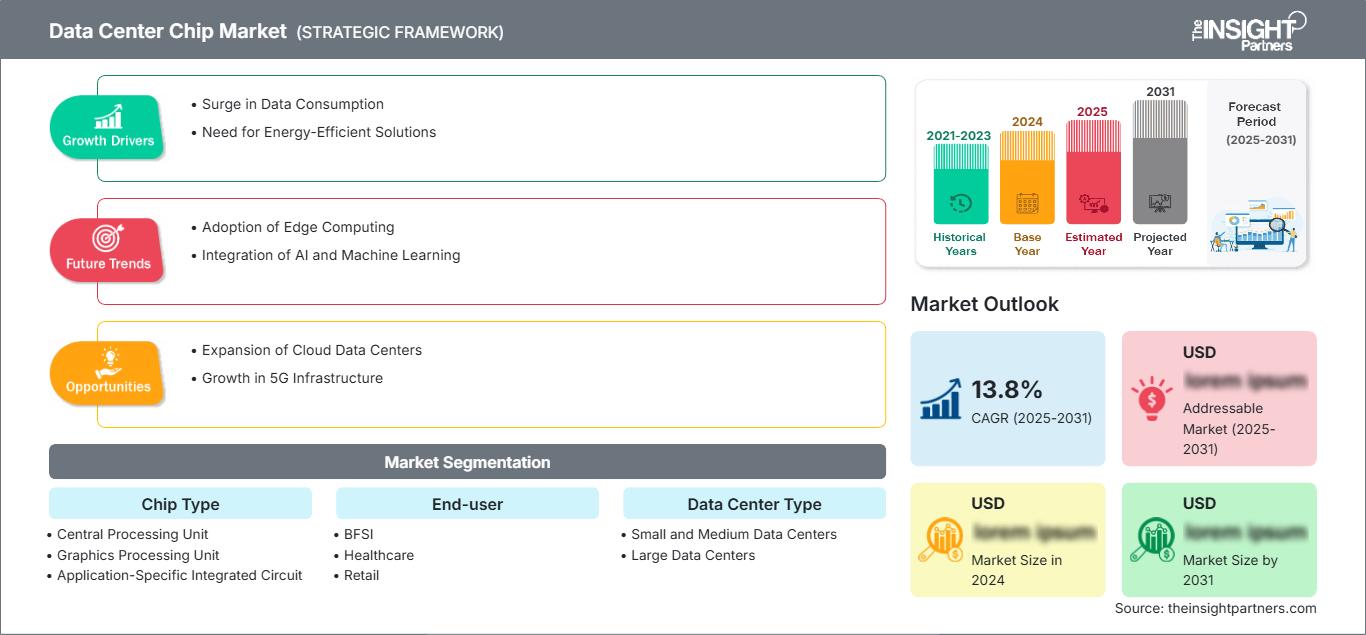
Data Center Chip Market: Strategic Insights
Regional Insights
North America Data Center Chip Market
The North American region accounts for 38–42% market share in 2025 and will experience a growth rate of CAGR between 10.8–12.2% during the period from 2026 to 2034. Data Center Chip Market share can be explained in terms of hyperscale cloud campus, AI model training cluster, financial computing, healthcare analytics, and federal compute modernization. The US dominates demand due to cloud platforms, chip designers, and purchase of AI infrastructure.
Regional customers consider factors like performance per watt, software readiness, availability of supply, and thermal readiness because AI racks consume more power density compared to enterprise servers. NVIDIA Corporation, Advanced Micro Devices, Inc., Intel Corporation, Broadcom Inc., Arm Limited, and Xilinx, Inc. are key customers or ecosystem players, but foundries and memory providers are important as well.
U.S. Data Center Chip Market
The U.S. accounts for 82-86% of North America in 2025 and exhibits CAGR growth of 10.9-12.3% from 2026 to 2034. Drivers behind demand include hyperscale AI training and inference services, semiconductor design excellence, and enterprise adoption of accelerated computing. Vendor participation is strong in NVIDIA Corporation, Advanced Micro Devices, Inc., Intel Corporation, Broadcom Inc., Arm Limited, and Xilinx, Inc.
Application trends include GPU clusters for foundation models, ASIC offerings for cloud inference, multicore CPU servers for virtualization, and FPGAs for latency-sensitive applications within financial services and telecommunications. The U.S. market places emphasis on liquid cooling, grid connection, secure supplies, and software portability as the rack scale becomes the predominant purchase unit for AI data centers.
Europe Data Center Chip Market
Europe represents 17-20% share by 2025 and experiences a CAGR of 9.8-11.2% between 2026-2034. Leading Europe is the UK via cloud zones, AI research, and financial compute. Germany provides industrial AI, automotive engineering and sovereign cloud initiatives; and France backs national AI infrastructure and compute for government sector.
The Netherlands and Ireland help via large colocation centers and connectivity corridors; and Italy and Spain via enterprise cloud and telecommunication transformation. Energy efficiency, data protection and supply chain transparency drive European buyer priorities. Semiconductor supportive policies and access to renewable power play a role in location selection, making efficient chip platforms purchase criteria.
APAC Data Center Chip Market
Share of APAC region is 31%-35% in 2025 and will have CAGR of 12.8%-14.5% from 2026 to 2034. China leads the region in terms of domestic cloud computing scale, AI applications, and alternative accelerators. Japan and South Korea contribute memory requirements, electronics manufacturing, and HPC needs, and India grows its cloud computing and digital public infrastructure.
Foundries and regional cloud nodes in Taiwan and Singapore continue to be significant players along with the policy factors of semiconductor independence, AI industrial policy, and data localization. The players involved in this region include Taiwan Semiconductor Manufacturing Company Limited, Samsung Electronics Co., Ltd., Huawei Technologies Co., Ltd., and merchant semiconductor suppliers.
Middle East & Africa Data Center Chip Market
Middle East and Africa will experience growth of 11.0 to 12.8% CAGR during 2026 to 2034. Saudi Arabia takes the lead through sovereign AI, cloud zones, energy-based infrastructure and smart cities initiatives. UAE contributes through financial services, aviation, AI in public sector, and enterprise cloud requirements, whereas South Africa facilitates regional collocation and telco workloads.
The Rest of MEA market stays project-based but shows improvement due to submarine cable connectivity, renewables and government digitization initiatives. The data center providers are focused on using those chip platforms which have less power consumption and high utilization because energy availability, need for cooling, and import time of hardware matter in their deployment.
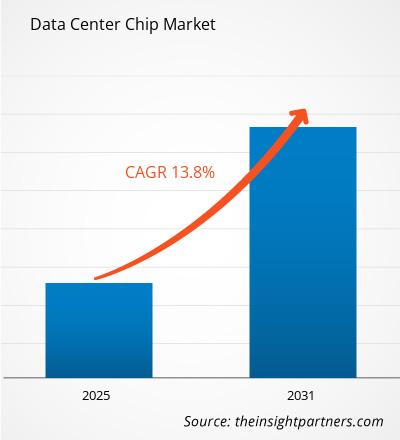
Segmentation Analysis
Chip Type
Chip Type is projected to grow at a CAGR range of 11.5–13.2% during 2026–2034. Data Center Chip Market scope is defined by workload specialization, memory bandwidth, software stack depth, and rack-level efficiency. Buyers increasingly combine general compute, acceleration, adaptive logic, and custom silicon to balance flexibility, cost, latency, and power budgets.
- Central Processing Unit: CPUs remain essential for virtualization, orchestration, database workloads, and host processing. Demand favors high-core-count processors with stronger memory bandwidth, security features, and efficient coordination of accelerators.
- Graphics Processing Unit: GPUs dominate AI training and high-throughput inference because parallel compute, HBM capacity, and mature software ecosystems support large models, simulation, analytics, and accelerated enterprise applications.
- Application-Specific Integrated Circuit: ASICs gain strategic importance where hyperscalers optimize cost, power, and latency for repeated AI inference, search, recommendation, video, and internal cloud workloads.
- Field-Programmable Gate Array: FPGAs serve low-latency, adaptable workloads in networking, financial services, telecom, storage acceleration, and prototyping where reconfigurability and deterministic performance are valued.
End-user
End-user is expected to grow at a CAGR range of 11.2–12.9% during 2026–2034. Adoption differs by workload intensity, compliance requirements, data gravity, and real-time analytics needs. BFSI, healthcare, telecom, and media users are increasing accelerator demand, while retail and utilities adopt chips through cloud services and private AI infrastructure.
- BFSI: BFSI users prioritize low-latency analytics, fraud detection, risk modeling, algorithmic trading, and secure private cloud, making high-performance CPUs, GPUs, and FPGAs strategically important.
- Healthcare: Healthcare demand is tied to imaging AI, genomics, hospital data platforms, drug discovery, and privacy-sensitive analytics that require reliable compute, accelerator availability, and compliant infrastructure.
- Retail: Retailers use cloud and edge-linked data center chips for recommendation engines, inventory optimization, pricing analytics, customer intelligence, and computer vision across digital and physical channels.
- Telecommunications: Telecom operators need chips for cloud-native cores, network analytics, virtualized RAN, security monitoring, and edge inference where latency, throughput, and energy efficiency drive platform selection.
- Media and Entertainment: Media companies adopt GPUs and specialized processors for rendering, video transcoding, content personalization, streaming optimization, and generative production workflows requiring scalable compute.
- Energy and Utilities: Energy and utility operators use data center compute for grid forecasting, seismic analysis, asset optimization, cybersecurity, and emissions analytics, with demand rising as digital operations expand.
Data Center Type
Data Center Type is projected to grow at a CAGR range of 11.0–12.6% during 2026–2034. Large facilities drive most chip consumption because AI training, cloud regions, and colocation campuses require dense racks and advanced cooling. Small and medium sites remain relevant for enterprise modernization, latency-sensitive workloads, and regulated data processing.
- Small and Medium Data Centers: These facilities adopt efficient CPUs, entry accelerators, and adaptive computing for private cloud, compliance, backup, edge analytics, and enterprise AI pilots with constrained power capacity.
- Large Data Centers: Large data centers dominate chip purchasing through hyperscale AI clusters, cloud regions, and colocation campuses that require GPUs, ASICs, high-speed networking, and liquid-cooling-ready platforms.
Opportunity Snapshot
| End-user | Revenue Contribution | Trend Tag | Adoption Stage |
| BFSI | High | Risk AI | Mature |
| Healthcare | Medium | Imaging AI | Scaling |
| Retail | Medium | Personalization | Scaling |
| Telecommunications | High | Cloud RAN | Scaling |
| Media and Entertainment | Medium | Render Farms | Scaling |
| Energy and Utilities | Medium | Grid AI | Emerging |
| Others | Low | Private Cloud | Emerging |
Data Center Chip Market Growth Drivers and Impact Analysis
AI Workloads Requiring Accelerated Compute at Scale
The demand for chips that can do large model processing at reduced latency and increased utilization is being driven by generative AI, recommendation engines, code assistants, search, and multimodal analytics. The market effect is a move from server-based buying to rack scale infrastructure that comes with GPUs, CPUs, memory, network, and cooling all considered as a package. Inference is being done closer to application use cases, thus adding to demand outside of frontier training clusters. This trend favors suppliers with rich software ecosystems, optimized libraries, consistent supply availability, and performance-power roadmaps.
Cloud Expansion and Enterprise Modernization
The trend of cloud migration goes on to add to the installed base of data center processors as databases, analytics, collaboration, cybersecurity, and vertical applications get hosted on scalable infrastructure. The process of modernization is not exclusive to hyperscale clouds because financial institutions, healthcare organizations, retail firms, telecoms, and manufacturing concerns create their private or hybrid compute infrastructures for sensitive applications. The market implication is that the demand for processors will be long-lived in relation to CPUs, GPUs, FPGAs, and ASIC-based services.
Power Efficiency Becoming a Procurement Constraint
Energy consumption per work unit has become the determining factor in the choice of chips in view of power constraints, delays in grid connections, and limitations in cooling. Rack density makes it necessary for thermal design, memory effectiveness, loss on interconnections, and work scheduling to become crucial factors in platform selection. Market implications include an increased uptake of advanced nodes, chiplets, accelerators, ARM CPUs, and liquid-cooled chips. Those manufacturers who will be able to offer tangible increases in performance per watt will be able to maintain their pricing levels.
Data Center Chip Market Future Trends
Custom AI Silicon Moving into Mainstream Cloud Architectures
Data Center Chip Market trends will increasingly center on custom AI silicon as cloud operators seek lower inference cost, predictable supply, and differentiated services. ASICs will not replace GPUs across all workloads, but they will absorb repetitive, high-volume tasks where models, software, and infrastructure can be tightly controlled. This trend should expand co-design relationships involving cloud platforms, IP providers, ASIC specialists, foundries, and packaging partners. Over time, customers will compare platforms by cost per token, latency, software portability, and operational resilience rather than processor category alone.
Chiplet and Advanced Packaging Architectures Expanding
Chiplet architectures and advanced packaging will become defining design choices as monolithic scaling becomes harder and AI workloads require more memory bandwidth. Designers can combine compute dies, I/O dies, HBM stacks, and specialized accelerators in packages optimized for yield, performance, and upgrade cadence. This direction strengthens the role of foundries, OSAT providers, substrate suppliers, and memory vendors. Future purchasing decisions will evaluate package reliability, thermal behavior, supply availability, and platform-level performance because the chip is increasingly inseparable from the module and rack design.
Data Center Chip Market Opportunities
Inference-Optimized Platforms for Regulated Industries
Data Center Chip Market Forecasts point to an opportunity in inference platforms designed for BFSI, healthcare, telecom, and public-sector users that need lower latency, data control, and auditable operations. Vendors can package CPUs, GPUs, ASICs, networking, security features, and software toolchains into validated reference designs for private and hybrid data centers. The opportunity is strongest where customers want generative AI but cannot move sensitive workloads entirely to public cloud. Suppliers should emphasize predictable cost per query, governance support, model serving efficiency, and integration with existing enterprise infrastructure.
Regional Supply Chain Partnerships and Sovereign Compute
Sovereign compute initiatives create an actionable opportunity for chip vendors, foundries, IP providers, and system integrators to build localized ecosystems. Governments and enterprises want reliable access to AI infrastructure without excessive exposure to export controls, geopolitical disruption, or single-region manufacturing risk. Partnerships can include local assembly, cloud region certification, security validation, service centers, and joint development with national research institutions. Companies that balance global technology leadership with regional compliance, training, and lifecycle support can win long-duration programs tied to digital government, defense analytics, education, and industrial policy.
Recent Developments
- June 2026: Qualcomm unveiled its Dragonfly data center roadmap for the agentic AI era, introducing a comprehensive portfolio that includes the Dragonfly C1000 CPU, Dragonfly AI100/AI300 inference accelerators, High Bandwidth Compute (HBC) architecture, and advanced networking solutions. The roadmap is designed to deliver high-performance, energy-efficient AI inference at hyperscale, enabling cloud providers and enterprises to support next-generation AI workloads with improved performance, scalability, and lower total cost of ownership.
- July 2026: Nvidia and SK Group unveiled a $500 billion-plus AI infrastructure initiative to accelerate the development of large-scale AI data centers and next-generation memory technologies. The partnership includes a long-term collaboration with SK Hynix to supply and co-develop high-bandwidth memory (HBM), plans by SK Telecom to build a 2-gigawatt AI data center powered by Nvidia’s Vera Rubin platform by 2027, and joint efforts with Naver and Brookfield to expand AI data center capacity in South Korea, strengthening the country's AI infrastructure and semiconductor ecosystem.
- July 2026: Samsung Electronics and Broadcom expanded their strategic partnership through a memorandum of understanding valued at more than US$200 billion through 2030. The collaboration covers high-bandwidth memory (HBM), advanced foundry manufacturing using Samsung’s sub-2nm process technology, and advanced semiconductor packaging to support next-generation AI and high-performance computing chips, strengthening Samsung’s position in the global AI semiconductor supply chain.
Frequently Asked Questions

- Comprehensive Market Sizing and Forecast Analysis
- Detailed Segmentation Analysis
- In-Depth Market Dynamics Assessment
- Regional and Country-Level Insights
- Competitive Landscape and Company Benchmarking
- Strategic Business Intelligence
Recent Reports
Testimonials

The Insight Partners' SCADA System Market report is comprehensive, with valuable insights on current trends and future forecasts. The team was highly professional, responsive, and supportive throughout. We are very satisfied and highly recommend their services.
RAN KEDEM Partner, Reali Technologies LTDs
I requested a report on a very specific software market and the team produced the report in a few days. The information was very relevant and well presented. I then requested some changes and additions to the report. The team was again very responsive and I got the final report in less than a week.
JEAN-HERVE JENN Chairman, Future Analytica
We worked with The Insight Partners for an important market study and forecast. They gave us clear insights into opportunities and risks, which helped shape our plans. Their research was easy to use and based on solid data. It helped us make smart, confident decisions. We highly recommend them.
PIYUSH NAGPAL Sr. Vice President, High Beam Global
The Insight Partners delivered insightful, well-structured market research with strong domain expertise. Their team was professional and responsive throughout. The user-friendly website made accessing industry reports seamless. We highly recommend them for reliable, high-quality research services
YUKIHIKO ADACHI CEO, Deep Blue, LLC.
This is the first time I have purchased a market report from The Insight Partners.While I was unsure at first, I visited their web site and felt more comfortable to take the risk and purchase a market report.I am completely satisfied with the quality of the report and customer service. I had several questions and comments with the initial report, but after a couple of dialogs over email with their analyst I believe I have a report that I can use as input to our strategic planning process.Thank you so much for taking the extra time and making this a positive experience.I will definitely recommend your service to others and you will be my first call when we need further market data.
JOHN SUZUKI President and Chief Executive Officer, Board Director, BK Technologies
I wish to appreciate your support and the professionalism you displayed in the course of attending to my request for information regarding to infectious disease IVD market in Nigeria. I appreciate your patience, your guidance, and the fact that you were willing to offer a discount, which eventually made it possible for us to close a deal. I look forward to engaging The Insight Partners in the future, all thanks to the impression you have created in me as a result of this first encounter.
DR CHIJIOKE ONYIA MANAGING DIRECTOR, PineCrest Healthcare Ltd.Reason to Buy
- Informed Decision-Making
- Understanding Market Dynamics
- Competitive Analysis
- Identifying Emerging Markets
- Customer Insights
- Market Forecasts
- Risk Mitigation
- Boosting Operational Efficiency
- Strategic Planning
- Investment Justification
- Tracking Industry Innovations
- Aligning with Regulatory Trends





 Get Free Sample for