
Data Center Virtualization Market Growth, Trends & Demand by 2034
Data Center Virtualization Market Size and Forecasts (2021 - 2034), Global and Regional Share, Trends, and Growth Opportunity Analysis Report Coverage : By Component (Solution, Services); Type (Server, Storage, Network, Desktop, Application, Others); Organization Size (Large Enterprises, SMEs); End User (BFSI, Healthcare, IT and Telecommunication, Manufacturing, Government, Retail, and Other); Geography (North America, Europe, Asia-Pacific, Middle East & Africa, South and Central America)
- Status : Data Released
- Report Code : TIPRE00039803
- Category : Technology, Media and Telecommunications
- No. of Pages : 150
- Available Report Formats :


- Last update date : July 30, 2026


2025 Market Size
US$ 11.00 Bn
Base year value
2034 Forecast
US$ 30.71 Bn
Projected by 2034
CAGR 2026-2034
12.08 %
Growth rate
Addressable Market
US$ 182.78 Bn
(2026-2034)
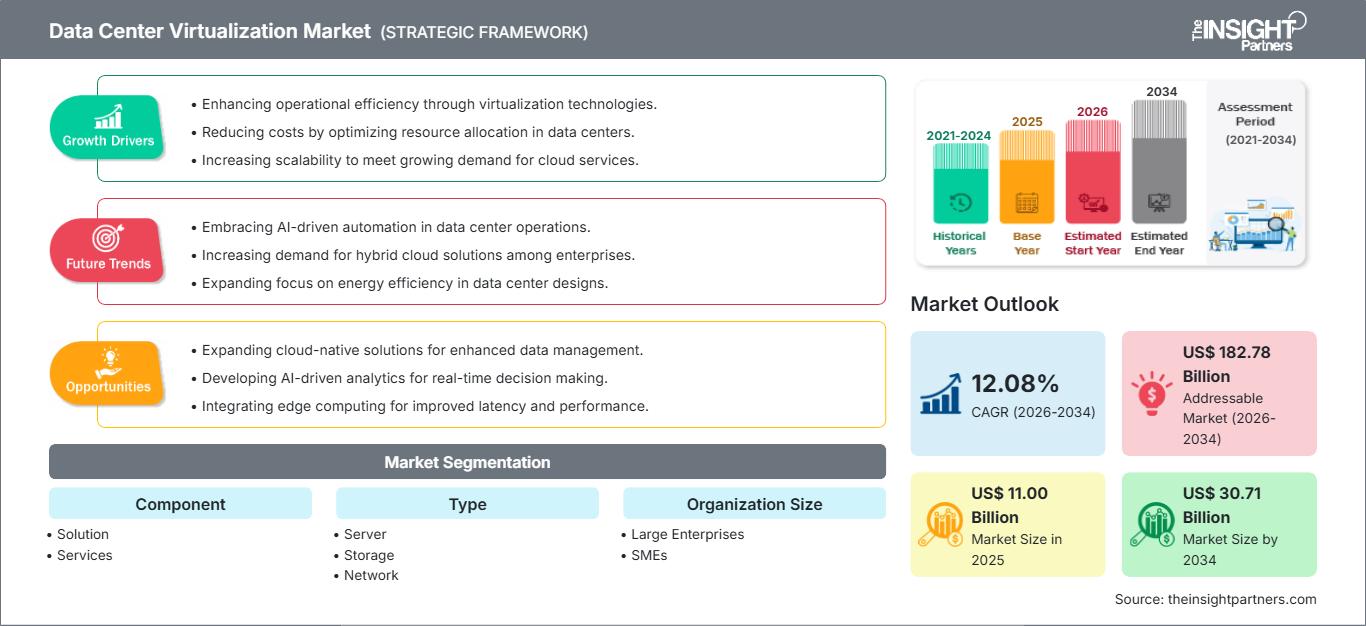
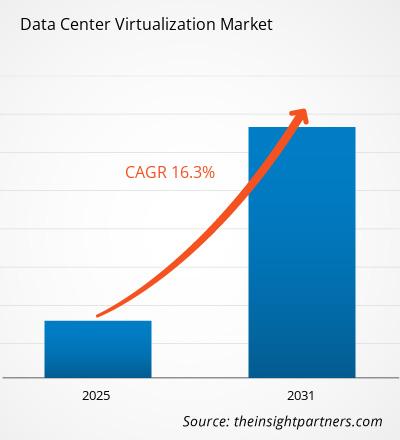
The data center virtualization market was valued at US$ 11.00 Billion in 2025 and is projected to reach US$ 30.71 Billion by 2034, expanding at a CAGR of 12.08% between 2026 and 2034, supported by rising hybrid cloud adoption and infrastructure modernization initiatives. Enterprises across industries are steadily consolidating physical infrastructure into virtualized environments to reduce operating costs and improve resource utilization, a shift that continues to define the market under study.
North America's data center virtualization market size is estimated to grow at a CAGR of 11.2-12.3% through 2034, driven by accelerated enterprise migration away from legacy hypervisor licensing models and rising investment in AI-ready infrastructure. Structural drivers include hyperscale data center expansion and growing demand among financial services and telecommunications firms for consolidated, software-defined compute environments that reduce hardware footprint and operational overhead across distributed enterprise networks.
Data Center Virtualization Market Assessment and Insights
- North America: leads the data center virtualization market with an estimated 36-40% share in 2025, growing at a CAGR of 11.2-12.3% during 2026-2034, supported by hyperscale infrastructure investment and enterprise hypervisor migration.
- US: The US accounts for 84-88% of North America's share in 2025, expanding at a CAGR of 11.0-12.0% through 2034, anchored by dense enterprise IT and hyperscale cloud deployments.
- Europe: held approximately 24-27% share in 2025 and is set to grow at a CAGR of 12.3-13.4% between 2026 and 2034, with Germany and the UK leading enterprise virtualization adoption.
- Asia Pacific: commanded 22-25% share in 2025 and is forecast to expand at the fastest CAGR of 14.5-15.8% through 2034, led by China and India amid rapid data center capacity expansion.
- Largest Segment: Solution led the component segment with a 58-62% share in 2025, growing at a CAGR of 12.4-13.4% through 2034 owing to sustained hypervisor and management software demand.
- High Growth Segment: IT and Telecommunication represented 20-23% share in 2025 and is projected to expand at the highest CAGR of 14.2-15.5% through 2034, driven by network function virtualization.
- Key companies analyzed in detail: ATTO Technology, Inc., AT&T, Cisco Systems, Inc., Dell Inc., Fujitsu, HCL Technologies Limited, Hewlett Packard Enterprise Development LP, Huawei Technologies Co., Ltd., IBM, Microsoft
Source: The Insight Partners' analysis based on proprietary research, government publications, company annual reports, investor presentations, industry databases, and expert interviews.
The development of virtualization in data centers follows a constant process of moving forward from simple server consolidation towards software-defined infrastructure for computing, storage, and networking. Companies more often use hypervisor-agnostic management systems to become independent from vendors due to the high licensing fees of the traditional ones. The production process has developed significantly since vendors use automated provisioning, live migration, and orchestration based on policies to support dense multi-tenant workloads. This trend develops rapidly as companies start rethinking their approaches to virtualization after the change of the licensing models in the industry.
Looking ahead, growth in the Data Center Virtualization Market is expected to broaden as enterprises in emerging economies accelerate data center buildouts to support digital service expansion and AI workload demand. Increased vendor investment in Kubernetes-native virtualization and per-socket licensing alternatives is reshaping competitive dynamics. Regulatory emphasis on data sovereignty and infrastructure resilience is further encouraging enterprises to modernize virtualization stacks, strengthening long-term demand across regulated industries including banking, healthcare, and government sectors.
Data Center Virtualization Market Report Scope
| Report Attribute | Details |
|---|---|
| Market size in 2025 | US$ 11.00 Billion |
| Market Size by 2034 | US$ 30.71 Billion |
| Global CAGR (2026 - 2034) | 12.08% |
| Historical Data | 2021-2024 |
| Forecast period | 2026-2034 |
Data Center Virtualization Market Analysis
The data center virtualization market growth is primarily driven by enterprises seeking to reduce hardware costs while improving infrastructure agility across compute, storage, and network layers. With the increase in licensing fees and the potential for vendor lock-in following a change in ownership of major hypervisor software, companies are looking at alternative platforms, which is driving up replacement rates. Companies in financial services, healthcare, and telecommunications see virtualization as critical to their needs for regulation, business continuity planning, and infrastructure management.
This includes hypervisor vendors, systems integrators, hardware manufacturers, and managed service providers, with the market moving toward hybrid cloud management platforms. The supply side dynamics continue to be driven by the fact that large enterprises do not wish to undertake disruptive replacements and require that vendors can interoperate with their current VMware environment. This puts those vendors with flexible licensing and multi-hypervisor options ahead.
A comprehensive data center virtualization market analysis reveals an increasingly competitive landscape reshaped by licensing disruption among legacy players. Cisco Systems, Inc. and Hewlett Packard Enterprise Development LP have introduced lightweight hypervisor alternatives targeting enterprises seeking to reduce dependency on traditional platforms, while IBM strengthens its Red Hat OpenShift Virtualization portfolio to support hybrid cloud migration. Dell Inc. and Fujitsu continue integrating virtualization capabilities within converged infrastructure offerings for enterprise data centers.
Huawei Technologies Co., Ltd. and Microsoft are strongly positioned due to their cloud-based virtualization stack offering, while AT&T and HCL Technologies Limited have been extending their managed virtualization capabilities in the area of telecommunications and enterprises. ATTO Technology, Inc. is contributing to the ecosystem via connectivity solutions for virtualized storage platforms.
● REPORT CUSTOMIZATION
Tailor This Report To Align With Your Specific Business Requirements
This report can be customized to align precisely with your business objectives, scope, and target markets. Customization options include tailored segmentation, geography, competitive analysis, and strategic insights to support informed decision-making.
Customize This Report →WHAT YOU CAN ADJUST
- ● Segmentations
- ● Geography
- ● Competitive Analysis
- ● Language Preferences
Data Center Virtualization Market: Strategic Insights
Regional Insights
North America Data Center Virtualization Market
North America held an estimated 36-40% of the global data center virtualization market share in 2025, sustained by dense hyperscale data center presence and early enterprise adoption of software-defined infrastructure. Regional compound annual growth rate is forecasted at 11.2-12.3% for the period from 2026 to 2034 due to rapid migrations from existing hypervisor license models and increasing adoption of hybrid cloud management solutions among big companies within financial services and IT sectors.
Key trends that drive the market include constant investments into AI-capable data centers and emphasis placed by enterprises on resilient infrastructure in light of recent licensing problems in leading vendors of virtualization software. Incremental contribution comes from Canada due to increased investments in cloud infrastructure. The United States is expected to generate the biggest regional demand due to the presence of many hyperscale players and large-scale deployments of IT infrastructures within regulated industries.
U.S. Data Center Virtualization Market
The United States accounted for approximately 84-88% of North America's share of the data center virtualization market in 2025, reflecting its position as the region's primary hub for enterprise IT infrastructure and hyperscale cloud deployment. The market is expected to grow at a CAGR of 11.0-12.0% through 2034, driven by expanding adoption of alternative hypervisor platforms among enterprises reassessing legacy licensing agreements across data-intensive industries.
Application trends show growing enterprise reliance on Kubernetes-integrated virtualization and unified management consoles spanning multiple hypervisors. Cisco Systems, Inc. and Hewlett Packard Enterprise Development LP maintain a strong operational presence through hypervisor and converged infrastructure offerings, while IBM and Microsoft compete through hybrid cloud-integrated virtualization platforms. Dell Inc. further strengthens its presence through virtualization-ready server and storage hardware supporting enterprise data center modernization initiatives nationwide.
Europe Data Center Virtualization Market
Europe accounted for approximately 24–27% share of the global Data Center Virtualization Market in 2025, growing at a CAGR of 12.3–13.4% through 2034, supported by stringent data sovereignty regulations and rising enterprise demand for consolidated, compliant infrastructure across banking, government, and manufacturing sectors throughout the region's increasingly digitized economy.
Germany ranks as the region's largest market, driven by its strong manufacturing base and enterprise investment in private cloud infrastructure supporting Industry 4.0 initiatives. The UK follows closely, with financial services firms accelerating virtualization adoption to manage regulatory compliance and legacy system modernization. France, Italy, and Spain collectively contribute steady growth, supported by expanding public sector digitization programs and rising enterprise data center investment across Southern Europe's technology sector.
APAC Data Center Virtualization Market
Asia Pacific held approximately 22–25% share of the global Data Center Virtualization Market in 2025 and is projected to expand at the fastest CAGR of 14.5–15.8% through 2034, led by China, driven by large-scale data center capacity expansion and government-backed digital infrastructure initiatives. Increasing cloud adoption, enterprise digital transformation, and investments in hybrid IT environments across countries such as India, Japan, South Korea, and Singapore are further supporting demand for virtualization technologies throughout the region.
Japan and South Korea emphasize enterprise-grade virtualization for financial and manufacturing sectors, while India and Australia show rising adoption amid expanding hyperscale investment and policy frameworks encouraging domestic data center development and cloud infrastructure modernization.
Middle East & Africa Data Center Virtualization Market
The Middle East & Africa region is projected to grow at a CAGR of 13.2–14.5% through 2034 in the Data Center Virtualization Market, with Saudi Arabia leading regional demand, supported by national digital transformation programs and substantial investment in hyperscale and government data center infrastructure tied to economic diversification strategies. Growing adoption of cloud computing, enterprise modernization initiatives, and increasing demand for scalable IT infrastructure are further contributing to market growth across the region.
The UAE strengthens its position as a regional cloud and data center hub, while South Africa and the Rest of MEA show gradual virtualization adoption as enterprises modernize legacy IT infrastructure to support expanding digital banking and telecommunications services.
Segmentation Analysis
Component
The component segment is projected to record a CAGR of 12.4–13.5%, reinforcing its central role in the data center virtualization market by covering solutions and services that support the deployment, optimization, and management of virtualized infrastructure. Solutions continue to account for the largest share, driven by persistent demand for hypervisors and virtualization management platforms, while services are gaining momentum as organizations increasingly require consulting, migration, integration, and support to address evolving licensing models and complex infrastructure modernization initiatives.
- Solution: Encompasses hypervisor platforms, virtual machine management software, and orchestration tools that form the technical foundation for enterprise infrastructure consolidation and workload management.
- Services: Includes consulting, implementation, and managed support offerings that help enterprises migrate legacy environments and maintain virtualized infrastructure performance over time.
Type
Type-based segmentation is expected to register a CAGR of 12.0–13.0%, highlighting the expanding adoption of virtualization across server, storage, network, desktop, and application environments within modern data centers. Server virtualization continues to lead the segment due to its proven advantages in resource optimization, workload consolidation, and operational efficiency, while network and application virtualization are witnessing accelerated adoption as enterprises advance toward software-defined infrastructure, greater automation, and more agile, scalable IT environments.
- Server: Represents the most widely adopted virtualization type, enabling enterprises to consolidate physical servers and improve compute resource utilization across data center environments.
- Storage: Supports flexible, software-defined storage pools that improve scalability and reduce dependency on dedicated physical storage hardware across enterprise infrastructure.
- Network: Enables software-defined networking capabilities that improve traffic management and reduce reliance on fixed physical network configurations within data centers.
- Desktop: Supports centralized management of virtual desktop environments, improving security and simplifying endpoint administration across distributed enterprise workforces.
- Application: Facilitates containerized and virtualized application deployment, improving portability and resource efficiency across hybrid and multi-cloud environments.
Organization Size
Organization size is projected to register a CAGR of 12.6–13.7%, shaping virtualization adoption trends as large enterprises focus on broad infrastructure consolidation and automation, while smaller organizations seek affordable and easier-to-manage deployment options. Large enterprises continue to account for the majority of spending due to their complex and distributed IT environments, whereas SMEs are accelerating adoption through cloud-delivered and subscription-based virtualization offerings that reduce capital expenditure and simplify ongoing infrastructure management.
- Large Enterprises: Deploy comprehensive virtualization across compute, storage, and network layers, prioritizing scalability, high availability, and integration with existing enterprise IT governance frameworks.
- SMEs: Favor simplified, cost-effective virtualization platforms that reduce hardware investment while enabling basic infrastructure consolidation without extensive dedicated IT staff.
End User
The end-user segment is projected to register a CAGR of 12.8–13.9%, driven by rising virtualization demand across regulated and technology-intensive industries, with BFSI and IT & telecommunications maintaining leadership through stringent compliance requirements and large-scale infrastructure needs. Healthcare, manufacturing, government, and retail organizations are steadily expanding adoption to strengthen digital transformation strategies, enhance cybersecurity and data protection, improve resource utilization, and increase operational efficiency across increasingly complex IT environments.
- BFSI: Relies heavily on virtualization for regulatory compliance, disaster recovery, and secure infrastructure consolidation across extensive branch and data center networks.
- Healthcare: Adopts virtualization to support electronic health record systems, data security compliance, and scalable infrastructure for growing digital health service demands.
- IT and Telecommunication: Leads network function virtualization adoption, leveraging software-defined infrastructure to support scalable, distributed telecommunications and cloud service delivery.
- Manufacturing: Increasingly virtualizes infrastructure to support Industry 4.0 initiatives, connecting operational technology systems with centralized data management platforms.
- Government: Adopts virtualization to modernize legacy infrastructure while meeting data sovereignty and security requirements across public sector digital services.
- Retail: Utilizes virtualization to support omnichannel infrastructure, point-of-sale systems, and centralized inventory management across distributed store networks.
Opportunity Snapshot
| End User | Revenue Contribution | Trend Tag | Adoption Stage |
| BFSI | High | Compliance Infrastructure | Mature |
| Healthcare | Medium | Data Security | Scaling |
| IT and Telecommunication | High | Network Functions | Scaling |
| Manufacturing | Medium | Industry 4.0 | Emerging |
| Government | Medium | Legacy Modernization | Scaling |
| Retail | Low | Omnichannel Systems | Emerging |
| Other | Low | Infrastructure Consolidation | Emerging |
Data Center Virtualization Market Growth Drivers and Impact Analysis
Enterprise Migration Away From Legacy Hypervisor Licensing
Major developments in the area of licenses of the leading vendors of virtualization software have driven enterprises to reconsider their strategies of infrastructure implementation, speeding up analysis of different hypervisor platforms. Enterprises with higher costs for per-core licensing are considering open-source and neutral vendor software, which helps to keep lower expenses on operations. This trend has opened a lot of opportunities for other vendors with simpler licensing schemes and support for existing implementations of VMware. Companies with many virtual machines are especially affected by high costs, hence the need for migration becomes critical in spite of the complexity of this process.
Rising Hyperscale and AI-Ready Infrastructure Investment
The expansion of hyperscale data centers with a large contribution of artificial intelligence workload is creating investment in virtualization technology that can facilitate dense, high-performance computing environments. The need for virtualization technology that can effectively manage GPU and computing resources through shared infrastructure has become increasingly necessary amid rising energy costs. In addition, the need for such virtualization technology is not only limited to the hyperscaler but also includes enterprises that wish to build their AI capacities by developing flexible virtualization layers that can accommodate both legacy and AI-specific workloads. Vendor companies with robust resource management capabilities are in an ideal position to capitalize on this growing market trend.
Regulatory Emphasis on Data Sovereignty and Compliance
The need for increased data sovereignty and compliance for specific industries is motivating firms in the banking, healthcare, and government industries to upgrade their virtualization infrastructure with better security and auditing capabilities. Regulators in various jurisdictions have been demanding stricter data residency and resiliency of the infrastructure, leading companies to opt for virtualization solutions that offer them fine-grained access control and audit trails. This pressure from regulators is felt particularly strongly in the financial services sector, wherein the infrastructure consolidation must find a balance between efficiency and compliance. Companies that show themselves to be highly compliant and maintain good relationships with regional data centers are preferred by firms subject to regulation.
Data Center Virtualization Market Future Trends
Convergence of Virtualization and Kubernetes-Native Platforms
Emerging data center virtualization market trends point toward deeper convergence between traditional hypervisor-based virtualization and container orchestration platforms. Enterprises increasingly seek unified environments capable of running both virtual machines and containerized workloads without maintaining separate management stacks. This convergence simplifies operations while enabling gradual application modernization without requiring disruptive full-scale migrations. Vendors integrating Kubernetes-native virtualization capabilities within existing management consoles are positioned to capture enterprises seeking flexible, future-ready infrastructure. Over the coming years, this trend is expected to reshape platform selection criteria, favoring providers offering seamless interoperability between legacy virtual machine environments and modern cloud-native application architectures.
Expansion of AI-Driven Infrastructure Automation
The use of artificial intelligence is becoming common in the area of virtualization management systems, where it helps in the automation of workload placement, capacity planning and prediction, and anomaly detection for enterprise infrastructures. With these systems, there is less need for human intervention and increased efficiency in the usage of resources in dense, multi-tenant data centers. In the near future, we expect enterprises to depend on AI-based automation to help deal with the complexity brought about by hybrid multi-hypervisor infrastructures. Companies that incorporate automation and observability capabilities will differentiate themselves through intelligent infrastructure management.
Data Center Virtualization Market Opportunities
Migration Services for Licensing-Disrupted Enterprises
Substantial opportunity exists for systems integrators and technology vendors to expand migration advisory and implementation services targeting enterprises reassessing virtualization strategies following major licensing disruptions. Organizations require specialized expertise to evaluate alternative platforms, plan phased migrations, and maintain operational continuity throughout transition periods. Current data center virtualization market forecasts suggest sustained demand for such services through the coming decade as enterprises gradually diversify away from single-vendor dependency. Providers building dedicated migration practices and interoperability tooling can capture significant incremental revenue while establishing long-term enterprise relationships extending well beyond initial platform transitions into broader infrastructure management engagements.
Vertical-Specific Compliance-Ready Virtualization Offerings
There is room for virtualization vendors to create custom solutions that meet the unique regulatory and operational needs of banking, healthcare, and government organizations. Organizations in such vertical industries prefer platforms that come with preconfigured compliance controls and audit features rather than generic infrastructure solutions. The effort made to ensure that a vendor gets into vertical-specific certification will help the vendor distinguish itself from others, in addition to its technical strengths and improve its competitive advantage in the industry. This way, vendors can charge more while building stronger customer relationships through specialized services.
Frequently Asked Questions

- Comprehensive Market Sizing and Forecast Analysis
- Detailed Segmentation Analysis
- In-Depth Market Dynamics Assessment
- Regional and Country-Level Insights
- Competitive Landscape and Company Benchmarking
- Strategic Business Intelligence
Recent Reports
Testimonials

The Insight Partners' SCADA System Market report is comprehensive, with valuable insights on current trends and future forecasts. The team was highly professional, responsive, and supportive throughout. We are very satisfied and highly recommend their services.
RAN KEDEM Partner, Reali Technologies LTDs
I requested a report on a very specific software market and the team produced the report in a few days. The information was very relevant and well presented. I then requested some changes and additions to the report. The team was again very responsive and I got the final report in less than a week.
JEAN-HERVE JENN Chairman, Future Analytica
We worked with The Insight Partners for an important market study and forecast. They gave us clear insights into opportunities and risks, which helped shape our plans. Their research was easy to use and based on solid data. It helped us make smart, confident decisions. We highly recommend them.
PIYUSH NAGPAL Sr. Vice President, High Beam Global
The Insight Partners delivered insightful, well-structured market research with strong domain expertise. Their team was professional and responsive throughout. The user-friendly website made accessing industry reports seamless. We highly recommend them for reliable, high-quality research services
YUKIHIKO ADACHI CEO, Deep Blue, LLC.
This is the first time I have purchased a market report from The Insight Partners.While I was unsure at first, I visited their web site and felt more comfortable to take the risk and purchase a market report.I am completely satisfied with the quality of the report and customer service. I had several questions and comments with the initial report, but after a couple of dialogs over email with their analyst I believe I have a report that I can use as input to our strategic planning process.Thank you so much for taking the extra time and making this a positive experience.I will definitely recommend your service to others and you will be my first call when we need further market data.
JOHN SUZUKI President and Chief Executive Officer, Board Director, BK Technologies
I wish to appreciate your support and the professionalism you displayed in the course of attending to my request for information regarding to infectious disease IVD market in Nigeria. I appreciate your patience, your guidance, and the fact that you were willing to offer a discount, which eventually made it possible for us to close a deal. I look forward to engaging The Insight Partners in the future, all thanks to the impression you have created in me as a result of this first encounter.
DR CHIJIOKE ONYIA MANAGING DIRECTOR, PineCrest Healthcare Ltd.Reason to Buy
- Informed Decision-Making
- Understanding Market Dynamics
- Competitive Analysis
- Identifying Emerging Markets
- Customer Insights
- Market Forecasts
- Risk Mitigation
- Boosting Operational Efficiency
- Strategic Planning
- Investment Justification
- Tracking Industry Innovations
- Aligning with Regulatory Trends





 Get Free Sample for