
Defoamers Market Size, Trends & Growth by 2034
Defoamers Market Size and forecasts (2021 - 2034) Global and Regional Growth Opportunity and Analysis, and Geography (North America, Europe, Asia Pacific, and South and Central America)
- Status : Data Released
- Report Code : TIPRE00003544
- Category : Chemicals and Materials
- No. of Pages : 150
- Available Report Formats :


- Last update date : July 15, 2026


2025 Market Size
US$ 4.16 Bn
Base year value
2034 Forecast
US$ 6.23 Bn
Projected by 2034
CAGR 2026-2034
4.60 %
Growth rate
Addressable Market
US$ 47.20 Bn
(2026-2034)
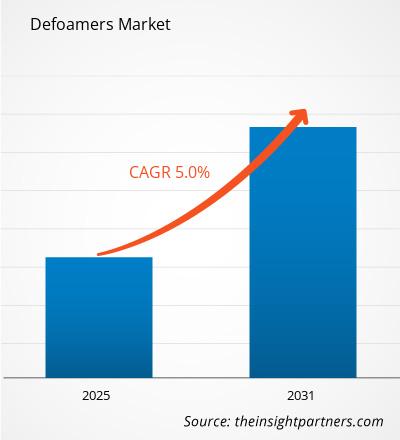
The Defoamers market size was valued at US$ 4.16 Billion in 2025 and is projected to reach US$ 6.23 Billion by 2034, registering a CAGR of 4.60% during 2026–2034. Market growth will continue as a result of rising activities related to industrial processing, strict quality standards applicable to manufacturing industries, and increased use of process optimization technologies. Market growth will depend on the demand in those industries where foam control is important in ensuring efficiency and high quality of operations and equipment.
For North America region, Defoamers size is forecasted to be driven by developed infrastructure of chemical manufacturing industry, growing activities in the field of wastewater treatment, and steady demand from paints and coatings applications. North American Defoamers market is anticipated to grow at a CAGR of 4.1% to 5.1% through 2026-2034.
Defoamers Market Assessment and Insights
- North America: Accounted for 30%–34% of the Defoamers market share in 2025 and is expected to grow at a 4.1%–5.1% CAGR during 2026–2034, driven by strong demand from coatings, wastewater treatment, food processing, and industrial chemical sectors.
- US: Represented 78%–82% of North American demand in 2025 and is projected to expand at a 4.2%–5.2% CAGR during 2026–2034, supported by a large manufacturing base and advanced specialty chemical production capacity.
- Europe: Held 25%–29% share in 2025 and is anticipated to grow at a 3.9%–4.9% CAGR during 2026–2034, led by Germany, France, the UK, Italy, and Spain through industrial modernization initiatives.
- Asia Pacific: Captured 31%–35% share in 2025 and is forecast to record a 5.0%–6.0% CAGR during 2026–2034, supported by industrial expansion in China, India, Japan, South Korea, and Southeast Asia.
- Largest Segment: Silicone-Based products accounted for a 36%–40% market share in 2025 and are expected to grow at a 4.8%–5.8% CAGR during 2026–2034 due to superior foam suppression and process stability.
- High Growth Segment: Food and Beverage represented a 12%–16% market share in 2025 and is projected to expand at a 5.6%–6.6% CAGR during 2026–2034, supported by production efficiency and hygiene requirements.
- Key companies analyzed in detail: Air Products and Chemicals, Inc., Ashland Inc., BASF SE, Clariant AG, Dow Inc., Elementis plc, Elkem ASA, Evonik Industries AG, KCC Corporation, Wacker Chemie AG.
Source: The Insight Partners' analysis based on proprietary research, government publications, company annual reports, investor presentations, industry databases, and expert interviews.
Industrial processing requirements have significantly influenced product development across the market. Formulations continue to emerge which facilitate ease of compatibility with aqueous systems, help in reducing residues and enable regulatory compliance goals. Innovations in silicone emulsions, mineral oil technology and biobased raw materials are helping redefine competitive positioning within the marketplace. Manufacturing approaches are moving towards an emphasis on blending efficiency and sustainability issues, especially for end-use products involving wastewater management, food processing and specialty coatings.
Future growth potential within the market will probably get stimulated through developments such as industrialization in developing economies, environmental legislation and investments in process efficiency technologies. Manufacturers are making efforts to develop local manufacturing capabilities to enhance supply chain efficiency and responsiveness to customers. Increasing preference for environmentally acceptable formulations and high demand from the pharmaceutical and food manufacturing sectors are likely to present other opportunities.
Defoamers Market Report Scope
| Report Attribute | Details |
|---|---|
| Market size in 2025 | US$ 4.16 Billion |
| Market Size by 2034 | US$ 6.23 Billion |
| Global CAGR (2026 - 2034) | 4.60% |
| Historical Data | 2021-2024 |
| Forecast period | 2026-2034 |
Defoamers Market Analysis
Defoamers market growth potential is driven by rising demand from various industrial sectors where the presence of foam negatively affects productivity, product consistency, and processing efficiency. Foam control additives are being increasingly applied in coating manufacturing, papermaking, wastewater treatment processes, petrochemical processing, and food manufacturing processes. As production increases and quality requirements grow stricter, industries continue to emphasize the importance of managing their foam effectively. The supply chain involves raw material suppliers, additive manufacturers, specialty chemicals formulators, distributors, and industrial end users.
Supply factors are affected by availability of silicones, specialty surfactants production, raw material price trends, and environmental regulations. Manufacturers have been making their formulations more efficient while also engaging in sustainable product development. Low VOC and environmentally friendly additives have helped innovate water and silicone-based technologies.
Defoamers market report describes the competitive landscape marked by technology differentiation, industry application expertise, and regional customer support capabilities. Participants compete on the basis of formulations, regulatory compliance, customizations, and supply. Investments have increasingly been oriented towards research and development activities.
Prominent organizations such as BASF SE, Dow Inc., Evonik Industries AG, Wacker Chemie AG, and Clariant AG keep diversifying their specialty additives portfolio. On the other hand, Air Products and Chemicals, Inc., Ashland Inc., Elementis plc, Elkem ASA, and KCC Corporation are enhancing their presence in the market through product development based on applications. The competitive edge is becoming dependent on developing an effective foam control solution along with sustainability goals.
● REPORT CUSTOMIZATION
Tailor This Report To Align With Your Specific Business Requirements
This report can be customized to align precisely with your business objectives, scope, and target markets. Customization options include tailored segmentation, geography, competitive analysis, and strategic insights to support informed decision-making.
Customize This Report →WHAT YOU CAN ADJUST
- ● Segmentations
- ● Geography
- ● Competitive Analysis
- ● Language Preferences
Defoamers Market: Strategic Insights
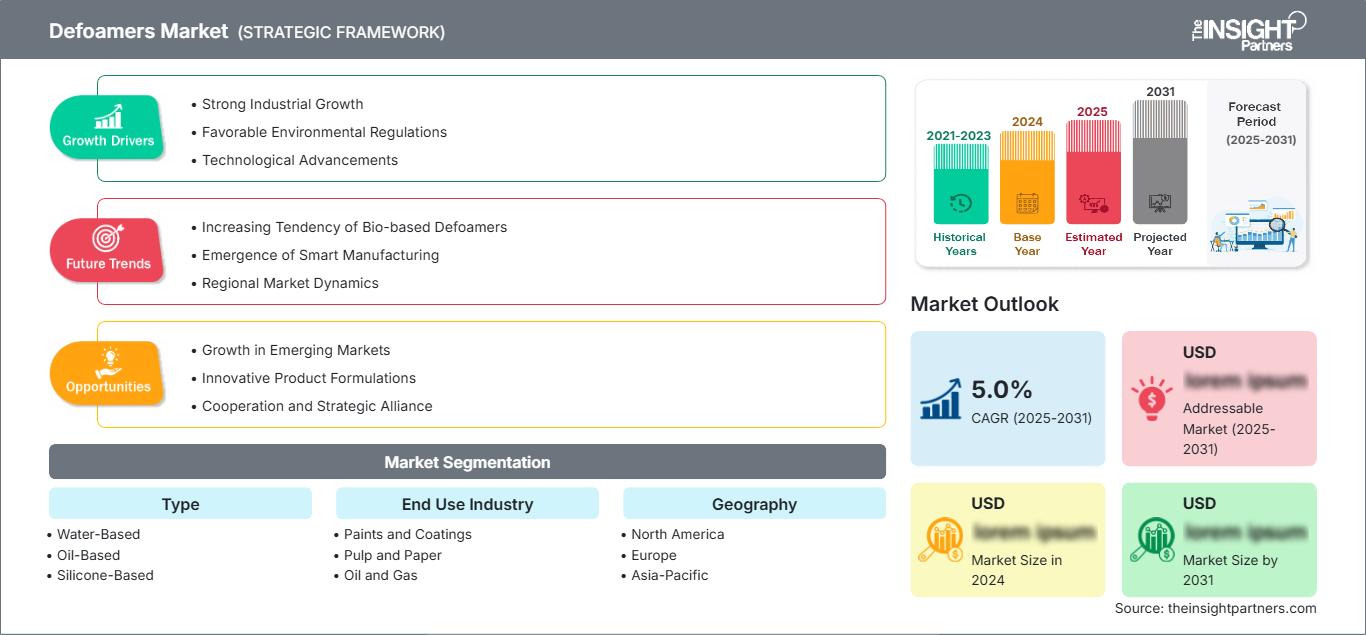
Regional Insights
North America Defoamers Market
North America accounted for 30%–34% of the market in 2025 and is expected to expand at a 4.1%–5.1% CAGR through 2034. This area also profits from having good specialty chemicals manufacturing, highly developed industrial manufacturing standards, and wide adoption in the sectors such as coatings, waste water treatment, food processing, and oilfield. The Defoamers’ market share in the region is still driven by the ongoing industrial modernization.
More and more companies in both the US and Canada pay much attention to the efficiency of equipment and quality of products. Growing investments into environmental regulations, water treatment facilities, and sustainable industrial manufacturing will further contribute to demand growth. Innovations in water-based defoamer products and silicone technologies also help.
U.S. Defoamers Market
The United States represented 78%–82% of North American demand in 2025 and is forecast to register a 4.2%–5.2% CAGR throughout the assessment period. Demand arises due to the existence of a diverse industrial sector including coating, food production, pharmaceuticals, pulp & paper, and energy processing industry. Investments in specialty chemical innovations facilitate market expansion and differentiation of products.
Some of the key players such as Dow Inc., Air Products and Chemicals Inc., Ashland Inc., and Elementis plc have been exhibiting considerable market activity throughout the nation. There has been an increasing trend in applications towards low residue formulations, sustainable chemistries, and foam control for particular processes.
Europe Defoamers Market
Europe held 25%–29% of the global market in 2025 and is projected to grow at a 3.9%–4.9% CAGR through 2034. Germany retains its position as the foremost regional market due to its robust chemical manufacturing, advanced coatings industry, and industrial processing operations.
The UK will retain demand due to food processing, pharmaceuticals manufacturing, and wastewater treatment industries. Contributions from France, Italy, and Spain are through coatings manufacturing, paper processing, industrial manufacturing, and specialty chemicals. The focus on environmentally friendly additives is driving innovation in formulations in regional end-use markets.
APAC Defoamers Market
Asia Pacific accounted for 31%–35% share in 2025 and is expected to achieve a 5.0%–6.0% CAGR through 2034, making it the fastest-growing regional market. China remains the leading country due to its extensive coatings, chemicals, textile, and manufacturing sectors. India continues to experience strong demand growth owing to industrial expansion, increasing wastewater treatment investments, and rising food processing activity.
In Japan and South Korea, there is consistent demand owing to manufacturing and specialty chemicals use, and in Australia, there is demand support in terms of mining and industry processing. The government has also shown interest in industrial modernization and water management, which would help in increasing the adoption of foam control technologies.
Middle East & Africa Defoamers Market
The Middle East & Africa market is projected to grow at a 4.3%–5.3% CAGR through 2034. The demand for foam control agents is chiefly driven by water treatment facilities, oil & gas industry, industrial chemicals, and construction projects. The Saudi Arabia and UAE continue to be major players owing to extensive industrial investments and diversification plans.
The South Africa satisfies regional demand through mining, pulp & paper, and manufacturing processes. In general, the region’s growing focus on wastewater reuse, industrial efficiency, and performance standards keeps fueling demand. Investments in the downstream industries will generate demand for foam control formulations..
Segmentation Analysis
Type
The type segment is projected to expand at a 4.5%–5.5% CAGR during 2026–2034. The Defoamers market trends within this segment continues to broaden as manufacturers seek solutions tailored to specific process conditions, regulatory requirements, and operational objectives. Selection is increasingly influenced by performance efficiency, compatibility with production systems, and environmental considerations. Product innovation remains focused on balancing rapid foam elimination with long-term process stability.
- Water-Based: Widely preferred in environmentally conscious applications due to lower emissions and compatibility with aqueous systems. Demand is increasing across wastewater treatment, paper processing, and selected coatings applications where regulatory compliance is a priority.
- Oil-Based: Maintains importance in industrial environments requiring strong foam suppression under challenging processing conditions. Adoption remains notable across pulp and paper operations, wastewater treatment facilities, and selected chemical manufacturing processes.
- Silicone-Based: Recognized for high efficiency, rapid foam collapse characteristics, and broad application suitability. These formulations remain strategically important for demanding industrial operations where persistent foam can disrupt productivity and product consistency.
End Use Industry
The end-use industry segment is expected to register a 4.8%–5.8% CAGR during 2026–2034. Demand patterns vary significantly across industries depending on production methods, process complexity, and quality requirements. Growing industrial output, stricter operational standards, and increasing process automation continue to encourage broader adoption of advanced foam-management technologies across multiple sectors.
- Paints and Coatings: Represents a major consumption area where foam control directly influences product appearance, application performance, and manufacturing efficiency. Consistent product quality requirements continue supporting sustained demand.
- Pulp and Paper: Defoamers remain essential for improving drainage efficiency, production stability, and processing speed. The segment benefits from ongoing modernization efforts and investments in operational efficiency.
- Oil and Gas: Utilized across drilling, refining, and processing activities where unwanted foam can negatively affect separation processes and operational reliability. Demand remains closely linked to industrial production activity.
- Food and Beverage: Increasingly important as manufacturers seek improved hygiene, productivity, and product consistency. Strict process control requirements support adoption of specialized food-grade formulations.
- Textile: Foam management solutions help improve dyeing consistency, chemical utilization, and equipment performance. Operational efficiency objectives continue to support market penetration.
- Pharmaceuticals: Requires highly controlled processing conditions where foam can influence production quality and batch consistency. Regulatory standards encourage use of specialized formulations.
- Metal: Industrial metalworking operations utilize these additives to improve processing efficiency, reduce production interruptions, and enhance quality consistency across manufacturing activities.
Opportunity Snapshot
| Segment Name | Revenue Contribution | Trend Tag | Adoption Stage |
| Paints and Coatings | High | Waterborne Coatings | Mature |
| Pulp and Paper | High | Mill Efficiency | Mature |
| Oil and Gas | Medium | Process Separation | Scaling |
| Food and Beverage | High | Food Hygiene | Scaling |
| Textile | Medium | Dye Optimization | Scaling |
| Pharmaceuticals | Medium | Clean Production | Emerging |
| Metal | Medium | Process Stability | Scaling |
| Others | Low | Utility Treatment | Emerging |
Defoamers Market Growth Drivers and Impact Analysis
Expansion of Industrial Processing Activities
Increased growth of industrial production will keep on driving the requirement for efficient foam control technologies within various industries, including chemical industry, coatings, pulp & paper industry, food industry, and energy sector. Formation of foams can lead to low efficiency, product deterioration, increase in downtime of production processes, and process inefficiency. With increasing emphasis on improving efficiency and reducing downtime in manufacturing process, there will be an increasing use of special formulations for foam control technology. It is particularly true for emerging markets, which have growing manufacturing capacity along with industrial upgrades and developments, thereby opening up new areas of demand for foam control technology.
Growing Investment in Wastewater Treatment Infrastructure
Foam issues occur quite often in water treatment plants, posing potential risks to the efficient and effective operation of these plants. Population growth, increased wastewater discharge from industries, and tighter environmental laws are pushing companies to invest in infrastructure. Foaming control agents will ensure reliable operations while also assisting in the compliance with water treatment norms. More and more municipal and industrial treatment plants are using advanced solutions to optimize plant performance and minimize maintenance needs. Thus, investment in water management will continue to drive future market demand.
Rise in Demand for High-Performance Coatings
Paint and coating producers today need additives that will enhance the visual appeal, applicability features, and production uniformity of the product. Foaming can cause surface irregularities, decrease coating performance, and disrupt the manufacturing process. New methods of foam control will contribute to overcoming the aforementioned problems. An increase in construction work, development of infrastructure, car manufacturing, and industrial maintenance is expected to boost the demand for coatings in the future. The trend towards more advanced formulations of the paint will lead to an increase in demand for additives.
Defoamers Market Future Trends
Development of Sustainable and Low-Emission Formulations
As the world of Defoamers progresses, sustainability considerations continue to gain importance. Companies have started making efforts to develop defoamer formulations that limit pollution, have better biodegradability qualities, and can contribute toward safe industry practices. There is a rising demand for low VOC and water-based defoamers in the areas of coatings, wastewater treatment, food industry, and specialty chemicals. It is likely that future development plans will be geared towards developing such formulations that not only offer high performance but also meet high environmental standards.
Integration of Customized Application-Specific Solutions
Market evolution in the future would involve an approach toward highly specialized formulas formulated for a certain environment of operation. Users are demanding formulations that would be specially developed to suit certain temperature ranges, manufacturing procedures, chemical composition, and regulations. This way, efficiency would be increased by lowering the amount of additives required, thus decreasing the cost involved. Formulation technology development, process monitoring technology, and industrial automation would probably help in advancing application-oriented technologies. Suppliers with the ability to offer technical knowledge with specialized solutions would find themselves at an advantageous position.
Defoamers Market Opportunities
Growth Potential in Food Processing Modernization
The food and beverages industry has tremendous room for growth due to investments by food manufacturers in automation and production processes. Foam control technologies may be used in maintaining hygiene standards and reducing process disruptions and inconsistencies. The increasing demand for processed foods in emerging economies increases the scope of opportunities. Defoamers Market forecast estimates indicate that companies that offer solutions that are regulatory compliant as well as have application capabilities can capitalize on increased production capacities.
Emerging Demand for High-Efficiency Water Treatment Solutions
The industry for water treatment infrastructure continues to be a sector that is interesting to invest in. The increasing levels of worries about water shortage and environmental sustainability are prompting investments in treatment plants around the world. It is important for the success of the operation to have foam control. Firms that can provide an efficient and eco-friendly formulation to their customers would stand to gain from increased infrastructure spending. The continued growth of wastewater treatment capacity in developing countries could provide lucrative prospects for market players.
Recent Developments
- May 2026: Wacker Chemie AG – Increased attention towards specialized silicone products that cater to industrial applications due to improvements in the product range at various global meetings on coatings and process industries. This is aimed at further consolidating the firm’s presence in high-end performance silicone-based additives, which include foam-control additives.
- March 2026: Evonik Industries AG – Advancements announced in the development of specialty additives that would enhance efficiency and sustainability in the industrial manufacturing process. Innovations in the formulation of additives for high performance in industrial coating, water treatment, and industrial production processes were emphasized by the company.
- March 2025: Evonik Coating Additives is unveiling its TEGO® Foamex 8420, a defoamer concentrate containing siloxane which helps in dealing with difficult cases of foaming in water-based applications. This product plays an important role in the production of printing ink and overprint varnish since foaming affects processes and reduces the quality of printing. Water-based inks and varnishes, particularly overprint varnish, have a considerable amount of foam stabilizers like DOSS.
Frequently Asked Questions

- Comprehensive Market Sizing and Forecast Analysis
- Detailed Segmentation Analysis
- In-Depth Market Dynamics Assessment
- Regional and Country-Level Insights
- Competitive Landscape and Company Benchmarking
- Strategic Business Intelligence
Recent Reports
Testimonials

The Insight Partners' SCADA System Market report is comprehensive, with valuable insights on current trends and future forecasts. The team was highly professional, responsive, and supportive throughout. We are very satisfied and highly recommend their services.
RAN KEDEM Partner, Reali Technologies LTDs
I requested a report on a very specific software market and the team produced the report in a few days. The information was very relevant and well presented. I then requested some changes and additions to the report. The team was again very responsive and I got the final report in less than a week.
JEAN-HERVE JENN Chairman, Future Analytica
We worked with The Insight Partners for an important market study and forecast. They gave us clear insights into opportunities and risks, which helped shape our plans. Their research was easy to use and based on solid data. It helped us make smart, confident decisions. We highly recommend them.
PIYUSH NAGPAL Sr. Vice President, High Beam Global
The Insight Partners delivered insightful, well-structured market research with strong domain expertise. Their team was professional and responsive throughout. The user-friendly website made accessing industry reports seamless. We highly recommend them for reliable, high-quality research services
YUKIHIKO ADACHI CEO, Deep Blue, LLC.
This is the first time I have purchased a market report from The Insight Partners.While I was unsure at first, I visited their web site and felt more comfortable to take the risk and purchase a market report.I am completely satisfied with the quality of the report and customer service. I had several questions and comments with the initial report, but after a couple of dialogs over email with their analyst I believe I have a report that I can use as input to our strategic planning process.Thank you so much for taking the extra time and making this a positive experience.I will definitely recommend your service to others and you will be my first call when we need further market data.
JOHN SUZUKI President and Chief Executive Officer, Board Director, BK Technologies
I wish to appreciate your support and the professionalism you displayed in the course of attending to my request for information regarding to infectious disease IVD market in Nigeria. I appreciate your patience, your guidance, and the fact that you were willing to offer a discount, which eventually made it possible for us to close a deal. I look forward to engaging The Insight Partners in the future, all thanks to the impression you have created in me as a result of this first encounter.
DR CHIJIOKE ONYIA MANAGING DIRECTOR, PineCrest Healthcare Ltd.Reason to Buy
- Informed Decision-Making
- Understanding Market Dynamics
- Competitive Analysis
- Identifying Emerging Markets
- Customer Insights
- Market Forecasts
- Risk Mitigation
- Boosting Operational Efficiency
- Strategic Planning
- Investment Justification
- Tracking Industry Innovations
- Aligning with Regulatory Trends





 Get Free Sample for