
Dental Handpiece Contra Angle Market Demand, Size & Forecast by 2034
Coverage: By Type (Stainless Steel, Titanium Alloy, and Others); End User (Hospitals, and Dental Clinics), and Geography (North America, Europe, Asia Pacific, and South and Central America)
- Status : Data Released
- Report Code : TIPRE00020934
- Category : Life Sciences
- No. of Pages : 150
- Available Report Formats :


- Last update date : August 21, 2026


2025 Market Size
US$ 1.32 Bn
Base year value
2034 Forecast
US$ 2.53 Bn
Projected by 2034
CAGR 2026-2034
7.48 %
Growth rate
Addressable Market
US$ 17.34 Bn
(2026-2034)
The Dental Handpiece Contra Angle Market, valued at US$ 1.32 Billion in 2025, is projected to reach US$ 2.53 Billion by 2034, registering a CAGR of 7.48% from 2026 to 2034. The growth of the industry will be due to higher procedure volumes, demand for replacement, ergonomics, and increased adoption of precise rotary instruments. Innovations in the industry have focused on reducing vibration, providing better visibility, longevity, sterility capabilities, and transmission of torque through the devices.
North America will continue to be a structurally attractive market, owing to the presence of an established dental care infrastructure, higher replacement rates for equipment, and widespread use of electric micromotor systems. The regional Dental Handpiece Contra Angle Market size is expected to have a CAGR of 6.8%-7.2% between 2026 and 2034.
Dental Handpiece Contra Angle Market Assessment and Insights
- North America: The region is estimated to represent a 39–43% share in 2025, growing at a 6.8–7.2% CAGR between 2026–2034. Established dental networks, replacement cycles, and premium instrument adoption support stable expansion across specialist and general practices.
- US: The US represents approximately 83–86% of North America's 2025 share, with a 6.7–7.1% CAGR between 2026–2034, supported by high clinic density, technology investment, and recurring equipment replacement.
- Europe: Europe is estimated at a 27–31% share in 2025, expanding at a 7.0–7.4% CAGR between 2026–2034. Germany, the UK, France, Italy, and Spain provide a mature installed base, strong dental manufacturing ecosystem, and increasing demand for ergonomic instruments.
- Asia Pacific: Asia Pacific accounts for a 21–25% share in 2025, with the fastest regional trajectory of 8.1–8.6% CAGR between 2026–2034. China, Japan, India, and South Korea benefit from expanding dental infrastructure and increasing private-clinic capacity.
- Largest Segment: Stainless Steel holds a 62–66% market share in 2025 and is estimated to grow at 7.0–7.4% CAGR from 2026–2034, supported by durability, manufacturing familiarity, and cost positioning.
- High Growth Segment: Dental Clinics represent the high-growth end-user segment, with a 67–71% market share in 2025 and a 7.8–8.2% CAGR from 2026–2034, driven by private practice modernization.
- Key companies analyzed in detail: KaVo Dental GmbH, Saeshin Precision Co., Ltd., Nakamura Dental MFG Co., Ltd., DENTSPLY SIRONA Inc., Anthogyr SAS, Nakanishi Inc., Bien-Air Dental SA, NSK Ltd., W&H Dentalwerk Bürmoos GmbH, NOUVAG AG.
Source: The Insight Partners' analysis based on proprietary research, government publications, company annual reports, investor presentations, industry databases, and expert interviews.
Product development trends are evolving from a focus on the simple function of the rotatory nature of the products to ergonomic design, smaller head size, lighting, vibration management, improved chuck mechanisms, and maintenance convenience. The use of stainless steel continues to be commercially relevant as it combines durability and manufacturing feasibility, whereas the use of titanium alloy focuses on weight reduction and luxury handling features. Today’s product ranges include more serviceability elements such as replaceable cartridges and reduced contamination systems.
During the forecast period, development investments will be made primarily in miniaturized electric systems, digital interface integration, surgery applications, and premium contra angles. Emerging markets are predicted to generate a disproportional share of additional units sold, as dentistry extends into rural and regional areas. Quality regulations concerning medical devices, their sterilization and reprocessing, will benefit manufacturers that can demonstrate performance consistency of materials used throughout its lifecycle.
Dental Handpiece Contra Angle Market Report Scope
| Report Attribute | Details |
|---|---|
| Market size in 2025 | US$ 1.32 Billion |
| Market Size by 2034 | US$ 2.53 Billion |
| Global CAGR (2026 - 2034) | 7.48% |
| Historical Data | 2021-2024 |
| Forecast period | 2026-2034 |
Dental Handpiece Contra Angle Market Analysis
Market growth for the Dental Handpiece Contra Angle Market will depend heavily on procedure volume, the growth of dental clinics, equipment replacement cycles, and the move to precise electrically driven systems. The value chain will include handpiece makers, suppliers of precision machined components, bearing and gear suppliers, dental unit makers, distributors, service providers, and dental clinics. Highest demand will be in markets where doctors want controlled torque, access, visualization, and repeatability during restorative, endodontic, prosthodontic, and implant related procedures.
Production economics require precision machining, surface finishes, miniature bearings, gear sets, optics, and verified sterilization performance. Stainless steel is still critical for high volume production, but titanium alloys help in premium positioning where reduced weight and corrosion resistance support higher costs. Increasingly, vendors use centralized manufacturing with regional distribution and service networks, allowing the management of inventory and the availability of service components.
According to the Dental Handpiece Contra Angle Market Report, competitive positioning is not about mere availability of products but rather about precise engineering, reliability, ergonomic design, serviceability, and the ability to integrate the product with motors and dental units. KaVo Dental GmbH, NSK Ltd., Nakanishi Inc., Bien-Air Dental SA, and W&H Dentalwerk Bürmoos GmbH compete in the market through distinctive designs of the handpieces and broad professional lineups, whereas Saeshin Precision Co., Ltd. and NOUVAG AG cater to the special needs of surgery and clinical care.
For DENTSPLY SIRONA Inc., the strength lies in the professional dental environment, whereas the strengths of Anthogyr SAS come from the special focus on implantology work processes. Nakamura Dental MFG Co., Ltd. positions itself as a company specializing in manufacturing activities, especially when it comes to precision engineering and functionalities of clinical care. Strategic investments will be more concerned with new product launches, digitalization, and service networks than production capacities.
● REPORT CUSTOMIZATION
Tailor This Report To Align With Your Specific Business Requirements
This report can be customized to align precisely with your business objectives, scope, and target markets. Customization options include tailored segmentation, geography, competitive analysis, and strategic insights to support informed decision-making.
Customize This Report →WHAT YOU CAN ADJUST
- ● Segmentations
- ● Geography
- ● Competitive Analysis
- ● Language Preferences
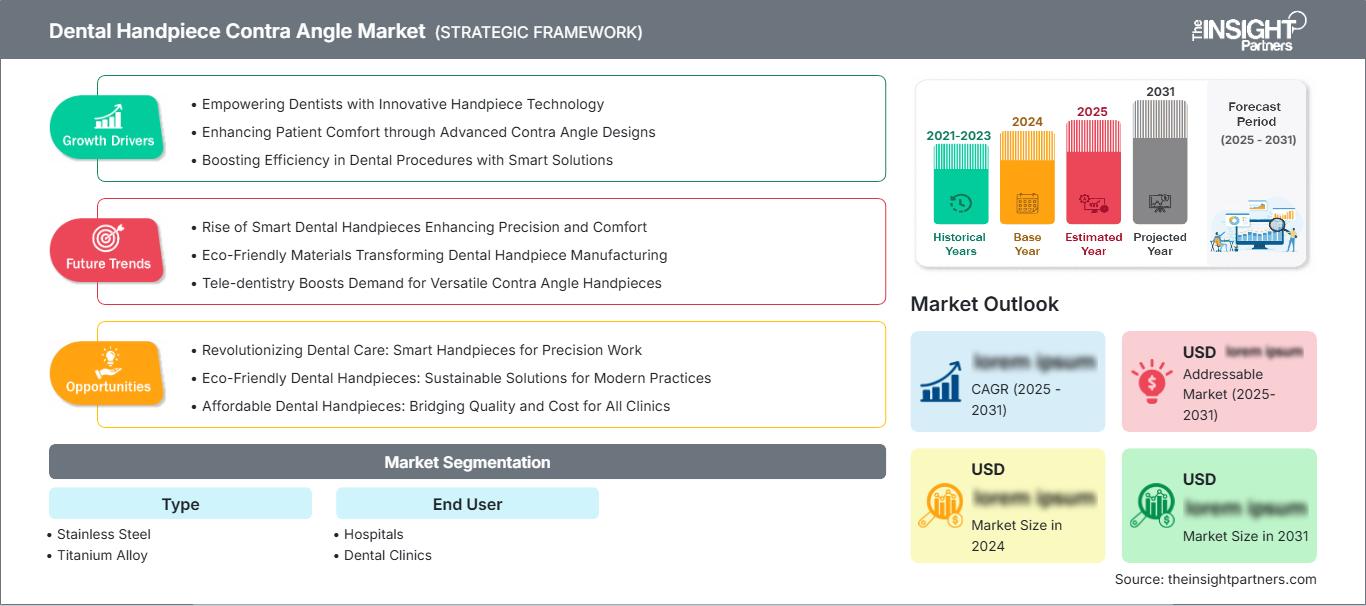
Dental Handpiece Contra Angle Market: Strategic Insights
Regional Insights
North America Dental Handpiece Contra Angle Market
North America is expected to capture a Dental Handpiece Contra Angle Market share of 39-43% in 2025 and register a 6.8-7.2% CAGR in 2026-2034. Favorable factors such as matured dental setup, presence of private practitioners, usage of restorative treatments, and regular replacement of old equipment facilitate the growth of the market in North America. Adoption of electric micromotors, expensive ergonomic instruments, and need for precise torque also helps in revenue generation. The US is the leading country market in this region.
The demands coming from Canada are relatively lower compared to the US. However, private dental, institutional dental, and upgradation of equipment in Canada add to the stable revenue generation in the region. Overall, decisions regarding purchasing are being made on the basis of total ownership cost, process of sterilization, warranty, repairing, and compatibility with existing motor. The availability of well-established manufacturers and distributors in the region is another favorable factor.
U.S. Dental Handpiece Contra Angle Market
The US constitutes about 83-86% of North America's 2025 share and is expected to grow at 6.7-7.1% CAGR between 2026-2034. Extensive dental expenditure, developed infrastructure of private practices, and demand for replacements ensure the US position. Foreign manufacturers like DENTSPLY SIRONA Inc., KaVo Dental GmbH, NSK Ltd., andBien-Air Dental SA have considerable commercial footprint.
Instrument application requires restorative dentistry, endodontic treatment, prosthodontics, implants, and general practice procedures. The main buyer setting for the industry is dental clinics as the latter regularly upgrades its equipment to make work more effective and comfortable for practitioners. Demand from hospitals arises for unique surgical operations. In addition, the market seeks dental handpieces that require less maintenance, small head, illumination, and can be used with existing electric motors.
Europe Dental Handpiece Contra Angle Market
Europe is expected to hold 27–31% market share in 2025, registering 7.0-7.4% CAGR during 2026-2034. Germany emerges as the dominant nation with the help of robust dental manufacturing industry, well-developed clinical infrastructure, and experienced professionals’ distribution networks. Other European nations such as the UK, France, Italy, and Spain generate further demand via private dentistry, hospital dentistry, and replacement products.
The UK is the place where there is demand for instruments that are ergonomic as well as reliable as private dental practices give more importance to efficient treatments and reliability of equipment. In Germany, advanced manufacturing capabilities are combined with an advanced installed base of equipment, which boosts the acceptance of high-end precision handpieces. France, Italy, and Spain also offer scope due to modernization of practices and efficiency in rotary procedures.
APAC Dental Handpiece Contra Angle Market
APAC is expected to account for a 21–25% share in 2025, with 8.1–8.6% CAGR in 2026–2034, being the top regional growth market. China takes the lead in regional demand, followed by Japan, South Korea, India, and Australia. Growing dental facilities, rising private clinic capacity, and improved equipment help in the process.
China and India represent an added level of importance in terms of their demands. There is relevance in Japan because of technological developments in dentistry. South Korea makes its relevance in terms of advanced dental clinics and manufacturing of medical devices, whereas the relevance of Australia arises from clinical standards. The region has growth prospects in view of the development in manufacturing, healthcare, and popularity of the service among the people. Reliability and scalability of instruments that provide premium functionality without being expensive become increasingly relevant in the region.
Middle East & Africa Dental Handpiece Contra Angle Market
Estimated growth rate of demand for Middle East and Africa is expected to increase at a 6.2%–6.7% CAGR between 2026–2034, with Saudi Arabia being the top market of the region. The UAE represents the largest market for the premium clinics; South Africa is a key market for demand for dental equipment in sub-Saharan Africa. Development of the private healthcare facilities and specialist clinics fuels purchase of equipment.
Rest of MEA region features fragmented demand with purchases mainly taking place in urban centers featuring healthcare facilities. Energy and infrastructure investments in the Gulf region fuel construction of clinics, hospitals, and medical complexes requiring advanced dental equipment. In the case of Africa, replacement of the equipment is limited due to financial and distribution restrictions but gradual development of urban dental practices.
Segmentation Analysis
Type
Type segmentation is shaped by material performance, instrument weight, durability, sterilization requirements, and purchase economics. Stainless steel remains the principal configuration because it combines established manufacturing processes with dependable mechanical performance. Titanium alloy supports premium positioning where lighter handling and corrosion resistance are valued. The type segment is projected to expand at a 7.2–7.6% CAGR from 2026–2034, with material innovation remaining central to product differentiation.
- Stainless Steel: Stainless-steel contra angles maintain the dominant position because established manufacturing capabilities, mechanical strength, sterilization compatibility, and broad clinical familiarity support widespread purchasing across hospitals and dental clinics.
- Titanium Alloy: Titanium-alloy instruments address clinicians seeking reduced weight, corrosion resistance, and premium ergonomics, making them strategically relevant for prolonged procedures and practices prioritizing advanced instrument handling.
End User
End User demand is influenced by procedure mix, procurement budgets, equipment utilization, replacement schedules, and the degree of specialization within clinical facilities. Dental clinics remain the principal purchasing environment because they represent a broad installed base and frequently replace instruments as practices modernize. Hospitals require specialized configurations for multidisciplinary and surgical applications. The segment is forecast to grow at a 7.4–7.8% CAGR from 2026–2034.
- Hospitals: Hospitals prioritize reliable, sterilization-compatible instruments for multidisciplinary dentistry, oral surgery, and complex procedures, with purchasing decisions strongly influenced by durability, service support, compatibility, and institutional procurement requirements.
- Dental Clinics: Dental clinics generate broad recurring demand because instruments are used intensively across restorative and specialist procedures, while independent practices increasingly prioritize ergonomic designs, efficient maintenance, and dependable lifecycle economics.
Opportunity Snapshot
| End User | Revenue Contribution (High/Medium/Low) | Trend Tag | Adoption Stage |
|---|---|---|---|
| Hospitals | Medium | Surgical Precision | Scaling |
| Dental Clinics | High | Clinic Modernization | Mature |
Dental Handpiece Contra Angle Market Growth Drivers and Impact Analysis
Rising Dental Procedure Volumes and Equipment Replacement
Growing treatment activity creates recurring requirements for reliable rotary instruments, while established practices must periodically replace handpieces because of wear, bearing degradation, chuck performance, and sterilization-related lifecycle demands. The World Health Organization estimates that oral diseases affect about 3.5 billion people globally, demonstrating the broad clinical burden that supports long-term dental service requirements. As treatment volumes rise, clinics increasingly evaluate instruments through throughput, maintenance intervals, ergonomic performance, and compatibility with existing motors. This shifts purchasing from simple replacement toward performance-oriented upgrades. Manufacturers can capture this demand by combining durable materials with service programs, interchangeable components, and broader product families. The resulting impact is a more resilient replacement market, particularly in established dental systems where installed equipment generates recurring demand.
Ergonomics and Precision Requirements in Clinical Workflows
Clinical preference is increasingly moving toward instruments that reduce operator fatigue while maintaining precise control over speed, torque, visibility, and cutting performance. Contra-angle designs with compact heads, balanced bodies, reduced vibration, and improved illumination can support more controlled access to difficult treatment areas. These characteristics have commercial importance because clinicians often use handpieces repeatedly during extended treatment sessions, making comfort and handling directly relevant to workflow efficiency. The impact extends beyond premium practices. As smaller private clinics modernize their equipment, ergonomic specifications increasingly become part of routine procurement criteria rather than specialist requirements. Suppliers that demonstrate measurable improvements in visibility, vibration control, maintenance, and instrument longevity can therefore differentiate their offerings while reducing customer sensitivity to initial acquisition price.
Expansion of Private Dental Infrastructure in Emerging Markets
Private dental infrastructure is expanding in several developing economies as urban populations grow, healthcare investment increases, and awareness of preventive and restorative treatment improves. WHO reports that most low- and middle-income countries still lack sufficient oral health services, indicating substantial unmet capacity rather than a saturated treatment environment. New clinics require complete equipment platforms, creating opportunities for manufacturers that can supply standardized handpiece configurations through regional distributors. The commercial effect is strongest where practices are transitioning from basic equipment to electric motor systems and more sophisticated rotary workflows. Vendors can accelerate penetration by offering tiered portfolios, local training, financing support, spare-parts availability, and service partnerships. This approach can convert infrastructure expansion into sustained instrument replacement and upgrade demand.
Dental Handpiece Contra Angle Market Future Trends
Connected Instrument Maintenance and Predictive Service Models
Future handpiece development is likely to extend beyond mechanical performance toward connected maintenance ecosystems. Instrument usage data, service histories, sterilization cycles, and replacement schedules can increasingly be captured through integrated dental-unit software or practice-management platforms. Such capabilities could help clinics identify abnormal vibration, declining performance, or maintenance requirements before failures interrupt treatment. The Dental Handpiece Contra Angle Market trends will therefore increasingly reflect lifecycle intelligence rather than isolated product specifications. Manufacturers may combine equipment sales with digital service contracts, automated maintenance reminders, and inventory planning. This model could reduce unplanned downtime while improving utilization of expensive instruments. Over time, predictive service could also create recurring revenue opportunities for suppliers and distributors, particularly among multi-site dental groups seeking standardized equipment management across geographically dispersed practices.
Advanced Materials and Smaller Precision Architectures
Material engineering is expected to become a stronger differentiator as manufacturers seek to reduce instrument weight without compromising durability or sterilization performance. Titanium alloys, advanced stainless-steel treatments, improved coatings, miniature bearings, and optimized gear assemblies can enable smaller heads and more balanced handpieces. Future designs may increasingly integrate illumination, improved spray delivery, and enhanced chuck systems within compact architectures. This direction should benefit clinicians performing procedures requiring precise access and extended instrument handling. Manufacturers will also need to demonstrate lifecycle durability because smaller components can increase engineering complexity and maintenance sensitivity. The Market trends are therefore likely to favor suppliers that can combine material science, precision machining, clinical ergonomics, and validated reprocessing performance into a single product platform.
Dental Handpiece Contra Angle Market Opportunities
Localized Production and Distribution in High-Growth APAC Markets
Manufacturers can pursue the Dental Handpiece Contra Angle Market Forecasts by strengthening localized distribution, technical support, and selected production capabilities across high-growth APAC economies. China, India, South Korea, and Southeast Asian markets offer differentiated opportunities because dental infrastructure varies considerably by city, clinic type, and procurement model. Rather than applying a single premium strategy, suppliers can develop tiered portfolios covering dependable stainless-steel instruments, advanced ergonomic configurations, and specialized surgical products. Local service centers can shorten repair cycles and improve customer confidence, while distributor partnerships can expand access beyond metropolitan markets. Strategic localization also reduces dependence on centralized inventory and can improve responsiveness to regulatory requirements. Investment should therefore prioritize service coverage, training, spare-parts availability, and channel development alongside direct manufacturing capacity.
Lifecycle Services and Premium Upgrade Programs
A second opportunity lies in converting replacement demand into structured lifecycle programs covering maintenance, refurbishment, trade-ins, spare parts, and premium upgrades. Clinics increasingly evaluate equipment through total ownership economics rather than acquisition price alone, creating room for suppliers to demonstrate measurable value through longer service intervals and reduced downtime. The Dental Handpiece Contra Angle Market Forecasts favor providers that can combine instrument sales with maintenance systems, training, and predictable service availability. Trade-in programs can also accelerate replacement of older handpieces while improving customer retention. For multi-site dental groups, standardized fleets and centralized maintenance contracts may offer additional efficiency. Vendors that build recurring service relationships can improve revenue visibility while strengthening barriers against lower-priced competitors that compete primarily through initial purchase cost.
Recent Developments
- April 2026: DENTSPLY SIRONA Inc. announced that its dental-dedicated MRI collaboration with Siemens Healthineers had achieved FDA clearance following clinical validation. The development reinforces the company’s broader strategy of integrating advanced technology into dental workflows and demonstrates continued investment in connected and technology-enabled dentistry.
- April 2025: Bien-Air Dental SA introduced the CA 1:2.5 high-speed contra-angle with latch-type burs, emphasizing robustness, stability, reduced vibration, and faster cutting. The product illustrates continued engineering efforts to improve mechanical performance and clinician handling within compact contra-angle architectures.
- April 2025: W&H Dentalwerk Bürmoos GmbH reported its IDS 2025 product presentation, featuring more than 10 new products, including the Synea Power Edition contra-angle developed for demanding applications such as zirconium restoration removal. The launch highlights continued investment in durable transmission instruments and integrated dental workflows.
Frequently Asked Questions

- Comprehensive Market Sizing and Forecast Analysis
- Detailed Segmentation Analysis
- In-Depth Market Dynamics Assessment
- Regional and Country-Level Insights
- Competitive Landscape and Company Benchmarking
- Strategic Business Intelligence
Recent Reports
Testimonials

The Insight Partners' SCADA System Market report is comprehensive, with valuable insights on current trends and future forecasts. The team was highly professional, responsive, and supportive throughout. We are very satisfied and highly recommend their services.
RAN KEDEM Partner, Reali Technologies LTDs
I requested a report on a very specific software market and the team produced the report in a few days. The information was very relevant and well presented. I then requested some changes and additions to the report. The team was again very responsive and I got the final report in less than a week.
JEAN-HERVE JENN Chairman, Future Analytica
We worked with The Insight Partners for an important market study and forecast. They gave us clear insights into opportunities and risks, which helped shape our plans. Their research was easy to use and based on solid data. It helped us make smart, confident decisions. We highly recommend them.
PIYUSH NAGPAL Sr. Vice President, High Beam Global
The Insight Partners delivered insightful, well-structured market research with strong domain expertise. Their team was professional and responsive throughout. The user-friendly website made accessing industry reports seamless. We highly recommend them for reliable, high-quality research services
YUKIHIKO ADACHI CEO, Deep Blue, LLC.
This is the first time I have purchased a market report from The Insight Partners.While I was unsure at first, I visited their web site and felt more comfortable to take the risk and purchase a market report.I am completely satisfied with the quality of the report and customer service. I had several questions and comments with the initial report, but after a couple of dialogs over email with their analyst I believe I have a report that I can use as input to our strategic planning process.Thank you so much for taking the extra time and making this a positive experience.I will definitely recommend your service to others and you will be my first call when we need further market data.
JOHN SUZUKI President and Chief Executive Officer, Board Director, BK Technologies
I wish to appreciate your support and the professionalism you displayed in the course of attending to my request for information regarding to infectious disease IVD market in Nigeria. I appreciate your patience, your guidance, and the fact that you were willing to offer a discount, which eventually made it possible for us to close a deal. I look forward to engaging The Insight Partners in the future, all thanks to the impression you have created in me as a result of this first encounter.
DR CHIJIOKE ONYIA MANAGING DIRECTOR, PineCrest Healthcare Ltd.Reason to Buy
- Informed Decision-Making
- Understanding Market Dynamics
- Competitive Analysis
- Identifying Emerging Markets
- Customer Insights
- Market Forecasts
- Risk Mitigation
- Boosting Operational Efficiency
- Strategic Planning
- Investment Justification
- Tracking Industry Innovations
- Aligning with Regulatory Trends





 Get Free Sample for