
Dental Intraoral Scanners Market Growth, Demand & Size by 2034
Coverage: By Type (Powder Free, and Powder Based); Modality (Standalone, Benchtop, Portable, and Wall Mounted); Technology (Optical Wand, and Confocal Microscopic Imaging); Application (Dental Restoration, Orthodontics, Periodontics, Endodontics, and Others); End Use (Dental Hospitals and Clinics, Dental Diagnostic Centers, Dental Academic and Research Institutes, and Others), and Geography (North America, Europe, Asia Pacific, and South and Central America)
- Status : Data Released
- Report Code : TIPRE00024404
- Category : Life Sciences
- No. of Pages : 150
- Available Report Formats :


- Last update date : August 25, 2026


2025 Market Size
US$ 722.9 Mn
Base year value
2034 Forecast
US$ 1,332.73 Mn
Projected by 2034
CAGR 2026-2034
7.03 %
Growth rate
Addressable Market
US$ 9,279.17 Mn
(2026-2034)
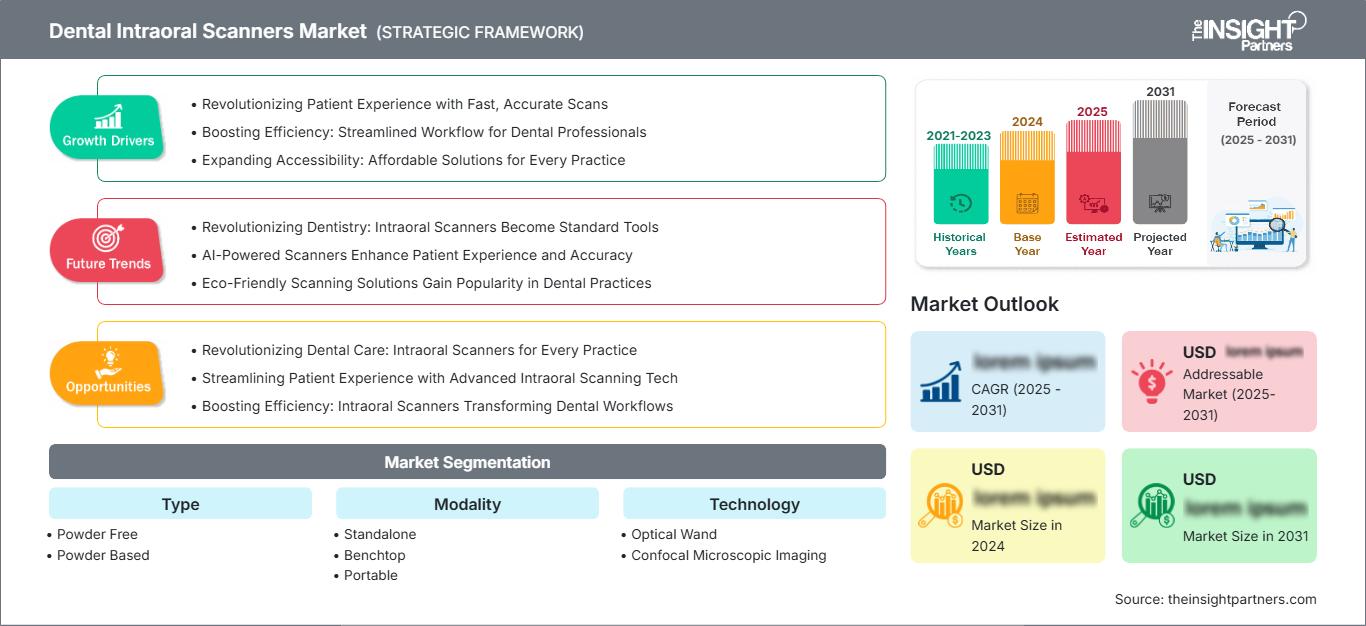
The Dental Intraoral Scanners Market was valued at US$ 722.9 Million in 2025 and is projected to reach US$ 1,332.73 Million by 2034, expanding at a CAGR of 7.03% from 2026 to 2034. Market growth is indicative of the ongoing shift from traditional impressions to digital oral geometries, which can be attributed to developments made in optical data collection and software, as well as clinical practices, restorative dentistry, and orthodontics in dental clinics and labs.
North America is projected to retain its relatively strong position in the Dental Intraoral Scanners Market Size, driven by a high rate of adoption of digital dentistry, dental service providers, and reimbursement systems that support technology-based procedures. The regional CAGR is forecasted to be at 7.4-7.8% during 2026-2034, driven by replacement needs and CAD/CAM integration.
Dental Intraoral Scanners Market Assessment and Insights
- North America: North America is projected to account for a 44–48% share in 2025 and grow at a CAGR of 7.4–7.8% between 2026–2034, supported by established digital workflows, dental service organizations, and high technology replacement activity.
- US: The US is expected to represent 87–91% of North America's 2025 market and grow at a CAGR of 7.3–7.7% between 2026–2034, led by organized practices and restorative digitization.
- Europe: Europe is estimated to hold a 22–26% share in 2025 and expand at a CAGR of 6.8–7.3% between 2026–2034, with Germany, the UK, France, Italy, and Spain supported by mature dental technology adoption and laboratory connectivity.
- Asia Pacific: Asia Pacific is estimated at an 18–22% share in 2025 and is projected to grow at a CAGR of 8.0–8.6% between 2026–2034, led by China, Japan, South Korea, India, and Australia as clinics modernize workflows.
- Largest Segment: Powder Free is estimated to command a 68–72% market share in 2025, with a CAGR of 7.2–7.6% between 2026–2034, reflecting simplified scanning and reduced workflow preparation.
- High Growth Segment: Portable scanners are estimated to hold a 20–24% market share in 2025 and expand at a CAGR of 9.1–9.6% between 2026–2034, supported by flexible chairside deployment.
- Key companies analyzed in detail: Dentsply Sirona, Carestream Dental LLC, Planmeca Oy, Align Technology, Inc., Medit Corp., 3Shape A/S, ACTEON Group, 3DISC, Owandy Radiology, Guangdong Launca Medical Device Technology Co., Ltd., Midmark Corporation, Ningbo Runyes Medical Instrument Co., Ltd., ASAHIROENTGEN IND. CO., LTD., DÜRR DENTAL SE, Condor, GC Europe AG, Apixia Corp., Shining 3D, Institut Straumann AG, and VATECH.
Source: The Insight Partners' analysis based on proprietary research, government publications, company annual reports, investor presentations, industry databases, and expert interviews.
The innovation trend in technology development of the Dental Intraoral Scanners Market favors scanner competition in terms of clinical intelligence, speed of acquisition, ergonomic design, and interoperable software. The production trend tends to focus on smaller optical systems, wireless communication capability, cloud computing, and reusable scanner elements. The differentiation among manufacturers is done through automation of alignment, wider field of view, artificial intelligence-based interpretation, and integration of workflows related to restoration, orthodontics, implants, and laboratory design.
Future growth of the market will have to take into account increasing investments in the new dental markets that are still developing in terms of digitalization of clinics. The regulatory environment, which focuses on patient safety, data handling, device interoperability, and eco-friendly healthcare solutions, might become an advantage for those companies that can provide a validated workflow and lifecycle management for devices.
Dental Intraoral Scanners Market Report Scope
| Report Attribute | Details |
|---|---|
| Market size in 2025 | US$ 722.9 Million |
| Market Size by 2034 | US$ 1,332.73 Million |
| Global CAGR (2026 - 2034) | 7.03% |
| Historical Data | 2021-2024 |
| Forecast period | 2026-2034 |
Dental Intraoral Scanners Market Analysis
The Dental Intraoral Scanners Market dynamics of Dental Intraoral Scanners are characterized by the requirement for faster digital impressions, patient comfort, and integration with the design software for restorations and orthodontics. The market ecosystem consists of suppliers of optical components, manufacturers of scanners, software companies, dental laboratories, distributors, dental practitioners, and CAD/CAM companies. The supply dynamics favor modularity in hardware and software, and open platforms that can be used for multiple clinical applications.
In the value chain, the competition among manufacturers is based on optical precision, speed of the scanning process, ergonomics, software capability, services, and inter-operability. It is essential that dental laboratories continue to be an important partner in terms of demand since digital files minimize the need for impressions and enable quick communication of the design. Clinical evaluation of scanners tends to be in terms of workflow cost-effectiveness and not in terms of hardware capability alone.
The competitive analysis of the Dental Intraoral Scanners Market Report suggests that the competitive structure is characterized as fragmented and technology oriented. The main companies competing in this sector on the basis of effectiveness of their scanning tools, workflow software, integration and dental ecosystem are Dentsply Sirona, Carestream Dental LLC, Planmeca Oy, Align Technology, Inc., Medit Corp., and 3Shape A/S. The competitors, such as ACTEON Group, 3DISC, Owandy Radiology, and Guangdong Launca Medical Device Technology Co., Ltd. add value to the competitive structure.
Increasingly, strategic positioning will depend on the ability to turn scanner hardware into a comprehensive digital workflow solution. Companies such as Midmark Corporation, Ningbo Runyes Medical Instrument Co., Ltd., ASAHIROENTGEN IND. CO., LTD., DÜRR DENTAL SE, Condor, GC Europe AG, Apixia Corp., Shining 3D, Institut Straumann AG, and VATECH are present within imaging, lab, restoration, implants, or digital dentistry ecosystem. This will result in investments moving towards software compatibility, AI-based functionality, wireless capabilities, and ecosystem integration.
● REPORT CUSTOMIZATION
Tailor This Report To Align With Your Specific Business Requirements
This report can be customized to align precisely with your business objectives, scope, and target markets. Customization options include tailored segmentation, geography, competitive analysis, and strategic insights to support informed decision-making.
Customize This Report →WHAT YOU CAN ADJUST
- ● Segmentations
- ● Geography
- ● Competitive Analysis
- ● Language Preferences
Dental Intraoral Scanners Market: Strategic Insights
Regional Insights
North America Dental Intraoral Scanners Market
North America is estimated to represent 44–48% of the Dental Intraoral Scanners Market share in 2025 and is projected to grow at a CAGR of 7.4–7.8% through 2034. The US drives regional demand through high dental technology penetration, organized practice groups, specialist dentistry, restorative workflows, and established laboratory networks. Canada contributes through steady modernization of private practices and dental laboratories.
Regional demand is strengthened by replacement cycles, digital impressions, and increasing expectations for effective patient communication. The manufacturers have the advantage of existing sales channels, while the dental societies are now evaluating the scanners on the basis of interoperability and workflow efficiency. It is also a good place for the development of software-driven technology, artificial intelligence diagnosis, and chairside CAD/CAM systems.
U.S. Dental Intraoral Scanners Market Market
Estimates indicate that the U.S. will dominate North America's 2025 market with a share of 87-91% and will grow at CAGR 7.3-7.7% in the period of 2026-2034. Demand will be driven by general dentistry, orthodontics, prosthodontics, implantology, and multi-location dental practices. Multi-location practices will be able to invest in scanners with the help of uniform workflow management, laboratories, and equipment.
Carestream Dental LLC, Align Technology, Inc., Dentsply Sirona, Medit Corp., 3Shape A/S, and other global companies have a strong business presence in the US market. Trends in application demand include restorative planning, digital orthodontic treatment, implant planning, and visualization of patients. Purchase decisions are affected by software compatibility, geographical coverage of services, training, and data migration capabilities. The developed dental technology infrastructure in the country allows it to play an important role in testing connected scanning systems with AI.
Europe Dental Intraoral Scanners Market Market
Estimated share in 2025 – 22–26%, CAGR is forecasted to be 6.8–7.3%. Germany is expected to stay on the top of the market owing to its well-developed ecosystem of dental technologies; meanwhile, the UK, France, Italy, and Spain have a considerable demand due to clinic digitalization and laboratory equipment.
The UK still gives preference to process efficiency, digital orthodontics, and cloud dental services. Germany will profit from its dental manufacturing industry and high laboratory penetration rate. The growth rates for France, Italy, and Spain are going to rise due to the replacement of traditional impressions and digital communications with laboratories. Throughout the region, interoperability, data security, medical devices compliance, and sustainability issues have an impact on purchase decision-making; meanwhile, well-established dental laboratories increase the demand for transferable digital files.
APAC Dental Intraoral Scanners Market Market
The APAC region is projected to account for 18-22% market share by 2025 and grow with a CAGR of 8.0-8.6%. China is the largest country, followed by Japan, South Korea, India, and Australia. The industrial strength, expansion of private dental clinics, and availability of digital tools drive adoption in the region.
China capitalizes on the presence of local devices manufacturing and increasing number of digital dental laboratories; Japan focuses on precision and process reliability. South Korea maintains activity in the domain of digital orthodontics and restoration techniques, and India is a promising long-term market due to clinics' digitization. Digital dentistry practices are well-developed in Australia.
Middle East & Africa Dental Intraoral Scanners Market Market
The Middle East and Africa region is projected to grow at a CAGR of 6.5–7.2% through 2034. Saudi Arabia leads regional adoption, followed by the UAE and South Africa, while the rest of MEA remains an emerging opportunity with uneven technology access and infrastructure.
Investment in the infrastructure of the health care sector in the Saudi Arabian and UAE contexts enables the acquisition of high-quality dental machinery especially in private hospitals and specialist clinics. In South Africa, there is already a relatively well-established dental services system. The income generated from the energy sector and infrastructure development in the Gulf nations allows for capital investments in the health care sector.
Segmentation Analysis
Type
The Type segment is projected to grow at a CAGR of 7.2–7.6% between 2026–2034. Powder-free systems are expected to remain dominant because they reduce preparation steps and simplify clinical use. Powder-based systems retain relevance in selected workflows where established operating practices and specific surface conditions influence clinician preference. The segment increasingly competes on workflow simplicity, scanning consistency, and total ownership cost.
- Powder Free: Powder-free scanners hold the strongest market position because they streamline chairside preparation, reduce operator handling, and support efficient digital impressions across restorative, orthodontic, and implant workflows.
- Powder Based: Powder-based systems retain demand among practices familiar with established scanning protocols, particularly where clinicians value specific surface acquisition characteristics or existing equipment investments.
Modality
The Modality segment is expected to expand at a CAGR of 8.3–8.7% during 2026–2034. Portable configurations should gain momentum as practices prioritize flexible room utilization and chairside convenience. Standalone and benchtop systems remain important for dedicated workflows, while wall-mounted configurations can address space management in facilities with standardized clinical layouts. Modality selection increasingly reflects workflow design rather than hardware preference alone.
- Standalone: Standalone scanners support dedicated clinical use and remain relevant where practices seek straightforward deployment without extensive integration into larger equipment configurations.
- Benchtop: Benchtop systems serve controlled scanning environments, including laboratories and facilities requiring stable positioning, repeatable workflows, and integration with broader digital production processes.
- Portable: Portable devices offer flexible movement between treatment rooms and locations, making them strategically important for multi-chair practices, mobile services, education, and space-constrained clinical environments.
- Wall Mounted: Wall-mounted configurations support organized clinical layouts where equipment positioning, accessibility, and efficient use of treatment-room space are important procurement considerations.
Technology
The Technology segment is forecast to grow at a CAGR of 7.4–7.8% from 2026 to 2034. Optical Wand systems remain widely applicable because of their clinical familiarity and expanding software capabilities. Confocal Microscopic Imaging benefits from demand for detailed surface acquisition and precision, particularly in workflows where scan quality and geometry fidelity directly affect downstream restorative or laboratory outcomes.
- Optical Wand: Optical wand systems remain broadly adopted because clinicians are familiar with handheld scanning, while manufacturers continue improving acquisition speed, ergonomics, alignment, and software-assisted capture.
- Confocal Microscopic Imaging: Confocal microscopic imaging supports precision-focused workflows where detailed surface capture and reliable geometry are important for demanding restorative, implant, and laboratory applications.
Application
The Application segment is anticipated to register a CAGR of 7.5–7.9% through 2034. Dental Restoration remains an important use case because digital impressions connect directly with CAD/CAM design and laboratory manufacturing. Orthodontics is supported by digital treatment planning, while Periodontics and Endodontics benefit from increasingly detailed digital records and multidisciplinary clinical workflows.
- Dental Restoration: Restorative workflows represent a major demand base because digital impressions can connect scanning directly with crown, bridge, implant, and other CAD/CAM design processes.
- Orthodontics: Orthodontic adoption is supported by digital treatment simulation, aligner planning, progress comparison, and patient communication, creating recurring demand for accurate and easily transferable scans.
- Periodontics: Periodontal applications benefit from longitudinal digital records that can support visualization, treatment planning, documentation, and communication between specialists and general practitioners.
- Endodontics: Endodontic workflows increasingly use digital records alongside imaging and treatment planning, creating a supporting application for scanners where detailed geometry and multidisciplinary information are required.
Opportunity Snapshot
| Application | Revenue Contribution (High/Medium/Low) | Trend Tag (MAX 2 words) | Adoption Stage (Emerging/Scaling/Mature) |
| Dental Restoration | High | Chairside CAD/CAM | Mature |
| Orthodontics | High | Aligner Planning | Mature |
| Periodontics | Medium | Digital Records | Scaling |
| Endodontics | Medium | Workflow Imaging | Scaling |
Dental Intraoral Scanners Market Growth Drivers and Impact Analysis
Integration of Scanning With End-to-End Digital Dentistry
The most powerful structuring factor would be the incorporation of scanners with the CAD/CAM design process, communication with the lab, orthodontics treatment, implants, and overall software. Rather than serving as individual impression machines, scanners become gateways to digital dental care treatment ecosystems. FDI’s 2025 digital dentistry policy highlights scanners, imaging, CAD/CAM, artificial intelligence, and electronic health systems as interrelated elements of contemporary oral healthcare. This ecosystem approach may result in increased equipment efficiency since one scanner can work for multiple types of treatments. It also alters the purchasing criteria as interoperability and software compatibility become almost as important as optical capabilities. From the manufacturer’s perspective, integration can help to retain customers and create revenue streams through software, while dental offices will be able to minimize manual impressions and communication with the labs and patients.
Expansion of Digital Workflows Across Organized Dental Practices
The growth of the size of organized dental practices leads to increased strategic importance of the standardization of scanning workflows. Multi-site groups can benefit from using common hardware, software, training, and laboratory procedures, achieving the advantages that individual dental practices do not have due to the economies of scale. Moreover, standardization facilitates monitoring of the efficiency of operations with indicators such as the quality of scans, utilization, turnover, and case acceptance. The consequences of standardization include changes in equipment purchases as centralized purchases will facilitate faster transitions to new, wireless, cloud-based or AI-assisted solutions. As a result, the competition of scanner suppliers can rely on fleet management services, integrations, and workflow analysis.
Rising Burden of Oral Disease and Need for Efficient Care
The global burden of oral disease provides a broad structural rationale for improving diagnostic and treatment workflows. WHO estimates that oral diseases affect approximately 3.5 billion people worldwide, while untreated dental caries affects about 2.5 billion people and severe periodontal disease affects around 1 billion. These figures reinforce the need for scalable prevention, diagnosis, treatment planning, and follow-up systems. Digital scanning does not replace clinical examination or radiography, but it can strengthen documentation, visualization, treatment communication, and restorative planning. As dental systems seek greater efficiency, digital records can help coordinate multidisciplinary care and support longitudinal monitoring. The resulting market impact is strongest where scanner adoption complements broader healthcare capacity expansion rather than functioning as a standalone technology upgrade.
Dental Intraoral Scanners Market Future Trends
AI-Enhanced Interpretation of Intraoral Scan Data
Dental Intraoral Scanners Market trends are increasingly moving toward AI-assisted interpretation rather than simple three-dimensional data capture. Future systems are likely to identify anatomical structures, highlight potential abnormalities, compare sequential scans, and organize clinically relevant information without requiring clinicians to manually inspect every region. Multimodal systems could combine optical scans with radiographic and patient-record information, creating richer treatment-planning environments. The commercial effect will depend on clinical validation, regulatory acceptance, explainability, cybersecurity, and integration with existing dental software. Vendors able to translate complex scan datasets into practical chairside insights may achieve stronger differentiation than suppliers competing solely on scanning speed. Over time, AI capabilities could also influence scanner utilization by extending the device's role from impression acquisition toward continuous oral health monitoring and patient engagement.
Cloud-Native Scanning and Distributed Treatment Workflows
Cloud-connected scanning is expected to become more important as dental practices coordinate treatment with external laboratories, specialists, manufacturers, and centralized design teams. Future platforms may automatically synchronize scan files, treatment plans, case instructions, and workflow status across authorized stakeholders, reducing manual file transfers and administrative delays. Cloud architecture can also support continuous software updates and centralized device management across multi-site organizations. However, adoption will depend on reliable connectivity, data governance, cybersecurity controls, interoperability, and clear ownership of patient information. The strategic opportunity is particularly relevant for dental groups and laboratories managing high case volumes. Vendors that combine secure cloud infrastructure with intuitive clinical interfaces can position scanning as a networked service rather than an isolated capital asset, potentially changing how dental practices evaluate equipment economics.
Dental Intraoral Scanners Market Opportunities
Localized Digital Dentistry Platforms in Emerging Markets
Emerging markets present an opportunity to develop localized scanner ecosystems tailored to clinical budgets, infrastructure constraints, training needs, and regional laboratory networks. India, Southeast Asia, Latin America, and selected Middle Eastern markets can benefit from simplified devices paired with localized software, distributor training, remote technical support, and financing structures. Dental Intraoral Scanners Market Forecasts should therefore consider not only unit adoption but also the transition from first-time digital users toward higher-value connected workflows. Manufacturers can capture this progression by designing upgrade paths that allow practices to begin with essential scanning capabilities and later add cloud services, CAD/CAM integration, analytics, or AI modules. Local partnerships with dental schools and laboratories could further reduce adoption barriers by creating skilled user communities and demonstrating practical economic benefits.
Scanner-Laboratory Networks and Workflow-as-a-Service Models
The expanding connection between dental clinics and laboratories creates an opportunity for providers to develop workflow-as-a-service models around scanning, design, manufacturing, and case management. Rather than selling equipment alone, suppliers can bundle scanners with software, laboratory connectivity, training, service, and financing. This approach can reduce the initial technology barrier for smaller practices while creating recurring revenue opportunities for vendors and laboratory partners. The model is particularly relevant where clinics have limited internal CAD/CAM capabilities but generate sufficient digital cases to justify outsourcing. Providers can differentiate through turnaround-time visibility, file validation, automated case routing, and integration with laboratory design systems. Strategic investment should focus on interoperability and predictable workflow economics, because long-term customer value will depend on reliable case throughput rather than scanner ownership alone.
Recent Developments
- June 2026: Planmeca Oy made the Planmeca Onyx intraoral scanner available for orders following its initial presentation at IDS 2025. The scanner supports wired and wireless operation and is designed around flexible clinical workflows, combining optical data capture with a form factor intended for dental practices of different sizes.
- October 2025: Align Technology, Inc. announced new iTero Digital Solutions innovations, including expanded chairside visualization and integrated software tools designed to support oral health assessment, treatment communication, restorative workflows, and Invisalign-related consultations. The update reinforced the company's strategy of connecting scanning hardware with broader digital treatment workflows.
- March 2025: Dentsply Sirona presented major enhancements to Primescan 2 at IDS 2025, including a new cart configuration, caries detection functionality, improved connectivity, and reduced internet requirements. The company positioned the updated system as a cloud-native platform supporting connected digital dentistry workflows.
Frequently Asked Questions

- Comprehensive Market Sizing and Forecast Analysis
- Detailed Segmentation Analysis
- In-Depth Market Dynamics Assessment
- Regional and Country-Level Insights
- Competitive Landscape and Company Benchmarking
- Strategic Business Intelligence
Recent Reports
Testimonials

The Insight Partners' SCADA System Market report is comprehensive, with valuable insights on current trends and future forecasts. The team was highly professional, responsive, and supportive throughout. We are very satisfied and highly recommend their services.
RAN KEDEM Partner, Reali Technologies LTDs
I requested a report on a very specific software market and the team produced the report in a few days. The information was very relevant and well presented. I then requested some changes and additions to the report. The team was again very responsive and I got the final report in less than a week.
JEAN-HERVE JENN Chairman, Future Analytica
We worked with The Insight Partners for an important market study and forecast. They gave us clear insights into opportunities and risks, which helped shape our plans. Their research was easy to use and based on solid data. It helped us make smart, confident decisions. We highly recommend them.
PIYUSH NAGPAL Sr. Vice President, High Beam Global
The Insight Partners delivered insightful, well-structured market research with strong domain expertise. Their team was professional and responsive throughout. The user-friendly website made accessing industry reports seamless. We highly recommend them for reliable, high-quality research services
YUKIHIKO ADACHI CEO, Deep Blue, LLC.
This is the first time I have purchased a market report from The Insight Partners.While I was unsure at first, I visited their web site and felt more comfortable to take the risk and purchase a market report.I am completely satisfied with the quality of the report and customer service. I had several questions and comments with the initial report, but after a couple of dialogs over email with their analyst I believe I have a report that I can use as input to our strategic planning process.Thank you so much for taking the extra time and making this a positive experience.I will definitely recommend your service to others and you will be my first call when we need further market data.
JOHN SUZUKI President and Chief Executive Officer, Board Director, BK Technologies
I wish to appreciate your support and the professionalism you displayed in the course of attending to my request for information regarding to infectious disease IVD market in Nigeria. I appreciate your patience, your guidance, and the fact that you were willing to offer a discount, which eventually made it possible for us to close a deal. I look forward to engaging The Insight Partners in the future, all thanks to the impression you have created in me as a result of this first encounter.
DR CHIJIOKE ONYIA MANAGING DIRECTOR, PineCrest Healthcare Ltd.Reason to Buy
- Informed Decision-Making
- Understanding Market Dynamics
- Competitive Analysis
- Identifying Emerging Markets
- Customer Insights
- Market Forecasts
- Risk Mitigation
- Boosting Operational Efficiency
- Strategic Planning
- Investment Justification
- Tracking Industry Innovations
- Aligning with Regulatory Trends





 Get Free Sample for