
Dental Restorative Supplies Market Growth, Trends & Forecast by 2034
Coverage: by Type (Metals and Alloys, Ceramics, Composite Materials, Other); Application (Impression Material, Expendable Pattern Materials, Denture Materials, Adhesive Material, Other), and Geography (North America, Europe, Asia Pacific, and South and Central America)
- Status : Data Released
- Report Code : TIPRE00008210
- Category : Life Sciences
- No. of Pages : 150
- Available Report Formats :


- Last update date : September 07, 2026


2025 Market Size
US$ 4.43 Bn
Base year value
2034 Forecast
US$ 6.15 Bn
Projected by 2034
CAGR 2026-2034
3.72 %
Growth rate
Addressable Market
US$ 48.07 Bn
(2026-2034)
The Dental Restorative Supplies Market is valued at US$ 4.43 Billion in 2025 and is projected to reach US$ 6.15 Billion by 2034, registering a CAGR of 3.72% during 2026–2034. The market includes materials and products used in both direct and indirect restoration procedures, where the need is driven by the incidence of oral disease, new material developments, digitization, procedural efficiencies, and increasing use of aesthetic restoration.
North America continues to be strategically significant due to the existing dental infrastructure, high levels of procedural use, and ongoing replacement of traditional restoration procedures with digitally empowered materials. The Dental Restorative Supplies Market Size in North America will witness growth at an estimated CAGR of 3.9% to 4.3% from 2026 to 2034.
Dental Restorative Supplies Market Assessment and Insights
- North America: North America is estimated to represent a 34–38% share in 2025, with the Dental Restorative Supplies Market growing at a 3.9–4.3% CAGR between 2026–2034, supported by established clinical infrastructure and restorative material replacement cycles.
- US: The US accounts for 28–32% of the global market in 2025 and is expected to grow at a 3.8–4.2% CAGR between 2026–2034, led by sophisticated dental practices and material upgrades.
- Europe: Europe holds a 27–31% share in 2025 and is projected to grow at a 3.4–3.8% CAGR between 2026–2034, with Germany, the UK, France, Italy, and Spain supporting demand through established restorative care systems.
- Asia Pacific: Asia Pacific represents a 22–26% share in 2025 and is anticipated to expand at a 4.2–4.7% CAGR between 2026–2034, with China, Japan, South Korea, India, and Australia shaping regional consumption.
- Largest Segment: Composite Materials holds an estimated 42–46% market share in 2025 and is expected to expand at a 3.8–4.2% CAGR between 2026–2034.
- High Growth Segment: Impression Material represents approximately 22–26% share in 2025 and is projected to grow at a 4.3–4.7% CAGR between 2026–2034.
- Key companies analyzed in detail: COLTENE Holding AG, Den-Mat Holdings LLC, DENTSPLY SIRONA Inc., GC Corporation, Ivoclar Vivadent AG, Kerr Corporation, Shofu Dental Corporation, VOCO GmbH, Zhermack S.p.A., and Ultradent Products, Inc.
Source: The Insight Partners' analysis based on proprietary research, government publications, company annual reports, investor presentations, industry databases, and expert interviews.
The evolution of material science has been significant to the development of restorative dentistry through better polymerization, fillers, adhesives, optical properties, and handling capabilities. Composite materials are used for minimally-invasive procedures while ceramics and metal alloys are suitable for use where high strength is required. Digital impressions, CAD/CAM production, and automated laboratories have impacted procurement procedures to push suppliers to offer materials for seamless integration into the process.
In future, regional investments will tend to focus on materials that deliver reliable clinical results and reduced procedure times. The emerging Asian market will present large volumes since dental access continues to grow, while European and North American markets will emphasize aesthetics, efficiency, and replacement needs. Biocompatibility, claims made and production consistencies will continue to shape the development of formulations, testing, and commercialization strategies.
Dental Restorative Supplies Market Report Scope
| Report Attribute | Details |
|---|---|
| Market size in 2025 | US$ 4.43 Billion |
| Market Size by 2034 | US$ 6.15 Billion |
| Global CAGR (2026 - 2034) | 3.72% |
| Historical Data | 2021-2024 |
| Forecast period | 2026-2034 |
Dental Restorative Supplies Market Analysis
The demand is based on the permanent requirement for repairing teeth with carious lesions, wearing, damage, and aged degradation. The development of the market for dental restorative materials is driven by a wide chain of players including raw-material manufacturers, formulations experts, dental distributors, laboratories, dentists, and patients. Today the selection of products focuses on strength, appearance, manipulation time, adhesion properties, and digitalization.
In response to these Dental Restorative Supplies Market trends, the manufacturers work to create consistent formulation, increase shelf life, and introduce solutions that decrease the number of processing steps. Clinics tend to use integrated kits covering preparation, bonding, restorative treatment, finishing, and maintenance stages. In a similar way, laboratories look for materials that fit the workflow with scanning, milling, and printing. Such trends favor those vendors who are able to ensure the quality of their products in different geographical markets while keeping the production costs low.
The competitive positioning of companies is becoming increasingly reliant upon the depth of the product portfolio, educational programs, reach of distribution, and the differentiation of formulations. COLTENE Holding AG offers a wide portfolio of restoratives and consumables, while DENTSPLY SIRONA Inc. offers both restoratives and connected technologies. On the other hand, GC Corporation, Ivoclar Vivadent AG, and Kerr Corporation differentiate themselves through materials knowledge and professional relationships. Shofu Dental Corporation and VOCO GmbH provide niche competencies in restoratives and clinical applications.
There is a growing trend toward strategic investment, which is more connected with high-quality composites, adhesives, CAD/CAM materials, and efficient distribution strategies. Zhermack S.p.A. remains up-to-date thanks to its products that are designed for impressions and laboratory procedures, whereas Den-Mat Holdings LLC offers aesthetic restorative products. Ultradent Products, Inc. provides competitive character of the market through the development of products that correspond to the needs of clinicians. It means that, according to the Dental Restorative Supplies Market Report, differentiation happens through integration.
● REPORT CUSTOMIZATION
Tailor This Report To Align With Your Specific Business Requirements
This report can be customized to align precisely with your business objectives, scope, and target markets. Customization options include tailored segmentation, geography, competitive analysis, and strategic insights to support informed decision-making.
Customize This Report →WHAT YOU CAN ADJUST
- ● Segmentations
- ● Geography
- ● Competitive Analysis
- ● Language Preferences
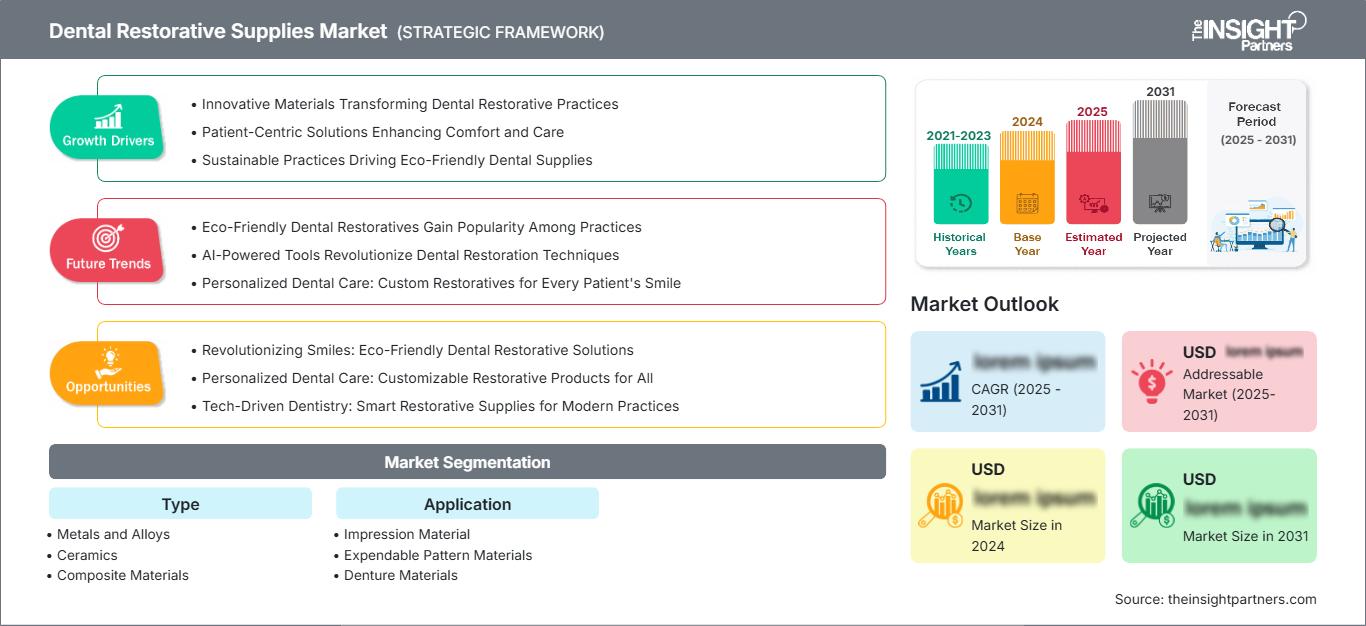
Dental Restorative Supplies Market: Strategic Insights
Regional Insights
North America Dental Restorative Supplies Market
The North American market is expected to command a 34-38% of the Dental Restorative Supplies Market share in 2025, and will experience a compound annual growth rate of 3.9-4.3% until 2034. This market has been supported by a high number of dental facilities, availability of insurance coverage for procedures, established lab network, and use of more restorative procedures.
In the region, the United States leads the way in terms of consumption, while Canada is a minor consumer of these materials. The trend of choice among dentists is now towards materials that are easy to apply, easily cured, aesthetically pleasing, and compatible with digital impressions. Access to these materials is key because independent practices rely on these regularly refilled consumable products.
U.S. Dental Restorative Supplies Market
The US holds around 76–84% of the total market for North America in 2025 and is expected to grow at a 3.8–4.2% CAGR during the 2024-2034 period. The high level of procedure intensity, the presence of large numbers of private practice networks, the dental laboratory sector, and advanced technological adoption drive steady demand for materials from both direct and indirect restorations.
Trends toward aesthetic composite materials, simplified adhesives, and materials that fit into chairside digital dentistry are emerging. Top-tier brands have the potential to succeed by offering faster procedures, good handling properties, and durable results. The consolidation of dental service organizations may also play a role in material selection since large-scale networks can standardize their material selection process.
Europe Dental Restorative Supplies Market
Europe has an estimated share of 27–31% in 2025 and will experience a 3.4–3.8% CAGR between 2025 and 2034, with Germany accounting for the most prominent country. Well-developed dental infrastructure, laboratory experience, and regulation favoring high-quality products ensure steady demand in key regions.
The United Kingdom satisfies demand by means of well-developed private and government dental programs. Germany enjoys demand due to its significant pool of professionals and developed dental laboratory environment. France, Italy, and Spain provide contributions via their well-developed networks of restorative care facilities and growing interest in aesthetic materials. In Europe, purchasing decisions take into account the clinical validation of the product, regulatory compliance, sustainability, and efficiency of the production process.
APAC Dental Restorative Supplies Market
Share of APAC is expected to be 22–26% in 2025 and is forecast to grow at a 4.2–4.7% CAGR from 2026 to 2034. Demand is driven by China, then Japan, South Korea, India, and Australia. Growth in the dental care infrastructure and increasing access help fuel demand.
The industrial production capacity, professional training, urbanization, and investments in the healthcare sector create the structural backdrop. China uses its industrial capacity to boost domestic dental services, whereas Japan focuses on high-quality materials. India represents the opportunity for high-volume market in the future as organized dentistry grows. Australia maintains high technology maturity, with digital workflows facilitating usage of premium materials.
Middle East & Africa Dental Restorative Supplies Market
ME&A constitutes a relatively small yet emerging demand cluster, comprising Saudi Arabia, the UAE, and South Africa. Growth in the cluster will come in at 3.6–4.1% CAGR until 2034, driven by private healthcare spending and the development of the dental infrastructure.
The UAE is currently the leader in terms of premium materials use, while in Saudi Arabia, modernization of the healthcare system and development of the infrastructure provide good opportunities. South Africa continues to be an important entry point to sub-Saharan Africa for advanced dental materials. RoMEA demand can vary significantly according to purchasing power and infrastructure.
Segmentation Analysis
Type
The Type segment of the Dental Restorative Supplies Market is projected to grow at a 3.7–4.1% CAGR during 2026–2034. Material selection depends on restoration location, mechanical loading, aesthetic expectations, clinician preference, and compatibility with fabrication workflows. Composite materials retain broad clinical relevance, while ceramics and alloys remain important where durability and specialized performance are prioritized.
- Metals and Alloys: Metals and alloys remain relevant for applications requiring mechanical strength, dimensional stability, and established laboratory processing. Their strategic role persists in selected restorative and prosthetic applications where durability outweighs aesthetic considerations.
- Ceramics: Ceramics serve aesthetic-focused restorative procedures because of their optical characteristics and resistance to staining. Demand is strengthened by CAD/CAM compatibility, enabling standardized fabrication and expanding laboratory efficiency across indirect restoration workflows.
- Composite Materials: Composite materials occupy the broadest clinical application base, combining aesthetic flexibility, conservative preparation, and chairside convenience. Their strategic importance is reinforced by continuing formulation improvements in filler technology, handling, and curing performance.
Application
The Application segment is expected to register a 3.5–4.5% CAGR during 2026–2034. Demand varies according to restorative procedure volumes, laboratory activity, replacement patterns, and adoption of digital impressions. Workflow simplification and material versatility increasingly influence purchasing decisions across clinical and laboratory settings.
- Impression Material: Impression materials remain essential for conventional restorative and prosthetic workflows. Their strategic relevance persists alongside digital scanning because many practices and laboratories continue using established physical impression techniques for selected indications.
- Expendable Pattern Materials: Expendable pattern materials support indirect fabrication by enabling accurate representation of restorative forms during laboratory processes. Demand is linked to laboratory throughput, casting activity, workflow reliability, and compatibility with established fabrication techniques.
- Denture Materials: Denture materials serve removable restoration workflows and remain relevant where tooth loss requires full or partial prosthetic replacement. Material development increasingly emphasizes aesthetics, durability, processing efficiency, and compatibility with digital denture fabrication.
- Adhesive Material: Adhesive materials are central to predictable bonding between restorative substrates and tooth structures. Their strategic importance rises as clinicians seek simplified protocols, reliable bond strength, reduced technique sensitivity, and compatibility with increasingly diverse restorative materials.
Opportunity Snapshot
| Application | Revenue Contribution (High/Medium/Low) | Trend Tag | Adoption Stage |
| Impression Material | High | Digital Hybrid | Mature |
| Expendable Pattern Materials | Low | Casting Workflow | Mature |
| Denture Materials | Medium | Digital Dentures | Scaling |
| Adhesive Material | High | Universal Bonding | Scaling |
Dental Restorative Supplies Market Growth Drivers and Impact Analysis
Rising Burden of Untreated Oral Disease
The global burden of oral disease provides a persistent clinical foundation for restorative material consumption. The World Health Organization reports that more than 3.5 billion people are affected by oral diseases, while untreated caries in permanent teeth affects about 2.3 billion people. This burden creates recurring treatment requirements ranging from direct fillings to more complex restorative procedures. In commercial terms, suppliers benefit when diagnosis converts into treatment, particularly in populations where access to dental services is expanding. The impact is strongest in markets where public and private healthcare systems are increasing oral-health capacity. However, affordability remains a constraint, encouraging manufacturers to develop products that balance clinical performance with material efficiency and lower procedure costs.
Preference for Aesthetic and Minimally Invasive Restorations
Clinician and patient preferences are increasingly influencing material selection beyond basic functional restoration. Tooth-colored composites and ceramics can address aesthetic expectations while supporting conservative preparation approaches. This shift affects product development by increasing the importance of shade matching, polish retention, translucency, filler technology, and handling characteristics. Manufacturers that can demonstrate consistent aesthetics without materially increasing procedural complexity are positioned to capture replacement demand from older restorative systems. The commercial impact extends across dentists and laboratories because aesthetic restorations often require coordinated material choices, including bonding systems and finishing products. As aesthetic expectations become normalized across routine dentistry, suppliers can expand higher-value product mixes while maintaining demand for established materials in cost-sensitive treatment settings.
Workflow Efficiency and Digital Dentistry Integration
Digital dentistry is changing the way restorative supplies are selected, ordered, fabricated, and used. Intraoral scanning, CAD/CAM design, milling, and additive manufacturing increasingly connect clinical data with laboratory production. This creates demand for materials engineered around digital workflows, standardized dimensions, predictable machining, and reproducible clinical outcomes. The commercial impact is not limited to digitally manufactured restorations because digital systems can also improve treatment planning and procurement coordination. Suppliers increasingly have incentives to build portfolios that connect materials with compatible equipment, software, and laboratory processes. This integration can strengthen customer retention while reducing procedural variability. It also encourages investment in technical support, education, and validated workflows rather than relying solely on individual material attributes.
Dental Restorative Supplies Market Future Trends
Greater Convergence of Digital and Conventional Restorative Workflows
The Dental Restorative Supplies Market trends are likely to reflect greater convergence between digital scanning, conventional materials, and digitally fabricated restorations. Practices will increasingly operate hybrid workflows rather than replacing every conventional technique. Suppliers can respond by developing materials that move efficiently between chairside and laboratory environments, with standardized shade systems and compatible finishing protocols. Hybrid procurement models may become more important as practices seek flexibility across patient cases. Over time, interoperability will influence product selection alongside mechanical and aesthetic performance. Companies that connect consumables with digital design and fabrication ecosystems may strengthen recurring customer relationships. This shift also creates opportunities for education programs that help clinicians transition between conventional impressions, digital scans, and combined workflows without disrupting established treatment routines.
More Application-Specific Material Formulations
Future product development is likely to move toward more application-specific formulations rather than broad, generalized material platforms. Manufacturers may optimize composites, adhesives, and ceramics around particular restoration classes, curing conditions, preparation approaches, and clinical environments. Such specialization can improve handling and procedural predictability while reducing unnecessary material compromise. Formulations may increasingly emphasize reduced technique sensitivity, improved wear resistance, enhanced optical integration, and compatibility with shorter treatment protocols. Regulatory expectations will continue requiring robust evidence for performance and safety claims, potentially increasing development costs. Nevertheless, targeted products can create clearer clinical differentiation and support premium pricing when measurable workflow or outcome benefits are established. This direction should encourage deeper collaboration among material scientists, clinicians, laboratories, and equipment manufacturers.
Dental Restorative Supplies Market Opportunities
Localized Manufacturing and Regional Distribution Platforms
The Dental Restorative Supplies Market Forecasts indicate an opportunity for suppliers to localize selected production and distribution activities in high-potential regions. Regional manufacturing can reduce logistics exposure, shorten replenishment cycles, and improve responsiveness to local regulatory requirements. Asia Pacific offers particularly relevant opportunities where dental infrastructure and professional capacity are expanding. Companies can prioritize products with stable recurring demand, including composites, adhesives, impression materials, and denture inputs. Partnerships with regional distributors and dental laboratories can provide market intelligence without requiring immediate large-scale commercial infrastructure. Investors should assess manufacturing economics, regulatory pathways, raw-material availability, and technical workforce depth before committing capital. Localized operations may also improve resilience when global supply chains experience transportation disruption or specialty-material shortages.
Integrated Material Portfolios for Multi-Site Dental Networks
Large dental groups and organized clinic networks create opportunities for suppliers to provide standardized restorative portfolios across multiple locations. A coordinated offering can include composites, bonding agents, impression materials, finishing products, and laboratory-compatible inputs, allowing procurement teams to reduce supplier fragmentation. The opportunity is particularly relevant where dental organizations seek consistent clinical protocols and predictable inventory management. Suppliers can strengthen value propositions through training, digital ordering, product traceability, and utilization analytics rather than relying exclusively on unit pricing. The Dental Restorative Supplies Market scope therefore extends beyond individual product sales toward broader workflow relationships. Strategic account management may become increasingly important as purchasing decisions shift from individual clinicians toward centralized procurement and network-level standardization.
Recent Developments
- August 2026: DENTSPLY SIRONA Inc. reported second-quarter 2026 results, including US$898 million in net sales, and announced an expanded Medline Sinclair partnership to broaden access to its Connected Technology Solutions portfolio across Canada. The company also reported continued investment under its Return-to-Growth strategy and share repurchases during the quarter.
- March 2026: COLTENE Holding AG reported 2025 results showing CHF240.0 million in group sales, with sales in local currencies broadly stable and market-share gains in EMEA. The company said it expected moderate revenue growth and improved profitability in 2026, following a recovery during the second half of 2025.
- April 2026: Shofu Dental Corporation announced multiple new products, including Provinaise Mild self-curing resin, resin brushes, the Ostromat 220 G2 ceramic-firing furnace, and expanded SHOFU BLOCK HC offerings. The company also outlined production-base expansion and plans to strengthen international distribution and restorative-material activities.
Frequently Asked Questions

- Comprehensive Market Sizing and Forecast Analysis
- Detailed Segmentation Analysis
- In-Depth Market Dynamics Assessment
- Regional and Country-Level Insights
- Competitive Landscape and Company Benchmarking
- Strategic Business Intelligence
Recent Reports
Testimonials

The Insight Partners' SCADA System Market report is comprehensive, with valuable insights on current trends and future forecasts. The team was highly professional, responsive, and supportive throughout. We are very satisfied and highly recommend their services.
RAN KEDEM Partner, Reali Technologies LTDs
I requested a report on a very specific software market and the team produced the report in a few days. The information was very relevant and well presented. I then requested some changes and additions to the report. The team was again very responsive and I got the final report in less than a week.
JEAN-HERVE JENN Chairman, Future Analytica
We worked with The Insight Partners for an important market study and forecast. They gave us clear insights into opportunities and risks, which helped shape our plans. Their research was easy to use and based on solid data. It helped us make smart, confident decisions. We highly recommend them.
PIYUSH NAGPAL Sr. Vice President, High Beam Global
The Insight Partners delivered insightful, well-structured market research with strong domain expertise. Their team was professional and responsive throughout. The user-friendly website made accessing industry reports seamless. We highly recommend them for reliable, high-quality research services
YUKIHIKO ADACHI CEO, Deep Blue, LLC.
This is the first time I have purchased a market report from The Insight Partners.While I was unsure at first, I visited their web site and felt more comfortable to take the risk and purchase a market report.I am completely satisfied with the quality of the report and customer service. I had several questions and comments with the initial report, but after a couple of dialogs over email with their analyst I believe I have a report that I can use as input to our strategic planning process.Thank you so much for taking the extra time and making this a positive experience.I will definitely recommend your service to others and you will be my first call when we need further market data.
JOHN SUZUKI President and Chief Executive Officer, Board Director, BK Technologies
I wish to appreciate your support and the professionalism you displayed in the course of attending to my request for information regarding to infectious disease IVD market in Nigeria. I appreciate your patience, your guidance, and the fact that you were willing to offer a discount, which eventually made it possible for us to close a deal. I look forward to engaging The Insight Partners in the future, all thanks to the impression you have created in me as a result of this first encounter.
DR CHIJIOKE ONYIA MANAGING DIRECTOR, PineCrest Healthcare Ltd.Reason to Buy
- Informed Decision-Making
- Understanding Market Dynamics
- Competitive Analysis
- Identifying Emerging Markets
- Customer Insights
- Market Forecasts
- Risk Mitigation
- Boosting Operational Efficiency
- Strategic Planning
- Investment Justification
- Tracking Industry Innovations
- Aligning with Regulatory Trends





 Get Free Sample for