
Dental Silicone Materials Market Size, Demand & Growth by 2034
Coverage: By Type (Color, Translucent); Application (Dental Clinics, Dental Hospitals) , and Geography (North America, Europe, Asia Pacific, and South and Central America)
- Status : Data Released
- Report Code : TIPRE00025414
- Category : Life Sciences
- No. of Pages : 150
- Available Report Formats :


- Last update date : September 08, 2026


2025 Market Size
US$ 2.63 Bn
Base year value
2034 Forecast
US$ 4.30 Bn
Projected by 2034
CAGR 2026-2034
5.63 %
Growth rate
Addressable Market
US$ 31.44 Bn
(2026-2034)
The Dental Silicone Materials Market is valued at US$ 2.63 Billion in 2025 and is projected to reach US$ 4.30 Billion by 2034, expanding at a CAGR of 5.63% from 2026 to 2034. It is marketed as a niche dental materials segment for impression, restorative, prosthodontics, and other clinical applications. Factors influencing the demand include the need for accuracy, properties of the material, efficiency, and further integration of traditional impression techniques along with digital dentistry.
North America represents a relatively developed environment for the demand, owing to developed dental infrastructure, high number of procedures, and the replacement of traditional impression systems. The Dental Silicone Materials Market Size is projected to grow at an approximate CAGR of 5.0-6.0% from 2026 to 2034. Growth factors include use of premium materials, multi-tooth restorations, and investments in dispensing and impression workflows.
Dental Silicone Materials Market Assessment and Insights
- North America: A mature clinical ecosystem supports strong utilization of high-performance silicone impression materials. Share in 2025 is estimated at 32–36%, with the region growing at a CAGR of 5.1–5.9% between 2026–2034 through premiumization and procedural consistency.
- US: The US accounts for an estimated 82–86% of North American demand, with a 26–30% global share in 2025 and a CAGR of 5.2–6.0% between 2026–2034.
- Europe: Germany, the UK, France, Italy, and Spain sustain established demand, particularly for precision impression systems. Share in 2025 is estimated at 27–31%, with a CAGR of 4.7–5.5% between 2026–2034.
- Asia Pacific: China, Japan, South Korea, India, and Australia provide expanding opportunities as organized dentistry and restorative procedures broaden. Share in 2025 is estimated at 24–28%, with a CAGR of 6.1–7.0% between 2026–2034.
- Largest Segment: Color materials represent an estimated 56–61% market share in 2025, supported by product identification, clinical handling, and differentiated visualization, with a CAGR of 5.0–5.8% through 2034.
- High Growth Segment: Dental Hospitals represent an estimated 30–35% market share in 2025 and are expected to grow at 6.0–6.8% CAGR through 2034 as complex procedures increase.
- Key companies analyzed in detail: COLTENE Holding AG, MAJOR PRODOTTI DENTARI S.P.A., ELSODENT, Ivoclar Vivadent AG, Prevest DenPro Limited, Den-Mat Holdings, LLC, DMP Dental, CAVEX Holland BV, Pac-Dent International, Inc., VERTYSYSTEM, Kettenbach GmbH & Co. KG.
Source: The Insight Partners' analysis based on proprietary research, government publications, company annual reports, investor presentations, industry databases, and expert interviews.
The market for Dental Silicone Materials has progressed from the traditional condensation silicone system to one that features better consistency in addition curing, improved hydrophilicity, control of viscosity, and dispensing through cartridges. The focus of manufacturing companies has shifted towards considerations like reproducibility, shelf life, color distinction, and suitability for complicated restorative procedures. Supply chains continue to be globally spread out, but material manufacturers are increasingly inclined to make materials compatible with chairside use, less variable in handling, and appropriate for laboratories that require model replication.
In the future, utilization of the material should increase in developing dental markets with privately owned clinics and hospitals growing their restorative capabilities. Development efforts should focus on material chemistry, automation of dispensing, and development of formulas that support digital planning, rather than compete with scanners. The compliance issues related to biocompatibility, traceability, labeling, and quality management should be considered by material providers venturing into several jurisdictions with similar product platforms.
Dental Silicone Materials Market Report Scope
| Report Attribute | Details |
|---|---|
| Market size in 2025 | US$ 2.63 Billion |
| Market Size by 2034 | US$ 4.30 Billion |
| Global CAGR (2026 - 2034) | 5.63% |
| Historical Data | 2021-2024 |
| Forecast period | 2026-2034 |
Dental Silicone Materials Market Analysis
Dental Silicone Materials Market needs to fulfill the need for accuracy, elastic recovery, tear resistance, and process time predictability. The need for the product comes from clinics through manufacturers of the material, distributors, dental practices, hospitals, laboratories, and purchasing organizations. Competition between manufacturers takes place based on composition of the material, viscosity, setting characteristics, packaging, and tray compatibility. This means that supply relies on the availability of special polymers, catalysts, fillers, colorants, and packaging materials.
Suppliers who can ensure the consistent quality of batches across regions will receive greater value in the market value chain. Availability of raw materials, prices of specialty chemicals, transportation costs, and regulatory documents affect purchase decisions. Increasingly, bigger clients seek standard product lines that will serve multiple operations without training staff. Hence, Dental Silicone Materials Market success is closely tied to clinic efficiency and replacement cycles, as well as manufacturers’ capability to deliver reliable products.
The competitive landscape continues to be divided among dental manufacturers and material suppliers around the world. COLTENE Holding AG, MAJOR PRODOTTI DENTARI S.P.A., Ivoclar Vivadent AG, and Dentsply Sirona engage in rivalry by leveraging broad dental offerings and wide-ranging distribution channels, whereas CAVEX Holland BV, Kettenbach GmbH & Co. KG, and Den-Mat Holdings, LLC have adopted a more niche strategy. Accordingly, the Dental Silicone Materials Market Report will pay attention to differentiation in formulations, geographic footprint, clinician awareness, and dispensing integration.
Material innovations tend to focus on gradual advancements instead of revolutionary change of the silicone technology in question. Material suppliers develop their product portfolio through specialized viscosities, better wetting properties, higher tear resistance, and delivery improvements. Effective positioning strategies require the development of partnerships, readiness for regulatory requirements, and capabilities of serving independent practitioners as well as institutional buyers. Companies with a complementary restorative portfolio may leverage cross-selling and procurement bundling to retain accounts without resorting to price wars.
● REPORT CUSTOMIZATION
Tailor This Report To Align With Your Specific Business Requirements
This report can be customized to align precisely with your business objectives, scope, and target markets. Customization options include tailored segmentation, geography, competitive analysis, and strategic insights to support informed decision-making.
Customize This Report →WHAT YOU CAN ADJUST
- ● Segmentations
- ● Geography
- ● Competitive Analysis
- ● Language Preferences
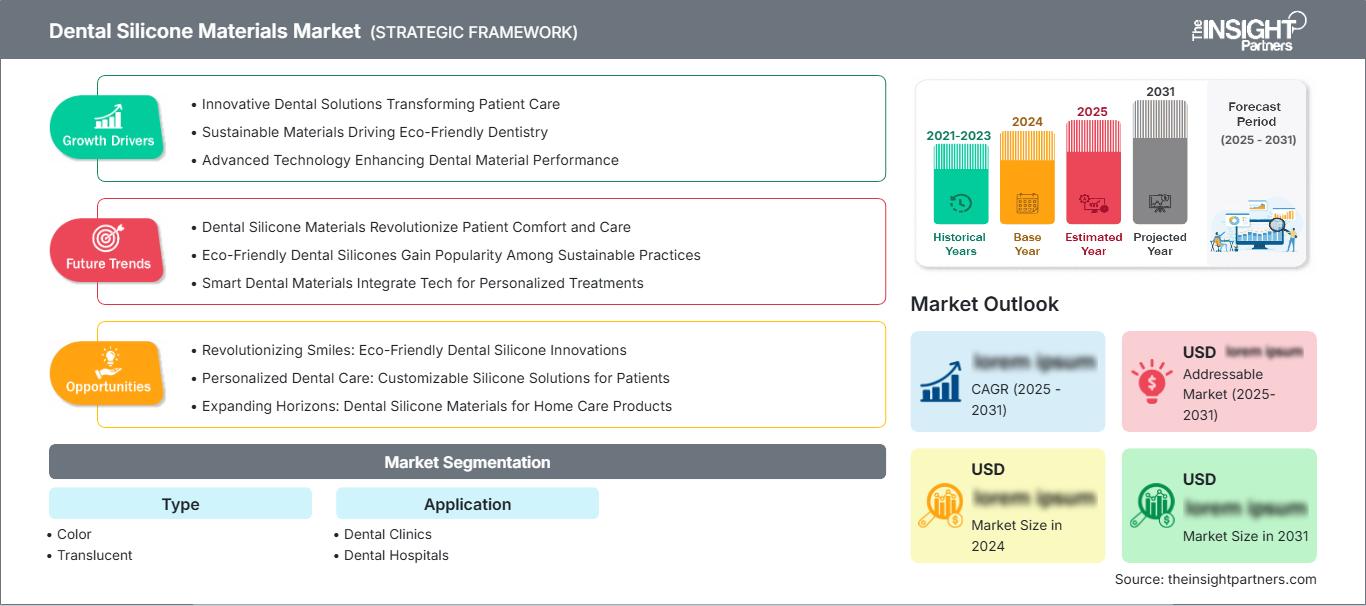
Dental Silicone Materials Market: Strategic Insights
Regional Insights
North America Dental Silicone Materials Market
The North American market is expected to account for 32-36% of the Dental Silicone Materials Market share in 2025, and will register a CAGR of 5.1-5.9% during 2024-2034. The US continues to be the dominant market, driven by large private dental infrastructure, existing restorative techniques, and usage of advanced impression solutions. Canada contributes through specialized dentistry and clinics, while purchase decisions are increasingly based on consistent material performance.
The structural growth driver comes from restorative and prosthodontic applications that still require precise conventional impressions despite the rising use of digital scanning. High-performance silicone materials are important in those cases where moisture control, subgingival detail definition, or complex geometries become an issue. Deep distribution, knowledge base of clinicians, and replacements drive ongoing demand. The regulatory maturity of the region works in favor of well-established manufacturers.
U.S. Dental Silicone Materials Market
The US market accounts for around 82-86% of North American consumption and is forecasted to witness a CAGR growth of 5.2-6.0% during the period till 2034. Purchasing can be varied from large dental service providers, specialist dental practices, laboratories, and independent dental practices. Major vendors are COLTENE Holding AG, Dentsply Sirona, Den-Mat Holdings, LLC, Ivoclar Vivadent AG, and Pac-Dent International, Inc.
Usage is dedicated to restorative, prosthodontic, implant, and bite registration applications, where dimensional stability and handling become important. Dispensing systems, variation of viscosity, and moisture resistance allow reaching chair-side consistency. Procurement is defined by efficiency of the whole process and not just the cost of the material. Well-established distribution system and regular replenishing of disposable materials make it possible to stimulate replacement. Digital impressions encourage silicone manufacturers to show their traditional materials in combination cases.
Europe Dental Silicone Materials Market
Europe is predicted to account for 27–31% of the global demand by 2025 and is forecast to experience a CAGR of 4.7–5.5% up to 2034. In Europe, Germany is the largest market, driven by a significant manufacturing presence in the dental industry, well-developed labs, and advanced techniques in restorative treatments. The United Kingdom, France, Italy, and Spain contribute extra demand through private dental practices and organized care facilities.
United Kingdom has an established usage of elastomeric impression systems and its purchases depend on clinical consistency, laboratory compatibility, and dispensing efficiency. Germany has robust manufacturing capacities and is technologically advanced in both practices and labs. France, Italy, and Spain provide diverse demand from restorative and prosthodontic treatments while distributors cater to specialty products. Documentation, sustainability, reliability, and regulatory compliance become increasingly important in Europe purchases in addition to clinical performance.
APAC Dental Silicone Materials Market
The share of APAC in 2025 is forecasted at 24-28%, with a 6.1-7.0% CAGR expected for the next decade, thus making APAC the region with the highest growth rate among all major regions. In the region, China is the largest market, followed by Japan, South Korea, India, and Australia. Development of private dental clinics and hospital dentistry increases the target audience.
The development of industrial sector allows expanding local manufacturing and distribution capacities as well as the availability of specialty chemicals. Development of healthcare sector increases the availability of restorative procedures. Japan and South Korea focus on precision, while China and India are volume-oriented. Australia has well-established clinical guidelines and professional sector. Increasing availability of dispensing systems will foster adoption of differentiated silicone compounds in developing countries.
Middle East & Africa Dental Silicone Materials Market
The Middle East and Africa region has lower demand volume but is attractive in its structure, with an expected CAGR of 4.8-5.8% for 2034. The largest countries include Saudi Arabia due to its healthcare system upgrades, the UAE and South Africa. Rest of MEA demand continues to be concentrated in big cities and private healthcare facilities.
Investments in energy-related industries in the Gulf countries help build up the healthcare infrastructure in hospitals and clinics, while advanced logistics of medical supplies ensures better availability of specialized dental consumables. The UAE is helped by advanced dental practices of the international community and medical tourism, and South Africa offers a fairly well-developed clinical environment.
Segmentation Analysis
Type
The Type segment in the Dental Silicone Materials Market covers Color and Translucent materials and is expected to expand at a 5.2–6.0% CAGR during 2026–2034. Product selection depends on visual identification, clinical handling, mixing control, and the ability to distinguish material layers during impression procedures. Color differentiation can improve workflow visibility, while translucent formulations can support specific visualization and aesthetic requirements.
- Color: Color-coded silicone materials support easier differentiation between base and catalyst components, improve handling visibility, and help clinicians identify material distribution during procedures requiring controlled application.
- Translucent: Translucent materials provide a visually neutral appearance and can suit specialized applications where unobtrusive material characteristics, visualization, or compatibility with particular clinical techniques influences purchasing decisions.
Application
The Application segment includes Dental Clinics and Dental Hospitals and is projected to grow at a 5.4–6.2% CAGR during 2026–2034. Demand varies according to procedure complexity, purchasing scale, staffing models, and equipment availability. Clinics remain important recurring buyers, while hospitals can generate higher-value requirements through specialist restorative, surgical, and prosthodontic services.
- Dental Clinics: Clinics represent the broadest recurring-use environment, with purchasing driven by routine restorative procedures, predictable chairside handling, convenient packaging, and compatibility with existing trays and dispensing systems.
- Dental Hospitals: Hospitals require dependable materials for diverse clinical cases, including complex restorative and prosthodontic procedures. Centralized procurement can favor standardized products, documentation, supply continuity, and broad viscosity availability.
Opportunity Snapshot
| Application | Revenue Contribution (High/Medium/Low) | Trend Tag | Adoption Stage |
|---|---|---|---|
| Dental Clinics | High | Chairside Workflow | Mature |
| Dental Hospitals | Medium | Complex Restorations | Scaling |
Dental Silicone Materials Market Growth Drivers and Impact Analysis
Expansion of Restorative and Prosthodontic Procedure Volumes
Rising access to restorative dentistry directly expands recurring consumption of impression materials because crowns, bridges, dentures, implants, and related procedures require accurate transfer of oral geometry. Aging populations, greater awareness of oral health, and increased willingness to pursue elective restorative treatment can raise procedure frequency in established markets. In developing economies, the driver is linked more closely to expanding private dental capacity and improved affordability. The impact on suppliers is a broader base of routine purchases across independent practices, hospitals, and laboratories. Manufacturers can benefit when formulations support multiple indications because customers prefer portfolios that reduce inventory complexity. Consequently, suppliers with broad viscosity ranges, reliable setting profiles, and standardized dispensing formats can capture recurring institutional and chairside demand.
Demand for Higher Accuracy and More Predictable Clinical Handling
Clinical productivity increasingly depends on minimizing impression defects, remakes, and repeated appointments. Silicone formulations that provide strong dimensional stability, elastic recovery, tear resistance, and effective wetting can reduce the probability of compromised impressions in challenging conditions. This creates a quality-driven purchasing environment in which clinicians may accept higher material costs when the product reduces procedural risk and chairside disruption. The commercial impact extends beyond material sales because predictable impression performance can improve laboratory throughput and restoration turnaround. Suppliers therefore have an incentive to invest in formulation refinement, cartridge systems, controlled viscosity, and working-time differentiation. As practices become more operationally disciplined, measurable handling advantages can become stronger purchasing criteria than simple unit pricing.
Growth of Organized Dental Procurement and Standardized Workflows
Organized dental groups, hospitals, and multi-site clinics are increasing the importance of standardized procurement. Centralized purchasing can shift demand toward suppliers capable of maintaining consistent quality across locations, supporting documentation requirements, and delivering reliable replenishment. Standardization also encourages clinics to reduce the number of brands and formulations used by staff, creating opportunities for suppliers with broad product ranges. The market impact is a gradual shift from highly fragmented purchasing toward account-based relationships and portfolio contracts. Manufacturers that combine clinical education, distribution coverage, and inventory planning can strengthen retention without depending entirely on discounts. This driver also increases the value of packaging efficiency and dispensing compatibility because standardized workflows require predictable use patterns across different practitioners and facilities.
Dental Silicone Materials Market Future Trends
Hybrid Conventional and Digital Impression Workflows
Digital scanning will continue to expand, but conventional silicone impressions are likely to remain relevant in complex cases, difficult access conditions, specific prosthodontic procedures, and practices where digital infrastructure is incomplete. The resulting trend is toward hybrid workflows rather than immediate substitution. Manufacturers are expected to design materials and accessories that fit smoothly into digitally planned treatment pathways, including standardized tray systems, clear labeling, and laboratory processes that combine physical impressions with digital records. Dental Silicone Materials Market trends will increasingly reflect interoperability at the workflow level rather than competition between individual technologies. Suppliers that understand when clinicians switch between scanning and physical impressions can position silicone products around specific procedural gaps, particularly where moisture, subgingival detail, patient tolerance, or equipment availability affects technology selection.
Advanced Dispensing and Material Customization
Future product development is likely to emphasize dispensing precision, customizable working characteristics, and simplified clinical preparation. Automated or semi-automated cartridge systems can improve mixing consistency while reducing operator variability and material waste. Manufacturers may increasingly differentiate products through viscosity combinations, setting profiles, color systems, and specialized formulations for distinct procedural conditions. This evolution should also encourage more modular product portfolios, allowing suppliers to tailor packaging and delivery systems to different practice sizes. Over time, purchasing decisions may shift toward complete material-delivery solutions rather than standalone silicone compounds. Such development can improve workflow predictability while giving manufacturers additional opportunities to establish differentiated intellectual property around formulation, packaging, and delivery mechanisms.
Dental Silicone Materials Market Opportunities
Localized Production and Distribution in Emerging Dental Economies
Emerging dental markets offer investment opportunities where local or regional manufacturing can reduce lead times, import exposure, and distributor dependency. China and India are particularly relevant because growing clinic networks create recurring consumables demand while domestic industrial capabilities can support packaging and selected material inputs. Regional partnerships can provide established manufacturers with regulatory knowledge and channel access without requiring immediate construction of full-scale facilities. Dental Silicone Materials Market Forecasts should therefore consider localization not only as a cost strategy but also as a route to portfolio adaptation, shorter replenishment cycles, and improved service levels. Investors can prioritize suppliers with strong quality systems, scalable manufacturing, and established distributor relationships. The strongest opportunities are likely to emerge where market expansion coincides with improving clinical standards and organized procurement.
Premium Formulations for Complex Restorative Procedures
Premium silicone formulations represent an opportunity to capture value from procedures where impression accuracy directly affects restoration quality and laboratory efficiency. Suppliers can focus investment on hydrophilicity, tear resistance, dimensional stability, controlled setting behavior, and specialized viscosity combinations rather than competing primarily on volume. Dental Silicone Materials Market Forecasts should account for increasing differentiation between basic routine products and higher-performance systems designed for challenging clinical conditions. Commercial strategies can include clinician education, laboratory partnerships, procedure-specific kits, and evidence-based product positioning. Premiumization may be particularly effective in mature markets where procedure volumes are relatively stable but customers remain willing to pay for reduced remake risk and improved workflow predictability.
Recent Developments
- March 2026: COLTENE Holding AG reported 2025 sales of CHF 240.0 million, with sales in local currencies broadly stable and market share gains in EMEA. The company reported a recovery during the second half of 2025 and outlined expectations for moderate revenue growth and improved profitability in 2026.
- March 2026: GC Corporation received a US patent grant covering a base paste for a dental additive silicone impression material. The patented formulation incorporates a polyether component with terminal alkenyl groups, reflecting continued technical development around silicone impression chemistry and material performance for dental applications.
- April 2025: Dentsply Sirona Pty Ltd received Australian registration for a dental silicone impression material, with the device listed as Class IIa and manufactured by Zhermack entities within the Dentsply Sirona group. The registration demonstrates continued regulatory activity supporting silicone-based impression products across international dental markets.
Frequently Asked Questions

- Comprehensive Market Sizing and Forecast Analysis
- Detailed Segmentation Analysis
- In-Depth Market Dynamics Assessment
- Regional and Country-Level Insights
- Competitive Landscape and Company Benchmarking
- Strategic Business Intelligence
Recent Reports
Testimonials

The Insight Partners' SCADA System Market report is comprehensive, with valuable insights on current trends and future forecasts. The team was highly professional, responsive, and supportive throughout. We are very satisfied and highly recommend their services.
RAN KEDEM Partner, Reali Technologies LTDs
I requested a report on a very specific software market and the team produced the report in a few days. The information was very relevant and well presented. I then requested some changes and additions to the report. The team was again very responsive and I got the final report in less than a week.
JEAN-HERVE JENN Chairman, Future Analytica
We worked with The Insight Partners for an important market study and forecast. They gave us clear insights into opportunities and risks, which helped shape our plans. Their research was easy to use and based on solid data. It helped us make smart, confident decisions. We highly recommend them.
PIYUSH NAGPAL Sr. Vice President, High Beam Global
The Insight Partners delivered insightful, well-structured market research with strong domain expertise. Their team was professional and responsive throughout. The user-friendly website made accessing industry reports seamless. We highly recommend them for reliable, high-quality research services
YUKIHIKO ADACHI CEO, Deep Blue, LLC.
This is the first time I have purchased a market report from The Insight Partners.While I was unsure at first, I visited their web site and felt more comfortable to take the risk and purchase a market report.I am completely satisfied with the quality of the report and customer service. I had several questions and comments with the initial report, but after a couple of dialogs over email with their analyst I believe I have a report that I can use as input to our strategic planning process.Thank you so much for taking the extra time and making this a positive experience.I will definitely recommend your service to others and you will be my first call when we need further market data.
JOHN SUZUKI President and Chief Executive Officer, Board Director, BK Technologies
I wish to appreciate your support and the professionalism you displayed in the course of attending to my request for information regarding to infectious disease IVD market in Nigeria. I appreciate your patience, your guidance, and the fact that you were willing to offer a discount, which eventually made it possible for us to close a deal. I look forward to engaging The Insight Partners in the future, all thanks to the impression you have created in me as a result of this first encounter.
DR CHIJIOKE ONYIA MANAGING DIRECTOR, PineCrest Healthcare Ltd.Reason to Buy
- Informed Decision-Making
- Understanding Market Dynamics
- Competitive Analysis
- Identifying Emerging Markets
- Customer Insights
- Market Forecasts
- Risk Mitigation
- Boosting Operational Efficiency
- Strategic Planning
- Investment Justification
- Tracking Industry Innovations
- Aligning with Regulatory Trends





 Get Free Sample for