
Desktop IP Phone Market Share, Growth & Demand by 2034
Coverage: by Type (Video Desktop IP Phone, Common Desktop IP Phone); End-user (Commercial, Individual) , and Geography (North America, Europe, Asia Pacific, and South and Central America)
- Status : Data Released
- Report Code : TIPRE00012529
- Category : Electronics and Semiconductor
- No. of Pages : 150
- Available Report Formats :


- Last update date : August 06, 2026


2025 Market Size
US$ 3.48 Bn
Base year value
2034 Forecast
US$ 6.17 Bn
Projected by 2034
CAGR 2026-2034
7.41 %
Growth rate
Addressable Market
US$ 45.54 Bn
(2026-2034)
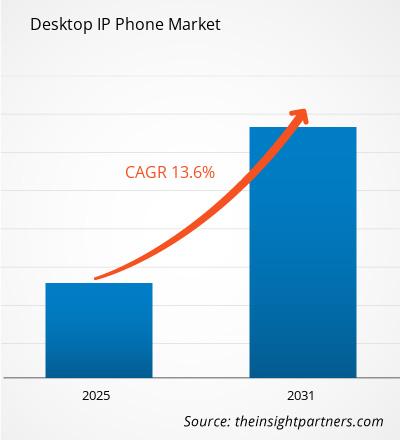
The desktop IP Phone market size reached US$ 3.48 Billion in 2025 and is forecasted to be US$ 6.17 Billion by 2034; it is predicted to grow at a CAGR of 7.41% during 2026-2034. The demand is driven by enterprise movement from traditional PBX to IP voice terminals; desktop IP phones are still important for regulated office environments, reception counters, customer service departments, healthcare institutions, and branch operations where reliable voice connectivity is required.
In North America, the size of Desktop IP Phone market is driven by repeated device renewal, hybrid office re-design, and the use of voice management solutions in the financial sector, healthcare organizations, educational establishments, and government institutions. The growth rate of Desktop IP Phone market in North America is forecasted to be between 6.8% and 7.3% CAGR during 2026-2034.
Desktop IP Phone Market Assessment and Insights
- North America accounted for 34–37% desktop IP Phone market share in 2025 and is expected to grow at a CAGR of 6.8–7.3% during 2026–2034, supported by UCaaS migration and regulated enterprise voice needs.
- US represented 78–82% of North America in 2025 and is projected to grow at a CAGR of 6.9–7.4% during 2026–2034.
- Europe held 25–28% share in 2025 and is expected to grow at a CAGR of 6.4–6.9%, led by the UK, Germany, France, Italy, and Spain.
- Asia Pacific captured 24–27% share in 2025 and is projected to grow at a CAGR of 8.2–8.8%, led by China, Japan, South Korea, India, and Australia.
- Largest Segment Common Desktop IP Phone held 67–71% market share in 2025 and is expected to grow at a CAGR of 6.8–7.2% during 2026–2034.
- High Growth Segment Video Desktop IP Phone held 29–33% market share in 2025 and is projected to grow at a CAGR of 8.5–9.1% during 2026–2034.
- Key companies analyzed in detail: ATCOM Technology Co., Ltd., Avaya LLC, Cisco Systems, Inc., Grandstream Networks, Inc., Mitel Networks Corporation, NEC Corporation, HP Inc. Poly, Snom Technology GmbH, Unify Software and Solutions GmbH, Yealink Network Technology Co., Ltd.
Source: The Insight Partners' analysis based on proprietary research, government publications, company annual reports, investor presentations, industry databases, and expert interviews.
Product development has evolved from individual desk top equipment into endpoint solutions that integrate well with cloud calling, contact center routing, and meeting solutions. In terms of production, there are changes as vendors place more emphasis on SIP compatibility, WiFi capability, security of the firmware, power efficient chip sets, and longevity of the product life cycle. This means that the market has become less reliant on employee allocations and more about locations where hard-wired devices are critical.
Demand in the future will come mostly from new office environments, healthcare facilities, hospitality establishments, logistics centers, and governmental buildings where only softphones will not cut it. Investment will be made in solutions that provide security and endpoint management and also work in conjunction with cloud services. Physical IP phones will continue to be popular due to regulatory concerns related to emergency calls, data security, and service continuance.
Desktop IP Phone Market Report Scope
| Report Attribute | Details |
|---|---|
| Market size in 2025 | US$ 3.48 Billion |
| Market Size by 2034 | US$ 6.17 Billion |
| Global CAGR (2026 - 2034) | 7.41% |
| Historical Data | 2021-2024 |
| Forecast period | 2026-2034 |
Desktop IP Phone Market Analysis
There is demand being created by companies who still need robust voice connections on the front desk, trading floor, nurse station, warehouse, classroom, and service counter. Demand comes from the rise in cloud calling, SIP trunking, broadband infrastructure, and device refresh driven by cybersecurity policies. Audio quality, provisioning, encryption capabilities, emergency calling ability, and collaboration application support are key purchasing factors when buying a replacement for an old telephone.
The market ecosystem consists of semiconductor makers, contract manufacturers, firmware providers, UC platform providers, distributors, telecom carriers, and managed services providers. Positive supply factors include the standardization of SIP and remote management of devices, which will help reduce deployment hurdles. However, intense price competition exists, especially in the desktop segment, although video endpoints and secure executive telephones have more potential profit margins.
The competitive landscape consists of platforms providers and endpoint providers separately. Cisco Systems, Inc., Avaya LLC, Mitel Networks Corporation, and NEC Corporation have the benefit of the existing voice infrastructure within the enterprise while Yealink Network Technology Co., Ltd., Grandstream Networks, Inc., Snom Technology GmbH, and ATCOM Technology Co., Ltd. rely on standard portfolios. According to the market analysis, certification and channel influence the buying decision.
Capital investment trends towards AI-enabled audio processing, endpoint security, Wi-Fi 6, Bluetooth peripherals, antimicrobial technologies, and cloud provisioning portal capabilities. HP Inc. Poly, Unify Software and Solutions GmbH, and Yealink are selling endpoints within the collaboration estate not standalone phones. The differentiation strategy relies on decreasing administrative expenses without compromising voice access reliability.
● REPORT CUSTOMIZATION
Tailor This Report To Align With Your Specific Business Requirements
This report can be customized to align precisely with your business objectives, scope, and target markets. Customization options include tailored segmentation, geography, competitive analysis, and strategic insights to support informed decision-making.
Customize This Report →WHAT YOU CAN ADJUST
- ● Segmentations
- ● Geography
- ● Competitive Analysis
- ● Language Preferences
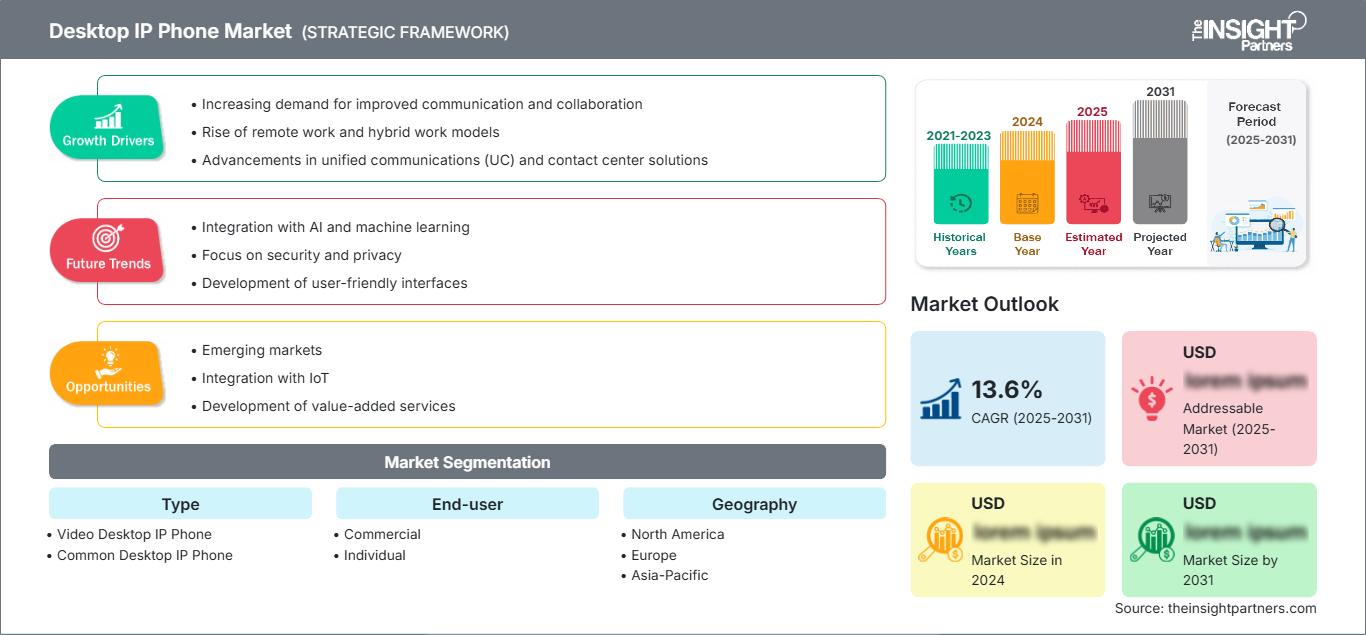
Desktop IP Phone Market: Strategic Insights
Regional Insights
North America Desktop IP Phone Market
The North American region accounted for a 34-37% market share in 2025 and will be growing at 6.8–7.3% CAGR between 2026–2034. North America is driven by its advanced cloud telephony ecosystem, extensive contact centers, and need for fixed end points in emergency, regulatory, and customer-facing scenarios. FCC reports indicate that interconnection of VoIP systems is still considered a voice service in the U.S.
While hybrid working has led to a reduction in one phone per employee model, there is an increase in the need for shared and managed endpoints. The financial services, healthcare, government organizations, and educational institutions continue to invest in desktop phones for reasons such as resiliency, reception, and security. Vendors which have certifications in Microsoft Teams Phone, Webex Calling, Zoom Phone, and SIP are expected to capitalize on the revenue generated through replacements.
U.S. Desktop IP Phone Market
In 2025, the United States comprised 78–82% of North America, with a forecasted CAGR growth of 6.9–7.4% during 2025-2034. Enterprise spending is enabled through refresh opportunities at the contact centers, branch office sites, hospitals, universities, banks, and governmental organizations. Visibility of the companies like Cisco Systems, Inc., Avaya LLC, HP Inc. Poly, and Grandstream Networks, Inc. is high because of their platform ecosystem and channels.
Application trends have been observed in terms of desk phone evolution to become an essential part of service delivery points and not a universal assignment to all employees. Phones now come equipped with centralized provisioning, security certificates, emergency calling, and integration with the collaboration platform. Public sector modernization, healthcare communications, and dispersed retailing are going to ensure fixed endpoints purchase regardless of the softphone deployment growth.
Europe Desktop IP Phone Market
In 2025, Europe held the share of 25–28%, which is expected to witness a CAGR of 6.4–6.9% during the period 2026–2034. Europe has been the highest adopter of SIP phones in the region owing to the presence of fixed endpoints used by financial institutions, business services, universities, and government agencies to conduct regulated communication.
Germany represents an important market owing to manufacturing, healthcare, logistics, and office modernization of the Mittelstand sector, where secure SIP phones have become an integral requirement for structured procurement process. France, Italy, and Spain have been growing owing to hospitality, government digitalization, and small business cloud calling solutions. Snom Technology GmbH, Unify Software and Solutions GmbH, and Yealink Network Technology Co., Ltd. have benefited from regional sales channels.
APAC Desktop IP Phone Market
The market share of APAC in 2025 is 24–27%, and it is projected to witness an 8.2–8.8% CAGR growth from 2026 to 2034 to become the region with the highest growth rate. In APAC, China dominates with its manufacturing scale, local vendors, digitization of enterprises, and upgrades in telecommunications infrastructure.
In Japan and South Korea, there is a preference for high quality and secure endpoint solutions for the business and government sectors. Meanwhile, India and Australia benefit from the development of IT services, education, healthcare, and cloud telephony.
Middle East & Africa Desktop IP Phone Market
Middle East & Africa region is expected to expand at a 7.1%-7.6% CAGR from 2026 to 2034, driven by UAE and Saudi Arabia. Voice devices fixed with the IP network for energy companies, smart cities, airports, hotels, and governmental offices need to be reliable.
South Africa drives demand in commercial, banking, educational, and governmental applications, whereas the Rest of MEA presents selected opportunities related to broadband and infrastructure projects. The purchasing process often focuses on durability, administration from the center, multilingual support, and integration with hosted PBX services from carriers.
Segmentation Analysis
Type
The Type segment is expected to grow at a 7.2–7.7% CAGR during 2026–2034. Desktop IP Phone Market scope by type is defined by the balance between cost-efficient common IP phones and premium video-enabled endpoints. Enterprises continue to standardize on common models for scale, while executive offices, telehealth rooms, reception areas, and hybrid collaboration spaces increasingly justify video desktop devices.
- Video Desktop IP Phone demand is rising in executive, telehealth, education, and hybrid collaboration settings where embedded video reduces device switching and supports more controlled communication experiences.
- Common Desktop IP Phone remains the volume base because it offers dependable voice, lower acquisition cost, simplified provisioning, and broad compatibility with SIP and cloud calling platforms.
End-user
The End-user segment is forecast to grow at a 7.0–7.5% CAGR during 2026–2034. Commercial buyers dominate because offices, hospitals, hotels, retail chains, schools, and public agencies need managed endpoints for shared workspaces and mission-critical voice. Individual users remain selective, typically purchasing devices for home offices, small professional setups, and dedicated VoIP lines.
- Commercial users generate the strongest recurring demand through branch modernization, contact center upgrades, desk sharing, and compliance-driven voice continuity requirements.
- Individual users represent a narrower but stable opportunity among remote professionals, consultants, and small offices that need dedicated voice hardware instead of softphone-only workflows.
Opportunity Snapshot
| End-user | Revenue Contribution | Trend Tag | Adoption Stage |
| Commercial | High | Cloud Calling | Mature |
| Individual | Low | Home Office | Scaling |
Desktop IP Phone Market Growth Drivers and Impact Analysis
Cloud PBX Migration and Managed Voice Modernization
Cloud PBX adoption is a primary driver because organizations are retiring fragmented premises systems and shifting voice management to subscription platforms. This transition does not eliminate desk phones; it changes procurement toward devices that can be remotely provisioned, updated, monitored, and integrated with collaboration software. The impact is strongest in multi-location enterprises, where centralized administration reduces truck rolls and simplifies compliance. As more providers bundle certified endpoints with calling plans, the Desktop IP Phone Market benefits from replacement cycles tied to platform migration rather than discretionary hardware purchasing.
Critical Voice Continuity in Regulated and Shared Spaces
Hospitals, banks, public agencies, hotels, schools, and logistics sites continue to require fixed phones because communication failure can affect service continuity, safety, or compliance. Dedicated endpoints remain easier to locate, audit, and maintain than personal devices in shared environments. Emergency calling requirements, role-based access, and predictable audio quality increase the value of desk phones at reception desks, nurse stations, control rooms, and service counters. This driver supports stable commercial demand even as personal softphone usage expands across knowledge workers.
Security, Certification, and Endpoint Lifecycle Requirements
Security expectations are increasing as voice endpoints become managed network devices rather than simple telephones. Buyers now assess encryption, secure boot, certificate handling, firmware support, provisioning controls, and compatibility with zero-trust network policies. Certified interoperability with major UC platforms also reduces deployment risk for enterprises moving across vendors or service providers. The market impact is a shift from price-only purchasing toward lifecycle value, especially for organizations with thousands of endpoints. Vendors that provide transparent updates, strong documentation, and partner certifications are better positioned for long-term contracts.
Desktop IP Phone Market Future Trends
AI-Enhanced Audio and Context-Aware Calling
Desktop IP Phone Market trends are moving toward AI-enhanced audio processing, including noise suppression, speaker optimization, meeting transcription support, and context-aware call handling. Future devices will increasingly function as intelligent communication endpoints that connect voice, video, directory data, and workflow prompts. This direction is especially relevant for healthcare, financial services, education, and service desks, where clarity and speed affect customer outcomes. Vendors that integrate AI features without increasing configuration complexity can raise endpoint value and defend margins in a market where basic voice hardware is highly competitive.
Platform-Certified Shared Workspace Endpoints
Shared workspace endpoints will become more specialized as offices shift from assigned seating to team zones, hot desks, and hybrid collaboration rooms. Devices will need fast login, QR-based user access, wireless peripheral pairing, and policy-based administration. This trend favors phones certified for multiple cloud calling environments and managed through centralized portals. As facility designs evolve, procurement will focus on fewer but more capable endpoints that support shared use, rapid reassignment, and stronger security controls across distributed office networks.
Desktop IP Phone Market Opportunities
Certified Endpoint Bundles for Cloud Calling Providers
Service providers and distributors can create stronger recurring revenue by bundling certified desktop phones with cloud calling subscriptions, installation, device monitoring, and lifecycle replacement. Desktop IP Phone Market Forecasts indicate that replacement-led demand will be more dependable than broad new-seat deployment, making bundled offers commercially attractive. Vendors should prioritize interoperability testing, automated provisioning templates, and channel enablement for managed service partners. The opportunity is strongest among small and mid-sized businesses that want enterprise-grade voice reliability without managing firmware, security settings, or vendor compatibility internally.
Verticalized Devices for Healthcare, Hospitality, and Retail
Verticalized product design offers a route to premium positioning where generic desk phones do not fully meet operational needs. Healthcare buyers value antimicrobial materials, easy cleaning, emergency keys, and integration with nurse call workflows. Hospitality properties need compact devices, guest-service keys, multilingual interfaces, and centralized room provisioning. Retail chains require durable endpoints for counters, back offices, and stores with limited IT support. Vendors that align hardware features, firmware templates, and channel messaging to these workflows can expand margin and improve replacement conversion rates.
Recent Developments
- April 2026: HP introduced the Poly Edge V Series Open SIP desk phones, designed for professional communication in hybrid and frontline work environments. The portfolio features AI-powered noise reduction, enhanced security through a Trusted Security Module, emergency alert functions, flexible connectivity options including Wi-Fi and Bluetooth, and scalable deployment support for offices, healthcare, hospitality, and other business environments.
- April 2026: Cisco announced the end-of-sale and end-of-life transition for the Unified IP Phone 6901. The company set October 2026 as the final order date and recommended migration to newer desk phone solutions. Existing customers with active service contracts will continue receiving support according to contract terms, with final support scheduled through October 2031.
- November 2024: Grandstream launched new DECT and carrier-grade IP phones, including the ruggedized DP735 cordless model and GRP2610(P) and GRP2611G desktop IP phones. The DP735 features IP67 protection, antimicrobial housing, extended range, and multiple SIP account support, while the GRP series offers zero-touch provisioning, noise reduction, conferencing, and enterprise-grade security for business communication deployments.
Frequently Asked Questions

- Comprehensive Market Sizing and Forecast Analysis
- Detailed Segmentation Analysis
- In-Depth Market Dynamics Assessment
- Regional and Country-Level Insights
- Competitive Landscape and Company Benchmarking
- Strategic Business Intelligence
Recent Reports
Testimonials

The Insight Partners' SCADA System Market report is comprehensive, with valuable insights on current trends and future forecasts. The team was highly professional, responsive, and supportive throughout. We are very satisfied and highly recommend their services.
RAN KEDEM Partner, Reali Technologies LTDs
I requested a report on a very specific software market and the team produced the report in a few days. The information was very relevant and well presented. I then requested some changes and additions to the report. The team was again very responsive and I got the final report in less than a week.
JEAN-HERVE JENN Chairman, Future Analytica
We worked with The Insight Partners for an important market study and forecast. They gave us clear insights into opportunities and risks, which helped shape our plans. Their research was easy to use and based on solid data. It helped us make smart, confident decisions. We highly recommend them.
PIYUSH NAGPAL Sr. Vice President, High Beam Global
The Insight Partners delivered insightful, well-structured market research with strong domain expertise. Their team was professional and responsive throughout. The user-friendly website made accessing industry reports seamless. We highly recommend them for reliable, high-quality research services
YUKIHIKO ADACHI CEO, Deep Blue, LLC.
This is the first time I have purchased a market report from The Insight Partners.While I was unsure at first, I visited their web site and felt more comfortable to take the risk and purchase a market report.I am completely satisfied with the quality of the report and customer service. I had several questions and comments with the initial report, but after a couple of dialogs over email with their analyst I believe I have a report that I can use as input to our strategic planning process.Thank you so much for taking the extra time and making this a positive experience.I will definitely recommend your service to others and you will be my first call when we need further market data.
JOHN SUZUKI President and Chief Executive Officer, Board Director, BK Technologies
I wish to appreciate your support and the professionalism you displayed in the course of attending to my request for information regarding to infectious disease IVD market in Nigeria. I appreciate your patience, your guidance, and the fact that you were willing to offer a discount, which eventually made it possible for us to close a deal. I look forward to engaging The Insight Partners in the future, all thanks to the impression you have created in me as a result of this first encounter.
DR CHIJIOKE ONYIA MANAGING DIRECTOR, PineCrest Healthcare Ltd.Reason to Buy
- Informed Decision-Making
- Understanding Market Dynamics
- Competitive Analysis
- Identifying Emerging Markets
- Customer Insights
- Market Forecasts
- Risk Mitigation
- Boosting Operational Efficiency
- Strategic Planning
- Investment Justification
- Tracking Industry Innovations
- Aligning with Regulatory Trends





 Get Free Sample for