
Dextrose Monohydrate Market Trends, Size & Growth by 2034
Coverage: by Type (Food Grade, Medical Grade); Applications (Pharma and Healthcare, Food and Feed Additives, Others) , and Geography (North America, Europe, Asia Pacific, and South and Central America)
- Status : Data Released
- Report Code : TIPRE00011248
- Category : Chemicals and Materials
- No. of Pages : 150
- Available Report Formats :


- Last update date : July 30, 2026


2025 Market Size
US$ 6.41 Bn
Base year value
2034 Forecast
US$ 8.44 Bn
Projected by 2034
CAGR 2026-2034
3.11 %
Growth rate
Addressable Market
US$ 67.45 Bn
(2026-2034)
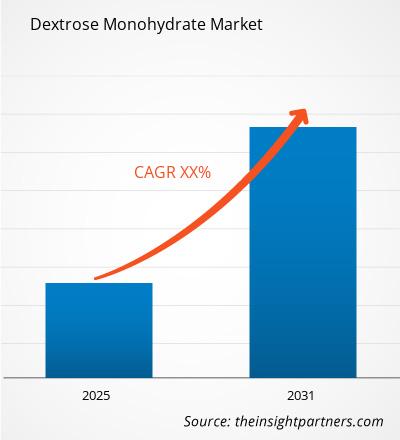
The Dextrose Monohydrate Market was valued at US$ 6.41 Billion in 2025 and is projected to reach US$ 8.44 Billion by 2034, registering a CAGR of 3.11% during 2026–2034. The market reflects steady demand from pharmaceutical, food, and feed additive applications where crystalline glucose supports sweetness, energy delivery, excipient performance, and controlled formulation functionality across regulated production environments.
Within North America, the Dextrose Monohydrate Market size outlook is shaped by pharmaceutical excipient qualification, sports nutrition usage, corn wet-milling capacity, and packaged food reformulation. Regional demand is estimated to grow at a 2.8%–3.6% CAGR during 2026–2034, supported by FDA-defined identity standards requiring at least 90.0% total solids and 99.5% reducing sugar on a dry basis for food-grade material.
Dextrose Monohydrate Market Assessment and Insights
- North America: Held 24%–28% share in 2025 and is expected to grow at a 2.8%–3.6% CAGR during 2026–2034, supported by integrated corn wet milling, pharmaceutical quality systems, and sports nutrition demand.
- US: Represented 76%–80% of North American demand in 2025 and is projected to grow at a 2.9%–3.7% CAGR during 2026–2034, led by excipient, food, and feed users.
- Europe: Accounted for 20%–24% share in 2025 and is expected to grow at a 2.4%–3.2% CAGR during 2026–2034, led by Germany, France, the UK, Italy, and Spain.
- Asia Pacific: Captured 38%–42% share in 2025 and is forecast to grow at a 3.5%–4.3% CAGR during 2026–2034, driven by China, India, Japan, South Korea, and Australia.
- Largest Segment: Food Grade held 84%–88% market share in 2025 and is expected to grow at a 2.8%–3.5% CAGR during 2026–2034, reflecting broad food and feed usage.
- High Growth Segment: Pharma and Healthcare held 22%–26% market share in 2025 and is projected to grow at a 3.8%–4.6% CAGR during 2026–2034, supported by parenteral and oral dosage applications.
- Key companies analyzed in detail: Archer Daniels Midland Company, Royal Avebe U.A., Cargill, Incorporated, Feitian Starch Co., Ltd., Foodchem International Corporation, Ingredion Incorporated, Roquette Frères S.A., Tate & Lyle PLC, Tereos SCA, Xiwang Group Company Limited.
Source: The Insight Partners' analysis based on proprietary research, government publications, company annual reports, investor presentations, industry databases, and expert interviews.
Development of the industrial manufacture of the Market has developed from a simple sweetener supply at the commodity level into an organized starch conversion, sourcing and grade. The current factories use enzymatic liquefaction, saccharification, purification, crystallization, centrifugation, and drying of D-Glucose Monohydrate. Simultaneously, the manufacturers try to manage particle size, moisture, ash and sulfur dioxide levels according to food code, pharmacopeia, and process requirements.
Growth opportunities still exist in areas where starch, health care manufacturing and consumption of processed foods intersect. New capacities in Asia Pacific, food security efforts in the Middle East, and pharmaceutical compliance investments in North America will influence the buying strategy. Consensus via Codex, FDA, USP, EP, BP, and JP standards will make it possible to qualify the product across borders while local feedstock will limit risks from grain, energy and transportation markets.
Dextrose Monohydrate Market Report Scope
| Report Attribute | Details |
|---|---|
| Market size in 2025 | US$ 6.41 Billion |
| Market Size by 2034 | US$ 8.44 Billion |
| Global CAGR (2026 - 2034) | 3.11% |
| Historical Data | 2021-2024 |
| Forecast period | 2026-2034 |
Dextrose Monohydrate Market Analysis
The market drivers are related to increasing demand for functional carbohydrates in candies, baked goods, beverages, infant formula, animal feed, pharmaceutical tablets and capsules, dialysis fluids, and parenteral nutrition. Dextrose offers quick solubility, medium degree of sweetness, fermentable carbohydrate, bulking properties, osmolality function, and energy source. It is produced from corn, wheat, potato or tapioca starch and depends on wet milling technology, enzyme conversion, sanitary crystallization procedure, and efficient bulk transportation.
Supply situation is influenced by availability of cereal crops, price of starch, energy, water, and compliance requirements. Corn continues to serve as main starting material in North America and China, while wheat and potato starch help in diversifying European production. The pharmaceutical grade dextrose production requires licensed facility, technical dossier, change control, and client audits, which raises switching costs relative to food grade dextrose. Therefore, the market is moderately consolidated around integrated starch producers.
Dextrose Monohydrate Market report reveals that competition exists due to feedstock integration, quality of documentation, regional distribution, and formulating assistance but not only due to pricing. Archer Daniels Midland Company and Cargill, Incorporated are advantaged by their huge corn processing facilities. Ingredion Incorporated, Roquette Frères S.A., Tate & Lyle PLC, and Tereos SCA gain from their food ingredient portfolio, while Royal Avebe U.A. gains from being potato starch specialist for Europe.
Asians such as Feitian Starch Co., Ltd., Foodchem International Corporation, and Xiwang Group Company Limited become competitive in terms of costs and exports, however, buyers keep looking at traceability, dossiers, and logistic stability. Capacity debottlenecking, efficient evaporation technology, separate production for pharmaceutical purposes, non-GMO or special certified grades are among investment directions. Strategic position in the market requires providing high purity, stability of supply, and technical services.
● REPORT CUSTOMIZATION
Tailor This Report To Align With Your Specific Business Requirements
This report can be customized to align precisely with your business objectives, scope, and target markets. Customization options include tailored segmentation, geography, competitive analysis, and strategic insights to support informed decision-making.
Customize This Report →WHAT YOU CAN ADJUST
- ● Segmentations
- ● Geography
- ● Competitive Analysis
- ● Language Preferences
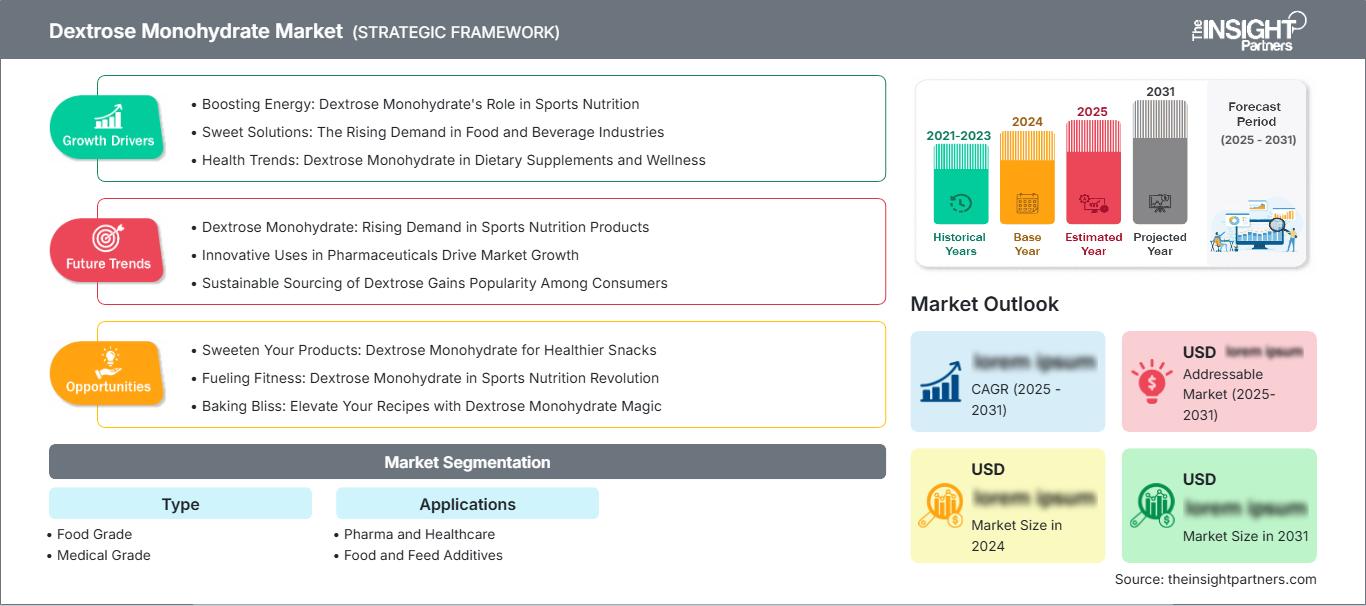
Dextrose Monohydrate Market: Strategic Insights
Regional Insights
North America Dextrose Monohydrate Market
North America held 24%–28% of the Dextrose Monohydrate Market share in 2025 and is expected to expand at a 2.8%–3.6% CAGR through 2034. The Market share in the region is supported by corn wet-milling scale, established pharmaceutical excipient supply chains, and standardized food ingredient specifications. Demand is concentrated in confectionery, sports nutrition, bakery, dialysis, and oral solid dosage manufacturing.
Regional producers benefit from proximity to corn supply, rail logistics, and food manufacturers seeking dependable bulk carbohydrates. FDA identity standards and USP-aligned pharmaceutical requirements encourage consistent quality systems. The demand also benefits from growing healthcare nutrition use, but mature sweetener consumption and reformulation toward reduced sugar keep regional growth measured rather than rapid.
U.S. Dextrose Monohydrate Market
The United States represented 76%–80% of North American demand in 2025 and is forecast to register a 2.9%–3.7% CAGR during 2026–2034. The country combines corn-processing depth with large pharmaceutical, nutraceutical, bakery, beverage, and animal nutrition markets. The Market activity is strengthened by qualified excipient procurement, contract manufacturing, and established distribution for packaged ingredients.
Archer Daniels Midland Company, Cargill, Incorporated, Ingredion Incorporated, and Tate & Lyle PLC maintain strong commercial relevance through starch processing, ingredient sales, and customer technical support. Application trends include clean-label sweetening, tablet dilution, fermentation feedstock, parenteral nutrition ingredients, and feed energy supplementation. Buyers emphasize documentation, allergen status, microbial control, and freight reliability when qualifying suppliers.
Europe Dextrose Monohydrate Market
Europe accounted for 20%–24% share in 2025 and is projected to grow at a 2.4%–3.2% CAGR through 2034. Germany leads regional demand through pharmaceutical manufacturing, confectionery, bakery, and chemical fermentation uses. France and the UK add stable food and healthcare consumption, while Italy and Spain contribute through bakery, beverages, feed, and private-label food production.
Royal Avebe U.A., Roquette Frères S.A., Tereos SCA, Tate & Lyle PLC, and Ingredion Incorporated support supply through starch-based ingredient portfolios. European buyers place high weight on non-GMO documentation, sustainability reporting, REACH-adjacent chemical safety expectations, and pharmacopoeial compliance. Slower population growth and sugar-reduction policies moderate volume expansion, but specialty and pharma-grade demand sustain value resilience.
APAC Dextrose Monohydrate Market
Asia Pacific held 38%–42% share in 2025 and is expected to grow at a 3.5%–4.3% CAGR through 2034. China is the leading country due to large corn starch capacity, food manufacturing scale, fermentation demand, and export-oriented ingredient supply. India, Japan, South Korea, and Australia add demand from pharmaceuticals, nutrition, processed foods, and feed.
Policy support for food processing, healthcare localization, and industrial biomanufacturing improves regional prospects. Feitian Starch Co., Ltd., Foodchem International Corporation, and Xiwang Group Company Limited strengthen China’s role in the Market, while multinational suppliers compete on quality systems and customer qualification. Growth remains linked to grain availability, energy pricing, and export compliance.
Middle East & Africa Dextrose Monohydrate Market
Middle East & Africa is projected to grow at a 3.1%–3.9% CAGR through 2034. Saudi Arabia and the UAE lead regional demand through food processing investments, healthcare expansion, and logistics hubs, while South Africa supports consumption through feed, bakery, and pharmaceutical distribution. Limited local starch conversion keeps many markets import dependent.
Food security programs, hospital infrastructure, and animal nutrition demand create incremental opportunities, although currency movements and freight costs affect procurement. Energy and infrastructure investment improves industrial clustering in Gulf economies, enabling better warehousing and re-export potential. Suppliers able to provide halal documentation, stable quality, and flexible pack sizes are better positioned across the region.
Segmentation Analysis
Type
The Type segment is expected to grow at a 2.9%–3.7% CAGR during 2026–2034. The Dextrose Monohydrate Market scope is defined by two grades that differ mainly in purity assurance, documentation burden, and end-use qualification. Food grade dominates volume because it serves broad sweetening, bulking, fermentation, and feed energy applications. Medical grade delivers higher value where pharmacopoeial compliance, pyrogen control, and validated manufacturing matter.
- Food Grade: This sub-segment holds the strongest volume position because it supports bakery, confectionery, beverages, fermentation, and animal feed formulations requiring solubility, sweetness, browning support, and reliable bulk availability.
- Medical Grade: This sub-segment is strategically important for tablets, capsules, dialysis, injectables, and parenteral nutrition, where impurity limits, pharmacopoeial compliance, validated documentation, and customer audits shape purchasing decisions.
Applications
The Applications segment is projected to grow at a 3.0%–3.8% CAGR during 2026–2034. Demand differs by regulatory intensity and formulation function. Food and feed additives account for the largest use base because dextrose provides sweetness, fermentable sugar, palatability, and energy density. Pharma and healthcare grows faster as excipient qualification, infusion nutrition, and bioprocessing applications require reliable crystalline glucose.
- Pharma and Healthcare: Demand is supported by parenteral nutrition, dialysis, oral solid dosage, and bioprocess media needs where controlled purity, documentation, osmotic performance, and batch consistency are commercially decisive.
- Food and Feed Additives: This sub-segment remains the largest outlet because dextrose improves sweetness, browning, fermentation, texture, palatability, and quick energy delivery in processed foods, beverages, and livestock nutrition.
Opportunity Snapshot
| Segment Name | Revenue Contribution | Trend Tag | Adoption Stage |
| Pharma and Healthcare | Medium | Excipient Quality | Scaling |
| Food and Feed Additives | High | Clean Label | Mature |
Dextrose Monohydrate Market Growth Drivers and Impact Analysis
Pharmaceutical Excipient Qualification and Healthcare Nutrition
The healthcare application provides a sustainable demand driver because the dextrose used in healthcare products needs to comply with strict impurity requirements and be compliant with documentation standards beyond what is required from bulk commodities used for food products. It is employed for parenteral nutrition, dialysis fluids, oral rehydration, tablets, and powders in hospitals and by manufacturers, where there is a need for consistency and compliance with regulation. Aging population, treatment of chronic diseases, and biologics production secure the supply chain. The Market will benefit because pharmaceutical buyers' decision to change suppliers after approval would take considerable time and be difficult because of an audit process involved.
Processed Food and Functional Nutrition Reformulation
The food industry adopts the dextrose monohydrate owing to its capability of providing moderate sweetness, high solubility, browning capability, fermenting agent, and bulking properties without requiring any significant formulation adjustments. Demand is important especially in bakery products, confectioneries, instant drinks, sports nutrition, meats, and powdered formulations. Clean label reformulations can prefer carbohydrates as ingredients, but the challenge of sugar reduction prevents any uncontrolled volumetric expansion. The Market benefits from applications which prioritize performance, economy, and processing efficiency rather than sweetness alone. Food safety certified, granulated, and allergens free suppliers can supply global and private label brands. The market effect remains constant, and growth relates to the consumption of packaged foods and sports nutrition.
Feedstock Integration and Regional Supply Security
There is an inherent strength in the structure of integrated starch processors because dextrose production relies on the consistent availability of corn, wheat, potato, or tapioca starch, enzymes, power, water, and drying facilities. Recent supply chain problems have prompted the buyer to reevaluate reliance on far-off suppliers and to qualify several regional suppliers. Close proximity to production eliminates risks in transportation and enhances flexibility to serve customers in food, feed, and pharmaceuticals. Consequently, the Market stands to gain from capacity expansion in agricultural zones and consumer centers. Integrated starch processors that own the process of feedstock procurement, wet milling, crystallizing, and packaging have better control over quality than traders do.
Dextrose Monohydrate Market Future Trends
Shift Toward Specialty Certified and Traceable Grades
The next phase of Dextrose Monohydrate Market trends will emphasize traceability, non-GMO positioning, halal and kosher documentation, pharma dossiers, and sustainability disclosure. Big purchasers of food and healthcare products will need more detailed information on ingredients than just the typical certificates of analysis. This will work to the advantage of those suppliers who can maintain traceability of their farms and processes using online quality systems. Even if sweetener prices become low, the specialty certified grades can help to maintain the margins. Eventually, documentation will ease qualifications for multinational buyers as well.
Greater Use in Fermentation and Bioprocess Feedstocks
Expansion in biomanufacturing may lead to increased use of crystalline glucose as a reliable source of carbon for fermentation, cell culture, enzyme production, production of organic acids and amino acids, and certain pharmaceutical intermediate products. Liquid glucose syrups continue to be used frequently, however, dry dextrose monohydrate provides better shelf life, easier administration, and reduced water movement in certain applications. Providers catering to this trend will require high purity standards and uniformity in solubility. The potential does not depend solely on volumes; it hinges on technical validation and contamination management.
Dextrose Monohydrate Market Opportunities
Expansion of Pharmaceutical-Grade Capacity in Asia
Asia offers attractive investment potential because healthcare manufacturing, injectable capacity, and contract development activity are expanding while regional buyers seek reliable excipient supply. Dextrose Monohydrate Market Forecasts indicate that suppliers adding validated pharmaceutical-grade lines, documentation support, and multilingual regulatory service can improve customer penetration. China and India provide scale, but Japan, South Korea, and Southeast Asia value dependable qualification and audit readiness. Investment should prioritize segregated production, pyrogen-controlled packaging, stability data, and technical teams that can support formulation approvals. This opportunity is action-oriented because qualification cycles are lengthy, meaning early capacity commitments can secure relationships before demand fully matures.
Premium Food Grade Products for Clean-Label Applications
High-quality food-grade dextrose may create value in those instances where clean labeling, particle size control, GMO-free certification, allergen information, or local procurement is needed. There are many possible applications for dextrose such as bakery products, confections, sports nutrition, powdered beverages, and functional snack foods since dextrose is a source of sweetening, structure building, fermentation, and fast sugar supply. Manufacturers must invest in special packaging solutions, test facilities, and joint development with brand owners to minimize the risk of reformulation. The most profitable market entry will be in those cases when businesses blend commodities and services.
Recent Developments
- June 2026: Nambawan Spain has launched Thaûma, a plant-derived thaumatin II sweetener aimed at aiding food and beverage manufacturers in reducing sugar. The product will be showcased with samples at IFT FIRST 2026, held from July 12–15 at McCormick Place in Chicago, Illinois, at Startup Pavilion, Booth 67.
- May 2026: Heartland Food Products Group has announced a definitive agreement to acquire the Americas business of Whole Earth Brands, which includes the Equal, Whole Earth, Swerve, and Chuker sweetener brands in North America and Latin America. Financial details have not been disclosed.
Frequently Asked Questions

- Comprehensive Market Sizing and Forecast Analysis
- Detailed Segmentation Analysis
- In-Depth Market Dynamics Assessment
- Regional and Country-Level Insights
- Competitive Landscape and Company Benchmarking
- Strategic Business Intelligence
Recent Reports
Testimonials

The Insight Partners' SCADA System Market report is comprehensive, with valuable insights on current trends and future forecasts. The team was highly professional, responsive, and supportive throughout. We are very satisfied and highly recommend their services.
RAN KEDEM Partner, Reali Technologies LTDs
I requested a report on a very specific software market and the team produced the report in a few days. The information was very relevant and well presented. I then requested some changes and additions to the report. The team was again very responsive and I got the final report in less than a week.
JEAN-HERVE JENN Chairman, Future Analytica
We worked with The Insight Partners for an important market study and forecast. They gave us clear insights into opportunities and risks, which helped shape our plans. Their research was easy to use and based on solid data. It helped us make smart, confident decisions. We highly recommend them.
PIYUSH NAGPAL Sr. Vice President, High Beam Global
The Insight Partners delivered insightful, well-structured market research with strong domain expertise. Their team was professional and responsive throughout. The user-friendly website made accessing industry reports seamless. We highly recommend them for reliable, high-quality research services
YUKIHIKO ADACHI CEO, Deep Blue, LLC.
This is the first time I have purchased a market report from The Insight Partners.While I was unsure at first, I visited their web site and felt more comfortable to take the risk and purchase a market report.I am completely satisfied with the quality of the report and customer service. I had several questions and comments with the initial report, but after a couple of dialogs over email with their analyst I believe I have a report that I can use as input to our strategic planning process.Thank you so much for taking the extra time and making this a positive experience.I will definitely recommend your service to others and you will be my first call when we need further market data.
JOHN SUZUKI President and Chief Executive Officer, Board Director, BK Technologies
I wish to appreciate your support and the professionalism you displayed in the course of attending to my request for information regarding to infectious disease IVD market in Nigeria. I appreciate your patience, your guidance, and the fact that you were willing to offer a discount, which eventually made it possible for us to close a deal. I look forward to engaging The Insight Partners in the future, all thanks to the impression you have created in me as a result of this first encounter.
DR CHIJIOKE ONYIA MANAGING DIRECTOR, PineCrest Healthcare Ltd.Reason to Buy
- Informed Decision-Making
- Understanding Market Dynamics
- Competitive Analysis
- Identifying Emerging Markets
- Customer Insights
- Market Forecasts
- Risk Mitigation
- Boosting Operational Efficiency
- Strategic Planning
- Investment Justification
- Tracking Industry Innovations
- Aligning with Regulatory Trends





 Get Free Sample for