
Digital Binoculars Market Demand, Trends & Forecast by 2034
Coverage: by Product Type (Thermal, Night Vision, Laser Rangefinder, Others); Application (Military, Astronomy, Hunting and Shooting, Others.) , and Geography (North America, Europe, Asia Pacific, and South and Central America)
- Status : Data Released
- Report Code : TIPRE00012530
- Category : Electronics and Semiconductor
- No. of Pages : 150
- Available Report Formats :


- Last update date : July 31, 2026


2025 Market Size
US$ 745.50 Mn
Base year value
2034 Forecast
US$ 954.26 Mn
Projected by 2034
CAGR 2026-2034
2.78 %
Growth rate
Addressable Market
US$ 7,714.74 Mn
(2026-2034)
The Digital Binoculars Market reached a value of US$ 745.50 Million in 2025 and is expected to grow to US$ 954.26 Million by 2034 at a Compound Annual Growth Rate (CAGR) of 2.78% during 2026–2034. The Digital Binoculars Market size will progress with the integration of imaging sensors, image stabilization, thermal imaging, night vision, and laser rangefinders into optical devices used for military, outdoor recreation, astronomy, hunting, and professional surveillance purposes.
In North America, the growth in demand is estimated to remain in the range of 2.6% to 3.0%, driven by defense modernization, outdoor recreation spending, and retailing through smart optical devices. The market growth of Digital Binoculars will be fuelled by military procurement cycles, hunting/shooting groups, border surveillance requirements, and astronomical users looking for compact imaging devices with recording and connectivity features.
Digital Binoculars Market Assessment and Insights
- North America held 34%–37% share in 2025 and is growing at a CAGR of 2.6%–3.0% during 2026–2034, supported by defense optics spending, hunting participation, and premium retail distribution.
- US represented 76%–80% of North America in 2025 and is growing at a CAGR of 2.7%–3.1%, led by tactical, hunting, and outdoor technology adoption.
- Europe accounted for 25%–28% share in 2025 and is advancing at a CAGR of 2.3%–2.7%, with Germany, the UK, France, Italy, and Spain leading adoption.
- Asia Pacific captured 24%–27% share in 2025 and is expanding at a CAGR of 3.1%–3.6%, led by China, Japan, South Korea, India, and Australia.
- Largest Segment Night Vision held 32%–36% market share in 2025 and is growing at a CAGR of 2.8%–3.2%, supported by low-light security and outdoor use.
- High Growth Segment Thermal held 24%–28% market share in 2025 and is growing at a CAGR of 3.5%–4.0%, driven by defense, rescue, and surveillance requirements.
- Key companies analyzed in detail: American Technologies Network Corporation, BARSKA Optics, Bushnell Corporation, Canon Inc., Teledyne FLIR LLC, Leupold & Stevens, Inc., Meade Instruments Corp., Nikon Corporation, Steiner-Optik GmbH, and X-Vision Optics.
Source: The Insight Partners' analysis based on proprietary research, government publications, company annual reports, investor presentations, industry databases, and expert interviews.
Innovation in technology is contributing to the creation of digital binoculars which will progress from simple attachments for cameras to more advanced sensor-based stabilizing systems making use of OLED/LCD screens as well as wireless technology and sturdy casing. In the Digital Binoculars Market, low costs of sensors, compact thermal cores, and better battery management are some of the trends being observed. Factors influencing production include the availability of optical glass, IR detectors, coatings, software and environmental testing in accordance with defense standards.
Upcoming trends will include increasing digitization in armed forces, monitoring of wildlife, sea patrols, astronomical education, and usage by individuals requiring multiple functions out of an optical system without having to carry additional camera equipment. Emerging geographical regions are contributing to better border security as well as outdoor sales channels, whereas safety regulations, conservation awareness, and night operation norms will contribute to superior products.
Digital Binoculars Market Report Scope
| Report Attribute | Details |
|---|---|
| Market size in 2025 | US$ 745.50 Million |
| Market Size by 2034 | US$ 954.26 Million |
| Global CAGR (2026 - 2034) | 2.78% |
| Historical Data | 2021-2024 |
| Forecast period | 2026-2034 |
Digital Binoculars Market Analysis
The growth of the Digital Binoculars Market share is driven by defense modernization, night use, wildlife observation, and recreational users who require binoculars capable of providing good viewing, imaging, and documentation of targets in a single device. Demand rises when there is a requirement for distance calculation, night vision, and documentation capability in the device.
In the ecosystem, optical lens manufacturers, thermal sensor providers, electronics assemblers, software providers, battery providers, defense distributors, sporting goods stores, and online marketplaces operate. The supply is affected by infrared detector cost, export regulations, waterproofing requirements, optical coating capacity, and component availability. Buyers evaluate field durability, range, magnification, sensor resolution, battery duration, post-purchase services, and accessories compatibility.
The digital binoculars market report reflects competition between imaging electronics vendors, imaging equipment vendors who produce outdoor optics, and defense-oriented manufacturers. The companies like Canon Inc. and Nikon Corporation emphasize stability features and high imaging capability, while American Technologies Network Corporation, Teledyne FLIR LLC, Steiner-Optik GmbH, Bushnell Corporation, BARSKA Optics, Leupold & Stevens, Inc., Meade Instruments Corp., and X-Vision Optics compete on application-oriented solutions.
Currently, investments are focused on miniaturization of thermal cores, digital night vision, Bluetooth or Wi-Fi transmission, GPS location tagging, artificial intelligence object recognition, and durable weather-proof cases. The strategic position for companies is becoming dependent on the balance between top-class performance and cost-effectiveness. Defense-oriented brands that have the capability to sell and provide warranty service can charge premiums as consumers move from analog observations to digital optics.
● REPORT CUSTOMIZATION
Tailor This Report To Align With Your Specific Business Requirements
This report can be customized to align precisely with your business objectives, scope, and target markets. Customization options include tailored segmentation, geography, competitive analysis, and strategic insights to support informed decision-making.
Customize This Report →WHAT YOU CAN ADJUST
- ● Segmentations
- ● Geography
- ● Competitive Analysis
- ● Language Preferences
Digital Binoculars Market: Strategic Insights
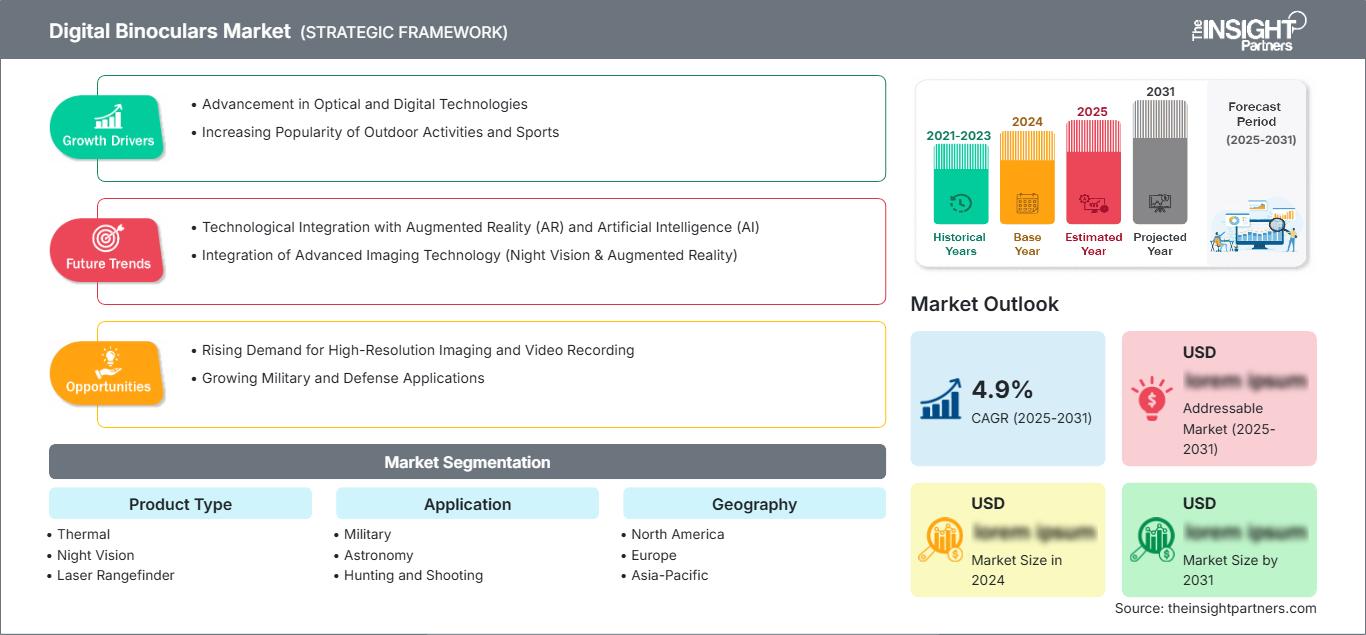
Regional Insights
North America Digital Binoculars Market
North America captured Digital Binoculars Market share of 34%–37% in 2025 and is estimated to grow at a rate of 2.6%–3.0% between 2026 and 2034. The growth in demand is backed by factors such as defense modernization, border monitoring, hunting/shooting, wildlife management, and astronomy, as these domains require portable digital devices for their activities.
The United States defense spending, local law enforcement agencies' modernization, and premium optics markets ensure a steady demand for night vision, thermal, and laser rangefinder binoculars. Higher disposable income leads to replacement of devices and online awareness about the product ensures comparisons on factors such as magnification, sensors, stabilization, and recording.
U.S. Digital Binoculars Market
The U.S. had 76%–80% share of North America in 2025, and is predicted to record growth of 2.7%–3.1%. The demand is focused on tactical users, hunting/shooting sports, marine observation, wildlife viewing, and astronomy retail segments. Users are seeking products that offer reliable rangefinding abilities, low light capability, durable housing, and convenient image/video recording features.
American Technologies Network Corporation, Bushnell Corporation, Leupold & Stevens, Inc., Teledyne FLIR LLC, BARSKA Optics, and X-Vision Optics continue to be relevant via specialty retailers and online retailing. Market trends include use of night vision in security/hunting applications, thermal imaging in search/surveillance applications, and laser rangefinder in shooting, land management, and outdoor navigation applications.
Europe Digital Binoculars Market
In 2025, Europe will represent 25%-28% market share and has forecast growth of 2.3%-2.7%, led by Germany on the strength of premium optics, outdoor activities, and military/security procurement. Adoption in the UK is encouraged by bird watching, marine viewing, and law enforcement. The French market benefits from military, hunting, and public safety usage.
Germany’s tradition of precision optics results in a high demand for expensive optics products, especially stabilized and rangefinding ones. Italy and Spain boost demand through hunting, marine observation, tourism, and nature conservation. Legal concerns regarding the ownership and use of night vision systems create an uneven market distribution, but the premium customer is still attracted by thermal and digital optics.
APAC Digital Binoculars Market
Market share of APAC was 24%–27% in 2025 and is anticipated to increase by 3.1%–3.6%. China is dominating in the region in terms of deployment. Japan, South Korea, India, and Australia drive demand for thermal imaging cameras due to their applications in defense modernization, electronics production, outdoor recreation, astronomy education, and wildlife monitoring.
Demand is driven by policy focus on border security, maritime security, and electronics capacity within the region. Japan and South Korea drive high-end optics applications, whereas India and Australia drive tactical, hunting, conservation, and remote-area observation applications.
Middle East & Africa Digital Binoculars Market
The Middle East & Africa region will witness growth of 2.8%-3.3% in 2026-2034, where the UAE leads the adoption. In Saudi Arabia, South Africa, and Rest of MEA, investments are being made in border surveillance, security of energy sites, wildlife protection, and event surveillance.
Rugged operating conditions lead to rugged thermal and night vision variants with long battery life and durable enclosures. Investments in energy infrastructures, mobility in the desert, and security on the coasts add up to specialized requirements, along with growth in premium retail.
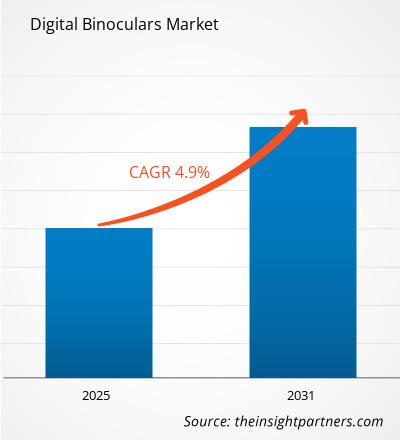
Segmentation Analysis
Product Type
Product Type is expected to grow at 2.9%–3.4% during 2026–2034 as buyers select devices according to visibility condition, target distance, mission duration, and budget. The Digital Binoculars Market scope under this segment covers thermal systems for heat signatures, night vision systems for low-light viewing, laser rangefinder models for distance measurement, and specialized digital optics for outdoor or astronomy use.
- Thermal devices are strategically important for defense, search and rescue, wildlife monitoring, and infrastructure security because heat detection works in darkness, smoke, foliage, and difficult weather.
- Night Vision models hold the broadest adoption base because they combine low-light visibility, recording, and consumer accessibility for hunting, surveillance, camping, and nocturnal wildlife observation.
- Laser Rangefinder binoculars serve hunters, shooters, maritime users, and tactical teams that need accurate distance measurement, target confirmation, and faster field decisions across varied terrain.
Application
Application is projected to grow at 2.6%–3.1% during 2026–2034 as digital optics move across professional and recreational use cases. Military remains a critical demand base, while astronomy, hunting and shooting, and outdoor observation expand consumer adoption. The segment benefits from improved image stabilization, longer battery life, better displays, and more affordable thermal and low-light sensors.
- Military users require rugged digital binoculars for reconnaissance, target identification, perimeter monitoring, convoy support, and night operations where reliability and environmental resistance are decisive.
- Astronomy demand is shaped by stabilized viewing, high magnification, image capture, and educational use, especially where users want portable alternatives to entry-level telescopes.
- Hunting and Shooting adoption is supported by rangefinding, low-light tracking, terrain assessment, and video documentation, making multifunctional binoculars valuable for ethical and accurate field decisions.
Opportunity Snapshot
| Application | Revenue Contribution | Trend Tag | Adoption Stage |
| Military | High | Tactical Vision | Scaling |
| Astronomy | Medium | Stabilized Viewing | Emerging |
| Hunting and Shooting | High | Range Accuracy | Mature |
| Others | Medium | Field Imaging | Scaling |
Digital Binoculars Market Growth Drivers and Impact Analysis
Defense and Security Users Need Better Night Awareness
Defense, border, law enforcement, and private security teams need portable observation tools that improve situational awareness without requiring heavy mounted systems. Digital binoculars with thermal, night vision, recording, and rangefinding functions help operators identify objects, document evidence, and coordinate responses in low-light or complex terrain. The market impact is higher demand for rugged housings, longer battery endurance, encrypted data handling, and accessories compatible with field missions. Procurement teams increasingly evaluate total operating reliability, not only optical magnification. This driver also strengthens service opportunities because mission-critical users require calibration, repair, firmware support, and training to keep devices operational across harsh environments.
Outdoor Recreation Supports Premium Optical Upgrades
Outdoor recreation is broadening the customer base for digital binoculars as hunters, shooters, birdwatchers, campers, and adventure travelers seek devices that combine viewing, imaging, and data capture. The shift is visible in premium retail channels where buyers compare stabilization, low-light capability, weather resistance, and mobile connectivity before purchase. Multifunctional optics reduce the need to carry separate cameras, rangefinders, and night observation tools. The impact is strongest for mid-priced products that translate professional features into consumer-friendly interfaces. Suppliers that simplify menus, improve battery life, and educate buyers through online content can increase conversion in seasonal and enthusiast-driven sales cycles.
Sensor Miniaturization Improves Product Economics
Sensor miniaturization is making advanced digital binoculars lighter, more affordable, and easier to integrate into compact housings. Smaller thermal cores, improved CMOS sensors, efficient displays, and better image-processing chips allow manufacturers to add features without making devices bulky. This improves adoption in astronomy, hunting and shooting, and professional surveillance where fatigue and portability influence purchase decisions. The market impact is broader price segmentation, faster refresh cycles, and more competition between optics specialists and electronics brands. As component costs moderate, suppliers can introduce differentiated models for entry, enthusiast, and professional buyers while preserving margins through software, accessories, and service packages.
Digital Binoculars Market Future Trends
AI-Enhanced Image Processing Becomes Common
Digital Binoculars Market trends will increasingly center on AI-enhanced image processing that improves target contrast, stabilizes video, reduces noise, and supports object highlighting in low-light conditions. Future devices are expected to offer smarter scene modes for hunting, maritime use, astronomy, and tactical observation. This trend will not replace optical quality, but it will help users interpret difficult scenes faster. Vendors will compete on algorithms, battery efficiency, firmware updates, and ease of use. The strongest adoption will occur where users need clearer interpretation rather than simple magnification, especially in security, wildlife, and professional field documentation.
Connected Field Optics Expand Data Workflows
Future products will increasingly connect binoculars with smartphones, cloud storage, mapping tools, and team communication platforms. The aim is to turn observation into a documented workflow, where users can capture images, tag location, share evidence, and review field activity. This trend is relevant for conservation teams, security agencies, hunters, and outdoor educators. Manufacturers will need to balance connectivity with cybersecurity, battery life, and user privacy. Products that make transfer simple while preserving rugged field performance will gain traction as buyers expect optics to function like connected imaging terminals rather than standalone viewing devices.
Digital Binoculars Market Opportunities
Military and Border Surveillance Modernization
Military and border surveillance modernization creates a clear opportunity for rugged digital binocular platforms that combine thermal, night vision, laser rangefinding, recording, and secure data export. Digital Binoculars Market Forecasts indicate that application-specific procurement will favor suppliers able to customize optics for local terrain, patrol patterns, and command requirements. Vendors can invest in modular accessories, training programs, maintenance contracts, and integration with broader surveillance networks. The opportunity is especially attractive where countries seek portable equipment before investing in fixed towers or vehicle-mounted systems. Successful suppliers will demonstrate reliability, export compliance, and lifecycle support rather than relying only on product specifications.
Consumer Premiumization in Outdoor Channels
A second opportunity lies in premium outdoor retail, where consumers are upgrading from analog binoculars to devices that record, stabilize, and enhance low-light viewing. Brands can target hunting and shooting, astronomy, wildlife travel, and marine observation with bundles that include tripods, batteries, protective cases, and mobile-app guidance. Retailers benefit when product education explains sensor resolution, field of view, detection range, and legal use. Suppliers that offer clear segmentation across beginner, enthusiast, and professional tiers can reduce buyer confusion. This opportunity rewards companies that combine optical credibility with intuitive electronics and strong after-sales support.
Recent Developments
- March 2026: Matata Xplore launches AI binoculars that can capture and identify in seconds - at a fraction of the cost of rivals. The company’s Solvia ED 8x32 series binoculars are being showcased publicly for the first time to UK audiences at the event, marking the brand’s official entry into the UK and Ireland through exclusive distribution partner Swains.
- January 2025: FUJIFILM Corporation announces the launch of the “FUJINON BINOCULAR TECHNO-STABI TS-L 1640” (TS-L 1640) and “FUJINON BINOCULAR TECHNO-STABI TS-L 2040” (TS-L 2040) with a global rollout starting at the end of January 2025. The TS-L 1640 and the TS-L 2040 have the magnification ratios of 16x and 20x respectively, offering the highest magnification levels in the series. These binoculars feature powerful image stabilization and an advanced optical system with ED lenses, allowing for brighter and clearer views of distant objects. Despite incorporating large 40mm objective lenses, they remain compact and lightweight. This advantage makes them versatile and suitable for a wide range of activities such as bird and wildlife watching, sports events, concerts, marine leisure and outdoor adventures.
- October 2024: Nikon Corporation introduced the STABILIZED binocular series, including 10x25 S and 12x25 S models with compact bodies, approximately 12-hour battery life, and stabilization technology designed to reduce hand-movement vibration by about 80%. The launch strengthened Nikon’s position in stabilized consumer optics for nature observation, sports, concerts, and travel use.
Frequently Asked Questions

- Comprehensive Market Sizing and Forecast Analysis
- Detailed Segmentation Analysis
- In-Depth Market Dynamics Assessment
- Regional and Country-Level Insights
- Competitive Landscape and Company Benchmarking
- Strategic Business Intelligence
Recent Reports
Testimonials

The Insight Partners' SCADA System Market report is comprehensive, with valuable insights on current trends and future forecasts. The team was highly professional, responsive, and supportive throughout. We are very satisfied and highly recommend their services.
RAN KEDEM Partner, Reali Technologies LTDs
I requested a report on a very specific software market and the team produced the report in a few days. The information was very relevant and well presented. I then requested some changes and additions to the report. The team was again very responsive and I got the final report in less than a week.
JEAN-HERVE JENN Chairman, Future Analytica
We worked with The Insight Partners for an important market study and forecast. They gave us clear insights into opportunities and risks, which helped shape our plans. Their research was easy to use and based on solid data. It helped us make smart, confident decisions. We highly recommend them.
PIYUSH NAGPAL Sr. Vice President, High Beam Global
The Insight Partners delivered insightful, well-structured market research with strong domain expertise. Their team was professional and responsive throughout. The user-friendly website made accessing industry reports seamless. We highly recommend them for reliable, high-quality research services
YUKIHIKO ADACHI CEO, Deep Blue, LLC.
This is the first time I have purchased a market report from The Insight Partners.While I was unsure at first, I visited their web site and felt more comfortable to take the risk and purchase a market report.I am completely satisfied with the quality of the report and customer service. I had several questions and comments with the initial report, but after a couple of dialogs over email with their analyst I believe I have a report that I can use as input to our strategic planning process.Thank you so much for taking the extra time and making this a positive experience.I will definitely recommend your service to others and you will be my first call when we need further market data.
JOHN SUZUKI President and Chief Executive Officer, Board Director, BK Technologies
I wish to appreciate your support and the professionalism you displayed in the course of attending to my request for information regarding to infectious disease IVD market in Nigeria. I appreciate your patience, your guidance, and the fact that you were willing to offer a discount, which eventually made it possible for us to close a deal. I look forward to engaging The Insight Partners in the future, all thanks to the impression you have created in me as a result of this first encounter.
DR CHIJIOKE ONYIA MANAGING DIRECTOR, PineCrest Healthcare Ltd.Reason to Buy
- Informed Decision-Making
- Understanding Market Dynamics
- Competitive Analysis
- Identifying Emerging Markets
- Customer Insights
- Market Forecasts
- Risk Mitigation
- Boosting Operational Efficiency
- Strategic Planning
- Investment Justification
- Tracking Industry Innovations
- Aligning with Regulatory Trends





 Get Free Sample for