
Digital Door Lock System Market Trends, Size & Growth by 2034
Coverage: By Type (Biometric Locks, Keypad Locks, Contactless Locks),End user (Commercial, Residential and Industrial), and Geography (North America, Europe, Asia Pacific, and South and Central America)
- Status : Data Released
- Report Code : TIPTE00002054
- Category : Electronics and Semiconductor
- No. of Pages : 150
- Available Report Formats :


- Last update date : August 12, 2026


2025 Market Size
US$ 33.38 Bn
Base year value
2034 Forecast
US$ 104.14 Bn
Projected by 2034
CAGR 2026-2034
13.48 %
Growth rate
Addressable Market
US$ 595.97 Bn
(2026-2034)
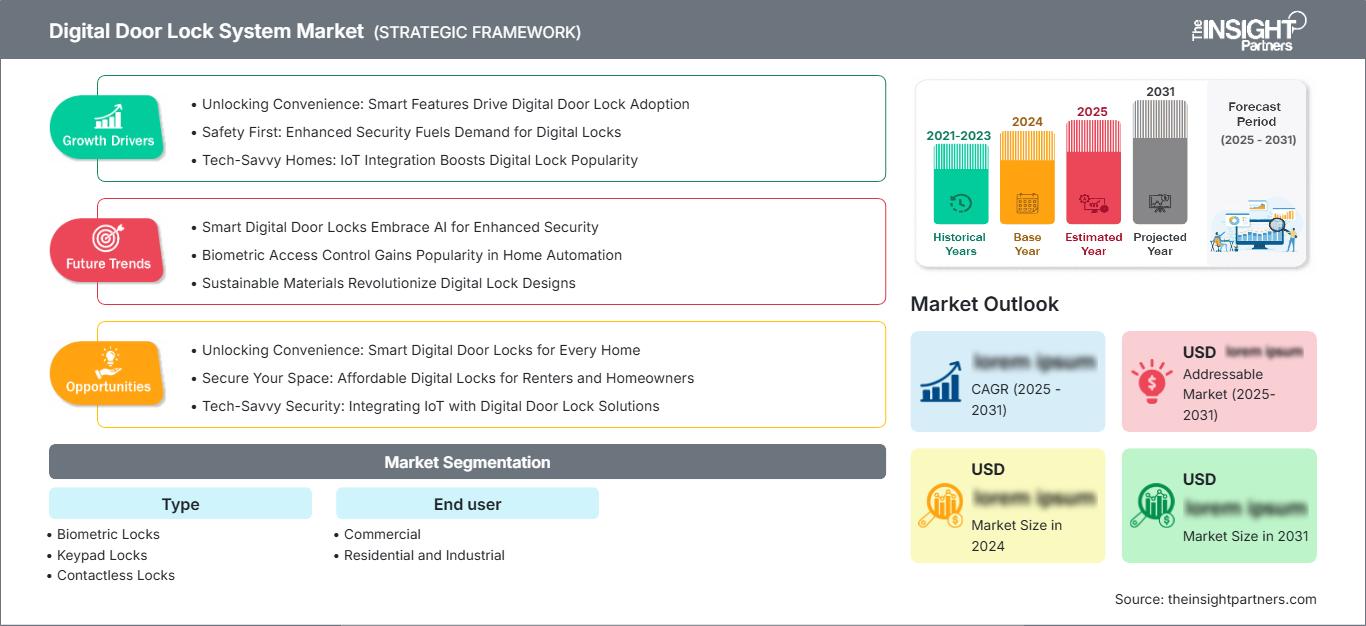
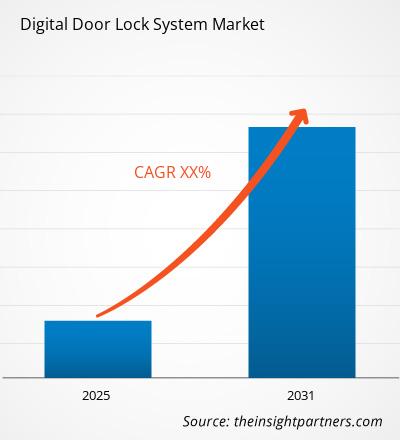
The Digital Door Lock System Market was US$ 33.38 Billion in 2025 and is expected to grow up to US$ 104.14 Billion in 2034, growing at a CAGR of 13.48%. Factors such as biometric access, keypad authentication, contactless entry, and the need for connected security in buildings are contributing towards the growth of the market.
In the North American region, the Digital Door Lock System Market size is driven by factors such as high prevalence of smart homes, multi-family access improvements, and enterprise adoption of access credentials managed via an app. The market is expected to grow at a rate of 12.0–13.0% CAGR up to 2034.
Digital Door Lock System Market Assessment and Insights
- North America accounted for 28–32% share in 2025 and is growing at a CAGR of 12.0–13.0% during 2026–2034, supported by smart homes, hospitality, offices, and multifamily access control.
- US represented 78–82% of North America in 2025 and is growing at a CAGR of 12.5–13.5% as rental housing and commercial campuses digitize entry points.
- Europe held 22–26% share in 2025 and is growing at a CAGR of 11.5–12.5%, led by Germany, the UK, France, Italy, and Spain.
- Asia Pacific captured 34–38% share in 2025 and is growing at a CAGR of 14.0–15.0%, led by China, Japan, South Korea, India, and Australia.
- Largest Segment Commercial held 42–46% market share in 2025, growing at a CAGR of 12.5–13.5% through 2034 due to access governance and security compliance.
- High Growth Segment Residential held 32–36% market share in 2025, growing at a CAGR of 14.0–15.0% as connected apartments and smart homes accelerate adoption.
- Key companies analyzed in detail: Cisco Systems, Inc., Godrej & Boyce Manufacturing Company Limited, Samsung Electronics Co., Ltd., Panasonic Holdings Corporation, Honeywell International Inc., Xeeder Technology Co., Ltd., ASSA ABLOY AB, RTX Corporation, Johnson Controls International plc, Nestwell Technologies, Allegion plc, dormakaba Holding AG.
Source: The Insight Partners' analysis based on proprietary research, government publications, company annual reports, investor presentations, industry databases, and expert interviews.
Migration towards Technology is causing the Digital Door Lock System Market to evolve from standalone electronic locks to interoperable, software-based access control systems. Biometric Locks are finding favor where traceability and identity confirmation are required, whereas Keypad Locks continue to enjoy their popularity in affordable residential and commercial applications. Contactless Locks find application in hotels, offices, hospitals, and logistic centers, due to their ability to facilitate credentialless access.
Future demand will be driven by new geographies where urban apartments, gated communities, business centers, and mixed use real estate have standardized on electronic access at construction stage itself. Concern for the safety of buildings and secure connectivity of devices has also caused the market to evolve further beyond consumer convenience to infrastructure-grade access management.
Digital Door Lock System Market Report Scope
| Report Attribute | Details |
|---|---|
| Market size in 2025 | US$ 33.38 Billion |
| Market Size by 2034 | US$ 104.14 Billion |
| Global CAGR (2026 - 2034) | 13.48% |
| Historical Data | 2021-2024 |
| Forecast period | 2026-2034 |
Digital Door Lock System Market Analysis
Factors contributing to the Digital Door Lock System Market growth include increasing building digitization, shortage of security staff, and demand from occupants for touchless entry systems. Commercial end users demand centralized management of credentials and recording of events, along with remote revocation, while residential end users focus more on convenience and guest access.
Improvements are taking place on the Supply side as lock manufacturers offer both longevity of mechanics and cloud-based service, mobile credentials, and sensors. According to Digital Door Lock System Market report, the source of value is moving from profit margins of the hardware to software and installation, maintenance, and ecosystems of device vendors, system integrators, property technology platforms, and building automation companies.
The competitive nature continues to be scattered but slowly tends to become platform-oriented. ASSA ABLOY AB, Allegion plc, dormakaba Holding AG, Honeywell International Inc., Samsung Electronics Co., Ltd., Panasonic Holdings Corporation, Godrej & Boyce Manufacturing Company Limited, and Cisco Systems, Inc. influence the purchase decision because of wide range of products, distribution channels, interoperability, and market positioning within enterprise cybersecurity.
Matter-enabled products, mobile authentication, cloud-managed access, and local storage of biometric templates are the areas of investments. Xeeder Technology Co., Ltd., Johnson Controls International plc, RTX Corporation, and Nestwell Technologies focus on markets that require specific expertise in building controls, industrial security, and/or local distribution.
● REPORT CUSTOMIZATION
Tailor This Report To Align With Your Specific Business Requirements
This report can be customized to align precisely with your business objectives, scope, and target markets. Customization options include tailored segmentation, geography, competitive analysis, and strategic insights to support informed decision-making.
Customize This Report →WHAT YOU CAN ADJUST
- ● Segmentations
- ● Geography
- ● Competitive Analysis
- ● Language Preferences
Digital Door Lock System Market: Strategic Insights
Regional Insights
North America Digital Door Lock System Market
The North America region held the share of 28–32% in 2025 and will grow at the CAGR rate of 12.0–13.0% between 2026–2034. This segment’s applications include commercial buildings, multi-family homes, hospitality, health care, education, and premium residences where access management, temporary credentials, and remote locking minimize administrative burden. The Digital Door Lock System Market share in the North America region is enhanced due to high property technology investments and an extensive network of security integrators.
The structural growth is facilitated by the risk management process by insurance companies, increasing labor costs for physical key management, and growing adoption of mobile credentials. The companies are standardizing the digital door lock systems across various office locations, whereas apartment complexes are using cloud access for managing the tenant turnover and maintenance. Integration with video surveillance, intrusion detection, and visitor management makes the Digital Door Lock System Market a crucial part of building security systems.
U.S. Digital Door Lock System Market
The U.S. accounted for 78-82% of North America in 2025 and is expected to have a CAGR of 12.5-13.5% between 2026 and 2034. There is highest demand in residential rental property, hotels, office buildings, warehouses, and educational institutions as facility managers require auditable access without additional security personnel. Distribution network of ASSA ABLOY AB, Allegion plc, Honeywell International Inc., Johnson Controls International plc, and Samsung Electronics Co., Ltd. helps in localization.
In terms of applications, increasing use of contactless cards for public spaces, biometrics for restricted zones, and keypad locks for smaller buildings are observed. The demand from multifamily property developers for mobile-based access is high as turnover rate of residents makes management of keys costly and difficult. From the viewpoint of commercial buildings, integration with occupancy analytics and visitor management system makes Digital Door Lock System Market a part of workplace security stack.
Europe Digital Door Lock System Market
Europe held 22-26% market share in 2025 and is anticipated to increase at a CAGR of 11.5-12.5% during 2026-2034. Germany leads in the segment owing to construction of commercial buildings, factories, and robust engineering requirements for digital locks that provide reliability. The UK comes next due to its growing demand for rental apartments, student accommodations, managed offices, and hospitality properties for cloud credential management system.
France, Italy, and Spain contribute through hotel upgrades, apartment renovations, and access upgrades for public buildings. High importance is accorded by buyers in the region to robustness, data security, and compliance of suppliers, which is beneficial for the market leaders including ASSA ABLOY AB, dormakaba Holding AG, Allegion plc, and Panasonic Holdings Corporation.
APAC Digital Door Lock System Market
The Asia Pacific region grabbed a market share of 34-38% in 2025 and will record a 14.0-15.0% CAGR up to 2034. China dominates the demand from the region due to apartment building activities, smart community initiatives, and the availability of electronics in the region. Japan and South Korea focus on the delivery of luxury houses and reliability, whereas India and Australia contribute through urban housing, office spaces, and security systems.
The drivers in terms of industry and policies in the APAC region play an important role. High scale of electronics manufacturing reduces the cost of components, whereas country-level initiatives to build digital infrastructure help in delivering connected buildings and access management. The developers in the residential sector now prefer including locks with intercoms, cameras, and energy management systems in their buildings.
Middle East & Africa Digital Door Lock System Market
Growth rate of the Middle East & Africa segment lies between 12.0% to 13.0% CAGR during 2026-2034 driven by Saudi Arabia, UAE, South Africa, and Rest of MEA. Leading demand from the region is driven by Saudi Arabia as hotels, housing developments, office spaces, and infrastructure require stronger access solutions. Contributions from UAE include premium real estate and hospitality renovation.
Other drivers include energy, logistics, and infrastructure assets that require controlled access, logging, and durability. South Africa is the retrofit market with residential and commercial demand for such solutions. Digital locks in MEA region will be most interesting with video access systems, building automation system, and installation services.
Segmentation Analysis
Type
The Digital Door Lock System Market is segmented by type into Biometric Locks, Keypad Locks, and Contactless Locks. This segment is projected to grow at a CAGR of 13–15% from 2026 to 2034, driven by technological advancements in authentication methods and evolving consumer preferences for secure and convenient access solutions. Each type addresses specific security requirements and user convenience factors, with adoption patterns varying across residential, commercial, and industrial applications.
- Biometric Locks: These locks utilize fingerprint, facial recognition, iris scanning, or voice recognition for user authentication. They are estimated to hold the largest market share of approximately 40–45% in 2025, driven by their superior security and the elimination of physical credentials. Adoption is particularly strong in commercial buildings, government facilities, and high-security residential applications where unauthorized access prevention is paramount.
- Keypad Locks: Keypad-based digital locks offer cost-effective access control through PIN codes or passwords. They remain popular in residential and small commercial settings due to their simplicity, affordability, and ease of installation. The segment benefits from retrofit applications where existing door hardware can be upgraded without significant structural modifications.
- Contactless Locks: These locks employ RFID cards, NFC-enabled smartphones, or Bluetooth proximity detection for credential-based access. The segment is projected to exhibit the highest growth rate of 15–17% from 2026 to 2034, fueled by post-pandemic hygiene concerns and the widespread adoption of mobile-based access solutions in hospitality, corporate offices, and shared workspaces.
End User
The Digital Door Lock System Market is segmented by end user into Commercial, Residential, and Industrial sectors. This segment is projected to grow at a CAGR of 13–15% from 2026 to 2034, reflecting the broadening application of digital access solutions across diverse property types and operational environments.
- Commercial: The commercial sector encompasses office buildings, hotels, retail stores, healthcare facilities, and educational institutions. This segment is estimated to hold the largest market share of approximately 45–50% in 2025, driven by the need for scalable access management, employee and visitor tracking, and integration with building management systems. The rise of flexible workspaces and co-working environments has further accelerated adoption.
- Residential: Residential applications include single-family homes, apartments, and gated communities adopting digital locks for enhanced security and convenience. The segment is experiencing robust growth as smart home penetration increases and consumers seek keyless entry solutions integrated with home automation platforms. Rental properties and vacation homes represent emerging sub-segments with significant potential.
- Industrial: Industrial applications include manufacturing facilities, warehouses, logistics centers, and critical infrastructure sites where access control is essential for operational security and regulatory compliance. The segment benefits from the integration of digital locks with time-attendance systems and safety protocols, though adoption has been relatively slower compared to commercial and residential sectors due to higher upfront costs and integration complexity.
Opportunity Snapshot
| End User | Revenue Contribution | Trend Tag | Adoption Stage |
|---|---|---|---|
| Commercial | High | Smart Access | Scaling |
| Residential | Medium | Home Automation | Scaling |
| Industrial | Medium | Operational Security | Emerging |
Digital Door Lock System Market Growth Drivers and Impact Analysis
Rising Complexity of Electronic Systems and Signal Integrity Requirements
The increasing complexity of electronic systems, driven by higher data rates, denser circuit boards, and tighter timing margins, has elevated the importance of signal integrity analysis in the product development lifecycle. Digital oscilloscopes with high bandwidth, deep memory, and advanced triggering capabilities enable design engineers to identify and resolve signal integrity issues such as jitter, crosstalk, and electromagnetic interference. The proliferation of high-speed serial interfaces, including PCI Express, USB, and Ethernet, has created demand for oscilloscopes capable of capturing and analyzing multi-gigabit signals. As electronic devices continue to push the boundaries of performance, the need for sophisticated measurement tools to validate design integrity and ensure compliance with industry standards will sustain growth in the Digital Oscilloscope Market.
Electrification and Increasing Electronic Content in Automotive Applications
The global automotive industry's transition toward electric vehicles and advanced driver-assistance systems has significantly expanded the addressable market for digital oscilloscopes. EVs require extensive testing of power electronics, including inverters, onboard chargers, and DC-DC converters, where oscilloscopes are essential for analyzing voltage and current waveforms under various operating conditions. ADAS systems incorporate multiple sensors, including radar, LiDAR, and cameras, all of which require rigorous testing and calibration using digital oscilloscopes. The increasing electronic content per vehicle, with modern cars containing hundreds of microcontrollers and sophisticated networking architectures, has made oscilloscopes indispensable tools for automotive engineers across the development and manufacturing lifecycle.
5G Deployment and Telecommunications Infrastructure Investment
The global rollout of 5G networks has created substantial demand for digital oscilloscopes in telecommunications equipment manufacturing, network deployment, and field testing. 5G infrastructure requires testing of high-frequency components, including millimeter-wave transceivers, power amplifiers, and filters, where oscilloscopes with high bandwidth and low noise are essential. The deployment of massive MIMO antennas and beamforming technologies has introduced new testing challenges that require advanced oscilloscope capabilities. Telecommunications equipment manufacturers and network operators rely on digital oscilloscopes for design validation, production testing, and network optimization. As 5G deployment continues globally and research into 6G technologies accelerates, the telecommunications sector will remain a key growth driver for the Digital Oscilloscope Market.
Digital Door Lock System Market Future Trends
AI-Powered Predictive Security Analytics
Artificial intelligence is transforming the Digital Door Lock System Market trends from passive access control devices into proactive security platforms capable of behavioral analysis and threat prediction. AI algorithms can learn user access patterns, detect anomalies such as unauthorized entry attempts or unusual access times, and trigger automated responses including alerts, lockdown sequences, or video recording activation. Machine learning models are being deployed to continuously improve authentication accuracy, reducing false rejection rates in biometric systems while maintaining stringent security thresholds. Manufacturers are embedding edge AI capabilities directly into lock hardware, enabling real-time decision-making without reliance on cloud connectivity. This trend is expected to drive premium product differentiation and create opportunities for subscription-based AI service offerings.
Convergence of Physical and Digital Access Control
The boundaries between physical access control and digital identity management are blurring as organizations seek unified platforms that manage both building entry and IT system access. Digital door locks are increasingly being integrated with corporate identity management systems, allowing employees to use a single credential such as a mobile device or biometric identifier for both physical premises and digital workspaces. This convergence is particularly relevant in hybrid work environments where organizations need to manage access dynamically across multiple locations and digital assets. Cloud-based access control platforms are enabling centralized administration, real-time permission updates, and comprehensive audit trails that satisfy regulatory compliance requirements. The trend toward unified access management is expected to drive partnerships between lock manufacturers and cybersecurity firms.
Digital Door Lock System Market Opportunities
Expansion in Affordable Housing and Mid-Market Segments
Declining component costs and economies of scale in manufacturing have made digital door lock systems increasingly accessible to mid-market residential buyers and affordable housing developments. Manufacturers have opportunities to develop cost-optimized product lines that retain essential security features while eliminating premium functionalities such as advanced biometrics or cloud connectivity. Volume procurement by housing developers and government housing agencies presents significant channel opportunities for suppliers willing to adapt their offerings to budget constraints. The trend toward modular, retrofit-friendly designs enables cost-effective upgrades in existing housing stock without extensive door replacement. Partnerships with homebuilders and property developers can establish recurring revenue streams through maintenance contracts and software updates.
Integration with Building Management and Energy Systems
Digital Door Lock System Market forecast are increasingly positioned as integral components of broader building management systems, offering opportunities for lock manufacturers to expand their value proposition beyond security. Integration with energy management systems enables occupancy-based lighting and HVAC control, contributing to building sustainability goals and operational cost savings. Access data can be correlated with energy consumption patterns to optimize building performance and identify inefficiencies. The growing emphasis on green building certifications such as LEED and BREEAM has created demand for intelligent building systems that demonstrate measurable environmental benefits. Manufacturers that develop open APIs and interoperability standards can capture value from this ecosystem integration trend.
Recent Developments
- July 2026: EZVIZ introduced the DL50FVS Plus, a 3-in-1 smart video door lock combining 3D facial recognition, a 2K video doorbell, and six unlocking methods. It also features AI-powered human detection, two-way communication, and remote access through the EZVIZ app, enhancing home security and convenience.
- July 2026: Thorbolt launched the GK1 smart door knob with support for Apple Home via Matter over Thread, enabling seamless integration with the Apple smart home ecosystem. The device offers multiple access methods, including Apple Home Key, fingerprint recognition, PIN codes, NFC cards, and physical keys, while emphasizing fast response and low-power connectivity.
- July 2026: Samsung announced that Samsung Wallet now supports Digital Home Keys for compatible smart door locks, allowing Galaxy users to unlock doors using their smartphones. The feature leverages NFC and UWB technologies for secure, keyless access and expands Samsung's digital wallet ecosystem for connected smart homes.]
Frequently Asked Questions

- Comprehensive Market Sizing and Forecast Analysis
- Detailed Segmentation Analysis
- In-Depth Market Dynamics Assessment
- Regional and Country-Level Insights
- Competitive Landscape and Company Benchmarking
- Strategic Business Intelligence
Recent Reports
Testimonials

The Insight Partners provided valuable market intelligence that supported our global go-to-market strategy. Their team was professional, responsive, and attentive to our feedback, providing thoughtful analysis and helpful methodological clarifications throughout the project.
Junmo Kim Chief Financial Officer (CFO), Enertech Co., Ltd.
The Insight Partners' SCADA System Market report is comprehensive, with valuable insights on current trends and future forecasts. The team was highly professional, responsive, and supportive throughout. We are very satisfied and highly recommend their services.
RAN KEDEM Partner, Reali Technologies LTDs
I requested a report on a very specific software market and the team produced the report in a few days. The information was very relevant and well presented. I then requested some changes and additions to the report. The team was again very responsive and I got the final report in less than a week.
JEAN-HERVE JENN Chairman, Future Analytica
We worked with The Insight Partners for an important market study and forecast. They gave us clear insights into opportunities and risks, which helped shape our plans. Their research was easy to use and based on solid data. It helped us make smart, confident decisions. We highly recommend them.
PIYUSH NAGPAL Sr. Vice President, High Beam Global
The Insight Partners delivered insightful, well-structured market research with strong domain expertise. Their team was professional and responsive throughout. The user-friendly website made accessing industry reports seamless. We highly recommend them for reliable, high-quality research services
YUKIHIKO ADACHI CEO, Deep Blue, LLC.
This is the first time I have purchased a market report from The Insight Partners.While I was unsure at first, I visited their web site and felt more comfortable to take the risk and purchase a market report.I am completely satisfied with the quality of the report and customer service. I had several questions and comments with the initial report, but after a couple of dialogs over email with their analyst I believe I have a report that I can use as input to our strategic planning process.Thank you so much for taking the extra time and making this a positive experience.I will definitely recommend your service to others and you will be my first call when we need further market data.
JOHN SUZUKI President and Chief Executive Officer, Board Director, BK Technologies
I wish to appreciate your support and the professionalism you displayed in the course of attending to my request for information regarding to infectious disease IVD market in Nigeria. I appreciate your patience, your guidance, and the fact that you were willing to offer a discount, which eventually made it possible for us to close a deal. I look forward to engaging The Insight Partners in the future, all thanks to the impression you have created in me as a result of this first encounter.
DR CHIJIOKE ONYIA MANAGING DIRECTOR, PineCrest Healthcare Ltd.Reason to Buy
- Informed Decision-Making
- Understanding Market Dynamics
- Competitive Analysis
- Identifying Emerging Markets
- Customer Insights
- Market Forecasts
- Risk Mitigation
- Boosting Operational Efficiency
- Strategic Planning
- Investment Justification
- Tracking Industry Innovations
- Aligning with Regulatory Trends





 Get Free Sample for