
Digital Scent Technology Market Trends, Size & Forecast by 2034
Coverage: By Hardware (E-nose, Scent Synthesizer); End-user (Security, Chemical, Food and Beverage, Healthcare and Life Sciences, Environmental, Others) , and Geography (North America, Europe, Asia Pacific, and South and Central America)
- Status : Data Released
- Report Code : TIPRE00007464
- Category : Electronics and Semiconductor
- No. of Pages : 150
- Available Report Formats :


- Last update date : July 28, 2026


2025 Market Size
US$ 1.35 Bn
Base year value
2034 Forecast
US$ 3.09 Bn
Projected by 2034
CAGR 2026-2034
9.60 %
Growth rate
Addressable Market
US$ 19.76 Bn
(2026-2034)
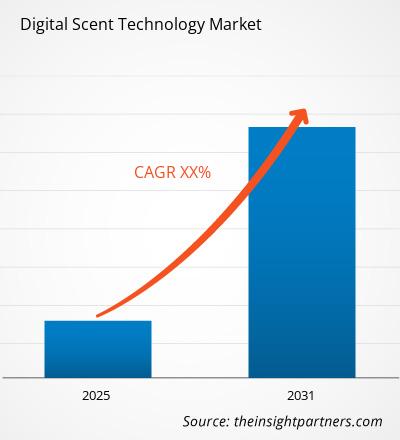
The Digital Scent Technology Market value was recorded at US$ 1.35 billion in 2025 and is forecast to reach US$ 3.09 billion by 2034, growing at a CAGR of 9.60% over the period from 2026 to 2034. The market includes devices such as e-noses, digital scent technology, and other olfactory systems for odor detection, digital scent delivery, quality control, diagnosis, monitoring, and volatile compound detection.
The North American Digital Scent Technology Market size is set to witness growth with a CAGR of 8.2-9.0% over 2026-2034 owing to developments in the study of breath analysis clinically, automation of food safety, and screening for homeland security. Sensor research funding and advanced healthcare facilities along with the use of portable VOC sensors have driven adoption.
Digital Scent Technology Market Assessment and Insights
- North America held 32–36% share in 2025 and is growing at a CAGR of 8.2–9.0% during 2026–2034, led by healthcare diagnostics, security screening, and food quality automation.
- US represented 78–82% of North American revenue in 2025 and is growing at a CAGR of 8.4–9.2% during 2026–2034, supported by diagnostics, defense, and industrial sensing.
- Europe accounted for 27–31% share in 2025 and is growing at a CAGR of 8.0–8.8% during 2026–2034, with Germany, France, the UK, Italy, and Spain leading adoption.
- Asia Pacific held 24–28% of the Digital Scent Technology Market share in 2025 and is growing at a CAGR of 10.8–11.6% during 2026–2034, led by China, Japan, South Korea, India, and Australia.
- Largest Segment Hardware held 68–72% market share in 2025 and is growing at a CAGR of 8.8–9.6% during 2026–2034 because devices remain the core deployment cost.
- High Growth Segment Healthcare and Life Sciences represented 18–22% market share in 2025 and is growing at a CAGR of 11.4–12.2% during 2026–2034, supported by breath diagnostics.
- Key companies analyzed in detail: AIRSENSE Analytics GmbH; Alpha MOS S.A.; ams-OSRAM AG; Aryballe Technologies SA; Comon Invent B.V.; Electronic Sensor Technology, Inc.; Odotech Inc.; Scent Sciences Corp.; ScentSational Technologies, LLC; The eNose Company.
Source: The Insight Partners' analysis based on proprietary research, government publications, company annual reports, investor presentations, industry databases, and expert interviews.
Olfaction detection has shifted from laboratory equipment to mobile electronic noses, VOC embedded sensor arrays, and programmable scent devices. In terms of production processes, the current trends in the market are concerned with the use of metal oxide sensors, optics technology, microfluidic devices, cartridges, and machine learning models for classifying odors. The market of Digital Scent Technology gets support due to quick calibration methods, low-power electronics, and cloud-based references making odor detection possible for quality control, environmental surveillance, and non-invasive clinical applications.
Future demands will depend on the manufacturing that will take place in the Asia Pacific region, diagnostics tests to be carried out in North America, food safety in Europe, and the monitoring of infrastructures in the Middle East countries. The miniaturized devices, cloud computing, and odor libraries will bring in investments in the health care industry, security industry, and industries dealing with odors.
Digital Scent Technology Market Report Scope
| Report Attribute | Details |
|---|---|
| Market size in 2025 | US$ 1.35 Billion |
| Market Size by 2034 | US$ 3.09 Billion |
| Global CAGR (2026 - 2034) | 9.60% |
| Historical Data | 2021-2024 |
| Forecast period | 2026-2034 |
Digital Scent Technology Market Analysis
The market grows as a result of necessity to quickly detect volatile organic compounds in food processing plants, hospitals, airports, laboratories, and industrial facilities. It becomes higher if the user needs objective evidence of odors, faster identification of spoiled items, detection of chemical threats, or breath analysis. Ecosystem consists of sensor manufacturers, cartridge manufacturers, instrument manufacturers, software providers, calibration laboratories, and industry experts.
Supply conditions are based on sensor accuracy, sensor humidity compensation, sampling technique, reagent stability, and pattern recognition accuracy. E-noses are dominant in the detection of odors while scent generators are selective for immersion applications, training, and sensory marketing. Consumers are actively involved in portability, false positive avoidance, wide library, service costs, and lab system compatibility.
According to Digital Scent Technology Market report, the market features a specialized competitive environment. AIRSENSE Analytics GmbH and Alpha MOS S.A. are competing using mature e-nose systems, whereas Aryballe Technologies SA pays attention to bio-inspired optical sensors. Support for this segment is provided by ams-OSRAM AG in the form of advanced sensor components and Electronic Sensor Technology, Inc. in terms of analytical odor detection.
The eNose Company, Odotech Inc., Comon Invent B.V., Scent Sciences Corp., and ScentSational Technologies, LLC increase possibilities of use in areas like odors identification, medical diagnosis, and scent delivery. The investor's preferences can be stated through portability, artificial intelligence technology for classification, clinical trial results, and repeat purchases. The positioning strategy will be based on accuracy, reference data, regulation compliance, and distribution.
● REPORT CUSTOMIZATION
Tailor This Report To Align With Your Specific Business Requirements
This report can be customized to align precisely with your business objectives, scope, and target markets. Customization options include tailored segmentation, geography, competitive analysis, and strategic insights to support informed decision-making.
Customize This Report →WHAT YOU CAN ADJUST
- ● Segmentations
- ● Geography
- ● Competitive Analysis
- ● Language Preferences
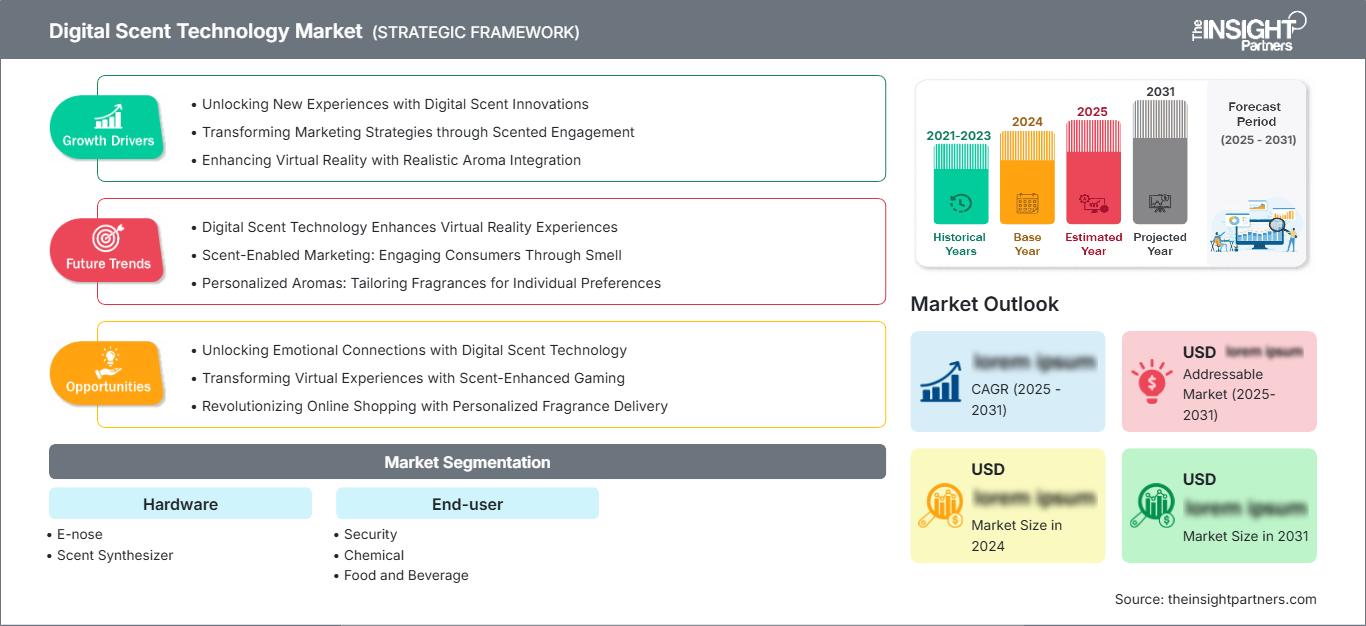
Digital Scent Technology Market: Strategic Insights
Regional Insights
North America Digital Scent Technology Market
North America held 32–36% share in 2025 and is projected to expand at a CAGR of 8.2–9.0% during 2026–2034. The market share in the region is supported by healthcare diagnostics research, food safety automation, airport security screening, indoor air quality programs, and laboratory adoption of portable VOC systems.
Region-specific demand is boosted by validation culture in line with FDA guidelines, research into breath biomarkers backed by NIH grants, procurement by defense agencies, and an established presence of laboratory instrumentation in the field. The users require reproducibility, sampling control, calibration traceability, and software audits. Field testing is being expedited by North American vendors and research labs as well.
U.S. Digital Scent Technology Market
United States was 78-82% of total North American revenue in 2025 and will witness a growth rate of CAGR of 8.4-9.2% from 2026 to 2034. Application areas include clinical breath testing, food & beverages quality assurance, hazardous substances detection, cannabis testing, indoor air testing, and chemical detection for defense purposes.
Companies like Electronic Sensor Technology, Inc., Scent Sciences Corp., and ScentSational Technologies, LLC bring the visibility of domestic companies, and foreign competitors are available through distributors and research avenues. In terms of application, miniaturization, reference library support, cloud computing and maintenance-free cartridges have seen the trend of adoption. United States market is also influenced by airport upgradation, pharmaceutical quality systems and hospital demand for non-invasive work flows.
Europe Digital Scent Technology Market
The European segment accounted for market share of 27-31% in 2025 and is expected to grow at a CAGR of 8.0-8.8% during 2026-2034. Germany is dominant due to industrial gas sensing, automobile cabin smell detection, chemical manufacturing, and process quality programs. UK is propelled by healthcare diagnostics, lab testing, security screening, and food authentication procedures.
In France, Aryballe Technologies SA and Alpha MOS S.A. are key driving factors. In Italy and Spain, there is demand from food and beverage, packaging, and environmental sensing applications. Consumer demands in Europe involve CE certification, safety of employees, nuisance odor, and repeated sensory analysis. There have been instances of adoption of the market where human panels were not economical, consistent, or dangerous.
APAC Digital Scent Technology Market
The Asia Pacific accounted for 24-28% market share in 2025 and is expected to witness a CAGR of 10.8%-11.6% in 2026-2034. China dominates with its electronics manufacturing, food processing, environmental monitoring, and chemical industry monitoring. Meanwhile, Japan and South Korea contribute by enabling precise sensors integration.
India and Australia gain from healthcare pilots, food safety, mining, and city smell detection. Smart manufacturing, air quality improvement, and domestic medical technology policies boost deployment. The price sensitivity still plays a role, but regional market benefits from regional electronics volume and growing analytical laboratory capacity.
Middle East & Africa Digital Scent Technology Market
ME&A will experience a CAGR of 7.4% - 8.2% during 2026-2034. The growth driver is led by Saudi Arabia through applications like petrochemicals monitoring, industry safety, airport scanning, and smart city solutions. UAE contributes to growth with additional applications in aviation, logistics, laboratories, and premium retail experiences.
South Africa and Rest of ME&A will depend upon applications like mining, utilities, water treatment, and food distribution. The energy infrastructure application brings rugged odor and VOC detection requirement because of harsh environmental conditions. The growth is selective due to local services, availability of consumables, and performance in harsh conditions.
Segmentation Analysis
Hardware
Hardware is projected to grow at a CAGR of 8.8–9.6% during 2026–2034. The Digital Scent Technology Market scope is concentrated in physical detection and emission devices because sampling modules, sensor arrays, cartridges, pumps, and embedded processors determine system accuracy and deployment economics. Buyers evaluate sensitivity, portability, response time, calibration stability, and consumable replacement cycles before scaling across facilities.
- E-nose systems lead detection use cases by converting odor and VOC patterns into digital signatures for quality control, security screening, clinical research, and environmental monitoring.
- Scent Synthesizer devices support controlled fragrance release in training, immersive media, product testing, and sensory marketing where repeatable scent delivery improves experience design and evaluation.
End-user
End-user demand is forecast to grow at a CAGR of 9.7–10.5% during 2026–2034. Adoption varies by risk tolerance, validation requirements, and return on automation. Security users value rapid threat recognition, food processors need objective odor quality evidence, healthcare organizations require clinical validation, and environmental users focus on continuous nuisance and hazardous emission tracking.
- Security applications use odor fingerprints to support explosives, narcotics, toxic gas, and hazardous material screening where rapid non-contact detection can strengthen inspection workflows.
- Chemical users apply olfactory analytics for leak detection, raw material verification, process deviation checks, and worker safety monitoring across production and storage environments.
- Food and Beverage companies deploy systems for freshness checks, off-odor detection, packaging taint evaluation, flavor consistency, and reduced dependence on human sensory panels.
- Healthcare and Life Sciences adoption is rising through breath VOC studies, infection screening pilots, microbiology workflows, and non-invasive diagnostic research requiring reproducible odor signatures.
- Environmental users focus on wastewater, landfill, industrial fence-line, indoor air, and community odor monitoring where objective evidence supports compliance and response planning.
Opportunity Snapshot
| End-user | Revenue Contribution | Trend Tag | Adoption Stage |
| Security | Medium | Threat Screening | Scaling |
| Chemical | Medium | VOC Safety | Mature |
| Food and Beverage | High | Freshness Control | Scaling |
| Healthcare and Life Sciences | High | Breath Diagnostics | Emerging |
| Environmental | Medium | Odor Compliance | Scaling |
Digital Scent Technology Market Growth Drivers and Impact Analysis
Food quality automation reduces dependence on sensory panels
Odor data must be acquired more quickly and objectively by food and drink manufacturers since sensory panels are too costly, inconsistent, and not easily scalable from shift to shift and plant to plant. E-noses could screen raw materials, detect rancidity, control fermentation, detect package taint, and analyze aroma profiles before products go into the market. This results in an increased need for high-throughput sample acquisition, database software which relates odor information to quality programs, and suppliers who decrease preparation time and supply reliable pass/fail models.
Healthcare research accelerates non-invasive VOC screening
Various facilities such as hospitals, universities, and breath VOC patterns for diseases such as infections, metabolic conditions, cancers, etc., are being analyzed by diagnosticians. The Digital Scent Technology Market can gain from the requirement of miniaturized breath analysis process which involves reliable sensors and machine learning algorithms to recognize complex chemical patterns. However, even before the commercialization process begins, vendors may see the market's positive effects through pilot purchases and partnerships. This will help them shift focus from research products to medical decision-making solutions.
Security and environmental monitoring require rapid odor intelligence
A need for faster identification of chemical threats, odors, and emissions is required by airports, border control agencies, industries, sewage treatment facilities, and city administrations. The ability of digital scent technology to aid in transforming an odor complaint or inspection process to structured evidence could help in raising an alarm, conducting investigations, and taking necessary compliance actions. Maximum impact would be realized when the identification of these chemicals is done in real time or near real time for improving safety, reducing downtime, and protecting the public from exposure.
Digital Scent Technology Market Future Trends
Bio-inspired sensors move from laboratory tools to embedded modules
Digital Scent Technology Market trends point toward bio-inspired sensors becoming embedded modules inside appliances, industrial equipment, diagnostic devices, and quality control stations. Silicon photonics, peptide coatings, and miniaturized gas sensor arrays are improving the balance between selectivity, form factor, and repeatability. Future systems will rely less on standalone laboratory instruments and more on connected modules that feed odor signatures into enterprise analytics. This shift can lower deployment barriers and create recurring revenue through sensor replacement, software subscriptions, and application-specific reference libraries.
AI odor libraries become strategic data assets
Future competition will shift toward proprietary odor libraries that improve classification accuracy across products, diseases, facilities, and chemical signatures. Machine learning models need large, well-labeled datasets that include humidity, temperature, sample preparation, and background interference. Companies that accumulate validated data from food, healthcare, environmental, and security settings can create defensible software layers. The trend will encourage partnerships between device makers, laboratories, hospitals, food producers, and infrastructure operators that can contribute repeatable real-world samples.
Digital Scent Technology Market Opportunities
Validated breath screening platforms for clinical pathways
Digital Scent Technology Market Forecasts support investment in breath screening platforms that combine standardized sample capture, validated sensor response, and cloud-based classification. The opportunity is strongest in triage, infectious disease screening, metabolic monitoring, and longitudinal patient follow-up where non-invasive testing can reduce burden on laboratories. Companies should prioritize clinical partnerships, regulatory evidence, reimbursement logic, and explainable algorithms. A phased strategy can begin with research-use systems, progress into decision-support workflows, and then target regulated diagnostic claims after sufficient study performance.
Industrial odor compliance networks for cities and plants
Municipalities, wastewater utilities, petrochemical sites, and food processors need objective odor records that connect complaints, emissions, weather, and operating events. Vendors can build opportunities around sensor networks, dashboards, service contracts, calibration programs, and analytics that distinguish nuisance odor from hazardous VOC events. The investment case improves when systems reduce manual patrols, support regulatory reporting, and help operators identify root causes. Regional partners will be important because deployment requires site surveys, maintenance, and confidence in local response capability.
Recent Developments
- June 2026: Givaudan announced that it has reached an agreement to acquire a majority stake in Eurofragance, a pure play fragrance house based in Barcelona, Spain. The alliance is aligned with Givaudan’s 2030 strategy to expand its presence and capabilities across local and regional markets.
- June 2026: Hindustan Unilever Limited (HUL) announced the inauguration of the new Unilever Fragrance Hub (UFH) in Mumbai, marking a significant milestone in Unilever’s global innovation journey and reinforcing India’s role as a key growth market and R&D hub. The India facility is the third global hub, following the UK and US, and represents the latest investment under Unilever’s overall €100 million programme to advance in-house, digitally enabled fragrance creation capabilities.
- December 2025: The Estée Lauder Companies Inc. (NYSE: EL) and Jo Malone London announced the launch of the Jo Malone London Scent Advisor, an innovative, AI-powered digital experience designed to help customers discover their perfect fragrance through an intuitive, conversational journey, bridging the gap between curiosity and confidence in online fragrance discovery.
Frequently Asked Questions

- Comprehensive Market Sizing and Forecast Analysis
- Detailed Segmentation Analysis
- In-Depth Market Dynamics Assessment
- Regional and Country-Level Insights
- Competitive Landscape and Company Benchmarking
- Strategic Business Intelligence
Recent Reports
Testimonials

The Insight Partners' SCADA System Market report is comprehensive, with valuable insights on current trends and future forecasts. The team was highly professional, responsive, and supportive throughout. We are very satisfied and highly recommend their services.
RAN KEDEM Partner, Reali Technologies LTDs
I requested a report on a very specific software market and the team produced the report in a few days. The information was very relevant and well presented. I then requested some changes and additions to the report. The team was again very responsive and I got the final report in less than a week.
JEAN-HERVE JENN Chairman, Future Analytica
We worked with The Insight Partners for an important market study and forecast. They gave us clear insights into opportunities and risks, which helped shape our plans. Their research was easy to use and based on solid data. It helped us make smart, confident decisions. We highly recommend them.
PIYUSH NAGPAL Sr. Vice President, High Beam Global
The Insight Partners delivered insightful, well-structured market research with strong domain expertise. Their team was professional and responsive throughout. The user-friendly website made accessing industry reports seamless. We highly recommend them for reliable, high-quality research services
YUKIHIKO ADACHI CEO, Deep Blue, LLC.
This is the first time I have purchased a market report from The Insight Partners.While I was unsure at first, I visited their web site and felt more comfortable to take the risk and purchase a market report.I am completely satisfied with the quality of the report and customer service. I had several questions and comments with the initial report, but after a couple of dialogs over email with their analyst I believe I have a report that I can use as input to our strategic planning process.Thank you so much for taking the extra time and making this a positive experience.I will definitely recommend your service to others and you will be my first call when we need further market data.
JOHN SUZUKI President and Chief Executive Officer, Board Director, BK Technologies
I wish to appreciate your support and the professionalism you displayed in the course of attending to my request for information regarding to infectious disease IVD market in Nigeria. I appreciate your patience, your guidance, and the fact that you were willing to offer a discount, which eventually made it possible for us to close a deal. I look forward to engaging The Insight Partners in the future, all thanks to the impression you have created in me as a result of this first encounter.
DR CHIJIOKE ONYIA MANAGING DIRECTOR, PineCrest Healthcare Ltd.Reason to Buy
- Informed Decision-Making
- Understanding Market Dynamics
- Competitive Analysis
- Identifying Emerging Markets
- Customer Insights
- Market Forecasts
- Risk Mitigation
- Boosting Operational Efficiency
- Strategic Planning
- Investment Justification
- Tracking Industry Innovations
- Aligning with Regulatory Trends





 Get Free Sample for