
Dimmers Market Growth, Share & Trends by 2034
Coverage: by Type (Universal, Incandescent/Halogen, Electronic Low Voltage (ELV), Magnetic Low Voltage (MLV), High Wattage Dimmers, Others); Control (Single Pole Dimming, Three-Way Dimming, Others); Connectivity (Wired Dimmers, Wireless Dimmers); Application (Residential, Commercial, Industrial) , and Geography (North America, Europe, Asia Pacific, and South and Central America)
- Status : Data Released
- Report Code : TIPRE00010107
- Category : Electronics and Semiconductor
- No. of Pages : 150
- Available Report Formats :


- Last update date : August 05, 2026


2025 Market Size
US$ 3.02 Bn
Base year value
2034 Forecast
US$ 4.66 Bn
Projected by 2034
CAGR 2026-2034
4.94 %
Growth rate
Addressable Market
US$ 34.86 Bn
(2026-2034)
In 2025, the Dimmers Market is estimated at US$ 3.02 Billion and is forecast to reach US$ 4.66 Billion by 2034, with a CAGR of 4.94% between 2026 and 2034. The market growth is being driven by LED retrofits, smart homes, commercial energy regulations, and digital addressable lighting controls making brightness control an essential requirement.
The North American Dimmers Market size is set to expand at a CAGR of 4.6-5.4%, owing to favorable factors such as residential remodeling, smart buildings, and increasing energy code requirements. Adoption in North America is more prevalent in the United States due to the rise in LED compatibility, connected switches, efficiency rebates, and installations by contractors.
Dimmers Market Assessment and Insights
- North America held 31–35% Dimmers Market share in 2025 and is growing at a CAGR range of 4.6–5.4% during 2026–2034, supported by smart home penetration, LED retrofits, and commercial building controls.
- US represented 76–80% of North America in 2025 and is growing at a CAGR range of 4.7–5.5%, led by residential upgrades and energy-code compliance.
- Europe accounted for 23–27% share in 2025 and is advancing at a CAGR range of 4.2–5.0%, with Germany, the UK, France, Italy, and Spain leading adoption.
- Asia Pacific captured 28–32% share in 2025 and is expanding at a CAGR range of 5.4–6.2%, led by China, India, Japan, South Korea, and Australia.
- Largest Segment Residential held 46–50% market share in 2025 and is growing at a CAGR range of 4.5–5.3%, supported by retrofit and smart-home demand.
- High Growth Segment Wireless Dimmers held 24–28% market share in 2025 and is growing at a CAGR range of 6.4–7.2%, driven by app control and retrofit convenience.
- Key companies analyzed in detail: Acuity Brands, Inc., ABB Ltd., Caribe Corporation, Cree Lighting USA LLC, Echelon Corporation, GE Lighting, a Savant company, Hubbell Incorporated, Leviton Manufacturing Co., Inc., LSI Industries Inc., and Lutron Electronics Co., Inc.
Source: The Insight Partners' analysis based on proprietary research, government publications, company annual reports, investor presentations, industry databases, and expert interviews.
Dimming technology has evolved from basic resistive load adjustment to LED-friendly electronics, phase cutting technology, 0-10V communication, wireless communication, and intelligent fixtures. Current manufacturing characteristics will rely on semiconducting quality, thermal management, firmware compatibility, aesthetic faceplates, and testing with large lamp product ranges. The Dimmers Market is indicative of a trend away from generic electrical accessories to advanced lighting control gadgets that enable energy efficiency, comfort, scenes creation, and intelligent buildings operations.
Further demand for dimmers will increase in multi-family residences, hotels, luxury retailers, office spaces, healthcare facilities, and industries looking for improved light quality and lower energy consumption. In growing regions, there is an increasing adoption of dimmable LEDs due to increased construction standards whereas mature regions focus on retrofit compatibility and smart platform capability. Building efficiency requirements and consumer desire for customized lighting will drive vendors who possess electrical reliability, user interface quality, and installation support.
Dimmers Market Report Scope
| Report Attribute | Details |
|---|---|
| Market size in 2025 | US$ 3.02 Billion |
| Market Size by 2034 | US$ 4.66 Billion |
| Global CAGR (2026 - 2034) | 4.94% |
| Historical Data | 2021-2024 |
| Forecast period | 2026-2034 |
Dimmers Market Analysis
Dimmers Market Growth will be fueled by rising penetration of LEDs, smart home technology, commercial energy management, and the requirements for flexible lighting environments. Dimmers decrease light output based on occupancy, daylighting, task requirement, and ambience requirement, thus reducing power consumption and improving comfort. The use of dimmers will rise as buildings increasingly utilize control technology not only to meet efficiency regulations but also to integrate lighting with automation platforms, sensors, and energy dashboards.
The value chain consists of semiconductor suppliers, switch manufacturers, lighting fixture manufacturers, distributors, electrical contractors, home-automation integrators, and facility owners. Lutron Electronics Co., Inc. and Leviton Manufacturing Co., Inc. continue to be prominent companies in the field of residential and commercial controls, whereas Acuity Brands, Inc., Cree Lighting USA LLC, Hubbell Incorporated, and LSI Industries Inc. link dimmer functions with luminaire or lighting system. ABB Ltd. and GE Lighting, a Savant company contribute to the electrical and connected home ecosystems.
Dimmers Market analysis indicates a competitive shift towards LED compatibility, appealing wall dimming switches, wireless compatibility, cybersecurity, and installer-friendly commissioning. Caribe Corporation and Echelon Corporation cater to niche controls and networked lighting solutions, while mainstream brands fight market share through strong distribution networks and standard-compatible products. In purchasing decisions, concerns around warranty coverage, flicker performance, apps and compatibility databases, as well as the price of devices become relevant.
Strategic investments are made in wireless retrofit solutions, smart panels, commercial control ecosystems, and platforms with integrated occupancy sensors, daylight harvesting and scheduling systems. Strategic positioning involves retail availability, electrical distributor partnerships, building specifications, and serving the needs of DIY customers and installers alike. Companies which minimize commissioning time and LED mismatches have the opportunity to maintain high margins in a diverse product category.
● REPORT CUSTOMIZATION
Tailor This Report To Align With Your Specific Business Requirements
This report can be customized to align precisely with your business objectives, scope, and target markets. Customization options include tailored segmentation, geography, competitive analysis, and strategic insights to support informed decision-making.
Customize This Report →WHAT YOU CAN ADJUST
- ● Segmentations
- ● Geography
- ● Competitive Analysis
- ● Language Preferences
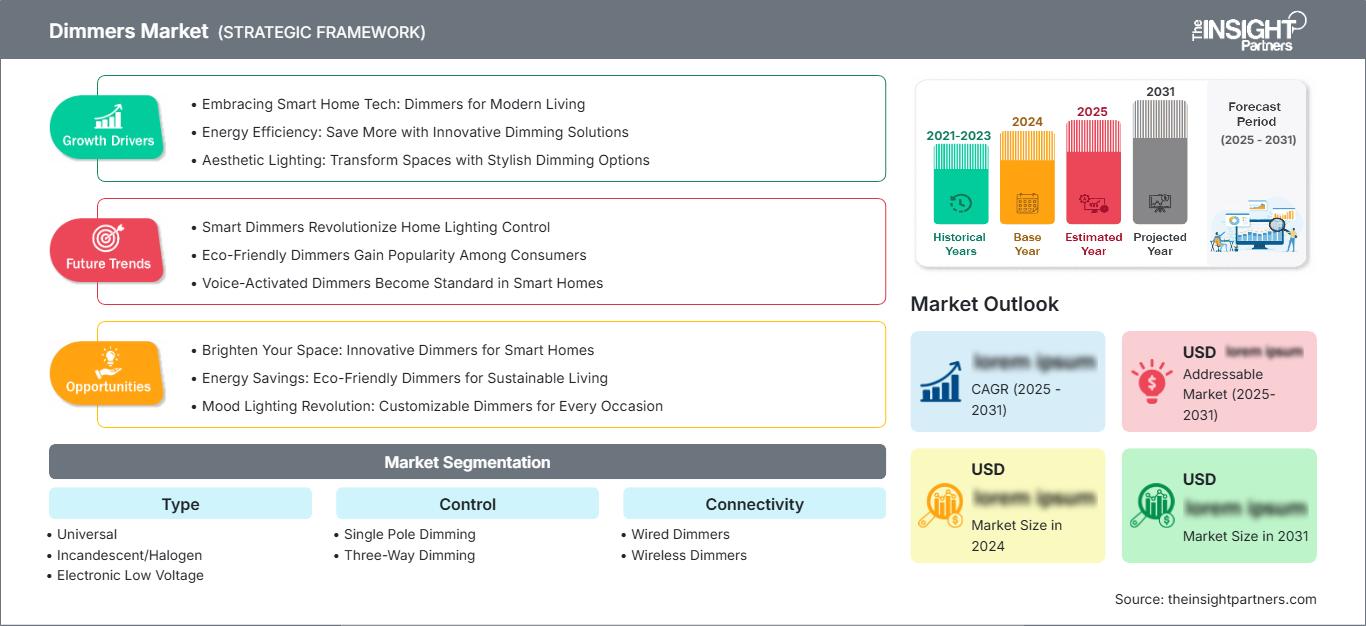
Dimmers Market: Strategic Insights
Regional Insights
North America Dimmers Market
North America accounted for 31-35% share in 2025 and is anticipated to witness growth at CAGR from 4.6-5.4% through 2034. Factors driving the Dimmers Market include home renovations, smart lighting, and mandatory codes in commercial construction. The key drivers of demand include installation of LEDs combined with smart thermostats, voice assistants, and home automation that make lighting control a part of overall residential energy management.
Canadian contribution includes energy-efficiency programs in the commercial sector, LED installation in the residential sector, while the U.S. holds leadership in projects and retail sales. Customers seek dimmers without flickering, compatibility with neutral and no-neutral wiring, and operation on extensive LED lamps listings. Price competitiveness limits growth; however, mandatory standards and an emphasis on comfort-driven lighting drive replacement cycles.
U.S. Dimmers Market Market
The US represented 76–80% of North America in 2025 and is forecast to grow at a CAGR range of 4.7–5.5%. Lutron Electronics Co., Inc., Leviton Manufacturing Co., Inc., Acuity Brands, Inc., Hubbell Incorporated, Cree Lighting USA LLC, and GE Lighting, a Savant company have strong channel presence across retail, electrical distribution, residential construction, and commercial projects. Applications include single-family homes, hotels, offices, schools, hospitals, restaurants, and warehouses.
Demand is reinforced by LED replacement, smart-home ecosystems, California-style lighting efficiency requirements, and consumer interest in ambience and wellness. Contractors value pre-tested compatibility tools, consistent wiring methods, and products that limit callbacks. Professional-grade three-way and wireless controls are gaining share in retrofits where homeowners want app scheduling, voice control, and scene-based lighting without major rewiring.
Europe Dimmers Market Market
The European region accounted for 23-27% in 2025 and will have a CAGR range of 4.2-5.0%. Germany is dominant due to the presence of efficiency in construction, higher-quality houses, and renovation in commercial spaces. In the United Kingdom, the driving factors are smart homes and hotel refurbishments. In France, Italy, and Spain, demand is created due to apartment renovations, commercial building renovations, tourism interior applications, and LED light installations.
The European procurement focuses on lower standby power consumption, electrical safety approvals, design-based wall controllers, and compliance with building automation protocols. The growth rate in the region is steady compared to Asia-Pacific as there is already an established stock of buildings; however, renovation intensity, energy prices, and decarbonization policies drive the installation of dimmers.
APAC Dimmers Market Market
The Asia Pacific market segment accounted for 28%-32% of the total market share in 2025 and is forecast to register a CAGR of 5.4%-6.2%. China is the leading market due to the high construction rate of homes, its own intelligent-home infrastructure, and manufacturing capacity for LED lights. India will continue to develop due to expensive houses, hotels, office buildings, and urban shopping malls, whereas Japan, South Korea, and Australia value quality, reliability, and connectivity in lighting systems.
Government regulations that encourage efficient lighting, fast urban development, and increasing number of affluent households will boost market growth. The Dimmers Market in APAC has a significant fixture manufacturing base, and retail digitization is quite fast there; however, fragmented standards and affordable imports affect pricing.
Middle East & Africa Dimmers Market Market
Middle East & Africa is projected to grow at a CAGR range of 4.3–5.1% as Saudi Arabia, the UAE, South Africa, and the rest of MEA invest in hospitality, premium housing, offices, malls, and energy-efficient public infrastructure. The UAE leads high-specification lighting control adoption, while Saudi Arabia adds demand through giga-projects and commercial construction.
Regional adoption is linked to luxury interiors, heat-related energy management, tourism assets, and smart-city programs. Projects often require reliable controls for high ambient temperatures and mixed international lighting brands. Growth remains project-driven, but premium construction supports specification-led dimmer demand.
Segmentation Analysis
Type
Type is expected to grow at a CAGR range of 4.7–5.5% during 2026–2034 as the Dimmers Market scope spans legacy lamps, LED fixtures, and higher-load commercial applications. Universal products are gaining preference because installers need one device to manage mixed loads, while specialized ELV, MLV, halogen, and high-wattage dimmers remain relevant where lighting systems require precise electrical matching.
- Universal dimmers hold strategic importance because they simplify inventory, reduce installation uncertainty, and support mixed LED, incandescent, and halogen loads in residential and light commercial retrofits.
- Incandescent/Halogen dimmers remain present in legacy housing, hospitality, and decorative lighting where warm dimming and familiar load behavior preserve demand despite LED replacement.
- Electronic Low Voltage dimmers serve premium LED drivers, accent lighting, and architectural systems requiring smooth trailing-edge control and low-noise performance.
- Magnetic Low Voltage dimmers address transformer-based fixtures in older commercial and specialty installations where compatibility and safe load handling remain essential.
- High Wattage Dimmers support larger spaces, multi-lamp circuits, and demanding commercial applications where durability, heat management, and electrical capacity influence specification decisions.
Control
Control is projected to grow at a CAGR range of 4.5–5.3% during 2026–2034 as installers balance simplicity with multi-location convenience. Single-pole dimming dominates basic room-level control, while three-way dimming gains importance in corridors, staircases, open-plan homes, and hospitality areas where occupants expect flexible operation from more than one wall location.
- Single Pole Dimming remains the volume foundation because bedrooms, kitchens, bathrooms, and small offices often require one control point with simple wiring and predictable installation cost.
- Three-Way Dimming is strategically important in premium homes, hotels, and commercial interiors where multi-entry spaces need coordinated brightness control and better occupant convenience.
Connectivity
Connectivity is expected to grow at a CAGR range of 5.1–5.9% during 2026–2034 as wired devices provide reliability and wireless products accelerate retrofit adoption. Wired dimmers remain trusted for code-driven projects and new construction, while wireless dimmers benefit from app control, voice integration, scene programming, and lower installation disruption in existing buildings.
- Wired Dimmers retain strong demand in new construction, commercial spaces, and professional electrical projects where stable operation, predictable wiring, and code compliance are essential.
- Wireless Dimmers are the fastest-rising sub-segment because they enable retrofit convenience, remote scheduling, voice control, and integration with broader smart-home or smart-building platforms.
Application
Application is projected to grow at a CAGR range of 4.8–5.6% during 2026–2034 as residential users seek ambience and commercial operators focus on energy management. Residential remains the largest base, but commercial adoption strengthens in offices, hospitality, retail, healthcare, and education. Industrial demand is narrower, centered on task lighting, safety, and controllable high-bay environments.
- Residential leads demand because homeowners combine LED retrofits, smart speakers, renovation projects, and comfort-focused lighting scenes across kitchens, living rooms, bedrooms, and outdoor areas.
- Commercial adoption rises as offices, hotels, retail stores, schools, and healthcare facilities use dimming for energy codes, ambience, daylight harvesting, and occupant experience.
- Industrial usage concentrates in warehouses, workshops, and manufacturing spaces where adjustable light levels improve task visibility, energy use, and operational safety.
Opportunity Snapshot
| Application | Revenue Contribution | Trend Tag | Adoption Stage |
| Residential | High | Smart Scenes | Scaling |
| Commercial | Medium | Code Controls | Scaling |
| Industrial | Low | Task Lighting | Emerging |
Dimmers Market Growth Drivers and Impact Analysis
LED Retrofit Momentum Expands Compatible Dimmer Demand
LED usage creates a robust replacement cycle because many old dimmers cause flickering, less trimming at the low end, humming, or poor performance with new light sources. In the process of installing LED lighting in homes, hotels, office buildings, and stores, contractors often use LED-friendly universal or ELV dimmers to prevent callbacks. The effects of the market development are quite practical and immediate – dimmers go in the bill of material for the installation rather than being an option. Technical databases, labeling, and training of contractors affect purchase decision. LED-compatible manufacturers can capitalize on their investment into energy efficiency to sell high-quality control.
Smart Homes and Connected Buildings Increase Control Expectations
Lighting is now expected to be used in creating scenes, following schedules, responding to voice commands, and even controlling the occupant's routine and the device from a mobile phone. Wireless dimmers help consumers and facilities managers to satisfy their needs for advanced lighting without the need to rewire the system. The market of Dimmers sees positive effects in the combination of lighting control along with thermostats, speakers, security solutions, and energy apps. Lighting is applied in commercial buildings in order to make people feel comfortable and create automated energy solutions.
Energy Codes and Sustainability Goals Support Specification
Building codes today tend to incentivize or mandate lighting control systems that conserve power through techniques like daylight harvesting, partial-on functions, and occupancy controls. Dimmer technology assists property owners in meeting these codes while adding versatility for commercial and residential offices, classrooms, health care facilities, and hotels. The practical effect has been the transition away from simple on-off switches toward lighting controls in renovations and new buildings. Electrical engineers have started assessing dimming suitability, load considerations, and coordination with sensors or building automation systems. Suppliers who offer compliant product lines, technical documents, and channel training gain specification opportunities prior to tendering, particularly when projects track energy performance.
Dimmers Market Future Trends
Adaptive Dimming Integrated with Human-Centric Lighting
The Dimmers Market trends will include adaptability control that adjusts light levels depending on time of day, amount of natural daylight, task activity, and individual preferences. The development of human-centric lighting programs is spreading beyond niche markets, now extending to hotels, hospitals, office buildings, and high-end homes. This requires dimmers that are able to interact with tunable white luminaires and scene controllers. The future will require good transition, performance at low-light levels, and presets more than just manual operation.
Interoperable Wireless Protocols Reshape Retrofit Channels
Wireless dimmers will move toward broader interoperability as smart-home platforms and commercial control systems standardize device onboarding. Matter, Zigbee, Bluetooth Mesh, Wi-Fi, and proprietary low-latency systems will continue to coexist, but buyers will expect fewer compatibility risks and clearer ecosystem choices. This shift can expand retrofit adoption because renters, homeowners, and small businesses prefer products that remain useful as platforms change. Channel strategy will adapt as electrical distributors, e-commerce sellers, and system integrators all compete for connected-control projects. Vendors that simplify pairing, security updates, and multi-brand integration will gain repeat purchase advantages.
Dimmers Market Opportunities
Retrofit Bundles for Residential LED and Smart-Home Upgrades
Dimmers Market Forecasts indicate strong opportunity in residential retrofit bundles that combine LED-compatible dimmers, wireless companion switches, app setup guidance, and verified lamp lists. Homeowners often upgrade lighting one room at a time, so suppliers can create packages for kitchens, living rooms, bedrooms, and outdoor zones. Retailers and contractors can improve conversion by selling comfort, energy savings, and scene control together rather than separate devices. The investment case is strongest where installation is simple and product returns are low. Brands with strong consumer education, neutral-wire alternatives, and attractive finishes can capture repeat purchases across whole-home modernization journeys.
Commercial Control Upgrades for Hospitality and Flexible Offices
Hotels, restaurants, retail stores, and flexible offices need lighting that adapts to occupancy, brand ambience, cleaning schedules, and energy targets. Dimmer suppliers can pursue these projects with scalable wired and wireless systems, centralized commissioning, and interfaces that facility teams can manage without specialist support. Opportunity is reinforced by renovation cycles and the shift toward experience-led interiors. Vendors should prioritize fixture compatibility, emergency-lighting coordination, and integration with occupancy sensors and building systems. Partnerships with lighting designers, electrical contractors, and facility management providers can convert one-off installations into repeat programs across chains, campuses, and property portfolios.
Recent Developments
- February 2026: Lutron Electronics Co., Inc. introduced its Intelligent Lighting portfolio at Integrated Systems Europe, combining addressable fixtures, wireless control, Ketra and Orluna product families, and phased regional rollout plans. The launch reinforced Lutron’s strategy of connecting dimming, natural light control, and premium residential experience through integrated lighting ecosystems.
- December 2025: Leviton Manufacturing Co., Inc. highlighted 2025 innovation activity including its LED Bulb/Dimmer Compatibility Tool, designed to help contractors and users match LED lamps with suitable dimmers and reduce field performance issues. The update emphasized practical installation support as LED compatibility remains a key market concern.
- August 2025: Acuity Brands, Inc. announced that nine Acuity Brands Lighting solutions were selected for the 2025 Illuminating Engineering Society Progress Report, including products offering multiple dimming options and nLight control compatibility. The recognition underscored continued innovation in controllable luminaires and lighting systems serving commercial applications.
Frequently Asked Questions

- Comprehensive Market Sizing and Forecast Analysis
- Detailed Segmentation Analysis
- In-Depth Market Dynamics Assessment
- Regional and Country-Level Insights
- Competitive Landscape and Company Benchmarking
- Strategic Business Intelligence
Recent Reports
Testimonials

The Insight Partners' SCADA System Market report is comprehensive, with valuable insights on current trends and future forecasts. The team was highly professional, responsive, and supportive throughout. We are very satisfied and highly recommend their services.
RAN KEDEM Partner, Reali Technologies LTDs
I requested a report on a very specific software market and the team produced the report in a few days. The information was very relevant and well presented. I then requested some changes and additions to the report. The team was again very responsive and I got the final report in less than a week.
JEAN-HERVE JENN Chairman, Future Analytica
We worked with The Insight Partners for an important market study and forecast. They gave us clear insights into opportunities and risks, which helped shape our plans. Their research was easy to use and based on solid data. It helped us make smart, confident decisions. We highly recommend them.
PIYUSH NAGPAL Sr. Vice President, High Beam Global
The Insight Partners delivered insightful, well-structured market research with strong domain expertise. Their team was professional and responsive throughout. The user-friendly website made accessing industry reports seamless. We highly recommend them for reliable, high-quality research services
YUKIHIKO ADACHI CEO, Deep Blue, LLC.
This is the first time I have purchased a market report from The Insight Partners.While I was unsure at first, I visited their web site and felt more comfortable to take the risk and purchase a market report.I am completely satisfied with the quality of the report and customer service. I had several questions and comments with the initial report, but after a couple of dialogs over email with their analyst I believe I have a report that I can use as input to our strategic planning process.Thank you so much for taking the extra time and making this a positive experience.I will definitely recommend your service to others and you will be my first call when we need further market data.
JOHN SUZUKI President and Chief Executive Officer, Board Director, BK Technologies
I wish to appreciate your support and the professionalism you displayed in the course of attending to my request for information regarding to infectious disease IVD market in Nigeria. I appreciate your patience, your guidance, and the fact that you were willing to offer a discount, which eventually made it possible for us to close a deal. I look forward to engaging The Insight Partners in the future, all thanks to the impression you have created in me as a result of this first encounter.
DR CHIJIOKE ONYIA MANAGING DIRECTOR, PineCrest Healthcare Ltd.Reason to Buy
- Informed Decision-Making
- Understanding Market Dynamics
- Competitive Analysis
- Identifying Emerging Markets
- Customer Insights
- Market Forecasts
- Risk Mitigation
- Boosting Operational Efficiency
- Strategic Planning
- Investment Justification
- Tracking Industry Innovations
- Aligning with Regulatory Trends





 Get Free Sample for