
Disk Storage System Market Analysis, Size, Share, Growth, Trends, and Forecast by 2034
Coverage: by Type (Single Disk Storage Systems, Multiple Disk Storage Systems); Applications (Automotive and Transportation, Industrial Automation, Energy and Power Distribution, Health care, Military, Consumer electronics) , and Geography (North America, Europe, Asia Pacific, and South and Central America)
- Status : Data Released
- Report Code : TIPRE00007944
- Category : Electronics and Semiconductor
- No. of Pages : 150
- Available Report Formats :


- Last update date : August 10, 2026


2025 Market Size
US$ 63.33 Bn
Base year value
2034 Forecast
US$ 110.4 Bn
Projected by 2034
CAGR 2026-2034
6.37 %
Growth rate
Addressable Market
US$ 786.06 Bn
(2026-2034)
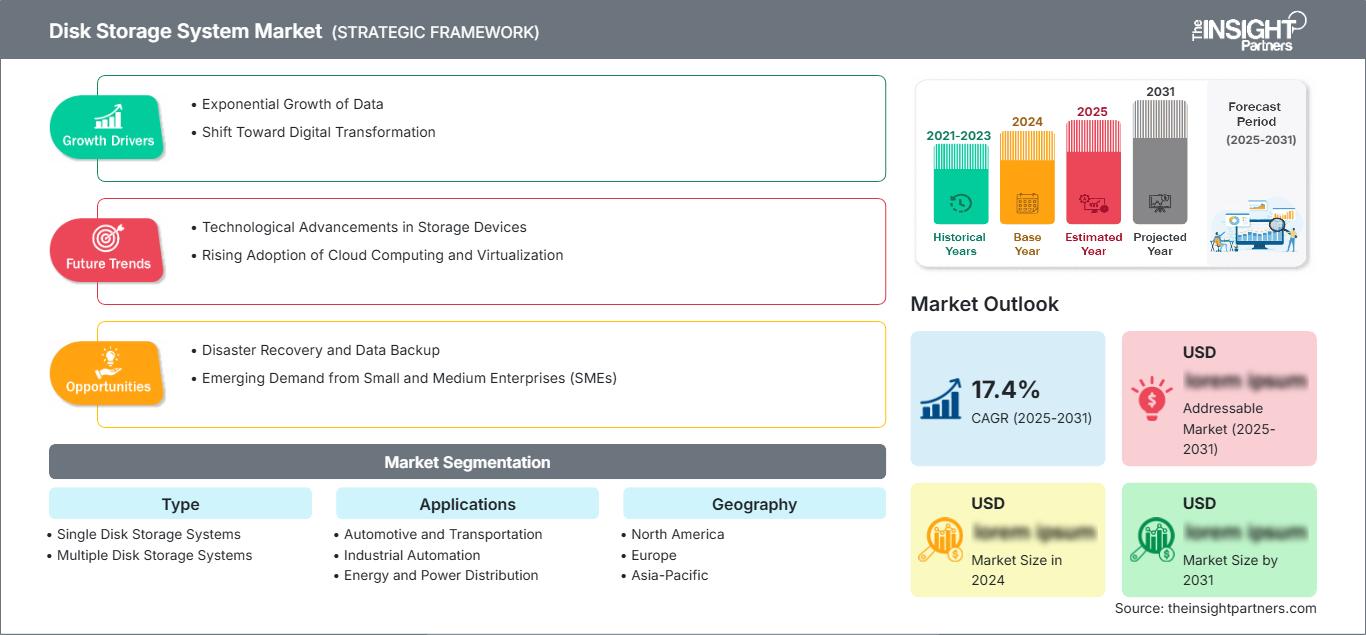
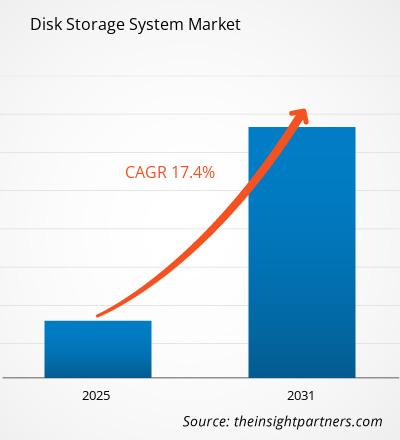
The global Disk Storage System market was valued at US$ 63.33 billion in 2025 and is expected to reach US$ 110.4 billion by 2034; it is estimated to record a CAGR of 6.37% during 2026-2034.
Disk Storage System Market Assessment and Insights
- North America: The region holds 34–37% share in 2025 and grows at a CAGR of 5.8–6.5% during 2026–2034, driven by cloud refresh cycles, cybersecurity recovery needs, and AI data pipelines.
- US: The country represents 80–84% of North America in 2025 and grows at a CAGR of 5.9–6.7% during 2026–2034.
- Europe: Europe accounts for 22–25% share in 2025 and grows at a CAGR of 5.2–5.9% during 2026–2034, led by Germany, the UK, France, Italy, and Spain.
- Asia Pacific: Asia Pacific represents 29–32% share in 2025 and grows at a CAGR of 6.8–7.6% during 2026–2034, with China, Japan, South Korea, India, and Australia anchoring demand.
- Largest Segment: Multiple Disk Storage Systems hold 67–71% market share in 2025 and grow at a CAGR of 6.3–7.0% during 2026–2034.
- High Growth Segment: Health care holds 10–13% market share in 2025 and grows at a CAGR of 7.2–8.1% during 2026–2034.
- Key companies analyzed in detail: Dell Technologies Inc.; Dell EMC; Hitachi Vantara LLC; Hewlett Packard Enterprise Company; International Business Machines Corporation; Micron Technology, Inc.; NetApp, Inc.; SanDisk Corporation; Seagate Technology Holdings plc; Western Digital Corporation.
Source: The Insight Partners' analysis based on proprietary research, government publications, company annual reports, investor presentations, industry databases, and expert interviews.
The development of technology is leading the Disk Storage System Market to shift away from individual capacity acquisition to the use of advanced storage systems that will integrate disk array technology, flash tiers, automated data services, and cyber-resilient backup. The production trends will focus on high density drives, modular control systems, efficient energy consumption, and software-enabled management. According to IDC, the revenue generated by the external enterprise storage market stood at US$ 8.0 billion in Q3 2025, whereas the all-flash array market grew by 17.6% year over year.
Future demands for storage will become widespread as manufacturers, hospitals, cars, energy grids, and even defense platforms create more data at the edges that need to be stored, synchronized, and kept secure. Regulatory demands with respect to patients' files, industrial safety, and business continuity will increase storage expenditure. Disk storage companies that have robust economics, flash integration, service automation, and supply chain reliability will fare well.
Disk Storage System Market Report Scope
| Report Attribute | Details |
|---|---|
| Market size in 2025 | US$ 63.33 Billion |
| Market Size by 2034 | US$ 110.4 Billion |
| Global CAGR (2026 - 2034) | 6.37% |
| Historical Data | 2021-2024 |
| Forecast period | 2026-2034 |
Disk Storage System Market Analysis
Factors driving Disk Storage Systems market include growing data, analytics based on AI, connectivity, and stringent recovery requirements. Strong demand is observed where companies require inexpensive storage, lifecycle assurance, and tiered design involving disk storage systems along with flash cache. The supply chain includes drive manufacturers, controller manufacturers, storage arrays, software-defined storage vendors, data centers, cloud vendors, distributors, and system service providers.
The supply factors include cost of NAND and HDD, enterprise refresh cycle, power limitations, and parts availability. IDC highlighted that external OEM enterprise storage revenues stood at US$ 9.9 billion during Q1 2026, increasing 22.9% year over year owing to delayed refresh cycles and AI-based storage. Purchasing considerations include latency, redundancy, encryption, replication, power consumption, ease of management, and vendor support.
The competitive environment still maintains its concentration but is highly technical, based on Disk Storage System Market analysis in terms of differences between enterprise arrays, flash-disk hybrid systems, scale-out storage solutions, backup appliances, and embedded drives. The competitors that are Dell Technologies Inc., Dell EMC, NetApp, Inc., Hewlett Packard Enterprise Company, International Business Machines Corporation, and Hitachi Vantara LLC participate in the market based on their enterprise-level platform, data services, cloud integration, and lifecycle programs.
Trends of investments in the market indicate that there is going to be an increased need for AI storage fabrics, ransomware recovery capabilities, energy-aware arrays, and higher density drive platforms. The companies Micron Technology, Inc., Seagate Technology Holdings plc, SanDisk Corporation, and Western Digital Corporation enhance the component and media layer, which increases the efficiency of system performance.
● REPORT CUSTOMIZATION
Tailor This Report To Align With Your Specific Business Requirements
This report can be customized to align precisely with your business objectives, scope, and target markets. Customization options include tailored segmentation, geography, competitive analysis, and strategic insights to support informed decision-making.
Customize This Report →WHAT YOU CAN ADJUST
- ● Segmentations
- ● Geography
- ● Competitive Analysis
- ● Language Preferences
Disk Storage System Market: Strategic Insights
Regional Insights
North America Disk Storage System Market
North America accounts for 34-37% share in 2025 and is expected to grow at a CAGR of 5.8-6.5% between 2026 and 2034. Disk Storage System Market share is bolstered by plans for cloud repatriation, AI infrastructure privately built, preservation of data for the healthcare industry, and upgrading cyber-resilient backups. Enterprises are replacing their storage systems after years of reduced investments, and there is a combination of all-flash and hybrid disk-based systems.
The firms such as Dell Technologies Inc., Dell EMC, NetApp, Inc., Hewlett Packard Enterprise Company, International Business Machines Corporation, Seagate Technology Holdings plc, and Western Digital Corporation support the local value chain. Buyers seek ransomware recovery, immutability backup, low power capacity layer, and VMware, Kubernetes, and public cloud integration. Canada helps the market through its cloud zones, media applications, and public sector digital services but the U.S. enterprise and hyperscale needs prevail.
U.S. Disk Storage System Market
The US contributes around 80%-84% towards North America's demand in 2025 and is projected to record a CAGR of 5.9%-6.7% between 2026-2034. These applications include cloud infrastructure services, defense logistics, hospital imaging services, automotive software testing, industry-level monitoring systems, and consumer devices ecosystem. The US has well-established procurement channels in enterprises, well-established colocation facilities and an abundance of storage architects and managed service providers.
Some of the leading market participants that have considerable presence in the US market include Dell Technologies Inc., Dell EMC, NetApp, Inc., Hewlett Packard Enterprise Company, International Business Machines Corporation, Micron Technology, Inc., Seagate Technology Holdings plc, SanDisk Corporation, and Western Digital Corporation. There will be a growing trend in procurement towards secure firmware, encryption capabilities, support services level agreements, telemetry-based maintenance services, and flexible consumption models.
Europe Disk Storage System Market
Europe contributes 22-25% share in 2025 and is expected to have a CAGR of 5.2-5.9% for 2026-2034. Germany drives through automation, auto engineering, manufacturing intelligence, and data sovereignty programs. The UK drives through finance, public cloud region, defense modernization, and media workloads that need a scalable and compliant and recovery-oriented storage environment.
France drives through healthcare IT, aerospace, telecom, and public sector cloud programs, while Italy and Spain drive through smart manufacturing, energy systems, and enterprise backup. Europe buyers consider GDPR compliance, energy efficiency, data residency, and vendor transparency as crucial. Europe's growth is not explosive but steady and is driven by cybersecurity and storage estate modernization.
APAC Disk Storage System Market
The APAC region holds a 29–32% share in 2025 and is anticipated to grow at a CAGR of 6.8–7.6% from 2026 to 2034. China is dominating with cloud computing, surveillance infrastructure, manufacturing process, and storage systems. Japan and South Korea contribute demand in the form of electronics, auto industry, robotics, telecoms, and reliable enterprise systems.
Demand from India and Australia for investments in storage systems comes from digital services, banking sector, healthcare, defense, and edge data centers. The main factors driving policy here are data localization, semiconductor manufacturing incentives, cloud regions, and industrial automation financing. Adoption in this region prefers multiple disk storage solutions.
Middle East & Africa Disk Storage System Market
Middle East & Africa is expected to achieve CAGR of 4.8% to 5.6% in 2026-2034. Saudi Arabia continues to lead through smart cities, energy infrastructure, digital government, and sovereign cloud deployments. The United Arab Emirates contribute through financial services, aviation, logistics, healthcare, and AI-driven government solutions.
The adoption of storage solutions in South Africa and Rest of MEA is highly selective and based on banking continuity, telecommunications infrastructure, mining, and critical infrastructure protection needs. The procurement of storage will be driven by factors such as import cost-effectiveness, support cost, security, and energy cost considerations.
Segmentation Analysis
Type
The Type segment is projected to grow at a CAGR of 5.9–6.8% during 2026–2034. Disk Storage System Market scope spans standalone capacity devices, multi-drive arrays, and managed systems that support redundancy, tiering, and recovery. Adoption depends on workload criticality, budget, data protection requirements, available space, power limits, and the need to integrate storage with cloud, edge, or enterprise applications.
- Single Disk Storage Systems serve compact workloads, consumer electronics, small offices, and embedded industrial devices where cost control, simple deployment, and local capacity matter more than advanced redundancy.
- Multiple Disk Storage Systems dominate enterprise, industrial, healthcare, and defense use cases because RAID, replication, hot-swap serviceability, and pooled capacity improve uptime and lifecycle economics.
Applications
The Applications segment is expected to grow at a CAGR of 6.1–7.1% during 2026–2034 as data retention spreads across operational technology, clinical workflows, vehicles, energy assets, defense platforms, and personal devices. Each application values storage differently, with industrial users prioritizing ruggedness, healthcare users emphasizing compliance, and consumer electronics makers balancing capacity, cost, and form-factor constraints.
- Automotive and Transportation demand is tied to connected vehicles, fleet telematics, infotainment data, test validation, and rail or aviation monitoring where dependable local and centralized storage supports analytics.
- Industrial Automation uses disk systems for machine logs, quality images, digital twins, and supervisory control records, making durability, redundancy, and predictable service intervals strategically important.
- Energy and Power Distribution requires storage for grid monitoring, asset inspection, outage analytics, and renewable integration, where secure retention supports reliability, compliance, and operational decision-making.
- Health care adoption is rising as imaging archives, electronic health records, genomics, and connected devices require resilient capacity with privacy controls, backup, and rapid retrieval.
- Military demand centers on mission planning, surveillance, logistics, simulation, and rugged field systems where secure erase, encryption, shock tolerance, and supply continuity are essential.
- Consumer electronics uses disk storage in personal computers, gaming systems, home media, and external drives, where affordability and capacity remain important despite flash substitution.
Opportunity Snapshot
| Application | Revenue Contribution | Trend Tag | Adoption Stage |
| Automotive and Transportation | Medium | Vehicle Data | Scaling |
| Industrial Automation | High | Factory Logs | Mature |
| Energy and Power Distribution | Medium | Grid Records | Scaling |
| Health care | High | Imaging Archive | Scaling |
| Military | Medium | Secure Field | Mature |
| Consumer electronics | Medium | Home Capacity | Mature |
Disk Storage System Market Growth Drivers and Impact Analysis
AI Data Pipelines and Hybrid Infrastructure Refresh
AI adoption is forcing organizations to revisit storage architecture because training data, inference logs, vector indexes, and backup copies expand faster than traditional business records. IDC’s 2026 storage tracker highlighted deferred refresh spending and AI-driven storage demand as key forces behind a 22.9% year-over-year rise in Q1 2026 external OEM storage spending. The market impact is a stronger case for tiered disk systems that hold large data sets economically while flash layers accelerate active workloads. Disk Storage System Market vendors can capture demand by improving metadata handling, replication, snapshot efficiency, and integration with GPU clusters, analytics platforms, and private cloud stacks.
Ransomware Recovery and Compliance-Driven Retention
Cyber resilience has become a board-level storage requirement as ransomware attacks, data leakage, and operational outages increase the cost of poor backup design. Enterprises are investing in immutable snapshots, air-gapped copies, encrypted drives, and rapid recovery appliances that preserve business continuity. Healthcare, defense, finance, transportation, and energy organizations also face retention mandates that make reliable capacity non-discretionary. The impact is stronger demand for multiple disk systems with policy-based replication, audit trails, and validated recovery workflows. Vendors that combine storage hardware with cyber-recovery software, monitoring, and service assurance can convert compliance pressure into recurring platform revenue.
Edge Data Growth Across Industrial and Mobility Systems
Factories, vehicles, substations, hospitals, ports, and military sites are generating more operational data outside centralized data centers. These environments need local storage for logs, images, sensor streams, and mission records before data is synchronized to cloud or enterprise repositories. Disk systems remain relevant where high capacity, predictable replacement, and cost per terabyte outweigh the need for ultra-low latency. The market impact is demand for ruggedized enclosures, redundant arrays, remote monitoring, and simplified maintenance. Suppliers that design for temperature variation, vibration, secure access, and low-touch administration can address edge deployments that standard enterprise racks cannot serve efficiently.
Disk Storage System Market Future Trends
Autonomous Storage Operations
Disk Storage System Market trends will increasingly center on autonomous operations that reduce manual provisioning, detect anomalies, optimize tier placement, and predict component failures. Future platforms will use telemetry, policy engines, and AI-assisted management to allocate capacity across disk, flash, and cloud targets according to workload behavior. This shift matters because storage teams face rising data volumes without proportional staffing increases. Vendors will differentiate through observability dashboards, self-healing workflows, API integration, and automated cyber-recovery validation. Buyers will favor systems that reduce operational risk while keeping capacity economics predictable.
Energy-Aware Capacity Platforms
Energy efficiency will become a more visible buying criterion as data centers face power constraints, sustainability reporting, and cooling cost pressure. Future disk storage systems will emphasize higher areal density, intelligent spin management, workload-aware tiering, and enclosure designs that reduce watts per terabyte. This trend will not remove the need for flash, but it will strengthen hybrid architectures that place cold and warm data on efficient capacity media. Vendors with transparent power metrics, lifecycle services, and density roadmaps will gain credibility with enterprises balancing data growth and energy budgets.
Disk Storage System Market Opportunities
Healthcare Imaging and Clinical Data Platforms
Healthcare creates a practical expansion route because imaging archives, pathology files, genomics, telehealth records, and connected devices require long retention, privacy controls, and fast retrieval. Disk Storage System Market Forecasts support investment in tiered platforms that combine capacity disks, flash caches, encryption, replication, and lifecycle policies for hospitals and diagnostic networks. Vendors can target this opportunity through reference architectures for picture archiving, electronic health records, and disaster recovery. Service partners should emphasize compliance documentation, migration support, and predictable subscription pricing to help healthcare buyers modernize without disrupting clinical workflows.
Industrial Edge and Energy Infrastructure Storage
Industrial and energy operators need storage close to equipment because latency, network outages, and data sovereignty can limit cloud-only approaches. Opportunity exists in rugged multiple-disk systems for machine vision, grid telemetry, predictive maintenance, and safety records. Suppliers can create value with preconfigured appliances that include redundancy, encryption, remote health monitoring, and simple replacement procedures. Partnerships with automation vendors, energy integrators, and telecom edge providers can shorten sales cycles. Investment should focus on certification, environmental testing, and software connectors that move selected data securely into enterprise analytics platforms.
Recent Developments
- February 2026: Western Digital unveiled its next-generation AI storage roadmap at Innovation Day 2026, introducing a 100TB+ HDD roadmap, a 40TB UltraSMR ePMR hard drive, new High Bandwidth Drive and Dual Pivot technologies for up to 2× bandwidth and I/O performance, and a power-optimized HDD that reduces power consumption by 20%. The company also announced an intelligent open API platform to simplify AI-scale storage deployments, reinforcing its focus on high-capacity, cost-efficient storage infrastructure for the AI era.
- April 2026: Seagate introduced a new portfolio of consumer storage solutions, including the Seagate One Touch desktop drive, FireCuda X Vault gaming expansion drive, and LaCie 8big Pro5 RAID storage system. The new lineup delivers higher storage capacities, professional-grade reliability, and scalable performance to support everyday backups, gaming libraries, and AI-driven creative workflows, addressing the growing consumer demand for high-capacity data storage.
- June 2023: DapuStor announced a strategic partnership with Spry Distributing to expand the availability of its enterprise and data center SSD storage solutions across the U.S. market. Through the collaboration, Spry Distributing will serve as a distributor for DapuStor’s full portfolio of NVMe enterprise SSDs, enabling broader market reach and providing customers with high-performance, reliable, and cost-effective storage solutions for enterprise applications.
Frequently Asked Questions

- Comprehensive Market Sizing and Forecast Analysis
- Detailed Segmentation Analysis
- In-Depth Market Dynamics Assessment
- Regional and Country-Level Insights
- Competitive Landscape and Company Benchmarking
- Strategic Business Intelligence
Recent Reports
Testimonials

The Insight Partners' SCADA System Market report is comprehensive, with valuable insights on current trends and future forecasts. The team was highly professional, responsive, and supportive throughout. We are very satisfied and highly recommend their services.
RAN KEDEM Partner, Reali Technologies LTDs
I requested a report on a very specific software market and the team produced the report in a few days. The information was very relevant and well presented. I then requested some changes and additions to the report. The team was again very responsive and I got the final report in less than a week.
JEAN-HERVE JENN Chairman, Future Analytica
We worked with The Insight Partners for an important market study and forecast. They gave us clear insights into opportunities and risks, which helped shape our plans. Their research was easy to use and based on solid data. It helped us make smart, confident decisions. We highly recommend them.
PIYUSH NAGPAL Sr. Vice President, High Beam Global
The Insight Partners delivered insightful, well-structured market research with strong domain expertise. Their team was professional and responsive throughout. The user-friendly website made accessing industry reports seamless. We highly recommend them for reliable, high-quality research services
YUKIHIKO ADACHI CEO, Deep Blue, LLC.
This is the first time I have purchased a market report from The Insight Partners.While I was unsure at first, I visited their web site and felt more comfortable to take the risk and purchase a market report.I am completely satisfied with the quality of the report and customer service. I had several questions and comments with the initial report, but after a couple of dialogs over email with their analyst I believe I have a report that I can use as input to our strategic planning process.Thank you so much for taking the extra time and making this a positive experience.I will definitely recommend your service to others and you will be my first call when we need further market data.
JOHN SUZUKI President and Chief Executive Officer, Board Director, BK Technologies
I wish to appreciate your support and the professionalism you displayed in the course of attending to my request for information regarding to infectious disease IVD market in Nigeria. I appreciate your patience, your guidance, and the fact that you were willing to offer a discount, which eventually made it possible for us to close a deal. I look forward to engaging The Insight Partners in the future, all thanks to the impression you have created in me as a result of this first encounter.
DR CHIJIOKE ONYIA MANAGING DIRECTOR, PineCrest Healthcare Ltd.Reason to Buy
- Informed Decision-Making
- Understanding Market Dynamics
- Competitive Analysis
- Identifying Emerging Markets
- Customer Insights
- Market Forecasts
- Risk Mitigation
- Boosting Operational Efficiency
- Strategic Planning
- Investment Justification
- Tracking Industry Innovations
- Aligning with Regulatory Trends





 Get Free Sample for