
DLP Projector Market Share, Growth & Forecast by 2034
Coverage: by Light Source (Lamp, LED, Laser); Chip Model (One Chip, Three Chip); Throw Distance (Normal Throw, Short Throw, Ultra-Short Throw); Application (Home Entertainment and Cinema, Business, Education and Government, Large Venues, Others) , and Geography (North America, Europe, Asia Pacific, and South and Central America)
- Status : Data Released
- Report Code : TIPRE00012248
- Category : Electronics and Semiconductor
- No. of Pages : 150
- Available Report Formats :


- Last update date : August 10, 2026


2025 Market Size
US$ 6.17 Bn
Base year value
2034 Forecast
US$ 12.59 Bn
Projected by 2034
CAGR 2026-2034
8.25 %
Growth rate
Addressable Market
US$ 84.28 Bn
(2026-2034)
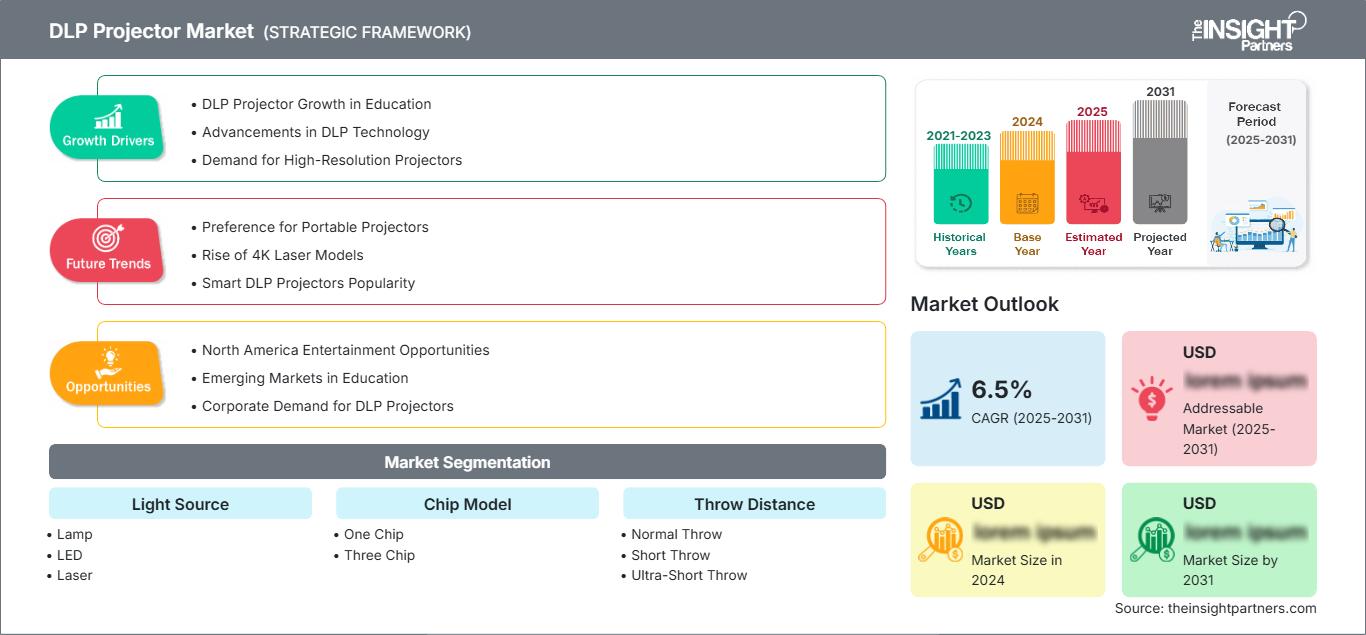
The DLP Projector Market holds a value of US$ 6.17 Billion in 2025 and will further advance to US$ 12.59 Billion by 2034, growing at a CAGR of 8.25% from 2026 to 2034. Demand is driven by lamp, LED and laser illumination technologies, one-chip and three-chip technology, diverse throw distances, and application in the areas of home entertainment, movies, corporate, education, government, and large venues.
Within the North America region, DLP Projector Market size is driven by an expected 7.4-8.2% CAGR with respect to upgrades of projection rooms by education districts, corporates, museums, churches, movie halls, and simulation centers. Growth is fueled by laser illumination technology, ultra-short throw in classroom setups, hybrid meeting places, and need for high-brightness large-size screens which are comparatively expensive on flat panel displays above 100 inches.
DLP Projector Market Assessment and Insights
- North America: North America held a 24–27% share in 2025 and is growing at a 7.4–8.2% CAGR between 2026–2034, supported by classroom upgrades, worship venues, simulation, cinema replacement, and enterprise collaboration rooms.
- US: The US represented 78–82% of North America in 2025 and is growing at a 7.5–8.3% CAGR between 2026–2034, led by education, corporate, cinema, and government demand.
- Europe: Europe accounted for a 19–22% share in 2025 and is growing at a 6.8–7.6% CAGR between 2026–2034, with Germany, the UK, France, Italy, and Spain leading installations.
- Asia Pacific: Asia Pacific held a 37–40% share in 2025 and is growing at an 8.8–9.7% CAGR between 2026–2034, driven by China, Japan, South Korea, India, and Australia.
- Largest Segment: Lamp light source led with a 42–45% market share in 2025 and a 5.8–6.6% CAGR between 2026–2034, reflecting installed-base replacement in education and business rooms.
- High Growth Segment: Laser light source held a 31–34% market share in 2025 and is growing at a 9.5–10.8% CAGR between 2026–2034 as buyers prioritize long life and lower maintenance.
- Key companies analyzed in detail: Acer Incorporated, Barco NV, Christie Digital Systems USA, Inc., Delta Electronics, Inc., Digital Projection Limited, Sharp NEC Display Solutions, Ltd., Optoma Corporation, Sharp Corporation, Texas Instruments Incorporated, and ViewSonic Corporation.
Source: The Insight Partners' analysis based on proprietary research, government publications, company annual reports, investor presentations, industry databases, and expert interviews.
Projection technologies are gradually shifting from maintenance-heavy lamps to more efficient laser and LED engines that increase light stability, color accuracy, and durability. The market for DLP Projector is driven by the use of digital micromirror devices, miniaturized optical engines, the availability of 4K models, and ultra-short-throw projectors suitable for classrooms and collaborative settings. Manufacturing factors include chipsets by Texas Instruments, the quality of optical elements, thermal management, design of enclosures, and channel capabilities.
Future demand will be determined by digitalization of classrooms in emerging markets, renovation of movie screens, immersive venues, and enterprise training. Technology investments in public education institutions, museums, tourist attractions, and military simulations are among the regulatory tailwinds for this market. Consumers will prefer projectors with low total cost of ownership, better brightness per watt, accurate colors, and adaptable throw ratios.
DLP Projector Market Report Scope
| Report Attribute | Details |
|---|---|
| Market size in 2025 | US$ 6.17 Billion |
| Market Size by 2034 | US$ 12.59 Billion |
| Global CAGR (2026 - 2034) | 8.25% |
| Historical Data | 2021-2024 |
| Forecast period | 2026-2034 |
DLP Projector Market Analysis
The DLP Projector Market drivers include entities requiring scalability of screen size, fast motion processing, and reliability in rooms where large flat screens are not cost-effective. Organizations in the areas of education, business, cinema, and event venues are upgrading their older lamps to brighter lamps which ensure lesser downtime and better collaborative performance. The demand is also supplemented by consumer use in home cinema for screen sizes of over 100 inches and gaming purposes.
The market ecosystem consists of chip manufacturer, projector manufacturers, optical components supplier, lamp module makers, distributors, audio visual integration services providers, screen manufacturing, and maintenance service providers. Favorable supply trends are towards firms that offer brightness variants, flexibility in throw distance, stable firmware, and lens ecosystem. Demand trends are supported by IATA passenger traffic recovery, modernization of public education infrastructure, and AVIXA commentary on immersive experiences investments.
The Competitive Structure of the DLP Projector Market includes elements of chipset availability, light source efficiency, installation flexibility, service availability, and specialization of application. The chipset technology leader is Texas Instruments Incorporated; however, Acer Incorporated, Optoma Corporation, and ViewSonic Corporation provide solutions for education, business, and home entertainment markets. Cinema, simulation, immersive rooms, and venue projection is covered by Barco NV, Christie Digital Systems USA, Inc., and Digital Projection Limited.
In order to bolster the overall projection ecosystem, Delta Electronics, Inc., Sharp NEC Display Solutions, Ltd., and Sharp Corporation provide the company with optical, visual solutions, and channel competencies. Trends of investment include laser phosphor technology, compact 4K projectors, ultra-short-throw classroom projectors, and high lumens projectors for auditoriums. Positioning requires consideration of total lifetime cost, reliability of brightness, color performance, lens offerings, warranty terms, and integrator confidence in multi-location deployments.
● REPORT CUSTOMIZATION
Tailor This Report To Align With Your Specific Business Requirements
This report can be customized to align precisely with your business objectives, scope, and target markets. Customization options include tailored segmentation, geography, competitive analysis, and strategic insights to support informed decision-making.
Customize This Report →WHAT YOU CAN ADJUST
- ● Segmentations
- ● Geography
- ● Competitive Analysis
- ● Language Preferences
DLP Projector Market: Strategic Insights
Regional Insights
North America DLP Projector Market
North America accounted for a 24–27% share in 2025 and is expected to grow at a 7.4–8.2% CAGR during 2026–2034. DLP Projector Market share is supported by school districts, higher education, worship facilities, corporate training spaces, museums, and cinema replacement. Laser models reduce lamp service and improve uptime.
Structural drivers include AV integrator depth, large installed classroom bases, government presentation rooms, and preference for screens above 100 inches. The US leads, while Canada adds demand from education, public venues, and enterprise collaboration. Acer Incorporated, Optoma Corporation, ViewSonic Corporation, Barco NV, Christie Digital Systems USA, Inc., Texas Instruments Incorporated, and Sharp NEC Display Solutions, Ltd. maintain strong regional relevance.
U.S. DLP Projector Market
The United States accounted for 78 to 82 percent of North America in 2025 and is experiencing a CAGR of 7.5 to 8.3 percent between 2026 and 2034. Factors driving demand are classroom renewal, corporate briefing centers, simulation suites, churches, movie theaters, and entertainment facilities. Application trends indicate ultra-short throw classroom applications, 4K home theater, laser movie halls, and portable business projectors.
Players active in the market include Texas Instruments Incorporated, Christie Digital Systems USA, Inc., Acer Incorporated, Optoma Corporation, ViewSonic Corporation, Barco NV, Digital Projection Limited, Sharp NEC Display Solutions, Ltd., Delta Electronics, Inc., and Sharp Corporation. End-users give preference to brightness, ease of replacement, ease of installation, warranty provision, software compatibility, and low maintenance needs.
Europe DLP Projector Market
Europe was responsible for 19–22% of the market in 2025 and is projected to expand at a 6.8-7.6% CAGR between 2026 and 2034. Germany is ahead through education technology, industrial training, corporate meeting spaces, and simulations. The United Kingdom adds a strong demand from universities, historic sites, churches, and movie theaters where laser projection is beneficial for reliability and consistency in operation.
France, Italy, and Spain add their contribution through museums, cultural institutions, hospitality, classroom settings, and public presentations. Energy efficiency requirements and increased public procurement scrutiny motivate consumers to assess total power consumption throughout life cycle, lamp-free nature and serviceability. Barco NV, Digital Projection Limited, Christie Digital Systems USA, Inc., Optoma Corporation, Acer Incorporated, ViewSonic Corporation, and Sharp NEC Display Solutions, Ltd. compete through certified AV partners.
APAC DLP Projector Market
APAC accounted for a 37–40% share in 2025 and is expected to witness a 8.8–9.7% CAGR from 2026 to 2034. APAC will be dominated by China due to purchases in education sector, home entertainment, domestic manufacturing, and commercial sites, whereas premium movies, games, and presentations in offices will be the focus of Japan and South Korea.
India and Australia provide additional growth from smart classes, coaching centers, government training centers, places of worship, and entertainment sectors. Growth drivers include digital education solutions, manufacturing of electronics, investments in tourism in cities, and increasing avenues for AV integration. Competition in the region will be on cost, brightness, size, accessibility, and ability to function in bright environments.
Middle East & Africa DLP Projector Market
Middle East & Africa is expected to grow at a 7.9–8.9% CAGR during 2026–2034. Saudi Arabia leads through tourism projects, universities, religious venues, event spaces, and cinemas, while the UAE supports premium hospitality, exhibitions, museums, and large corporate presentation environments.
South Africa and Rest of MEA demand is linked to education, government halls, banking training rooms, and public venues. Energy reliability, heat tolerance, dust protection, and local maintenance capacity influence procurement. Providers offering laser models, sealed optical engines, flexible lenses, and service partnerships are positioned to address both premium venues and cost-sensitive institutional projects.
Segmentation Analysis
Light Source
The Light Source segment is projected to grow at a 7.7–8.8% CAGR during 2026–2034. DLP Projector Market scope by light source reflects a transition from lamp replacement economics to laser and LED longevity. Buyers compare brightness stability, color performance, maintenance intervals, heat output, and initial price when selecting systems for classrooms, cinemas, boardrooms, worship halls, and home theaters.
- Lamp: Lamp systems remain important in cost-sensitive classrooms, training rooms, and small businesses because installed familiarity, lower upfront cost, and replacement availability sustain demand despite maintenance requirements.
- LED: LED projectors serve portable, home entertainment, and compact business uses where instant-on performance, long life, lower heat, and small optical engines support convenient deployment.
- Laser: Laser models gain strategic importance in cinema, large venues, education, and enterprise rooms because they offer longer life, higher brightness consistency, and reduced lamp-service downtime.
Chip Model
The Chip Model segment is forecast to grow at a 7.4–8.5% CAGR during 2026–2034. One-chip systems dominate mainstream business, education, portable, and home entertainment categories because they enable compact and cost-effective designs. Three-chip systems remain essential where color accuracy, brightness, and premium image quality justify higher investment in cinema, simulation, projection mapping, and large venues.
- One Chip: One-chip projectors support broad market penetration because they balance price, portability, brightness, and resolution for classrooms, meeting rooms, consumer theaters, and mobile presentation needs.
- Three Chip: Three-chip projectors address premium venues that require higher brightness, richer color, reduced rainbow artifacts, and dependable performance for cinema, staging, simulation, and immersive installations.
Throw Distance
The Throw Distance segment is projected to grow at a 7.8–8.9% CAGR during 2026–2034. Normal throw remains common in auditoriums and traditional rooms, while short throw and ultra-short throw designs gain relevance where space, shadows, and presenter movement matter. Education, home entertainment, and collaboration rooms increasingly value easy installation and large images from limited distance.
- Normal Throw: Normal throw projectors remain relevant for auditoriums, cinemas, lecture halls, and large meeting rooms where ceiling mounts, longer projection paths, and flexible lenses are practical.
- Short Throw: Short throw systems gain demand in classrooms, small meeting rooms, training centers, and retail spaces where reduced shadows and closer placement improve usability.
- Ultra-Short Throw: Ultra-short throw projectors support interactive education, compact home cinema, and collaboration rooms by producing large images from near-wall placement with minimal presenter obstruction.
Application
The Application segment is projected to grow at an 8.0–9.1% CAGR during 2026–2034. Home entertainment and cinema benefit from premium viewing demand, while business and education installations rely on replacement cycles and collaboration needs. Government and large venues require durable systems for training, public communication, auditoriums, events, simulation, and immersive visitor experiences.
- Home Entertainment and Cinema: This application is strengthened by 4K content, dedicated home theaters, premium cinema upgrades, gaming, and large-screen viewing that flat panels cannot match economically.
- Business: Business demand centers on boardrooms, hybrid meeting rooms, training facilities, and briefing centers where projection supports collaboration, presentations, data review, and flexible room layouts.
- Education and Government: Education and government buyers prioritize classroom visibility, interactive learning, lecture halls, public training, and multipurpose rooms, making reliability and low service requirements critical.
- Large Venues: Large venues require high-lumen, lens-flexible, and serviceable projectors for auditoriums, houses of worship, museums, events, projection mapping, and immersive attractions.
Opportunity Snapshot
| Application | Revenue Contribution | Trend Tag | Adoption Stage |
| Home Entertainment and Cinema | High | 4K Cinema | Scaling |
| Business | Medium | Hybrid Rooms | Mature |
| Education and Government | High | Smart Class | Scaling |
| Large Venues | Medium | Immersive Mapping | Emerging |
DLP Projector Market Growth Drivers and Impact Analysis
Laser Migration Reduces Ownership Cost
The reason why laser lighting has begun to influence purchasing behavior is that customers are beginning to consider not only the projector’s price but also the cost of the service, the rate of decrease of light, its color constancy, and downtime. Educational institutions, movie theaters, large spaces, and campuses will definitely profit from the fewer replacements of lamps, cleaning of filters, and visits of specialists. This effect will be especially noticeable in classrooms with heavy usage where interruptions affect education, movie ticket sales, or the cost of events. Moreover, laser-based models can provide sealed optical paths and greater levels of brightness.
Education and Training Rooms Need Scalable Visuals
Learning and training scenarios keep on needing display systems which are visible to big audiences, allow for dynamic room setups, and can work with the creation of digital content. The use of projectors is more beneficial for large images (more than 100 inches), especially since there would be no need for purchasing big screens. The ultra-short throw display systems help in reducing the shadow and can be used for interactive lessons, while the brighter ones can be used for lecture theaters and government training centers. There are tangible results in the form of constant need to replace them because of their inability to perform in hybrid learning and other functions.
Large Venues Expand Immersive Projection Use
Large venues are adopting projection for immersive storytelling, digital art, projection mapping, simulation, entertainment, houses of worship, museums, and branded events. These use cases require higher lumens, flexible lenses, color accuracy, edge blending, and reliable operation across complex installations. The impact reaches beyond hardware sales because integrators need calibration tools, content partners, mounting systems, and maintenance services. DLP systems are well positioned where motion performance, contrast, and modular deployment matter. As venues compete for visitor engagement and premium experiences, high-brightness three-chip and laser platforms can command stronger margins than basic meeting-room devices.
DLP Projector Market Future Trends
Compact 4K Laser Platforms Move Mainstream
DLP Projector Market trends point toward compact 4K laser systems that combine high resolution, lower maintenance, and easier installation for classrooms, home theaters, meeting rooms, and small venues. As optical engines become more efficient, vendors can offer brighter models in smaller cabinets with reduced noise and heat. Future differentiation will depend on color volume, gaming latency, smart connectivity, lens flexibility, and consistent brightness over years of use. This trend will make premium features available to mid-range buyers, expanding replacement demand beyond flagship cinema or staging environments and pressuring lamp-based models in mainstream channels.
Projection Mapping Becomes Operationally Simpler
Projection mapping is expected to move from specialist event work toward repeatable use in museums, retail spaces, education labs, visitor centers, and corporate experience rooms. Software-assisted alignment, calibration, warping, and content workflows will lower technical barriers and shorten deployment time. Hardware requirements will still favor stable brightness, lens precision, color matching, and serviceable laser platforms. The trend should create demand for projectors sold as part of integrated experience systems rather than standalone devices. Vendors that partner with mapping software providers and integrators can capture value from design, deployment, maintenance, and periodic content refresh.
DLP Projector Market Opportunities
Managed Refresh Programs for Education Networks
DLP Projector Market Forecasts indicate opportunity in managed refresh programs for school districts, universities, coaching networks, and public training centers that operate large installed bases. Suppliers can package ultra-short-throw or laser projectors with mounts, screens, warranty coverage, classroom setup, and service scheduling. This approach converts fragmented replacement purchases into planned multi-year programs with predictable budgets. Channel partners should prioritize asset audits, total cost comparison, and standardized room designs that reduce installation variability. The best programs will address content compatibility, teacher usability, spare-unit availability, and maintenance response times, making procurement simpler for institutions with limited AV staffing.
Premium Venue Systems for Immersive Experiences
Premium venue systems create investment potential where projection, content, audio, control, and spatial design converge. Museums, attractions, cinemas, religious venues, auditoriums, and corporate brand centers need high-brightness projectors that support edge blending, curved surfaces, 3D, and long operating hours. Suppliers can differentiate through integrated solutions that combine projectors with lenses, media servers, calibration tools, and service contracts. The opportunity is action-oriented because venue owners often buy outcomes, such as immersion and audience engagement, not devices alone. Partnerships with designers, integrators, and content studios can increase project size and strengthen recurring service revenue.
Recent Developments
- May 2026: Panasonic Projector & Display Corporation acquired 100% of the issued shares of HIVE Media Control Ltd., a UK-based media technology company specializing in media playback and control solutions. The acquisition strengthens Panasonic’s integrated visual solutions portfolio by combining its projection and display technologies with HIVE’s software-based media control capabilities, enabling enhanced solutions for immersive environments, fixed installations, entertainment venues, and large-scale visual experiences. HIVE will continue operating as a standalone, vendor-neutral business while expanding customer value across playback, control, projection, and display workflows.
- April 2025: BenQ India launched the W2720i, the world’s first AI-powered 4K home cinema projector, featuring an AI Cinema Mode that automatically optimizes picture quality based on ambient lighting and scene content. The projector delivers 4K UHD resolution, 2,500 ANSI lumens brightness, a 4LED RGBB light source with up to 30,000 hours lifespan, 90% DCI-P3 CinematicColor™ coverage, and HDR10+/HDR10/HLG support. It also includes built-in Android TV, supports screen sizes up to 200 inches, and offers flexible installation with 1.3x zoom, Auto Screen Fit, 8-point Corner Fit, and vertical lens shift for premium home entertainment applications.
- April 2025: Vivitek, a brand of Delta, launched the D8000Z Series of DLP HEP (High Efficiency Pixel) laser projectors for large venue applications. The series includes three models — DU8053Z (14,000 lumens), DU8055Z (16,000 lumens), and DK8155Z (15,000 lumens) — featuring 4K+ resolution, dual-laser technology, and HEP DMD architecture for enhanced brightness, contrast, reliability, and energy efficiency. Designed for demanding environments such as auditoriums, education facilities, corporate venues, museums, and immersive installations, the projectors support 360° operation, portrait projection, edge blending, geometric correction, powered lens shift, and lens position memory for flexible installation and seamless large-scale visual experiences.
Frequently Asked Questions

- Comprehensive Market Sizing and Forecast Analysis
- Detailed Segmentation Analysis
- In-Depth Market Dynamics Assessment
- Regional and Country-Level Insights
- Competitive Landscape and Company Benchmarking
- Strategic Business Intelligence
Recent Reports
Testimonials

The Insight Partners' SCADA System Market report is comprehensive, with valuable insights on current trends and future forecasts. The team was highly professional, responsive, and supportive throughout. We are very satisfied and highly recommend their services.
RAN KEDEM Partner, Reali Technologies LTDs
I requested a report on a very specific software market and the team produced the report in a few days. The information was very relevant and well presented. I then requested some changes and additions to the report. The team was again very responsive and I got the final report in less than a week.
JEAN-HERVE JENN Chairman, Future Analytica
We worked with The Insight Partners for an important market study and forecast. They gave us clear insights into opportunities and risks, which helped shape our plans. Their research was easy to use and based on solid data. It helped us make smart, confident decisions. We highly recommend them.
PIYUSH NAGPAL Sr. Vice President, High Beam Global
The Insight Partners delivered insightful, well-structured market research with strong domain expertise. Their team was professional and responsive throughout. The user-friendly website made accessing industry reports seamless. We highly recommend them for reliable, high-quality research services
YUKIHIKO ADACHI CEO, Deep Blue, LLC.
This is the first time I have purchased a market report from The Insight Partners.While I was unsure at first, I visited their web site and felt more comfortable to take the risk and purchase a market report.I am completely satisfied with the quality of the report and customer service. I had several questions and comments with the initial report, but after a couple of dialogs over email with their analyst I believe I have a report that I can use as input to our strategic planning process.Thank you so much for taking the extra time and making this a positive experience.I will definitely recommend your service to others and you will be my first call when we need further market data.
JOHN SUZUKI President and Chief Executive Officer, Board Director, BK Technologies
I wish to appreciate your support and the professionalism you displayed in the course of attending to my request for information regarding to infectious disease IVD market in Nigeria. I appreciate your patience, your guidance, and the fact that you were willing to offer a discount, which eventually made it possible for us to close a deal. I look forward to engaging The Insight Partners in the future, all thanks to the impression you have created in me as a result of this first encounter.
DR CHIJIOKE ONYIA MANAGING DIRECTOR, PineCrest Healthcare Ltd.Reason to Buy
- Informed Decision-Making
- Understanding Market Dynamics
- Competitive Analysis
- Identifying Emerging Markets
- Customer Insights
- Market Forecasts
- Risk Mitigation
- Boosting Operational Efficiency
- Strategic Planning
- Investment Justification
- Tracking Industry Innovations
- Aligning with Regulatory Trends





 Get Free Sample for