
Door Intercom Market Size, Demand & Growth by 2034
Coverage: by Product (Ordinal Intercom System, Wi-Fi Intercom System); Application (Apartments, Houses, Hotel, Office, Others) , and Geography (North America, Europe, Asia Pacific, and South and Central America)
- Status : Data Released
- Report Code : TIPRE00010109
- Category : Electronics and Semiconductor
- No. of Pages : 150
- Available Report Formats :


- Last update date : August 06, 2026


2025 Market Size
US$ 6.24 Bn
Base year value
2034 Forecast
US$ 12.74 Bn
Projected by 2034
CAGR 2026-2034
8.26 %
Growth rate
Addressable Market
US$ 85.28 Bn
(2026-2034)
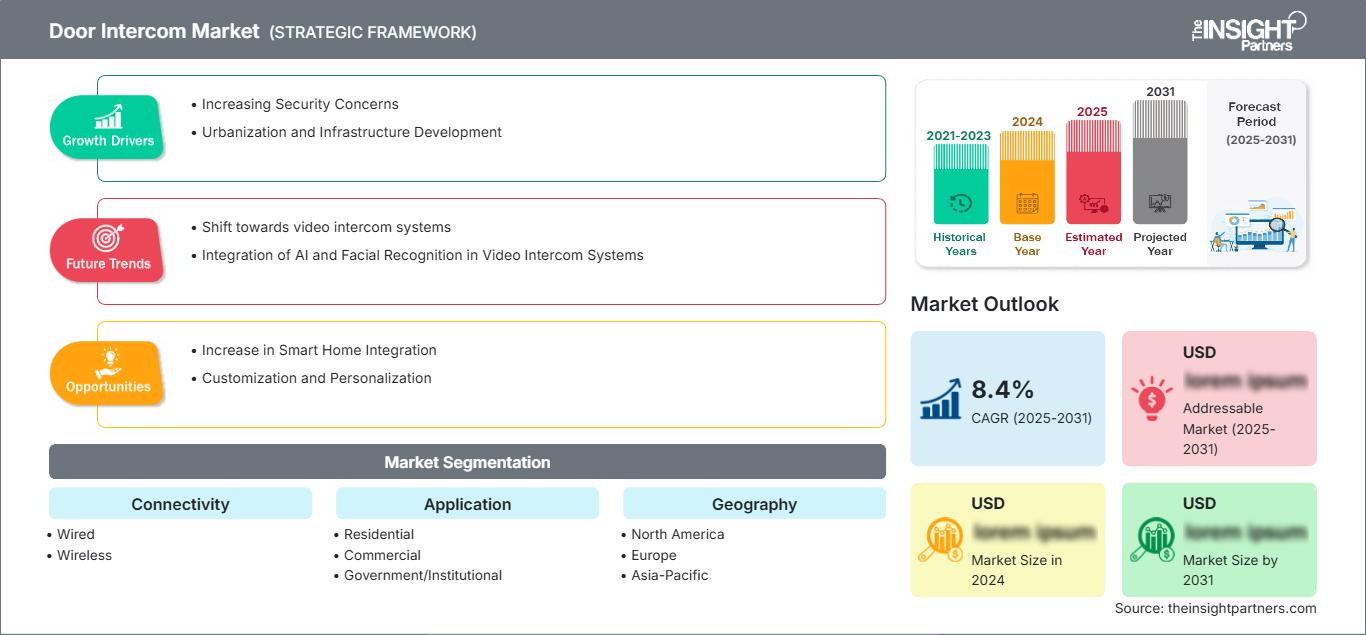
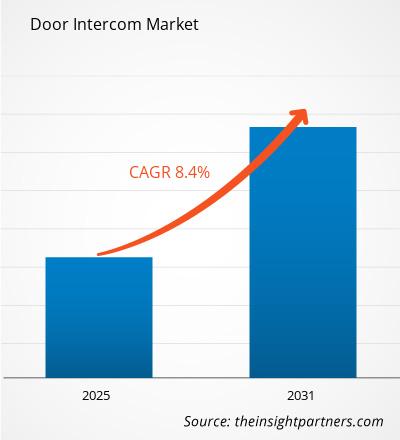
The Door Intercom Market is estimated to be US$ 6.24 Billion in 2025 and will witness significant growth to reach US$ 12.74 Billion in 2034, growing at a CAGR of 8.26% during 2026-2034. Increasing demand for intercom market is attributed to connected access control, video verification technology, smart infrastructure development, and increased security requirements of property owners who replace audio-only systems with integrated door entry systems.
Door Intercom Market size in North America will witness growth driven by modernization of multi-family housing developments, increasing expenditure on access control technologies, and usage of IP-based security systems. The Market in North America is expected to grow at a CAGR of 7.8%-8.4% from 2026-2034. Retrofit opportunities in apartment blocks, office complexes, hospitals, and government buildings will fuel steady demand.
Door Intercom Market Assessment and Insights
- North America accounted for 30–33% share in 2025 and is projected to grow at a CAGR of 7.8–8.4% during 2026–2034, supported by smart apartment retrofits, enterprise access-control upgrades, and code-driven security investments.
- US represented 76–79% of North America in 2025 and is expected to advance at a CAGR of 7.9–8.5% through 2034, led by multi-tenant housing and commercial campuses.
- Europe held 24–27% share in 2025 and is forecast to grow at a CAGR of 7.4–8.0%, with Germany, the UK, France, Italy, and Spain leading privacy-compliant video entry deployments.
- Asia Pacific captured 29–32% share in 2025 and should expand at a CAGR of 8.8–9.5%, as China, Japan, South Korea, India, and Australia scale smart-building and urban security investments.
- Largest Segment Residential held 42–46% market share in 2025 and is projected to grow at a CAGR of 8.1–8.7%, driven by apartment entry systems, smart homes, and package-security needs.
- High Growth Segment Wireless connectivity held 36–40% market share in 2025 and is expected to grow at a CAGR of 9.0–9.8%, supported by easier retrofit installation and app-based monitoring.
- Key companies analyzed in detail: ABB Ltd., Arabian Gulf Switchgear LLC, Eaton Corporation plc, ESL Power Systems, Inc., Hager SE, Larsen & Toubro Limited, Legrand SA, NHP Electrical Engineering Products Pty Ltd, Schneider Electric SE, Siemens Aktiengesellschaft.
Source: The Insight Partners' analysis based on proprietary research, government publications, company annual reports, investor presentations, industry databases, and expert interviews.
Migration of technology is also altering the procurement process as owners move away from using analog audio panels to video-based IP terminals, mobile credentials, and cloud visitation. The manufacturing process becomes more modular where manufacturers start combining various components such as cameras, microphones, relays, controllers, and firmware into scalable packages. The availability of semiconductors, cyber secure firmware, and interoperability with access control panels are becoming considerations when it comes to lead times, while installers prefer systems that ease the installation process.
The technology adoption is expected to expand into new urban centers in which apartments are built under requirements for security measures and energy-efficient buildings. Future investments should be made in wireless technologies, PoE equipment, cloud-based dashboards, and privacy-by-design analytics. The regulatory tailwind of secure access, logging of visitors, and building communications will boost replacement cycles.
Door Intercom Market Report Scope
| Report Attribute | Details |
|---|---|
| Market size in 2025 | US$ 6.24 Billion |
| Market Size by 2034 | US$ 12.74 Billion |
| Global CAGR (2026 - 2034) | 8.26% |
| Historical Data | 2021-2024 |
| Forecast period | 2026-2034 |
Door Intercom Market Analysis
The Demand side growth cycle for the Door Intercom market share is driven by the synergy between physical security, home automation, and building automation. Individual customers have a need for visualization and remote unlocking features while commercial customers demand audit logs, monitoring from a central location, and integration into their surveillance systems. The supply chain now incorporates not only the electrical equipment but also the software, cameras, networking, and installation services, thus the importance of system reliability becomes equal to the cost of the devices.
The Supply side favors companies with wide electrical distribution networks and installation certifications. Wired systems are more preferable in new construction due to reliable power sources and reduced connectivity risks compared to wireless solutions. Component makers, panel makers, software companies, electrical contractors, facility managers, and security integrators are part of the supply chain ecosystem.
Positioning of Competition in the Door Intercom Market Report is dependent on electrical know-how, access-control solutions, and channels. ABB Ltd., Legrand SA, Schneider Electric SE, and Siemens Aktiengesellschaft leverage their portfolio of building infrastructure products, while Arabian Gulf Switchgear LLC, ESL Power Systems, Inc., and NHP Electrical Engineering Products Pty Ltd have project-based electrical environments, where strong entry communication is needed.
Capital is going into IP video solutions, wireless modules, app interfaces, and cyber-resistant firmware. Eaton Corporation plc, Hager SE, Larsen & Toubro Limited, and Legrand SA are positioned to exploit their strengths in power distribution, smart wiring, and building products. Differentiation is becoming more and more dependent on interoperability, installer training, lifecycle services, and privacy & safety standards compliance.
● REPORT CUSTOMIZATION
Tailor This Report To Align With Your Specific Business Requirements
This report can be customized to align precisely with your business objectives, scope, and target markets. Customization options include tailored segmentation, geography, competitive analysis, and strategic insights to support informed decision-making.
Customize This Report →WHAT YOU CAN ADJUST
- ● Segmentations
- ● Geography
- ● Competitive Analysis
- ● Language Preferences
Door Intercom Market: Strategic Insights
Regional Insights
North America Door Intercom Market
North America had a market share of 30–33%, attributed to an established installed base and continued retrofit spending on apartments, offices, educational institutions, hospitals, and public buildings. The Door Intercom Market share in the region benefits from high adoption rates of smart locks, broadband connections, and video surveillance systems. The CAGR is forecasted at 7.8-8.4% for 2026-2034, driven by the need for remote visitor authentication and centralized logs of access.
The structural forces that are behind the market are renovation of multi-family homes, bettering of the corporate campuses, and communication needs for entry. Wired solutions still matter in new buildings, while wireless solutions are gaining ground in the rental market owing to minimal installation impact. Competitiveness of vendors in the intercom market hinges on their ability to provide an access control system, video and maintenance.
U.S. Door Intercom Market Market
The U.S. accounted for 76-79% share of North America in 2025 and is projected to witness a CAGR of 7.9-8.5% till 2034. Demand is seen in multi-tenant housing, commercial office spaces, health care campuses, educational institutes, logistics centers, and gated communities. Buyers' requirements have evolved to include video-based and mobile application-based solutions that could cater to recording visitors, package room access, and remote door entry.
Vendor coverage is total as Schneider Electric SE, Legrand SA, Eaton Corporation plc, ABB Ltd., and Siemens Aktiengesellschaft are present in the building electrification channel in addition to access infrastructure. The adoption will be supported by IP-based panels used for new construction and wireless kits for retrofit applications. Commercial demand will be propelled by the budgeting for security purposes and residential by smart home awareness and package security.
Europe Door Intercom Market Market
In 2025, Europe’s share was 24–27%, and Europe is expected to grow at a CAGR of 7.4–8.0% during the forecast period of 2026–2034. Germany has been the top country in Europe, owing to a robust stock of apartments, electrical contractors, and demand for privacy-compatible video intercoms. The second-largest country has been the UK, which is seeing numerous retrofit opportunities in residential high-rises, office buildings, and public properties.
The contribution of France, Italy, and Spain also comes in terms of urban renewal, hotel renovation, and development of properties. GDPR standards set by EU influence the design of the product by providing secure image processing and data logging. Wired systems are more common for new constructions, while wireless systems are often used in listed buildings.
APAC Door Intercom Market Market
The APAC region held the largest market share in 2025, with 29–32%, and is expected to witness the highest growth at a CAGR of 8.8–9.5% from 2026–2034. China is ahead of all other regions in the development of apartments, smart community initiatives, and factory security modernization, whereas Japan and South Korea focus on reliable building communications and intelligent residential buildings.
Indian and Australian growth drivers include urban housing developments, gated communities, and commercial buildings' modernization. Government supported smart cities, manufacturing localization, and broadband expansion drive IP-based and wireless technologies' adoption. The industry verticals are growing due to needs of logistics parks, data centers, and manufacturing parks for controlled access.
Middle East & Africa Door Intercom Market Market
Middle East & Africa is expected to grow at a CAGR of 7.6–8.3% during 2026–2034, led by Saudi Arabia and the UAE. Large residential compounds, hospitality projects, public buildings, and energy-related facilities are specifying secure door communication as part of broader access-control and surveillance packages.
South Africa, as well as the rest of MEA, can add value by upgrading the security of their commerce and infrastructure. Environmental conditions, power stability, and guard station integration will affect product choice. Arabian Gulf Switchgear LLC and international suppliers of electrical equipment can help in projects where the three components meet.
Segmentation Analysis
Connectivity
Connectivity is forecast to grow at a CAGR of 8.3–9.0% during 2026–2034 as buyers balance installation cost, reliability, and remote management. The Door Intercom Market scope across connectivity is widening because retrofit buildings often favor wireless devices, while new projects still specify wired panels for stable power, cybersecurity control, and long service life.
- Wired systems retain strong demand in new apartments, commercial offices, institutional campuses, and industrial facilities where dependable power, fixed cabling, and integrated access-control panels are preferred.
- Wireless systems are strategically important in retrofits, rental housing, small offices, and temporary facilities because they reduce installation disruption and support smartphone-based visitor communication.
Application
Application is expected to grow at a CAGR of 8.0–8.8% during 2026–2034, reflecting adoption across homes, offices, civic buildings, and controlled industrial sites. Residential remains the largest demand base, while commercial and government users increasingly require auditability, visitor logs, and integration with surveillance. Industrial buyers prioritize rugged equipment, restricted-area access, and centralized security oversight.
- Residential demand is driven by apartment entry, villa security, package management, and smart-home integration, making it the core volume market for audio, video, wired, and wireless systems.
- Commercial adoption is led by offices, retail sites, hotels, and healthcare properties that need visitor screening, staff safety, access logs, and integration with broader security platforms.
- Government/Institutional use is expanding in schools, municipal buildings, transport assets, and public facilities where controlled entry, accountability, and accessible communication support safer operations.
- Industrial installations focus on manufacturing plants, logistics parks, energy sites, and warehouses where rugged door communication helps manage contractors, deliveries, and restricted-area access.
Opportunity Snapshot
| Application | Revenue Contribution | Trend Tag | Adoption Stage |
| Residential | High | Smart Entry | Mature |
| Commercial | High | Visitor Logs | Scaling |
| Government/Institutional | Medium | Secure Access | Scaling |
| Industrial | Medium | Rugged Entry | Emerging |
Door Intercom Market Growth Drivers and Impact Analysis
Smart Building Integration Raises Specification Value
Door entry is no longer treated as an isolated buzzer. Developers increasingly specify intercoms alongside surveillance cameras, smart locks, access credentials, elevators, and building-management systems. This raises average project value because buyers require compatible panels, secure networking, software configuration, and after-sales support. The impact is strongest in multi-tenant residential and commercial properties where centralized visitor management improves operational efficiency. Vendors with electrical distribution, access-control partnerships, and installer certification gain an advantage because procurement teams prefer integrated packages that reduce commissioning risk and long-term maintenance complexity.
Retrofit Demand Expands Wireless Adoption
Occupied apartments, small offices, schools, and heritage buildings often face high disruption costs when new cabling is required. Wireless intercoms address this constraint by enabling quicker installation, mobile alerts, and flexible entry-point coverage. The real-world impact is a larger serviceable market for installers because projects that previously appeared uneconomic can be completed with less downtime. Wireless growth also supports subscription software, cloud storage, and remote diagnostics, creating recurring revenue opportunities while helping property managers modernize security without major building works.
Security Accountability Drives Institutional Procurement
Government, education, healthcare, and industrial facilities are tightening entry procedures to improve visitor accountability. Intercoms with video verification, door-release controls, and event records support safer front-desk operations and strengthen incident review. The market impact is visible in tenders that bundle communication devices with access control, emergency response, and surveillance upgrades. These buyers value reliability, cybersecurity, service continuity, and compliance documentation more than low unit cost, allowing established electrical and security suppliers to defend margins through certified systems and support contracts.
Door Intercom Market Future Trends
AI-Assisted Visitor Recognition Moves Toward Edge Devices
Door Intercom Market trends point toward selective use of AI at the edge rather than full reliance on cloud analytics. Future systems are expected to process visitor detection, motion alerts, low-light enhancement, and suspicious loitering cues locally to reduce latency and privacy risk. This approach suits Europe’s data-protection environment and enterprise cybersecurity policies. Suppliers that can combine embedded intelligence with transparent consent controls, configurable retention, and secure firmware updates should be better positioned as buyers demand smarter entry systems without expanding unnecessary data exposure.
Cloud Managed Multi-Site Entry Becomes Standard
Property portfolios increasingly need consistent entry policies across apartments, retail chains, schools, warehouses, and offices. Cloud-managed intercom platforms will become more common because they allow administrators to provision users, review events, update firmware, and support multiple doors from one interface. The shift will favor subscription pricing, remote diagnostics, and managed-service partnerships. It also raises expectations for uptime, encryption, access permissions, and local failover, encouraging vendors to build stronger software teams and closer relationships with security integrators.
Door Intercom Market Opportunities
Retrofit Bundles for Multi-Tenant Housing
Investors can capture near-term demand by packaging intercom hardware, wireless gateways, mobile apps, installation, and maintenance into standardized retrofit bundles for apartment owners. Door Intercom Market Forecasts indicate that housing operators will prioritize systems that reduce package theft, support remote leasing workflows, and lower front-desk workload. A bundled model shortens purchasing decisions because it converts complex electrical projects into predictable service upgrades. Vendors should tailor offerings by building age, tenant density, broadband availability, and property-management software integration to improve conversion and retention.
Industrial Gateways for Controlled Facilities
Industrial facilities need ruggedized entry communication for gates, loading bays, cleanrooms, substations, and hazardous-area perimeters. This creates an opportunity for suppliers that can combine durable panels, noise-resistant audio, camera verification, access relays, and integration with control rooms. Energy, logistics, and manufacturing buyers are willing to pay for reliability because failed entry communication can delay deliveries or weaken site security. Partnerships with switchgear, automation, and electrical contractors can accelerate adoption by embedding intercoms into broader facility modernization programs.
Recent Developments
- June 2025: Akuvox, a leader in smart intercom and smart home solutions, proudly announced the launch of two groundbreaking products: X937 Surveillance + Intercom AI Monitor and the X910 Single-Button Package Detection Door Phone. The launch of the two new models marks one step forward for Akuvox in secure communication and surveillance, delivering seamless integration, advanced functionality, and unparalleled user experience for residential and commercial applications.
- March 2026: Panasonic Life Solutions India introduced the VL-VQ Series SIP-based IP Video Intercom System, marking a new advancement in residential security solutions. Designed to address the growing demand for smarter security in gated communities and high-rise residential developments, the system delivers an integrated IP-based platform. It features a three-tier security architecture that seamlessly links individual homes, building entry points, and central security management, enabling a more connected and efficient security ecosystem.
- June 2026: J&R Technology launched its new K20 Series and K86 Series IP Video Intercom Terminals, designed to meet the increasing demand for advanced security communication and intelligent connectivity solutions. The newly introduced systems provide high-definition video communication, reliable performance, and flexible SIP-based integration for industrial, commercial, and public safety applications.
Frequently Asked Questions

- Comprehensive Market Sizing and Forecast Analysis
- Detailed Segmentation Analysis
- In-Depth Market Dynamics Assessment
- Regional and Country-Level Insights
- Competitive Landscape and Company Benchmarking
- Strategic Business Intelligence
Recent Reports
Testimonials

The Insight Partners' SCADA System Market report is comprehensive, with valuable insights on current trends and future forecasts. The team was highly professional, responsive, and supportive throughout. We are very satisfied and highly recommend their services.
RAN KEDEM Partner, Reali Technologies LTDs
I requested a report on a very specific software market and the team produced the report in a few days. The information was very relevant and well presented. I then requested some changes and additions to the report. The team was again very responsive and I got the final report in less than a week.
JEAN-HERVE JENN Chairman, Future Analytica
We worked with The Insight Partners for an important market study and forecast. They gave us clear insights into opportunities and risks, which helped shape our plans. Their research was easy to use and based on solid data. It helped us make smart, confident decisions. We highly recommend them.
PIYUSH NAGPAL Sr. Vice President, High Beam Global
The Insight Partners delivered insightful, well-structured market research with strong domain expertise. Their team was professional and responsive throughout. The user-friendly website made accessing industry reports seamless. We highly recommend them for reliable, high-quality research services
YUKIHIKO ADACHI CEO, Deep Blue, LLC.
This is the first time I have purchased a market report from The Insight Partners.While I was unsure at first, I visited their web site and felt more comfortable to take the risk and purchase a market report.I am completely satisfied with the quality of the report and customer service. I had several questions and comments with the initial report, but after a couple of dialogs over email with their analyst I believe I have a report that I can use as input to our strategic planning process.Thank you so much for taking the extra time and making this a positive experience.I will definitely recommend your service to others and you will be my first call when we need further market data.
JOHN SUZUKI President and Chief Executive Officer, Board Director, BK Technologies
I wish to appreciate your support and the professionalism you displayed in the course of attending to my request for information regarding to infectious disease IVD market in Nigeria. I appreciate your patience, your guidance, and the fact that you were willing to offer a discount, which eventually made it possible for us to close a deal. I look forward to engaging The Insight Partners in the future, all thanks to the impression you have created in me as a result of this first encounter.
DR CHIJIOKE ONYIA MANAGING DIRECTOR, PineCrest Healthcare Ltd.Reason to Buy
- Informed Decision-Making
- Understanding Market Dynamics
- Competitive Analysis
- Identifying Emerging Markets
- Customer Insights
- Market Forecasts
- Risk Mitigation
- Boosting Operational Efficiency
- Strategic Planning
- Investment Justification
- Tracking Industry Innovations
- Aligning with Regulatory Trends





 Get Free Sample for