
Dual Screen Laptops Market Size, Growth & Trends by 2034
Coverage: By Screen Size (Up to 12.9", 13" to 14.9", More than 15"); Price (Up to USD 1500, More than USD 1500) , and Geography (North America, Europe, Asia Pacific, and South and Central America)
- Status : Data Released
- Report Code : TIPRE00019779
- Category : Electronics and Semiconductor
- No. of Pages : 150
- Available Report Formats :


- Last update date : August 06, 2026


2025 Market Size
US$ 2.9 Bn
Base year value
2034 Forecast
US$ 3.26 Bn
Projected by 2034
CAGR 2026-2034
1.32 %
Growth rate
Addressable Market
US$ 27.88 Bn
(2026-2034)
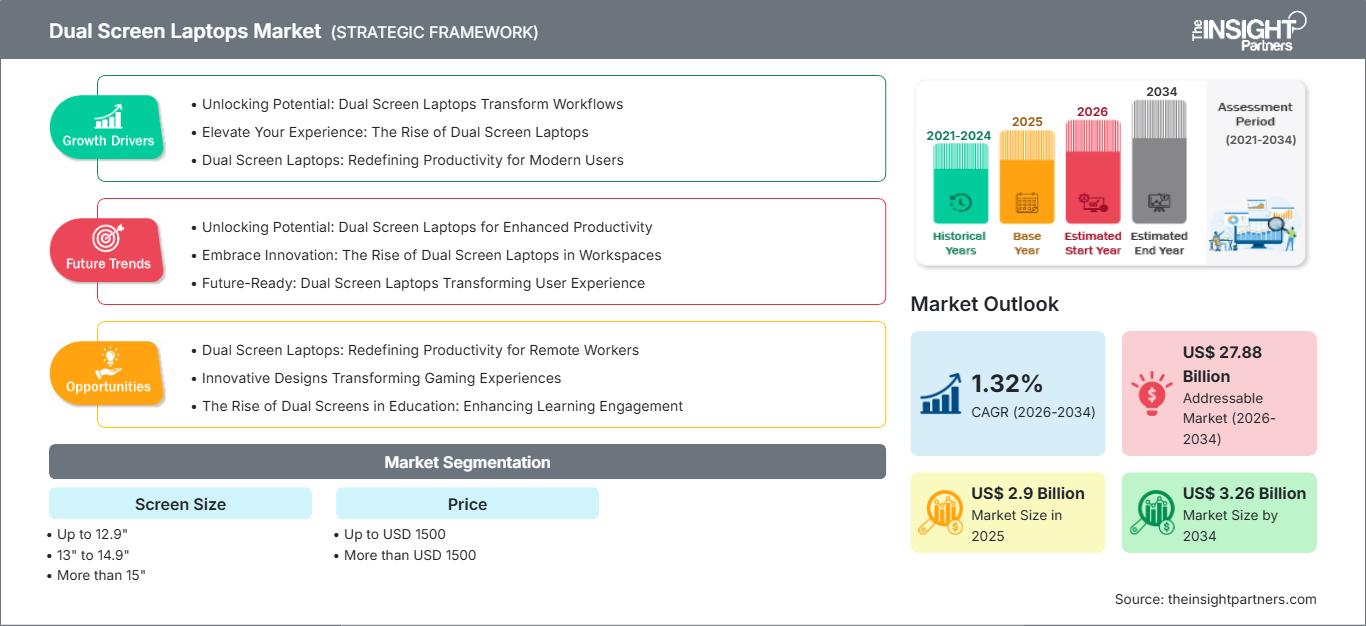
The Dual Screen Laptops Market is valued at US$ 2.9 Billion in 2025 and estimated to be worth US$ 3.26 Billion in 2034 with a CAGR of 1.32% between 2026 and 2034. The market will shift from its experimental phase to become a concentrated premium notebook segment for mobile professionals, creators, developers, analysts, and hybrid workers looking for built-in multitasking capabilities without dependency on an external monitor.
In North America, growth rate of Dual Screen Laptops Market size is estimated to be in the range of 1.1–1.5%, due to selective upgrades of premium notebooks by corporate purchasers. Demand driver for this segment comes from hybrid working conditions, creator workflows, AI-enabled PCs adoption, and better OLED panel availability. Nevertheless, high price tag and battery compromises prevent widespread adoption.
Dual Screen Laptops Market Assessment and Insights
- North America held 34–37% share in 2025 and is growing at a CAGR range of 1.1–1.5% during 2026–2034, supported by premium enterprise refreshes, software-centric work, and high acceptance of mobile multitasking devices.
- US represented 82–85% of North America in 2025 and is growing at a CAGR range of 1.2–1.6%, led by creators, consultants, developers, and executive users.
- Europe accounted for 24–27% share in 2025 and is advancing at a CAGR range of 0.9–1.3%, with Germany, the UK, France, Italy, and Spain leading adoption.
- Asia Pacific captured 28–31% share in 2025 and is expanding at a CAGR range of 1.5–2.0%, led by China, Japan, South Korea, India, and Australia.
- Largest Segment More than 15 inches held 42–46% market share in 2025 and is growing at a CAGR range of 1.0–1.4%, supported by creator and workstation use.
- High Growth Segment 13 inches to 14.9 inches held 31–35% market share in 2025 and is growing at a CAGR range of 1.6–2.1%, driven by portable dual-OLED designs.
- Key companies analyzed in detail: ASUSTeK Computer Inc., HP Inc., Lenovo Group Limited, Microsoft Corporation, Dell Technologies Inc., Intel Corporation, Mobile Pixels Inc., Apple Inc., Acer Inc., and Samsung Electronics Co., Ltd.
Source: The Insight Partners' analysis based on proprietary research, government publications, company annual reports, investor presentations, industry databases, and expert interviews.
The Product evolution in the Dual Screen Laptops has evolved from experiments in secondary strips and foldable models into usable dual screen notebooks with detachable keyboards, styluses, software control of windows and AI chips. The production dynamics will be contingent upon OLED panels, hinges, heat management, battery efficiency, and operating systems compatibility. The focus will shift to creators, financial customers, programmers, and business travelers rather than consumers buying general-purpose notebooks.
Going forward, the demand in the segment will be determined by whether the OEMs can make their devices lighter, more efficient in terms of batteries and affordable but still keep their high-resolution screens premium. Emerging markets will be additional sources for demand as professional services, education in design, gaming and software development become more advanced. The regulatory tailwind is an indirect one via energy efficiency, right-to-repair and corporate security considerations.
Dual Screen Laptops Market Report Scope
| Report Attribute | Details |
|---|---|
| Market size in 2025 | US$ 2.9 Billion |
| Market Size by 2034 | US$ 3.26 Billion |
| Global CAGR (2026 - 2034) | 1.32% |
| Historical Data | 2021-2024 |
| Forecast period | 2026-2034 |
Dual Screen Laptops Market Analysis
Drivers for Dual Screen Laptops Market include the requirement to run collaboration apps, spreadsheets, design software, code editors, dashboards and references simultaneously on a single portable machine. The ecosystem includes OLED panel manufacturers, hinge and chassis suppliers, chipmakers, operating system makers, notebook ODM/OEMs, peripheral providers, and enterprise distributors. There is high demand in places where the productivity advantage justifies a premium cost and where external monitors are impractical.
The supply chain is controlled due to the fact that this segment still represents a premium segment in the overall notebook category. The OEMs have to reconcile power consumption by dual displays, the thinness of the chassis, keyboard feel and durability. Intel Corporation offers products to help this segment in terms of AI PC processors and graphics integration, while Samsung Electronics Co., Ltd. helps with OLED displays.
Dual Screen Laptops Market report positioning competitive factors are: industrial design; screen performance; hinge robustness; accessories; and software. As for now, the dual-screen notebook designs are controlled by ASUSTeK Computer Inc. and Lenovo Group Limited. Nevertheless, HP Inc. and Dell Technologies Inc. produce comparable products within premium and foldable product lines. The software factor is influenced by Microsoft Corporation due to Windows multitasking and pen support.
Trends in investment include development of premium productivity hardware, artificial intelligence (AI) PCs refresh cycle, and creator-centric devices equipped with bright OLED displays and optimized battery usage. Apple Inc. continues to play a role due to its significant customer base setting expectations despite the lack of dual-screen laptops from the company. Mobile Pixels Inc. covers portable screen extension market needs, stressing the point that customers need more screen real estate but still care about cost, weight, and battery performance.
● REPORT CUSTOMIZATION
Tailor This Report To Align With Your Specific Business Requirements
This report can be customized to align precisely with your business objectives, scope, and target markets. Customization options include tailored segmentation, geography, competitive analysis, and strategic insights to support informed decision-making.
Customize This Report →WHAT YOU CAN ADJUST
- ● Segmentations
- ● Geography
- ● Competitive Analysis
- ● Language Preferences
Dual Screen Laptops Market: Strategic Insights
Regional Insights
North America Dual Screen Laptops Market
North America has been seen as having a market share between 34-37% in 2025 and is expected to increase with a CAGR range of 1.1–1.5% till 2034. The Dual Screen Laptops Market share growth is driven by the development of hybrid work models, higher premium notebooks adoption, and corporates willing to pay for productivity-focused devices. The demand is focused amongst consulting, design, software, financial analysis, and executive use cases where users benefit from more screens.
Retail visibility is great for North America along with early adoption and enterprise trials of AI-enabled PCs. ASUS and Lenovo introduced their dual screen laptops in 2025 while Microsoft’s Windows operating system is vital in generating multitasking workflow processes. Adoptions are hampered by the expensive cost structure, poor battery life when using dual display, and purchase of sturdy hardware.
U.S. Dual Screen Laptops Market
The US represented 82–85% of North America in 2025 and is forecast to grow at a CAGR range of 1.2–1.6%. Company presence includes ASUSTeK Computer Inc., Lenovo Group Limited, HP Inc., Dell Technologies Inc., Microsoft Corporation, Intel Corporation, Apple Inc., and Mobile Pixels Inc. through devices, processors, operating systems, accessories, and enterprise channels.
Trends in application include remote consultations, financial modeling, software development, editing for creators, research work, and business trips. Consumers make comparisons between dual screen notebooks and ultrabooks as well as portable screens. The most compelling applications are those where users require a split screen every day, not just when multitasking is needed. The American market is thus resilient but picky.
Europe Dual Screen Laptops Market
The share of Europe was at 24–27% in 2025 and is projected to grow at the CAGR of 0.9-1.3%. Germany has the leading position through engineering, design, manufacturing analytics, and enterprise computing investments. The UK is represented by the demand in financial services, consulting, media, and software companies. France, Italy, and Spain have contributions through creative industries, education, public sector digitalization, and luxury consumers.
European consumers place high importance on reparability, energy efficiency, security, and long-term support, which slows down the process of procurement compared to North America. Lenovo Group Limited, ASUSTeK Computer Inc., HP Inc., Dell Technologies Inc., Microsoft Corporation, and Intel Corporation assist with the region's adoption via retail and enterprise channel. The growth is relatively low since the cost is high and competes with traditional notebooks and docking stations and external displays.
APAC Dual Screen Laptops Market
The Asia Pacific region accounted for 28-31% share in 2025 and is forecast to experience growth at a rate of CAGR 1.5-2.0%. China dominates owing to electronics manufacturing, community of creators, gaming, and quick experiments with premium devices. Japan and South Korea boost demand by design, education, and technology professionals, while India and Australia contribute growth owing to IT services and startups and remote working.
Incentives to produce electronics comprise industry and policy drivers, which include digital education, localizing AI PCs, and strong display chain availability. The market in APAC benefits from being close to panel manufacturers and being assembled within the OEMs. Use is higher when the products are marketed as portable computers instead of unique laptops for coding, design, and creation.
Middle East & Africa Dual Screen Laptops Market
Middle East & Africa is projected to grow at a CAGR range of 0.8–1.2% as the UAE, Saudi Arabia, South Africa, and the rest of MEA expand premium device procurement for consulting, government digitization, education, and creative sectors. The UAE leads through smart-city work, media production, and high disposable income technology purchases.
Energy and infrastructure programs provide a market for mobile professionals who work on dashboards, scheduling, and review of designs. South Africa’s contributions are through business and educational services. However, further uptake of MEA is hampered by the cost-sensitive nature of the market. The vendor firms have to provide warranties, Arabic-language productivity suites, and financing options through channels.
Segmentation Analysis
Screen Size
Screen Size is expected to grow at a CAGR range of 1.2–1.7% during 2026–2034 as Dual Screen Laptops Market scope covers compact, mid-size, and large-screen formats. Larger models suit creators and workstation users, while 13 inches to 14.9 inches balances mobility with usable dual-display space. Smaller designs remain constrained by keyboard comfort and screen readability.
- Up to 12.9 inches devices serve education, light productivity, and ultra-portable use cases where low weight matters, but limited workspace and typing ergonomics restrict professional adoption.
- 13 inches to 14.9 inches systems appeal to mobile professionals because dual OLED panels, detachable keyboards, and manageable weight create a practical balance between portability and productivity.
- More than 15 inches models address creators, gamers, engineers, and analysts who prioritize expansive displays, stronger cooling, and workstation-like multitasking over maximum portability.
Price
Price is projected to grow at a CAGR range of 1.0–1.5% during 2026–2034 because dual-screen laptops remain positioned above standard notebooks. The below USD 1500 tier can broaden demand if component costs fall, while more than USD 1500 systems dominate current value due to OLED panels, premium processors, stylus bundles, and specialized hinge engineering.
- Up to USD 1500 devices are strategically important for education, small businesses, and early adopters, but limited model availability keeps this tier smaller than premium categories.
- More than USD 1500 systems dominate revenue because buyers expect OLED quality, AI PC processors, durable hinges, detachable keyboards, and accessories that justify premium positioning.
Opportunity Snapshot
| Screen Size | Revenue Contribution | Trend Tag | Adoption Stage |
| Up to 12.9 inches | Low | Micro Mobility | Emerging |
| 13 inches to 14.9 inches | High | Portable OLED | Scaling |
| More than 15 inches | High | Creator Workspace | Mature |
Dual Screen Laptops Market Growth Drivers and Impact Analysis
Hybrid Work Raises Demand for Portable Multiscreen Productivity
Hybrid employees increasingly work across calls, documents, dashboards, browsers, and messaging tools without a fixed desk setup. Dual-screen notebooks reduce dependence on external monitors and help users maintain context when moving between offices, client sites, classrooms, and homes. The market impact is strongest in roles where time spent switching windows creates measurable friction, such as consulting, finance, software development, and content production. OEMs benefit when they position devices as workflow tools rather than novelty hardware. Enterprise adoption will still require proof that battery life, durability, support, and security match conventional premium laptops.
OLED Panel Maturity Improves Product Viability
Dual-screen systems require thin, bright, color-accurate, and energy-efficient displays, making OLED supply maturity central to category economics. South Korean and Chinese display ecosystems have improved panel availability for premium notebooks, helping OEMs design thinner dual-display products with richer contrast and touch capability. The market impact appears in better screen symmetry, higher refresh rates, stylus support, and more polished form factors. However, OLED cost still limits mass-market penetration. Manufacturers that secure reliable panels, reduce burn-in concerns, and optimize power management can protect margins while making dual-screen devices more credible for professional workloads.
AI PC Refresh Cycles Create Premium Upgrade Windows
AI PC launches create an upgrade window for manufacturers to bundle local AI processing with expanded visual workspace. Dual-screen laptops can use the second display for meeting summaries, creative tool palettes, coding assistants, research notes, or real-time dashboards while the main screen remains focused on primary work. The impact is strategic because buyers may view the form factor as part of a broader productivity refresh, not a standalone gimmick. Intel Corporation and software vendors can influence adoption by improving battery efficiency, graphics performance, and window management. OEMs that connect AI workflows to dual displays will have clearer differentiation.
Dual Screen Laptops Market Future Trends
Software-Defined Multitasking Experiences
Dual Screen Laptops Market trends will increasingly center on software-defined multitasking rather than hardware novelty. Future devices will need smarter snapping, app memory, pen shortcuts, virtual keyboards, AI meeting panels, and context-aware workspace layouts. Users will judge value by how quickly a device recreates their preferred work arrangement after travel, sleep mode, or docking. This shift favors OEMs with strong software utilities and close collaboration with operating system providers. It also creates opportunities for enterprise IT teams to standardize productivity templates for analysts, designers, developers, and executives using the same hardware platform.
Convergence of Dual Screens and Creator Workstations
Creator workflows will push dual-screen laptops toward workstation-like configurations with stronger graphics, calibrated OLED panels, stylus input, and accessory ecosystems. Video editors, designers, architects, and streamers can use the secondary display for timelines, controls, notes, or preview windows. Future designs will need better cooling, longer battery reserves, and lighter materials to keep mobility credible. The trend will favor 14-inch and larger devices where screen area is sufficient for professional tools. OEMs that validate color performance and software compatibility will gain trust from creators who cannot accept workflow instability.
Dual Screen Laptops Market Opportunities
Enterprise Productivity Bundles
Dual Screen Laptops Market Forecasts indicate an opportunity to package devices with deployment services, software training, docking accessories, extended warranties, and workflow templates for specific roles. Enterprises often hesitate because the form factor is unfamiliar, not because the productivity case is weak. Vendors can reduce risk by creating bundles for consultants, finance teams, developers, and creative departments that include support guidance and security-ready configurations. This approach shifts the sales conversation from hardware specifications to measurable workflow improvement. Channel partners can also offer pilot programs that compare dual-screen usage against ultrabooks plus portable monitors.
Education and Creator Economy Expansion
Education, design schools, online creators, and independent professionals create an opportunity for lower-cost dual-screen systems as component prices decline. Students can use one screen for lectures and the other for notes, coding, research, or design tools. Creators can edit, stream, and manage references without carrying separate displays. Vendors should prioritize durable hinges, stylus support, financing, and education discounts to build early familiarity. The opportunity is strongest in Asia Pacific and North America, where digital learning, creator monetization, and premium device financing already support adoption of specialized computing products.
Recent Developments
- January 2026: ASUS Republic of Gamers (ROG) is proud to announce the launch of the all-new Zephyrus Duo, the world’s first 16-inch dual-screen OLED gaming laptop. This flagship gaming machine is powered by the latest Intel Core Ultra Processor and paired with up to an NVIDIA GeForce RTX 5090 Laptop GPU running at 135W TGP, enabling flagship gaming and content creation. The Zephyrus Duo offers five dedicated operation modes to enhance workflows. This ultra-premium machine is housed in a CNC-milled aluminum chassis with a stunning Stellar Grey colorway, and comes complete with a detachable magnetic keyboard to keep users gaming and creating wherever life takes them.
- January 2025: Lenovo Group Limited introduced the Yoga Book 9i Gen 10 at CES 2025 with dual 14-inch OLED displays, a 120 Hz variable refresh rate, Intel Core Ultra processors, and improved keyboard experience. The update reinforced Lenovo’s commitment to dual-display productivity notebooks for premium mobile users.
- January 2025: ASUSTeK Computer Inc. refreshed its Zenbook DUO positioning for 2025, keeping the dual-screen productivity concept visible alongside Lenovo at CES. Coverage emphasized the model’s practical dual-display layout, detachable keyboard, and role as a lower-friction alternative to foldable laptops.
Frequently Asked Questions

- Comprehensive Market Sizing and Forecast Analysis
- Detailed Segmentation Analysis
- In-Depth Market Dynamics Assessment
- Regional and Country-Level Insights
- Competitive Landscape and Company Benchmarking
- Strategic Business Intelligence
Recent Reports
Testimonials

The Insight Partners' SCADA System Market report is comprehensive, with valuable insights on current trends and future forecasts. The team was highly professional, responsive, and supportive throughout. We are very satisfied and highly recommend their services.
RAN KEDEM Partner, Reali Technologies LTDs
I requested a report on a very specific software market and the team produced the report in a few days. The information was very relevant and well presented. I then requested some changes and additions to the report. The team was again very responsive and I got the final report in less than a week.
JEAN-HERVE JENN Chairman, Future Analytica
We worked with The Insight Partners for an important market study and forecast. They gave us clear insights into opportunities and risks, which helped shape our plans. Their research was easy to use and based on solid data. It helped us make smart, confident decisions. We highly recommend them.
PIYUSH NAGPAL Sr. Vice President, High Beam Global
The Insight Partners delivered insightful, well-structured market research with strong domain expertise. Their team was professional and responsive throughout. The user-friendly website made accessing industry reports seamless. We highly recommend them for reliable, high-quality research services
YUKIHIKO ADACHI CEO, Deep Blue, LLC.
This is the first time I have purchased a market report from The Insight Partners.While I was unsure at first, I visited their web site and felt more comfortable to take the risk and purchase a market report.I am completely satisfied with the quality of the report and customer service. I had several questions and comments with the initial report, but after a couple of dialogs over email with their analyst I believe I have a report that I can use as input to our strategic planning process.Thank you so much for taking the extra time and making this a positive experience.I will definitely recommend your service to others and you will be my first call when we need further market data.
JOHN SUZUKI President and Chief Executive Officer, Board Director, BK Technologies
I wish to appreciate your support and the professionalism you displayed in the course of attending to my request for information regarding to infectious disease IVD market in Nigeria. I appreciate your patience, your guidance, and the fact that you were willing to offer a discount, which eventually made it possible for us to close a deal. I look forward to engaging The Insight Partners in the future, all thanks to the impression you have created in me as a result of this first encounter.
DR CHIJIOKE ONYIA MANAGING DIRECTOR, PineCrest Healthcare Ltd.Reason to Buy
- Informed Decision-Making
- Understanding Market Dynamics
- Competitive Analysis
- Identifying Emerging Markets
- Customer Insights
- Market Forecasts
- Risk Mitigation
- Boosting Operational Efficiency
- Strategic Planning
- Investment Justification
- Tracking Industry Innovations
- Aligning with Regulatory Trends





 Get Free Sample for